How to Survive in the Woods Summary, Characters and Themes
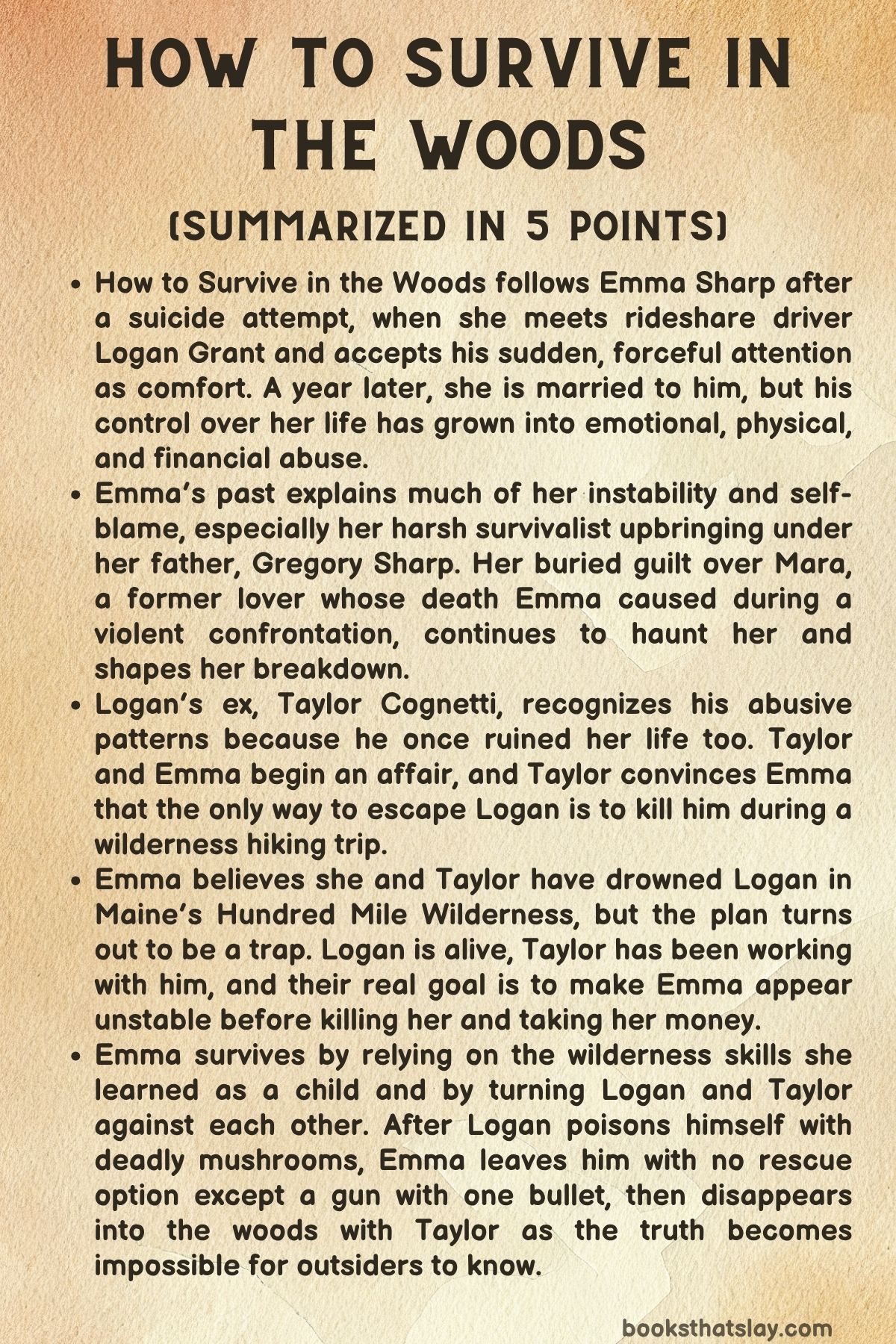
How to Survive in the Woods by Kat Rosenfield is a dark psychological thriller about control, trauma, survival, and revenge. The novel follows Emma Sharp, a wealthy woman whose life has been shaped by violence, guilt, and brutal lessons from her survivalist father.
After a suicide attempt, she falls under the influence of Logan Grant, a man who first appears protective but gradually becomes her abuser. As Emma’s marriage, past, and sense of reality collapse, a planned wilderness murder turns into a deadly contest of endurance. The book asks who truly knows how to survive when civilization, trust, and mercy are gone.
Summary
Emma Sharp wakes up in a hospital after trying to kill herself. She is not relieved to be alive.
In fact, she is angry that the attempt failed. Still, she understands that if she wants to leave the hospital, she must pretend to be grateful, cooperative, and ready to recover.
She gives the doctors what they need to hear and prepares to return to her life, even though she still feels detached from it.
After she is released, Emma gets into a rideshare driven by Logan Grant. Logan notices the bandages on her wrists and quickly understands what has happened.
Instead of reacting with pity or fear, he tells her she is “not allowed” to die. His confidence shocks her.
Emma is used to managing other people’s reactions, but Logan does not seem interested in being managed. When he drives past her home and takes her to breakfast instead, Emma accepts it.
She is too exhausted to resist, and there is a strange comfort in letting someone else decide what happens next.
A year later, Emma is engaged to Logan. What first seemed like care has turned into control.
Logan has slowly taken over Emma’s home, her routines, her food, her work, her friendships, and even the way she thinks about herself. Emma’s friend Shay sees what is happening and warns her that Logan is erasing her piece by piece.
Emma does not want to hear it. She chooses Logan, cuts Shay out of her life, and marries him.
Once they are married, Logan’s control becomes more direct and more violent. He hurts Emma and then helps her create lies to explain the injuries.
At one point, he pulls out her hair, and the two of them create a false story about an accident with an immersion blender. The lie is absurd, but Emma participates in it because she has become used to hiding the truth.
Logan also gains more influence over Vitalist, Emma’s nutrition company. As he grows stronger in public, Emma becomes smaller in private.
Emma’s history explains some of the damage inside her. She is the daughter of Gregory Sharp, a wealthy survivalist who raised her according to harsh rules.
Her childhood was not soft or safe. Gregory trained her to live in the wilderness, to endure pain, and to mistrust weakness.
The skills he gave her were useful, but the lessons came at a cost. Emma learned survival, but she also learned fear, secrecy, and emotional isolation.
Her past also contains the story of Mara, a woman Emma once loved. Their relationship ended in disaster.
After a confrontation involving a gun, a chaotic struggle led to Mara’s death. Emma killed her and allowed the truth to remain buried beneath another version of events.
Her public breakdown in Denver and the suicide attempt that followed were connected to this hidden guilt. Emma’s life with Logan does not create her pain from nothing; it feeds on wounds that were already there.
Logan’s ex-girlfriend, Taylor Cognetti, becomes important to Emma’s life. Taylor used to be Logan’s business partner, and she knows what kind of man he is.
Logan once destroyed Taylor’s life by sending a sexual video of her to potential partners, damaging both her reputation and their fitness business. Taylor recognizes the signs of abuse in Emma’s marriage because she has lived through Logan’s cruelty herself.
Emma and Taylor begin an affair. Taylor offers Emma attention, desire, and understanding at a time when Emma feels trapped.
But Taylor also brings dangerous information. She tells Emma that Logan has resumed sleeping with her and that he has said he expects Emma to kill herself so he can inherit her money.
To Taylor, waiting for Logan to ruin them both is not an option. She proposes that they kill him first.
The plan centers on a hiking trip into Maine’s Hundred Mile Wilderness. Emma believes the idea is to make Logan’s death look like an accident.
They will drug him, drown him in a remote pond, and later report that he died while drunk. The wilderness offers distance, confusion, and danger, making an accidental death believable.
Emma, shaped by her father’s training, understands the woods well enough to believe they can control the situation.
At the pond, Emma and Taylor lure Logan into the water. They hold him under until he appears to be dead.
They wrap his body in a sleeping bag and sleep near the campfire, believing the worst part is over. But the next morning, Logan’s body is gone.
This disappearance destroys Emma’s fragile sense of control. She begins to suspect that someone is watching them.
A strange hiker called Dirty Bird appears, adding to her fear. Later, Emma sees what looks like Logan in the trees, and the boundary between reality and panic begins to blur.
The truth is not that Emma has imagined Logan. He is alive.
The drowning was staged. Logan and Taylor had planned it together, using drugs, hand warmers, and Logan’s strength as a swimmer to make Emma believe she had killed him.
Their goal was not to free Emma from abuse. Their goal was to break her mind and then kill her in the wilderness.
Once Emma was dead, Logan and Taylor could take her money and let the world believe she had finally ended her own life.
When Dirty Bird becomes a threat to the plan, Logan kills him by kicking him off a cliff. This confirms the danger Emma is in.
She is drugged, injured, betrayed, and far from help, but she is not helpless. The wilderness is the one place where Emma’s childhood training becomes an advantage.
Logan and Taylor believe they have trapped a fragile woman, but they have underestimated what Gregory Sharp taught his daughter.
Emma begins to survive by using the skills buried beneath years of trauma. She escapes restraint, observes the land, and follows Logan and Taylor instead of simply running blindly.
She also starts turning them against each other. Emma understands fear, guilt, dependence, and manipulation because she has lived with them for years.
She uses that knowledge to disturb the bond between Logan and Taylor. Their partnership begins to crack.
Taylor, who had seemed like Emma’s ally and lover, is revealed as another person willing to use her. Yet Taylor is also not as powerful as Logan.
As the situation worsens, Logan abandons Taylor in the woods. His betrayal shows that his loyalty has always been only to himself.
Taylor, like Emma, was useful to him until she was not.
Emma’s final confrontation with Logan comes after he eats poisonous mushrooms, mistaking them for edible puffballs. Emma recognizes them as destroying angels, deadly mushrooms that will kill him without medical help.
Logan has also taken Emma’s emergency beacon, leaving himself without a way to call for rescue. For once, his theft and arrogance work against him.
Emma explains what he has eaten and what it means. She does not need to attack him directly.
The woods, his own mistake, and his own selfishness have already sentenced him. She leaves him a gun with one bullet and walks away.
Later, she hears the shot. Logan’s death is not a dramatic rescue or a clean act of justice.
It is a grim ending shaped by the same wilderness he tried to use against her.
Afterward, Emma and Taylor vanish into the woods. Searchers look for them, including Pete from the hostel.
Pete understands that Emma is much more capable than most people realize. He suspects she may know exactly how to stay hidden and alive.
Still, when asked whether the women are likely to survive, he says no. His answer gives the authorities permission to stop hoping and allows the official story to close around absence rather than truth.
The public will create its own explanations for what happened to Emma Sharp and Taylor Cognetti. People will talk about Emma’s money, her marriage, her mental health, and her disappearance.
They will turn her life into rumor and theory. But the truth remains hidden in the wilderness, known only to the women who walked into it and did not return to the world as everyone expected.
In the end, How to Survive in the Woods is about more than physical survival. Emma survives abuse, betrayal, guilt, and the false stories others tell about her.
The woods become both a threat and a refuge. They strip away money, status, marriage, business, and reputation until only instinct and knowledge remain.
Emma was raised to survive in harsh places, and although that upbringing damaged her, it also gives her the tools to outlast the people who mistake her pain for weakness.
Characters
In How to Survive in the Woods, the characters are shaped by control, survival, guilt, manipulation, and the uneasy line between victimhood and violence. The book presents survival not only as a physical skill but also as an emotional and psychological condition.
Each major character either teaches Emma something about power or reveals how easily care, love, fear, and dependence can become traps.
Emma Sharp
Emma Sharp is the central and most psychologically layered character in the book. At the beginning, she is a woman who has survived a suicide attempt but does not truly feel grateful to be alive.
Her anger at waking up in the hospital shows the depth of her despair, while her decision to pretend recovery reveals how practiced she is at hiding her real emotions. Emma is not simply fragile or helpless; she is someone whose pain has been buried under performance, silence, and survival instincts.
Her emotional state is shaped by trauma, guilt, and the exhausting need to keep functioning even when she no longer wants to live.
Emma’s relationship with Logan exposes one of her deepest vulnerabilities: her desire to surrender control. After years of carrying unbearable guilt and after a lifetime of being shaped by her father’s brutal lessons, Logan’s certainty initially feels comforting to her.
When he tells her she is not allowed to die and begins making decisions for her, Emma experiences his control as relief rather than danger. This makes her an especially tragic character because the very thing that seems to save her becomes another form of imprisonment.
She lets Logan take over her habits, her home, her friendships, her work, and even her sense of self because she is too wounded to recognize control disguised as care.
At the same time, Emma is far more capable than others believe. Her survival training, emotional endurance, and ability to observe danger become crucial later in the story.
The wilderness reveals the version of Emma that Logan and Taylor underestimate. She has been damaged, manipulated, and isolated, but she has not been emptied of intelligence or instinct.
When she realizes that the plan was never to kill Logan but to destroy her, she begins to return to the skills and toughness that were forced into her as a child. Her transformation is not simple empowerment; it is darker and more complicated.
Emma survives by accepting parts of herself that are frightening, wounded, and morally ambiguous.
Emma’s past with Mara also makes her morally complex. She is not only a victim of Logan, Taylor, or Gregory; she is also someone who has caused irreversible harm.
Her guilt over Mara’s death is central to her self-hatred and collapse. This makes Emma a character who cannot be understood only through sympathy.
She is haunted because she knows she has crossed lines that cannot be undone. By the end of How to Survive in the Woods, Emma becomes a figure of secrecy and myth, someone the public can only guess at.
Her disappearance into the wilderness suggests both escape and exile. She survives, but survival does not make her innocent, healed, or free in any simple way.
Logan Grant
Logan Grant is the book’s clearest embodiment of coercive control. He first appears as a strangely comforting rescuer, noticing Emma’s pain and interrupting her suicidal thoughts with confidence and authority.
His early behavior seems protective on the surface, but that protection quickly reveals itself as possession. Logan understands Emma’s vulnerability and uses it to make himself necessary to her.
He does not love Emma in a generous or equal way; he studies her weaknesses and builds a life in which she becomes dependent on his approval, decisions, and version of reality.
Logan’s abuse is especially disturbing because it develops gradually. He does not begin as an obvious monster.
He begins as someone decisive, attentive, and seemingly certain of what Emma needs. This makes his control more believable and more frightening.
By taking over her food, work, friendships, home, and opinions, he does not merely hurt her physically; he erases her identity. The incident in which he pulls out her hair and then helps invent a false story about an accident shows how abuse in the story depends on both violence and narrative control.
Logan harms Emma, then controls the explanation of the harm.
His ambition is also tied to his cruelty. Logan wants access not only to Emma’s body and obedience but also to her money, company, and social position.
His growing power at Vitalist shows that he is not acting out of spontaneous rage alone. He is strategic, calculating, and financially motivated.
His relationship with Taylor further reveals that his pattern of exploitation existed before Emma. What he did to Taylor’s business and reputation shows that he destroys women when they threaten his ego or independence from him.
In the wilderness, Logan’s arrogance becomes his weakness. He believes he can manipulate Emma’s mind, stage his own death, murder Dirty Bird, abandon Taylor, and still control the outcome.
He sees himself as smarter and stronger than everyone else, but he misunderstands the kind of survival Emma knows. His death by poisonous mushrooms is fitting because it exposes the limits of his confidence.
He mistakes danger for something harmless, just as he assumes Emma is too broken to defeat him. The gun Emma leaves him with one bullet turns his final moment into a grim reversal of power.
Logan, who once told Emma she was not allowed to die, ends as the one trapped with death as his only remaining choice.
Taylor Cognetti
Taylor Cognetti is one of the most deceptive and morally unstable characters in the story. At first, she appears to be someone who understands Logan’s cruelty because she has survived it herself.
Her history with him gives her credibility, and her connection with Emma seems to offer Emma recognition, desire, and solidarity. Taylor seems to see what others refuse to see: that Logan is abusive, dangerous, and predatory.
Because of this, her relationship with Emma initially feels like a possible escape from Logan’s control.
However, Taylor’s role becomes increasingly complicated because her victimhood does not make her trustworthy. She was indeed harmed by Logan when he destroyed their business and humiliated her by sending a sexual video to potential partners.
That betrayal explains her anger and her desire for revenge, but it does not excuse her later choices. Taylor uses intimacy as a weapon.
She begins an affair with Emma, reveals Logan’s intentions, and proposes murder as though it is a solution. Her ability to present violence as rescue makes her especially dangerous.
Taylor’s betrayal of Emma shows that she is not simply manipulated by Logan; she also participates in manipulation. Her part in the staged drowning and the plan to kill Emma reveals that she is willing to exploit Emma’s trauma for money and survival.
Taylor understands what it means to be controlled by Logan, yet she still helps him control another woman. This makes her a deeply compromised character.
She is both harmed and harmful, both desperate and calculating.
By the end, Taylor’s position becomes unstable because Logan abandons her too. This is important because it shows the emptiness of her alliance with him.
She believes she can share power with a man who has already proven he destroys people, but Logan sees her as disposable. Taylor’s final disappearance with Emma leaves her fate morally unresolved.
She may be a victim again, a survivor, a prisoner of Emma’s judgment, or a partner in a new hidden life. Her character remains unsettling because she forces the reader to ask whether shared suffering creates loyalty or simply gives damaged people better tools for betrayal.
Shay
Shay functions as a voice of warning and clarity in Emma’s life. She sees what Emma cannot or will not see about Logan.
Her warning that Logan is erasing Emma is one of the clearest descriptions of his abuse. Shay recognizes that Emma’s personality, independence, and relationships are being slowly absorbed into Logan’s control.
Unlike Logan, who presents control as love, Shay understands that real care requires honesty and respect for Emma’s autonomy.
Shay’s importance comes from the fact that Emma cuts her off. This shows how isolating abusive relationships can be.
Emma’s rejection of Shay is not because Shay is wrong, but because Shay threatens the false safety Emma has found with Logan. Shay represents the outside perspective that could disturb Emma’s dependence.
In this sense, her absence becomes as meaningful as her presence. Once Emma pushes Shay away, Logan has more room to dominate her life without challenge.
Shay also helps reveal the tragedy of Emma’s emotional condition. Emma is not unaware on some deep level that something is wrong, but she is not ready to face it.
Shay’s warnings demand a kind of self-protection that Emma does not yet believe she deserves. Through Shay, the story shows how victims of control can become separated from the people most capable of helping them.
Shay is not a major action-driving character, but she is morally important because she stands for the friendship, perspective, and ordinary human concern that Emma loses as Logan’s power grows.
Gregory Sharp
Gregory Sharp is one of the most important forces behind Emma’s personality, even though much of his influence comes through memory and backstory. As Emma’s father, he raised her with wealth, survivalism, and brutal rules.
His training gave Emma real physical skills, but it also damaged her understanding of safety, love, and power. Gregory’s version of parenting seems to have been based less on tenderness than on preparation, discipline, and domination.
He taught Emma how to survive the wilderness, but he also helped create the emotional wilderness inside her.
Gregory’s influence complicates Emma’s later survival. The very training that harmed her becomes part of what saves her.
This makes him a disturbing figure because his cruelty cannot be dismissed as useless. He gave Emma knowledge, endurance, and practical instincts, but those gifts came wrapped in fear and emotional violence.
Emma’s ability to track, endure injury, and think strategically in the woods is connected to him, yet so is her difficulty trusting care that is gentle or healthy.
He also helps explain why Emma is vulnerable to Logan. Having been raised by a controlling man who framed harshness as preparation, Emma has already learned to associate domination with protection.
Logan’s control feels familiar before it feels dangerous. Gregory’s role in the book is therefore not limited to his direct treatment of Emma; he shapes the emotional logic through which she understands relationships.
He is a father whose lessons continue to govern his daughter’s body and mind long after she has left his direct control.
Mara
Mara is one of the most haunting characters in the story because she represents love, guilt, and the past Emma cannot escape. Emma’s relationship with Mara was emotionally significant, and its violent end becomes one of the central wounds in Emma’s life.
Mara is not merely a lost lover; she is the person whose death forces Emma to confront the most frightening parts of herself. The tragedy surrounding Mara is what helps lead to Emma’s public breakdown and suicide attempt.
Mara’s importance lies in how deeply she shapes Emma’s self-image. Emma does not see herself only as someone who has suffered.
Because of Mara, she also sees herself as someone capable of violence and betrayal. This is why her guilt is so destructive.
It is not vague regret; it is tied to a specific death and to Emma’s knowledge that she allowed the truth to be buried. Mara becomes the emotional ghost behind Emma’s despair, a reminder that the past has not been resolved simply because it has been hidden.
In the broader story, Mara also challenges any simple reading of Emma as purely innocent. Emma’s trauma does not erase her responsibility.
Her pain is real, but so is the harm connected to Mara’s death. This moral complexity gives the book much of its darkness.
Mara may not dominate the present-day action, but she dominates Emma’s conscience. Through her, the story explores how secrets can become a kind of living punishment, following a person into every later relationship and decision.
Dirty Bird
Dirty Bird is a strange and unsettling figure in the wilderness section of the story. His presence increases the sense that Emma and Taylor are not alone and that the woods contain threats beyond their own plan.
At first, he seems like an unpredictable outsider, someone who might be dangerous, helpful, suspicious, or simply strange. His nickname and behavior make him feel almost like a figure from wilderness folklore, adding to the atmosphere of uncertainty and paranoia.
His main importance comes from what happens to him. Logan kills Dirty Bird by kicking him off a cliff, and this act confirms the full extent of Logan’s violence.
Until that moment, much of the danger has been psychological, domestic, or hidden behind manipulation. Dirty Bird’s death makes Logan’s brutality direct and undeniable.
Logan is not merely abusive or greedy; he is willing to murder an inconvenient witness.
Dirty Bird also functions as a contrast to Emma. Both exist in the wilderness, but Emma understands the woods through training, memory, and survival, while Dirty Bird appears as part of the wilderness’s unpredictability.
His death shows that Logan’s attempt to control everything cannot coexist with the random presence of other people. Dirty Bird disrupts the staged plan simply by appearing, and Logan responds with lethal force.
This makes him a minor character with a major narrative purpose: he exposes the murder plot as something far more dangerous than Emma first understands.
Pete
Pete appears near the end as one of the people involved in the search after Emma and Taylor vanish into the wilderness. His role is important because he provides an outside perspective on Emma’s disappearance.
Unlike the public, which is likely to invent stories about Emma and Taylor, Pete senses that Emma may be more capable than others realize. His suspicion suggests that the official version of events will never fully capture the truth.
Pete’s response when asked whether the women are likely to survive is especially meaningful. By saying no, he gives the authorities permission to stop hoping, but his private understanding seems more complicated.
He may not know exactly what happened, but he understands enough to doubt the simplest explanation. This makes him a quiet guardian of ambiguity.
He does not expose Emma, and he does not insist on a heroic rescue narrative.
As a character, Pete helps close the story by showing how Emma’s fate becomes unknowable to the outside world. He stands at the boundary between civilization and wilderness, between public explanation and hidden truth.
His presence reinforces the idea that Emma has moved beyond the reach of ordinary interpretation. Whether she is dead, alive, guilty, free, or transformed is not something Pete can prove.
His uncertainty becomes part of the book’s final mystery.
Themes
Control and the Loss of Self
In How to Survive in the Woods, Emma’s life after meeting Logan shows how control can grow slowly until it becomes almost invisible to the person being controlled. Logan does not begin by appearing openly cruel; he presents himself as protective, certain, and necessary at a moment when Emma is emotionally shattered.
Because she has lost faith in her own judgment, his decisions feel like relief. Over time, that relief turns into dependence.
He takes charge of her home, her food, her work, her friendships, and even the way she understands herself. The abuse becomes not only physical but psychological, because Logan’s real goal is to make Emma doubt her own instincts.
Shay’s warning matters because it shows that Emma’s identity is disappearing from the outside before she can fully admit it herself. The theme becomes powerful because the danger is not only that Logan hurts Emma, but that he convinces her she cannot exist without him.
Survival as Knowledge and Self-Reclamation
Survival in the story is not only about enduring hunger, injury, weather, or danger in the wilderness. For Emma, survival is tied to memory, training, and the return of a self she has tried to bury.
Her father’s brutal lessons were damaging, but they also left her with skills that Logan and Taylor underestimate. In the wilderness, Emma is forced to stop being passive.
The same mind that once accepted Logan’s control begins to observe, calculate, track, and respond. Her ability to survive becomes a form of self-reclamation because she is no longer simply reacting to what others do to her.
She begins making choices again. The woods strip away the false life Logan built around her and return her to something older, harsher, and more capable.
This theme is especially striking because Emma’s survival is morally complicated. She is not made innocent by her suffering, but she becomes active, alert, and unwilling to be erased.
Guilt, Trauma, and the Burden of the Past
Emma’s present cannot be understood without the guilt and trauma she carries from her past. Her suicide attempt is not presented as a sudden collapse but as the result of buried pain that has been pressing on her for years.
The death of Mara remains at the center of Emma’s inner life because it combines love, violence, secrecy, and shame. Emma does not simply grieve Mara; she is haunted by her own role in what happened.
This makes her vulnerable to Logan because she already sees herself as damaged and deserving of punishment. Her past also affects the way she responds to danger.
She has been trained to survive, but she has also been trained to endure cruelty. The story uses Emma’s guilt to show how trauma can distort a person’s sense of what they deserve.
Her struggle is not only against Logan and Taylor, but against the belief that her own life has already been ruined beyond repair.
Deception, Performance, and Hidden Truth
Almost every major relationship in the story is shaped by deception. Emma pretends to be grateful after surviving her suicide attempt so she can leave the hospital.
Logan pretends to be her rescuer while slowly becoming her captor. Taylor pretends to be Emma’s ally and lover while working with Logan to destroy her.
Even Logan’s death is staged as part of a larger performance meant to make Emma doubt reality. These layers of deception create a world where truth is always unstable and survival depends on seeing through the roles people play.
Public stories also matter: Emma’s breakdown, Mara’s death, Logan’s abuse, and the final disappearance are all surrounded by versions of events that hide more than they reveal. The ending strengthens this theme because the outside world is left with guesses, while the real story remains known only to those who lived it.
Deception becomes both a weapon and a shield, used to control, escape, and survive.