How to Write a Love Story Summary, Characters and Themes
How to Write a Love Story by Catherine Walsh is a contemporary novel about grief, creative pressure, legacy, and the difficult process of claiming a voice of one’s own. The story follows Ciara Sheridan, the daughter of a beloved fantasy author, as she tries to finish the final book in her father’s famous Ravian series after his death.
When Sam Avery, an editor and lifelong fan, arrives from New York to help, their clash begins with mistrust but slowly opens into understanding. The book explores what it means to honor the past without being trapped by it, and how stories can help people heal.
Summary
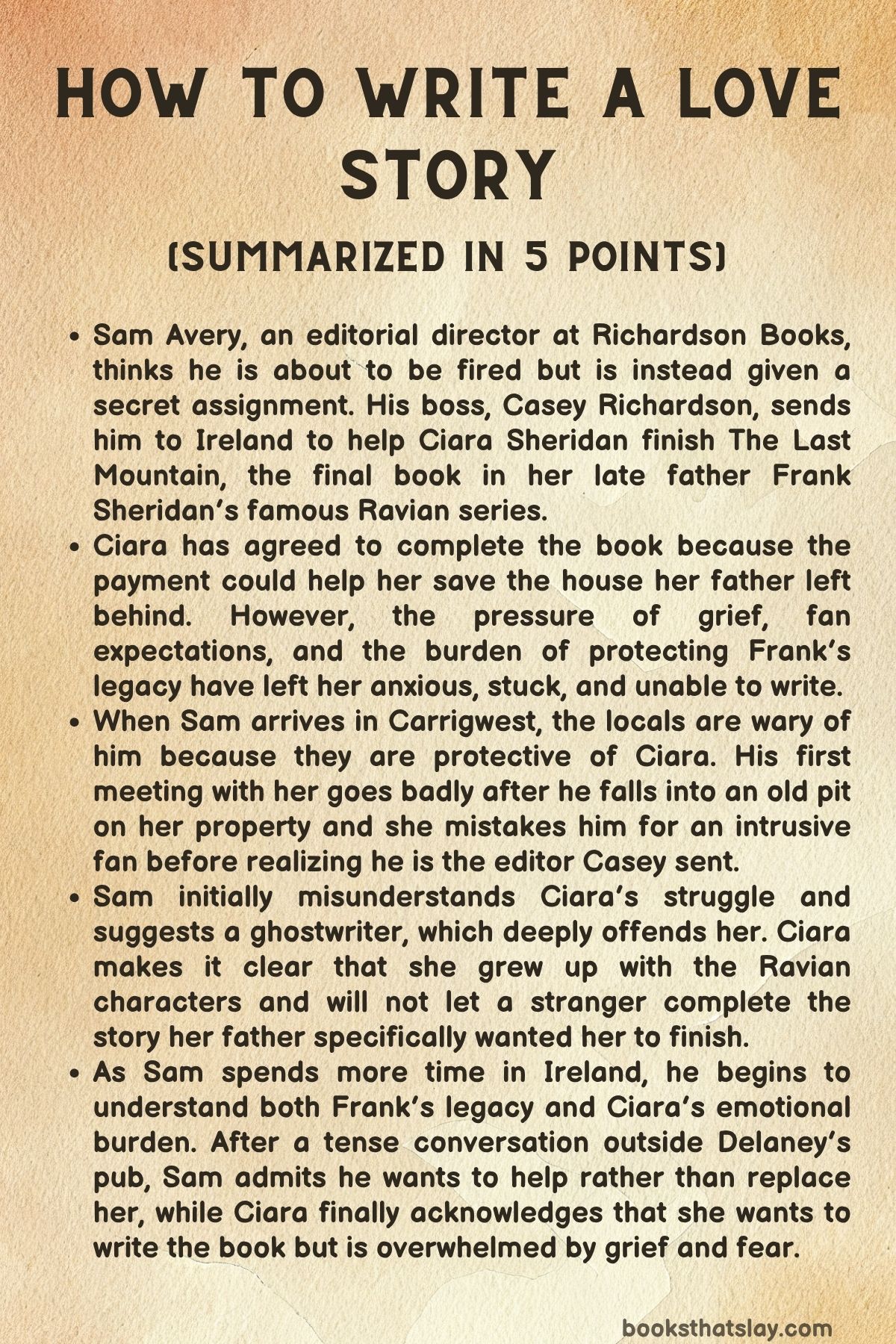
Ciara Sheridan is living in County Kerry, Ireland, carrying a burden that feels far larger than she knows how to handle. Her father, Frank Sheridan, was a legendary fantasy writer, famous for creating the Ravian series, a world loved by readers across generations.
Before his death, Frank left instructions that only Ciara should finish How to Write a Love Story, the long-awaited final book in the series. To the public, this seems like a great honor.
To Ciara, it feels like being asked to step into a role she never chose, under the eyes of fans who have already decided what the book should be.
In New York, Sam Avery, an editorial director at Richardson Books, arrives at work anxious after receiving a vague message from his boss, Casey Richardson. Sam believes he may be about to lose his job.
Instead, Casey reveals a confidential development: Ciara has agreed to complete her father’s final Ravian book, but she has stopped sending pages and is barely responding to emails. The publisher is worried.
The book matters financially, culturally, and emotionally, and the deadline is becoming a serious concern. Casey knows Sam is not only an experienced editor but also a devoted Ravian fan who understands Frank Sheridan’s work deeply.
He asks Sam to go to Ireland and help Ciara finish the manuscript.
Ciara, meanwhile, is doing almost everything except writing. She spends time helping her best friend Maddie at a smoothie truck near the beach, using small errands and distractions to avoid the blank page.
Maddie sees through her excuses and pushes her to return home and work. Ciara is exhausted, anxious, and unable to sleep properly.
Her father’s house, which she inherited, has become another source of stress. It is famous among Frank’s fans, but it is also old, expensive, and in need of repairs.
Selling it would solve many practical problems, yet Ciara cannot bear the thought. The house feels like the last physical piece of her father, and giving it up would seem like losing him all over again.
Ciara accepted the publisher’s offer partly because the money could help save the house. At first, she managed to write a few opening chapters, but then the pressure closed in.
She is not simply writing a book. She is finishing her father’s legacy, continuing a world millions of readers care about, and exposing herself to judgment from fans who may never accept her version.
Her own past as a writer makes this harder. She once wrote under a pseudonym, but when her identity became public, she felt exposed and vulnerable.
Now she must write under the weight of her real name and her father’s fame.
When Sam arrives in Carrigwest, he checks into a plain room above Delaney’s pub, run by Ronan. He tries to find Ciara’s house, but the locals are wary of strangers and protective of her.
Ronan refuses to give directions. Eventually, Sam gets help from Bernard, an elderly farmer, by allowing Bernard to believe he is Ciara’s boyfriend.
Excited to see the famous Sheridan home, Sam makes his way through the woods, only to fall into an old pit Ciara once dug while researching a crime novel. This humiliating accident becomes his first real encounter with Ciara.
Ciara finds him in the pit and immediately suspects he is an intrusive fan, especially after noticing his Ravian tattoo. Her suspicion is understandable.
Since Frank’s death, fans have trespassed on the property, left objects behind, and even entered the house. Her home has become a place people feel entitled to because of what her father created.
When she realizes Sam is the editor Casey sent, the situation does not improve. Sam is shocked to learn how little progress she has made and reacts by scolding her about the deadline.
Their first meeting ends badly, with both of them defensive and frustrated.
The next day, Sam returns to the house and meets Maddie, who lets him in using a secret key. Maddie explains some of what Ciara has endured since Frank’s death, helping Sam understand that Ciara’s guarded behavior is not simple rudeness.
It is self-protection. Ciara wakes up furious to find Sam and Maddie inside, but eventually she agrees to show Sam her office and Frank’s notes.
For Sam, touching Frank Sheridan’s handwritten pages is thrilling. As a fan, he knows how important these notes are.
As an editor, however, he sees the problem at once. The notes contain character ideas, themes, and broad intentions, but they do not provide a finished plot.
Sam makes another mistake when he suggests that the publisher could bring in a ghostwriter. Ciara reacts with anger.
To her, that suggestion proves he does not understand what this book means. She grew up with these characters.
She lived in the shadow of her father’s work. She knows the pressure of being treated as Frank Sheridan’s daughter before being seen as herself.
Most of all, Frank specifically wanted her to finish the story. Letting a stranger take over would feel like betraying him.
That night, Ciara reflects on how trapped she feels between duty and fear. She calls Casey, who reassures her that Sam is one of the best editors in the business and that she should try to let him help.
Casey also shares memories of Frank, and this softens Ciara. Hearing someone else speak warmly about her father reminds her that Frank was not only a public figure or a literary icon.
He was loved by people who knew him personally, and his memory exists beyond the demands of fans and publishers.
Sam begins to understand that he mishandled his arrival. He studies Frank’s notes more carefully and realizes that the emotional center of the final book lies with Finn and Maeve, two beloved characters whose ending Frank intended to be happy.
This matters to Sam not only as an editor but as someone who has loved the Ravian series for years. Yet he also knows that love for the books does not give him ownership over Ciara’s grief or creative process.
While waiting for Ciara to send new pages, Sam spends time at Delaney’s pub. Ronan slowly warms to him and shows him old photos of Frank.
These glimpses of Frank’s life outside the books help Sam see the man behind the legend. When Ciara comes into the pub, she and Sam attempt an uneasy truce, agreeing not to talk about work.
But Sam cannot fully let the subject go. Bernard and Ronan continue to treat him as if he is Ciara’s boyfriend, making the situation awkward for both of them.
When Ronan brings out Frank’s photos and mentions Sam’s deep fandom, Ciara becomes overwhelmed and leaves.
Sam follows her outside, and for the first time, they speak more honestly. He admits that he came to help, not to replace her.
He also tells her the truth from an editor’s point of view: he cannot edit a blank page. Ciara, in turn, admits that she does want to write the book.
Her problem is not indifference or laziness. She is blocked by grief, pressure, fear, and the impossible feeling that whatever she writes will either disappoint readers or fail her father.
This confrontation marks a shift between them. Sam begins to see Ciara not as an obstacle to the book’s completion, but as a person trying to survive the weight of expectation.
Ciara begins to see that Sam’s devotion to Ravian, though sometimes clumsy, comes from care rather than entitlement. Their relationship starts in conflict, shaped by misunderstanding and defensiveness, but beneath that tension is a shared desire to protect Frank’s story and give it the ending he wanted.
At its center, How to Write a Love Story is about more than finishing a famous fantasy series. It is about a daughter facing the legacy of a father she loved, an editor learning that stories belong to people before they belong to readers, and two guarded individuals discovering that trust can be built one honest conversation at a time.
Ciara’s struggle is creative, emotional, and personal. Sam’s journey is about moving from admiration of a fictional world to respect for the woman entrusted with completing it.
Together, they must find a way forward that honors Frank without erasing Ciara, and that turns the final Ravian book from a burden into a story she can truly claim.
Characters
Catherine Walsh’s How to Write a Love Story presents its characters through grief, pressure, loyalty, creativity, and the complicated emotional weight of finishing something left behind by someone beloved.
Sam Avery
Sam Avery is one of the central figures in the book, and his role begins with professional anxiety before expanding into something much more personal. As an editorial director at Richardson Books, he is hardworking, knowledgeable, and deeply invested in his career, but his fear that he is about to be fired shows that he is not as confident as his position might suggest.
His lifelong love for the Ravian series makes him more than just a detached editor; he arrives in Ireland as someone who has emotionally lived with Frank Sheridan’s world for years. This gives him insight, passion, and genuine reverence for the unfinished book, but it also causes problems because he initially approaches Ciara with the impatience of a fan and the urgency of a publishing professional rather than the sensitivity she needs.
Sam’s biggest flaw is that he assumes productivity can be solved through pressure. When he first sees how little Ciara has written, he reacts with alarm and criticism, which makes him seem harsh and unsympathetic.
His suggestion of a ghostwriter especially reveals how badly he misunderstands the emotional meaning of the project for Ciara. However, Sam is not cruel; he is someone who makes mistakes because he is focused on the deadline, the legacy of the series, and the expectations surrounding the final book.
Once he realizes he mishandled the situation, he begins to shift. His willingness to study Frank’s notes, listen more carefully, and admit that he came to help rather than replace Ciara shows emotional growth.
Sam’s character is important because he represents both the pressure of the outside world and the possibility of genuine collaboration.
Ciara Sheridan
Ciara Sheridan is one of the most emotionally complex characters in the book. She is the daughter of the late fantasy writer Frank Sheridan, and this identity shapes almost every part of her life.
She has inherited not only her father’s house and his unfinished literary legacy, but also the expectations of readers, publishers, and fans who see her as the only person capable of completing his final work. Her struggle is not simple laziness or unwillingness.
She is grieving, anxious, exhausted, and trapped between love for her father and fear of failing him. Her inability to write comes from emotional pressure rather than lack of talent or care.
Ciara’s guarded nature is understandable because her privacy has been repeatedly violated by fans who trespass, leave objects, and treat her home as a public shrine. This makes her suspicious of Sam when he first appears, especially because his Ravian tattoo marks him as a passionate fan.
She has learned to protect herself, her father’s memory, and the house that still connects her to him. At the same time, her refusal to sell the house shows how deeply she clings to the past.
The house is expensive and deteriorating, but to Ciara it represents the last physical bond she has with Frank. Her decision to accept Richardson Books’ offer is therefore practical and emotional at once: she needs the money, but she also wants to honor what her father asked of her.
Ciara’s anger at the idea of a ghostwriter reveals her pride, loyalty, and pain. She does not see the final book as a task that can simply be assigned to someone else.
She grew up with the characters, lived under the shadow of her father’s fame, and carries the burden of being both his daughter and the chosen person to complete his work. Her earlier experience writing under a pseudonym also adds depth to her character.
She knows what it feels like to create privately and then be exposed publicly, which explains why writing this final book feels so frightening. Ciara is a character caught between inheritance and selfhood, and much of her emotional journey comes from learning whether she can write from love rather than fear.
Casey Richardson
Casey Richardson is an important supporting character because he sets the main conflict in motion. As Sam’s boss at Richardson Books, he has authority and influence, but he is also carrying the pressure of a major publishing responsibility.
His secret about Ciara agreeing to finish the final Ravian book shows that he is managing a delicate situation with enormous professional stakes. He knows the book matters to readers, to the company, and to Frank Sheridan’s legacy, but he also understands that Ciara is struggling.
By sending Sam to Ireland, Casey acts as the bridge between the publishing world and Ciara’s private grief.
Casey is not presented as simply a corporate figure who wants pages delivered. His conversations with Ciara show warmth and emotional intelligence.
When he reassures her that Sam is one of the best editors in the business, he is trying to help her trust the support being offered. More importantly, when he shares memories of Frank, he gives Ciara something she badly needs: proof that her father is remembered not only as a famous author but as a person.
Casey’s role is quieter than Sam’s or Ciara’s, but he helps reveal the emotional stakes behind the professional deadline. He represents the part of the publishing world that can be compassionate rather than merely demanding.
Frank Sheridan
Frank Sheridan is dead before the main events unfold, but his presence dominates the book. As the legendary author of the Ravian series, he is both a public icon and a private father, and the tension between those two identities deeply affects Ciara.
To fans, Frank is a fantasy legend whose unfinished final book has become almost mythical. To Ciara, he is the father she loved and lost, someone whose memory is tied to a house, handwritten notes, old photographs, and the characters they both knew intimately.
Because he left instructions saying only Ciara should finish the final book, he places an enormous responsibility on her, even if his intention was likely rooted in trust and love.
Frank’s notes reveal both his creative vision and his limitations as an absent presence. They contain broad ideas and character material but not a complete plot, which means Ciara cannot simply follow a clear map.
This makes his legacy even heavier because he has left enough to guide her but not enough to protect her from uncertainty. His intended happy ending for Finn and Maeve also suggests that Frank valued emotional resolution, not just epic fantasy structure.
Frank functions as the emotional center of the story even though he is not physically present. He is remembered differently by different characters: as a father, a friend, a famous writer, and a creator whose world still has power over people’s lives.
Maddie
Maddie is Ciara’s best friend and one of the most grounding characters in the story. She understands Ciara’s avoidance, anxiety, and grief better than most people around her, which allows her to be both supportive and blunt.
Her work at the smoothie truck near the beach places her in a more ordinary, practical world compared with the intense literary and emotional pressure surrounding Ciara’s house. Maddie’s presence gives Ciara a space where she can be something other than Frank Sheridan’s daughter or the person expected to finish a beloved series.
Maddie’s friendship is protective but not passive. She knows Ciara is procrastinating and pushes her to go home and work, showing that she does not enable Ciara’s avoidance.
At the same time, she explains Ciara’s situation to Sam, helping him understand why Ciara is so guarded. By letting Sam into the house with a secret key, Maddie crosses a boundary, but her intention is to help move things forward.
She acts from loyalty and concern, even when her choices create conflict. Maddie’s role is important because she sees Ciara as a whole person, not as a literary heir or a publishing problem.
Ronan
Ronan, the owner of Delaney’s pub, represents the protective spirit of the local community. When Sam first arrives in Carrigwest, Ronan refuses to give him directions to Ciara’s house, which immediately shows that the locals are aware of what Ciara has endured and are willing to guard her privacy.
His suspicion of Sam is not unreasonable; fans have crossed boundaries before, and Ronan does not want to help another stranger intrude on her life. This makes him a small but meaningful barrier between Ciara and the outside world.
As the story progresses, Ronan warms to Sam, suggesting that he is not hostile by nature. He is cautious, observant, and loyal.
His old photographs of Frank add emotional texture to the story because they show Frank as part of a real community, not only as a famous author. Ronan also contributes to the awkward humor surrounding the mistaken belief that Sam is Ciara’s boyfriend.
Beneath that humor, however, his character reinforces an important idea: Ciara is not completely alone. Even though she feels isolated in grief and pressure, there are people nearby who care about her and remember her father with affection.
Bernard
Bernard, the elderly farmer, has a smaller role, but he adds warmth, humor, and local color to the book. His decision to give Sam directions after assuming Sam is Ciara’s boyfriend creates one of the story’s awkward misunderstandings.
This moment is funny, but it also shows how closely the community watches over Ciara and how interested they are in her life. Bernard’s assumption suggests a familiar, small-town atmosphere where personal stories travel quickly and where strangers are noticed.
Bernard’s character also helps move the plot forward by allowing Sam to reach Ciara’s house. Without him, Sam’s arrival would be delayed, and the first major confrontation between Sam and Ciara might not happen in the same way.
His role may be brief, but he contributes to the tone of the story by mixing comedy with protectiveness. Like Ronan, Bernard reflects the community around Ciara, a community that may be nosy at times but is also loyal and watchful.
Finn
Finn is a character from the Ravian series within How to Write a Love Story, and although he exists inside Frank Sheridan’s fictional world, he matters deeply to the main emotional conflict. Sam’s study of Frank’s notes reveals that the final book hinges partly on Finn and Maeve, which means Finn is not just a background fantasy figure.
He represents the unresolved promise of Frank’s work and the expectations of readers who have waited for closure. For Sam, Finn is part of a beloved story that shaped his life as a fan.
For Ciara, Finn is also tied to childhood, memory, and her father’s imagination.
Finn’s importance lies in what he symbolizes. He is part of the creative inheritance Ciara must face, and his ending becomes one of the ways Frank’s intentions survive after his death.
Because Frank wanted Finn and Maeve to have a happy ending, Finn becomes connected to hope, resolution, and emotional faithfulness. Ciara’s challenge is not simply to write events for him, but to honor what he meant to her father and to the readers who love him.
Maeve
Maeve, like Finn, belongs to the Ravian world, but her significance reaches beyond the fictional series inside the story. She is part of the emotional heart of Frank’s unfinished final book, and her relationship with Finn appears to be central to the ending Frank imagined.
The fact that Frank intended happiness for them suggests that Maeve’s role is tied to fulfillment, healing, and the completion of a long emotional arc. She becomes one of the figures through whom the larger story explores whether endings can bring comfort after loss.
Maeve also helps reveal the difference between writing as a mechanical task and writing as an act of emotional responsibility. To an outsider, she might seem like one more character who needs an ending, but to Ciara and Sam she carries years of meaning.
Sam approaches her with the reverence of a devoted reader, while Ciara approaches her with the intimacy of someone who grew up alongside these characters through her father’s work. Maeve’s presence reminds the reader that fictional characters can feel real to the people who love them, and that completing their story requires care, not just plot construction.
Themes
Grief and the Weight of Inheritance
In How to Write a Love Story, Ciara’s grief is not shown as a single emotional moment but as a constant pressure shaping her choices, fears, and daily life. Her father’s death leaves behind more than memories; it leaves a house, a famous literary legacy, unfinished work, public expectations, and private guilt.
The house becomes a physical symbol of her attachment to him. It is expensive, damaged, and difficult to maintain, yet selling it feels like giving away the last living part of her father.
Her struggle to complete his final book comes from the same emotional conflict. She wants to honor his wish, but every page forces her to face his absence and the impossible task of stepping into his creative world.
Grief also affects her confidence, sleep, motivation, and trust in others. Instead of making her weak, the story presents grief as something complicated: it can protect memories, but it can also trap a person in fear.
Creative Pressure and Fear of Failure
Ciara’s inability to write is rooted not in laziness but in the intense pressure surrounding the unfinished manuscript. The final book is not simply another project; it is the conclusion to a beloved series with devoted fans, a demanding publisher, and the shadow of a legendary writer behind it.
Ciara knows that whatever she writes will be judged not only as a story but as a reflection of her father’s legacy and her own worth as a writer. Her earlier experience of writing under a pseudonym also adds to this fear, because once her identity was revealed, her work became harder to separate from public opinion.
Sam initially misunderstands her silence as resistance, but her struggle is really the result of anxiety, responsibility, and perfectionism. The theme shows how creativity can become painful when it is tied to expectation.
Writing requires imagination, but for Ciara, it also requires courage, vulnerability, and the willingness to disappoint people.
Trust, Misjudgment, and Emotional Distance
The early relationship between Ciara and Sam is built on misunderstanding because both of them arrive with strong assumptions. Sam sees Ciara as someone who is failing to meet a professional obligation, while Ciara sees Sam as another outsider invading a space that has already been violated by fans.
Their first meetings are tense because neither fully understands the other’s position. Sam’s fandom makes Ciara suspicious, especially because her home and privacy have been threatened before.
At the same time, Sam’s professional urgency prevents him from recognizing the emotional burden behind her delays. The theme develops through their gradual movement from judgment toward honesty.
When Sam admits that he is there to help rather than replace her, and when Ciara explains that she wants to write but feels trapped by grief and fear, the distance between them begins to narrow. Trust here is not immediate.
It is earned through listening, humility, and the courage to speak plainly.
Privacy, Fame, and the Cost of Public Attention
Ciara’s life shows the darker side of being connected to fame. Although her father’s success brings admiration, opportunity, and financial value, it also brings intrusion.
Fans trespass on the property, leave objects behind, and even enter the house, turning a private family space into something that feels publicly owned. This explains why Ciara is guarded when Sam arrives and why the locals protect her so fiercely.
Her father’s work has given many readers comfort and meaning, but their devotion sometimes ignores Ciara’s right to privacy and emotional safety. The house, famous because of Frank Sheridan, becomes both a home and a burden.
Ciara cannot fully live freely inside it because others attach their own fantasies to it. This theme also connects to her identity as a writer.
Once her pseudonym is exposed, she loses control over how people see her work. The story suggests that fame can preserve a legacy, but it can also consume the people left behind.