My Friends by Fredrik Backman Summary, Characters and Themes
My Friends by Fredrik Backman is a novel about the people who keep one another alive, sometimes without realizing how much their presence matters.
Moving between a group of troubled teenagers twenty-five years in the past and a grieving young artist in the present, the story examines friendship, art, loss, violence, memory, and the strange ways people become family. At its center is a famous painting whose real value has little to do with money and everything to do with the laughter hidden inside it. The novel asks what survives after people die and suggests that love can continue through stories, pictures, habits, jokes, and the people we choose to notice.
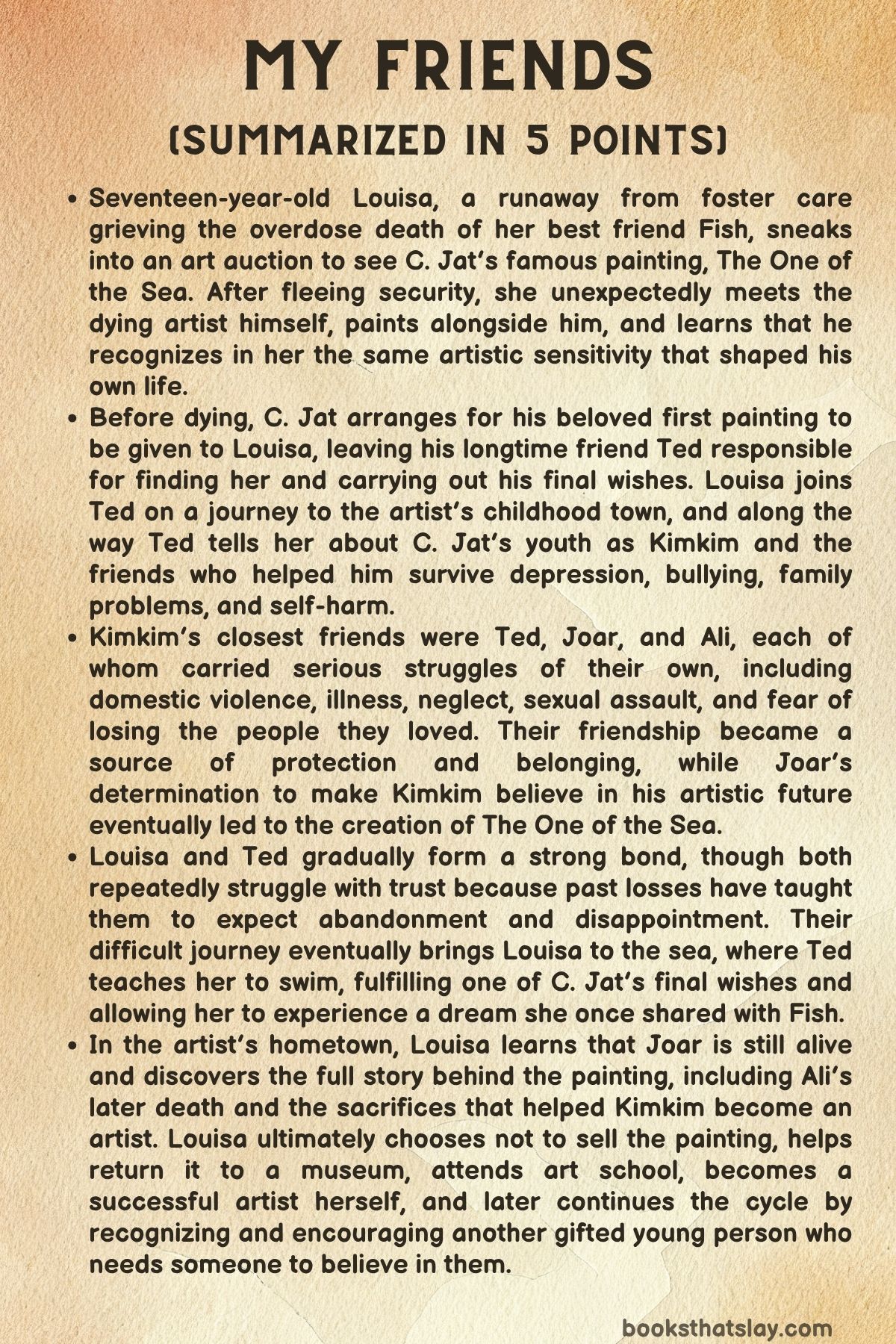
Summary
Seventeen-year-old Louisa enters an exclusive art auction by climbing through a bathroom window and disguising herself as part of the staff. She has come to see My Friends artist C. Jat’s first famous painting, The One of the Sea, a work wealthy collectors admire for its financial worth while Louisa understands it as something far more personal.
The painting appears to be a seascape, but three tiny teenagers sit laughing at the end of a pier. Louisa immediately recognizes that their friendship, rather than the water surrounding them, is the true center of the picture.
Her connection to the painting is inseparable from Fish, her best friend from foster care, who died from an overdose only weeks earlier. Fish had been Louisa’s closest companion, and the two had dreamed of seeing the painting and eventually reaching the sea together.
Louisa’s own childhood has been filled with abandonment and unsafe foster homes. A postcard showing The One of the Sea once became one of the few beautiful possessions she carried from place to place, and Fish helped her believe that painful memories could still belong to her even when the facts behind them were imperfect.
At the auction, Louisa crosses the barrier around the painting and draws a tiny fish on the wall beside it as a private memorial. Security intervenes, Louisa panics when she is physically restrained, and she escapes after a chaotic struggle.
Behind the building she collides with a sick, trembling man accompanied by a ginger cat. He protects her from the guard, helps gather the belongings scattered from her backpack, and listens as she speaks about Fish, foster care, running away, and her approaching eighteenth birthday.
The stranger tells her that he is dying, yet encourages her desire to keep living. When Louisa gives him her treasured postcard, the two begin covering the church wall with spray-painted images, until the man paints tiny skulls and Louisa realizes that she has been talking to C. Jat himself.
Twenty-five years earlier, C. Jat was a deeply unhappy fourteen-year-old boy named Kim, usually called Kimkim by his friends. He grew up believing that he was strange and worthless, while depression, bullying, family shame, and self-harm placed him in constant danger.
His closest friends were Ted, Joar, and Ali. They were children from difficult homes who used jokes, swimming, reckless adventures, insults, loyalty, and repeated rituals to protect one another from problems far larger than they were equipped to solve.
Joar was especially determined to keep Kimkim alive. After discovering pills and injuries suggesting self-harm, he decided that his friend needed a future, so he pushed him toward an art competition and told him to paint the sea.
Back in the present, C. Jat recognizes Louisa as another wounded young artist and insists that her creativity belongs to her rather than to him. Before police arrive, he makes her promise not to hurt herself, tells her to learn to swim, and urges her to keep painting.
C. Jat is later taken to hospital, where Ted joins him. Ted has loved him for most of his life and has secretly followed his final instruction by spending nearly the artist’s entire fortune to purchase The One of the Sea from the auction.
C. Jat dies peacefully beside Ted after asking him to find Louisa and give her the painting. The following morning Louisa hears of his death on the radio and struggles with the fact that the private, frightened man she briefly knew has instantly become public property again through headlines and commentary.
A few days later Louisa returns to the alley and continues the mural she painted with him. Ted eventually finds her and gives her the postcard, the spray can, and the astonishing inheritance C. Jat left behind: The One of the Sea itself.
Louisa initially wants no part of a painting worth an enormous amount of money. Ted explains that C. Jat believed she had truly understood what the picture contained and had recognized something of his younger self in her.
Ted is traveling back to the town where the painting was created in order to bury C. Jat’s ashes. Louisa learns that Ted is one of the teenagers represented in the picture and insists on traveling with him, partly because she has spent years imagining that the laughing children on the pier might have accepted her among them.
During the train journey, Ted gradually tells Louisa the story of the four friends. Joar grew up with a violent father and a loving mother trapped in the same dangerous household, while Ted lived beneath the shadow of his father’s cancer, an abusive older brother, and a family culture that treated emotional vulnerability as weakness.
Ali joined the group with fierce energy, humor, and a talent for fighting. Her mother had died, her father was irresponsible, and she later survived sexual violence committed by one of the drunken adults allowed into her home.
Ali and Joar fell in love, although affection between them was often expressed through arguments and reckless gestures. Because trust was difficult for Ali, telling Joar that she trusted him carried a seriousness equal to telling him she loved him.
Another crucial person entered Kimkim’s life through coincidence. Christian, a temporary school janitor with skull tattoos and an artistic background, saw Kimkim’s drawings and became one of the first adults to treat him as an artist instead of a problem.
Christian encouraged him to create without seeking permission and understood that the boy drew emotions rather than simply objects. He also recognized the signs of depression and told Kimkim directly not to hurt himself.
Christian died from drugs soon afterward, and the school painted over the mural he and Kimkim had created together. Kimkim stopped drawing, which terrified his friends and made Joar even more determined to push him toward the art competition.
Joar’s belief in Kimkim demanded real sacrifice. His mother sold treasured skates to buy Joar a bicycle, but Joar immediately sold the bicycle and used the money to purchase the canvas, brushes, and paint his friend needed.
Kimkim eventually painted The One of the Sea in Ted’s basement. Rather than painting himself visibly among the three friends, he placed his presence into the entire scene and signed the work C. Jat, combining the names Christian, Joar, Ali, and Ted.
In the present, Louisa becomes frightened by how safe she feels with Ted and secretly leaves the train. Her instinct tells her that kindness creates attachment, attachment creates vulnerability, and losing a genuinely good person may hurt more than avoiding connection altogether.
Ted wakes, discovers she is gone, and follows her into a dangerous area. Two men pretending to help him attack and rob him, but Louisa returns carrying a metal pipe and saves his life.
The two barely escape, only to watch their train depart with the painting and C. Jat’s ashes still aboard. They argue bitterly, admit that both of them considered abandoning the other, and recognize that each has learned to expect disappointment before trust.
Help arrives from an older taxi driver, whose eccentric warmth gives them another example of ordinary kindness. They fail to catch the train, but the painting is eventually returned by another passenger while the box containing the ashes appears to have been discarded.
Ted decides that they cannot control everything. Since they are near the sea, he and Louisa break into a sporting-goods store, leave payment behind, take swimming clothes, and walk to the water.
Ted then fulfills one of C. Jat’s final instructions by teaching Louisa to swim. Louisa reaches the sea she once dreamed of seeing with Fish and carries her lost friend into that moment through memory.
Ted and Louisa finally reach the town where the four teenagers grew up. Ted takes her toward the old neighborhood and arrives at the home of Joar, whom Louisa has assumed for much of the story must have died young.
Joar is alive. He is older, burdened by a difficult life, wearing an ankle monitor after imprisonment, but unmistakably the boy whose loyalty shaped the painting.
The truth about his childhood gradually emerges. Joar had once planned to kill his violent father in order to save his mother, but she discovered the knife and replaced it with bars of soap before taking the weapon herself.
Before either could use it, Joar’s father was struck by a steel beam at work and suffered devastating brain damage. He survived and became dependent on the very woman he had abused, while Joar came to understand that his mother’s compassion represented strength rather than weakness.
Joar also reveals what happened with the art competition. The friends discovered too late that Kimkim was too old to enter, and Joar responded by breaking into the museum and hanging the painting on a wall himself so that his friend could see that his work belonged there.
When the children needed an adult to confirm the painting was theirs, Kimkim called the number Christian had given him. Christian’s mother arrived, immediately recognized Kimkim as the young artist her son had once described, and became instrumental in helping him attend art school.
The surviving adults eventually tell Louisa the final pieces of the past. Kimkim escaped the town and became internationally successful, but Ali moved abroad and later disappeared while surfing shortly after turning eighteen.
Joar remained behind, cared for his disabled father, watched his mother eventually find a gentler life, and later went to prison after violently defending a woman from an abusive man. Ted became a teacher, although violence and grief continued to shape his life.
Louisa ultimately refuses to sell The One of the Sea. She fears that turning the picture into money would teach her to measure art by price, destroying the very understanding that allowed her to love the painting in the first place.
Instead, Louisa, Ted, and Christian’s mother break into the museum and hang the painting on an empty wall. Their act reverses Louisa’s first entrance into the art world: she once broke into an auction to see a picture privately owned by the wealthy, but now she enters a museum to return the picture to everyone.
The supposed loss of C. Jat’s ashes is also repaired when the train conductor reveals that he saved the box. The ashes eventually return home, Kimkim is buried near his old friends, and Louisa paints wings on his gravestone.
Life continues rather than resolving into perfect happiness. Ted considers new forms of teaching, Joar imagines opening a repair workshop, and Christian’s mother helps arrange Louisa’s artistic education.
Ted and Joar finance her schooling, and Louisa eventually travels, paints, succeeds, and becomes the creator of an image that may someday matter to another lonely child as deeply as C. Jat’s postcard once mattered to her.
Years later, Louisa finds a gifted teenager making art in an alley. She immediately calls Ted and says she has found one of them, repeating the recognition that once passed from Christian to Kimkim and from Kimkim to Louisa.
The story closes by showing that friendship does not defeat death by preventing everyone from dying. It defeats erasure by making people visible, carrying their laughter forward, and teaching the living to recognize the next person who needs someone to believe in them.
Characters
Louisa
Louisa is the central figure through whom the past is rediscovered and given a future. In My Friends, she begins as a seventeen-year-old runaway shaped by abandonment, unsafe foster homes, grief, distrust, and the recent death of Fish, yet she also possesses an intense sensitivity to beauty that prevents hardship from reducing her entirely to anger.
Her aggression is closely connected to survival. She reacts violently when adults grab her, carries tools that suggest constant readiness for danger, knows how to disappear without attracting attention, and instinctively recognizes threatening men before Ted does.
Louisa’s greatest difficulty is not identifying cruelty but accepting kindness. Bad treatment fits the world she understands, while genuine generosity frightens her because it creates attachment and therefore creates something she could lose.
Her decision to leave Ted on the train shows how deeply this fear controls her. She runs not because she believes Ted is secretly cruel, but because she is beginning to believe that he may actually care for her.
Her artistic imagination becomes the alternative to that fear. Louisa sees the three laughing teenagers inside The One of the Sea when wealthy viewers see only a valuable object, and C. Jat immediately recognizes that her ability to perceive emotional truth is the foundation of her own creative identity.
Fish’s death leaves Louisa carrying enormous guilt, especially because she believes staying beside someone should have been enough to save them. Through Ted, Joar, C. Jat, and Christian’s mother, she gradually learns that love does not grant control over another person’s survival.
Her growth is therefore not a transformation from damaged to healed. She remains impulsive, defensive, funny, reckless, and emotionally vulnerable, but she begins allowing herself to belong to other people.
By the end, Louisa accepts education, friendship, artistic ambition, and a future she once could barely imagine. Most importantly, she becomes capable of recognizing another young artist and offering the same kind of recognition that once kept Kimkim alive, completing the novel’s generational movement from being seen to learning how to see others.
C. Jat / Kimkim
C. Jat is presented simultaneously as a world-famous artist and as Kimkim, a frightened boy whose friends spent much of adolescence trying to keep him alive. My Friends gradually removes the public mythology surrounding him and replaces it with the private person underneath: anxious, wounded, funny, sensitive, and permanently connected to the teenagers who first believed in him.
As a child, Kimkim can recognize beauty almost everywhere except within himself. Bullying, his parents’ shame, humiliating treatment at school, depression, pills, and self-harm convince him that his sensitivity is evidence of defect rather than talent.
Joar, Ted, Ali, and later Christian provide competing evidence. They treat his existence as valuable before he can do so himself, and their faith becomes part of the emotional structure supporting his survival.
His artistic gift does not remove his suffering. International success gives him money and recognition but also places enormous pressure on a person already struggling with fear, panic, addiction, and the difficulty of living comfortably inside himself.
The One of the Sea reveals what art means to him most clearly. Rather than paint himself visibly, he paints the world created by the presence of his friends, suggesting that his identity exists inside the relationships that allowed him to become an artist at all.
His pseudonym reinforces this idea because C. Jat combines the names of Christian, Joar, Ali, and Ted. Even the name under which the world celebrates him is therefore a hidden acknowledgement that artistic creation was never an entirely solitary act.
His final encounter with Louisa gives his life a last act of recognition. Instead of encouraging dependence on his fame, he insists that her creativity belongs to her, asks her not to hurt herself, and gives her the painting because he sees what she might become.
C. Jat’s importance lies not simply in the art he leaves behind but in the movement from being rescued by others to becoming capable of helping rescue someone else. His life remains imperfect and painfully brief, but his influence continues because Louisa eventually repeats his act of recognition with another young artist.
Ted
Ted is a character defined by fear of loss and by an almost automatic habit of caring for others despite repeatedly claiming that he cannot bear responsibility for them. His caution, orderliness, anxiety, and need for control are understandable responses to a childhood in which illness, family violence, shame, and death taught him how quickly safety can disappear.
His father’s long illness introduces mortality into his life early, while his older brother’s violence and the masculine expectations enforced by his family teach him to associate vulnerability with danger. Ted therefore grows into an adult who finds emotional exposure difficult even when his capacity for love is enormous.
His bond with Kimkim becomes one of the deepest relationships in the story. Their connection cannot be reduced comfortably to conventional romance, yet they function as home for one another, especially during the later period when Ted is recovering from a stabbing and Kimkim is becoming increasingly unwell.
Ted’s profession as a teacher is another expression of his childhood. Having known adults who humiliated vulnerable children, he tries to become the kind of adult who intervenes instead, even though that instinct eventually results in his near-fatal stabbing.
His relationship with Louisa begins with resistance because she immediately represents another possible loss. He repeatedly says he does not want responsibility for her while buying her ticket, protecting her from authority figures, carrying her belongings, telling her his most private stories, and running after her when she disappears.
Louisa eventually forces Ted to reconsider parts of his own past. Her outsider’s perspective allows her to question assumptions about his mother, his teaching, his courage, and the idea that surviving violence should require emotional silence.
By the conclusion, Ted has not escaped grief, but he begins imagining a life that extends beyond protecting himself from future loss. His decision to consider teaching again suggests that care remains central to who he is, even after care has repeatedly cost him.
Joar
Joar is rough, funny, impulsive, loyal, frighteningly brave, and much more emotionally perceptive than his behavior initially suggests. Growing up under the control of a violent father forces him to develop strength early, but the story repeatedly distinguishes protective aggression from the cruelty he fears inheriting.
His devotion to Kimkim becomes one of his defining traits. After discovering signs that his friend may be suicidal, Joar does not possess the language or emotional tools for a careful conversation, so he translates fear into action and becomes obsessed with making Kimkim paint.
The art competition matters to Joar because he wants his friend to imagine belonging somewhere beyond their town. When the competition becomes impossible, Joar physically breaks into the museum and hangs the painting himself, turning his belief into a literal statement that Kimkim deserves a place on those walls.
His sacrifice of the bicycle captures his character especially well. His mother gives up something precious to provide him with a bicycle of his own, but Joar immediately sells it to buy art materials for Kimkim, giving away a symbol of personal freedom in order to create a possible future for his friend.
Joar’s relationship with his mother reveals the gentler side hidden beneath his aggression. He worships her ability to create joy despite violence and gradually understands that her compassion, which others mistake for weakness, requires a form of courage different from his own.
His relationship with Ali gives him another reason to imagine survival. He has spent years expecting to die young, but loving her eventually forces him to acknowledge that he wants an ordinary future.
Adult Joar remains marked by the same instinct to protect. His imprisonment after attacking a man who was beating a woman shows that he never fully learns how to separate protection from violence, making him admirable and troubling at the same time.
He represents a person who successfully avoids becoming his father without ever escaping what his father taught his body about conflict. His tenderness survives, but it lives beside anger rather than replacing it.
Ali
Ali arrives with such confidence, aggression, humor, and unpredictability that she initially appears nearly fearless. Her behavior gradually reveals itself as armor developed by a girl whose mother has died, whose father cannot provide stability, and whose home has exposed her to unsafe adults.
Her relationship to trust is particularly important. After being sexually assaulted by one of her father’s acquaintances, trust becomes dangerous and difficult, which explains why telling Joar that she trusts him carries such extraordinary emotional weight.
Ali refuses to perform vulnerability in expected ways. She fights, insults people, sings badly, makes jokes, loves birds, provokes Joar, and turns embarrassment into comedy whenever possible.
Yet she is also capable of remarkable emotional insight. When Ted speaks about his father’s cancer, Ali suggests that sadness may contain beauty, offering comfort in a form that surprises him.
Her romance with Joar develops through conflict because both characters find direct tenderness difficult. Beneath their arguments is a powerful recognition that each understands what it means to live in a home where safety cannot be assumed.
Ali also imagines one of the story’s most revealing versions of happiness. When she invents ordinary lives inside houses, her fantasy is not wealth or prestige but a boring home with food, electricity, parents who remain, and children who feel safe.
Her eventual disappearance while surfing is devastating because she had become one of the characters most strongly associated with movement, defiance, and survival. Yet the fact that she reached another sea and became an accomplished surfer also means that she temporarily achieved the freedom she wanted.
Ali remains present after death through Joar’s loyalty, Ted’s memories, Kimkim’s art, and the emotional inheritance Louisa receives from their stories. Her absence becomes another example of how a person can continue shaping the living long after physical presence ends.
Fish
Fish is physically absent from most of the story but emotionally present throughout Louisa’s journey. She was Louisa’s closest friend in foster care, the person who became family when biological and institutional forms of family repeatedly failed them.
Fish taught Louisa how to survive dangerous environments, recognize manipulative kindness, steal small moments of happiness, and imagine that certain memories could remain permanent even when everything else disappeared. Her influence appears constantly in Louisa’s habits and assumptions.
Her worldview is both protective and damaging. Warning Louisa that apparently kind people may be dangerous is sensible within the world they know, but after Fish dies, Louisa continues applying that lesson so rigidly that genuine kindness also becomes frightening.
Fish’s death from an overdose creates the guilt that Louisa carries into nearly every new relationship. Because Louisa once obeyed Fish’s instruction not to follow her out of foster care, she imagines that choosing differently might have prevented the death.
The library memory captures their friendship at its happiest and saddest. They once spent an illegal overnight adventure there creating a perfect moment together, and Fish later dies in the same place among the fairy tales that had briefly allowed them to escape reality.
Fish ultimately represents the permanent presence of someone who is gone. Louisa cannot save her retrospectively, but she can carry her to the painting, the sea, art school, and the future.
Christian
Christian appears only briefly in Kimkim’s youth, but his effect on the artist’s life is enormous. As a temporary janitor and struggling young artist with skull tattoos, he enters the school almost by accident and immediately recognizes creative ability where other adults have seen only behavioral problems.
His greatest gift to Kimkim is permission. Christian does not demand that the boy justify why he wants to draw unusual bodies, wings, emotions, or unsettling images; instead, he treats making art as naturally as a bird making sound.
Christian also understands the danger surrounding Kimkim because he has experienced addiction and emotional instability himself. His recognition therefore extends beyond artistic talent to the signs that the boy may be harming himself.
His instruction not to hurt himself becomes especially important because it later echoes in C. Jat’s request to Louisa. The phrase becomes part of a chain in which one vulnerable artist passes survival forward to another.
Christian’s sudden death makes his role more painful because Kimkim loses the first adult artist who truly saw him almost immediately after finding him. When the school then paints over their mural, both the person and the proof of their connection seem to vanish.
Yet Christian continues through Kimkim’s skulls, his advice, his mother, and the phone number he leaves behind. A short friendship therefore alters decades of lives.
Christian’s Mother
Christian’s mother provides one of the story’s clearest examples of grief becoming a continuing relationship rather than something that ends. She never claims to have recovered from Christian’s death; instead, she describes learning to live differently with his absence.
Her background as an art historian allows her to recognize Kimkim’s ability immediately when he calls her from the museum. More importantly, she recognizes the human significance of her son having identified the boy as someone like himself.
She becomes the adult connection the teenagers desperately lack. After seeing Kimkim’s work, she helps create access to art education, validates the painting, and ultimately contributes to the possibility of his leaving the town.
Her relationship with Louisa repeats this pattern across generations. She does not merely discuss Christian or Kimkim with Louisa; she also helps organize the practical future through which Louisa can become an artist.
Her idea of seeing mistaken glimpses of Christian in crowds as a form of hide-and-seek shows her refusal to treat love as something cancelled by death. Grief remains painful, but imagination makes room for continuing affection without denying reality.
Christian’s mother therefore functions as a bridge connecting Christian, Kimkim, and Louisa. Through her, recognition travels from one generation of vulnerable artists to the next.
Joar’s Mother
Joar’s mother is judged by many people around her as careless, unconventional, or irresponsible, but the story gradually reveals extraordinary emotional strength beneath those judgments. She gives Joar affection, laughter, imagination, and a sense that life can contain joy even inside a violent home.
Her relationship with her son is one of mutual protection. Joar thinks his role is to save her from his father, while she quietly tries to prevent him from destroying his own life in the attempt.
Her decision to replace his knife with soap is one of her most important actions. She understands what Joar intends to do and chooses to carry the terrible responsibility herself rather than allow her child to become a killer.
Her kindness after her husband’s disabling accident complicates easy ideas about strength. She cares for a man who abused her not because the abuse deserves forgiveness but because dependency awakens a compassion that violence never managed to eliminate.
Joar eventually realizes that his father’s physical dominance was never the same thing as true power. His mother’s ability to remain loving, protective, humorous, and human under years of fear becomes the greater strength.
Her sacrifice of inherited skates to buy Joar a bicycle also reveals how completely she wants him to experience freedom. Although he later sells the bicycle for Kimkim’s art materials, the generosity behind both decisions becomes part of the painting’s history.
Joar’s Father
Joar’s father represents the destructive power of violence inside a home and the culture of silence that permits it to continue. His control depends on fear, unpredictability, alcohol, and the certainty that his wife and son must constantly measure their behavior around his moods.
His cruelty toward the bird is particularly revealing. He believes he is crushing something Joar loves and watches his son while doing it because the emotional injury matters as much to him as the physical destruction.
The surrounding adults deepen his significance. Men who work beside him see evidence of violence but convince themselves that loyalty means refusing to interfere with another man’s household.
His workplace accident radically changes the family’s power structure. Brain damage leaves him unable to dominate physically, exposing the difference between appearing powerful and possessing genuine moral strength.
His survival creates uncomfortable complexity because there is no clean punishment or satisfying confrontation. Instead, the man who made others dependent on his moods becomes dependent on the woman he abused.
Through him, the story examines how violence damages not only its direct victims but whole communities that learn to look away.
Ted’s Mother
Ted initially remembers his mother as stern, emotionally distant, and determined that her sons should become hard enough to survive. Her insistence on masculine strength leaves Ted believing that fear, grief, and softness are personal failures.
Later memories complicate that judgment. Louisa suggests that some actions Ted interpreted as rejection may have been imperfect attempts to protect him from the worst parts of his family’s illness and violence.
Stories from Ted’s brother reveal another version of their mother before cancer transformed the household. She had once been playful, deeply in love, and capable of a kind of openness Ted never experienced directly.
Her friendship with Ali later reveals still more emotional depth. Conversations about motherhood, grief, and failure allow her to be seen not simply as a hard parent but as someone exhausted by years of fear and responsibility.
Ted’s revised understanding does not erase the pain she caused. Instead, it demonstrates one of the book’s larger ideas: people contain versions of themselves that even those closest to them may never fully know.
Ted’s Older Brother
Ted’s older brother initially appears mainly as a source of fear because he repeatedly beats Ted and performs the narrow masculinity enforced by the environment around them. His association with the Ox strengthens Ted’s belief that young men can become dangerous without warning.
The brother later becomes more complicated. After their father dies, he shares memories that allow Ted to understand his parents as people who existed before illness consumed the family.
He also demonstrates an unexpected capacity to see Ted clearly. His refusal to assume heterosexuality when discussing Ted’s relationships and his belief that Ted could become the kind of teacher his future children might admire suggest affection that he has rarely expressed well.
That conversation contributes to his eventual choice not to follow the Ox into serious criminal violence. He does not become a perfect brother, but he becomes evidence that harmful patterns can be interrupted.
His characterization challenges Ted’s tendency to divide the past into fixed roles of victim and aggressor. The person who frightened him also carried grief, loyalty, shame, and the possibility of choosing differently.
Kimkim’s Parents
Kimkim’s parents contribute significantly to his childhood belief that something is wrong with him. His mother desperately wants him to appear normal, while his father drinks and responds to his sensitivity with distance and shame.
Their failures matter because the rejection comes from the people whose acceptance should have been most secure. Kimkim’s friends consequently become essential not merely as companions but as an alternative emotional family.
The parents are not left completely unchanged. After the events surrounding Joar’s father and Kimkim’s artistic breakthrough, his father begins confronting his own cowardice and the ways he has failed his son.
He quietly keeps one of Kimkim’s drawings, suggesting that recognition has arrived even though direct communication remains difficult. Later, the parents sell possessions to help finance Kimkim’s artistic education.
Their belated support cannot undo the damage done earlier. It does, however, show that adults who have failed a child are still capable of seeing their failure and choosing a different response before every opportunity disappears.
The Temporary Taxi Driver
The older taxi driver enters during one of Ted and Louisa’s most chaotic moments and briefly becomes a model of practical, unceremonious kindness. She helps them without demanding a detailed justification for why they deserve assistance.
Her long marriage provides Louisa with an unfamiliar picture of ordinary devotion. Holding hands during anger, exchanging food, keeping another living thing alive, and continuing after the deaths of children present love as repeated behavior rather than dramatic declaration.
Her presence matters because Louisa has been trained to treat strangers as possible threats. The taxi driver becomes one of several people who slowly prove that caution and trust do not have to cancel one another.
She also carries them physically closer to the sea, making her a small but meaningful participant in Louisa’s movement toward a dream once shared with Fish.
The Train Conductor
The conductor begins largely as a comic presence in Louisa’s attempts to embarrass Ted, but he gradually becomes associated with a future Ted has not yet decided whether he wants. His friendly exchanges suggest the possibility that connection may still exist beyond Ted’s grief for Kimkim.
He also becomes unexpectedly important when C. Jat’s ashes appear to have been lost. Rather than discard the box, he preserves it and helps arrange its eventual return.
That action reflects one of the story’s recurring ideas: enormous emotional consequences often depend on small choices made by people who do not fully understand their significance. Saving an apparently insignificant box allows the dead artist to return home.
The conductor therefore represents possibility rather than resolution. Ted is not suddenly ready for another relationship, but considering future travel or future affection is already a major change for someone who has spent so long expecting loss.
The Mother with the Baby
The mother traveling with her baby plays a small role but becomes important to Louisa’s developing sense of herself. By allowing Louisa to hold the child, she offers trust without demanding that Louisa first prove she deserves it.
For someone raised in environments where adults often regarded her as troublesome, dangerous, or unreliable, being trusted with something fragile has enormous emotional force. Louisa responds with careful tenderness.
The mother later helps ensure that Ted’s belongings and the valuable painting are returned after the train departs without them. Her actions quietly reinforce the idea that strangers can become part of one another’s survival through simple decency.
The Minister
The minister appears around Ted’s father’s funeral and responds to Joar’s anger about God, cancer, injustice, and death without humiliating him. His willingness to tolerate irreverent questions offers the teenagers a rare example of an adult who does not demand obedience before compassion.
He also notices Kimkim’s artistic ability and praises a drawing rather than treating it as another sign that the boy is strange. Coming after years of criticism, such recognition carries disproportionate importance.
The minister’s value lies less in providing theological answers than in allowing grief, anger, humor, and art to exist in the same space. He represents an adult presence that can withstand children’s pain without immediately trying to control it.
The Owl
The art teacher nicknamed the Owl represents institutional authority at its most damaging. Instead of helping Kimkim understand his artistic instincts, the teacher humiliates him because his work does not conform to expected subjects or styles.
The physical confrontation with Kimkim becomes especially dangerous because being grabbed triggers panic. The event pushes an already vulnerable child toward another moment of crisis.
The Owl’s treatment stands in direct opposition to Christian’s approach. Where Christian sees feeling, possibility, and artistic identity, the Owl sees deviation that needs correction.
This contrast demonstrates that artistic talent alone does not guarantee survival. Whether a young person continues creating may depend heavily on whether adults interpret difference as possibility or as a problem.
The Ox
The Ox embodies the violent social rules surrounding Ted’s adolescence. His homophobic abuse and physical aggression enforce a version of masculinity built around domination, humiliation, and fear of difference.
His importance is increased by the way his behavior influences other boys. Ted’s older brother becomes dangerous partly because he remains near people such as the Ox and accepts their standards for what strength should look like.
The brother’s eventual refusal to follow the Ox into more serious violence becomes evidence that such influence, while powerful, is not absolute. The cycle can be interrupted when someone begins imagining a different identity.
Themes
Friendship as Survival and Chosen Family
Friendship in My Friends operates as a form of protection for children who cannot depend consistently on parents, institutions, or other adults. Kimkim, Ted, Joar, Ali, Louisa, and Fish repeatedly survive moments of fear because another person notices what is happening and refuses to leave them alone.
The friendships are not idealized as calm or emotionally articulate. These characters fight, insult one another, make reckless decisions, misunderstand each other, disappear, and occasionally cause serious pain.
What gives their relationships power is repetition. The teenagers call out that they are still present after jumping into the water, promise to meet again at the crossroads, sit beside Ted after his father’s funeral, gather around Kimkim while he paints, and keep returning even when they have no language for what they fear.
Chosen family becomes especially important because blood relationships often fail to provide safety. Louisa finds family in Fish and later in Ted, while Kimkim’s friends become the people who recognize value in him before he can recognize it himself.
The book also refuses the comforting idea that love always saves a person from death. Christian dies, Fish dies, Ali dies, and Kimkim eventually dies despite being deeply loved.
What friendship can do is make life more possible while it lasts and prevent death from becoming complete disappearance. The living carry jokes, rituals, stories, images, habits, and phrases forward, allowing relationships to continue changing people long after one member is gone.
Art as Recognition, Memory, and Belonging
Art matters most when one person uses it to recognize another. The One of the Sea is financially valuable to collectors, but its deeper meaning comes from Kimkim’s attempt to preserve the emotional reality of his friends laughing at the end of a pier.
Louisa understands the painting because she does not approach it primarily as an object of prestige. She sees children whose closeness resembles the kind of belonging she has always wanted, which is why the picture reaches her long before she knows their individual stories.
Christian’s relationship with Kimkim establishes the pattern. He looks at a child dismissed as strange and understands that the drawings contain an artistic language worth protecting.
C. Jat later performs the same act for Louisa. Instead of telling her to imitate him, he insists that her art is already hers, giving her creative independence rather than turning himself into the source of her identity.
Louisa eventually repeats the recognition with another teenager. The movement suggests that artistic communities survive when people who were once noticed become capable of noticing others.
The museum also changes meaning across the story. At first it represents exclusion, wealth, institutional judgment, and the belief that poor children do not belong near valuable art.
By the end, placing the painting inside the museum becomes an act of reclaiming access. The work belongs there not because of its price but because it carries human experience that should be available to anyone capable of seeing themselves inside it.
Grief, Memory, and Continuing Relationships with the Dead
Death repeatedly separates characters physically without ending their influence on one another. Louisa continues speaking internally with Fish, Ted carries Kimkim and Ali through memory, Joar lives beside the absence of his first love, and Christian’s mother continues responding to imagined glimpses of her son.
The story resists the idea that healthy grief requires completely leaving the dead behind. Christian’s mother offers a different model in which absence slowly becomes something a person learns to carry rather than something successfully defeated.
Art provides one way of carrying it. Kimkim’s painting preserves a brief moment when his friends were alive together, while Louisa’s drawings later allow Ted and Joar to encounter the young Kimkim they remember.
Ordinary objects perform a similar function. A postcard, a cigarette brand, a watch, flowers, soap, a bicycle, a drawing, and even a joke can suddenly reopen relationships with people who are no longer physically present.
This continuing connection does not remove pain. Louisa still cries for Fish, Ted still fears losing people, and Joar still experiences Ali’s death as something capable of happening again whenever her story is told.
What changes is the meaning of remembrance. Memory becomes less about remaining trapped in the instant of death and more about refusing to reduce a whole person to the fact that they died.
The dead therefore remain active within the emotional lives of the survivors. They influence decisions, careers, friendships, art, acts of courage, and the way new people are welcomed into old circles.
Violence, Shame, and the Possibility of Breaking Cycles
Violence enters the lives of many characters early enough that fear becomes ordinary. Joar watches his father abuse his mother, Louisa survives dangerous foster environments, Ali experiences sexual violence, Ted is beaten by his brother and other boys, and Kimkim is bullied and physically controlled by adults who do not understand his panic.
The damage extends beyond individual acts. Repeated violence teaches characters expectations about themselves and others: Louisa expects kindness to become dangerous, Joar fears he may become his father, Ted associates weakness with emotional honesty, and Ali treats trust as something that must be earned under extreme conditions.
Silence allows much of the harm to continue. The harbor workers know enough about Joar’s family to suspect abuse but reinterpret loyalty as a reason not to interfere.
Other adults fail differently. The Owl humiliates Kimkim rather than asking what his behavior means, while Ali’s father creates an unsafe home through negligence rather than direct physical control.
Breaking the cycle therefore requires more than simply defeating one violent person. It depends on different choices being made repeatedly.
Ted becomes a teacher who intervenes for vulnerable students. Christian responds to a troubled child with recognition rather than shame, Joar’s mother prevents her son from becoming a killer, and Ted’s brother eventually refuses to follow the Ox into greater violence.
The characters remain marked by what happened to them, and several continue reacting aggressively under threat. The story nevertheless argues that inheritance is not destiny: people may carry the language of violence inside them without being required to pass its cruelty forward.