Of Flame and Fury Summary, Characters and Themes
Of Flame and Fury by Mikayla Bridge is a fantasy novel centered on seventeen-year-old Kelyn “Kel” Varra, a phoenix tamer struggling to protect her family farm and the rare phoenix Savita while surviving the violent world of competitive phoenix racing.
What begins as a story of debt, rivalry, dangerous sport, and unexpected attraction gradually becomes a larger conflict about animal freedom, scientific ambition, ecological destruction, and the limits of human ownership. Kel’s changing relationship with rival rider Warren “Coup” Coupers forces her to question her own moral compromises, while the powerful Cristo Industries draws her into a scheme that threatens Savita’s life and Kel’s understanding of everything phoenixes represent.
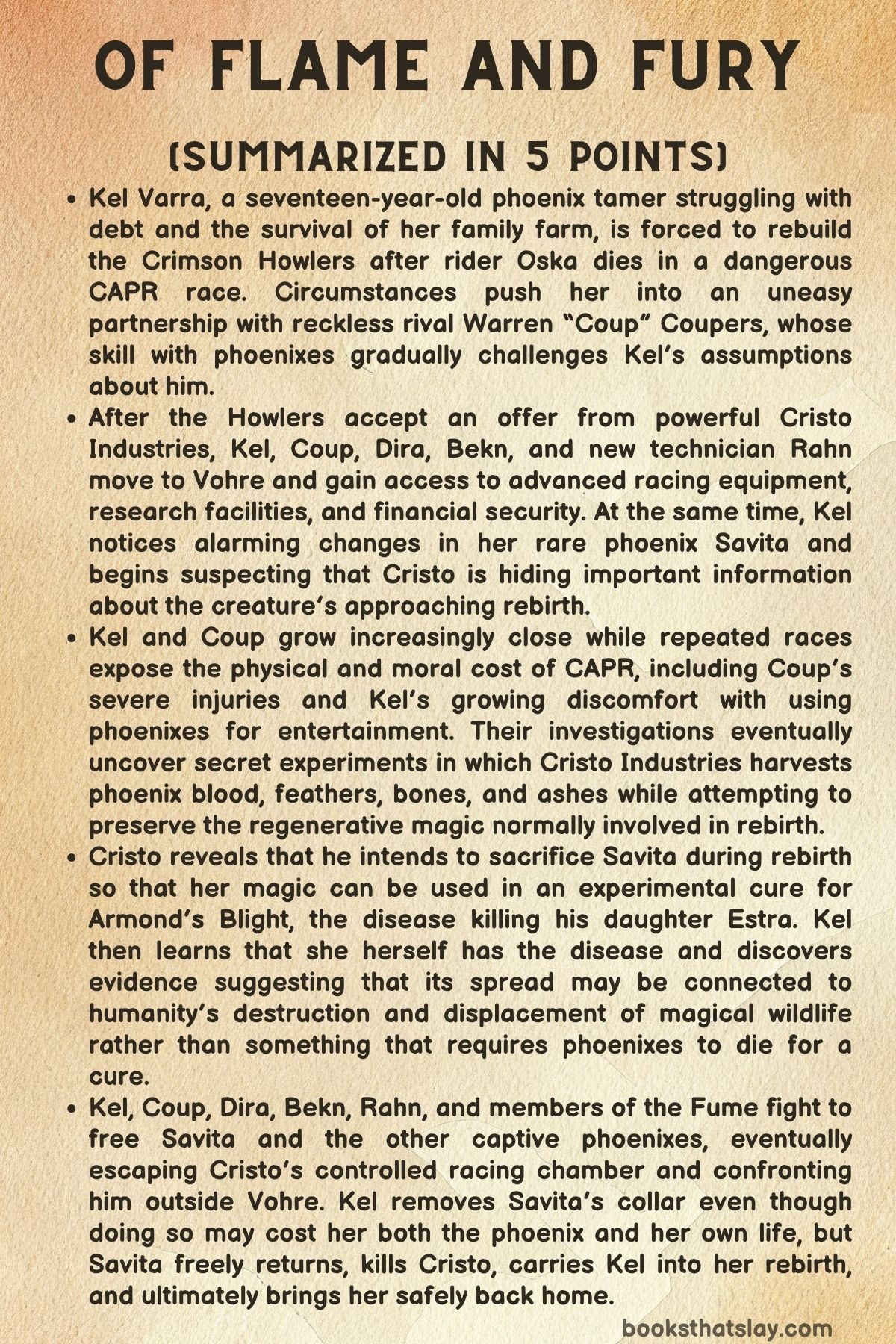
Summary
Kelyn “Kel” Varra works as the tamer for the Crimson Howlers, a struggling CAPR phoenix-racing team whose survival depends heavily on prize money. Kel is already buried under debts connected to her family farm and the care of Savita, the rare carnel phoenix her family has protected for generations.
During an important race, the Howlers’ rider Oska sees rival racer Warren “Coup” Coupers perform a reckless stunt by unfastening himself from his phoenix and flattening his body against it. Desperate to match him, Oska attempts the same maneuver despite warnings from Kel, strategist Dira, and technician Rube.
Oska loses control, falls from Savita, and dies. Kel directs much of her grief toward Coup, blaming his public recklessness for inspiring Oska, while Coup argues that Oska made her own decision and that he cannot be responsible for everyone who copies him.
The death fractures the team further when Rube decides to leave racing altogether after receiving an opportunity to study at Cendor University. Kel is now missing both a rider and a technician, placing her financial survival in even greater danger.
Unexpectedly, Coup also loses his place on the Star Chasers because of his dangerous behavior. Dira proposes that Coup join the Crimson Howlers as their new rider, accompanied by his older brother Bekn, who manages his career and publicity.
Kel strongly opposes the idea, but circumstances quickly demonstrate that she and Coup can function together. When a member of the Fume removes the collar from a phoenix in Fieror, the frightened creature becomes dangerously destructive, and Kel risks serious injury to calm it and replace the collar.
Coup remains beside her and saves her from a potentially fatal attack. Reporters capture the incident, turning Kel and Coup into a popular public pairing and giving Bekn an opportunity to build media interest around their new partnership.
Coup soon surprises Kel with his understanding of phoenix behavior. Savita accepts him unusually quickly, suggesting that behind his public recklessness is someone who genuinely understands the animals he rides.
At the same time, Savita begins experiencing alarming spikes in temperature, breathing, and heart rate. Kel suspects that the phoenix may be approaching rebirth far earlier than expected, a process capable of releasing enormous heat.
Romar Harte, a recruiter for Cristo Industries, approaches Kel with an offer from Canen Cristo. Cristo wants Kel and Coup involved in his Vohre operation, promising extensive resources, advanced phoenix research, employment, and enough financial support to solve many of Kel’s problems.
Kel distrusts Cristo Industries because of its relationships with CAPR, the Cendorian government, technological control systems, and institutions her father had viewed suspiciously. Nevertheless, she finally accepts after insisting that Dira and Bekn be included.
Before the team leaves Fieror, Kel’s failing farm suffers another disaster when the aviary burns down. She believes the blaze was caused by deteriorating electrical infrastructure she could not afford to repair, deepening her guilt and making Cristo’s offer feel almost impossible to refuse.
Coup supports her after the fire and reveals that he once knew Kel’s father, Leon. Leon had defended mistreated phoenixes at the public aviary where Coup worked, giving Kel her first real indication that Coup’s concern for phoenix welfare is deeper than his racing image suggests.
The Howlers travel to Vohre and enter Cristo’s technologically advanced compound. Kel meets Rahn, a gifted technician from Ebrait who admires Cristo for giving her opportunities and eventually becomes the Howlers’ replacement technician.
Canen Cristo presents himself as knowledgeable, generous, and deeply committed to research. He shows Kel the Prism, a diamond-lined chamber supposedly designed to withstand phoenix rebirth, while explaining that one of his major goals is finding a cure for Armond’s Blight, a devastating neurological disease.
The disease carries personal meaning for Coup because his mother died from it. His loss also explains much of his self-destructive behavior: Bekn sacrificed his education and savings after their mother died, and Coup believes he must repay his brother through racing success regardless of the danger to himself.
Kel and Coup gradually become emotionally closer. Their public relationship is partly manufactured by Bekn for publicity, but staged appearances reveal real attraction, shared guilt, fear of loss, and a growing recognition that both of them sacrifice themselves and their phoenixes for people they love.
Their new team proves successful in Vohre racing. Savita and Coup win major events through a mixture of Dira’s strategy, Savita’s abilities, improved technology, and Coup’s willingness to take extraordinary risks.
Those victories come at a cost. Savita’s temperature continues rising, and Coup is eventually catastrophically injured after refusing repeated orders to slow down during a dangerous race involving turbulent air created by sprites.
Kel realizes how deeply she has come to care about him when she sees him unconscious and badly burned. She initially avoids visiting him because his injuries awaken memories of Oska and her father, but Dira forces her to confront the fact that fear has become one of the main forces controlling her relationships.
Meanwhile, Kel discovers that Cristo Industries has restricted her access to Savita’s medical information. Hidden darkening feathers confirm that Savita is approaching rebirth, while suspiciously normal medical readings suggest that Cristo’s employees have been concealing what is happening.
Her suspicions grow after she and Dira witness researchers secretly sedating, muzzling, and harvesting biological material from phoenixes. Later, Kel and Coup discover phoenix ash inside the supposedly unused Prism, indicating that at least one phoenix entered the chamber and failed to regenerate.
Kel and Coup finally admit their attraction and kiss, but their relationship develops alongside increasingly serious evidence against Cristo. Even so, Kel continues racing because she fears that refusing could allow authorities to classify Savita as dangerous and take her away.
A race through Vohre Forest forces Kel to ride Savita herself. The course has been cut through wild phoenix territory, and the racers soon encounter uncollared phoenixes capable of controlling their flames far more intelligently than Kel had been taught to believe.
The discovery changes Kel’s understanding of collars. She begins recognizing that the idea of phoenixes as creatures incapable of controlling themselves may serve human systems of domination more than genuine animal protection.
Members of the Fume then capture her. Their leader, Bryna, argues that phoenixes deserve liberation from human control, although Kel rejects the movement’s violent methods and points out that the Fume also imposes human assumptions upon the animals.
Kel escapes, reunites with Savita, and is attacked again before fleeing on the phoenix. During another confrontation with a wild phoenix, Kel falls from Savita’s back and expects with complete certainty that Savita will rescue her.
Savita does not catch her. Kel survives only because emergency equipment reduces the impact, but the experience destroys her assumption that affection gives her a special claim on Savita’s loyalty.
After recovering, Kel investigates Cristo’s compound more aggressively. She discovers harvested phoenix remains, preserved magical material, ash from permanently dead phoenixes, and a much larger hidden diamond chamber.
Cristo finally captures her and explains his project. Inspired by the legend of Landon Ryker and the phoenix Deja, he believes phoenix rebirth magic can regenerate human bodies and cure Armond’s Blight.
His research requires preserving phoenix ash before it can return to the reborn animal, meaning the phoenix must permanently die. Savita, already nearing rebirth, has become the ideal subject.
Cristo admits that much of Kel’s recent suffering was deliberately engineered. He caused the fire that destroyed her aviary to force her into financial dependence, manipulated media coverage to portray Savita as unstable, and used dangerous races to accelerate the phoenix’s rebirth.
His motive is personal as well as scientific. His daughter Estra is dying from Armond’s Blight, and Cristo has convinced himself that sacrificing phoenixes is acceptable if doing so might save her and eventually countless others.
Kel soon learns something even more devastating. Coup and her friends reveal that she has forgotten events that everyone else remembers, including postcards from her mother and weeks of interaction with Estra.
Combined with insomnia, trembling hands, confusion, violent emotional changes, and memory loss, the truth becomes undeniable: Kel also has Armond’s Blight. Her condition has worsened because she has been spending time near Estra, since sufferers experience intensified symptoms in one another’s presence.
Rahn admits that she knew about Cristo’s attempts to preserve phoenix magic, although she did not initially know that Savita would be sacrificed. She also reveals research suggesting that Armond’s Blight may be associated with the destruction and displacement of magical wildlife.
Regions where magical ecosystems remain healthier experience fewer cases, while heavily developed regions where such creatures have disappeared suffer much higher rates. This raises the possibility that humanity has been attempting to cure a disease partly created by its own destruction of the natural world.
Kel refuses to sacrifice Savita even though the phoenix’s death might provide a cure for Kel herself. With Coup, Dira, Bekn, and eventually Rahn, she escapes confinement and races to stop Cristo before he can force Savita into rebirth.
Rahn has secretly contacted Bryna and the Fume, creating an uneasy alliance. The group releases captive phoenixes throughout Cristo’s compound to distract security while the Howlers enter the enormous hidden Prism.
Inside, Cristo has created an artificial CAPR track. Savita and several other phoenixes are being forced to race through modified collars while the heat of competition drives Savita toward rebirth.
Rahn puts herself directly in the path of the racing phoenixes, correctly predicting that Cristo will stop them rather than allow her to die. Her decision gives Kel time to reach Savita, although Rahn is later severely burned when Cristo resumes the experiment.
Kel touches Savita without protective gloves and begins seeing their relationship differently. She no longer needs Savita to behave like a human companion or prove love through obedience, because the phoenix’s value does not depend on meeting Kel’s emotional expectations.
Kel and Coup use Savita and the other phoenixes’ racing instincts against Cristo, directing them toward his observation window and breaking through the structure. They escape on Savita, but Cristo pursues them personally.
When he catches them, Cristo argues that Savita will abandon Kel once freed and that killing the phoenix is justified by the possibility of saving human lives. Kel finally rejects the entire premise that Savita must earn the right to live by serving people.
She tears away Savita’s nearly melted collar, even though Cristo shoots her in the process. Savita immediately flies away, apparently confirming the fear Kel has carried since her fall in the forest.
Kel accepts the decision anyway. Freedom means allowing Savita to choose a life that may not include her, rather than granting freedom only on the condition that the phoenix remains loyal.
Cristo prepares to kill Kel and Coup, but Savita unexpectedly returns of her own choice. She attacks Cristo and kills him, ending his attempt to control her rebirth.
Kel is now dying from both her injury and Armond’s Blight. Savita deliberately lowers the flames along her body and invites Kel to climb onto her, creating the possibility that the ancient story of a phoenix sharing its rebirth might be true.
Kel says goodbye to Coup and chooses that uncertain possibility. She flies away with Savita as the phoenix enters rebirth, unsure whether she will survive.
Five weeks later, Cristo’s crimes have been exposed, research connecting ecological destruction to Armond’s Blight has become public, Rahn has survived her burns, and Estra has died. Coup continues searching for Kel and Savita while refusing to abandon hope.
He finally returns to the Varra farm, the place most closely associated with both of them. Just when he begins believing he may have searched everywhere, a huge shadow crosses the land, wings sound overhead, and he hears Kel laughing, confirming that she has returned.
Characters
Kelyn “Kel” Varra
In Of Flame and Fury, Kel develops from someone convinced that she understands the difference between protection and exploitation into someone forced to question nearly every assumption she has made about phoenixes, racing, responsibility, and love. Her greatest strength is her devotion, but that same devotion frequently becomes possessiveness because she initially believes caring for Savita gives her special knowledge of what the phoenix needs.
Kel’s financial desperation also makes her morally complicated. She condemns CAPR’s cruelty while continuing to place Savita in races because she needs the money, creating a conflict between the ethical person she wants to be and the compromises she repeatedly makes.
Grief shapes much of her behavior. Her father’s death, Oska’s death, the possible loss of her farm, and her fear of losing Savita make Kel depend heavily on anger and control whenever she feels vulnerable.
Her relationship with Coup challenges those defenses because he recognizes contradictions she would rather ignore. Their attraction matters not merely as romance but because trusting him forces Kel to accept that caring about someone always includes the possibility of losing them.
Her greatest change arrives when she removes Savita’s collar. At that point, Kel finally accepts that genuine care cannot depend on ownership, obedience, or repayment, even when releasing control may cost her Savita and her own chance of surviving Armond’s Blight.
Warren “Coup” Coupers
Coup first appears to represent everything Kel dislikes about CAPR: he is reckless, attention-seeking, highly theatrical, and willing to gamble with his life for victory. His behavior contributes indirectly to Oska’s fatal decision, establishing him as someone whose charisma can have dangerous consequences even when he is not intentionally harming others.
As the book reveals more of him, however, his recklessness becomes connected to grief, guilt, and obligation. After his mother died from Armond’s Blight, Bekn sacrificed his own plans and financial security to care for him, leaving Coup convinced that he must repay his brother regardless of what that repayment costs physically.
His willingness to endanger himself therefore reflects a damaged understanding of self-worth. Coup treats his body as a resource he can spend because he considers the lives and futures of people he loves more valuable than his own.
His understanding of phoenixes complicates Kel’s initial judgment of him. He respects Savita’s intelligence, recognizes her boundaries, and forms a genuine relationship with her, demonstrating that care for animals and participation in a harmful system can exist uncomfortably within the same person.
Coup’s romance with Kel gradually becomes a source of emotional honesty. By the end, he begins accepting that survival is not cowardice and that his grief requires attention rather than another dangerous performance.
Dira
Dira is Kel’s closest friend, strategist, and one of the strongest stabilizing forces in the story. Having left Dresva and built a new life in Cendor, she places enormous importance on independence and reacts strongly whenever other people make decisions on her behalf.
Her conflict with Kel after the move to Vohre is therefore about more than Cristo’s employment offer. Kel’s decision threatens the autonomy Dira fought to create after leaving her previous home, making the disagreement deeply personal.
Dira is also unusually capable of challenging Kel without abandoning her. She confronts Kel when her anger becomes cruel, calls attention to her increasingly strange behavior, forces her to face her avoidance of Coup, and eventually helps Kel recognize symptoms she cannot understand herself.
Her relationship with Rahn gives Dira another emotional conflict. She wants to trust Rahn because her feelings are genuine, but Rahn’s loyalty to Cristo forces Dira to consider whether affection can survive betrayal.
Dira ultimately chooses neither blind loyalty nor easy rejection. Her willingness to save Rahn even while angry shows that she can distinguish accountability from emotional erasure, making her one of the book’s clearest examples of love that does not depend on pretending mistakes never happened.
Bekn Coupers
Bekn is more than Coup’s publicist or mitigator in Of Flame and Fury. He is the person who reconstructed his life around protecting his younger brother after their mother died, abandoning education plans and using his savings to provide stability.
That sacrifice becomes one of the central causes of Coup’s reckless behavior. Bekn never intended his care to become a debt, yet Coup interprets it that way, illustrating how love can create damaging obligations when the people involved cannot speak openly about guilt.
Bekn approaches most problems through caution, planning, publicity, and risk management. He often frustrates Kel because he wants evidence before confronting powerful enemies, but his caution usually comes from understanding how badly impulsive action can hurt people with less institutional power.
His work with the media initially appears superficial, particularly when he encourages the manufactured romantic story surrounding Kel and Coup. Yet he understands that public perception has practical consequences, and this skill becomes essential after Cristo’s death when controlling the narrative helps prevent powerful interests from concealing the truth.
Bekn’s long-term importance lies in the question of whether he can eventually live for himself. Coup’s growth requires releasing him from permanent guardianship, while Bekn must learn that devotion to family does not require sacrificing every independent ambition.
Rahn
Rahn is one of the most morally conflicted characters in the book because her loyalty to Cristo grows from genuine gratitude rather than simple obedience. He provided opportunities, education, and independence that allowed her to build a life outside the expectations associated with her influential family.
That history explains why she initially interprets Cristo’s research generously. She knows that phoenix material is being investigated for medical purposes and accepts the ethical compromises because she believes the ultimate goal of curing Armond’s Blight justifies research she has been taught to see as necessary.
Her time with the Howlers changes her perspective. Through Kel, Dira, Coup, Bekn, and Savita, Rahn begins seeing phoenixes not primarily as magical biological resources but as living beings whose behavior cannot be reduced to technological management.
Her relationship with Dira intensifies the consequences of her divided loyalty. When Dira discovers how much Rahn knew, the betrayal becomes personal because Rahn’s secrecy endangered both Savita and people Dira considers family.
Rahn ultimately chooses the Howlers and risks her life to stop the artificial race. Her decision to stand directly in front of the controlled phoenixes demonstrates both courage and a tragic understanding of Cristo: she knows his affection for her may succeed where ethical arguments have failed.
Savita
Savita is essential to the novel not merely as Kel’s phoenix but as a living challenge to human assumptions about animals, loyalty, freedom, and ownership. Kel initially interprets Savita through the language of protection while still expecting trust, attachment, and recognizable forms of reciprocity.
Savita repeatedly resists those expectations. She can be affectionate, intelligent, aggressive, unpredictable, strategic, and independent without fitting comfortably into human moral categories.
Her failure to catch Kel in the forest is especially important. Kel has assumed that their bond makes her uniquely protected, but Savita’s refusal exposes how easily human beings transform affection into an imagined contract that the other creature never agreed to.
The later removal of Savita’s collar completes this challenge. Kel must free her without knowing whether Savita will return, because freedom that requires continued obedience is only another version of control.
Savita does return, but the meaning of that return depends entirely on its voluntary nature. By choosing Kel after being given the opportunity to leave, Savita turns companionship from an obligation imposed by ownership into an independent act whose exact emotional meaning remains her own.
Canen Cristo
Within Of Flame and Fury, Canen Cristo functions most effectively because his motivation is understandable even when his actions become indefensible. He is not pursuing power merely for personal advancement; he is attempting to save his daughter Estra from Armond’s Blight while also believing his work could produce a cure for countless future patients.
His tragedy lies in allowing that purpose to erase every ethical boundary. Once he accepts the premise that killing one phoenix may save many people, deception, coercion, media manipulation, experimentation, and deliberate endangerment become increasingly easy for him to justify.
Cristo’s treatment of Kel demonstrates the scale of his corruption. He destroys her aviary, engineers her financial dependence, controls information about Savita, influences public opinion, and repeatedly places the team in dangerous races designed to accelerate Savita’s rebirth.
He genuinely cares about people such as Estra and Rahn, which makes his behavior more disturbing rather than less. His capacity for love remains intact, but he restricts moral consideration to the lives he values most directly.
His final error is assuming that usefulness determines worth. Savita matters to him because her death could produce medicine, while Kel ultimately learns that a life does not need to benefit humanity in order to deserve protection.
Bryna
In Of Flame and Fury, Bryna represents the radical opposite of Cristo’s system of technological control. As a leader within the Fume, she believes phoenixes and other magical creatures must be liberated from human domination, and she is willing to use sabotage and violence to achieve that goal.
Her criticism of CAPR and collars contains important truths. Humans have created systems that restrict phoenixes, exploit their bodies, destroy their habitats, and then use the resulting dependence as evidence that continued control is necessary.
Yet Bryna also demonstrates the danger of ideological certainty. The Fume’s sabotage of the forest race exposes riders and phoenixes to extreme danger, showing that claiming to act for liberation does not automatically make an action respectful toward the beings supposedly being protected.
Her exchanges with Kel are important because neither woman can entirely dismiss the other. Bryna forces Kel to confront the possibility that her idea of responsible ownership is still ownership, while Kel challenges Bryna to recognize that liberation imposed without understanding can become another human-centered decision.
Their eventual cooperation against Cristo is therefore practical rather than sentimental. It shows that opposing systems can temporarily share a goal without erasing their serious moral disagreements.
Oska
Oska’s relatively brief presence has consequences throughout the entire story. Her death establishes the physical cost of CAPR and prevents the races from being treated merely as exciting competitions.
Her decision to copy Coup also raises difficult questions about responsibility. Coup does not force her to take the risk, but his celebrated performance helps create an environment in which dangerous behavior becomes a model for success.
For Kel, Oska becomes another source of unresolved grief and guilt. Kel repeatedly returns to memories of her death whenever Coup takes risks, making Oska part of the emotional reason Kel becomes increasingly terrified of losing another rider.
Oska also exposes a structural problem within CAPR. Competitors are rewarded for spectacle, pressure encourages escalation, and young participants are placed in situations where extreme danger can appear like the quickest route to recognition.
Her death therefore remains important even after the plot moves far beyond Fieror. It establishes the question the novel continues asking: how much responsibility belongs to individuals, and how much belongs to systems designed to reward harmful decisions?
Rube
In Of Flame and Fury, Rube represents a possible alternative to the destructive patterns surrounding the Crimson Howlers. After Oska dies, he recognizes that remaining in CAPR is not the life he wants and accepts an educational opportunity at Cendor University.
His departure initially feels like abandonment to Kel because the team is already collapsing. From Rube’s perspective, however, leaving demonstrates a healthy willingness to reject a dangerous environment rather than allowing loyalty to trap him.
His reaction to Savita after Oska’s death also reveals how grief changes perception. He calls Savita dangerous and resents the phoenix for continuing after Oska falls, while Kel responds defensively because she interprets any criticism of Savita as an attack on something central to her own identity.
Rube therefore contributes to the book’s questions about responsibility and animal behavior. His grief makes him want a clear object to blame, just as Kel initially blames Coup, even though the circumstances are more complicated than either reaction allows.
His decision to pursue mechatronics and software also contrasts with characters who repeatedly surrender their futures to debt, guilt, or obligation. Rube chooses a path beyond racing before the others learn how necessary such choices can be.
Leon Varra
Leon Varra remains influential despite dying before the central events of the story. Kel remembers him as both a father and an ethical authority, particularly because of his commitment to phoenix welfare and his refusal to accept relationships he considered compromised.
Of Flame and Fury Coup tells about Leon defending mistreated phoenixes reinforces that reputation. Leon listened when a young Coup raised concerns that officials had ignored, demonstrating a willingness to use his position on behalf of both animals and people with less authority.
Kel nevertheless risks turning her father into an impossible moral standard. She frequently judges her own decisions by imagining what Leon would have done, even though her financial circumstances force her into compromises he did not have to face in exactly the same way.
His memory also contributes to her fear of attachment. Losing him taught Kel that human relationships can disappear permanently, encouraging her to treat Savita’s apparent immortality as emotional protection against future loss.
The Gilded Lullaby and the story of Landon Ryker and Deja further connect Leon to Kel’s final decision. Memories received from her father become part of the uncertain hope that allows her to trust Savita’s rebirth.
Harrin Varra
Harrin Varra, Kel’s grandfather, represents an earlier form of the Varra family’s relationship with phoenixes. He acquired Savita as a newborn not for racing but for conservation research, particularly because captive phoenix reproduction had begun failing.
That history matters because it gives Kel a family legacy separate from CAPR. Her desire to protect Savita is tied not only to personal affection but also to an inherited belief that humans have a responsibility to understand and preserve phoenix populations.
At the same time, Harrin’s ownership of Savita is part of the system Kel later learns to question. Even conservation can involve captivity, technological control, and assumptions about what humans are entitled to manage.
His legacy therefore becomes more complicated as Kel changes. She does not need to reject her grandfather’s concern for phoenix survival, but she must reconsider the methods through which that concern has traditionally been expressed.
Harrin also connects the threatened farm to something larger than property. Losing it would mean losing a place associated with family history, research, Savita, and Kel’s understanding of who she is.
Estra Cristo
Estra is largely absent from Kel’s conscious memory for much of the storyline in in Of Flame and Fury, yet she becomes central to both the mystery and Cristo’s motivation. Her advanced Armond’s Blight is the immediate reason Cristo is willing to force Savita into a fatal experiment.
Her role becomes especially unsettling because Kel has apparently spent weeks interacting with her without retaining those memories. Estra therefore functions as evidence of how far Kel’s own disease has progressed before Kel understands that she is ill.
Estra also prevents Cristo’s motives from becoming abstract. He is not merely pursuing a theoretical medical breakthrough; he is watching his daughter die and believes he has reached a point where conventional morality offers him nothing except the certainty of losing her.
That reality creates sympathy without providing justification. Estra never becomes responsible for the violence committed in her name, and there is no indication that she chooses Savita’s sacrifice.
Her eventual death reinforces the futility of Cristo’s attempt to control everything. In trying to defeat loss through domination, he destroys lives and institutions without ultimately saving the person whose suffering motivated him.
Romar Harte
Romar Harte serves as the doorway through which the Crimson Howlers enter Cristo Industries. His recruitment offer arrives at precisely the moment when Kel is financially vulnerable, making the apparent opportunity especially difficult to evaluate objectively.
He represents the polished institutional face of Cristo’s power. Before Kel understands the hidden experiments, Cristo Industries presents itself through people like Romar as generous, sophisticated, practical, and capable of providing solutions that independent individuals could never afford.
Romar’s role is therefore less about personal development and more about how powerful institutions establish trust. He does not need to threaten Kel because the conditions surrounding her have already made the offer attractive.
In retrospect, his proposal becomes part of Cristo’s larger strategy of control. The luxury, employment, resources, research access, and financial stability all help transform dependence into something that initially resembles rescue.
Through Romar, the story shows that exploitation does not always begin with obvious violence. Sometimes it begins with an offer that seems designed to solve exactly the problems a vulnerable person can no longer solve alone.
Councillor Trystas
Councillor Trystas functions as a largely indirect source of pressure because the possibility of council intervention becomes one of Kel’s greatest fears. Requests for evidence regarding Savita’s behavior create the possibility that authorities could classify the phoenix as dangerous and authorize lethal action.
This threat becomes especially powerful because Cristo can influence the information being supplied. Temperature records, racing footage, aggressive behavior, and public narratives can all be arranged to create a version of Savita that supports intervention.
Trystas therefore represents institutional authority that may act on evidence without understanding how that evidence was produced. Kel becomes trapped because refusing races might make Savita appear unstable, while participating in those races exposes her to situations that make instability easier to claim.
The character’s significance lies less in individual personality than in the machinery surrounding powerful decisions. Savita’s life can be transformed into an administrative question decided through documents and recorded behavior rather than through meaningful understanding of the animal herself.
Alma
Alma appears only briefly, but her interaction with Coup has an important function in Kel’s emotional development. Her open flirtation with him provokes jealousy that Kel is not yet prepared to admit.
Until that moment, Kel can dismiss much of her closeness with Coup as publicity, irritation, competition, or reluctant teamwork. Alma’s presence makes that explanation harder to maintain because Kel’s reaction is personal rather than strategic.
The incident also demonstrates how poorly Kel initially understands her own emotions. She responds by becoming sharp and withdrawing instead of acknowledging attraction directly.
Alma therefore serves as a small but effective catalyst. She does not significantly alter the external conflict, but she forces Kel to recognize that the supposedly manufactured romance has created feelings that exist independently of cameras and publicity.
Her role illustrates how minor characters can expose truths that the central characters are actively avoiding.
Landon Ryker
Landon Ryker exists primarily through legend, yet the story associated with him influences several major decisions. According to the old account, he was mortally injured before his phoenix Deja somehow shared her rebirth with him and restored his life.
Cristo interprets the legend as a scientific possibility. For him, Ryker’s survival becomes evidence that phoenix regenerative power can be extracted, reproduced, and converted into a medical cure.
Kel ultimately approaches the legend differently. She does not try to force Savita to reproduce the miracle; she accepts an invitation from the phoenix without knowing what will happen.
Ryker therefore represents the difference between possibility and entitlement. A story suggesting that something miraculous once occurred does not prove that humans have the right to kill phoenixes in an attempt to manufacture the same result.
The legend’s ambiguity is essential because both Cristo and Kel act without certainty. The difference lies in whether they respond to uncertainty through coercion or trust.
Deja
Deja, the phoenix connected to Landon Ryker’s legend, is important because her supposed decision to share rebirth becomes the foundation for Cristo’s entire research program. He treats the ancient event as a mechanism that can be scientifically reproduced.
Yet the original story appears to involve something voluntary. If Deja truly saved Ryker, the act cannot simply be separated from the phoenix’s agency and reduced to biological material.
That distinction becomes crucial when Savita approaches her own rebirth. Cristo wants to reproduce Deja’s miracle by killing a phoenix and harvesting its magic, whereas Kel ultimately allows Savita to determine whether anything will be shared at all.
Deja therefore becomes a symbolic predecessor to Savita. Both challenge the assumption that extraordinary power gives humans automatic rights over the being who possesses it.
The story associated with Deja also preserves uncertainty rather than eliminating it. Kel survives not because she proves the legend scientifically but because she finally becomes willing to trust a relationship she cannot completely explain or control.
Themes
Freedom, Control, and the Ethics of Ownership
Kel’s relationship with Savita repeatedly exposes the difference between caring for another being and claiming authority over that being. Kel genuinely loves Savita, protects her from mistreatment, studies her behavior carefully, and condemns people who treat phoenixes as disposable equipment.
Yet Kel also keeps Savita collared, races her for money, and assumes their history gives her unique emotional rights over the phoenix. When Savita fails to catch Kel during her fall, the shock comes partly from realizing that Kel has unconsciously expected loyalty as repayment for years of care.
The wild phoenixes deepen this conflict by demonstrating that uncollared animals can regulate their own flames. Their existence undermines the argument that technological restraint is automatically necessary for safety and suggests that human institutions may have converted control into a supposedly scientific necessity.
The Fume offers the opposite extreme. Bryna correctly identifies exploitation but assumes that liberation justifies sabotage regardless of the consequences, showing that imposing freedom can still become another human decision made over the creatures involved.
In Of Flame and Fury, Kel finally moves beyond both ownership and forced liberation. Removing Savita’s collar matters because Kel does so without requiring Savita to remain with her afterward.
Savita’s eventual return becomes meaningful precisely because departure was possible. The story therefore defines respect not as receiving loyalty in exchange for kindness, but as recognizing that another living being possesses value and agency even when its choices may cause pain.
Grief, Debt, and Self-Sacrifice
Loss repeatedly transforms love into obligation for the central characters. Coup believes Bekn’s sacrifices after their mother’s death created a debt so enormous that he must repay it through CAPR winnings, even if racing destroys his body.
Bekn never asks for that repayment. Coup creates the obligation himself because guilt gives him a measurable task to perform, allowing him to avoid confronting grief that cannot actually be repaid or repaired.
Kel responds to loss differently but reaches similar extremes. Her father’s death, Oska’s death, and the possibility of losing the farm make her increasingly desperate to preserve Savita, because the phoenix appears to offer permanence in a life where people repeatedly disappear.
Cristo represents the most destructive version of the same pattern. His inability to accept Estra’s approaching death leads him to treat almost any sacrifice as reasonable, including destroying Kel’s home, manipulating public opinion, killing phoenixes, and endangering racers.
These characters repeatedly mistake sacrifice for proof of love. Coup risks himself for Bekn, Kel compromises herself for Savita, and Cristo destroys others for Estra, even though none of those loved individuals necessarily demands such behavior.
Growth begins when characters stop treating suffering as a currency. Coup agrees to seek help, Kel releases Savita rather than demanding that the phoenix save her, and Bekn begins imagining a future not permanently defined by guardianship.
The theme ultimately argues that devotion becomes dangerous when people believe love must be demonstrated through endless repayment. Grief cannot be eliminated by creating new debts.
Power, Exploitation, and Moral Compromise
Nearly every major institution in the story turns vulnerability into opportunity. CAPR converts animal fear and human risk into entertainment, Cristo Industries turns phoenix bodies into potential medical resources, media organizations reshape complex events into profitable narratives, and political authorities can decide Savita’s fate through evidence that powerful people control.
Kel initially wants to believe personal motives separate her from these systems. She races Savita because she needs money rather than because she enjoys cruelty, but Coup correctly challenges the idea that necessity completely erases participation.
That conflict becomes more difficult once Cristo offers Kel everything she lacks. Better facilities, financial security, medical technology, conservation resources, and employment make compromise feel practical rather than corrupt.
Cristo’s power is especially dangerous because it rarely begins with force. He creates dependency, controls information, influences public perception, restricts records, and presents himself as the person capable of solving problems that he has sometimes secretly created.
His medical goal makes the ethical question even harder. A potential cure for Armond’s Blight could save many people, yet the possibility of enormous benefit does not automatically justify killing beings whose magic makes the cure possible.
Kel eventually recognizes that noble intentions cannot make every method acceptable. The same principle applies to the Fume, whose language of liberation does not excuse creating situations in which animals and humans are killed.
The novel repeatedly refuses the comforting idea that morality depends only on choosing the correct side. It asks characters to examine what their choices actually require from those who possess less power.
Ecological Destruction, Disease, and Human Consequences
Armond’s Blight initially appears to be an unexplained medical tragedy. People develop tremors, confusion, insomnia, memory loss, neurological decline, and eventual death, creating desperation strong enough to make Cristo’s search for a cure seem understandable.
The later discovery that cases may correspond with the destruction of magical wildlife changes the meaning of the disease. Regions where magical creatures and natural habitats have been severely damaged appear to suffer more heavily, while areas with healthier ecosystems experience fewer cases.
This possibility shifts the problem from individual illness toward collective responsibility. Humans may have spent years searching for a technological cure while continuing the environmental destruction that contributes to the condition itself.
The destruction of Vohre Forest for a CAPR race makes this contradiction especially visible. A natural phoenix habitat is damaged for entertainment while the same society searches desperately for a cure to a disease that may be connected to the disappearance of magical creatures.
Cristo’s solution repeats the original mistake on a smaller scale. Instead of restoring ecological balance, he attempts to kill additional phoenixes and extract their magic, treating nature as a storehouse of resources capable of repairing damage caused by earlier exploitation.
Kel’s survival offers a different possibility. She receives whatever Savita gives only after surrendering ownership and allowing the phoenix to act freely.
The theme therefore connects environmental survival with moral humility. Human beings cannot assume they can destroy living systems indefinitely and then solve every consequence by extracting one more resource from the creatures that remain.