The Heart of Everything Summary, Characters and Themes
The Heart of Everything by Marc Levy is a novel about fatherhood, unfinished relationships, grief, and the chances people sometimes receive to repair what was left unresolved.
At its center is Thomas, a successful concert pianist whose emotionally distant father, Raymond, has been dead for five years. When Raymond inexplicably returns as a ghost, Thomas is drawn into a strange mission involving an old love, hidden letters, and a journey from Paris to San Francisco. Beneath its supernatural premise, the story is concerned with a simpler question: how people express love when pride, fear, habit, and time have prevented them from saying what matters.
Summary
Thomas is a successful concert pianist preparing to perform Rachmaninoff’s Piano Concerto No. 2 at the Salle Pleyel in Paris. Although accomplished and respected, he remains nervous before major performances and leads a largely solitary life shaped by touring, failed relationships, and an emotional reserve that resembles the distance he once experienced with his father, Raymond.
On the fifth anniversary of Raymond’s death, Thomas visits his mother, Jeanne, carrying her favorite flowers. After smoking one of Jeanne’s unusually strong joints to calm his nerves, Thomas hears Raymond warning him near the balcony and then sees his dead father sitting in a familiar armchair, leaving him convinced that he must be hallucinating.
Raymond behaves with characteristic calm and even guides Thomas through his panic using the breathing technique he once taught him before performances. Thomas attempts to dismiss the encounter as a drug-induced experience, but Raymond later appears in Thomas’s apartment when no marijuana is involved, making the rational explanation increasingly difficult to maintain.
During Thomas’s concert, Raymond appears in the front row and causes his son to miss several notes before Thomas recovers. Backstage, Thomas encounters Sophie, a former lover who tells him she has found someone else and warns him that his inability to commit may cost him future happiness as well.
Raymond soon begins revealing things Thomas never knew while he was alive. He confesses that he once fell deeply in love with Camille, a woman he met during family summer holidays while he was still married to Jeanne, and explains that Thomas unknowingly helped create opportunities for Raymond and Camille to spend time together.
Still desperate for a conventional explanation, Thomas visits his psychiatrist acquaintance Sylvain, who interprets Raymond as a psychological manifestation of unresolved grief and Thomas’s dependence on parental approval. That interpretation collapses when Raymond reappears, and Thomas finally accepts that his father’s presence is something he cannot explain away.
Raymond then reveals why he has returned. Camille has recently died in San Francisco, and Raymond believes that if his ashes are mixed with hers and scattered together, the two of them will finally be able to remain together after death.
Thomas is appalled by the request because fulfilling it would mean interfering with Camille’s grieving family and possibly stealing her remains. Raymond explains that after Camille’s husband moved the family to California, he and Camille continued secretly exchanging letters for twenty years, maintaining a love they could never openly live.
Thomas nevertheless decides to help and plans a trip to San Francisco around his concert schedule. When he visits Jeanne to retrieve Raymond’s urn, he is surprised to discover that she knows exactly where it is hidden and also directs him to a wooden box containing Camille’s letters, suggesting that Raymond’s secrets were never quite as secret from Jeanne as Thomas assumed.
Father and son travel together to California, and the journey gives them a rare opportunity to speak openly about their relationship. Raymond admits that his emotional restraint created distance between them, while Thomas reveals that he observed and remembered his father far more closely than Raymond had realized.
During the flight, a passenger suffers a diabetic emergency. Raymond, formerly a celebrated surgeon, tells Thomas what to do, and Thomas follows his instructions, administering glucagon and saving the man’s life; for a moment, Thomas experiences the direct satisfaction Raymond once found through medicine.
In San Francisco, Thomas rents an apartment in the Victorian home of physician Lauren Kline and her husband, Arthur. As Thomas and Raymond walk through the city, Raymond repeatedly challenges his son’s habit of using music, travel, and professional obligations as defenses against emotional commitment.
Their discussions also clarify Thomas’s childhood assumptions. Raymond tells him that his birth did not destroy his parents’ marriage; instead, Raymond and Jeanne gradually stopped caring for their relationship, while Thomas himself taught Raymond the meaning of unconditional love.
The plan becomes morally harder when Thomas visits the San Francisco Columbarium and meets Camille’s daughter, Manon. She is around his age, speaks French, and immediately forms a connection with him, making Thomas realize that stealing Camille’s ashes would mean taking something precious from a grieving daughter rather than simply defeating Camille’s husband.
Raymond refuses to surrender the dream he and Camille waited decades to fulfill. At the same time, he begins doing things for Thomas, including taking him to Davies Symphony Hall, where Thomas is allowed to play and receives contact information that might eventually lead to an American performance.
Thomas spends time with Lauren, Arthur, Paul, and Mia, whose discussions about love and partnership reinforce Raymond’s argument that distance does not have to be an excuse for avoiding relationships. Meanwhile, Raymond secretly studies the Columbarium and notices its organ, creating a way for Thomas to enter Camille’s funeral without joining the mourners directly.
On the morning of the funeral, the scheduled organist has a suspicious accident, and Manon asks Thomas to substitute after remembering that he is a musician. Thomas agrees, hiding Raymond’s urn near the altar while playing music for a ceremony that unexpectedly becomes a joyful celebration reflecting Camille’s personality, complete with disco songs and dancing.
Afterward, Thomas tries to approach Camille’s urn but is interrupted by Manon. Their conversation reveals that they knew one another during childhood holidays in France, the same summers during which Raymond and Camille were falling in love, and their connection becomes increasingly personal.
Thomas then realizes that he has accidentally left Raymond’s urn inside the locked Columbarium. Police attention makes the problem worse, since explaining the urn would require Thomas to admit that he brought human remains into the United States and entered the funeral under questionable circumstances.
When the broken seal on Camille’s urn is discovered, Manon’s father becomes convinced that someone tried to steal the ashes. Raymond urges Thomas to leave before the situation becomes more dangerous, but Thomas refuses to abandon his father’s remains and decides to break into the building to retrieve them.
Before the burglary, Raymond finally tells Thomas how proud he has always been of him. He admits that he mistakenly believed emotional distance was part of being a strong father and asks Thomas to promise that he will someday perform at Davies Symphony Hall and remember Raymond when the audience applauds.
Thomas successfully breaks into the Columbarium and recovers Raymond’s urn, but Raymond senses that Camille’s ashes are no longer there. Accepting apparent defeat, Raymond asks Thomas to scatter him at Baker Beach rather than return him to a shelf in Paris, and he tells his son that the greatest journey of his life was being Thomas’s father.
Manon soon discovers that her father has taken Camille’s urn home. Meanwhile, Thomas reads Camille’s letters and finds something in her final message that convinces him the mission may not be impossible after all, while a detective named Pilguez begins investigating the strange theft of Raymond’s urn.
Pilguez eventually tells Manon about Raymond and Camille’s relationship and identifies Thomas as the boy she knew during childhood summers. Manon’s memories return, but she still has to confront the disturbing possibility that Thomas came to San Francisco intending to interfere with her mother’s remains.
Thomas meets Manon and tells her the extraordinary truth about Raymond’s ghost and his request. When she doubts him, Raymond briefly speaks through Thomas and recalls private details from Manon’s childhood that Thomas could not have known, after which Thomas gives her Camille’s letters and his written confession.
Manon spends the night reading Camille’s correspondence and discovers that her mother’s relationship with Raymond was not a temporary affair but a love that endured across decades of separation. Camille’s letters reveal both the happiness Raymond awakened in her and the painful conflict between personal desire, marriage, motherhood, and responsibility.
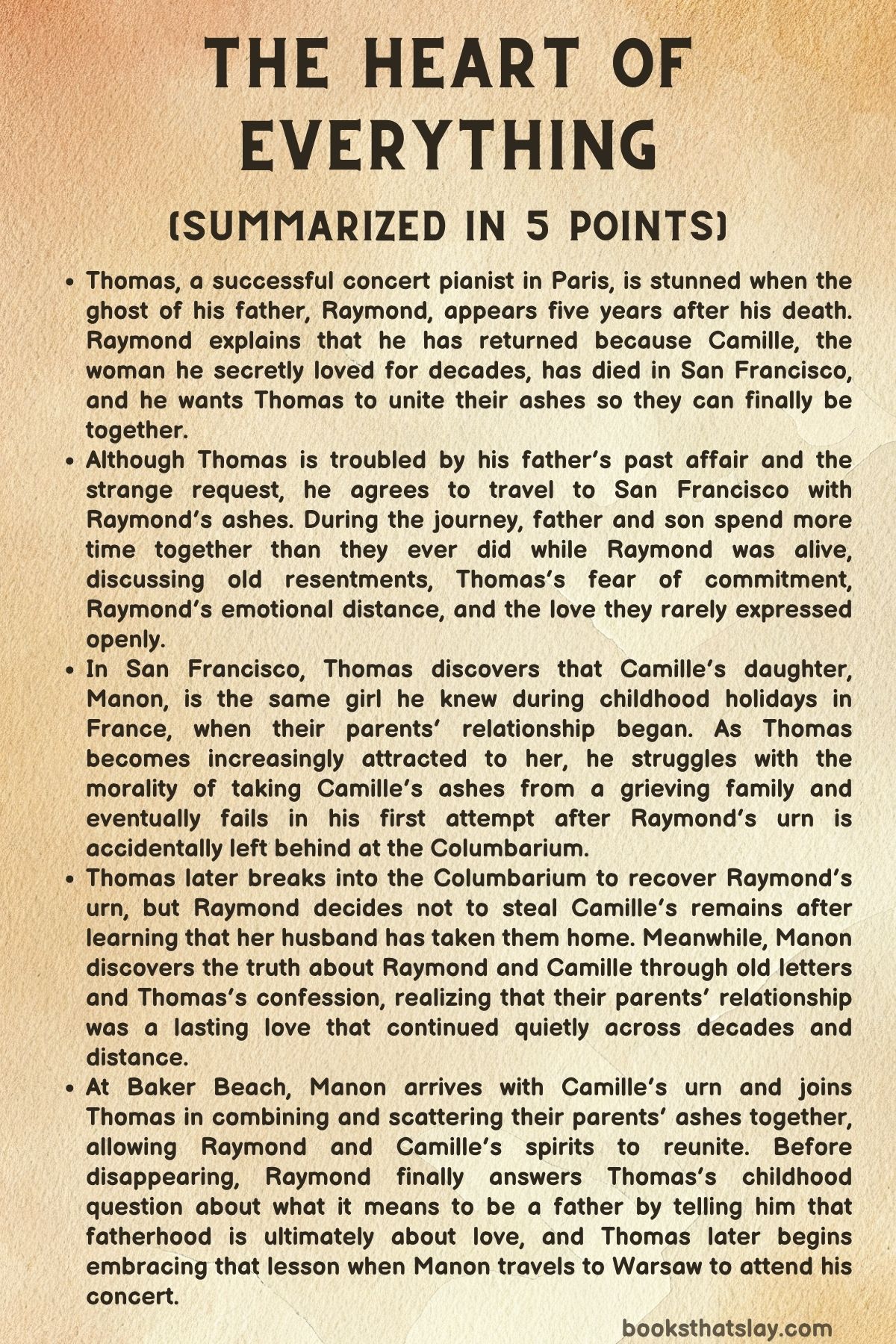
At Baker Beach, Thomas prepares to scatter Raymond’s ashes alone until Manon arrives carrying Camille’s urn. Having read everything, she chooses to honor what their parents wanted, allowing Thomas to mix the ashes before Manon scatters them together across the beach.
Camille’s spirit appears beside Raymond, finally allowing them to reunite. Before disappearing, Raymond answers the question Thomas asked him as an eight-year-old—what it means to be a father—and reduces all the failures, responsibilities, pride, fear, and sacrifice of parenthood to its essential truth: love.
Thomas then flies to Warsaw for his scheduled performance. While playing Rachmaninoff again, he deliberately loses concentration after seeing Manon sitting in the audience, showing that he is finally allowing someone else to share the life he once protected through solitude and music.
Characters
Thomas
The Heart of Everything presents Thomas as a gifted and internationally successful concert pianist whose professional confidence contrasts sharply with his emotional uncertainty. Music gives him discipline, identity, and purpose, but it also provides a convenient structure behind which he can avoid confronting loneliness, failed relationships, and unresolved feelings about his father.
His relationship with Raymond defines much of his emotional development. Thomas admired his father’s accomplishments as a surgeon but interpreted Raymond’s restraint as distance, leaving him with a sense that he had never fully earned the admiration or emotional closeness he wanted.
Thomas initially responds to Raymond’s return with fear, skepticism, and a strong desire for rational explanations. His visit to Sylvain shows how badly he wants the supernatural encounter to fit into an understandable psychological framework, yet his eventual acceptance demonstrates a willingness to trust experience rather than hide behind explanations.
The trip to San Francisco becomes a test of Thomas’s loyalty and moral judgment. He agrees to help Raymond even though the request is absurd and ethically troubling, but his response to Manon shows that he is not willing to treat other people’s grief merely as an obstacle to his father’s wishes.
His courage is also practical rather than theatrical. He saves a diabetic passenger by trusting Raymond’s medical instructions, risks legal trouble to recover his father’s urn, and ultimately tells Manon the truth even though confession could destroy her opinion of him.
By the end, Thomas has changed less in profession than in emotional orientation. Seeing Manon in Warsaw signals that he no longer intends to use his career as an excuse for remaining unreachable, making his transformation fundamentally about learning that love does not diminish independence or ambition.
Raymond
Raymond is the emotional center of The Heart of Everything, even though he enters the main story five years after his death. A celebrated surgeon, husband, father, and secret lover, he is defined by the gap between the intensity of what he feels and the limited way he expresses those feelings while alive.
His return initially appears to be motivated by Camille. He wants Thomas to travel across the world, retrieve Camille’s ashes, combine them with his own, and scatter them so that a relationship denied fulfillment in life can finally be completed in death.
Yet Raymond’s real unfinished business gradually becomes his relationship with Thomas. Their journey gives him a chance to speak about pride, regret, marriage, fatherhood, and emotional failure in ways he never managed when physical life still gave him countless opportunities.
Raymond can be demanding and manipulative, particularly when his longing for Camille leads him to minimize the moral consequences of interfering with her funeral. His schemes also provide much of the story’s humor, since the dignified former surgeon approaches breaking into funeral facilities with the seriousness of a medical operation.
At the same time, he possesses a strong capacity for care. He guides Thomas through panic, saves the diabetic passenger through his son, supports Thomas’s American musical ambitions, and eventually abandons the plan to take Camille’s ashes when he realizes the mission has failed.
His final answer about fatherhood gives his character its clearest meaning. Raymond spent much of his life treating strength, duty, and emotional restraint as parts of being a good father, only to understand after death that none of these matters without communicating love.
Jeanne
Jeanne appears at first as Thomas’s sharp-witted, independent mother, but The Heart of Everything gradually shows that she possesses a deeper understanding of Raymond’s past than either Raymond or Thomas initially acknowledges. Her humor and lack of conventional sentimentality conceal years of experience with a marriage that had emotionally ended long before Raymond physically died.
She does not romanticize Raymond after his death. Her reaction to the anniversary reflects a woman who can remember him without pretending that their marriage remained happy, and this emotional realism prevents her from becoming merely the betrayed wife in Raymond and Camille’s love story.
Her response when Thomas tries to steal Raymond’s urn is particularly revealing. Jeanne immediately understands what he is looking for, tells him where the urn is hidden, instructs him to take Camille’s letters, and calmly transfers responsibility for Raymond’s remains to their son.
This reaction implies both knowledge and acceptance. Jeanne appears to understand that Raymond carried an emotional life beyond their marriage, but rather than trying to control his memory after death, she allows Thomas to discover the truth and decide what should happen next.
She also recognizes the emotional distance that developed between Thomas and Raymond. Her suggestion that reconnecting with his father’s memory could help Thomas is ironic because Raymond is literally accompanying him, but it also shows Jeanne’s accurate understanding of what her son still needs.
Camille
Camille remains physically absent for almost the entire novel, yet her influence shapes the journey taken by both Raymond and Thomas. She is first known through Raymond’s memories and later through Manon’s recollections and the letters she wrote across many years.
Her relationship with Raymond was not simply based on excitement or rebellion. The letters reveal a woman who had devoted herself heavily to motherhood and whose encounter with Raymond restored a part of her personal identity that responsibility had pushed aside.
Camille therefore exists within a painful conflict between private desire and public obligation. She loves Raymond deeply but also understands that acting fully on that love would affect spouses and children, so the relationship continues largely through memory and correspondence after geographical separation.
Her final years add another layer of sadness because dementia gradually removes her ability to recognize even Manon. This decline makes the preservation of her letters especially important, since written language retains the inner life that illness eventually erased from daily interaction.
Camille also exercises control over the tone of her own farewell. Her request for a joyful funeral filled with music and dancing suggests that she wanted death to be associated with personality and celebration rather than only solemnity.
Her appearance beside Raymond at Baker Beach completes an emotional promise that neither of them could fulfill in life. The moment does not erase the complicated consequences of their relationship, but it confirms the sincerity and endurance of what they felt for one another.
Manon
Manon becomes one of the most important forces in The Heart of Everything because she changes Thomas’s mission from an abstract promise to a moral problem involving a real grieving person. Before meeting her, Thomas can think of Camille’s ashes mainly as the object Raymond needs; afterward, he understands that the urn represents a mother whom Manon has just lost.
Her first interactions with Thomas are marked by instinctive familiarity and attraction. Neither initially understands why the other seems recognizable, but their later discovery that they knew one another as children connects their emerging relationship to the hidden history of their parents.
Manon is compassionate but not naïve. She initially defends Thomas against accusations of grave robbery because his generous performance at Camille’s funeral does not match the image of a malicious intruder, yet she confronts him directly once she learns that he has concealed important information.
Reading Camille’s letters forces Manon to confront the difference between the mother she knew and the private woman Camille had been. Rather than rejecting that hidden identity, she accepts that her mother possessed desires, regrets, and emotional loyalties that existed beyond motherhood.
Her decision to bring Camille’s urn to Baker Beach demonstrates independence from her father and compassion toward both Raymond and Thomas. She chooses not merely to believe an impossible story but to honor a truth revealed through decades of letters and forgotten childhood memories.
Her journey to Warsaw completes the parallel between the two generations. Raymond and Camille were separated partly because ordinary life created distance between them, while Manon chooses to cross that distance and enter Thomas’s professional world rather than allowing travel to become another reason for separation.
Sophie
Sophie represents one of the clearest consequences of Thomas’s emotional avoidance. She appears backstage after his Paris performance to tell him that she has found someone else, but her departure is not presented as betrayal; instead, she makes clear that Thomas never gave their relationship enough commitment to become stable.
Her importance lies less in the duration of her role than in what she tells Thomas about himself. Sophie recognizes that his pattern of emotional retreat will continue unless he makes a conscious decision to behave differently when another opportunity for love appears.
In that sense, Sophie prepares the narrative for Manon. Her warning becomes increasingly meaningful as Raymond gives Thomas similar advice, and the ending suggests that Thomas has finally understood what Sophie had already identified in him.
Marcel
Marcel, the lighting engineer at the Salle Pleyel, is a modest but stabilizing presence in Thomas’s professional world. Before the concert, he reassures Thomas that he is ready, offering the kind of simple confidence Thomas struggles to give himself.
His role also helps establish that Thomas’s anxiety exists despite his professional success. The reassurance of someone familiar with the performance environment emphasizes that Thomas’s fear is not caused by lack of preparation but by his own demanding standards.
Sylvain later interprets Marcel symbolically as representing Thomas’s conscience. Whether or not that interpretation is correct, Marcel functions as one of the ordinary human anchors surrounding Thomas while his private reality becomes increasingly extraordinary.
Sylvain
Sylvain is a psychiatrist and longtime acquaintance whom Thomas consults when he becomes desperate to understand Raymond’s return. His importance comes from representing the rational psychological explanation Thomas hopes will restore order to his life.
He interprets Raymond as unresolved grief, Sophie as fear of commitment, the conductor as authority, and Marcel as conscience. His reading is plausible enough to comfort Thomas temporarily because each interpretation touches genuine emotional problems that exist independently of the supernatural events.
Yet Raymond’s immediate reappearance undermines Sylvain’s explanation without making it entirely meaningless. Even if the ghost is real, Sylvain correctly identifies Thomas’s dependence on approval, unresolved grief, and reluctance to trust himself, making him useful as a character who reaches accurate conclusions through an incorrect explanation.
Colette
Colette is Jeanne’s friend and part of the small circle surrounding Thomas’s family life. Her presence at Thomas’s concert beside Jeanne reinforces the warmth and companionship that Jeanne has maintained independently after the breakdown of her marriage.
She also contributes to the book’s lighter tone through the discovery of marijuana in Raymond’s old desk, which initially provides Thomas with a convenient explanation for seeing his father. Although she is not central to the later events, Colette helps establish Jeanne’s personality and the ordinary domestic setting from which the supernatural story begins.
Serge
Serge is Thomas’s friend in Paris and represents the ordinary social life Thomas temporarily leaves behind. When Thomas spends an evening listening to Serge discuss familiar relationship problems, he suddenly recognizes how extraordinary and limited his remaining time with Raymond may be.
Serge therefore functions as a measure of changed priorities. Problems that would normally absorb Thomas’s attention seem less urgent once he understands that he has been granted an impossible opportunity to speak with his dead father.
His brief role helps Thomas recognize the value of presence. The realization contributes to Thomas’s later decision to change his flight plans and remain with Raymond as long as possible.
Lauren Kline
Lauren Kline is the physician who owns the San Francisco house where Thomas rents an apartment. Her medical profession immediately appeals to Raymond and creates an amusing reminder of the career through which he once defined much of his own identity.
Lauren is lively, welcoming, and generous toward Thomas. She and Arthur lend him suitable clothing for Camille’s funeral, helping a near-stranger without requiring elaborate explanations about why his travel arrangements are so disorganized.
Her home also provides Thomas with a social environment during a journey dominated by ghosts, ashes, and unresolved family history. Through Lauren and her friends, Thomas encounters examples of people who openly discuss relationships and companionship rather than treating emotional vulnerability as something to avoid.
Arthur
Arthur is Lauren’s husband and shares her generosity toward Thomas. He lends Thomas his car so that he can explore San Francisco and later provides clothing for Camille’s funeral, making him an important practical supporter during Thomas’s stay.
More broadly, Arthur and Lauren represent an established partnership that contrasts with the failed or interrupted relationships surrounding Thomas. Their shared home and easy hospitality offer an image of domestic connection that does not require either person to surrender individuality.
Arthur’s role is deliberately understated. He demonstrates through ordinary behavior the kind of stable companionship Raymond wants Thomas to stop assuming is impossible.
Paul
Paul is a writer and one of Lauren and Arthur’s friends. His fascination with Thomas’s vague remarks about traveling with his father’s ashes and ghosts introduces an amusing self-consciousness into a story in which impossible events are actually happening.
His struggle to complete a manuscript also places him beside Thomas as another creative person whose work can dominate attention. Their conversation helps broaden the novel’s interest in the relationship between artistic activity and personal life.
Paul is not responsible for changing Thomas directly, but the evening in which he participates contributes to an atmosphere where love, work, happiness, and creativity can be discussed openly. That openness contrasts with the emotional silence that characterized much of Raymond’s relationship with Thomas.
Mia
Mia provides one of the clearest pieces of relationship advice Thomas receives outside his family. She argues that loving someone whose career involves travel does not automatically make a relationship impossible; one possible answer is simply to travel with that person.
Her observation directly challenges Thomas’s habit of treating touring as a reason why lasting intimacy cannot work. Rather than viewing logistical difficulty as proof that commitment is unrealistic, Mia treats it as a practical problem that two willing people can solve together.
The ending gives her comment additional significance when Manon travels to Warsaw. Her presence in the concert hall demonstrates precisely the type of choice Mia described: movement can become part of a relationship instead of the force that ends it.
Mr. Bartel
Mr. Bartel, Manon’s father and Camille’s husband, occupies a morally complicated position because Raymond’s great love story was also a source of pain and humiliation within his marriage. After discovering the emotional relationship, he moved his family to California, physically separating Camille and Raymond.
His anger when Camille’s urn is disturbed is therefore understandable. From his perspective, Raymond’s connection to Camille belongs to a painful history, and Thomas’s suspicious presence at the funeral appears to threaten his family even after Camille’s death.
Yet Mr. Bartel is not reduced to jealousy. During Camille’s dementia, he finds himself unable to continue visiting when she no longer recognizes him, and his later guilt reveals how grief, helplessness, and fear shaped his behavior.
His decision to remove Camille’s urn from the Columbarium comes from attachment rather than cruelty. He wants to keep her close, even though Manon eventually concludes that her mother should be released rather than permanently contained by the needs of those who survived her.
Teresa
Teresa is the longtime housekeeper in Manon’s family home and a quiet observer of the family’s grief. Her subtle guidance toward the library allows Manon to discover that her father has brought Camille’s urn home.
Her understated behavior suggests familiarity with Mr. Bartel’s emotions and with the tensions surrounding Camille’s death. Rather than confronting anyone directly, she gives Manon the opportunity to discover the truth herself.
Teresa therefore functions as a discreet facilitator. Her small action helps move Camille’s remains toward the final decision that will eventually allow Raymond and Camille to be reunited.
Detective Pilguez
Detective Pilguez enters the story after the Columbarium burglary and approaches an increasingly absurd situation with professional skepticism. The theft is unusual because the only missing object is an urn of human ashes, and the investigation gradually leads him from the funeral manager to Mr. Bartel and finally to Thomas.
He initially finds Bartel’s theory about Raymond and Camille difficult to believe, which is reasonable given the extraordinary chain of events. His investigation nevertheless becomes important because it uncovers information that Thomas himself has not yet fully explained to Manon.
By telling Manon that Thomas was the boy from her childhood summers and revealing the relationship between Raymond and Camille, Pilguez unintentionally reconnects pieces of Manon’s past. His police investigation therefore becomes a mechanism for recovering memory rather than merely enforcing the law.
The Conductor
The conductor appears mainly in connection with Thomas’s performances and represents the professional standard against which Thomas measures himself. When Raymond unexpectedly appears in the Salle Pleyel audience, Thomas misses several notes, and the conductor immediately notices the disruption.
The conductor’s later horror when Thomas misses another note in Warsaw creates a deliberate contrast. The first mistake comes from confusion and shock, while the final one comes because Thomas willingly allows his attention to move beyond music when he sees Manon.
Through that contrast, the conductor indirectly helps measure Thomas’s transformation. Professional perfection once dominated Thomas’s attention, whereas the ending shows him accepting that a meaningful life may contain moments more important than flawless execution.
Themes
Fatherhood, Emotional Restraint, and the Expression of Love
The question of what it means to be a father appears at both the beginning and end of The Heart of Everything, giving Thomas and Raymond’s relationship a circular structure. When Thomas asks the question as a child, Raymond cannot answer directly, partly because he understands fatherhood through responsibility and action rather than emotional language.
Raymond cared for Thomas through practical acts, concern for his health, attention to his future, and the example he tried to provide through his own demanding profession. Yet these actions did not always communicate what Raymond believed they communicated, because Thomas often experienced his father’s reserve as disappointment or emotional absence.
The supernatural reunion exposes the difference between loving someone and successfully making that love understood. Raymond realizes that he spent years believing authority and self-control were essential parts of fatherhood while failing to tell Thomas plainly that he admired him and was proud of the person he had become.
Thomas, meanwhile, learns that his father’s silence did not mean indifference. Their journey gives both men the opportunity to reinterpret memories that once seemed evidence of distance.
The final answer on Baker Beach strips away the complicated expectations Raymond attached to being a father. His conclusion that fatherhood is ultimately love does not dismiss responsibility or sacrifice; instead, it establishes that those qualities have their fullest value only when the child is allowed to recognize the affection beneath them.
Grief, Memory, and Second Chances
Grief in the story is not presented simply as sadness after death. Thomas has continued functioning successfully for five years after Raymond’s death, yet his father’s return reveals how much remained unfinished because death ended the relationship before either man had spoken openly.
Raymond’s supernatural presence turns memory into something temporarily active. Instead of merely remembering conversations from childhood, Thomas can challenge his father’s decisions, ask questions, express resentment, and discover that many of his assumptions about Raymond were incomplete.
Camille’s letters perform a similar function for Manon. Dementia erased much of Camille’s ability to communicate before death, but her correspondence preserves a version of herself that her daughter never fully knew: a woman capable of intense romantic desire, conflict, regret, and a private emotional life beyond motherhood.
The second chances offered by the story are therefore not attempts to reverse death. Raymond cannot remain with Thomas, Camille cannot reclaim the years she lost with Raymond, and neither family can rewrite the past.
What changes is the meaning assigned to what already happened. Thomas finally receives the goodbye he was denied, Manon gains a fuller understanding of her mother, and Raymond can say the words he once assumed were unnecessary.
The story suggests that closure is less about removing grief than about transforming incomplete memory into understanding. Loss remains permanent, but the emotional relationship with the dead can change when hidden truths are finally faced.
Love, Timing, and the Choices People Fail to Make
Romantic love in The Heart of Everything repeatedly exists in tension with timing, responsibility, and fear. Raymond and Camille find each other when both already belong to established family lives, creating a relationship that is emotionally powerful but extremely difficult to live without harming other people.
Their eventual separation does not destroy their attachment. Twenty years of secret letters show how a love can survive distance while also demonstrating the enormous cost of a relationship that exists mainly in memory rather than daily life.
Thomas risks reproducing a different version of the same failure. His problem is not that circumstances forbid intimacy but that he repeatedly allows work, touring, and fear of commitment to become reasons for avoiding it.
Sophie recognizes this before Thomas does, while Raymond repeatedly warns him that a career should not become protection against emotional vulnerability. Mia later expresses the issue in practical terms when she suggests that people can adapt to travel rather than treating distance as proof that relationships cannot work.
Manon’s journey to Warsaw becomes the alternative to Raymond and Camille’s long separation. Instead of allowing Thomas’s profession to create immediate distance, she enters his world and shows that connection can survive movement when both people actively choose it.
Love in the novel is therefore not presented as sufficient by itself. Feeling must be accompanied by decisions, courage, communication, and a willingness to reorganize life around another person.
Identity Beyond Family Roles
Several characters must recognize that the people closest to them possessed identities beyond the roles through which they were usually known. Thomas sees Raymond primarily as his father and as an accomplished surgeon, but the journey reveals a man with private regrets, romantic desires, unrealized dreams, professional pride, fear, humor, and emotional weakness.
Raymond similarly discovers that Thomas is no longer simply the child he once guided. His son has become an independent artist capable of courage, moral judgment, compassion, and decisions Raymond cannot control.
Manon undergoes an even more dramatic reassessment of Camille. For most of her life, Camille exists primarily in the role of mother, particularly during the painful period in which dementia gradually destroys recognition and ordinary communication.
The letters reveal a younger and more private Camille who experienced motherhood as only one part of herself. Loving Raymond awakened desires she had pushed aside, and acknowledging that history requires Manon to accept that parents possess inner lives their children may never completely know.
Jeanne also resists a narrow role. She is not simply the abandoned wife but a perceptive woman who appears to understand more about Raymond’s relationship with Camille than Thomas expects and chooses not to control Raymond’s memory after his death.
The story ultimately treats maturity as the ability to see loved ones as complete individuals rather than fixed family identities. Thomas and Manon both become more capable of understanding their parents once they recognize that being a father or mother was only one part of lives filled with contradictions, mistakes, desires, duties, and choices.