The Hard Line Summary, Characters and Themes
The Hard Line (Gray Man #15) by Mark Greaney is an espionage thriller centered on Court Gentry, the highly skilled operative known as the Gray Man, but its conflict becomes intensely personal when an old assassin enters his life seeking revenge.
Alongside that private battle, the novel follows a major conspiracy involving compromised American intelligence, hired killers, political ambition, and Chinese intelligence operations. The story repeatedly examines the consequences of violence across generations, particularly through Court, Campbell Coyle, Zack Hightower, and their families. What begins with a deadly encounter in Bulgaria eventually develops into a much larger struggle involving betrayal, assassination, family loyalty, and the dangerous cost of living by violence.
Summary
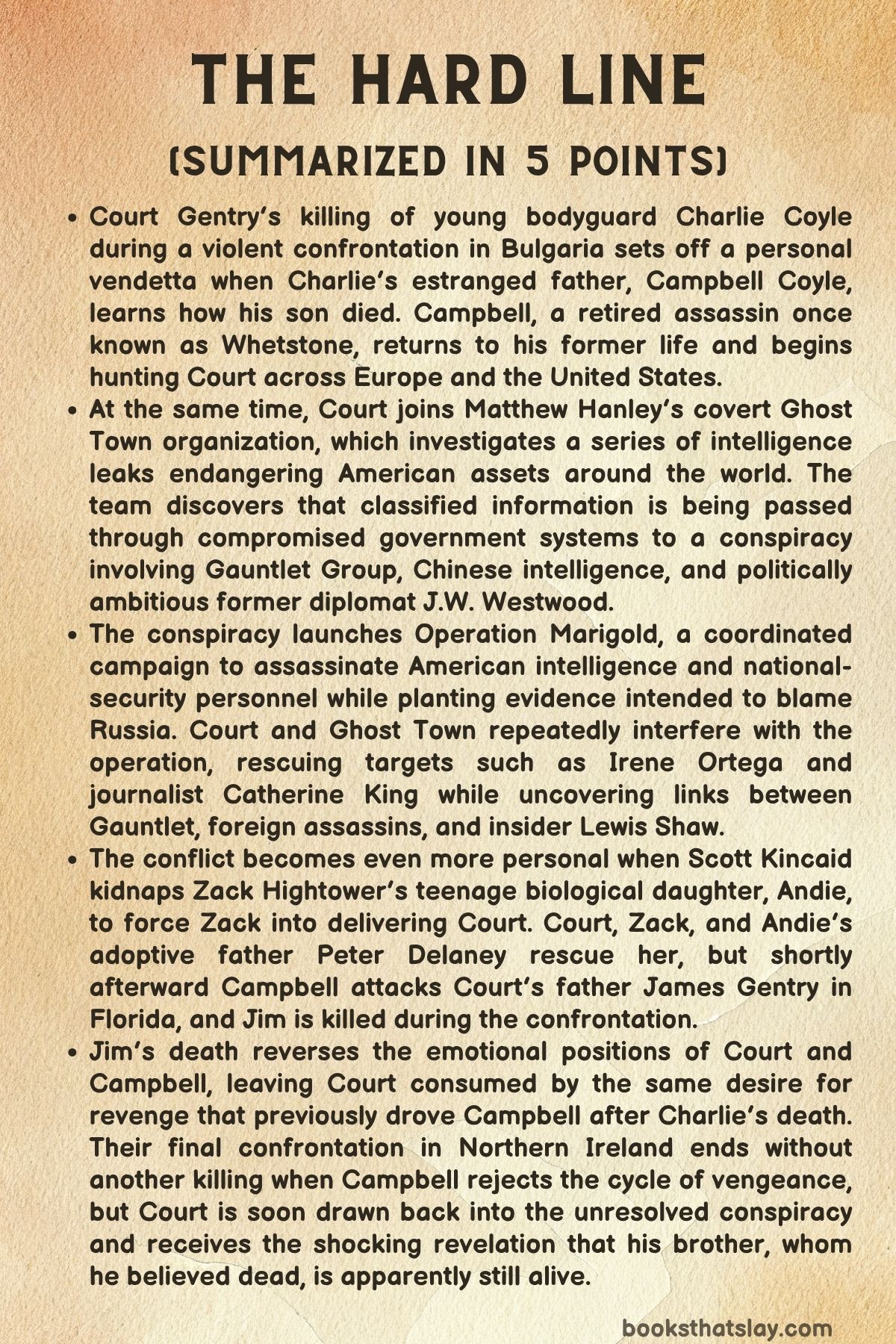
Charlie Coyle is a twenty-four-year-old Northern Irishman working as a bodyguard for Bulgarian criminal Sasho Minchev in Varna. He dislikes the work and wants to return to his wife Deirdre and their infant son Ronan, but financial problems and a determination to finish his contract keep him in Bulgaria.
Charlie has also been fighting alcoholism and hopes the job will help him stabilize his life. During a video call with Deirdre, trouble develops downstairs when Minchev confronts an American visitor, forcing Charlie to leave his family call and respond.
The American is Court Gentry, the Gray Man, who has approached Minchev because he needs assistance entering Russia. Minchev instead seizes Court’s phone, identifies him, threatens to circulate his photograph among criminal contacts, and orders his men to cripple him.
Court escapes captivity and fights his way through the hotel. Charlie locks Minchev inside a suite and tries to protect him, but Court reaches the room after killing or disabling several guards.
Charlie shoots Court, but Court’s body armor saves him. During their brutal fight, Court stabs Charlie deeply in the chest with a concealed wrist blade before killing Minchev, recovering his phone, and escaping.
Charlie survives for eight days but dies after infection and inadequate treatment. Deirdre travels to County Armagh to tell Charlie’s estranged father, who has been living quietly under the name Jon Jo Sheehan.
Jon Jo is actually Campbell Coyle, a former assassin once known as Whetstone. His father Rory had been connected to the IRA, and Campbell later entered the French Foreign Legion before becoming an exceptionally effective contract killer.
Campbell abandoned violence years earlier, but Charlie’s death destroys his retirement. He retrieves hidden weapons, ammunition, equipment, and money, deciding that he will find and kill the man responsible for his son’s death.
At the same time, a much larger conspiracy is developing in the United States. Former congressman and ambassador J.W. Westwood III has been receiving classified intelligence from Lewis Shaw, an IT systems analyst inside the Office of the Director of National Intelligence.
Shaw secretly accesses restricted material and passes it to Westwood, who forwards it to Chinese intelligence. Westwood convinces himself that creating American national-security failures will ultimately strengthen his political career and give him the power he believes he deserves.
Court, meanwhile, returns from a dangerous mission in Russia and reconnects with CIA veteran Matthew Hanley. Hanley is building an unofficial intelligence organization known as Ghost Town, supported through corporate fronts, aircraft, vehicles, weapons, surveillance systems, false identities, and covert facilities.
Hanley gives Court a new assignment involving a CIA asset in Nicaragua known as Caprice. Her identity appears to have been compromised, and Court is sent outside conventional CIA channels to extract her.
The extraction turns into a firefight when local forces and members of the Renazco organization attack. Court discovers something even more disturbing when Chinese operatives appear at the scene, proving that highly restricted American intelligence has reached a foreign service.
Court saves Caprice, but the incident confirms that a serious breach exists somewhere inside the American intelligence system. Hanley begins investigating secretly because normal government channels themselves may be compromised.
Campbell travels to London and confronts Marcus Maragos, the security consultant who arranged Charlie’s work. After learning that Maragos knowingly placed the struggling young man with dangerous criminals, Campbell kills him and begins following leads that connect Charlie’s mysterious American killer to Court Gentry.
Former British intelligence figures Sir Allen Glazebrook and Bill Tully identify the man as the Gray Man and connect him to Hanley. Campbell also learns that American contractors are recruiting elite assassins for exceptionally lucrative work in the United States.
That recruitment is connected to Operation Marigold. Westwood, Chinese intelligence officer Gracie Wu, and Gauntlet Group executive Michael Scardino are organizing coordinated assassinations of American national-security personnel.
Their plan is to kill more than twenty targets, make the deaths appear to be the work of Russian operatives, and then have Gauntlet eliminate supposed Russian perpetrators. The manufactured crisis would damage American institutions, benefit Chinese interests, strengthen Gauntlet, and create political opportunities for Westwood.
Campbell accepts employment from Scardino, but his true purpose is gaining access to information that can lead him to Court. He begins carrying out Marigold killings while continuing his private search for his son’s killer.
Ghost Town, meanwhile, investigates Irene Ortega, an ODNI employee whose credentials were apparently used to access information concerning the Nicaragua operation. Court, Zack Hightower, Chris Travers, Arnold Reyes, Jill Mori, and the rest of the team begin covert surveillance.
Ortega behaves like someone trained to detect surveillance, making her appear suspicious. However, Ghost Town gradually realizes that she may herself be under observation.
At the Hirshhorn Museum, Ortega meets Lewis Shaw. Court and his colleagues identify signs of another professional surveillance team around them, while an unidentified operative using sophisticated disguise techniques appears nearby.
The evidence causes Hanley to suspect that Ortega’s credentials may have been stolen or misused rather than deliberately employed by her. Shaw consequently becomes the stronger suspect.
The conspiracy then moves to eliminate Ortega before she can expose what has happened. Belarusian assassin Alexi Kravchuk, known as Deep Space, enters the United States with Gauntlet assistance and prepares to kill her.
As multiple American intelligence officials are murdered elsewhere, Ghost Town observes Gauntlet personnel surrounding Ortega’s residence. Court realizes that surveillance has turned into an assassination attempt.
Zack and Travers confront Gauntlet teams outside while Court enters Ortega’s apartment through a dangerous exterior approach from an adjacent building. He reaches her seconds before Deep Space can complete the assassination and kills the contract killer.
Travers is badly wounded during the street fighting, while Zack kills the men opposing him. Ortega survives and is evacuated aboard Ghost Town’s aircraft.
During questioning, Ortega explains that she discovered irregularities involving her credentials and was investigating Shaw herself. Her meeting at the museum was part of that effort, and her unusual travel route was designed to determine whether she was being followed.
Ghost Town now has increasingly strong evidence connecting Shaw, Gauntlet, and the foreign assassins. Campbell, however, introduces another threat by breaking into Hanley’s highly protected home.
Campbell contacts Court directly and reveals that Charlie was his son. Court finally understands that the Bulgarian bodyguard he barely remembered has become the reason one of Europe’s deadliest retired assassins is hunting him.
Court argues that Charlie participated knowingly in an armed confrontation and shot him first. Campbell understands the tactical explanation but cannot emotionally accept that his son’s death should simply be treated as an occupational consequence.
Their conflict becomes a mirror between two men who understand violence professionally but interpret it differently when family is involved.
Journalist Catherine King later provides Ghost Town with another important lead. A former Gauntlet pilot, David Rudder, had planned to tell her about suspicious company flights used to transport foreigners into the United States outside ordinary controls.
Rudder dies before their meeting, but Catherine reveals enough for Court to connect one flight to Deep Space. Gauntlet therefore appears to have directly imported and supported foreign killers.
An assassin named Asem Shaban, known as Snare, attacks Catherine before Court can safely remove her from Georgetown. Court protects her during a running battle, and CIA officer Jim Pace intervenes by striking Snare with his vehicle.
The conspiracy now realizes that Ghost Town is becoming dangerously close to exposing Marigold. Westwood, Scardino, and their partners use Shaw’s access to investigate Hanley’s organization and uncover personal information about its members.
One of their discoveries concerns Zack Hightower. Zack has secretly watched his biological daughter, fifteen-year-old Andrea “Andie” Delaney, from a distance because he believes staying outside her life protects her from his violent profession.
Scott Kincaid, known as Lancer, has been released from Cuban imprisonment by Gauntlet to participate in Marigold. Because he hates Court, he uses information about Zack to find Andie and turn her into leverage.
Kincaid’s men first ambush Zack at an MRI facility, where Zack survives by improvising with the magnetic environment and medical equipment. Kincaid then tells him that Andie will be exchanged for Court.
Andie is kidnapped from a mountain resort after trying to escape on her snowboard. Zack joins Peter Delaney, the man who has raised her, and is forced to admit that he is Andie’s biological father.
Court arrives and works with Zack and Pete to rescue her from Kincaid’s cabin. Andie herself fiercely resists her captors before Court eventually reaches her during the assault.
Zack battles Kincaid outside the cabin and kills him after a savage fight. Andie survives, but Pete tells Zack that he wants him out of their lives, reinforcing Zack’s fear that his presence brings danger to the daughter he loves.
Court then realizes his own family may be targeted and flies to Florida to protect his father, James Gentry. Jim is elderly but still highly capable, having spent much of his life teaching firearms and tactical skills.
Campbell arrives with armed Irish-American supporters supplied through Gerry Kearney. Court and Jim retreat into an old firearms training structure that both know extremely well.
A violent battle follows during a severe storm. Court and his father use the building’s confusing corridors, catwalks, rooms, and deteriorating structures to overcome Campbell’s numerical advantage.
Court finally comes face-to-face with Campbell on an elevated catwalk. Before they can finish their duel, a weakened section collapses, sending parts of the structure crashing down.
Campbell survives beneath the wreckage and later sees Jim. Campbell tells him to stop because he does not intend to kill Court’s father, but Jim raises his revolver.
Jim’s weapon lands on an empty chamber. Campbell fires instinctively and shoots him through the heart.
Court discovers his father dead after Campbell escapes. Campbell later apologizes and insists the killing was unintended self-defense, but Court now responds exactly as Campbell did after Charlie’s death: explanations no longer matter.
Court vows to kill Campbell. Their positions have reversed, with both men convinced that the other’s understandable actions cannot outweigh the death of a father or son.
The Marigold conspiracy continues manipulating events. Scardino reveals that Gauntlet itself killed Shaw once he became a liability, while Gracie and Westwood consider assassinating Senator Paula Kerr so that Westwood might gain an opportunity to enter the Senate.
Ghost Town also suffers political interference when Trey Watkins orders Hanley’s investigation shut down. Because only a few senior officials could have accessed personal information about Court and Zack, suspicion begins moving toward highly placed government figures.
Consumed by his father’s death, Court travels to Northern Ireland despite Hanley’s desire for him to remain focused on Marigold. He first meets Deirdre and admits that he was the man who killed Charlie.
Deirdre refuses to accept the revenge logic of either Court or Campbell. She intends to raise Ronan under her own family name and separate the child from the Coyle tradition of violence.
Court eventually finds Campbell near the Coyle family graves in Ballycastle. Campbell says he no longer blames Court for Charlie because he finally recognizes that his own pursuit of revenge helped extend the same destructive cycle he thought he was avenging.
He offers Court the opportunity to return later and fight if Court still requires vengeance. Court remains angry over Jim’s death but begins questioning whether killing Campbell will accomplish anything.
Before the confrontation can resume, Court receives urgent news from Washington. Hanley and Watkins have been attacked; Hanley survives badly injured, but Watkins is killed, weakening the suspicion that Watkins was the senior conspirator.
Court abandons his confrontation with Campbell and returns to the United States. During the flight, Angela Lacy tells him about James Gentry’s funeral, where surveillance footage captured an unidentified man watching from a distance.
Court sees the image and immediately recognizes the figure. The mysterious attendee is Court’s brother, whom Court believed to be dead, leaving him with a final revelation while Marigold and its hidden architects remain unresolved.
Characters
Courtland Gentry
Court Gentry is the central operative of The Hard Line, a man whose extraordinary tactical abilities are matched by an increasingly complicated understanding of the consequences of his profession. He begins the story behaving according to the survival logic that has governed most of his adult life: when Minchev threatens his identity and orders his men to cripple him, Court treats everyone standing between him and escape as a legitimate operational obstacle.
Charlie’s later death initially means little to Court because Charlie was only one armed opponent among many. Campbell’s arrival forces him to confront the uncomfortable truth that people killed during operations continue to exist in the memories and families of those left behind.
Court never accepts that killing Charlie was tactically unnecessary, and the circumstances strongly support his position. Charlie shot him while protecting a violent criminal, leaving Court in a close-range fight where hesitation could have meant death.
What changes is Court’s emotional understanding of Campbell after James Gentry is killed. The rational explanations Court offered about Charlie suddenly become intolerable when applied to his own father, revealing how difficult it is to maintain detached professional morality once personal grief enters the equation.
Court’s role in Ghost Town shows another side of his development. Although he is naturally solitary, he increasingly functions as part of a team, protecting Ortega, Catherine King, Andie, Hanley, Zack, and others rather than operating only for a narrowly defined objective.
His decision not to immediately kill Campbell in Northern Ireland is particularly important. Court reaches the point where revenge is available to him but begins to understand that following Campbell’s path would reproduce the same chain of retaliation that destroyed both families.
Campbell Coyle
Campbell Coyle is both antagonist and tragic counterpart to Court, and his position in The Hard Line prevents him from being reduced to a conventional villain. Once known as Whetstone, Campbell has spent decades trying to bury the assassin he became after growing up around political violence, family death, military service, manipulation, and covert killing.
His quiet identity as Jon Jo Sheehan represents a genuine attempt to escape that past. Charlie’s death destroys that constructed peace because Campbell interprets his son’s killing not as an unfortunate occupational consequence but as a personal debt that only the killer’s death can settle.
Campbell’s tragedy lies partly in the distance between himself and Charlie before Charlie dies. Deirdre’s visit reveals that Campbell barely knew the life his son had built, had never met Ronan, and had already become associated in Deirdre’s mind with the destructive inheritance she wants her child to avoid.
His pursuit of Court is therefore driven by grief, guilt, and an attempt to recover paternal responsibility too late. By avenging Charlie, Campbell can imagine himself finally acting as the father he failed to be while Charlie was alive.
His methods reveal that Whetstone remains exceptionally dangerous. He infiltrates protected homes, manipulates security systems, pressures intelligence veterans, recruits criminal manpower, accepts assassination contracts, and repeatedly demonstrates the patience and tactical awareness of a professional who has survived far longer than most killers.
Yet Campbell gradually becomes aware that his employers are manipulating him and that his revenge is recreating the same conditions that shaped his own violent life. Jim Gentry’s accidental death becomes the decisive moral shock because Campbell suddenly occupies Court’s position: he has killed someone’s father while insisting the circumstances should matter.
By the cemetery confrontation, Campbell has abandoned the certainty that began his quest. His willingness to walk away does not erase the deaths he caused, but it shows that he has finally recognized revenge as a self-perpetuating obligation rather than a form of justice.
Charlie Coyle
Charlie Coyle dies near the beginning of the novel, but his influence extends through nearly every stage of the story. He is important precisely because he is not presented merely as a faceless bodyguard killed by the hero.
Charlie is a young husband and father struggling with debt, alcoholism, unstable employment, and the desire to rebuild his life. He dislikes working for Minchev but remains because he has promised to finish his contract and believes earning money is part of repairing his responsibilities toward Deirdre and Ronan.
His moral weakness is his willingness to work for violent criminals despite recognizing what they are. That choice places him inside Minchev’s criminal world and eventually positions him between Court and survival.
At the same time, Charlie’s love for Deirdre and Ronan prevents his death from feeling morally simple. The book uses him to demonstrate how people involved in dangerous professions can simultaneously be compromised participants in violence and deeply important members of ordinary families.
Charlie’s greatest narrative importance comes after his death. Campbell sees only the son who died, while Court initially remembers only the armed man who shot him, and the conflict between those two perspectives drives the personal war.
Matthew Hanley
Matthew Hanley is the architect and strategic center of Ghost Town. He understands that conventional intelligence institutions have become vulnerable to leaks and therefore creates an organization that can operate outside normal structures while still serving American interests.
Hanley is pragmatic, secretive, and comfortable with legal and bureaucratic ambiguity. He knows that Court and Zack are dangerous men, but he also understands how to direct their abilities toward problems that ordinary officers cannot handle.
His leadership style combines command with loyalty. When Court kills Chinese attackers during the Nicaragua extraction, Hanley defends him because he recognizes that Court was saving an American asset rather than manufacturing an international incident.
Hanley’s growing attachment to Ghost Town gives the organization an unusual character. It becomes more than a temporary collection of contractors because Hanley builds infrastructure, identities, aviation resources, logistics, analysis, and personal trust around the team.
His near-fatal attack near the end shows how dangerous the conspiracy has become. By then Hanley has moved from investigating national-security compromises to becoming one of the people the conspirators must physically eliminate.
Zack Hightower
Zack Hightower combines physical toughness, aggression, humor, and a deeply hidden paternal vulnerability. In The Hard Line, his relationship with Andie reveals that beneath his professional identity is a man who has sacrificed ordinary family life because he believes distance is the only reliable way to protect his daughter.
Zack watches Andie from afar rather than introducing himself as her biological father. His visits to her café allow him small glimpses of her life, but he refuses to claim a place in it because he knows the enemies attached to his profession could eventually discover her.
That fear becomes reality when Kincaid identifies Andie as leverage. Zack’s anguish comes from realizing that the sacrifice he made by staying away did not ultimately protect her.
His performance during the MRI attack illustrates his defining professional quality: adaptation under extreme pressure. Even wounded and deprived of his normal weapons, he turns the medical environment itself against trained attackers.
The cabin rescue exposes Zack’s emotional limits more clearly. Kincaid’s willingness to threaten Andie transforms the confrontation from professional combat into something personal, and Zack kills him with fury after the rescue.
Pete’s rejection of Zack afterward is painful because it confirms Zack’s belief that his presence can damage Andie’s life. His love for his daughter therefore remains defined by absence, responsibility, and the painful acceptance that protecting someone may mean surrendering the relationship one wants with them.
Andrea “Andie” Delaney
Andie is far more than a passive kidnapping victim. She is independent, observant, physically capable, and quick to recognize danger even though she has no knowledge of the covert world surrounding Zack.
Her snowboarding ability becomes a practical survival tool when she attempts to escape the men pursuing her. Once captured, she continues assessing her surroundings and attacks a guard with whatever object she can obtain.
Her actions establish that courage exists in the story outside the professional intelligence world. Andie does not have Court’s or Zack’s training, yet she repeatedly refuses to surrender psychologically to armed adults.
She also represents the innocent future Zack is desperate to keep separate from his past. The conspiracy’s decision to target her shows how intelligence compromises become morally worse when secret information about operatives is converted into threats against people who never chose their dangerous lives.
J.W. Westwood III
J.W. Westwood III represents ambition stripped of meaningful ethical boundaries. He is educated, politically experienced, socially respected, and capable of presenting himself as a serious figure concerned with America’s future.
His private actions reveal something very different. Westwood knowingly participates in the transfer of classified information to Chinese intelligence and supports an assassination program intended to destabilize his own country’s institutions.
His most dangerous characteristic is his ability to rationalize betrayal. He does not think of himself as someone who has simply sold his country; instead, he imagines that present damage is acceptable because future political power will allow him to reshape America according to his vision.
That self-justification allows personal ambition to masquerade as national purpose. His willingness to consider Senator Paula Kerr’s death because it could create a Senate opportunity demonstrates that whatever larger political philosophy he claims to possess has ultimately become inseparable from his desire for advancement.
Gracie Wu
Gao Yuanyuan, known as Gracie Wu, is the Chinese intelligence officer who provides the foreign strategic direction behind Marigold. Unlike Westwood, she does not need elaborate personal justifications because she understands clearly that the operation is intended to damage American institutions and benefit China.
Gracie treats human beings as assets, liabilities, or opportunities. Westwood is useful because his ambition can be cultivated, while assassins and compromised officials are useful only as long as they serve the larger operation.
Her calm strategic perspective gives the conspiracy continuity even when individual killings fail. The death of Deep Space, Ortega’s survival, and Ghost Town’s investigation are serious complications, but Gracie responds by adjusting targets and political objectives rather than panicking.
She therefore represents institutional patience rather than personal rage. Where Campbell kills for family and Westwood conspires for ambition, Gracie acts according to the strategic interests of the intelligence service she represents.
Michael “Big Mike” Scardino
Scardino serves as the operational bridge between political conspiracy, foreign intelligence, Gauntlet Group, and hired assassins. He recruits killers, arranges logistics, distributes targets, and helps turn classified information into physical violence.
His work demonstrates why Gauntlet is so dangerous. The company possesses enough access, infrastructure, aviation capacity, personnel, and government relationships to support assassinations while appearing to be a legitimate national-security contractor.
Scardino has few illusions about the nature of his work. He understands that people such as Campbell, Kincaid, Deep Space, and Snare are tools whose motivations can be exploited.
His mistake is assuming that professional killers remain controllable once their private motives become stronger than financial incentives. Campbell’s obsession with Court and Kincaid’s personal hatred of the Gray Man both create complications that expose the limits of Scardino’s transactional worldview.
Lewis Shaw
Lewis Shaw is the technical enabler of the conspiracy. His position inside the Office of the Director of National Intelligence gives him access to information whose compromise places American assets and officers in immediate danger.
Rather than stealing information crudely, Shaw abuses legitimate system access and hides his activity inside government networks. His misuse of Ortega’s credentials demonstrates how insider threats can manipulate institutional trust from within.
Shaw is also expendable. Once Ortega survives and Ghost Town begins connecting him to the leaks, Gauntlet kills him and attempts to manipulate the circumstances around his death.
His fate reveals one of the defining truths of the conspiracy: loyalty exists only upward. The people organizing Marigold expect obedience from their assets but feel no obligation to protect those assets once they become inconvenient.
Irene Ortega
Irene Ortega begins as a suspect because her credentials were used to access compromised intelligence. Her behavior appears to strengthen that suspicion because she uses techniques associated with surveillance detection.
The investigation gradually reveals the opposite truth. Ortega has recognized irregularities in her own access records and begun privately searching for the person responsible, eventually focusing on Lewis Shaw.
Her caution is therefore evidence of intelligence rather than guilt. She understands that using normal reporting channels could alert the same people who misused her credentials, so she attempts to investigate without revealing what she knows.
Her survival is crucial because she becomes a living contradiction of the conspirators’ manufactured narrative. Once Deep Space is sent to kill her, the assassination attempt itself confirms that she possesses information someone desperately wants suppressed.
Scott Kincaid
Scott Kincaid, known as Lancer, is a professional killer whose involvement becomes intensely personal because of his hatred of Court. Gauntlet secures his release from Cuban imprisonment and offers him work, but Kincaid immediately asks for information that will help him settle his own score.
His kidnapping of Andie demonstrates his willingness to attack emotional vulnerabilities rather than simply confront professional opponents directly. He understands that Zack’s daughter can be used to force Zack into betraying Court.
Kincaid therefore represents violence without Campbell’s remaining moral restraint. Campbell’s revenge at least originates in grief for his son, whereas Kincaid comfortably threatens an innocent teenager for leverage.
His death at Zack’s hands is the direct consequence of that decision. By bringing Andie into the conflict, he ensures that Zack will treat their confrontation not as another mission but as an existential threat to his child.
James Gentry
James Gentry is central to the emotional reversal that gives The Hard Line much of its moral weight. He is Court’s father, a highly experienced firearms instructor whose age has reduced his physical capacity without removing his awareness, courage, or tactical intelligence.
Jim’s relationship with Court is shaped by shared knowledge of weapons and danger. Their reunion in Florida contains familiarity and humor, but both men immediately understand the seriousness of Campbell’s threat.
During the shoot-house battle, Jim proves that experience can compensate for age. He and Court use their intimate knowledge of the old training structure to survive against a larger attacking force.
His death changes Court fundamentally because it removes the emotional distance from which Court had judged Campbell. When Campbell later describes Jim’s death as an unintended act of self-defense, Court discovers that logical explanations provide almost no comfort when the dead man is his own father.
Deirdre Coyle
Deirdre is one of the story’s clearest voices against inherited violence. She loves Charlie but refuses to romanticize the choices that placed him in criminal environments, and she openly blames both Marcus Maragos and Campbell for contributing to the conditions surrounding his death.
Her determination to protect Ronan becomes her defining motivation. She refuses Campbell’s money and intends to raise the child outside the identity and expectations attached to the Coyle family.
When Court later approaches her, Deirdre is capable of acknowledging her anger without surrendering to Campbell’s logic of revenge. She understands that Court, Campbell, and Charlie all belong to a world in which violence repeatedly creates reasons for further violence.
Her decision that Ronan will carry the McDermott name is therefore symbolic as well as practical. She is attempting to end a family inheritance that previous generations accepted as inevitable.
Peter Delaney
Peter Delaney is Andie’s real father in the emotional and practical sense, regardless of biology. He has raised her, protected her, and built the stable family life Zack deliberately chose not to enter.
Learning that Zack is Andie’s biological father creates understandable anger because the revelation arrives only after Zack’s dangerous world has placed her in the hands of kidnappers. Pete therefore sees Zack less as a tragic protector than as the source of a threat his family never agreed to accept.
Even so, Pete controls that anger long enough to participate rationally in the rescue. His emergency-services background allows him to contribute practical knowledge rather than remaining a helpless civilian.
His demand that Zack stay away after Andie’s rescue is harsh but consistent with his responsibility as her father. Pete’s priority is not resolving Zack’s emotional conflict; it is restoring safety and stability to the daughter he has actually raised.
Catherine King
Catherine King represents the investigative power of journalism within a story dominated by intelligence agencies and covert operators. Her work on Gauntlet puts her in danger because she approaches secrets from outside the institutions that normally control classified information.
David Rudder’s attempt to contact her demonstrates that sources trust her enough to bring evidence of misconduct. Even after Rudder dies, the information he intended to provide allows Catherine to help connect Gauntlet with the covert transportation of foreign assassins.
Her presence also reminds Court that information itself can be as dangerous as weapons. Catherine does not need to carry a gun to threaten Marigold; simply possessing the correct facts makes her important enough to assassinate.
Jim Pace
Jim Pace begins as a conventional CIA officer assigned to quietly assist the investigation, but he repeatedly demonstrates that he is prepared to act decisively when circumstances demand it. His intervention during the Georgetown attack saves Court from Snare at the moment when the assassin has nearly secured a lethal advantage.
Pace therefore becomes a useful contrast with the corrupt insiders surrounding Marigold. He represents the possibility that institutions compromised by traitors still contain individuals willing to risk themselves to defend colleagues and uncover the truth.
His removal from active participation when Watkins shuts down the investigation raises further suspicions about the chain of command. Pace’s usefulness makes his forced exclusion appear particularly dangerous because it weakens the group precisely when the conspiracy is becoming more aggressive.
Angela Lacy
Angela Lacy operates as an important connection between Ghost Town and the remaining legitimate parts of the intelligence establishment. She assists Hanley while trying to navigate the political and bureaucratic dangers surrounding an investigation that cannot safely operate through normal channels.
Lacy is valuable because she recognizes evidence even when official narratives point elsewhere. As Gauntlet and its allies attempt to construct a Russian explanation for the assassinations, she remains connected to the people who have directly witnessed contradictory facts.
Her conversation with Court in the epilogue reinforces her continuing role after Hanley’s injuries and Watkins’s death. She becomes one of the people holding together the remaining intelligence picture while the conspiracy is still unresolved.
Chris Travers
Chris Travers is a former CIA paramilitary officer whose integration into Ghost Town gives Hanley another experienced field operator. He works effectively beside Court and Zack without requiring the independence or personal attention that surrounds the two better-known operatives.
His serious neck wound during the battle around Ortega’s residence shows the physical price paid by Ghost Town’s personnel. Travers continues functioning despite the injury long enough to contribute to the team’s survival.
His character helps establish Ghost Town as a genuine operational unit rather than simply an extension of Court. The risks are distributed across professionals who trust one another enough to act independently while still supporting a shared mission.
Arnold Reyes
Arnold Reyes serves as Ghost Town’s logistics specialist, but the Ortega operation shows that his usefulness extends beyond supply and administration. He enters the Hirshhorn carrying recording equipment because his appearance makes him less conspicuous than the team’s more visibly dangerous field operators.
The assignment also places him in an uncomfortable situation because the recording glasses interfere with his normal vision. His willingness to operate despite that disadvantage reflects the flexibility Ghost Town requires from every member.
Arnold later provides emergency assistance when Travers is wounded. His role shows that successful covert operations depend not only on elite shooters but also on personnel capable of adapting across surveillance, logistics, medical emergencies, and transportation.
Jill Mori
Jill Mori is the analytical and technical intelligence center supporting Ghost Town’s field personnel. Her monitoring of cameras, video feeds, identities, vehicles, and movements allows Court and the others to act with information that would otherwise be unavailable.
Her identification of the disguised assassin moving toward Ortega is especially important. Court’s physical ability can save Ortega only because Jill helps create the information picture that tells him where and when to intervene.
She represents the less visible side of modern intelligence work. The novel repeatedly demonstrates that field skill without technical support is insufficient against an enemy using databases, surveillance systems, corporate resources, and stolen government access.
Trey Watkins
Trey Watkins occupies an ambiguous position for much of the story because he both supports Ghost Town and later orders the Marigold investigation terminated. His senior position makes him one of the relatively few people who might possess access to the sensitive information used against Court and Zack.
That ambiguity causes suspicion to move toward him when the conspiracy begins exposing personal identities. His decision to shut down Hanley’s work appears especially troubling because Ghost Town has already accumulated strong evidence against Gauntlet.
Watkins’s death ultimately complicates that theory. His murder suggests that he was more likely another target than the senior traitor, leaving Court and the surviving investigators with an even more dangerous uncertainty about who above them remains compromised.
Marcus Maragos
Marcus Maragos represents the exploitative side of private security contracting. He knows Charlie has struggled with alcoholism, dismissals, and professional instability, yet continues placing him with criminals because Charlie needs work and Maragos benefits from arranging it.
Campbell’s anger toward him therefore has an understandable foundation even though the murder is unjustifiable. Maragos did not personally kill Charlie, but he repeatedly treated Charlie’s vulnerability as an opportunity for business.
His recognition of the name Whetstone confirms Campbell’s reputation and inadvertently gives Campbell access to information about assassins being recruited in America. His death becomes the moment Campbell definitively abandons retirement and resumes killing.
Sasho Minchev
Sasho Minchev is the criminal whose actions create the original collision between Court and the Coyle family. Arrogant and impulsive, he humiliates Court, seizes his phone, threatens to distribute identifying information, and orders his men to inflict severe injuries on him.
Those choices turn what might have been a criminal negotiation into a survival situation. Charlie’s duty to protect Minchev then places him directly in Court’s path.
Minchev’s importance lies less in personal complexity than in causation. His reckless behavior produces consequences that continue long after his own death, eventually contributing to a vendetta spanning Bulgaria, Britain, the United States, and Northern Ireland.
Alexi Kravchuk
Alexi Kravchuk, known as Deep Space or Spiral, represents the international professional-assassin component of Marigold. His sophisticated disguise work, concealed entry into the United States, and carefully planned approach to Ortega show that the conspiracy is using specialists rather than ordinary hired gunmen.
His mission also provides Ghost Town with physical proof that Gauntlet’s involvement extends beyond information leaks. Gauntlet personnel assist his transportation, surveillance, and attack preparations.
Court’s killing of Deep Space prevents Ortega’s assassination but also forces the covert investigation into open violence. From that point onward, Ghost Town and Gauntlet are no longer merely observing one another; they are directly killing opposing personnel on American soil.
Asem Shaban
Asem Shaban, known as Snare, is another elite assassin recruited for Marigold. His attack on Catherine King demonstrates that the conspirators are willing to kill civilians and journalists once information becomes sufficiently dangerous.
Snare proves more capable than many of the Gauntlet gunmen surrounding him and nearly kills Court during the Georgetown pursuit. His presence reinforces the scale of Marigold, which relies on multiple independent killers rather than a single assassination team.
His defeat through Jim Pace’s sudden intervention also emphasizes that even Court cannot control every tactical situation alone. Survival repeatedly depends on cooperation and timing rather than individual reputation.
Gerry Kearney
Gerry Kearney connects Campbell’s personal history in Northern Ireland with organized Irish-American criminal networks in Boston. His respect for Rory Coyle and Whetstone leads him to provide Campbell with manpower and resources.
Kearney’s assistance shows how old loyalties can survive across generations and geography. Campbell does not need to build an organization from nothing because the reputation of his family and former identity still opens doors decades later.
Those inherited loyalties also contribute to further deaths. The men Kearney supplies eventually follow Campbell into the assault on James Gentry’s property, where most are killed.
Sir Allen Glazebrook
Sir Allen Glazebrook represents the old intelligence world from which Campbell emerged. His extensive security seems impressive until Campbell bypasses it and appears inside his protected estate without detection.
Glazebrook understands immediately what Campbell’s return means because Whetstone’s reputation belongs to an earlier generation of covert warfare. His knowledge helps Campbell connect Court with Hanley and identify a route into the American intelligence environment.
Unlike Tully, Glazebrook survives because he recognizes when resistance is useless. His encounter with Campbell illustrates how reputations created through decades of covert violence can retain power long after the men involved have officially retired.
Bill Tully
Bill Tully is closely connected to the manipulation that shaped Campbell’s early career. He represents intelligence officers who treated Campbell as a useful weapon while deliberately controlling what he knew about targets, loyalties, and political realities.
Campbell’s confrontation with him is therefore more than an information-gathering exercise. It forces Campbell to reconsider how much of his supposedly autonomous career was actually directed by people who understood his emotional vulnerabilities.
When Tully attempts to resist and mislead him, Campbell kills him. The murder is another sign that Campbell’s return as Whetstone is not limited to avenging Charlie; old resentments and unfinished grievances are also resurfacing.
Zoya Zakharova
Zoya remains mostly outside the immediate action, but she is personally important to Court. His communication with her aboard the boat gives him a rare space in which he can speak about the expanding crisis without performing solely as an operative.
Her urgent message in Northern Ireland ultimately interrupts Court’s planned confrontation with Campbell. That interruption becomes significant because it prevents Court from making an irreversible decision while driven primarily by grief.
Zoya therefore represents one of Court’s connections to a life beyond solitary violence. Even when she is not physically beside him, her presence can redirect him toward obligations and relationships larger than revenge.
Skip Echols
Skip Echols begins as a private investigator assigned to watch James Gentry because Russian retaliation against Court’s family remains possible. Jim quickly detects the surveillance and effectively transforms Skip from hidden observer into acquaintance.
Skip’s presence becomes more significant after Jim’s death. He helps handle the practical aftermath and later records the Arlington funeral so the team can identify anyone conducting hostile surveillance.
That recording produces the final major revelation when Court recognizes his supposedly dead brother among the distant mourners. Skip therefore contributes to the story not through violence but through patient observation and protective loyalty.
Themes
The Cycle of Revenge
Revenge operates as a chain in which each act of violence produces a new justification for another. The Hard Line establishes this pattern through Charlie’s death, because Court sees the killing as the unavoidable result of an armed confrontation while Campbell sees exactly the same event as an offense that demands personal repayment.
Campbell’s pursuit demonstrates how grief can transform understandable love into destructive obligation. He revives Whetstone, kills Maragos and Tully, accepts Marigold assassination work, recruits armed supporters, crosses continents, and finally attacks the Gentry property because he believes allowing Charlie’s death to remain unanswered would represent a failure of fatherhood.
The moral symmetry becomes unmistakable after Jim Gentry dies. Campbell argues that the shooting was accidental and defensive because Jim raised his weapon first, but Court immediately discovers that explanations which sounded convincing after Charlie’s death become emotionally meaningless when applied to his own father.
Court is therefore placed inside the same psychological structure he previously criticized. He wants Campbell dead not because killing him will solve an operational problem, but because grief demands an action that feels proportionate to loss.
Deirdre offers the clearest rejection of that logic. Her determination to raise Ronan outside the Coyle identity recognizes that revenge survives through inheritance when each generation accepts responsibility for settling the grievances of the previous one.
Campbell ultimately reaches a similar conclusion at the cemetery. His decision to walk away does not undo his violence, but it recognizes that vengeance cannot restore Charlie and that killing Court would merely create another bereaved family waiting to retaliate.
Court’s hesitation at the same moment suggests that breaking the cycle requires someone to accept an unresolved loss. Justice and grief remain incomplete, but refusing another killing becomes the only action capable of preventing the chain from continuing.
Family, Parenthood, and Inherited Consequences
Parents repeatedly attempt to protect children while discovering that their own choices have already shaped the dangers those children face. Campbell, Court, Zack, Jim, Deirdre, Pete, Charlie, and Andie are connected through different versions of this conflict.
Campbell’s relationship with Charlie is defined by absence and regret. He has withdrawn from the violent life that once dominated him, but he has also become estranged from his son and does not even know that Ronan exists until Deirdre arrives with news of Charlie’s death.
His revenge can therefore be understood partly as delayed fatherhood. Unable to repair his relationship with Charlie, Campbell converts his guilt into a mission against Court, imagining that avenging the dead can compensate for what he failed to provide while his son was alive.
Zack makes the opposite choice with Andie. He remains absent deliberately because he believes his enemies cannot threaten a daughter whose connection to him is hidden, yet the conspiracy proves that secrecy offers no permanent guarantee.
Andie’s kidnapping turns Zack’s sacrifice into a painful contradiction. The profession that convinced him to stay away eventually reaches her anyway, leaving him without either the family relationship he surrendered or the security he hoped that surrender would create.
Jim and Court provide another version of inherited danger. Jim taught Court many of the tactical abilities that later define his career, and those same skills allow father and son to fight together inside the old training structure when Campbell attacks.
Deirdre alone attempts a more radical break with inheritance. In The Hard Line, her decision that Ronan will carry the McDermott name rejects the idea that a child should inherit a family’s violent identity, obligations, enemies, and mythology.
The book consequently presents family as both a source of extraordinary loyalty and a point of vulnerability. Love motivates protection, sacrifice, revenge, kidnapping, secrecy, and courage, but the larger warning is that people cannot always isolate those they love from consequences created by their own past choices.
Loyalty, Betrayal, and Corrupted Institutions
The national-security conspiracy depends on the difference between public loyalty and private allegiance. Westwood presents himself as a patriotic political figure while secretly assisting Chinese intelligence, Shaw works inside the American intelligence system while abusing its access, and Gauntlet benefits from national-security relationships while supporting assassinations of the people those institutions are supposed to protect.
Westwood’s betrayal is especially revealing because he refuses to understand himself as a traitor. He treats political ambition as justification, convincing himself that weakening the country temporarily is acceptable if the resulting instability eventually helps place him in power.
That rationalization demonstrates how institutional betrayal can begin with self-deception. Once Westwood decides that his personal vision of America’s future is more important than existing democratic and intelligence structures, almost any act can be reframed as necessary.
Gauntlet represents a different form of corruption because private contractors possess access without equivalent accountability. The company can transport assassins, provide surveillance, obtain sensitive information, support killings, and then position itself publicly as part of the solution.
Ghost Town exists partly because ordinary institutional channels can no longer be trusted. Hanley understands that investigating through the same systems being compromised would allow the conspirators to observe or sabotage the inquiry.
The contrast between compromised insiders and figures such as Hanley, Angela Lacy, Jim Pace, Ortega, and Travers prevents the story from treating institutions themselves as inherently corrupt. Instead, systems become dangerous when trust, secrecy, authority, and access are concentrated in individuals who exploit them.
Lewis Shaw’s fate provides the harshest illustration of corrupted loyalty. He risks everything to provide information to Westwood’s network, only for Gauntlet to kill him once his continued existence threatens the conspiracy.
The result is a world where loyalty must constantly be tested against action rather than titles, employers, or official credentials. Individuals claiming to defend national interests may be undermining them, while unofficial operatives working outside normal rules may be the people actually trying to prevent institutional collapse.
Violence, Responsibility, and Moral Perspective
The story repeatedly asks whether the morality of violence depends on the act itself, the circumstances surrounding it, or the relationship between the observer and the victim. Court and Campbell provide the clearest test because both are professional killers who can explain lethal actions rationally until one of those actions touches their own family.
Court’s killing of Charlie is tactically understandable. Charlie is armed, works for Minchev, shoots Court, and actively prevents him from reaching a criminal who has threatened his identity and ordered his mutilation.
Campbell nevertheless experiences the event through a completely different moral lens. Charlie’s professional decisions remain relevant facts, but they cannot compete emotionally with Campbell’s understanding that the dead man was his son.
Jim Gentry’s death reverses those positions. Campbell insists that he did not intend to kill Jim and fired only after Jim raised a weapon, yet Court finds himself unwilling to accept reasoning nearly identical to what he previously offered regarding Charlie.
This reversal exposes the instability of moral certainty. People often evaluate violence differently depending on whether they know the victim, identify with the killer, or experience the consequences personally.
The professional assassins involved in Marigold reveal another extreme. Deep Space, Snare, and Kincaid convert violence into specialized labor, while Scardino reduces assassination to logistics, payment, transportation, intelligence, and target management.
Court and Zack also possess professional relationships with violence, but their willingness to risk themselves protecting Ortega, Catherine, Andie, and others complicates any attempt to categorize them simply as killers. Their abilities can destroy lives, yet those same abilities can prevent murders when directed toward protection.
The deeper moral conflict therefore concerns responsibility after violence rather than a simple division between violent and nonviolent characters. The story suggests that circumstances matter, but so do consequences, and a person cannot completely control how survivors interpret a death.
Court and Campbell’s final unresolved relationship captures that tension. Neither man’s grief is irrational, yet acting on grief threatens to produce another death, another bereaved family, and another justification for retaliation.