The Marigold Cottages Murder Collective Summary, Characters and Themes
The Marigold Cottages Murder Collective by Jo Nichols is a murder mystery built around an eccentric group of neighbors whose shared address gradually becomes a chosen family. At the center is Mrs. B, the elderly owner of the Marigold Cottages, whose fierce loyalty to her tenants pulls everyone into an amateur investigation after a man is found dead on the property.
The mystery expands beyond the question of who committed the killing, examining fear, prejudice, loneliness, second chances, marriage, family, and the strange ways damaged people learn to protect one another. What begins as an attempt to defend one wrongly accused resident eventually exposes nearly everyone’s secrets.
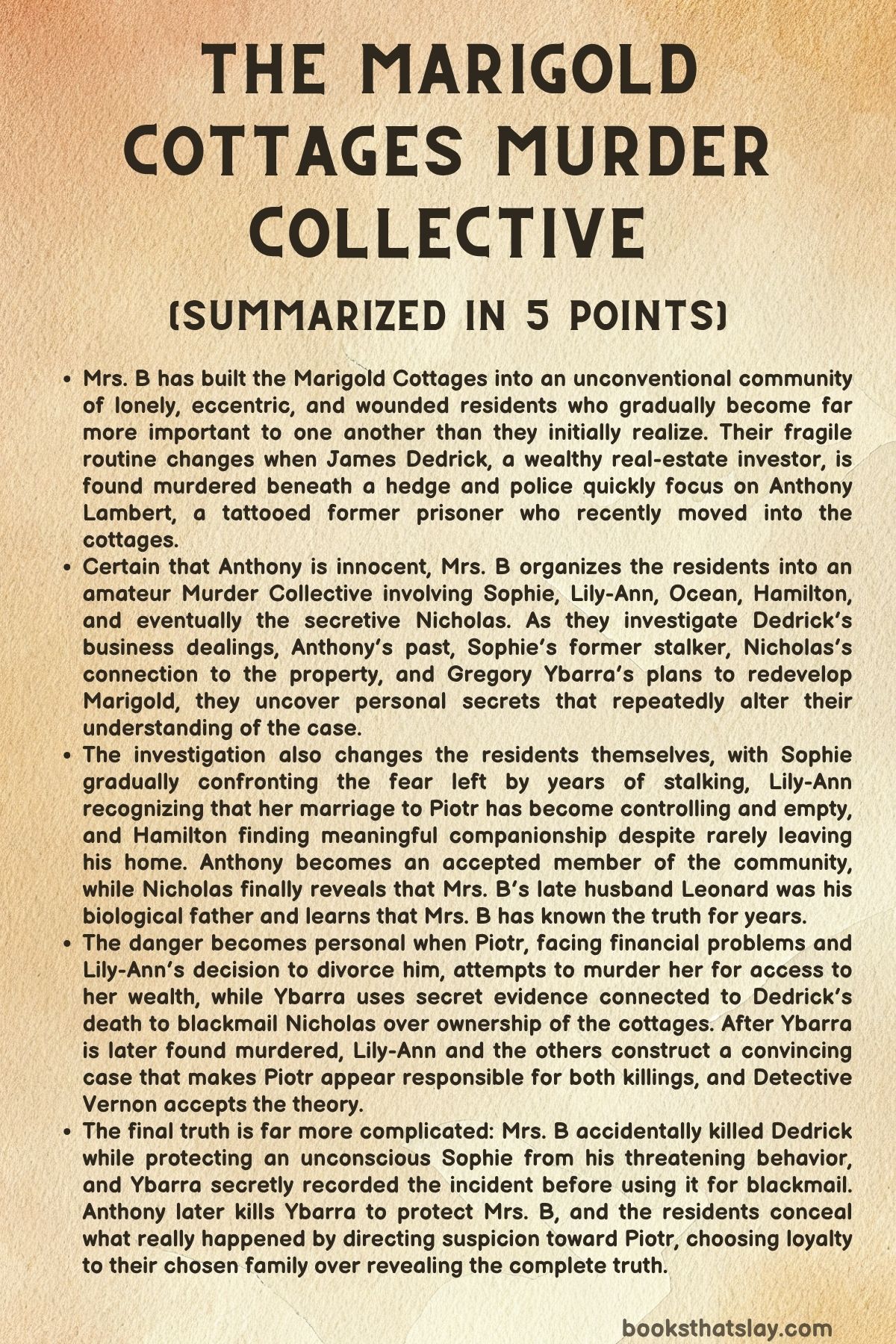
Summary
Golda Bakofsky, known throughout the Marigold Cottages as Mrs. B, owns six small rental homes in Santa Barbara that she purchased decades earlier with her late husband Leonard. She sees the residents less as tenants than as imperfect people who need a place where they can belong, even when they resist becoming involved in one another’s lives.
Among them are Sophie Gilman, a theatre administrator still affected by a college stalker; work-obsessed Lily-Ann Novak, who is separated but not divorced from her wealthy husband Piotr; artist and single mother Ocean Mistral; withdrawn city planner Nicholas Perez; homebound Hamilton; and Ocean’s children Riley and Miles. Their routines change when Mrs. B rents a tiny studio beside Ocean’s home to Anthony Lambert, a large, tattooed former prisoner whom she met near the property.
Sophie is immediately uneasy about Anthony because he seems to recognize her, while Ocean worries about allowing a convicted man to live beside her children. Mrs. B nevertheless insists that Anthony deserves a chance, and his quiet behavior soon begins contradicting the threatening image others initially formed of him.
The tenants begin communicating more frequently through a group chat that Sophie organizes for safety. At the same time, Nicholas secretly becomes involved in a city rezoning proposal that could greatly increase the value of the Marigold property by allowing high-density development.
Real-estate investor Gregory Ybarra soon expresses interest in acquiring the cottages. He sees the land primarily as a profitable development opportunity, while Nicholas understands both the city’s need for housing and the emotional importance of the existing property.
The mystery begins when Sophie wakes after one of her heavy-drinking nights and sees what she first assumes is a sleeping man beneath the hedge outside her cottage. She quickly realizes he is dead.
The victim is James Dedrick, a wealthy real-estate investor who has suffered a fatal blow to the head. Detective Sergeant Vernon Enible immediately approaches the case with assumptions shaped more by appearance and criminal history than careful investigation.
When Vernon meets Anthony, his attention settles almost entirely on him. Anthony is physically intimidating, has a violent criminal record, lives near the body, once worked as a bouncer, and has what looks like blood on his sleeve.
Anthony refuses to answer Vernon’s questions without legal representation, which Vernon treats as suspicious instead of a legitimate exercise of his rights. The detective takes him into custody, while Mrs. B immediately declares that Anthony could not have killed Dedrick.
Mrs. B’s absolute certainty becomes the reason the neighbors begin investigating. She organizes the Marigold Cottages Murder Collective, gathering Sophie, Lily-Ann, Ocean, Hamilton, and eventually Nicholas around the goal of proving Anthony innocent.
Each member brings a different strength. Lily-Ann loves solving orderly problems, Hamilton can research people online without leaving home, Sophie records everything as possible material for a play, Ocean is fiercely protective, and Mrs. B is willing to ignore ordinary boundaries whenever somebody she loves needs help.
Their investigation reveals that Dedrick had come to Santa Barbara because Ybarra wanted him to invest in redeveloping Marigold. Dedrick had a habit of arriving early to business meetings to conduct his own reconnaissance, giving him a reason to visit the property secretly before meeting Ybarra.
The collective also investigates Sophie’s former stalker, Neal Hesse. Hamilton and Nicholas discover disturbing evidence suggesting Hesse has continued targeting women, but Ocean eventually confirms that Hesse was at home on the night of Dedrick’s murder.
Anthony’s connection to Sophie is also explained. Years earlier, while working at the Sidecar, he found Sophie unconscious after one of her blackout-drinking episodes and carried her safely home.
Mrs. B saw Anthony helping Sophie that night, which explains why she trusted him even before offering him the studio. Anthony had later hoped to warn Sophie about how dangerously vulnerable her drinking made her, but he never knew how to approach the subject.
Meanwhile, the neighbors’ personal lives become part of the investigation. Sophie grows closer to Nicholas and begins recovering some of the confidence that Neal Hesse destroyed.
Lily-Ann becomes increasingly drawn to Anthony while recognizing how controlling and emotionally unsatisfying her marriage to Piotr has become. Hamilton discovers that helping the collective allows him to participate in a community without pretending his homebound life can simply be corrected.
Vernon continues building his case against Anthony. He pressures another detainee, Ian Talken, until Ian claims that Anthony confessed, and police also obtain doorbell footage apparently showing Anthony burglarizing Dedrick’s home.
Lily-Ann and Hamilton secretly acquire the video and notice that the tattoo on the masked burglar is slightly different from Anthony’s. Ocean eventually tracks down Anthony’s former prison friend Perch, who has a nearly identical tattoo and admits he was the person who burglarized Dedrick’s empty house.
The burglary was unrelated to the homicide, but it accidentally strengthened the false case against Anthony. Vernon remains unwilling to reconsider his overall theory even as the evidence becomes less convincing.
The investigation becomes more serious when Mrs. B deliberately confesses to Dedrick’s murder. She gives police a knobkerrie marked with what appears to be Dedrick’s blood and claims that she accidentally struck him when he threatened her.
The collective quickly suspects that she created the physical evidence herself by rubbing the club in blood left near the crime scene. Her purpose is not to convince everyone that she is guilty but to create enough reasonable doubt to prevent Anthony from being convicted.
Her plan succeeds in weakening the prosecution, but it frightens the neighbors because Mrs. B is willing to sacrifice her own freedom. Anthony, equally loyal, tells Ocean that he would falsely confess if doing so would save Mrs. B.
The collective responds by trying to manufacture alibis for Mrs. B. Sophie, Riley, and Hamilton separately visit Vernon with implausible stories claiming they watched her throughout the murder night.
Vernon recognizes the deception immediately. He nevertheless admits that he already doubts Mrs. B killed Dedrick, because he remains convinced Anthony is responsible.
During this period, Ocean discovers Mrs. B’s will and learns that Nicholas will inherit the Marigold Cottages. Nicholas eventually reveals that Leonard Bakofsky was his biological father, born from Leonard’s affair with Nicholas’s mother.
Nicholas has avoided Mrs. B because he assumes she does not know the truth and feels guilty about benefiting from Leonard’s betrayal. In reality, Mrs. B has known for years and regards Nicholas as another person Leonard loved rather than as an enemy.
Gregory Ybarra learns about Nicholas’s inheritance and pressures him into signing over his future interest in the property. Nicholas initially claims he made the choice voluntarily, but the truth is far darker.
Ybarra was present when Dedrick died and secretly recorded the killing. He uses the video as leverage, threatening consequences for Mrs. B unless Nicholas agrees to surrender control of the property.
At the same time, Lily-Ann finally ends her marriage to Piotr. She realizes that Marigold feels more like home than the luxurious house she shared with him and understands that Piotr does not truly appreciate who she is.
Soon afterward, someone places a branch against Lily-Ann’s bedroom window, knowing her obsession with order will compel her to remove it. When she steps outside, a masked attacker tries to kill her with a claw hammer.
Sophie hears the struggle and eventually charges outside wielding a tequila bottle. Her intervention saves Lily-Ann, and Lily-Ann recognizes the attacker as Piotr.
The attempted murder exposes Piotr’s financial motive. His finances are collapsing, Lily-Ann’s divorce threatens his access to her wealth, and he would benefit enormously if she died before their separation became legally final.
Lily-Ann becomes convinced Piotr also killed Dedrick. The likely theory is that Piotr was waiting near Marigold to attack Lily-Ann when Dedrick unexpectedly encountered him, forcing Piotr to eliminate a witness.
That theory, however, is not the real answer.
Nicholas knows more than he has admitted because he has seen evidence of the original killing. Ybarra’s recording reveals the actual circumstances of Dedrick’s death, and Nicholas has been cooperating with Ybarra largely to protect Mrs. B.
Before the truth can reach the authorities, Ybarra comes to Marigold and tells Mrs. B that he controls the property’s future. He also announces his intention to take the murder video to police.
Anthony follows him.
Soon afterward, Ybarra’s body is discovered beneath another hedge. He has been beaten to death, and a bloody blue Mizuno golf club is found nearby.
Lily-Ann immediately takes control of the situation. Piotr owns expensive Mizuno clubs, and she realizes the second death can be used to create a case that will permanently remove the man who tried to kill her.
The residents present Vernon with a carefully constructed theory. They argue that Piotr wanted Lily-Ann dead for financial reasons, killed Dedrick when Dedrick accidentally witnessed his preparations, and later killed Ybarra because Ybarra knew too much.
Piotr’s severe financial difficulties support the motive, and his fingerprints are found on the golf club. Vernon eagerly accepts the theory because solving two murders would benefit his career.
The apparent resolution allows the Marigold community to return to ordinary life. Anthony and Lily-Ann become a couple, Nicholas finally speaks openly with Mrs. B about Leonard, Hamilton becomes more securely connected to his neighbors, and Sophie begins taking both her writing and her drinking more seriously.
Anthony takes Miles to see the migrating whales he had feared he might miss while imprisoned. Ocean realizes she no longer carries sole responsibility for protecting Mrs. B because the residents now protect one another.
Only at the end does Sophie reveal the complete truth.
On the original murder night, blackout-drunk Sophie collapsed outside her cottage. James Dedrick found her and began dragging her toward her home while making threatening sexual remarks.
Mrs. B saw what was happening and intervened with her knobkerrie. She intended to protect Sophie and drive Dedrick away, but the blow killed him.
Ybarra secretly filmed the incident and later used the video to blackmail both Mrs. B and Nicholas. When he finally threatened to turn over the recording, Anthony killed Ybarra to protect Mrs. B.
Lily-Ann then arranged the cover-up. Anthony replaced evidence at the scene with Piotr’s golf club, which already carried Piotr’s fingerprints, and the group supported the story that Piotr had committed both murders.
Piotr was innocent of Dedrick’s and Ybarra’s deaths, but he had genuinely attempted to murder Lily-Ann for financial gain. The residents therefore accept the false conclusion that sends a dangerous man toward punishment while preserving the freedom of Mrs. B and Anthony.
Sophie completes her play knowing that its public version cannot contain the true ending. The final secret belongs to the people of Marigold, whose loyalty has crossed from friendship into something far more morally complicated.
Characters
Golda Bakofsky — Mrs. B
Mrs. B is the emotional and moral center of The Marigold Cottages Murder Collective, even though her morality is far from conventional. She believes damaged people do not need to be corrected before they deserve affection, housing, friendship, or protection, and she has built the Marigold community around that principle.
Her care is active rather than sentimental. She rents to Anthony despite his prison record, creates the Murder Collective to defend him, manipulates people into helping one another, worries about Hamilton’s isolation, protects Sophie, plans for Ocean to continue caring for the residents after her death, and quietly tries to bring Nicholas into the family he has spent years avoiding.
Mrs. B also possesses a willingness to cross legal and ethical lines when loyalty demands it. She kills Dedrick accidentally while protecting Sophie, conceals the truth, later falsely confesses in order to create reasonable doubt for Anthony, and accepts personal risk without hesitation.
Her relationship with Nicholas reveals the full generosity of her understanding of family. Leonard’s affair could have made Nicholas a permanent symbol of betrayal, but she instead regards him as another person her husband loved and chooses to leave him the property.
Mrs. B therefore represents both the warmth and danger of unconditional loyalty. Her love creates a genuine family, but that same love ultimately helps justify secrecy, deception, obstruction, and the concealment of homicide.
Sophie Gilman
Sophie undergoes one of the clearest personal transformations in The Marigold Cottages Murder Collective. Neal Hesse’s stalking taught her to interpret visibility as danger, and much of her adult behavior reflects an effort to remain unnoticed, apologetic, and protected from the possibility of attracting another person’s harmful attention.
Her drinking represents another form of escape. Blackout nights leave her unable to remember events and dangerously dependent on others, including Anthony, who once finds her unconscious and carries her home.
Writing gradually gives Sophie a way to reclaim authorship of her own life. At first she treats the Marigold residents as material for a play while keeping her fictionalized self at the edges, but Nicholas identifies the problem and tells her that her work needs more of her.
That advice affects more than the play. Sophie confronts Neal directly, begins resisting alcohol as an automatic response to fear, lies to Vernon in an effort to help Mrs. B, and finally saves Lily-Ann by charging an armed attacker with a tequila bottle.
Her courage never depends on becoming fearless. Sophie remains anxious, vulnerable, and sometimes impulsive, but she stops accepting the idea that fear should decide how much space she is allowed to occupy.
By the end, she also becomes the keeper of the complete truth. Her finished play cannot reveal what actually happened, forcing her to recognize the difference between artistic truth, factual truth, and the secrets people preserve to protect those they love.
Lily-Ann Novak
Lily-Ann approaches the world through order, efficiency, logic, and completion. She finds comfort in tasks with identifiable solutions, which makes a murder investigation almost irresistible because it converts frightening disorder into a problem she can organize.
Her emotional development is quieter than Sophie’s but equally significant. At first, Lily-Ann regards the other residents with detached curiosity, yet she steadily becomes protective of Sophie, comfortable with Hamilton, loyal to Mrs. B, and emotionally invested in Anthony.
Her marriage to Piotr shows the cost of living according to systems that no longer serve her. She remains technically married partly because promises matter to her and partly because an unfinished marriage offends her instinct for completion.
Anthony helps expose what has been missing. He does not try to redesign Lily-Ann’s personality, soften her directness, criticize her work habits, or make her conform to his preferences.
Piotr’s attempt to murder her finally removes any remaining ambiguity. Lily-Ann reacts in a distinctly characteristic way: she does not simply panic or retreat but immediately begins determining how to build the strongest possible case against him.
Her role in framing Piotr for two murders reveals the darker side of her logic. Once she concludes that Piotr is genuinely dangerous, she treats the legal narrative almost as another problem to solve, accepting deception as a practical method for neutralizing a threat.
Ocean Mistral
Ocean is defined by protective responsibility. As Riley and Miles’s primary parent and someone who has known Mrs. B since childhood, she automatically evaluates people according to whether they might endanger those she loves.
That instinct explains her early suspicion of Anthony. She is less interested in abstract ideas about rehabilitation than in the immediate question of whether a former prisoner should live beside her children.
Ocean’s willingness to revise that judgment is essential to her character. Once Anthony demonstrates gentleness, patience, and loyalty, she becomes one of his strongest defenders.
Her relationship with Mrs. B moves gradually from dependence toward succession. Mrs. B entrusts Ocean with power of attorney and gives her detailed instructions for continuing to care for the Marigold residents.
Ocean also carries unresolved feelings about motherhood, sacrifice, and abandonment. Her former wife Zoe gave birth to their children but eventually left the family, while Ocean became the parent responsible for the ordinary, repetitive work of raising them.
By the end, Ocean understands that care does not have to be solitary. Mrs. B’s greatest achievement is not persuading Ocean to replace her but creating a community strong enough that responsibility can be shared among many people.
Anthony Lambert
Anthony is introduced in The Marigold Cottages Murder Collective, through the assumptions other people make about his body, tattoos, criminal history, and silence. Vernon sees an obvious killer, Sophie initially sees a possible threat, and Ocean sees a risk to her children.
The novel gradually replaces those assumptions with evidence of the person Anthony is trying to become. He accepts unglamorous work, helps neighbors without demanding recognition, treats Mrs. B with affection, protects vulnerable people, cares about Miles, and approaches Lily-Ann with patience rather than control.
His criminal history is not erased. Anthony genuinely has a violent past, and his later assault on Neal Hesse shows that violence remains an available response when he believes somebody deserves punishment.
His central question is therefore not whether he has ever been dangerous but what kind of man he chooses to be now. That question makes his eventual killing of Ybarra especially significant.
Anthony murders Ybarra to protect Mrs. B from exposure. The act comes from loyalty rather than selfishness, but it demonstrates that his instinct to solve threats through violence has never completely disappeared.
His romance with Lily-Ann offers another possible future. Around her, Anthony experiences acceptance, attraction, domestic intimacy, and belonging without needing to prove himself through force.
Nicholas Perez
Nicholas initially appears detached, secretive, and almost deliberately unpleasant. His isolation, however, is built less on contempt for the Marigold residents than on shame about his connection to Leonard Bakofsky.
As Leonard’s son from an affair, Nicholas grows up with money and occasional paternal attention but without a legitimate place in Leonard’s primary family. After Leonard’s death, he assumes Mrs. B’s generosity toward him exists only because Leonard requested it.
His belief that she does not know the truth makes ordinary affection from Mrs. B almost unbearable. He responds by staying distant, hoping emotional withdrawal will reduce the damage his existence represents.
Sophie steadily challenges that strategy. Their growing relationship forces Nicholas to explain his family history, his dissatisfaction with himself, and his fear that inherited advantages have allowed him to move through life without committing fully to anything.
Ybarra’s blackmail then converts Nicholas’s passivity into an ethical crisis. He signs away his future interest in Marigold because Ybarra possesses evidence that could implicate Mrs. B.
Nicholas ultimately learns that Mrs. B already knew about Leonard and chose to love him anyway. That revelation removes the shame on which much of his identity has been built and allows him to become an active member of the community rather than someone permanently standing outside it.
Hamilton
In The Marigold Cottages Murder Collectivem, Hamilton is homebound and increasingly unable to cross the boundary of his cottage, but the book refuses to reduce him to a problem requiring a cure. He has built a functional life around his limitations and feels frustrated by assumptions that happiness must require living according to conventional expectations.
The Murder Collective gives Hamilton a form of participation suited to his abilities. His gaming connections, research skills, patience, and comfort with online investigation make him unexpectedly valuable.
His friendship with Lily-Ann is especially important because she does not treat his isolation as something morally wrong. He similarly refuses to tell her that working constantly must necessarily make her unhappy.
Hamilton also possesses strong empathy for Sophie. He recognizes that fear does not always disappear and understands that a meaningful life can exist even when certain boundaries remain.
His willingness to help Mrs. B eventually pushes him beyond his normal tolerance for risk. He participates in questionable investigative methods, offers false information to police, and even considers leaving his home when Lily-Ann is attacked.
Hamilton’s growth therefore occurs through connection rather than transformation into a different person. He remains himself while discovering that being physically isolated does not require being emotionally alone.
Detective Sergeant Vernon Enible
In The Marigold Cottages Murder Collective, Vernon represents institutional certainty without genuine curiosity. He enters the investigation expecting a simple case and quickly decides Anthony fits the role of murderer because of his appearance, record, size, and proximity to the body.
Once Vernon reaches that conclusion, nearly everything becomes evidence supporting it. Anthony’s silence looks guilty, Mrs. B’s defense looks irrational, and contradictory information becomes an obstacle rather than a reason to reconsider.
His methods become increasingly troubling. He pressures Ian Talken toward providing incriminating testimony, encourages Sophie to remember behavior that could implicate Anthony, and repeatedly treats legal safeguards as inconveniences.
Vernon does not think of himself as corrupt. That makes his behavior more revealing because he believes procedural shortcuts are acceptable when an officer is sufficiently certain about a suspect’s guilt.
Career ambition also affects his judgment. Solving a major murder case would strengthen his professional reputation, and later the possibility of attributing two murders to Piotr becomes attractive.
His eventual acceptance of the false case against Piotr completes the irony. Vernon spends the entire story believing himself unusually capable of recognizing criminals, yet the community successfully directs him toward the conclusion it wants him to reach.
Piotr
Piotr initially appears more controlling than openly dangerous. He comments on Lily-Ann’s body, orders for her, criticizes her work habits, assumes his preferences should govern their relationship, and frames his behavior as concern.
His concern eventually becomes clearly possessive. He interprets Lily-Ann’s independence as a temporary mistake and treats their separation as something he can reverse rather than a decision he must respect.
Financial collapse transforms his controlling tendencies into lethal intent. Because divorce threatens his access to Lily-Ann’s wealth, her death becomes materially advantageous.
Piotr carefully attempts to establish himself elsewhere before attacking her, showing that the assault is planned rather than impulsive. He also spends time portraying Anthony as dangerous, creating a convenient figure who could potentially absorb suspicion.
He does not commit the two murders ultimately attributed to him, making his ending morally complicated. The collective deliberately allows him to bear responsibility for crimes he did not commit because he genuinely tried to murder Lily-Ann.
Piotr therefore becomes the person on whom the community’s private justice is imposed. His actual guilt is serious enough that the residents convince themselves factual innocence regarding the murders no longer deserves protection.
Gregory Ybarra
Gregory Ybarra sees Marigold primarily as valuable land being used inefficiently. His interest in the cottages is tied to rezoning, redevelopment, investment, and the assumption that Mrs. B’s age will eventually make resistance to a sale irrelevant.
His greatest advantage comes from accidentally obtaining evidence of Dedrick’s death. Instead of reporting what he recorded, he recognizes the video as leverage.
Ybarra uses the recording to pressure Mrs. B and Nicholas, eventually obtaining Nicholas’s future property rights. His behavior converts a tragic accidental killing into an opportunity for personal profit.
Unlike some villains in the novel, Ybarra rarely needs physical force. Information and property law provide the tools he uses to dominate others.
His death occurs when he decides to stop merely threatening exposure and actually take the evidence to authorities. Anthony kills him to protect Mrs. B, demonstrating how Ybarra’s manipulation pushes another character toward irreversible violence.
Ybarra therefore represents exploitation in its most calculated form. He repeatedly assumes that every relationship, weakness, secret, and piece of property has a price that can be converted into advantage.
Riley
In The Marigold Cottages Murder Collective, Riley is Ocean’s teenage daughter, intelligent, rebellious, and uncomfortable with being treated as a child when she believes she understands more than adults assume. Her secrecy after Dedrick’s death initially makes Ocean wonder whether she witnessed something important.
The truth is more ordinary. Riley slipped outside to smoke with a friend while Miles was unattended and concealed it because she feared Ocean’s anger.
Her loyalty to Anthony develops quickly. She challenges Vernon, insists Anthony is innocent, and later uses temporary tattoos as a gesture of solidarity.
Riley also inherits much of Ocean and Mrs. B’s instinct to involve herself when someone she loves is threatened. She participates in the effort to provide Mrs. B with a false alibi despite the legal risk.
Her presence helps keep the novel’s family relationships grounded. Murder may dominate the adults’ attention, but Ocean still has to deal with rule-breaking, sibling responsibility, adolescent defiance, and the difficult process of giving a teenager greater independence.
Miles
Miles provides innocence without being merely decorative. His acceptance of Anthony is based on everyday behavior rather than criminal records, police theories, or adult prejudice.
He becomes attached to Anthony through ordinary acts of friendship and becomes deeply worried that imprisonment will prevent him from seeing the migrating gray whales. The whales turn into a small but meaningful symbol of the life Anthony might lose.
Miles responds to Anthony’s arrest by imagining practical ways to help, including letters, public appeals, and cupcakes. His solutions are naïve, but his refusal to treat the situation as hopeless affects the adults around him.
The flowers and welcome-home artwork he gives Anthony after his release are especially important. Anthony is moved because he has rarely received uncomplicated affection that asks nothing from him.
Miles ultimately gets to take Anthony whale watching, completing one of the novel’s gentlest emotional arcs. His friendship demonstrates how belonging can be created through small repeated gestures rather than dramatic declarations.
James Dedrick
In The Marigold Cottages Murder Collective, James Dedrick is dead for almost the entire story, yet his personality continues shaping the mystery. He is wealthy, controlling, competitive, and accustomed to using power to gain an advantage.
His habit of arriving early to investigate business opportunities explains why he is at Marigold before his scheduled meeting with Ybarra. That decision places him in the courtyard at exactly the wrong moment.
The final revelation changes the meaning of his death. Dedrick encounters an unconscious Sophie and begins dragging her toward her cottage while making threatening remarks.
Mrs. B intervenes to protect Sophie, intending to stop him rather than kill him. His death is therefore neither a calculated assassination nor part of the real-estate conspiracy that occupies much of the investigation.
Dedrick functions as the event around which everyone else’s hidden problems become visible. His death exposes Anthony to prejudice, Mrs. B to legal danger, Nicholas to blackmail, Ybarra to temptation, Sophie to buried vulnerability, and the entire community to choices they never expected to face.
Neal Hesse
Neal Hesse represents the long-term damage created by stalking. Years after his behavior toward Sophie, she still structures parts of her life around the fear he created.
His abuse depended on making intrusion look small enough to dismiss individually while creating a constant atmosphere of surveillance. Stolen objects, unwanted constructions, observation, and invasion of private spaces gradually destroyed Sophie’s sense that ordinary life was safe.
The investigation shows that Hesse has not meaningfully changed. Evidence suggests another young woman is receiving similar unwanted attention, while Ocean discovers that his wife Kelly also appears frightened of him.
He is not Dedrick’s killer, but eliminating him from the murder inquiry does not make him harmless. His danger exists independently of the central homicide.
Anthony’s decision to break Hesse’s elbows provides another example of the book’s unstable relationship with justice. Sophie later confronts Hesse herself, and her victory is psychological rather than legal: she refuses to continue behaving as though he possesses permanent authority over her fear.
Leonard Bakofsky
In The Marigold Cottages Murder Collective, Leonard is dead before the central events, but his choices continue affecting Mrs. B and Nicholas. His affair with Nicholas’s mother created a family relationship that Nicholas believes must remain hidden.
Leonard supported Nicholas materially and spent limited time with him, leaving Nicholas with both advantages and emotional uncertainty. Before dying, he asked Mrs. B to provide for his son.
The later revelation that Mrs. B already knew about the affair complicates Leonard’s legacy. His betrayal caused pain, but it did not prevent Mrs. B from recognizing his love for Nicholas as real.
Leonard’s history also shapes the future ownership of Marigold. The property ultimately passes toward Nicholas not simply because of biological inheritance but because Mrs. B consciously chooses to include him.
Perch
In The Marigold Cottages Murder Collective, Perch, also known as TG, is Anthony’s former prison friend and the source of one of the case’s most misleading pieces of evidence. He and Anthony received similar wing-and-flame tattoos while incarcerated.
After Dedrick’s death, Perch burglarizes the empty Altadena house. Doorbell footage captures him masked, making his similar tattoo appear to identify Anthony.
Perch’s crime has no connection to the murder, yet it illustrates how unrelated wrongdoing can become convincing evidence when investigators already believe they know the answer. Once Vernon interprets the footage through his theory of Anthony’s guilt, the resemblance seems almost definitive.
Ocean’s discovery of Perch exposes the mistake and helps undermine the prosecution. His role is brief but essential because he demonstrates how coincidence can become dangerous when combined with confirmation bias.
Ian Talken
Ian Talken is a vulnerable detainee whose situation Vernon exploits. Initially, Ian says Anthony barely spoke to him and certainly never confessed.
Vernon makes clear, however, that cooperation could influence how Ian’s own serious charges are handled. He does not explicitly order Ian to invent testimony but creates a powerful incentive for him to provide the statement police want.
Ian later claims that Anthony confessed to killing Dedrick. The collective immediately finds the story inconsistent with Anthony’s behavior, but the alleged confession becomes an important part of the official case.
Ian is less a mastermind than an example of how unequal pressure can distort evidence. His testimony reveals how a criminal investigation may reward information that confirms police expectations even when its reliability is doubtful.
Zoe
Zoe is Ocean’s former wife and the biological mother of Riley and Miles. Although she remains mostly outside the immediate events, her absence significantly shapes Ocean’s understanding of parenting.
Other people once assumed Zoe would naturally become the more nurturing parent because she gave birth to the children and presented a softer personality. In practice, Ocean handled the exhausting daily work of care.
Zoe eventually left for another relationship in Europe, leaving Ocean to continue raising the children. Her departure contributes to Ocean’s distrust of romantic assumptions about family and reinforces her belief that love must be demonstrated through sustained responsibility.
Kelly Hesse
Kelly Hesse appears briefly but significantly when Ocean visits Neal’s home. She is caring for a baby and seems exhausted, guarded, and frightened of her husband.
Ocean immediately recognizes behavior that suggests Kelly may be living in an abusive environment. Rather than forcing her to disclose anything, Ocean offers information about a women’s shelter.
Kelly broadens the consequences of Neal’s behavior beyond Sophie. His capacity for intimidation is not a closed episode from college but part of an ongoing pattern affecting women around him.
Her presence also allows Ocean’s protective instincts to operate outside the Marigold community. Ocean cannot rescue Kelly by force, but she can make sure help is available if Kelly chooses to reach for it.
Themes
Chosen Family and the Meaning of Community
The residents begin as people who happen to rent cottages around the same courtyard, but proximity gradually becomes responsibility. Mrs. B believes from the beginning that damaged people can still belong together, and the entire story tests whether that belief can survive fear, suspicion, secrets, and even criminal acts.
In The Marigold Cottages Murder Collective, community develops through practical behavior rather than declarations. Lily-Ann organizes and solves problems, Ocean feeds and protects people, Hamilton provides information, Sophie records their shared experiences, Anthony performs physical tasks, the children offer uncomplicated affection, and Mrs. B repeatedly pushes everyone into contact.
Their relationships are frequently uncomfortable. They argue, insult one another, invade privacy, conceal information, and briefly fracture when pressure becomes too intense.
Yet the important distinction is that conflict does not end belonging. Ocean apologizes to Sophie, Nicholas finally stops avoiding Mrs. B, Lily-Ann realizes she is genuinely liked, Hamilton understands that he can participate without becoming somebody else, and Anthony discovers that people will fight to keep him in their lives.
By the final gathering, Ocean understands that Mrs. B’s real legacy is not simply the cottages. She has created a network in which care is distributed, allowing each person to become responsible for the continued survival of the others.
Justice, Truth, and Moral Compromise
The murder investigation repeatedly separates legal truth from moral judgment. Vernon assumes that finding the person who looks most like a criminal is equivalent to finding justice, while the residents become increasingly willing to violate laws if they believe the official system threatens an innocent or vulnerable person.
Anthony is initially innocent of Dedrick’s death, yet the system quickly constructs a convincing case against him. His history, physical appearance, Perch’s misleading tattoo, Ian’s pressured testimony, and Vernon’s assumptions combine into a narrative that looks stronger than it actually is.
The residents respond with deception of their own. Mrs. B manufactures evidence for a false confession, Sophie and others invent alibis, Hamilton obtains information improperly, and the collective eventually helps create a false murder case against Piotr.
The final situation makes simple moral judgment difficult. Mrs. B accidentally killed Dedrick while preventing a threatened assault on Sophie, while Anthony deliberately killed Ybarra to protect Mrs. B.
Piotr did not commit either homicide, yet he genuinely tried to murder Lily-Ann for financial gain. The residents therefore decide that factual accuracy matters less than placing a dangerous man where he can no longer hurt them.
The story leaves justice deliberately unsettled. Legal guilt, moral guilt, factual truth, and community loyalty do not produce the same answer.
Fear, Visibility, and Reclaiming Personal Agency
Fear affects several residents differently, but Sophie provides the clearest exploration of what happens when fear becomes a permanent organizing force. Neal’s stalking teaches her that being noticed can lead to danger, so she responds by becoming apologetic, cautious, and almost determined to disappear.
Her drinking creates another form of disappearing. Blackouts remove memory and responsibility temporarily but leave her physically vulnerable, as the final revelation about Dedrick makes painfully clear.
Nicholas’s criticism of Sophie’s play becomes important because he notices she has made herself a side character in her own work. His advice that the play needs more of her forces Sophie to recognize that Neal’s influence has extended into her creativity and identity.
Recovery does not transform Sophie into someone without anxiety. Instead, she begins acting while fear is present.
She confronts Neal, enters the police station alone, refuses to retreat from Marigold, chooses not to use alcohol automatically, and runs outside when Lily-Ann is attacked. Her courage is imperfect and sometimes reckless, but it is active.
Hamilton provides a useful contrast because his development does not depend on defeating his own limitations. Together, their stories suggest that agency means choosing how to live with fear rather than satisfying somebody else’s definition of normality.
Second Chances, Identity, and the Possibility of Change
Anthony’s presence forces nearly every character to decide whether a person should be permanently defined by the worst things in his past. His criminal history is real, and the novel never pretends that violence disappeared simply because he served his sentence.
What changes is Anthony’s relationship to his own identity. He works an ordinary job, helps neighbors, cares about children, values small experiences such as seeing whales, and asks himself what kind of man he wants to become.
The community gives him opportunities to practice another identity. Mrs. B trusts him, Ocean gradually accepts him, Miles loves him without reservation, Hamilton relies on him, and Lily-Ann sees qualities in him that cannot be reduced to his record.
Other characters confront similar questions. Lily-Ann chooses a new life outside her marriage, Nicholas learns that his father’s betrayal does not make him personally shameful, Sophie stops defining herself entirely through what Neal did to her, and Hamilton discovers that connection does not require abandoning the life he has built.
The theme becomes complicated because change is not presented as a clean transformation. Anthony still uses violence against Hesse and ultimately kills Ybarra.
Second chances therefore do not erase responsibility or guarantee perfection. They create the possibility of choosing differently, even when old impulses, mistakes, and contradictions remain part of the person moving forward.