Trouble’s Turn to Lose Summary, Characters and Themes
Trouble’s Turn to Lose by Susan M. Boyer is a mystery novel centered on Hadley Cooper, a private investigator whose professional case becomes tied to a deeply personal family secret. The story begins with a ghostly visit from Hadley’s dead mother and quickly expands into a murder investigation involving planted evidence, erased security footage, hidden affairs, lost children, and a killer who has been moving through several lives with careful cruelty.
The book combines crime-solving, family revelation, romance, and the supernatural, giving Hadley a case that forces her to trust both evidence and instinct. It’s the 3rd book of the Carolina Tales series.
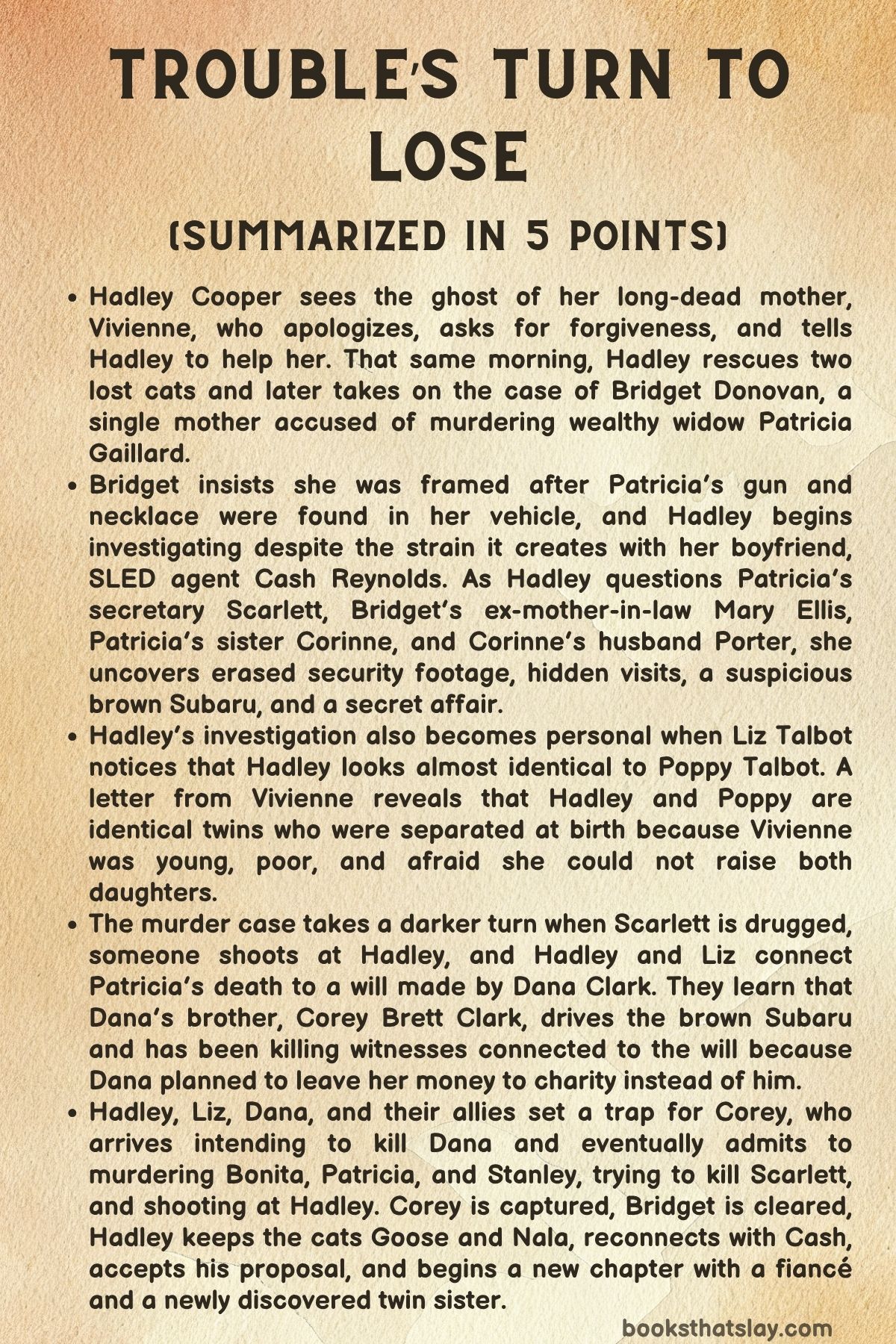
Summary
Hadley Cooper’s life shifts in a strange and unsettling way one Saturday morning on Sullivan’s Island. At sunrise, she sees the ghost of her mother, Vivienne, who died almost twenty-five years earlier.
Vivienne’s appearance is brief but urgent. She tells Hadley that she is sorry, that she wants forgiveness, and that Hadley must help her.
She also insists that what Hadley is seeing is real, even though Vivienne is not supposed to be there. Hadley is shaken by the encounter and tries to explain it away as imagination, grief, stress, or some trick of the light, but the morning continues to feel unusual.
Soon afterward, she finds two trapped cats near her house. She rescues them and brings them inside, surprised to learn that she is not allergic to cats as she always believed.
Since she does not know who owns them, she decides to care for them temporarily while trying to find their home.
Later that day, Hadley goes to her new private investigation office in Mount Pleasant, where Carolyn Talbot arrives with a request. Carolyn wants Hadley to help Bridget Donovan, a single mother who has been accused of murdering Patricia Gaillard, a wealthy widow.
Hadley hesitates because her boyfriend, Cash Reynolds, is the SLED agent working the case. Hadley and Cash have an understanding that she will not interfere with his investigations, and accepting Carolyn’s request could damage both their personal relationship and his professional work.
Carolyn insists that Bridget is innocent and cannot afford the kind of defense that could protect her from a wrongful conviction. Hadley agrees only to speak with Bridget, but that meeting changes her mind.
In jail, Bridget tells Hadley that she worked for Patricia and found her body. Afterward, Patricia’s gun and a diamond necklace were discovered in Bridget’s vehicle, making the case against her look strong.
Bridget insists she has been framed. Her deepest fear is not only prison but losing her children, Hutton and Delaney, to Mary Ellis Donovan, her controlling former mother-in-law.
Bridget wants them to stay with her trusted friend Imani instead. Hadley believes Bridget’s fear and sincerity, and she begins to suspect the evidence has been arranged to make Bridget look guilty.
Hadley brings in public defender Dana Smalls to help Bridget and tells Cash that she has taken the case. Cash is hurt and upset, but the two agree to keep a strict boundary between their work.
Hadley begins investigating Patricia’s life, her home, and the people close to her. Patricia’s secretary, Scarlett Hathaway, insists Bridget is innocent, but Scarlett also distracts Hadley with talk of ghosts and a spirit guide.
Scarlett claims she has an alibi named Brett Campbell, but the number she provides does not lead anywhere useful. Hadley also learns that the security footage from Patricia’s house has been erased, and that a brown Subaru was seen near the house on the night Patricia was killed.
Mary Ellis Donovan soon becomes a possible suspect. She had been secretly visiting Patricia because she wanted help advancing her son Arlo’s music career.
Patricia had a connection in Nashville named Uma Jennings, and Mary Ellis hoped that connection could open doors for Arlo. Mary Ellis also wants influence over Bridget’s children, giving her a personal stake in Bridget’s downfall.
Hadley sees that the case is not as simple as it first appears. Too many people had reasons to want Patricia dead, and too many pieces of evidence seem placed rather than naturally discovered.
Carolyn’s daughter, Liz Talbot, a former investigator, joins the effort. Liz has her own experience with the supernatural because her deceased best friend Colleen appears to her as a guardian spirit.
This makes Hadley take Vivienne’s visit more seriously, even though she still struggles to accept it. Liz also notices something startling: Hadley looks almost exactly like Poppy Talbot, Liz’s sister-in-law.
That resemblance becomes the beginning of a second mystery, one that belongs not to Patricia’s murder but to Hadley’s own past.
Hadley meets Poppy and begins comparing details about their births. Eventually, she receives a letter that Vivienne left with Gavin before her death.
The letter reveals that Hadley and Poppy are identical twins. Vivienne had been young, poor, and frightened that she could not raise both babies.
With help from nurse Linda McMurtry, she arranged for one twin to be adopted and altered the records. Hadley realizes that this is the secret behind Vivienne’s apology.
Her mother was asking forgiveness not only for dying but for separating Hadley from her twin sister.
While Hadley processes the shock of discovering Poppy, the murder case grows more complicated. Patricia’s sister Corinne had argued with her before the murder.
Hadley also learns that Patricia once loved Corinne’s husband, Porter Barnwell. During a search of Patricia’s house with Liz, Hadley finds Porter’s cuff links and evidence that Porter and Patricia had renewed their affair.
They also discover Patricia’s will, which leaves one hundred thousand dollars each to Bridget and Scarlett. This will creates another problem for Bridget’s defense because it gives her an apparent financial motive.
It also makes Scarlett look suspicious.
Porter becomes angry when Hadley’s investigation touches his family. He confronts Cash in a restaurant, accusing him of sending Hadley to harass them.
The confrontation ruins an important dinner, one during which Cash seems to have planned to propose to Hadley. The pressure between Cash and Hadley grows.
Their relationship is strained not because they stop caring for each other, but because their loyalties, duties, and methods keep colliding.
Hadley and Liz continue looking at Mary Ellis, Scarlett, Corinne, and Porter. Each person has secrets.
Each person could have gained something or protected something by Patricia’s death. Hadley decides to force a reaction by staging a fake blackmail drop at Waterfront Park.
She calls the suspects and claims that the erased security footage has been restored. She expects one of the obvious suspects to appear, but instead a strange man in a gray hoodie shows up.
Hadley follows him, loses him, and then spots the brown Subaru connected to the night of the murder.
Hadley and Liz follow the man to Scarlett’s home and find Scarlett unconscious. She has been drugged with Lorazepam and alcohol.
Emergency services arrive in time to save her. Later, Scarlett explains that Brett came back, acted as though they were going out, and likely drugged her.
Hadley realizes Scarlett was not simply lying about Brett; she was being used by someone dangerous. Soon afterward, someone shoots at Hadley outside her home.
A sudden gust of wind knocks her down just before the bullets pass, and Hadley believes Vivienne may have protected her. Cash learns about the shooting from law enforcement rather than from Hadley, and he is furious that she did not tell him herself.
He says he cannot be with someone who shuts him out during serious danger and tells her he needs time to think.
The case begins to open when Hadley and Liz revisit the UPS store where Patricia had mailed a pound cake and Arlo’s music to Uma Jennings. The store owners remember that Patricia and baker Stanley Mahaffey witnessed a will for a relief nurse named Dana Clark.
The notary, Bonita Diez, later died, and Stanley has also been murdered. When Hadley and Liz contact Dana Clark, they learn that Dana’s brother is Corey Brett Clark.
Corey drives a brown Subaru and has been staying as a house sitter near Hadley’s home. Corey knew that Dana made a will leaving her money to charity instead of to him.
That gives him a motive for destroying the will and killing the people connected to it.
Hadley realizes Corey’s plan had touched several people. He had first tried to pick up Bridget at a grocery store, likely planning to use her before she accidentally became tied to the murder.
If Bridget had taken him home, he could have planted evidence in her car after killing Patricia. Instead, he targeted Scarlett and used her as part of his cover.
Hadley and Liz search Bonita’s house and find photos proving that the cats Hadley rescued, Goose and Nala, belonged to Bonita. Corey had killed Bonita but taken the cats so they would not starve, then lost them near Hadley’s home.
Hadley, Liz, and their allies set a trap. Dana calls Corey and makes him believe she is home and vulnerable.
Corey arrives with champagne and cheese puffs, intending to kill her. Dana challenges him to switch glasses, and when he refuses, his plan becomes clear.
He pulls a gun and admits he intended to kill Dana. He also admits to destroying her will, murdering Bonita, Patricia, and Stanley, attempting to kill Scarlett, and shooting at Hadley.
Hadley uses bear spray against him, and Liz, Nate, and Bart help subdue him.
Corey’s confession clears Bridget. With the murder solved, Bridget is freed from the charge and receives help from the Talbot & Andrews Foundation, including work and a scholarship.
Hadley keeps Goose and Nala, accepting them as part of her life. She also reconciles with Cash over dinner.
Hadley apologizes for shutting him out, and Cash admits that a future with her matters more to him than any job. He proposes, and she accepts.
By the end of Trouble’s Turn to Lose, Hadley has solved a murder, saved an innocent woman, found the truth about her mother’s secret, gained a twin sister, adopted two cats, and moved toward a new life with Cash. Vivienne’s impossible visit has led Hadley toward forgiveness, justice, and the family she never knew she had.
Characters
Hadley Cooper
Hadley Cooper is the emotional and investigative center of the book. She begins the story as a private investigator trying to build her new office and define her professional identity, but the case forces her into situations that test her judgment, courage, and emotional openness.
Her first instinct is to doubt the ghostly visit from Vivienne, which shows her practical side, yet she is not so rigid that she refuses evidence simply because it feels impossible. Hadley’s compassion is one of her strongest traits.
She agrees to meet Bridget despite the conflict it creates with Cash, and once she senses that Bridget is being framed, she cannot ignore the injustice. At the same time, Hadley’s flaw is her habit of carrying danger alone.
She keeps the shooting from Cash and hides too much of her fear, not because she lacks love for him, but because she has learned to rely on herself. By the end of the story, she grows into someone who can accept help, accept family, and accept love without treating vulnerability as weakness.
Cash Reynolds
Cash Reynolds is Hadley’s boyfriend and the SLED agent assigned to Patricia Gaillard’s murder. His role places him in direct tension with Hadley because they both care about justice but must work from different sides of the same case.
Cash is principled, protective, and deeply committed to his work, yet he is also emotionally invested in Hadley and worried about the risks she takes. His frustration with her is not simply professional jealousy or pride.
He feels hurt because Hadley repeatedly steps into danger and keeps him outside the most frightening parts of her life. Cash’s anger after the shooting shows how seriously he takes trust in their relationship.
His near-proposal, interrupted by Porter’s confrontation, reflects his desire for a stable future with Hadley, but the story makes him confront whether that future can survive their dangerous work. His final proposal shows that he chooses Hadley fully, not as someone he can control or protect completely, but as a partner he wants beside him.
Vivienne Cooper
Vivienne Cooper’s presence is brief but powerful. As Hadley’s mother, she carries the story’s deepest personal secret: the truth that Hadley has an identical twin sister, Poppy.
Vivienne’s ghostly visit begins as a mystery of its own, but it gradually becomes clear that her unfinished business is rooted in guilt, love, and regret. She was young, poor, and frightened when she made the decision to separate her twin daughters, and although the act caused lasting loss, the book presents it as a desperate choice rather than a cruel one.
Vivienne’s request for forgiveness gives Hadley a painful truth to process, but it also gives her the chance to understand her mother as a flawed human being. The gust of wind that saves Hadley from being shot suggests that Vivienne’s love continues to act in Hadley’s life, even from beyond death.
In Trouble’s Turn to Lose, Vivienne becomes both a source of sorrow and a guide toward healing.
Bridget Donovan
Bridget Donovan is the wrongly accused single mother whose situation draws Hadley into the murder investigation. Her role is important because she gives the case its moral urgency.
Bridget is not wealthy or powerful, and the evidence planted against her makes her vulnerable to a system that could easily treat her as guilty before the truth is known. Her fear is centered not only on prison but on her children, Hutton and Delaney, and what might happen to them if Mary Ellis gains control.
Bridget’s love for her children makes her sympathetic, but she is not written merely as a helpless victim. She has enough clarity to tell Hadley what matters most and enough trust to accept help when she has little reason to believe anyone will believe her.
Her eventual clearing restores her freedom, but the story also gives her a path forward through work and education, making her ending feel like a second chance rather than just an escape from accusation.
Patricia Gaillard
Patricia Gaillard is the murder victim, but her life continues to shape the book after her death. She was wealthy, connected, and surrounded by people who wanted something from her, whether money, influence, secrecy, or emotional loyalty.
Her connection to Uma Jennings makes her valuable to Mary Ellis, who wants help for Arlo’s music career. Her will creates suspicion around Bridget and Scarlett because she leaves each of them a large sum of money.
Her renewed affair with Porter Barnwell adds another layer of secrecy and gives Corinne a possible emotional motive. Patricia’s choices show that she was not isolated from the lives around her, even if her wealth placed her in a different social position.
She had the power to help people, disappoint people, and expose people. Her death becomes the point where hidden relationships, old resentments, and false assumptions rise to the surface.
Scarlett Hathaway
Scarlett Hathaway is Patricia’s secretary and one of the early figures who complicates Hadley’s investigation. She insists Bridget is innocent, which makes her useful to Hadley, but she also behaves oddly and talks about ghosts and a spirit guide, making it harder to know how reliable she is.
Her claim that Brett Campbell is her alibi creates suspicion because the phone number does not produce answers. The discovery that Patricia’s will leaves Scarlett one hundred thousand dollars gives her a possible motive, and for a time she appears to be hiding more than she admits.
Later, however, Scarlett becomes another target of Corey Brett Clark. Her drugging reveals that she has been manipulated and endangered rather than simply deceptive.
Scarlett’s character works as a reminder that strange behavior is not the same as guilt. She may be evasive and unusual, but she is not the killer.
Liz Talbot
Liz Talbot is one of Hadley’s strongest allies in the book. As a former investigator, she brings experience, intelligence, and confidence to the case, and her partnership with Hadley strengthens the investigation.
Liz is also important because she helps Hadley think differently about the supernatural. Since Liz’s deceased best friend Colleen appears to her as a guardian spirit, she does not dismiss Hadley’s experience with Vivienne.
Instead, she gives Hadley a model for accepting something strange without abandoning reason. Liz’s recognition that Hadley resembles Poppy is a turning point in Hadley’s personal story, and her investigative instincts help connect the murder case to Corey.
Liz is practical, loyal, and observant, but she also has a warmth that allows Hadley to trust her. Her presence connects the mystery plot with the family revelation, making her essential to both sides of the story.
Poppy Talbot
Poppy Talbot represents the lost half of Hadley’s life. Her resemblance to Hadley begins as a strange observation, but it soon becomes the doorway to the truth about their birth.
Poppy is not central to the murder investigation in the same way Hadley or Liz is, yet her importance is emotional and structural. She gives Hadley a living answer to Vivienne’s apology.
Through Poppy, Hadley learns that her identity is larger and more complicated than she believed. Poppy also represents the life that might have been Hadley’s if different choices had been made, but the story does not frame her as a rival or replacement.
Instead, she becomes a possibility for connection. Her existence transforms Vivienne’s secret from an abstract betrayal into a real relationship Hadley can now choose to build.
Corey Brett Clark
Corey Brett Clark is the true killer and the most dangerous figure in the story. For much of the book, he stays in the background, hidden behind false names, staged evidence, and other people’s secrets.
His connection to the brown Subaru, Scarlett’s false alibi, Dana Clark’s will, and the deaths of Bonita, Patricia, and Stanley reveals a calculated pattern. Corey’s motive begins with greed and resentment toward his sister Dana, whose will leaves money to charity instead of him, but his crimes grow into a wider campaign of concealment.
He kills people who can expose the truth and attempts to manipulate women into becoming useful tools or convenient scapegoats. His decision to take Bonita’s cats so they will not starve adds a disturbing contradiction to his character: he can show a small act of care while committing murder without remorse.
His final confession exposes how much damage he has caused while hiding in plain sight.
Dana Clark
Dana Clark is central to the hidden motive behind the murders. Her decision to make a will leaving her money to charity instead of Corey gives him the reason to destroy documents and eliminate witnesses.
Dana is vulnerable because Corey assumes he can reach her through family access and emotional manipulation, but she proves braver and sharper than he expects. During the trap, she plays her role carefully, allowing Corey to believe he has control while forcing him into revealing himself.
Her challenge about switching glasses is a quiet but decisive moment because it exposes his plan without physical force. Dana’s presence shows how financial entitlement can turn violent when someone believes another person’s assets should belong to him.
She also helps shift the case from suspicion of Bridget, Scarlett, and the Gaillard circle toward the true chain of crimes.
Mary Ellis Donovan
Mary Ellis Donovan is controlling, ambitious, and deeply invested in shaping the lives around her. Her desire to gain access to Bridget’s children makes her frightening from Bridget’s perspective, and her secret visits to Patricia create reasonable suspicion.
Mary Ellis wants Patricia’s Nashville connection to help Arlo’s music career, and her frustration over failed hopes gives her a motive that seems believable for much of the story. What makes Mary Ellis effective as a suspect is not that she appears obviously murderous, but that she is willing to pressure people and pursue control.
She represents a form of family power that can become suffocating, especially for Bridget, who fears losing her children to someone with more confidence, resources, and social force. Even when she is not the killer, Mary Ellis remains one of the story’s clearest examples of how control can harm vulnerable people.
Corinne Barnwell
Corinne Barnwell is Patricia’s sister and one of the characters surrounded by emotional suspicion. Her argument with Patricia before the murder places her close to the case, and the discovery of Patricia’s affair with Porter gives Corinne a painful possible motive.
Corinne’s role is tied to betrayal, marriage, and family resentment. If she knew about Porter and Patricia, her anger would be understandable, even if murder would be extreme.
The investigation uses Corinne to show how old emotional wounds can look like evidence when a crime has occurred nearby. Her connection to Patricia is complicated by sisterhood, rivalry, and the presence of Porter between them.
Corinne’s character helps widen the suspect field and keeps the case rooted in personal history rather than simple material gain.
Porter Barnwell
Porter Barnwell is Corinne’s husband and Patricia’s former love, later revealed to have renewed an affair with Patricia. His cuff links and connection to Patricia’s house make him suspicious, and his anger toward Hadley and Cash suggests a man who feels cornered.
Porter’s confrontation with Cash at the restaurant exposes his arrogance and defensiveness. He does not want his family’s private life examined, and he reacts by trying to intimidate the people asking questions.
Porter’s affair gives him a possible motive because Patricia’s death could protect him from exposure, shame, or domestic fallout. Even though he is not the killer, he is morally compromised.
His presence shows how secrets can contaminate an investigation, making innocent people look guilty because they are hiding something unrelated to the murder.
Carolyn Talbot
Carolyn Talbot is the person who brings Bridget’s case to Hadley. Her compassion and persistence start the central investigation.
Carolyn understands that Bridget is at a severe disadvantage, and she refuses to let lack of money decide the outcome of a murder accusation. Her belief in Bridget pushes Hadley past her initial refusal and forces her to consider a case she would rather avoid because of Cash.
Carolyn’s role may be smaller than Hadley’s or Liz’s, but it is meaningful because she acts from moral conviction. She also connects Hadley to Liz and, indirectly, to the discovery of Poppy.
Carolyn’s intervention shows how one person’s refusal to look away can change the direction of several lives. Without her, Bridget might remain trapped by planted evidence and weak representation.
Dana Smalls
Dana Smalls is the public defender Hadley brings into Bridget’s case. Her role grounds the book in the legal consequences of the investigation.
Bridget does not simply need someone to find clues; she needs someone who can protect her rights and fight the formal accusation against her. Dana Smalls provides that necessary legal support.
Her presence also shows Hadley’s practical intelligence. Hadley understands that solving the case outside the courtroom is not enough if Bridget lacks proper representation inside the system.
Dana Smalls stands for the legal side of justice, the part that must translate discoveries into defense, credibility, and protection for the accused.
Bonita Diez
Bonita Diez is one of Corey’s victims and becomes important through the evidence she leaves behind. As the notary connected to Dana Clark’s will, Bonita knows too much for Corey’s safety.
Her death is part of his effort to erase the paper trail that could reveal his motive. The discovery that Goose and Nala belonged to Bonita gives her character an emotional presence even after death.
The cats connect Hadley’s strange morning to the larger case, proving that seemingly unrelated events are part of the same chain. Bonita’s role also shows Corey’s mixture of cruelty and contradiction.
He kills her, yet takes the cats so they will not starve, creating one of the story’s most unsettling details.
Stanley Mahaffey
Stanley Mahaffey is the baker who witnessed Dana Clark’s will and later becomes another victim of Corey. His connection to Patricia through the UPS store and the pound cake seems minor at first, but it becomes a key part of the breakthrough.
Stanley’s murder proves that Patricia’s death is not an isolated act tied only to her household or family drama. It belongs to a larger pattern of eliminating witnesses.
Stanley represents the kind of ordinary person who gets caught in a dangerous secret simply by doing a routine favor. His death raises the stakes of the investigation and helps Hadley and Liz understand that the killer is protecting a hidden motive beyond Bridget, Mary Ellis, Scarlett, Corinne, or Porter.
Goose and Nala
Goose and Nala, the two cats Hadley rescues, are more than a charming side detail. Their appearance at the beginning of the story seems random, but they become physical evidence connecting Hadley to Bonita and Corey’s crimes.
Hadley’s discovery that she is not allergic to them also suggests that parts of her life have been shaped by assumptions that may not be true, echoing the later revelation about Poppy. The cats soften Hadley’s domestic world while also guiding the investigation toward Bonita’s house.
By keeping them at the end, Hadley accepts not only two animals but a new kind of home life. In Trouble’s Turn to Lose, Goose and Nala help connect mystery, comfort, and fate.
Themes
Justice for the Vulnerable
Bridget’s accusation shows how quickly a vulnerable person can be trapped when money, status, and planted evidence work against her. She is a single mother with limited resources, facing a murder charge that appears convincing on the surface because the killer has placed Patricia’s gun and necklace in her vehicle.
Her fear is not abstract; she may lose her freedom, her children, and her future. Hadley’s choice to help her is therefore not just a professional decision but a moral one.
The book presents justice as something that requires active effort from people willing to question easy answers. Carolyn’s plea, Hadley’s investigation, Dana Smalls’s legal help, and Liz’s support all become part of a wider defense against a system that could easily accept Bridget as guilty.
The story suggests that innocence alone is not always enough to save someone. Evidence must be tested, assumptions must be challenged, and people with power or skill must choose to stand beside those who have less protection.
Family Secrets and the Cost of Silence
Hadley’s discovery that Poppy is her identical twin reshapes her understanding of her entire life. Vivienne’s decision to separate her daughters was made from fear and poverty, but the secrecy that followed left Hadley with a missing part of herself.
The emotional force of this revelation comes from its mixture of betrayal and compassion. Vivienne did something painful, yet she did it under pressure and carried the guilt until death.
Her ghostly apology shows that silence does not erase the past; it only delays the moment when the truth must be faced. The theme also appears in the murder investigation, where affairs, wills, family ambitions, and hidden resentments distort the truth around Patricia’s death.
In Trouble’s Turn to Lose, secrets are rarely harmless. They protect people temporarily, but they also create confusion, suspicion, and grief.
Healing begins when Hadley learns what was hidden and chooses to move toward connection rather than remain trapped in anger.
Trust, Love, and Emotional Risk
Hadley and Cash’s relationship is tested not because they lack love, but because love requires honesty at the exact moments when Hadley is most tempted to protect herself through silence. Cash understands danger as part of their work, but he cannot accept being shut out after someone shoots at Hadley.
His anger comes from fear and from the realization that Hadley still treats her most serious threats as burdens she must carry alone. Hadley’s independence is admirable in her work, but in her personal life it becomes a wall.
The proposal at the end matters because it is not simply romantic closure. It follows an emotional conflict in which both characters must decide whether their future can survive risk, secrecy, and professional pressure.
Cash chooses Hadley despite the complications of her work, and Hadley accepts that partnership means letting someone stand close enough to know when she is afraid. The story treats trust as an active choice, not a simple feeling.
The Past Returning Through the Supernatural
Vivienne’s ghostly visit and Colleen’s presence in Liz’s life give the story a supernatural layer that is closely tied to unfinished emotional business. The supernatural is not used only to create mystery; it helps reveal truths that ordinary evidence cannot reach quickly enough.
Vivienne appears because Hadley needs to know about Poppy, needs to understand her mother’s regret, and perhaps needs protection from danger. The sudden gust of wind before the shooting suggests that love and guilt can reach forward from the past in ways Hadley cannot fully explain.
Liz’s acceptance of Colleen’s guidance helps Hadley move from denial toward openness. This theme works because the ghostly elements do not replace investigation.
Hadley still follows evidence, interviews witnesses, tracks suspects, and pieces together motive. The supernatural instead acts as a push toward the truths Hadley is ready to face.
The dead are not finished with the living because forgiveness, justice, and family remain unresolved.