Twisted Pawn Summary, Characters and Themes
Twisted Pawn by L.J. Shen is a dark mafia romance centered on Tierney Callaghan and Achilles Ferrante, two people bound by childhood trauma, obsession, betrayal, and a dangerous criminal world that treats love as weakness. The book follows a brutal succession struggle inside the Ferrante Camorra clan while revisiting the painful history that shaped Tierney and Achilles’s bond.
Their relationship is intense, damaged, and often destructive, but the story also focuses on survival, loyalty, revenge, and the difficult process of breaking old patterns. At its core, it is about two scarred people trying to decide whether love can exist without possession, fear, or control. It’s the 2nd book of the Society of Villains series.
Summary
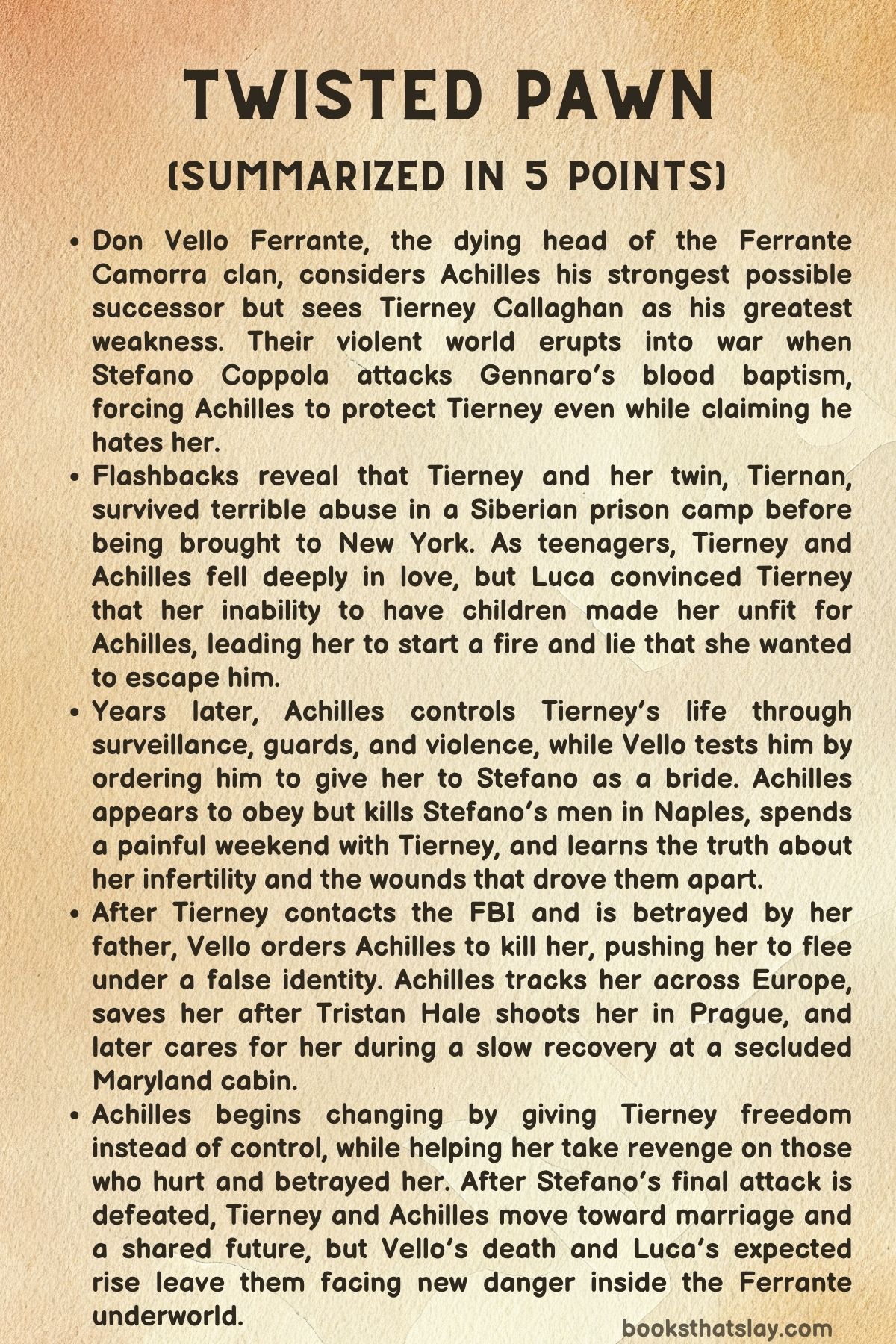
Don Vello Ferrante, the aging head of the Ferrante Camorra clan, knows his time is running out. As death approaches, he must decide who will inherit power after him.
For a long time, he believes his brutal second son, Achilles, is the strongest choice. Achilles is feared, loyal to the clan, and capable of extreme violence, but Vello sees one dangerous flaw in him: Tierney Callaghan.
Tierney is the reckless daughter of Irish mobster Tyrone Callaghan and the twin sister of Tiernan Callaghan, who is married to Lila Ferrante. Achilles has hated Tierney for years, but he has also never stopped wanting her, protecting her, and obsessing over her.
Vello understands that this attachment could destroy Achilles as a future don.
The present story opens in Naples at the blood baptism of Gennaro, the infant son of Tiernan and Lila. The Ferrantes observe a savage tradition in which a child is baptized in an enemy’s blood.
During the ceremony, Achilles slits the throat of a rival underboss over the baptismal font. The act confirms the Ferrantes’ cruelty and their belief that blood, power, and family are inseparable.
The ceremony soon turns into open warfare when Stefano Coppola, known as Sangue Blu, attacks the church with his men. Gunfire breaks out, smoke fills the building, and a headless corpse mounted on a booby-trapped horse is sent into the nave.
In the chaos, Achilles immediately protects Tierney. He hides her beneath a pew, gives her a gun, and later uses his own body to shield her from an explosion.
Tiernan protects Lila and their children, while Tierney manages to shoot a gunman who threatens them. The attack is not just an ambush but a formal declaration of war against the Ferrante clan.
It also exposes the truth Achilles tries to hide: no matter how much he claims to hate Tierney, he cannot let her die.
The past explains why their connection is so complicated. Tierney and her twin, Tiernan, survived terrible abuse in a Siberian prison camp before their father brought them to New York.
In the camp, a boy named Alex Rasputin, also called Lyosha, helped them survive. He protected them, taught them, and gave them matching tattoos before their escape.
After arriving in America, Tierney remains damaged by what happened to her. She is haunted by nightmares, loneliness, and the feeling that no place is safe.
Achilles first enters her life when they are both fourteen. He finds her in her bedroom after a nightmare, covers her with a blanket, and stays silently until morning.
From there, a bond forms between them. Achilles brings her gifts, teaches her English, watches over her, and becomes the first person outside her twin who makes her feel protected.
Tierney calls him Chelovek, meaning “human,” because he feels like the first safe and real person in her life. As they grow older, their closeness turns into love.
Their teenage relationship collapses because of fear, manipulation, and sacrifice. Luca Ferrante tells Tierney she can never be a proper wife for Achilles because she cannot give him heirs.
Tierney has no uterus because of what was done to her in the camp, and she believes this makes her unfit to stand beside Achilles if he is expected to become don. Rather than tell him the full truth, she decides to remove herself from his life.
She starts a fire, intending to die and make her death look accidental so Achilles can move on. Achilles saves her but suffers severe burns.
When he wakes in the hospital, Tierney lies and tells him she started the fire because she wanted to escape him. Broken by the lie, Achilles ends their relationship and vows to ruin her life, though he never stops loving her.
Years later, Achilles has made good on that vow in terrible ways. He stalks Tierney, watches her apartment, places guards around her, controls her movements, and kills many of the men she sleeps with.
He claims ownership even while refusing to openly claim her as his partner. Tierney lives in anger, pain, and defiance, resenting Achilles for his control while still being emotionally bound to him.
After the baptism attack, Vello and Luca negotiate with Stefano Coppola. Stefano demands drugs, territory concessions, and Tierney as his wife.
Tiernan believes that marriage to Stefano may give Tierney a chance at a new life away from New York and away from Achilles’s control, so he agrees to the match. Vello then offers Achilles the future leadership of the Ferrante clan if he gives Tierney up.
Achilles appears to accept and is ordered to personally deliver her to Coppola as proof that she is not his weakness.
Achilles tells Tierney he has found her a husband. She is crushed when she realizes he is not choosing her for himself.
Tiernan drives her to the plane, insisting the marriage may be best for her. On the flight to Italy, Tierney provokes Achilles and then offers him a bargain: she will spend one weekend with him if he stops the wedding and lets her go afterward.
Achilles accepts. When they land in Naples, he kills Coppola’s men who have come to collect her and takes Tierney away.
During their weekend together, Achilles and Tierney fight, sleep together, and reopen wounds neither of them has ever healed. Tierney finally tells him she cannot get pregnant because she has no uterus.
Achilles realizes that this truth explains part of why she pushed him away when they were younger. He begins to understand that the fire was not the simple betrayal he believed it to be, but he still does not know the whole truth.
When they return to New York, Achilles lets Tierney go because he tells himself she deserves freedom. Hurt and angry, Tierney contacts FBI Agent Tom Rothwell, who has long tried to persuade her to turn against the Ferrantes.
She gives him evidence while trying to protect Tiernan, Lila, Enzo, and others. Her father, Tyrone, betrays her by telling Vello that she went to the FBI.
Tiernan brings Tierney to the Ferrante mansion to negotiate her survival. Vello demands that she kneel and kiss his ring.
Instead, Tierney bites off his finger. Luca tries to kill her, but Achilles points his gun at Luca and forces the room to let Tierney leave.
Vello then orders Achilles to hunt her down and kill her.
Tierney flees with a forged passport under the name Louise Fisher. She dyes her hair, takes cash, and goes to Venice, hoping Achilles will follow so she can kill him first.
Achilles tracks her with help from Jeremie Rasputin’s hacking skills. In Venice, they confront each other while wearing masks.
They fight, Tierney injures him, and Achilles carries her to a cheap hotel instead of killing her. He then tries to send her away and plans to marry Katya Rasputin to satisfy his father, but he secretly keeps following Tierney.
In Prague, Tristan Hale, the assassin Vello hired as backup, shoots Tierney in the head from behind. The bullet fractures her skull but does not enter her brain.
Achilles chooses to save her instead of chasing Tristan.
Tierney wakes in a New York hospital, where Lila tells her she survived. Achilles visits and admits Tristan shot her.
He also reveals he told Vello he will not marry Katya. Tiernan, Lila, Achilles, and others retaliate against Vello so violently that his authority weakens.
Achilles then takes Tierney to a secluded cabin in Maryland to help her recover. At first, she is nearly catatonic, but he bathes her, feeds her, supports her through flashbacks, and helps her slowly return to herself.
When she is stronger, he brings her back to Tiernan and Lila, and she tells him not to contact her again.
Achilles does not disappear, but he changes his approach. He stops stalking her and tries to prove he can respect her freedom.
Tierney forces him to face the harm he caused, especially the way he treated control as love. Achilles tells her that Luca was the person who convinced her she could never be his wife.
Tierney finally reveals the real reason she started the fire: she meant to die because she thought Achilles would be better without her. This truth reshapes their understanding of the past.
Achilles helps Tierney take revenge on the men who abused her in Russia. He also keeps Tyrone imprisoned in the Ferrante basement for betraying her.
Tierney eventually watches her father die from a snakebite arranged by Achilles. His death closes one part of her painful history, though it does not erase what he allowed, caused, or failed to protect her from.
Stefano Coppola later returns to attack Achilles’s apartment. Tierney disobeys Achilles and goes after Stefano herself, killing several of his men before she is captured.
Achilles arrives in time, and Tierney helps fight back. Stefano shoots her, but her protective vest saves her.
Achilles then breaks Stefano’s neck, ending the immediate threat from Coppola and weakening the rival clan’s challenge.
Tierney moves into Achilles’s apartment. Their relationship does not become simple or easy, but both begin therapy and try to live together without repeating their old patterns.
Achilles arranges for her belongings to be brought from her former apartment and starts showing her that he wants a future based on choice rather than ownership. He later proposes on a plane, presenting her with the home and life he hopes to build with her.
Tierney accepts.
They marry quietly in Naples with family and friends present. By the epilogue, Achilles is leading Ferrante interests in Naples, but the political danger is not over.
Enzo calls to say Don Vello has died and the clans are looking for the new don. Luca is expected to be crowned head of the Ferrante underworld, and Achilles and Tierney prepare to return for the funeral.
They know the event may bring more violence, but they face it together.
Characters
Tierney Callaghan
Tierney Callaghan is one of the most damaged and defiant figures in the book, shaped by abuse, survival, betrayal, and a lifelong need to control her own fate. Her childhood in the Siberian prison camp leaves her with nightmares, trauma, and a deep fear of being trapped again.
She often responds to pain with recklessness because danger feels more familiar to her than safety. Her inability to have children becomes a source of shame because Luca weaponizes it against her, convincing her she would ruin Achilles’s future.
Tierney’s choice to start the fire is not simple cruelty; it comes from self-hatred and a mistaken belief that her death would free Achilles. In the present, she refuses submission even when it could save her life, as shown when she bites Vello’s finger instead of kissing his ring.
Her journey in Twisted Pawn is about reclaiming agency after years of being treated as a weakness, a bargaining chip, or a possession.
Achilles Ferrante
Achilles Ferrante is violent, obsessive, loyal, and emotionally scarred by the loss he thinks Tierney caused. He is raised in a world where power means control, and he carries that belief into his relationship with Tierney.
His love for her is real, but for much of the story it expresses itself through surveillance, possession, intimidation, and punishment. He stalks her, interferes with her life, and kills men around her because he cannot bear the thought of her belonging to anyone else.
Yet Achilles is also repeatedly unable to harm her when ordered to do so, proving that his attachment is stronger than his loyalty to Vello. His growth comes when he recognizes that protecting Tierney is not the same as owning her.
By stopping his stalking, accepting therapy, and giving her space to choose him freely, he begins to separate love from domination. He remains dangerous, but he becomes more honest about his damage and his need to change.
Don Vello Ferrante
Don Vello Ferrante represents the old Camorra order, where family, blood, obedience, and violence matter more than individual happiness. As the dying head of the Ferrante clan, he measures people by their usefulness and weaknesses.
He sees Achilles as a strong potential successor but views Tierney as the flaw that could compromise him. Vello’s cruelty is not impulsive; it is strategic.
He tests Achilles by ordering him to give Tierney to Stefano and later by ordering him to kill her. Vello’s demand that Tierney kneel and kiss his ring shows his need to dominate not only enemies but anyone who threatens his authority.
When Tierney bites off his finger, she humiliates him and exposes the limits of his control. In the book, Vello functions as the force trying to turn Achilles into a ruler without softness, but his failure lies in misunderstanding that Achilles’s love for Tierney is not removable.
Tiernan Callaghan
Tiernan Callaghan is Tierney’s twin brother and one of the few people who truly understands the horror of her past. Their shared survival in the Siberian camp gives them a bond that is deeper than ordinary sibling loyalty.
However, Tiernan’s choices are not always easy to admire. His decision to agree to Tierney’s marriage to Stefano comes from a complicated place: he wants her away from Achilles’s control and believes a different life might save her, but he still treats her future as something that can be negotiated by men around her.
Tiernan is protective of Lila and their children, and he acts decisively during the baptism attack. He also brings Tierney to the Ferrante mansion to negotiate after her FBI betrayal, showing that he still tries to keep her alive even when the situation is dangerous.
Tiernan is loyal, damaged, and pragmatic, but his protectiveness can become controlling when he assumes he knows what freedom should look like for Tierney.
Lila Ferrante
Lila Ferrante brings emotional steadiness into a violent world ruled by men who often confuse loyalty with brutality. As Tiernan’s wife and Gennaro’s mother, she stands at the center of the Ferrante and Callaghan family connection.
During the church attack, she becomes one of the people Tiernan is desperate to protect, but she is not only a passive figure in danger. She later supports Tierney after the shooting, giving her news of her survival and remaining present through the aftermath.
Lila’s role is important because she offers Tierney a kind of female loyalty that is not based on rivalry or control. She understands the family’s violence but still holds onto care, patience, and emotional intelligence.
In Twisted Pawn, Lila helps show that survival inside a mafia family does not always mean becoming cold. She is a reminder that tenderness can exist even in a ruthless environment, though it must constantly defend itself.
Luca Ferrante
Luca Ferrante is one of the quiet architects of Tierney and Achilles’s suffering. His greatest act of damage comes when he convinces young Tierney that she can never be worthy of Achilles because she cannot give him heirs.
He understands exactly where to strike: Tierney’s shame, trauma, and fear of ruining the person she loves. Unlike characters who use open violence, Luca uses emotional cruelty and social expectations to break people.
His attempt to kill Tierney after she bites Vello’s finger shows that he remains loyal to the family power structure and sees her as a threat that should be eliminated. Luca’s expected rise after Vello’s death signals further danger because he is not simply a rival; he is someone who has already shaped the central wound between Tierney and Achilles.
His power comes from manipulation, inheritance, and his ability to present cruelty as family duty.
Stefano Coppola
Stefano Coppola, also known as Sangue Blu, is the external enemy whose war against the Ferrantes accelerates the central conflict. His attack on the baptism is designed to insult, frighten, and weaken the Ferrante clan at a symbolic family ceremony.
He understands the power of spectacle, using gunmen, smoke, and a booby-trapped corpse to make his threat impossible to ignore. His demand for Tierney as a wife is not romantic; it is a power move meant to claim leverage over both the Ferrantes and Achilles.
Stefano treats Tierney as a prize that can prove dominance over his enemies. His later attack on Achilles’s apartment confirms that he is not satisfied with negotiation or temporary advantage.
His death at Achilles’s hands removes an immediate rival, but his role in the story is larger than that. He exposes how women in this criminal world are often used as payment, punishment, alliance, or insult.
Tyrone Callaghan
Tyrone Callaghan is a father whose failures and betrayals mark Tierney deeply. He brings Tierney and Tiernan to New York after their suffering in Siberia, but that act does not make him a true protector.
His history with them is shadowed by what they endured and by his inability or unwillingness to give Tierney the safety she needed. His worst betrayal comes when he tells Vello that Tierney went to the FBI.
By doing so, he places his own daughter in mortal danger and proves that family loyalty means little when weighed against his self-interest or fear. Achilles’s decision to imprison him and arrange his death by snakebite is brutal, but within the story’s moral world, it becomes part of Tierney’s revenge.
Tyrone represents the kind of parent whose blood connection gives him power over a child, but whose actions destroy any claim to love or trust.
Alex Rasputin / Lyosha
Alex Rasputin, known as Lyosha, belongs to Tierney and Tiernan’s earliest memories of survival. In the Siberian prison camp, he protects them, teaches them, and helps them hold onto identity in a place designed to strip people of it.
His matching tattoos for the twins become a lasting symbol of loyalty and shared endurance. Lyosha’s importance is not measured by present-day power but by the role he plays in keeping Tierney and Tiernan alive when they are at their most vulnerable.
He represents a form of protection that predates Achilles and differs from Achilles’s later possessive behavior. Lyosha helps without trying to own Tierney.
Because of that, his memory carries a rare purity in a story full of transactional alliances, family betrayals, and violent debts. He stands as proof that even in the worst conditions, human connection can become a lifeline.
Jeremie Rasputin
Jeremie Rasputin serves as a practical ally in the present-day conflict, especially through his hacking skills. Achilles relies on him to track Tierney after she flees under a false identity.
Jeremie’s role shows how power in the criminal world is not limited to guns, soldiers, and old family names. Information is also a weapon, and his ability to locate people makes him valuable.
His involvement also connects the present action to the wider Rasputin network, which is tied to Tierney’s past through Lyosha and to Achilles’s attempted political solution through Katya. Jeremie is not as emotionally central as Tierney or Achilles, but he supports the machinery that keeps the plot moving.
His skills help Achilles find Tierney, though that help also raises questions about privacy, pursuit, and whether Achilles has truly learned to let Tierney make her own choices.
Tristan Hale
Tristan Hale is the assassin hired by Vello as a backup when Achilles cannot be trusted to kill Tierney. His attack in Prague is cold, professional, and almost fatal.
By shooting Tierney from behind, he becomes the physical instrument of Vello’s order and the clearest proof that Vello’s threat is not symbolic. Tristan’s role also forces Achilles into a defining choice.
Achilles can chase the man who shot Tierney or save Tierney’s life. He chooses Tierney, and that choice openly places him against his father’s command.
Tristan does not need much emotional history to matter in the story because his function is sharp and decisive. He turns Vello’s suspicion into action and pushes Achilles past the point where he can pretend to obey the clan while protecting Tierney in secret.
Katya Rasputin
Katya Rasputin represents the life Achilles might choose if he surrendered fully to family expectation. His planned marriage to Katya is not driven by love but by strategy, obedience, and the need to satisfy Vello.
In that sense, Katya is less a romantic rival than a symbol of the future Achilles is expected to accept: a politically useful wife, a controlled household, and a clean break from Tierney. Achilles’s refusal to marry her becomes important because it marks a public rejection of the path designed for him.
Katya’s presence also highlights the difference between a marriage arranged for power and a relationship built through pain, history, and choice. Even though she is not the emotional center of the book, her role helps clarify what Achilles must give up if he wants Tierney.
Enzo Ferrante
Enzo Ferrante appears as part of the broader Ferrante family structure and becomes important near the end when he calls Achilles with news of Vello’s death. His message signals that the private struggles between Achilles and Tierney are about to collide again with clan politics.
Enzo’s role reflects the constant pressure of family duty in the story. No matter how far Achilles and Tierney move toward healing, the Ferrante underworld continues to pull them back into danger.
Enzo’s call also shifts the ending from personal resolution to political uncertainty. With Luca expected to be crowned and the clans searching for a new don, Enzo helps set up the sense that violence is not finished.
His presence reinforces that in this world, family news is rarely just family news; it is often a warning.
Themes
Love, Possession, and Freedom
Achilles and Tierney’s relationship is built on love, but for much of the story that love is poisoned by control. Achilles protects Tierney, but he also stalks her, monitors her apartment, controls her guards, and kills men who enter her life.
His behavior shows how easily devotion becomes possession when a person is raised to believe that power means ownership. Tierney wants Achilles, but she also knows that love without freedom is another kind of cage.
Her demand that he stop stalking her is one of the most important emotional turning points because it forces him to prove change through restraint rather than violence. Twisted Pawn treats love as something that must be chosen freely, not forced through fear, guilt, or obsession.
Achilles begins to grow only when he understands that keeping Tierney alive is not enough. He must also allow her to live as her own person, even if that means risking rejection.
Trauma and the Fight to Reclaim the Self
Tierney’s trauma is not limited to memory; it shapes her body, choices, fears, and relationships. The abuse she suffered in the Siberian camp leaves her with nightmares and a damaged sense of worth.
Her inability to have children becomes another wound because others use it to define her value. Luca’s cruelty works because it turns her private pain into a reason she believes she should disappear from Achilles’s life.
Her suicide attempt through the fire comes from a belief that she is saving him from a future ruined by her. Later, after being shot, she enters a near-catatonic state, showing how trauma can return the body to helplessness even after years of fighting.
Her recovery at the cabin is slow and physical, built through bathing, eating, patience, and presence. The story presents healing not as a sudden cure but as a difficult return to the self after years of being treated as broken.
Family Loyalty and Betrayal
Family in the novel is both shelter and weapon. Tierney’s deepest bond is with Tiernan, who survived the camp with her and continues to protect her, yet even he makes decisions about her future without fully respecting her choice.
Vello treats family as a system of obedience, testing Achilles by demanding that he sacrifice Tierney for power. Luca uses family expectations to convince Tierney that she is unworthy, and Tyrone betrays his own daughter by exposing her contact with the FBI.
The story repeatedly shows that blood ties do not guarantee safety, love, or loyalty. Some of the cruelest harm comes from fathers, brothers, and clan elders who claim authority over the lives of others.
At the same time, chosen loyalty appears through Lila, Lyosha, and eventually Achilles when he rejects Vello’s orders. The book separates real loyalty from blind obedience, showing that family can only mean something when it protects rather than consumes.
Power, Succession, and the Cost of Rule
The Ferrante succession conflict turns personal relationships into political tests. Vello does not simply ask who is strongest; he asks who can rule without weakness.
To him, Achilles’s love for Tierney is not a human attachment but a defect that must be removed. Stefano’s demand for Tierney as a wife also shows how power in this world is negotiated through bodies, marriages, territory, and humiliation.
Women are treated as bargaining tools, and violence becomes a language used to send messages between clans. Achilles’s possible rise depends on whether he can perform cruelty at the level expected by his father.
Yet the story complicates that idea by showing that ruthless obedience does not make someone stronger. Vello’s authority weakens because he misjudges the loyalty of those around him and underestimates Tierney’s refusal to submit.
The cost of rule is not only bloodshed; it is the pressure to destroy whatever remains human in the person expected to lead.