Quiet Obsession Summary, Characters and Themes
Quiet Obsession by I.A. Dice is a dark college romance centered on Millie Ward, a young woman trying to rebuild herself after a deeply humiliating betrayal. At Gravemont College, she is surrounded by her protective brother Hyde and his intense circle of friends, but it is Creed, a fighter carrying his own brutal past, who unsettles her most.
The book focuses on silence, shame, desire, control, jealousy, and recovery. Its emotional core lies in two damaged people recognizing each other’s pain while struggling to decide whether love can be safe when it is also overwhelming.
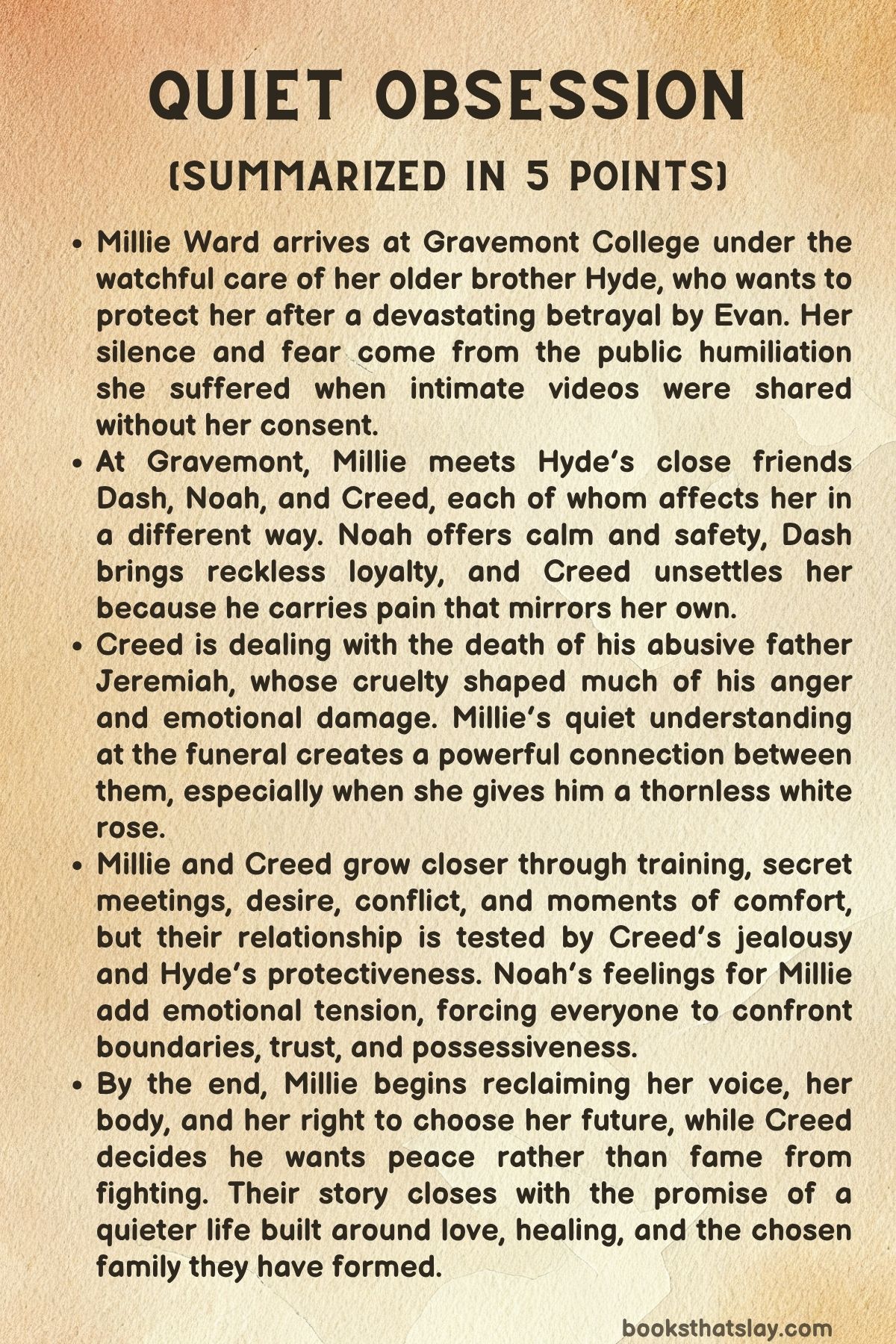
Summary
Quiet Obsession begins with Millie Ward arriving at Gravemont College under the care of her older brother, Hyde. Hyde has arranged her enrollment and placed her in North Wing, the senior dorm where he lives, so he can keep her close.
From the beginning, Millie is quiet, withdrawn, and clearly marked by something terrible that happened before college. She speaks to Hyde more easily than to anyone else, but even with him, there is strain beneath their bond.
Hyde’s care comes from love, but also from guilt. He knows he failed her when she needed him most.
Millie’s past is slowly revealed as the reason for her silence. She was manipulated by Evan, a boy who earned her trust, secretly recorded intimate moments, shared the videos online, and turned her into the target of public humiliation.
The damage was so severe that Millie attempted an overdose. Hyde carries the weight of having ignored her calls on the night her life collapsed.
His failure created a wound between them that neither sibling fully knows how to repair.
At Gravemont, Millie is introduced to Hyde’s closest friends. Dash is charming, reckless, and chaotic, the kind of person who hides loyalty behind jokes and wild behavior.
Noah is quiet, controlled, and watchful, someone who understands boundaries and offers Millie comfort without forcing her to explain herself. Creed is absent at first because his abusive father, Jeremiah, has died.
Millie also meets Abby, her cheerful freshman roommate, who quickly becomes friendly with her despite Millie’s guarded nature.
Millie’s first connections at college form slowly. She begins spending time with Noah and Dash, and chess becomes one of the ways she interacts with Noah.
Their time together is calm and structured, giving Millie a sense of safety. When Creed calls Hyde while drunk and emotionally unstable after Jeremiah’s death, Millie convinces Hyde to go help him.
She stays behind with Noah and Dash, a small but important step because it shows she can survive Hyde’s absence, even if only briefly.
Creed’s life is shaped by years of violence from Jeremiah. His father was cruel, abusive, and powerful in the ugliest way.
When Jeremiah suffers a heart attack, Creed watches him die and delays calling for help until he knows Jeremiah cannot be saved. This moment does not make Creed feel free in a simple way.
It leaves him with anger, relief, disgust, and the bitter knowledge that even death cannot erase the damage Jeremiah caused. Hyde helps Creed arrange the funeral, which is intentionally plain and stripped of honor.
There are no military tributes, no grand casket, and no false praise.
Millie, Dash, and Noah travel to Seattle for Jeremiah’s funeral. Millie meets Creed there and is immediately shaken by him.
She cannot speak around him, even though she has managed to speak to Noah and Dash. Creed’s presence affects her differently.
He sees her without softening himself for her, and that scares and draws her at the same time. At the funeral, Creed’s aunt Greta criticizes the bare burial, but Creed confronts her for knowing about Jeremiah’s abuse and doing nothing.
The friends mark Jeremiah’s death in their own defiant ways. Dash urinates on the grave, they drink Jeremiah’s prized bourbon, and Millie removes the thorns from a white rose.
She drops the thorns into the grave and gives Creed the flower, silently showing that she understands the difference between what is beautiful and what has caused pain.
After the funeral, the tension between Millie and Creed grows. At Creed’s house, Hyde, Noah, and Dash try to handle Millie gently, especially when she refuses to eat.
Their worry becomes pressure, and Millie shuts down. Creed responds differently.
He orders her to sit and eat, not treating her as breakable. Millie obeys, and the moment unsettles everyone.
Creed realizes that Millie does not always respond to softness. Sometimes she pushes against people who handle her too carefully, but she reacts when someone refuses to collapse under her silence.
Back at Gravemont, Millie tries to build a life while still being haunted by the past. Rumors spread about Hyde’s silent little sister, and she fears that the videos Evan posted will resurface.
Abby’s romantic chaos often pushes Millie out of their room, sending her to the library or toward Noah’s quiet company. Noah becomes a steady presence.
During one intimate moment, things move further than Millie can handle, but Noah stops the instant she asks. He gives her his bed and sleeps elsewhere, proving that closeness does not have to mean pressure.
Millie is also drawn into the hidden fight nights at Gravemont’s abandoned theater, where Creed dominates in the cage. Watching him fight awakens something in her.
Creed’s violence is controlled, direct, and honest in a way that contrasts with the hidden violation she suffered from Evan. Creed notices her too, and his attraction grows alongside jealousy, especially when he sees how easily Noah comforts her.
He resists his feelings because Millie is Hyde’s sister, but his restraint begins to fail.
Creed starts training Millie in boxing and strength work. The gym becomes a place where she can use her body without feeling trapped by it.
Through exercise, she begins meeting fear with effort instead of retreat. During one session, she calls Creed “Eli,” a name only his mother used.
Creed tells her that the name is now hers, making it a private bond between them. Their attraction finally breaks during a hidden encounter in the gym equipment closet.
Millie feels powerful afterward, as if she has made a choice for herself rather than having something taken from her. Creed, however, panics when he realizes she was a virgin and sees blood.
His fear turns into anger, and he lashes out. Millie says she hates him, and Creed spirals into a violent bar fight that leaves him hospitalized.
The aftermath forces both of them to face what they are doing to each other. Flashbacks show that Creed has known about Millie’s overdose longer than she realized.
He was with Hyde when Hyde learned what happened and saw her unconscious in the hospital. Even before properly meeting her, Creed had been affected by her pain.
After the gym incident, Millie struggles with shame because Abby worries the bruises on her body mean she was hurt. Millie’s own feelings are more complicated.
To her, those marks are tied to choice, strength, and being fully present in her body again.
Millie and Creed slowly reconnect through secret meetings, kisses, sex, and moments of quiet comfort. She begins sketching again and designs a tattoo for Creed, showing that her creativity is returning along with her voice and confidence.
She also speaks with her former psychiatrist, who helps her question whether being seen is always dangerous or whether she can survive visibility without letting fear control her.
Hyde begins to realize that Millie and Creed are involved, and his protectiveness leads to conflict. He wants Millie safe, but his idea of safety often feels like control.
Noah also has feelings for Millie, and Creed’s jealousy becomes sharper because Noah knows how to respect Millie’s limits. Millie’s recurring dreams involving both men intensify Creed’s insecurity.
He wants Millie entirely, but he also understands that Noah reaches a part of her that cannot be dismissed.
At a fight-night party, Creed sees Millie and Noah together and misreads their closeness. Instead of asking what is happening, he reacts from jealousy and fear, kissing Flora in front of everyone.
Millie is devastated and runs. Noah punches Creed, and Hyde’s guilt erupts into anger.
Millie finally confronts Hyde about how deeply he hurt her before Evan ever entered the picture. She tells him that Evan pressed on wounds Hyde had already created when he shut her out years earlier.
This confrontation is painful but necessary because it forces Hyde to see that love does not erase neglect.
Heartbroken, Millie decides to transfer away from Gravemont. Creed stops her and apologizes, and they reconcile during an intense night together.
Their relationship does not become simple, but they stop pretending they can avoid what they mean to each other. Creed later works to repair his bond with Hyde.
Noah helps Hyde understand that Creed loving Millie does not mean Hyde is losing him. It may mean they are becoming family in a new way.
Hyde and Millie also begin repairing their sibling relationship, though their progress is uneven. They argue, test each other, and slowly learn how to remain connected without repeating old damage.
Eventually, Creed admits that Millie’s dreams and desires involving Noah cannot be ignored forever. Millie, Creed, and Noah share one night together.
For Creed, the experience is difficult because sharing Millie costs him emotionally, but it also shows him Noah’s care and respect. By morning, Creed and Millie reaffirm that they belong together, while Noah remains deeply trusted by both of them.
The story ends after time has passed. Creed chooses not to pursue professional fighting because he does not want fame, constant travel, or a life exposed to the public.
After everything he and Millie have survived, he wants peace more than glory. He wants a future built with Millie and their chosen family.
As he and Millie look over a place they plan to make their own, Creed realizes that happiness is no longer something distant or impossible. It is quiet, real, and finally within reach.
Characters
Millie Ward
Millie Ward is the emotional center of the book, a young woman whose silence is not emptiness but survival. After Evan’s betrayal and the public humiliation that followed, she enters Gravemont College carrying shame, fear, anger, and a deep distrust of being seen.
Her near-silence is one of the clearest signs of how trauma has reshaped her life. She does not simply avoid speaking; she avoids exposure, judgment, and the possibility of being hurt again.
Yet Millie is not written as weak. Her quietness hides a sharp awareness of people, and her gestures often say what words cannot.
The white rose she gives Creed after removing its thorns shows her ability to understand pain with startling clarity. Her relationship with Creed pushes her toward parts of herself she has buried, especially her need for control over her body and choices.
Noah gives her safety, Hyde gives her protection mixed with guilt, and Creed gives her confrontation. Across the book, Millie’s journey is about reclaiming agency.
She begins sketching again, trains physically, speaks hard truths to Hyde, and learns that desire does not have to belong to the person who harmed her. In Quiet Obsession, Millie’s growth is uneven and messy, which makes it feel more honest.
Creed
Creed is one of the darkest and most emotionally damaged figures in the novel, shaped by Jeremiah’s lifelong abuse and by the complicated relief of surviving his father. His decision to delay calling an ambulance while Jeremiah dies reveals how much hatred, exhaustion, and pain he has carried.
Creed is not simply violent; he is a man who has learned violence as a language because tenderness was made unsafe in his childhood. The cage gives him control over pain, anger, and power, but Millie unsettles him because she sees beyond the fighter.
He recognizes something in her silence because he understands what it means to live after someone has tried to break you. His treatment of Millie is often harsh compared with Hyde’s and Noah’s carefulness, yet that harshness sometimes reaches her because he refuses to treat her as helpless.
Creed’s flaws are significant. His jealousy, possessiveness, panic, and self-destructive behavior hurt Millie, especially when he kisses Flora out of insecurity.
Still, he is capable of remorse and change. By the end of Quiet Obsession, his choice to walk away from professional fighting shows that he no longer wants a life built around spectacle.
He wants a private future, emotional safety, and a home with Millie.
Hyde Ward
Hyde Ward is Millie’s older brother, protector, and one of the people most responsible for the emotional conditions that left her vulnerable before Evan’s betrayal. His love for Millie is obvious, but it is tangled with guilt and control.
By pulling strings to get her into Gravemont and placing her in North Wing, he tries to keep her close enough to protect her from everything that once harmed her. The problem is that Hyde often mistakes protection for repair.
He cannot undo the night he ignored her calls, and his guilt makes him overcorrect by treating Millie as if she might collapse at any moment. His friendship with Creed, Dash, and Noah shows that Hyde is loyal and deeply connected to his chosen family, but Millie’s presence forces him to confront old failures.
His hardest moment comes when Millie tells him that Evan exploited wounds Hyde had already made by shutting her out years earlier. That accusation changes Hyde’s role in the story.
He is no longer just the guilty brother trying to keep danger away; he becomes someone who must admit that he was part of the harm. His eventual acceptance of Creed and Millie’s relationship suggests growth, but it does not erase the difficult work still ahead between him and his sister.
Noah
Noah is controlled, quiet, and emotionally careful, making him one of the safest people in Millie’s new life at Gravemont. Unlike Hyde, he does not smother her with anxious protection, and unlike Creed, he does not challenge her with intensity from the start.
Noah offers steadiness. His chess games with Millie create a space where communication can happen without pressure, and his ability to stop immediately when she asks during an intimate moment proves his respect for her boundaries.
That moment is central to his character because it shows that his care is not performative. He wants Millie, but he does not place desire above her safety.
Noah’s feelings for her are clear, and this complicates his friendship with Creed, yet he rarely behaves as if Millie is something to be won. He also becomes a bridge between others, especially when he helps Hyde understand that Creed’s relationship with Millie does not have to mean abandonment.
Noah’s presence in Millie and Creed’s relationship adds emotional tension, but it also reveals the difference between possessiveness and trust. He is a character who understands longing, restraint, and loyalty, and his role remains important even when Millie ultimately chooses Creed.
Dash
Dash brings chaos, humor, and fierce loyalty into the book. At first glance, he can seem like the reckless friend whose purpose is to lighten dark moments, but his behavior often reveals a deeper emotional commitment to the people he loves.
His reaction at Jeremiah’s grave is crude, but it is also an act of rage on Creed’s behalf. By urinating on the grave and joining the others in rejecting Jeremiah’s false dignity, Dash makes it clear that he has no interest in pretending an abuser deserves respect simply because he is dead.
Dash’s wildness contrasts with Noah’s calm and Hyde’s anxious control, giving the friend group a different kind of energy. He may not always know how to help Millie in a careful way, but he accepts her presence and becomes part of the strange, loyal circle surrounding her.
Dash’s importance lies in the way he refuses polite lies. He reacts honestly, sometimes outrageously, but usually from a place of love.
In a story filled with secrecy, shame, and suppressed pain, Dash often acts as the person who breaks tension by doing what others are too restrained to do.
Abby
Abby is Millie’s roommate and one of the few people at Gravemont who approaches her without the heavy knowledge of her past. Her cheerfulness gives Millie access to a more ordinary version of college life, even though Abby’s romantic misadventures often make their shared room feel unstable.
Abby does not always understand Millie’s trauma, and her concern over the bruises on Millie’s body shows the gap between how things appear from the outside and how Millie experiences them internally. Still, Abby’s reaction matters because it forces Millie to think about how complicated her own sense of choice has become.
Abby represents the outside world’s instinct to categorize visible signs as harm, while Millie is trying to understand moments that feel tied to agency rather than victimhood. Abby is not part of the central emotional triangle between Millie, Creed, and Noah, but she plays an important role in showing how Millie exists among people who do not know every detail of her history.
Through Abby, the book shows the difficulty of reentering ordinary social life after trauma, especially when ordinary friendships still come with confusion, awkwardness, and unintended pressure.
Evan
Evan is the source of Millie’s public trauma and one of the clearest villains in the story, even though his presence is mostly felt through what he has done. He manipulated Millie’s trust, secretly recorded intimate moments, and posted them online, turning private vulnerability into public cruelty.
His actions are not just betrayal; they are a violation of consent, privacy, and identity. Evan’s importance comes from the lasting damage he leaves behind.
He makes Millie afraid of being watched, judged, desired, and exposed. His abuse also reveals how existing wounds can be exploited.
Millie later recognizes that Evan did not create every part of her pain from nothing; he pressed into loneliness and abandonment that already existed because of Hyde’s emotional absence. That does not reduce Evan’s responsibility.
Instead, it shows how predatory people often find weak points and use them. Evan functions as the shadow over Millie’s new life at Gravemont.
Even when he is not physically present, the fear of discovery and humiliation follows her. His role in the book is to show how a single act of calculated cruelty can fracture someone’s relationship with their body, voice, and future.
Jeremiah
Jeremiah is Creed’s father and the force behind much of Creed’s rage, violence, and emotional damage. Though he dies early in the story, his presence remains powerful because abuse does not end neatly with the abuser’s death.
Jeremiah’s cruelty shaped Creed’s childhood and trained him to associate power with fear. His heart attack creates a morally loaded moment for Creed, who waits before calling for help because part of him needs to know Jeremiah is truly gone.
That choice shows how deeply Jeremiah destroyed the normal bond between father and son. The funeral becomes a rejection of everything Jeremiah might have wanted: honor, respect, military ceremony, and public dignity.
Creed refuses to dress his father’s life in lies. Jeremiah’s role is also important because he exposes the failure of bystanders.
Greta’s condemnation at the funeral is hollow because she knew about the abuse and did nothing. Through Jeremiah, the book examines how violence within families can be hidden, excused, or ignored until the survivor is left to carry the full burden.
He is dead for much of the story, but his damage lives inside Creed until Creed begins choosing a different future.
Greta
Greta, Creed’s aunt, represents the hypocrisy of family members who protect appearances rather than victims. Her outrage over Jeremiah’s plain funeral is not rooted in justice or love; it is rooted in image.
She wants Jeremiah buried with the honors and dignity she believes he deserves, but Creed’s confrontation exposes her failure. She knew enough about Jeremiah’s abuse to understand what had happened in that house, yet she did not intervene.
Greta’s character is important because she shows that abuse is often sustained not only by the abuser but also by people who look away. Her criticism of the funeral becomes offensive because it asks Creed to honor a man who terrorized him.
In that scene, Greta becomes a symbol of social respectability used as a shield for cruelty. She cares about how death looks more than how life was lived.
Creed’s refusal to accept her judgment is one of his clearest acts of self-defense. By challenging her, he refuses to let the family rewrite Jeremiah into a respectable man simply because the truth is uncomfortable.
Flora
Flora’s role is brief but emotionally significant because she becomes the person Creed uses to wound Millie during a moment of jealousy. Creed kisses her at a fight-night party after misreading Millie and Noah’s closeness, and the act is less about Flora herself than about Creed’s insecurity and self-sabotage.
Flora functions as a catalyst for one of the central ruptures between Creed and Millie. Her presence exposes how quickly Creed can turn pain outward when he feels threatened.
She is not developed as deeply as the main characters, but the scene involving her matters because it forces consequences. Millie sees Creed choose public cruelty in a way that echoes her sensitivity to humiliation and exposure, even though the situation is different from Evan’s betrayal.
Flora’s role also shows the toxic side of possessiveness. Creed does not simply feel hurt; he tries to regain power by making Millie hurt too.
Through Flora, the book creates a turning point where Creed must face the damage caused by jealousy when it is allowed to become punishment.
Millie’s Former Psychiatrist
Millie’s former psychiatrist serves as a voice of clarity during Millie’s recovery. Unlike the people in Millie’s daily life, the psychiatrist is not driven by sibling guilt, romantic desire, jealousy, or friendship.
This distance allows her to ask questions that Millie needs but may not want to face. Her guidance encourages Millie to consider whether being seen is always dangerous or whether she can survive attention without letting it define her.
That question is central to Millie’s growth. After Evan’s betrayal, visibility became linked with shame, exposure, and loss of control.
The psychiatrist helps Millie separate the past from the present and think about what she can tolerate now. She does not give Millie a simple answer or push her toward a single decision.
Instead, she helps Millie examine fear without being ruled by it. Her role is quiet but meaningful because recovery in the book is not only physical or romantic.
It also requires reflection, language, and the ability to ask whether old defenses are still protecting Millie or keeping her trapped.
Themes
Reclaiming Control After Violation
Millie’s story is shaped by the struggle to regain control after Evan’s betrayal turns her private life into public humiliation. Her silence, fear of rumors, and anxiety about being seen all come from the same wound: she was robbed of the right to decide who could know her, watch her, or speak about her.
Quiet Obsession treats recovery as a process of rebuilding choice in small, difficult steps. Millie does not suddenly become confident because she meets Creed, nor is her pain cured by romance.
Instead, she starts reclaiming control through actions that reconnect her to her body and voice. Boxing, training, sketching, speaking hard truths, and choosing intimacy on her own terms all become ways of taking back parts of herself.
The book also shows that control is complicated for someone who has been harmed. What looks concerning from the outside may feel empowering to Millie because the difference lies in consent and choice.
Her journey asks readers to understand that healing is not always gentle or easy to interpret. Sometimes it looks like anger, risk, desire, refusal, or the first attempt to say yes without fear.
The Damage Caused by Protection Without Trust
Hyde’s relationship with Millie shows how protection can become another form of control when it is driven by guilt instead of trust. He loves his sister deeply, but after failing to answer her calls on the night of her overdose, he tries to make up for that failure by keeping her close and managing her life.
His decision to enroll her at Gravemont and place her in North Wing comes from fear as much as care. He wants to prevent another disaster, but in doing so, he often treats Millie as fragile rather than capable.
This creates tension because Millie needs support, not ownership. Hyde must learn that loving someone after trauma does not mean making every decision for them.
It means accepting that they may choose things that scare him, including Creed. The book is strongest in showing that Hyde’s guilt cannot be allowed to become Millie’s cage.
Their confrontation is painful because Millie forces him to understand that his emotional absence wounded her before Evan ever did. Repair between them begins only when Hyde stops seeing himself as her sole protector and starts seeing her as a person with her own agency.
Abuse, Silence, and the Failure of Bystanders
Creed’s history with Jeremiah reveals how abuse survives inside families through fear, denial, and the silence of those who know enough to act but choose not to. Jeremiah’s cruelty shapes Creed long before the story begins, teaching him that power means domination and that pain is something to endure without help.
His death does not bring clean freedom because Creed is left with the emotional habits abuse created. The plain funeral becomes an act of truth-telling.
Creed refuses to give Jeremiah the honor that society might expect, because public respectability would turn his suffering into a lie. Greta’s appearance at the funeral sharpens this theme.
Her outrage over the burial exposes her concern for appearances, while Creed’s accusation reveals that she knew about the abuse and did nothing. The book uses this conflict to show that abusers are often protected by silence as much as by power.
People who look away can become part of the harm, even if they never raise a hand themselves. Creed’s refusal to praise Jeremiah is not pettiness.
It is a survivor rejecting the demand to make an abuser look better in death than he was in life.
Desire, Jealousy, and Emotional Responsibility
The romance at the center of the story is intense because desire is never separated from fear, insecurity, and responsibility. Creed and Millie are drawn to each other partly because they recognize damage in one another, but recognition does not automatically make them safe.
Creed’s desire for Millie often clashes with his possessiveness, especially when Noah is involved. Noah’s connection with Millie is gentle and respectful, which makes Creed feel threatened because he knows Noah can reach her in ways he cannot always manage.
This jealousy becomes destructive when Creed kisses Flora to hurt Millie after misreading a moment between her and Noah. The act shows that passion without emotional discipline can become punishment.
At the same time, the book does not present desire as wrong or shameful. For Millie, desire can be part of recovery when it is chosen freely and respected.
The difficult night involving Millie, Creed, and Noah forces Creed to confront the difference between ownership and trust. By the end, the story suggests that love requires more than wanting someone intensely.
It requires restraint, honesty, apology, and the willingness to stop using pain as a weapon.