Purple State Summary, Characters and Themes
Purple State by Dana Perino is a contemporary political romance about three New York women who leave behind stalled careers, disappointing relationships, and familiar routines to volunteer in a crucial Wisconsin battleground before a presidential election. At its center is Dorothy “Dot” Clark, a public relations worker searching for a life that feels useful, honest, and chosen rather than merely expected.
The book combines campaign work, small-town community, friendship, and romance as Dot, Mary, and Harper discover that political conviction is not separate from personal courage. It is a story about changing plans, taking risks, and redefining home.
Summary
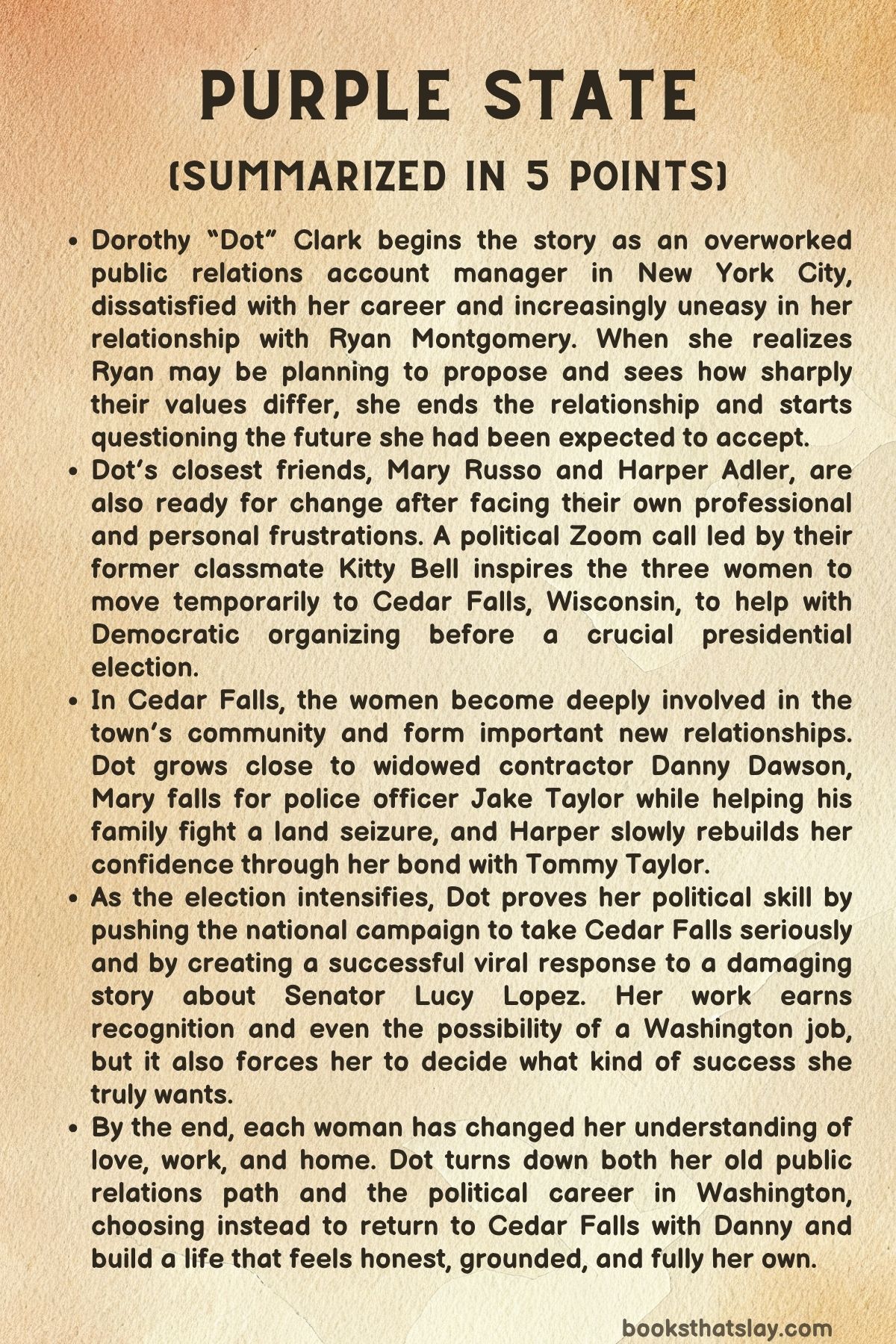
Dorothy “Dot” Clark begins the story in New York City, where her life looks successful from the outside but feels increasingly wrong from within. At twenty-five, she works as a public relations account manager, handling demanding tech clients and trying to satisfy a senior vice president who gives her pressure but little appreciation.
Her professional life is exhausting and unstable, and rumors of layoffs make the future even more uncertain. Her personal life is no steadier.
She is dating Ryan Montgomery, a polished finance man who seems like a safe choice but no longer feels like the right one. When Dot sees signs that Ryan may be preparing to propose, including a Tiffany’s visit and talk of a vineyard weekend, her discomfort becomes impossible to ignore.
Dot’s doubts about Ryan grow sharper during a dinner where his political and social views come into clearer focus. He presents ideas that clash with her values, and Dot recognizes that she is not simply bored; she is looking at a future that would require her to shrink or compromise parts of herself.
Outside the subway near her Upper West Side apartment, she ends the relationship. The breakup is painful but also freeing.
It clears away the illusion that she should accept a life just because it is respectable, stable, or easy to explain to other people.
Dot’s closest friends, Mary Russo and Harper Adler, are also unsettled. Mary is a corporate lawyer from Staten Island who has achieved the kind of career success her family can admire, but she is bored and unsatisfied by the work.
She is also tired of the expectation that she should settle down on someone else’s schedule. A brief hope for romance with Manny at Legal Aid collapses when she learns he has a boyfriend, adding one more disappointment to a life that already feels too tightly controlled.
Harper, meanwhile, teaches English at an elite private school and is still recovering from a humiliating relationship with Kai, a cheating surfer she once followed to Senegal. Her job becomes intolerable when wealthy parents pressure the school over grades, and the headmaster crosses a line by propositioning her while suggesting he can help protect her position.
Harper quits, choosing dignity over security.
The three friends are pulled toward change after Dot hosts a political Zoom call led by Kitty Bell, their former NYU classmate. Kitty now works as director of a Democratic Super PAC called For the Win, and she explains that the party needs volunteers willing to move to battleground states before the next presidential election.
The goal is to gather local knowledge, build connections, and understand communities that could decide the national result. Dot is especially drawn to Cedar Falls, Wisconsin, a politically important suburb near Milwaukee.
The idea gives her something she has been missing: a chance to use her skills for work that feels meaningful.
At first, Mary and Harper are unsure. Moving away from New York for politics sounds extreme, temporary, and impractical.
Yet each woman has her own reason to say yes. Dot is newly single, her job is unstable, and she wants a purpose beyond client management.
Mary can continue her legal work remotely and is restless enough to try something new. Harper has left her teaching job and needs space to rebuild her confidence.
Together, they decide to treat the move as an adventure that will last until the election. In January, they rent a large Craftsman house in Cedar Falls and begin a new chapter far from the lives they had planned.
Dot throws herself into local campaign work. She joins the Democratic office, working with Fletcher Abbott and Rose on For the Win’s Wisconsin operation.
Her public relations background becomes useful as she learns how national politics depends on local trust, patient organizing, and attention to details outsiders often miss. Mary continues her law work from Wisconsin, though she gradually becomes connected to problems in the community around her.
Harper tries to write, heal, and understand what she wants next. The town is not merely a campaign site for them; it becomes a place filled with people, routines, and relationships.
Cedar Falls also brings new romantic possibilities. Dot meets Danny Dawson, a contractor and widower who is connected to Ted and Jeanie Jankowski, the beloved owners of Reader Falls bookshop.
Danny carries grief from his marriage to his late wife, Sadie, but he is kind, capable, and grounded in the town. Mary meets Jake Taylor, a police officer and farmer’s son whose steadiness contrasts with the hollow ambition she has seen elsewhere.
Harper adopts a tiny dog named Pippi and grows close to Tommy Taylor, Jake’s brother, who runs the local bar, the Sin Bin. Tommy’s warmth and humor help Harper relax into a life she did not expect to want.
As the women become more involved in Cedar Falls, they are welcomed into the Taylor family’s world. Joe and Grace Taylor invite them to Sunday supper at the farm, where family, food, and loyalty shape the rhythm of life.
Mary learns that the Taylor farm is under threat from a government-backed manufacturing project that could take the land. Her legal instincts awaken as she begins researching whether the seizure can be challenged.
For the first time in a long while, her legal work feels connected to real people and real consequences. She is not just serving corporate interests; she is helping a family fight for its home.
Dot’s connection to Danny deepens as she helps him renovate Reader Falls bookshop. The project becomes more than a building improvement; it becomes a community effort and a sign of what Cedar Falls values.
Dot sees how local spaces can hold memory, identity, and belonging. Working beside Danny lets her see his patience, skill, and loyalty, and their bond strengthens through ordinary tasks as much as romantic moments.
Harper, meanwhile, spends more time with Tommy through fishing trips, gatherings, and quiet conversations. After the pain caused by Kai, she is afraid of trusting too quickly, but Tommy’s sincerity begins to soften her defenses.
The political campaign becomes more intense as the Democratic primary narrows between Governor Ramsey Stone and Senator Lucy Lopez. Lopez eventually becomes the presidential nominee, with Stone as her running mate.
Dot believes Cedar Falls and its county could play a decisive role in Wisconsin and perhaps the national election. She grows frustrated when Lopez’s campaign overlooks the town, treating it as less important than flashier campaign stops.
Dot refuses to let Cedar Falls be ignored. She pushes for attention, uses her instincts, and proves that local understanding can change political strategy.
One of Dot’s boldest moves comes after a damaging story about Lopez’s personal life threatens to shift the media conversation. Dot creates a risky dating-app-style viral post that reframes the narrative and gives the campaign a fresh way to respond.
The move succeeds, drawing attention for its creativity and speed. Dot’s talent impresses Kitty and eventually Lopez herself.
The campaign begins to see Dot not as a temporary volunteer but as someone with genuine political skill. Lopez even offers Dot a potential job in Washington if the campaign wins, placing Dot in front of a future she once might have considered ideal.
The friends’ relationships complicate their plan to return to New York after the election. Mary falls deeply for Jake, whose loyalty to his family and land gives him a seriousness she respects.
Her research into the farm dispute uncovers possible conflicts involving the law firm behind the land deal, including foreign-client issues and national security concerns. Her work gives the Taylors a way to fight back, and it also gives Mary a clearer sense of the kind of lawyer she wants to be.
Harper and Tommy grow closer, but when Tommy tells her he loves her, Harper panics. She fears being hurt again and worries that choosing him might mean losing the version of herself she built in New York.
Her fear briefly pulls her away from the relationship she actually wants.
Dot faces her own misunderstanding with Danny. When she sees him having dinner with another woman, she assumes the worst and avoids him rather than asking the truth.
Mary urges her to stop hiding and face the situation directly. Dot learns that Danny has not betrayed her, and the misunderstanding forces her to confront how fear can distort what she sees.
Danny loves her, but he also carries the memory of Sadie, and Dot must decide whether she can accept his past without competing with it. Their honesty brings them closer, and before Election Day they finally admit their love.
Election Day arrives with pressure, exhaustion, and uncertainty. Dot works from early morning at the For the Win office as the returns come in.
The race is extremely close, and several states, including Wisconsin, remain undecided late into the night. Dot has spent months organizing, worrying, persuading, and fighting for Cedar Falls, but she reaches a point where she understands that she has done everything within her power.
When Danny arrives outside the office in the snow, Dot chooses not to spend the rest of the night staring at results. She leaves notes for Fletcher and Rose, crosses Election Day off her calendar, and goes home with Danny.
That night, Dot chooses love and presence over endless anxiety. She tells Danny that she accepts Sadie as part of his life and history, not as a rival.
Their commitment marks a personal victory separate from the election result. The story then moves to New Year’s, when the Wisconsin men visit New York with the women.
Mary brings Jake to her family’s Sunday supper, where he fits in with surprising ease, and his notice of an NYPD recruiting poster hints that he may consider a future closer to her world. Harper brings Tommy to meet her family, showing that she is no longer running from a serious relationship or from the possibility of a shared life.
Dot walks the High Line with Danny and realizes that New York, once the center of her identity, no longer defines belonging for her. She has changed too much to return unchanged.
In the epilogue, Dot goes back to Milwaukee with Danny. She has turned down both her old public relations path and the Washington political job, choosing instead to move to Cedar Falls and build a life with him.
Her friends and neighbors welcome her home at Danny’s house. When Danny carries her over the threshold, Dot feels certain that after all her worry, planning, and second-guessing, she has finally chosen the life that fits her.
Characters
Dorothy “Dot” Clark
Dot Clark is the central figure of the book, and her journey is shaped by the tension between the life she is expected to want and the life that slowly proves right for her. At the beginning, she is capable, ambitious, and socially aware, but she is trapped in a public relations job that drains her and a relationship that offers stability without real connection.
Dot’s breakup with Ryan is not only a romantic decision; it is her first major refusal to accept a future that feels false. In Cedar Falls, she begins to use her professional instincts for a cause that matters to her, and the campaign gives her a sense of purpose she never found in client work.
Her growth comes from learning that control and certainty are not the same as happiness. In Purple State, Dot becomes someone who can take risks not because she has stopped worrying, but because she has learned to trust what her choices reveal about her own values.
Mary Russo
Mary Russo is practical, intelligent, and outwardly successful, but much of her life has been shaped by duty rather than desire. As a corporate lawyer from Staten Island, she knows how to meet expectations, work hard, and present herself as someone who has things under control.
Beneath that competence, however, she is restless. Her move to Cedar Falls allows her to rediscover the moral purpose of law.
The Taylor farm dispute gives Mary a problem that is personal, urgent, and human, and her research into the land seizure shows how sharp and determined she can be when justice is at stake. Her relationship with Jake also draws out a more vulnerable side of her.
She is not softened in a simplistic way; rather, she becomes more honest about wanting love, meaningful work, and a future that is not dictated by family pressure or career prestige alone.
Harper Adler
Harper Adler is a character marked by disappointment, self-protection, and gradual renewal. Her past with Kai has left her embarrassed and wary, while her teaching job at the private school shows how institutions can punish people who lack power while protecting those who have it.
When the headmaster propositions her and implies he can shield her career, Harper’s decision to quit becomes an act of self-respect. In Cedar Falls, she is unsure of what she wants, but that uncertainty gives her room to grow.
Adopting Pippi and spending time with Tommy help her reconnect with tenderness, humor, and trust. Harper’s fear after Tommy tells her he loves her is believable because she has already been hurt by misplaced devotion.
Her growth lies in understanding that caution may protect her from pain, but it can also block her from joy.
Danny Dawson
Danny Dawson is steady, generous, and emotionally layered. As a widower, he carries the memory of Sadie not as a closed wound but as a lasting part of who he is.
His work as a contractor and his connection to Reader Falls bookshop show his investment in community and continuity. Danny is not presented as a man who rescues Dot from her uncertainty; instead, he offers a model of patience and grounded love.
His relationship with Dot develops through shared work, honest conversations, and the gradual building of trust. The misunderstanding involving his dinner with another woman reveals Dot’s fears more than his flaws, and his response allows the relationship to move toward maturity.
Danny’s importance in the story comes from the way he helps Dot see that love does not require a clean past or a perfectly planned future. It requires truth, acceptance, and the courage to stay.
Jake Taylor
Jake Taylor represents loyalty, steadiness, and rootedness. As a police officer and a farmer’s son, he belongs deeply to Cedar Falls and to the Taylor family’s land.
His love for Mary is tied to his broader sense of duty: he protects people, honors his family, and understands that home is something maintained through commitment. Jake’s character gives Mary a vision of masculinity very different from the polished, status-driven men around her professional world.
He is not flashy or performative; his appeal lies in reliability, sincerity, and quiet strength. The farm conflict also gives his character emotional weight because the threat to the land is not abstract for him.
It is a threat to memory, family, and identity. His possible willingness to consider New York by the end shows that his rootedness is not rigidity.
He can imagine change when love makes it meaningful.
Tommy Taylor
Tommy Taylor brings warmth, humor, and emotional openness to the story. As the owner of the Sin Bin and Jake’s brother, he is part of the social center of Cedar Falls, but he is more than comic relief or a romantic contrast.
Tommy’s ease with people helps Harper feel safe after a period of humiliation and mistrust. He does not pressure her to become someone else, and his affection grows through shared time rather than grand gestures.
When he tells Harper he loves her, her fear briefly overtakes her, yet his honesty remains important because it asks her to confront the difference between danger and vulnerability. Tommy’s role in the book is to show that love can be light without being shallow.
His steadiness gives Harper a reason to believe that happiness does not always arrive as drama; sometimes it appears as kindness, patience, and a place to return to.
Kitty Bell
Kitty Bell is the catalyst who turns private dissatisfaction into public action. As the director of For the Win, she understands political urgency and the importance of local work in battleground states.
Her Zoom call gives Dot, Mary, and Harper a chance to imagine a different use for their skills and energy. Kitty is ambitious and politically savvy, but she is also practical enough to recognize talent when she sees it.
Her relationship with Dot matters because she helps open the door to a version of Dot’s life that is larger than public relations and more purposeful than passive frustration. Through Kitty, Purple State shows how political movements often depend on networks of young, driven people who are willing to translate belief into labor.
She is not the emotional center of the story, but without her, the women might never have left the lives that were limiting them.
Ryan Montgomery
Ryan Montgomery functions as the embodiment of the future Dot almost accepts. He is handsome, successful, and respectable, which makes him seem like an obvious choice from the outside.
Yet his relationship with Dot lacks the depth and shared values she needs. His possible proposal creates the pressure that forces Dot to be honest with herself, and his conservative-leaning comments at dinner make clear that the problem is not merely boredom.
Ryan represents comfort without alignment. He is not necessary as a villain; his importance lies in showing how a seemingly good match can still be wrong when it asks one person to ignore her instincts.
By leaving him, Dot begins to stop performing the role of someone who should be satisfied and starts becoming someone willing to choose truth over appearances.
Fletcher Abbott
Fletcher Abbott is part of the political world Dot enters in Cedar Falls, and his role helps ground the campaign in day-to-day labor rather than spectacle. Working with Dot and Rose at the local Democratic office, Fletcher represents the kind of organizer who understands that elections are built through persistence, logistics, and local knowledge.
His presence gives Dot a team and a structure through which her political instincts can develop. He also helps show that campaign work is not only speeches, polls, and national headlines.
It is made of office hours, voter contact, planning, frustration, and the belief that small efforts can matter when the margin is narrow.
Rose
Rose helps create the local campaign environment that allows Dot to become useful and confident. Her work beside Fletcher and Dot suggests the importance of people who keep political operations running without necessarily receiving public attention.
Rose’s role may be quieter than Dot’s, but she contributes to the sense that Cedar Falls is not simply a backdrop. It is a community where many people are doing their part.
Her presence also gives Dot a more collaborative political experience, reminding her that meaningful work often depends on shared effort rather than individual ambition alone.
Tommy and Jake’s Parents, Joe and Grace Taylor
Joe and Grace Taylor represent family, hospitality, and the emotional stakes of the land conflict. Their Sunday suppers welcome the women into a world built on tradition, labor, and belonging.
They are important because they make the Taylor farm more than a legal case or a romantic setting. Through them, the farm becomes a living home shaped by memory and care.
Grace and Joe also help Mary see the human consequences of law, policy, and development. Their warmth gives the story much of its small-town emotional foundation, and their vulnerability in the face of the land threat makes the conflict feel personal.
Ted and Jeanie Jankowski
Ted and Jeanie Jankowski, the owners of Reader Falls bookshop, stand for the cultural and communal life of Cedar Falls. Their shop is a place where people gather, remember, and feel connected.
The renovation of Reader Falls gives Dot and Danny a shared project, but it also shows how local businesses can hold a town’s identity. Ted and Jeanie’s importance lies less in dramatic action and more in what they represent: continuity, neighborliness, and the kind of community institution that makes a place feel like home.
Through them, Dot begins to understand Cedar Falls as a real town with history and affection, not merely a strategic political location.
Senator Lucy Lopez
Senator Lucy Lopez is the Democratic nominee whose campaign becomes central to Dot’s political work. She is significant not only as a candidate but as a test of Dot’s instincts and courage.
When Lopez’s campaign overlooks Cedar Falls, Dot recognizes a strategic mistake and fights to correct it. When Lopez faces a damaging personal story, Dot’s viral response helps reshape the conversation and proves that she understands modern political communication.
Lopez’s offer of a Washington job shows how far Dot has come professionally, but it also creates a choice. Dot must decide whether success means following power to D.C. or building a life rooted in the place and people who changed her.
Governor Ramsey Stone
Governor Ramsey Stone begins as Senator Lopez’s rival in the Democratic primary and later becomes her running mate. His role shows the shifting alliances of electoral politics, where competition can turn into partnership when the larger goal requires unity.
Stone’s presence helps create the national political stakes around the local work in Cedar Falls. He also reflects the practical side of campaigns, where personalities, strategy, and coalition-building must align if a party hopes to win.
Though he is not central to the personal lives of Dot, Mary, and Harper, he helps frame the broader contest that gives their volunteer work urgency.
Kai
Kai is Harper’s former boyfriend, and his importance comes from the damage he leaves behind. By cheating on Harper after she followed him to Senegal, he becomes a symbol of misplaced trust and youthful self-abandonment.
Harper’s fear of loving Tommy is partly shaped by what happened with Kai. She once changed her life for someone who did not deserve that devotion, and she is afraid of repeating the mistake.
Kai’s role in the book is mostly retrospective, but it explains why Harper is guarded. He represents the past she must stop allowing to define her choices.
Manny
Manny is a brief but revealing figure in Mary’s early storyline. Mary’s mistaken hope that he might become a romantic prospect shows her longing for connection beneath her controlled exterior.
When she learns that Manny has a boyfriend, the moment becomes less about rejection and more about Mary’s larger dissatisfaction. She is ready for something to change, but New York keeps offering dead ends, misunderstandings, and routines that do not nourish her.
Manny’s role is small, yet it helps push Mary toward the realization that her current life is not giving her what she wants.
Sadie
Sadie, Danny’s late wife, is absent from the present action but emotionally important. She is part of Danny’s history, and Dot’s ability to accept that history becomes crucial to their relationship.
Sadie is not treated as an obstacle to be erased. Instead, she represents the truth that adult love often comes with memory, loss, and prior attachments.
Dot’s final acceptance of Sadie as part of Danny allows her to love him more fully and maturely. Sadie’s presence in the story gives Danny depth and gives Dot a chance to grow beyond jealousy or insecurity into a more generous understanding of love.
Themes
Home as a Chosen Place
Home is presented not as a fixed address but as a place created through belonging, care, and commitment. Dot, Mary, and Harper begin in New York, a city that has shaped their identities and ambitions, yet none of them feels fully at peace there.
Their move to Cedar Falls is supposed to be temporary, but the town slowly changes the way they understand stability. Sunday suppers at the Taylor farm, the renovation of Reader Falls bookshop, the local campaign office, the Sin Bin, and Danny’s house all become spaces where the women experience connection in forms they did not expect.
Dot’s journey makes this theme especially clear. She once believes New York is the only place that can define her, but by the end she understands that home can be chosen through love, work, friendship, and shared responsibility.
The book suggests that leaving a familiar place is not always an act of escape. Sometimes it is a way of finding the life that finally feels honest.
Politics as Local Responsibility
Politics in Purple State is not treated only as national drama, media coverage, or election-night suspense. It is shown as a local responsibility shaped by conversations, community trust, and attention to places that larger campaigns may overlook.
Dot’s work in Cedar Falls teaches her that a battleground state is not an abstract electoral map. It is made of towns, families, businesses, farms, fears, and hopes.
Her frustration with the Lopez campaign’s neglect of Cedar Falls reflects a larger criticism of political strategy that forgets ordinary communities until votes are needed. Dot’s viral response to the damaging Lopez story shows her professional skill, but her more important growth comes from understanding the people behind the data.
Mary’s legal work on the Taylor farm also connects politics to policy, land, and power. The story argues that democracy depends not only on candidates but on citizens who are willing to show up, listen, organize, and defend what matters in their own communities.
Love After Disappointment
Romance in the story is shaped by the wounds each woman carries before finding a healthier relationship. Dot leaves Ryan because she recognizes that a polished future without shared values would become a quiet form of unhappiness.
Harper is haunted by Kai’s betrayal and fears that loving Tommy may require the same kind of self-loss she experienced before. Mary is tired of being competent and alone, unsure whether love can fit into the life she has built.
The men they meet in Cedar Falls matter because they offer forms of affection rooted in patience, respect, and steadiness. Danny does not ask Dot to erase his past with Sadie, and Dot must learn that mature love includes acceptance of what came before.
Jake gives Mary a sense of partnership tied to loyalty and moral purpose. Tommy gives Harper room to trust again.
The theme shows that disappointment does not make love impossible. It can make people more careful, but it can also teach them what honesty and safety should feel like.
Friendship as a Force for Change
The friendship among Dot, Mary, and Harper is the foundation that makes every major risk possible. None of the women would likely move to Wisconsin alone, but together they create enough courage to leave the familiar.
Their bond is not passive comfort; it is active support. They challenge one another, witness one another’s mistakes, and push one another toward better choices.
Mary’s insistence that Dot confront Danny after the misunderstanding is a clear example of friendship functioning as moral clarity. The friends also allow each other to change without demanding that everyone return to the identities they held in New York.
This is important because each woman’s life moves in a different direction once Cedar Falls begins to feel real. Their friendship survives romance, career shifts, political pressure, and uncertainty because it is flexible enough to make room for growth.
The story treats female friendship as a form of courage: not a side element to love or ambition, but the relationship that makes transformation possible in the first place.