The Witch’s Orchard Summary, Characters and Themes
The Witch’s Orchard by Archer Sullivan is a mystery thriller centered on private investigator Annie Gore, who accepts what initially appears to be a nearly hopeless cold case in the Appalachian town of Quartz Creek.
Ten years earlier, three little girls disappeared under strangely similar circumstances, each case marked by an applehead doll. One child returned without explanation, while the other two remained missing. Annie’s arrival forces the town to reconsider assumptions, secrets, family loyalties, and old failures. What begins as a search for one missing girl expands into a dangerous investigation involving captivity, murder, manipulated memories, grief, folklore, and people who have spent years protecting devastating truths.
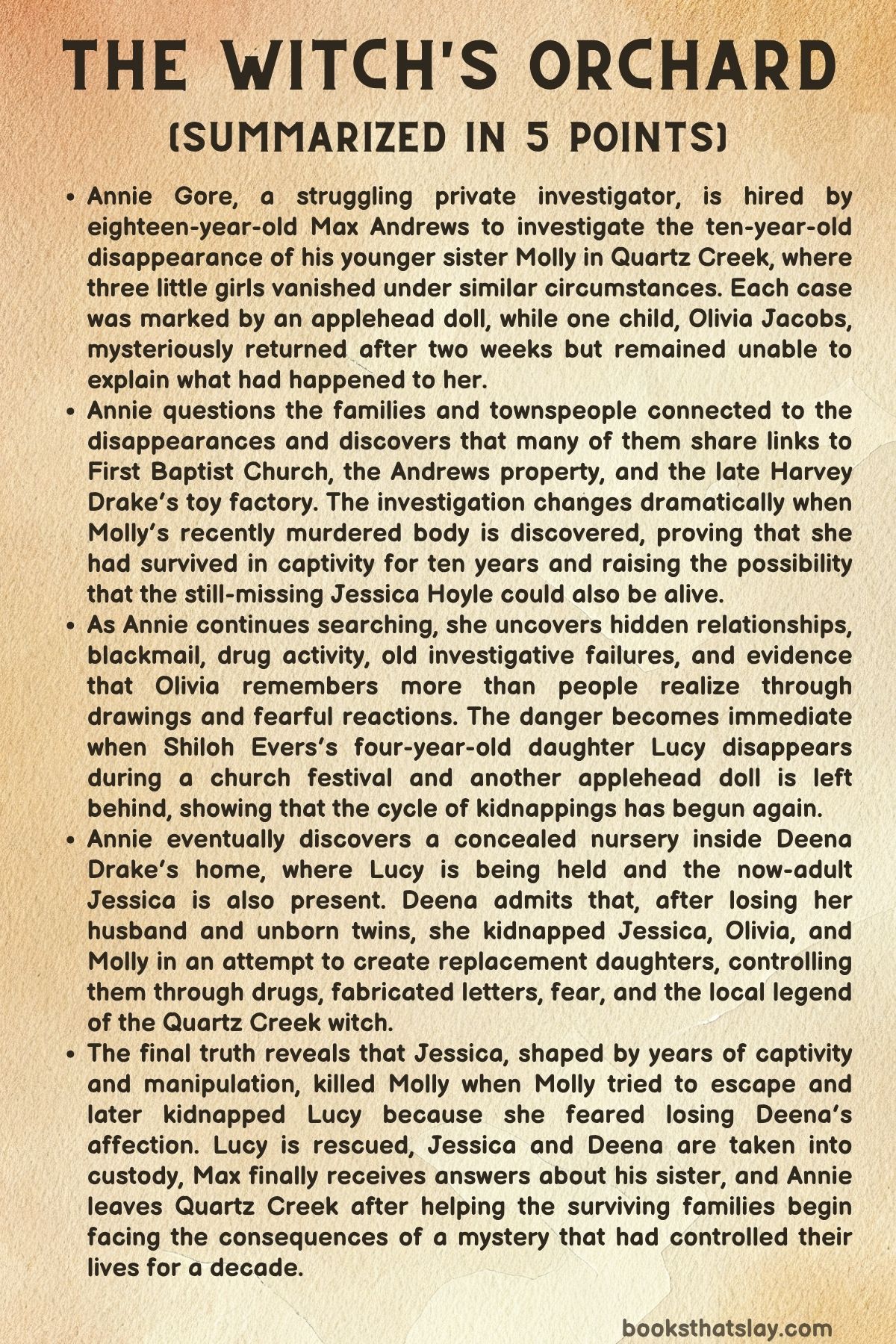
Summary
Private investigator Annie Gore is barely keeping her Louisville business afloat when eighteen-year-old Max Andrews approaches her with a case that has dominated almost his entire life. Ten years earlier in Quartz Creek, North Carolina, three young girls disappeared within a short period: Jessica Hoyle, Olivia Jacobs, and Max’s younger sister Molly, with an applehead doll left behind in each case.
Jessica was never found, Olivia returned mysteriously after two weeks, and Molly vanished only days after Olivia came home. Max has spent years collecting information and saving money, and he hires Annie because he cannot imagine building a future while still wondering what happened to his sister.
Annie agrees to spend a week in Quartz Creek and moves into a cabin on the Andrews property. Max explains that Molly disappeared from the family home while their mother Janice was gardening outside, their father Greg was away, and Max was receiving a piano lesson from Deena Drake.
The disappearance destroyed the Andrews family. Greg eventually became a long-haul trucker, Janice died by suicide, and Max remained emotionally bound to the search for Molly, turning down artistic and educational opportunities because leaving Quartz Creek feels to him like abandoning her.
The town is also shaped by a local legend about the Witch of Quartz Creek, a story involving mothers, daughters, magical apples, birds, and a grieving witch transformed into a crow. Different residents tell different versions, and the imagery of apples and crows repeatedly follows Annie as she begins questioning the people connected to the missing girls.
Annie first examines the Andrews home and learns that Molly’s room was emptied after Janice’s death, although Max secretly preserved a few belongings. She also discovers that Max is a gifted woodblock artist whose talent could take him far beyond Quartz Creek if he ever allowed himself to leave.
Her next interviews take her to the families of Olivia and Jessica. Olivia, now fifteen, is autistic and nonverbal, and her mother Kathleen refuses to let Annie question her because previous attempts to obtain information about the kidnapping caused Olivia considerable distress.
Olivia had disappeared during a church picnic and returned two weeks later, asleep on her family’s porch, covered with scratches and bruises. She never explained where she had been, leaving the town with no idea whether she escaped or was deliberately returned.
Jessica’s mother Mandy tells Annie that her daughter vanished from a playground outside First Baptist Church. Mandy had been exhausted, pregnant, and caring for another small child, and she later admits that she briefly fell asleep while Jessica played nearby.
Mandy has blamed herself for years, while her abusive husband Tommy has become increasingly unreliable. Annie also learns that Tommy’s cousin Dwight was working as a plumber at the Andrews property on the day Molly disappeared, placing him close to one of the crimes.
Several other figures repeatedly appear around the old cases. Deena Drake, Max’s former piano teacher and widow of factory owner Harvey Drake, was at the Andrews home on the day Molly vanished and had also been present at First Baptist around the times Jessica and Olivia disappeared.
Pastor Bob Ziegler and his wife Rebecca were likewise connected to the church and later turn out to have visited the Andrews family on the morning Molly disappeared. Sheriff Cole Jacobs, Olivia’s uncle, reacts angrily to Annie’s investigation because he fears that reopening the past will traumatize Olivia.
Deputy AJ Barnes is much more cooperative. He respects Max, understands that the original investigation may have been limited by local assumptions, and gradually becomes Annie’s closest ally in Quartz Creek.
The case changes completely when Annie discovers the body of a young woman inside the quartz stone circle. A childhood scar beneath the woman’s chin confirms the horrifying truth: Molly Andrews remained alive for ten years and was murdered only shortly before Annie found her.
Molly’s timing makes Annie fear that her investigation caused the killer to act. Sheriff Jacobs openly blames her for provoking someone who had apparently kept Molly hidden for a decade.
Annie briefly considers leaving the case, but someone breaks into her cabin, steals her laptop and gun case, and takes Max’s handmade casebook. Max responds by hiring Annie again, this time asking her to discover who kept Molly captive, who killed her, and whether Jessica might still be alive.
The autopsy raises new questions. Molly was strangled, but she also had unexplained organ damage, had been clean and well cared for, and had eaten biscuits and tea with honey shortly before death.
Her red velvet dress resembles the clothing worn by the applehead doll associated with her childhood disappearance. Annie realizes that Molly’s killer deliberately presented her body as a human version of the symbolic doll.
Meanwhile, Nicole Jacobs and Tam Hoyle, the older siblings of Olivia and Jessica, secretly approach Annie. Nicole gives her years of drawings Olivia has made since returning from captivity, all dominated by repeated spiral shapes.
The teenagers also direct Annie toward the abandoned DrakeCo toy factory, where the Lovely Lady Lavender dolls connected to the case were once made. Annie visits the factory and discovers Tommy, Dwight, and Elaine Hoyle involved in a methamphetamine operation that erupts in explosions and fire.
Dwight and Elaine die while Tommy survives with serious burns. Although the drug operation explains some of their secrecy, it does not solve the kidnappings, and Dwight’s death removes someone who may have known more.
Annie and AJ grow personally closer while examining the recovered police records. They discover that Bob and Rebecca Ziegler were at the Andrews property on the day Molly disappeared, along with Deena and Dwight, broadening the circle of possible suspects.
The danger becomes immediate when Shiloh Evers’s four-year-old daughter Lucy disappears during First Baptist’s Fall Festival. An applehead doll made from an old Lovely Lady Lavender body is left among Lucy’s belongings, and the attached hair appears to belong to Molly.
The old kidnapper, or someone who knows the old crimes intimately, has acted again. Annie realizes that the case is no longer only about reconstructing history; another child may currently be in captivity.
Greg Andrews finally admits that he and Janice had serious marital problems and had been receiving counseling from Bob and Rebecca shortly before Molly disappeared. Annie consequently investigates the Zieglers more closely, while suspicion also continues to surround Deena.
Annie secretly searches Deena’s enormous home and notices two significant details. Deena withdraws exactly one thousand dollars in cash every month, and the dimensions of her upstairs bedroom do not seem consistent with the exterior size of the building.
At first she cannot explain either clue. Deena also gives Annie another version of the witch legend, speaking with unusual emotion about lost daughters, grief, and transformation.
When Nicole secretly brings Olivia to Annie, the investigation finally receives direct information from the only surviving child known to have escaped the kidnapper. Olivia reacts severely to Jessica’s childhood photograph, strongly suggesting that Jessica was present during her captivity.
Olivia becomes even more terrified when Annie mentions the Witch of Quartz Creek. The legend was evidently used to frighten her, while her repeated spiral drawings remain unexplained.
Soon afterward, someone tries to kill Annie with a rifle. She escapes to Susan McKinney’s cabin, strengthening her suspicion of Susan because Susan knows local plants, makes applehead dolls, and has long been associated with the witch legend.
Molly’s toxicology results later reveal grayanotoxin poisoning from mountain laurel, a substance that can cause hallucinations and serious illness. Because Susan understands herbal plants, Annie initially becomes convinced that Susan may be connected to the captivity.
The truth begins shifting when Mandy returns Max’s stolen casebook and Annie’s gun box, which she found in Tommy’s vehicle. Tommy apparently committed the burglary, while further questioning exposes disturbing allegations involving his younger sister Odette and suggests that former sheriff Donald Kerridge may once have tried to protect Jessica from Tommy.
The final breakthrough arrives at Deena’s house. Annie finds Bob Ziegler bleeding from a gunshot wound, hears Lucy upstairs, and finally recognizes what was wrong with the house’s dimensions.
Behind a wall hanging in Deena’s bedroom is a concealed steel door leading to a hidden nursery. Lucy is there, and Deena is tied to a chair, but before Annie can understand the situation, she is attacked by an adult Jessica Hoyle.
Once trapped inside the room, Annie finally learns what happened ten years earlier. Deena had desperately wanted children, then suffered the devastating loss of Harvey and a pregnancy with twins during the same period.
Afterward she created two applehead dolls representing the daughters she had lost. When she saw Jessica unsupervised outside First Baptist, she convinced herself that the child was meant to replace one of her dead babies.
Jessica followed her willingly. Sheriff Kerridge later discovered Jessica in Deena’s vehicle but allowed Deena to keep her because he believed Jessica was being abused by Tommy, just as Tommy had allegedly abused Odette.
Kerridge eventually intended to expose what he had done, so Deena poisoned him. She later abducted Olivia as a second daughter but struggled with Olivia’s autism, drugged her with mountain-laurel preparations, and eventually returned her after threatening her with the witch legend.
Deena then abducted Molly using a drugged cookie. Dwight discovered the secret and blackmailed Deena for one thousand dollars each month, explaining both Deena’s regular withdrawals and Dwight’s unexplained cash.
For ten years, Jessica and Molly lived inside Deena’s concealed nursery. Deena manipulated them with drugs, false stories, and fabricated letters supposedly exchanged with their families, convincing them that leaving would endanger both themselves and the people they loved.
Jessica eventually stopped taking the drugs and learned that Deena had lied. She planned to escape with Molly, but Molly heard Annie talking outside about Max’s continued search and decided to run home.
Jessica panicked and strangled Molly because she feared losing the comfortable life she had come to identify as her home. She then dressed Molly in the red doll-like dress and left her body at the stone circle.
Jessica was also the person who tried to shoot Annie. Even more shockingly, Jessica—not Deena—kidnapped Lucy because she feared Deena was becoming emotionally distant and believed bringing home another little girl might restore their strange family arrangement.
Jessica plans to murder Annie and Bob, kill Deena with an overdose, and create a false murder-suicide story. Before she can complete the plan, Shiloh arrives armed, shoots Jessica in the shoulder, and rescues Lucy with Annie’s help.
The mystery is finally resolved. Olivia’s mysterious spiral drawings turn out to represent roses, connecting her memories to Deena’s enormous rose garden and providing the final symbolic clue that Shiloh recognizes.
Bob survives, Sheriff Jacobs suspends himself because his secret relationship with Deena compromised his judgment, and authorities begin sorting through the crimes committed by Deena, Jessica, Dwight, Kerridge, and others. Jessica survives and faces the consequences of killing Molly and abducting Lucy while also remaining a victim of years of confinement, drugs, manipulation, and distorted memories.
Max finally receives letters Molly wrote during captivity and begins accepting that his responsibility to her is over. Annie refuses his money and encourages him to pursue the artistic opportunities he repeatedly sacrificed while waiting for his sister.
Mandy leaves Tommy and prepares to support Jessica despite the painful reality of their reunion. Molly is finally buried beside Janice, Lucy returns safely to Shiloh, and Quartz Creek can at last confront what happened rather than continuing to live around unanswered questions.
Annie leaves town carrying Max’s crow woodblock and the emotional consequences of everything she uncovered. As she drives toward Louisville and reconnects with Leo, she recognizes that solving the case has not erased its damage, but it has allowed several people—including herself—to begin moving forward.
Characters
Annie Gore
Annie Gore is the investigative center of The Witch’s Orchard, and much of her characterization comes from the tension between professional discipline and a deeply personal inability to ignore people who need help. She approaches Quartz Creek as an outsider, which allows her to notice contradictions that longtime residents have accepted or stopped questioning.
Her persistence is rooted partly in her childhood with a violent father and a mother who repeatedly remained in an abusive marriage. Having learned early that vulnerable people are not always able to rescue themselves, Annie carries a powerful instinct to intervene even when doing so places her in danger.
Her military background gives her investigative skill, physical courage, and experience with risk, but it has also left emotional injuries that she has never completely resolved. Flashbacks to a deadly military incident and the pregnancy she lost reveal that Annie’s toughness is partly a survival mechanism rather than evidence that she is unaffected by trauma.
Annie’s greatest strength is also one of her most serious weaknesses. She refuses to walk away when she believes someone remains in danger, yet this determination repeatedly becomes recklessness, from entering the burning toy factory to searching Deena’s home and continuing the investigation while sick and injured.
Her relationship with Max shows her compassionate side because she understands that solving the case is not only about locating Molly. Max needs permission to stop organizing his entire life around the possibility of his sister’s return.
Her relationships with AJ and Leo reveal different parts of her emotional life. AJ becomes a source of immediate intimacy and trust during the Quartz Creek investigation, while Leo represents a longer, more complicated emotional connection associated with safety, shared history, and home.
Max Andrews
Max Andrews begins the novel as a young man who has spent most of his life emotionally frozen at the moment his sister disappeared. His childhood ended when Molly vanished and his family disintegrated afterward, leaving him with a sense that searching for her became his responsibility.
His casebook demonstrates both intelligence and obsession. Max has patiently preserved evidence, tracked details, and saved enough money to hire Annie, but the same devotion has prevented him from imagining a meaningful future outside Quartz Creek.
His artistic ability creates one of the strongest contrasts in his characterization. Max possesses genuine talent and receives educational and international opportunities, yet he repeatedly refuses them because leaving town feels morally equivalent to abandoning Molly.
Finding Molly dead initially appears capable of destroying him because his hope has been the structure around which he organized his adulthood. Instead, knowing the truth eventually gives him a path toward mourning rather than endless waiting.
The letters Molly wrote during captivity are particularly important because they restore part of the relationship stolen from him. By the end, Max can begin accepting artistic opportunities because continuing his life no longer feels like a betrayal of his sister.
Deena Drake
Deena Drake is the central architect of the original kidnappings and the most psychologically significant antagonist in The Witch’s Orchard. Her actions originate in catastrophic grief after Harvey’s death and the miscarriage of her twins, but the story makes clear that suffering explains her transformation without excusing what she does.
Her desperation to become a mother gradually turns other people’s children into objects she believes she has the right to claim. She looks at Jessica, Olivia, and Molly not primarily as individuals with families and identities of their own but as possible replacements for the daughters she lost.
Deena’s hidden nursery reveals the physical expression of that distorted worldview. She creates an artificial domestic world in which abducted children are fed, clothed, educated, and controlled while being denied freedom, truth, and genuine relationships with their families.
Her methods depend less on constant physical violence than on psychological control. Drugs, fabricated letters, invented illnesses, folklore, fear, and isolation allow her to convince Jessica and Molly that captivity is protection.
Deena also proves capable of murder when her constructed family is threatened. Poisoning Sheriff Kerridge demonstrates that preserving her secret becomes more important to her than any moral boundary.
Her relationship with Jessica becomes particularly destructive because Jessica grows up internalizing Deena’s possessiveness. The final tragedy is therefore not only that Deena kidnaps children, but that she teaches one of them to understand love as ownership, fear, secrecy, and control.
Jessica Hoyle
Jessica Hoyle occupies the most complicated position in The Witch’s Orchard because she is simultaneously a kidnapped child, a manipulated survivor, and eventually a murderer and kidnapper herself. She disappears at an age when she is vulnerable enough to accept Deena’s attention and eventually grows up almost entirely inside Deena’s fabricated reality.
Years of isolation and drugs damage Jessica’s understanding of memory, family, morality, and independence. Deena provides comfort and material security while also depriving her of freedom, making it difficult for Jessica to separate affection from captivity.
Jessica eventually discovers that Deena has lied and secretly stops taking the drugs. This demonstrates intelligence and emerging independence, but her attachment to the life Deena created remains powerful.
Her murder of Molly is the darkest expression of that conflict. Jessica claims to love Molly and originally intends to escape with her, yet when Molly tries to return to Max, Jessica kills her rather than risk losing the life she associates with security.
Jessica then repeats Deena’s behavior by abducting Lucy. Instead of escaping the emotional structure created by her captor, she recreates it by treating another child as a possible replacement family member.
The novel therefore refuses to reduce Jessica to either villain or victim. Her crimes are real and devastating, but they emerge from a childhood deliberately distorted by an adult who taught her that love could justify imprisonment and possession.
Molly Andrews
Molly Andrews is physically absent through much of the story of The Witch’s Orchard, yet she motivates nearly every major decision made by Max and Annie. Her disappearance fractures the Andrews family, contributes to Janice’s death, changes Greg’s life, and prevents Max from moving forward.
The discovery that Molly survived for ten years transforms her from an abstract missing child into someone who endured a stolen adolescence. Her letters to Max later confirm that she continued thinking about her family despite Deena’s attempts to rewrite her reality.
Molly’s decision to run home after learning that Max is still searching for her reveals that Deena’s psychological control was never complete. The knowledge that she remained loved gives Molly enough hope to challenge years of captivity.
Her death at Jessica’s hands is especially tragic because freedom is almost within reach. The red dress and symbolic presentation of her body also show how completely others have tried to turn Molly into a symbol rather than allowing her to exist as herself.
Even after death, however, Molly changes the direction of the investigation. Finding her proves that Jessica may still be alive and ultimately makes the exposure of the entire hidden system possible.
Shiloh Evers
Shiloh Evers initially appears as Max’s loyal friend and a warm presence in Quartz Creek, but she becomes increasingly important as the investigation develops. She has supported Max for years and understands how deeply Molly’s disappearance has limited his ability to create a future.
Her daughter Lucy gives Shiloh a direct connection to the horror the Andrews, Hoyles, and Jacobs families experienced. When Lucy disappears, Shiloh moves from supporter to terrified parent, and the reversal gives the older kidnappings renewed emotional immediacy.
Despite her fear, Shiloh remains observant. Her recognition that Olivia’s spiral drawings represent roses becomes the clue that directs attention toward Deena’s property.
Her final appearance at the hidden nursery also demonstrates extraordinary courage. Rather than remaining passive while others search, she follows the clues, enters the house armed, and intervenes when Jessica threatens Annie and Lucy.
Shiloh’s rescue of her daughter provides one of the book’s strongest contrasts with the older cases. Ten years earlier, families were left without answers; this time, determined investigation and cooperation prevent another child from disappearing permanently.
AJ Barnes
AJ Barnes, in The Witch’s Orchard, represents the kind of local law enforcement officer Annie needs in order to investigate effectively. Unlike Sheriff Jacobs, he does not automatically treat Annie as an intruder or assume the old investigation reached every possible conclusion.
His knowledge of Quartz Creek gives Annie valuable context, while his willingness to share records and evidence allows her to identify overlooked connections. He understands that familiarity can become a weakness when investigators cannot imagine that trusted community members might be responsible.
AJ is also important because he provides Annie with emotional stability without trying to control her. When she becomes exhausted and discouraged, he offers practical support and quiet company rather than simplistic reassurance.
Their physical relationship develops naturally from mutual respect and shared danger. The book does not force it into a permanent romantic conclusion, which makes their connection feel consistent with Annie’s independent nature.
AJ ultimately functions as both investigative partner and emotional counterbalance. He respects Annie’s instincts while occasionally reminding her that persistence does not require solving every problem immediately.
Olivia Jacobs
Olivia Jacobs is the only original abducted child known to have returned alive, making her the closest thing the investigation has to a direct witness. Because she is autistic and nonverbal, however, many adults incorrectly assume that she cannot provide meaningful information.
Her behavior shows that she remembers far more than people realize. Her repeated rose drawings, her reaction to Jessica’s photograph, and her terror at the witch legend eventually become crucial evidence.
Olivia’s history in The Witch’s Orchard also exposes failures by adults who believed communication had to happen on their terms. The FBI agent who tried to force information from her and the church members who surrounded her with unwanted prayer both treated her distress as an obstacle instead of attempting to understand her perspective.
Nicole’s willingness to trust Olivia allows Annie to approach her differently. By using images, music, and patience, Annie gains information that had remained inaccessible for years.
Olivia therefore becomes essential to solving the case not despite her different way of communicating but through it. The challenge lies in whether others are willing to pay attention carefully enough to understand what she has been expressing all along.
Mandy Hoyle
In The Witch’s Orchard, Mandy Hoyle has spent ten years blaming herself for Jessica’s disappearance. Her admission that she fell asleep while Jessica played nearby reveals how guilt has distorted her understanding of responsibility.
She was exhausted, pregnant, caring for small children, and struggling economically when Jessica vanished. Annie recognizes that these conditions made Mandy vulnerable but did not make her responsible for another person choosing to abduct her daughter.
Mandy’s marriage to Tommy adds another layer to her situation. She supports much of the household while living with a man known for drinking and violence, making her another character whose choices have been constrained by fear and limited resources.
Her eventual discovery of Max’s stolen casebook helps redirect Annie toward Tommy’s hidden history. More importantly, Mandy ultimately leaves him and chooses to support Jessica after her recovery.
Jessica’s return is not the joyful reunion Mandy imagined for years. Even so, Mandy accepts the reality of who her daughter has become and prepares to help her face both the trauma inflicted on her and the consequences of what she has done.
Susan McKinney
In The Witch’s Orchard, Susan McKinney functions for much of the novel as an intentionally suspicious figure. She lives in the woods, understands plants, makes applehead dolls, tells fortunes, and is closely associated with the local witch legend.
These characteristics make it easy for Annie and the town to imagine her as responsible for the disappearances. The old anonymous accusation against her further strengthens that suspicion.
In reality, Susan repeatedly tries to help people in indirect ways. She supports Mandy during her troubled marriage, provides Deena with guidance after Harvey’s death, treats Annie after the shooting, and understands grief without pretending that it can be magically removed.
Susan’s major weakness is her failure to recognize what Deena has become. Because she sees Deena primarily as a grieving woman, she does not imagine that grief has developed into possession, kidnapping, and murder.
Her character therefore exposes the danger of interpreting people through familiar categories. Annie suspects Susan because she resembles the legendary witch, while Susan underestimates Deena because she resembles a grieving widow.
Sheriff Cole Jacobs
Cole Jacobs is initially one of Annie’s strongest obstacles. His hostility is partly territorial, but his most important motivation is his desire to protect Olivia, who is both his niece and a child he believes was badly mistreated by earlier investigators.
His account of the original investigation complicates the impression that he is simply incompetent or defensive. He inherited the case under difficult circumstances after Sheriff Kerridge died and had to confront an FBI agent who abused Olivia while attempting to obtain information.
Cole’s protectiveness becomes excessive because it prevents Olivia from being treated as someone capable of contributing to the investigation. By trying to shield her completely, he almost helps keep crucial information hidden.
His secret relationship with Deena creates a more serious professional conflict. Because he is emotionally involved with her, he gives her an alibi for Lucy’s disappearance and becomes less capable of viewing her objectively.
His decision to suspend himself once the truth is exposed demonstrates that he recognizes the seriousness of the failure. Cole is therefore not presented as corrupt in the same manner as Deena, but as someone whose personal loyalties damage his professional judgment.
Leo
In The Witch’s Orchard, Leo is connected primarily to Annie’s past rather than the Quartz Creek community. Their relationship was formed through military service, investigative work, danger, and shared knowledge that Annie rarely discusses with other people.
He recognizes Annie’s talent before she fully develops it herself, recruiting her into investigative work after she follows a suspicious financial trail beyond her assigned duties. His confidence in her abilities helps explain the career she later builds.
Leo also understands Annie’s emotional habits. When she cannot directly discuss her fear or guilt, their ritual of talking about ordinary things such as breakfast allows him to comfort her without forcing disclosure.
Their relationship carries unresolved romantic and emotional tension. Annie may form other relationships, including her connection with AJ, but Leo remains associated with continuity and belonging.
The ending does not resolve their future in conventional romantic terms. Instead, Annie’s recognition that Leo represents home suggests that their bond exists at a deeper level than simple physical attraction.
Greg Andrews
In The Witch’s Orchard, Greg Andrews responds to Molly’s disappearance by escaping the physical and emotional environment associated with his daughter. His decision to become a long-haul trucker separates him from the house and from Max, even as both men remain shaped by the same loss.
At first Greg wants Annie to stop investigating because he hopes Molly’s death will finally allow Max to move forward. His position may appear cold, but it reflects his belief that endless searching has already consumed too much of his son’s life.
Lucy’s disappearance changes him. Greg recognizes that whatever happened to Molly is still capable of harming other children, so closure can no longer mean simply accepting his own family’s loss.
He also provides important information about his troubled marriage with Janice and their counseling with Bob and Rebecca. His eventual cooperation helps Annie reconstruct the circumstances surrounding Molly’s disappearance.
Greg’s character shows a different form of grief from Max’s. Max responds by remaining emotionally fixed in Quartz Creek, while Greg survives by repeatedly leaving it.
Janice Andrews
Janice Andrews dies before the main events but remains central to understanding the Andrews family. After Molly disappears, she preserves her daughter’s room and repeatedly washes Molly’s clothes, maintaining routines connected to a child who is no longer present.
Her actions reveal an inability to accept uncertainty rather than a simple refusal to recover. Without confirmation of Molly’s death or survival, Janice cannot fully mourn because there is no clear ending to mourn.
The collapse of her marriage and her eventual suicide show the destructive psychological cost of unresolved disappearance. She becomes one of the many people harmed indirectly by Deena’s decision to take Molly.
Janice’s earlier desire for more children also adds complexity to the family’s history. Her disagreements with Greg had already created strain before the kidnapping, which means Molly’s disappearance destroys a household that was vulnerable but still functioning.
Kathleen Jacobs
In The Witch’s Orchard, Kathleen Jacobs is defined primarily by her fierce protection of Olivia. After watching investigators, therapists, and church members repeatedly try to obtain information from her daughter, she becomes convinced that reopening the past will only cause more harm.
Her refusal to let Annie speak with Olivia is therefore understandable even when it hinders the investigation. Kathleen believes protecting her daughter must take priority over solving crimes that occurred a decade earlier.
The discovery of Molly’s body and later Lucy’s disappearance make that position increasingly difficult to maintain. Jessica may still be alive, and another child may now be experiencing the same captivity.
Kathleen’s character highlights the conflict between protecting a survivor and asking that survivor to revisit traumatic experiences for the benefit of others. There is no simple solution, which gives her resistance greater emotional credibility.
Nicole Jacobs
Nicole is one of the first people to recognize that Olivia’s silence does not mean she lacks knowledge or agency. She has spent years observing her sister’s drawings and behavior and understands that adults frequently underestimate her.
Her decision to bring Olivia secretly to Annie is risky because it directly defies Kathleen and Sheriff Jacobs. Nicole nevertheless believes that Lucy’s immediate danger justifies giving Olivia the opportunity to help.
She also challenges the assumption that Olivia was deliberately returned because the kidnapper rejected her. Nicole proposes that Olivia may have escaped, an interpretation that treats her sister as capable rather than passive.
Through Nicole, the story emphasizes the importance of relationships built on close observation and respect. She understands Olivia partly because she has learned to notice forms of communication that other people dismiss.
Tam Hoyle
In The Witch’s Orchard, Tam Hoyle shares Max’s need for answers but approaches the mystery from a different family position. As Jessica’s brother, he has grown up inside uncertainty, poverty, conflict, and public speculation about what happened to his sister.
His interest in becoming a police officer suggests that Jessica’s disappearance has shaped his sense of purpose. Like Max, he has built part of his future around responding to something that happened when he was young.
Tam’s decision to work with Nicole reflects frustration with adults who have spent years withholding information in the name of protection. He wants Jessica searched for as a living person once Molly’s survival demonstrates that long-term captivity is possible.
Although his role is smaller than Max’s, he represents the impact unsolved disappearance has on siblings. Missing children do not vanish only from parents; they also alter the identities and futures of the brothers and sisters left behind.
Tommy Hoyle
In The Witch’s Orchard, Tommy Hoyle initially appears suspicious because of his violence, drinking, criminal associations, and presence around people connected to the investigation. His involvement with the methamphetamine operation and burglary of Annie’s cabin makes him genuinely dangerous even though he is not the original kidnapper.
The revelations concerning Odette make him far more disturbing. His drugged comments suggest that his sister accused him of sexual abuse and that Susan and Sheriff Kerridge attempted to intervene.
This history explains why Kerridge may have believed returning Jessica to Tommy was unsafe. His decision to let Deena keep Jessica is still disastrous, but Tommy’s behavior helps explain the fear behind it.
Tommy therefore functions partly as a false suspect and partly as a genuine source of harm. He did not commit the kidnappings, but his abusive behavior indirectly contributes to the decisions that allow Jessica’s captivity to continue.
Dwight Hoyle
Dwight Hoyle becomes important because he is one of the few people who discovers Deena’s secret while Molly and Jessica are still captive. Instead of rescuing the girls or contacting police, he turns that knowledge into a source of income.
His monthly blackmail payments explain Deena’s regular cash withdrawals and Dwight’s lifestyle despite limited legitimate income. His silence lasts for years because the continued captivity remains financially useful to him.
Dwight’s behavior demonstrates another form of moral failure surrounding the case. He does not create the crime, but he chooses personal benefit over the freedom of two kidnapped children.
His death in the factory fire prevents him from being questioned fully. Only after Deena confesses does the extent of his complicity become clear.
Bob Ziegler
Bob Ziegler is repeatedly placed near major events, making him an understandable suspect. His military past, hidden history involving statutory rape allegations, presence at the Andrews property, and influence within First Baptist all increase Annie’s concern.
His actions toward Olivia after her return also reveal serious limitations. The church’s attempt to change her through hands-on prayer causes distress and later contributes to her fearful reaction when Annie shows photographs.
Yet Bob is ultimately not responsible for the kidnappings. His secrecy mostly reflects personal shame, religious boundaries, and his effort to protect information obtained through counseling.
His shooting by Jessica demonstrates how close he comes to becoming another victim of the real crime. Bob’s role therefore shows how suspicious behavior and concealed history can be relevant without making someone the central offender.
Rebecca Ziegler
Rebecca Ziegler is quieter than Bob but remains connected to several key moments. She was present at First Baptist when Jessica disappeared and at the picnic when Olivia vanished, and she later visited the Andrews family with Bob on the day Molly disappeared.
Her role in counseling Greg and Janice explains why the couple visited the Andrews home. Annie initially sees the coincidence as potentially sinister because Rebecca appears repeatedly around the timelines.
Rebecca also once visited Susan, suggesting that she carried private worries she never fully explained. These small mysteries contribute to the atmosphere of secrecy surrounding nearly everyone in Quartz Creek.
Ultimately, Rebecca demonstrates how ordinary private matters can become suspicious inside an unresolved investigation. Her presence matters, but it is not evidence of guilt.
Lucy
Lucy is Shiloh’s four-year-old daughter and the child whose disappearance transforms a historical investigation into an immediate rescue effort. Her kidnapping proves that the pattern associated with Jessica, Olivia, and Molly is not safely contained in the past.
Jessica chooses Lucy because she wants another child inside the strange family structure Deena created. This makes Lucy the potential next generation of the same cycle of possession and replacement.
Unlike the original victims, Lucy is found quickly because Annie, Shiloh, AJ, Olivia, Nicole, and others are actively connecting evidence instead of treating each clue separately. Her rescue represents the first clear interruption of the pattern rather than another unresolved loss.
Sheriff Donald Kerridge
Donald Kerridge is dead before Annie arrives, but his decisions profoundly shape the mystery. When he discovers Jessica after Deena abducts her, he chooses not to return the child because he believes Tommy may be abusing her.
That choice begins as an attempt to protect Jessica but becomes one of the greatest failures in the story. Instead of using lawful means to remove her from danger, Kerridge allows a grieving and unstable woman to keep a kidnapped child.
His later decision to confess suggests that he eventually understands the consequences of what he has done. Deena poisons him before he can expose the truth.
Kerridge demonstrates how good intentions can become destructive when someone believes personal judgment justifies ignoring legal and moral boundaries.
Odette Hoyle
Odette Hoyle never participates directly in the present investigation, but her history changes how Annie understands both Tommy and Sheriff Kerridge. Evidence suggests that Odette confided in Susan about abuse by Tommy and that Kerridge attempted to intervene.
Her situation becomes the reason Kerridge is terrified that Jessica may suffer similar harm. In that sense, Odette’s experience indirectly influences his disastrous decision to leave Jessica with Deena.
Odette also represents another person whose suffering remained partly hidden inside family secrecy. Her warnings were not taken seriously enough while she was alive, and only years later does their significance become clear.
Harvey Drake
Harvey Drake is central to Deena’s emotional history despite dying before the kidnappings. His death occurs while Deena is pregnant, and her miscarriage later that same night destroys the family future she had imagined.
His ownership of the toy factory also connects the Drake family to the Lovely Lady Lavender dolls later incorporated into the kidnappings. After his death, the factory closes and Quartz Creek suffers economically, linking private grief with broader community decline.
Deena’s preservation of Harvey’s clothing years later shows that she never fully reorganized her life after losing him. Her inability to accept that loss becomes part of the psychological foundation for her attempt to construct a replacement family.
Themes
Grief, Replacement, and the Refusal to Accept Loss
Grief in The Witch’s Orchard repeatedly becomes dangerous when characters try to avoid accepting what has been taken from them. Deena represents the most extreme form of this response, converting the deaths of Harvey and her unborn twins into a belief that other people’s daughters can replace the family she lost.
Her crime is built on substitution rather than simple cruelty. Jessica becomes one daughter, Olivia is intended to become another, and Molly eventually takes Olivia’s place when Deena’s imagined relationship with Olivia fails to match her expectations.
The same idea appears in less destructive forms throughout the story. Max keeps his life suspended because moving away from Quartz Creek feels like abandoning Molly, while Janice preserves Molly’s room and clothing because uncertainty makes ordinary mourning almost impossible.
Greg does the opposite by physically leaving the town through long-distance trucking, yet his movement is also a way of escaping grief rather than resolving it. Jessica later repeats Deena’s replacement logic when she kidnaps Lucy, hoping another child can repair her unstable relationship with Deena or replace Molly.
The novel distinguishes mourning from possession. Healthy grief requires accepting that another person cannot be recreated, substituted, or permanently preserved, while destructive grief tries to prevent change at any cost.
Love Versus Possession
Many relationships in the story force a distinction between loving someone and trying to own them. Deena repeatedly claims a maternal relationship with the kidnapped girls, yet everything she does removes their freedom, identities, families, and ability to choose their own futures.
Her hidden nursery appears comfortable enough to resemble a protected childhood environment. That appearance makes the captivity even more disturbing because Deena uses care itself as a mechanism of control.
Jessica absorbs this lesson over ten years. She genuinely believes she loves Molly, but when Molly chooses Max and freedom, Jessica responds by killing her rather than accepting separation.
The same pattern appears again when Jessica takes Lucy. Instead of understanding family as a relationship entered freely, she has learned that love means keeping desired people close through manipulation, drugs, secrecy, and force.
Other relationships provide a contrast. Annie cares about Max but ultimately encourages him to leave Quartz Creek, while Shiloh supports him without demanding that his future remain connected to hers.
Mandy’s final response to Jessica is another important example. She does not receive the daughter she remembers, yet she accepts the adult Jessica actually is and prepares to support her through a painful legal and psychological future rather than attempting to recreate the lost child of ten years earlier.
Trauma, Memory, and Communication
Trauma shapes not only what characters remember but also whether they can express those memories in forms other people recognize. Olivia embodies this most clearly because she possesses crucial knowledge for years without communicating it through conventional speech.
Her spiral drawings are repeatedly overlooked because adults search for direct explanations. Once the drawings are understood as roses, information that had existed in plain sight becomes meaningful.
Jessica’s memory is damaged differently. Years of drugs, false letters, isolation, threats, and invented stories leave her uncertain about portions of her childhood and even about whether some events she fears truly happened.
Annie also experiences involuntary memories from military trauma. Sounds, physical sensations, danger, and exhaustion return her temporarily to experiences she normally keeps controlled, showing that trauma is stored through more than deliberate recollection.
The investigation succeeds when people stop demanding that memory appear in a convenient form. Annie uses photographs and music with Olivia, Nicole trusts patterns she has observed for years, and Shiloh recognizes the meaning of the spiral motion.
The story therefore treats communication as an act of interpretation as much as speech. Survivors may express what happened through behavior, images, fear responses, rituals, fragments, or physical reactions long before they can explain their experiences directly.
Folklore, Fear, and Misinterpretation
The Witch of Quartz Creek legend changes depending on who tells it, but certain images remain constant: mothers, daughters, apples, birds, hunger, separation, and grief. These recurring elements allow the legend to function as a reflection of the teller rather than a fixed explanation of events.
Different residents emphasize punishment, sacrifice, starvation, possession, or maternal loss. Their versions reveal personal fears and beliefs while also shaping how they interpret the real disappearances.
The legend becomes dangerous when symbolic storytelling is mistaken for literal evidence. Susan appears suspicious because she lives in the woods, understands plants, makes applehead dolls, and resembles the community’s idea of a witch.
Annie temporarily falls into the same mistake. Once Molly’s poisoning is traced to mountain laurel, Susan seems to fit so many folkloric clues that Annie nearly allows the story to determine the suspect instead of allowing evidence to determine the story.
Deena exploits this cultural fear deliberately. She uses the witch legend to terrify Olivia into silence and arranges the kidnappings around applehead imagery, turning local tradition into a psychological weapon.
The eventual solution requires separating symbol from responsibility. The supernatural legend does not cause the crimes; human grief, manipulation, abuse, secrecy, and failed judgment do, while folklore provides the language through which those actions are disguised and misunderstood.