Amongst Women Summary, Characters and Themes
Amongst Women is a family novel by John McGahern about power, memory, love, and damage inside an Irish household. Set largely in rural Ireland, it follows Michael Moran, a former guerrilla fighter whose authority at home shapes the lives of his wife Rose and his children.
Moran is proud, wounded, controlling, and deeply dependent on the family he often hurts. The novel studies how children grow away from a difficult parent while still feeling tied to him. It is quiet, tense, and observant, showing how ordinary family routines can carry both care and fear.
Summary
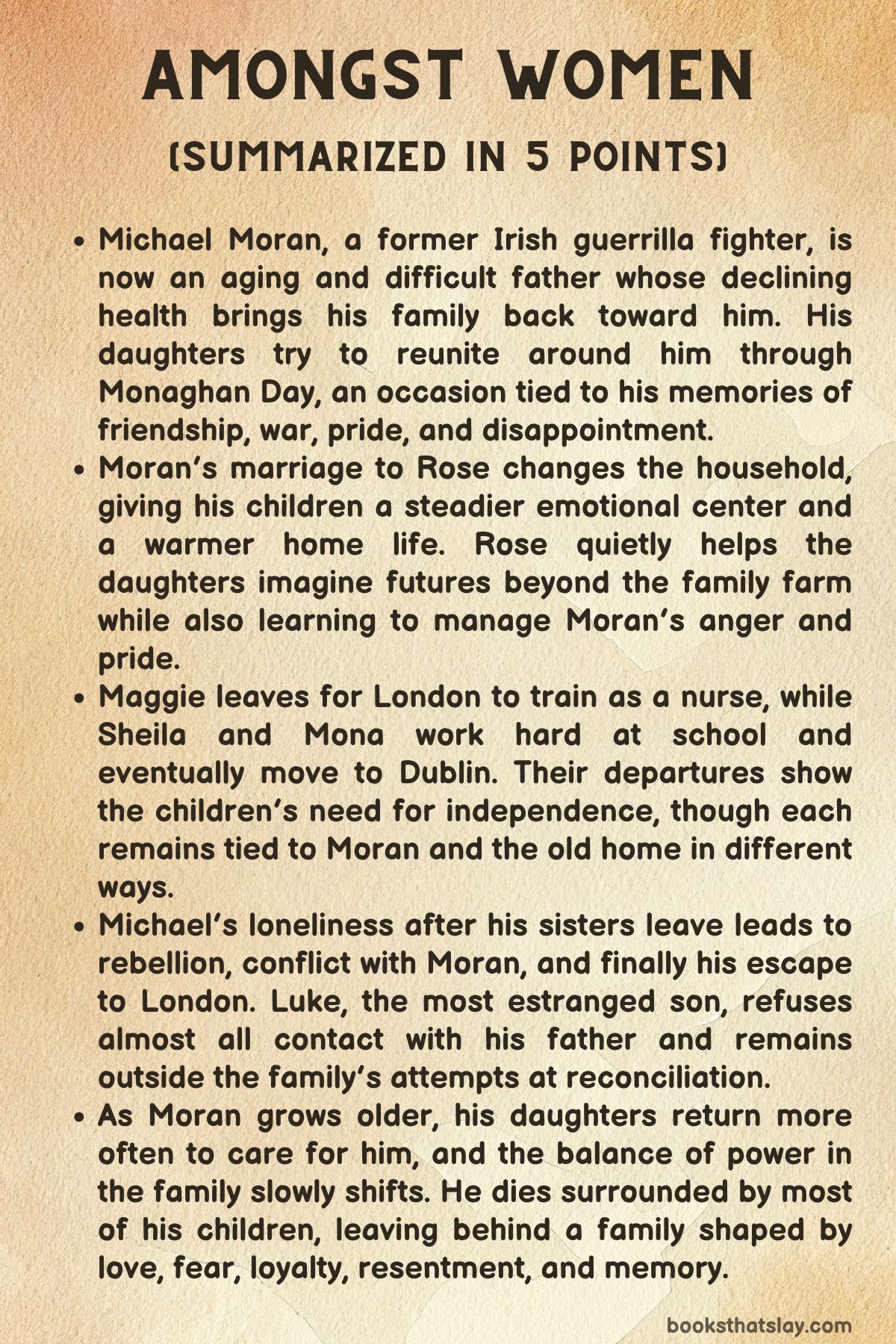
Amongst Women begins with Michael Moran in failing health. His adult children, especially his daughters, are worried about him and want to draw the family back together before it is too late.
They think of Monaghan Day, the annual February fair in Mohill, as a way to reunite around him. The occasion once mattered deeply to Moran, partly because of his old friend McQuaid, with whom he used to spend the day.
Now the children are scattered between Dublin and London, and not all of them are willing to return. Mona, Sheila, and Maggie come home to be with Moran and Rose, his second wife, while Michael and Luke remain more distant.
The visit brings the past into the house, though Moran resists being reminded of it. His daughters speak of McQuaid and of the old Monaghan Days, hoping to cheer him, but Moran dislikes having his life treated as something finished or fixed in memory.
He wants the present to remain under his control. Still, he speaks a little about his time during the Irish Civil War.
To him, war was ugly but clear. It offered rules, enemies, and action, while ordinary life has been harder to master.
This feeling helps explain much of Moran’s later behavior. He is a man who once knew how to command, and he has carried that habit into family life.
The story looks back to the last Monaghan Day Moran spent with McQuaid. Their friendship has been shaped by shared military experience, but the bond is strained.
McQuaid has become a prosperous cattle dealer, while Moran lives modestly and remains anxious about money. Moran’s daughters serve the two men as they talk, watching for any sign of anger.
The conversation turns to the Irish state that followed the struggle for independence. Moran feels that the fighting achieved little, while McQuaid takes pride in the fact that Ireland is no longer ruled by England.
Their disagreement exposes more than politics. Moran seems resentful of McQuaid’s success, and McQuaid senses it.
By the end of the visit, Moran knows their friendship has changed forever.
Rose enters Moran’s life after meeting him at the post office. She has returned to the area to care for her own family and knows Moran’s reputation as a widower and a difficult man.
Local gossip hints at trouble in his military past, and people watch her interest in him with suspicion. Rose, however, is practical and determined.
She understands the power of family, social habit, and careful behavior. She approaches Moran steadily, meeting him at the post office and gradually forming a quiet courtship.
She also makes an effort with his children, aware that she must earn their trust if she is to enter the household.
Moran and Rose marry in a small ceremony. His daughters are anxious the night before, unsure how their lives will change.
The reception is held at Rose’s family home, an arrangement that causes embarrassment because it departs from local custom. After the wedding, Rose comes into Moran’s house and begins reshaping it.
She brings warmth, order, and a more settled domestic rhythm. The daughters quickly become close to her, and together they learn how to manage Moran’s moods.
They remain subject to his authority, but through patience and cooperation they also learn to contain it.
Rose’s presence changes Maggie’s future. At nineteen, Maggie has little left to do at home, and Rose gently suggests that she should begin a life of her own.
She proposes nursing in England. Moran is wary, partly because Luke, his estranged son, had once argued for the same thing and the matter had led to conflict.
Luke had left for England after a serious break with his father. Eventually Moran allows Maggie to apply.
When she is accepted into a London hospital, Luke agrees to meet and help her. Moran is angered by Luke’s limited contact and lashes out at Rose.
He later tries to make peace by taking Rose to the beach, but she sees clearly that married life with him will mean enduring sudden changes in temper.
Maggie leaves for London with mixed feelings. Moran reassures her that she will always have a home with him and Rose, yet her departure marks the beginning of the children’s movement away from Great Meadow, the family home.
Maggie writes back that she is doing well and has seen Luke, who works in construction and studies accounting. Meanwhile, Sheila and Mona focus intensely on school, knowing education and work may give them a way out.
Michael, the youngest, enjoys animals and gardening but has little interest in becoming the kind of farmer Moran expects.
Sheila and Mona succeed in their exams and are offered civil service jobs. Sheila also has the chance to go to university and study medicine, but Moran refuses to support that ambition.
She enters the civil service instead, giving up the path she truly wanted. The sisters move to Dublin, and their departure leaves Michael alone with Moran and Rose.
The house feels emptier, and Michael becomes restless. Without his sisters, he loses interest in his old hobbies and begins going to dances, drinking, staying out late, and testing his father’s authority.
The conflict between Moran and Michael grows. Moran locks the house against him and hits him after catching him sneaking in.
Michael also begins a sexual relationship with Nell, an older woman visiting from New York, and this gives him a new sense of independence. Moran discovers that Michael has been skipping school and becomes furious.
Michael runs away to Dublin, hoping his sisters will help him reach London. Sheila persuades him to return and finish school, believing that leaving too soon will harm his future.
She negotiates a temporary peace, but father and son soon clash again. After a physical fight, Michael runs away once more, and this time his sisters help him leave for London.
With the children gone, Moran and Rose face an empty house. Sheila and Mona visit often from Dublin; Maggie comes from London when she can.
Maggie marries Mark, an Englishman, and though Moran and Rose approve of him, they do not attend the wedding. Michael eventually visits home again, and his quarrel with Moran is treated as something past.
Luke, however, remains apart. He refuses to return to Moran’s house and carries no affection for his father.
Michael tries to persuade him to visit, but Luke will not soften.
Luke finally returns to Ireland for Sheila’s wedding in Dublin, where he and Moran meet again. Their reunion is polite but cold.
There is no true reconciliation, only the appearance of family order for the occasion. Afterward, Moran’s children gather at the old home and help with the hay.
The work is hard, and Sheila’s husband Sean struggles with it. The family also has to adjust to the sight of Sheila and Sean as a married couple with their own private bond.
Still, Moran and Rose are glad to have the house full again, even briefly.
Years pass. Sheila and Maggie have children, though Sheila is careful about how much time her children spend with Moran because she fears he may damage their confidence as he damaged hers.
Michael marries an Englishwoman, and his sisters are unsettled by how easily Moran accepts her. Mona remains unmarried and continues to be strongly tied to her father and sisters.
Moran grows older and receives pensions for his military service and age, but he keeps farming as much as he can. The world changes, while he remains fixed in many of his old ways.
As Moran’s health declines, he writes to Luke, saying he never meant him harm and apologizing for the pain he caused. Luke sees the letter as a sign that Moran may be dying, but when Maggie asks him to return for Monaghan Day, he refuses.
The daughters come more often and become united in caring for Moran. For once, their shared purpose gives them power over him, and Moran begins to fear their strength.
He knows death is near and spends time looking at his meadow, recognizing beauty he had not fully valued.
At the end of Amongst Women, Moran dies peacefully with all his children except Luke gathered around him. Luke does not attend the wake or funeral.
Rose, Sheila, Maggie, and Mona carry out the rituals of death and burial with care and respect. Moran leaves behind a family marked by loyalty, fear, anger, and lasting attachment.
His children have escaped him in practical ways, but emotionally they remain shaped by him and by the home they once struggled to leave.
Characters
Michael Moran
Michael Moran stands at the center of the family’s emotional life. He is a former guerrilla fighter whose habits of command survive long after the war has ended.
In Amongst Women, Moran is not presented as a simple villain, but as a proud, damaged, controlling man who depends deeply on the very people he frightens and wounds. His anger often comes from fear: fear of poverty, fear of being forgotten, fear of losing authority, and fear that his children will judge him or leave him behind.
He cannot bear the past being raised unless he controls the telling of it, and he resents any version of memory that weakens his sense of himself. At home, he demands loyalty and obedience, but he also needs affection, service, and reassurance.
His children grow up learning how to read his moods, avoid his anger, and protect one another from him. As he ages, his power weakens, and the daughters he once dominated become his caretakers.
His final days reveal both his vulnerability and the lasting hold he has over the family.
Rose Brady Moran
Rose is one of the most important stabilizing forces in the family. She enters Moran’s life with a clear understanding of social custom, family structures, and emotional survival.
She knows that Moran has a difficult reputation, but she is drawn to him and chooses him with open eyes. After marriage, she becomes much more than a replacement wife or housekeeper.
She reshapes the household, gives the daughters emotional support, and helps the children move toward futures beyond the farm. Her influence is quiet but powerful.
She rarely challenges Moran directly unless she must, but she knows how to guide events around him. Rose also pays a price for her place in the family.
She becomes the person most exposed to Moran’s shifting temper after the children leave. Her love is practical rather than naive; she recognizes his cruelty, pride, and neediness, yet remains committed to him.
Her strength lies in patience, emotional intelligence, and her ability to keep the family from breaking completely apart.
Maggie Moran
Maggie is the eldest daughter and the first of the girls to move into a new life outside the family home. Before Rose arrives, Maggie’s role is closely tied to domestic duty.
She serves, helps, obeys, and carries the habits expected of a daughter in Moran’s household. Rose’s arrival releases her from some of that burden and allows her to imagine a future of her own.
Her move to London to train as a nurse marks a major shift in the family pattern. Maggie is gentle and dutiful, but she is not passive.
She accepts opportunity when it comes and gradually builds a life beyond her father’s control. Even after marrying Mark and having a child, she remains emotionally tied to the family.
Her connection with Luke in London also makes her a bridge between the obedient children and the estranged son. Maggie shows how departure from Moran’s house does not mean complete freedom from it.
She creates distance, but family loyalty continues to shape her choices.
Sheila Moran
Sheila is intelligent, ambitious, and deeply affected by Moran’s authority. Her academic success gives her the possibility of studying medicine, but Moran refuses to support that dream, pushing her instead toward the civil service.
This decision becomes one of the clearest examples of how his control limits his children’s lives. Sheila accepts the practical path, but the loss of her ambition reveals the emotional cost of obedience.
She is not weak, however. She often acts as a negotiator within the family, especially when Michael runs away and must be persuaded to return.
Later, as a wife and mother, Sheila becomes more protective and guarded. She does not want her children exposed too closely to Moran because she understands how easily his words and moods can damage confidence.
Sheila’s character shows the long-term effects of growing up under a dominant parent. She survives, succeeds, and builds a life, but she never forgets what was taken from her.
Mona Moran
Mona remains the most closely tied to the family home among Moran’s daughters. Unlike Maggie and Sheila, she does not marry, and her identity remains strongly connected to her father, Rose, and her sisters.
Mona’s loyalty is intense, but it is not simple happiness. She has been shaped by the same atmosphere of fear, duty, and affection that marks the others.
Her unmarried status suggests a life still bound to the emotional patterns of childhood, even after she has physically left the house. Mona helps care for Moran during his illness and shares in the collective strength the daughters develop near the end of his life.
Her role is especially important because she reflects the way family bonds can become both shelter and confinement. She loves Moran and remains devoted to him, yet that devotion seems to limit her ability to form a separate life.
Mona represents the child who escapes geographically but remains emotionally enclosed by the family.
Michael Moran Jr.
Michael is the youngest child and the son who most visibly clashes with Moran inside the home. As a boy, he is lonely after his sisters leave, and without their protection he becomes more exposed to his father’s demands.
He is drawn to animals, gardening, dances, drink, and sexual discovery, all of which mark his movement toward independence. His relationship with Nell gives him a new sense of adulthood, and that confidence increases the conflict with Moran.
Their fights show the painful struggle between a father who wants obedience and a son who wants selfhood. Michael first runs to Dublin, then eventually escapes to London with his sisters’ help.
Unlike Luke, however, Michael does not fully reject Moran. Later, he returns home, and the old quarrel is treated as something that can be passed over.
Michael’s character shows a more flexible form of rebellion. He resists, leaves, and builds his own life, but he still keeps some affection for his father.
Luke Moran
Luke is the clearest example of lasting estrangement. His break with Moran happened before much of the central family action, but his absence hangs over the household.
Unlike the others, Luke refuses to soften his judgment of his father. He lives in England, works in construction, studies accounting, and helps Maggie when she arrives in London, but he keeps Moran at a firm distance.
His refusal to return home is not only stubbornness; it is a form of self-preservation. While Michael can eventually let conflict fade, Luke cannot accept the family’s habit of covering over pain in the name of loyalty.
Even when Moran writes an apology, Luke reads it as a sign of approaching death rather than as a reason for reconciliation. He does return for Sheila’s wedding, but his meeting with Moran is cold and formal.
By refusing to attend Moran’s wake or funeral, Luke remains the one child who will not participate in the final family ritual. In Amongst Women, he represents the cost of authority when forgiveness is no longer possible.
McQuaid
McQuaid is important less for his presence in the family than for what he reveals about Moran. He is Moran’s old companion from the war, and their shared history gives him access to a part of Moran’s life that the children only partly understand.
On Monaghan Day, McQuaid’s visit brings back memories of comradeship, violence, hardship, and political disappointment. Yet the meeting also exposes rivalry.
McQuaid has become wealthy, confident, and socially successful, while Moran remains anxious, proud, and resentful. Their disagreement over the Irish government shows two very different ways of looking at the past.
McQuaid can accept the outcome of the struggle because Ireland is no longer under English rule, but Moran sees failure and betrayal. The end of their friendship suggests Moran’s inability to live peacefully with difference, success in others, or any memory that weakens his own pride.
McQuaid functions as a mirror in which Moran’s bitterness becomes more visible.
Nell
Nell plays a brief but significant role in Michael’s coming of age. She is older, sexually experienced, and visiting from New York, which gives her an air of distance from the closed world of Moran’s household.
Through his relationship with her, Michael begins to see himself as a man rather than only as Moran’s son. This shift is emotionally dangerous inside the family because Moran’s authority depends on keeping Michael under control.
Nell is not developed as fully as the Moran family members, but her role is important because she gives Michael a taste of adult independence. She also connects desire with escape.
After his involvement with her, Michael becomes less willing to submit quietly to his father’s rules. Nell therefore acts as a catalyst in Michael’s rebellion, even though she is not responsible for the conflict itself.
Mark
Mark, Maggie’s English husband, represents the life Maggie builds outside Ireland and outside Moran’s immediate control. Moran and Rose approve of him, though they do not attend the wedding.
His Englishness is significant because the Moran children’s adult lives increasingly stretch beyond the boundaries of the family farm and Irish rural society. Mark is not a disruptive figure; he seems acceptable, steady, and part of Maggie’s new world.
Yet his presence also shows how far Maggie has moved from the life expected of her as Moran’s eldest daughter. Her marriage confirms that she has formed a household of her own.
Mark’s role is quiet, but he helps mark Maggie’s transformation from dutiful daughter into adult woman, wife, and mother.
Sean
Sean, Sheila’s husband, enters the family through marriage and immediately shows how difficult it is for outsiders to fit into Moran’s world. During the hay work, he struggles with the physical labor that the Moran family knows well.
His difficulty is not only practical; it marks him as someone from outside the family’s shared habits and tests. The family also has to adjust to the open intimacy between Sheila and Sean, which makes her new life visible in a way they cannot ignore.
Sean represents Sheila’s movement into marriage and adult independence, but he also reveals how powerful the old family atmosphere remains. Even when the children marry, return, and bring spouses with them, Moran’s house still imposes its own emotional pressure.
Themes
Family Loyalty and Emotional Control
Family loyalty in Amongst Women is never simple comfort. It is built from love, duty, fear, habit, and shared survival.
Moran’s children continue to return to him even after they have suffered under his authority. His daughters in particular organize themselves around his needs, first as young girls trying to keep peace in the house and later as adults caring for him during illness.
Their loyalty does not mean they are blind to his faults. Sheila understands the damage he has done to her confidence.
Maggie builds a life at a distance. Mona remains deeply attached, perhaps too attached.
Luke rejects the family pattern almost completely by refusing to return, even when Moran is dying. The family bond is therefore shown as powerful but uneven.
It can protect, but it can also trap. Moran depends on his family while also controlling them, and they resist him while still seeking his approval.
The emotional force of the household comes from this contradiction: the children want freedom, yet the idea of home continues to pull them back. Loyalty becomes both an act of love and a burden they cannot fully put down.
Authority, Masculinity, and Fear
Moran’s authority comes from a model of masculinity shaped by war, pride, discipline, and command. He expects obedience because he once lived in a world where command had immediate meaning.
At home, however, that same habit becomes destructive. He treats family life as something to be controlled, not shared.
His anger toward Michael, his refusal to support Sheila’s medical ambitions, and his resentment of Luke all show his need to remain the central power in the household. Yet beneath this force is fear.
Moran fears poverty, irrelevance, emotional exposure, and loss of respect. He is harsh partly because gentleness would require him to admit need.
His masculinity depends on appearing firm, but his dependence on Rose and his daughters reveals how fragile that image is. As he grows older and weaker, the balance shifts.
The women who once feared his anger become the ones who manage his care. His authority does not disappear all at once, but it is reduced by age, illness, and emotional need.
The theme shows how power inside a family can be strongest when it is least secure.
Escape, Education, and Limited Freedom
Leaving Moran’s house is necessary for the children, but escape is never complete. Education and work offer practical routes out.
Maggie leaves for London to train as a nurse. Mona and Sheila succeed in exams and enter the civil service.
Michael eventually runs away to England. Luke builds the firmest distance by refusing to return.
These departures show the younger generation moving toward wider possibilities than rural family life can offer. Yet each escape is limited by emotional memory and family obligation.
Sheila loses the chance to study medicine because Moran will not support it, showing how even ambition depends on parental permission. Maggie’s new life in London does not erase her attachment to home.
Michael leaves after conflict but later returns as though the worst has faded. Mona remains especially bound to the family even after adulthood.
Luke alone creates a severe break, and even that break is defined by Moran because it is built around refusal. Freedom in the novel is therefore practical before it is emotional.
The children can leave the house, find jobs, marry, and live elsewhere, but the patterns formed under Moran’s rule continue to shape how they think, love, and protect themselves.
Memory, the Past, and the Burden of History
The past is always present, but Moran wants to control how it is remembered. His military service gives him pride, status, and grievance.
He speaks of war as harsh but simple, suggesting that it was easier for him than ordinary life because it gave him clear enemies and clear action. Peace, family, and aging are more difficult because they require compromise and emotional openness.
His memories of McQuaid and Monaghan Day reveal both nostalgia and resentment. McQuaid’s success unsettles him, and their disagreement over Ireland’s political outcome shows Moran’s bitterness about history.
The children inherit this burden without fully knowing its source. They live under the emotional remains of a conflict that ended before their adult lives began.
Moran’s past becomes part of the atmosphere of the house: tense, proud, guarded, and easily disturbed. Near death, memory changes again.
The daughters gather around him, old conflicts are softened or ritualized, and the family prepares to remember him despite the harm he caused. Luke’s refusal to attend the funeral shows that memory cannot be made whole by ceremony.
The past remains divided, depending on who is asked to carry it.