Among the Betrayed Summary, Characters and Themes
Among the Betrayed by Margaret Peterson Haddix is a young adult dystopian novel about fear, survival, and the hard work of choosing what is right when trust has been broken. Set in a world where families are forbidden to have more than two children, the story follows Nina, an illegal third child who has lived under false names and constant danger.
After she is arrested by the Population Police, Nina is forced into a situation where saving herself may mean betraying others. The novel examines courage, guilt, faith, and the painful difference between love and loyalty. It’s the 3rd book of the Shadow Children series.
Summary
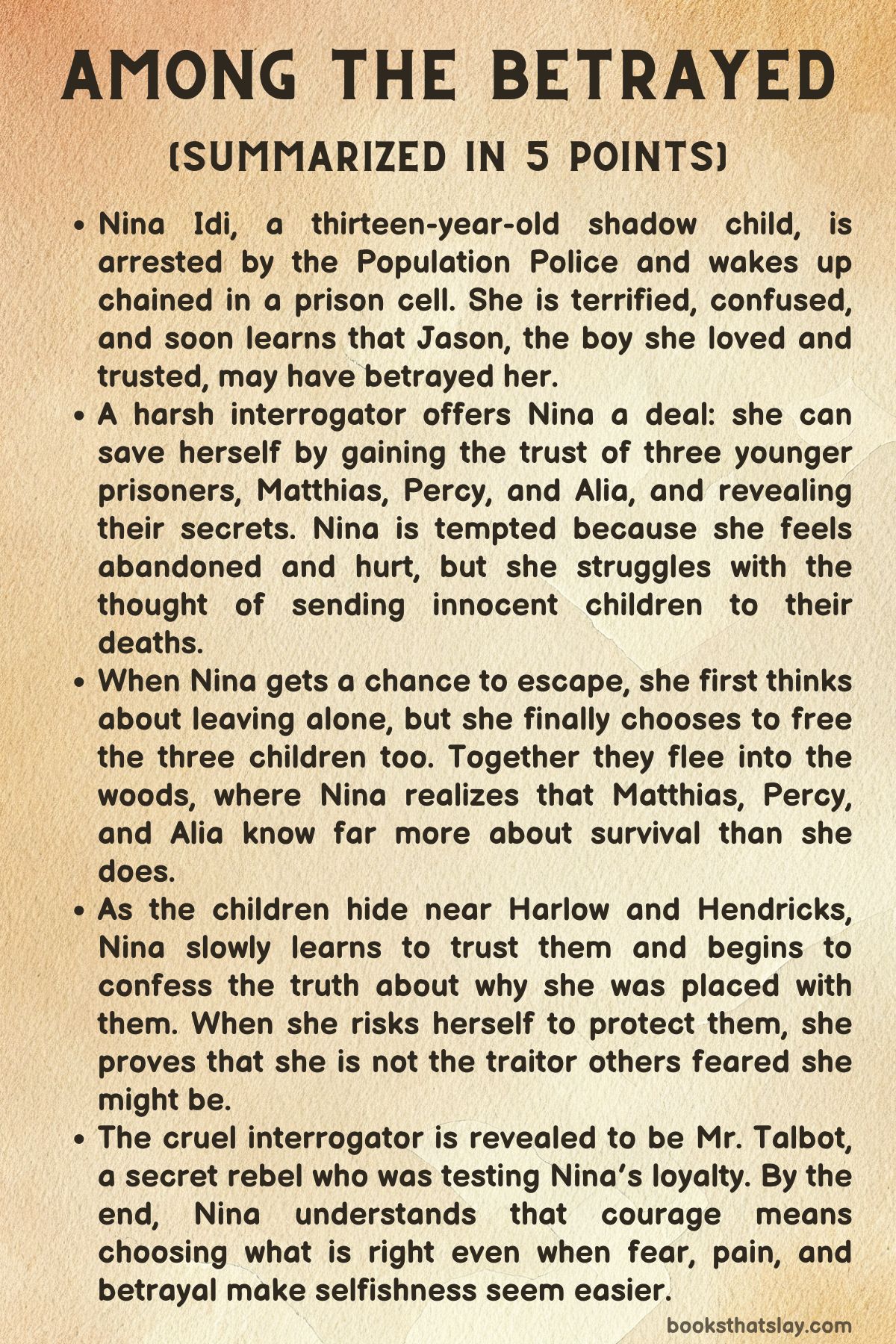
Nina Idi, a thirteen-year-old girl, wakes in a prison cell, chained to the wall and aching from her arrest. She has spent her life fearing the Population Police because she is a shadow child, an illegal third child living under a false identity.
Her real name is Elodie Luria, but her family gave her the name Nina Idi after years of sacrifice to buy her a fake identification card. Now she is alone, frightened, and unsure how much the authorities know.
A harsh man questions her and accuses her of betraying her country. Nina cannot understand how simply being born could be called betrayal, but she knows that speaking carelessly could endanger her family.
The man tells her that her friend Jason, whom she loved and trusted, confessed against her. Nina refuses to believe it at first.
Jason had seemed to care about shadow children and had gathered illegal children from Harlow School for Girls and Hendricks School for Boys to talk about freedom and resistance. He had told them about Jen Talbot, a brave girl who died after organizing a protest for the rights of third children.
Nina had admired Jen and wanted to be brave like her.
The man then reveals that Jason’s real name is Scott Renault and that he was not a shadow child at all. He had posed as one to help expose illegal children.
Nina is horrified. The man plays a recording in which Jason claims Nina was the main operator who helped him trick others.
Nina is furious and smashes the tape recorder, insisting she will not agree to the accusation. Her anger slowly hardens into pain.
She feels foolish for believing Jason loved her, and she begins to wonder whether anyone has ever truly protected her.
The man offers Nina a deal. A group of three illegal children has been arrested, and the Population Police want to know who made their fake IDs and where their families are.
Nina must enter their cell, gain their trust, and learn their secrets. If she refuses, she will die.
Nina hates the idea, but she is hurt by Jason’s betrayal and by the silence of the girls who did not defend her when she was arrested. She begins to think she must protect only herself.
When Nina is taken to the other cell, she expects dangerous prisoners, but instead she finds three small children: Matthias, Percy, and Alia. Matthias is ten, Percy is nine, and Alia is six.
They are dirty, hungry, and frightened, yet they are careful not to reveal too much. They warn Nina not to say her real name because the Population Police might be listening.
Nina is troubled by their innocence, especially Alia’s, and feels the first stirrings of guilt. These children have no parents with them and rely completely on one another.
As days pass, Nina is taken back and forth between the cell and the man’s office. In the office, she is fed good food while the children remain hungry.
She feels ashamed that she cannot bring them anything at first. Later, she begins stealing small bits of food, though she does not know how to share them without exposing herself.
She also reports to the man that the children still will not talk. He becomes impatient and gives her an ultimatum: if she does not learn their secrets within twenty-four hours, all four of them will be executed.
Then an unexpected chance appears. A guard collapses, claiming he has been poisoned, and in the confusion Nina grabs his keys.
She realizes she has the means to escape. At first, she thinks only of saving herself.
Leaving alone would be easier and safer. But she remembers Matthias, Percy, and Alia, and she knows they will die if she abandons them.
She also remembers the love of her family, especially the aunties and grandmother who cared for her. Nina chooses to return to the children’s cell and free them.
The children do not immediately trust her. They think the escape may be a trick, but Nina convinces them that she is their only chance.
Together they plan to flee into the woods near Harlow and Hendricks, a place Nina believes might be safe. During the escape, Nina learns that the younger children are far more capable than she is.
They know how to move quietly, unlock doors, avoid danger, and even disable a security system. They climb out through a window and run until they reach the woods.
Once outside, Nina feels both free and helpless. She has spent most of her life indoors, hidden behind walls and curtains, and she knows almost nothing about surviving outside.
Matthias, Percy, and Alia know how to read signs, hide tracks, and judge directions. When they need to find Harlow, Percy helps Nina reason from her memory of the sunrise during her transport to prison.
Nina is humbled by how much the children know.
The group travels through the woods, sharing stolen food and resting when they can. Nina still struggles with suspicion.
Jason’s betrayal has made her afraid to trust anyone. She wonders whether the children might betray her too.
Yet she also understands that she cannot survive without them. At a river, her lack of experience nearly exposes them when she tries to swim and is spotted by officers.
Alia saves her by pretending to be her sister and showing fake ID cards. Nina realizes the children have been hiding important truths from her, including their skill with forged identities.
When they reach the woods near Harlow, Nina sees her old school from the outside and understands how confining it really was. The children reveal more of their past: they lived on the streets, created fake IDs for illegal children, and learned how to survive without adults.
They also explain that someone betrayed them, which is why they were captured. Nina begins to see that betrayal has wounded them too.
For a few days, the woods feel like a new home, but their food runs out. Nina’s idea of planting apple seeds is useless because she does not understand how long food takes to grow.
She remembers Lee Grant, a boy from Hendricks who knows about gardening, and the others decide Nina must go find him. Disguised as a boy, she reaches Hendricks but becomes overwhelmed and runs away before speaking to anyone.
On her way back, she finds a garden full of vegetables. The group begins secretly taking food from it.
One day, while gathering vegetables, Nina is caught by Lee and Trey. They know who she is and accuse her of helping Jason betray other shadow children.
They take her to Mr. Hendricks, but Nina’s first thought is not for herself. She worries about Matthias, Percy, and Alia and how to warn them.
She escapes, runs back to the children, and finally confesses everything. She tells them the man ordered her to betray them, that Jason betrayed her, and that she had once considered saving only herself.
She admits her real name and tells them to leave without her.
At that moment, the harsh man appears. Nina panics, but the children reassure her that she has passed the test.
The man is revealed to be Mr. Talbot, Jen Talbot’s father and a secret enemy of the Population Police. He has been pretending to work with them while secretly fighting them.
He explains that Nina had to be tested because she knew about many illegal children, and the resistance needed to know whether she could be trusted. Matthias, Percy, and Alia were part of the test.
The officers at the bridge were part of it too. Nina is shaken by the cruelty of the test but realizes that when the final choice came, she protected the children instead of herself.
Afterward, Nina stays at Mr. Hendricks’s house with Matthias, Percy, and Alia while plans are made to send them to a safer school with new fake IDs. Lee tells Nina that Jason may not have wanted her killed; he may have tried to save her in his own twisted way.
Nina asks Mr. Talbot about the recording of Jason’s confession and learns that the tape was fake. Jason did love her, but he is still alive and still involved in a dangerous secret operation with the Population Police.
Nina cannot forgive him, but Mr. Talbot warns her not to live only with bitterness.
Nina thinks about the stories her grandmother told her, stories about staying true to oneself through suffering. She sees that goodness is not proven by never being afraid or angry.
It is proven by what a person chooses when fear and anger are strongest. By the end of Among the Betrayed, Nina is no longer the sheltered girl who only wanted to hide.
She has learned to act, to trust carefully, and to stand with others against the system that made all shadow children live in fear.
Characters
Nina Idi / Elodie Luria
Nina is the central character of Among the Betrayed, and her journey is shaped by fear, shame, mistrust, and gradual moral courage. At the beginning, she is a frightened thirteen-year-old who has spent her life being told that her existence is dangerous.
As an illegal third child, she has learned to hide, obey, and survive quietly. Her fake identity, Nina Idi, separates her from her real self, Elodie Luria, and this split identity becomes a major part of her emotional struggle.
She is not only imprisoned by the Population Police but also by years of secrecy and fear. When she is arrested, she does not immediately become heroic.
Instead, she becomes confused, angry, and desperate, which makes her feel painfully real. Her first instinct is survival, even if survival may require betraying Matthias, Percy, and Alia.
Nina’s strongest conflict is internal. She wants to believe she is good, but she is also tempted to protect herself at any cost.
Jason’s betrayal wounds her deeply because she had trusted him with her real name and her affection. That betrayal makes her question everyone around her and almost pushes her toward becoming the kind of person she hates.
Yet Nina’s goodness shows itself through hesitation, guilt, and finally action. She cannot fully accept the idea of handing over three younger children to death.
Her decision to free them proves that courage is not natural to her; it is chosen under pressure. By the end, Nina becomes stronger not because she stops being afraid, but because she learns to act despite fear.
She also learns that trust is risky but necessary, and that identity is not only about a name but about the choices one makes when tested.
Jason Barstow / Scott Renault
Jason is one of the most troubling characters because he represents charm, betrayal, and moral confusion. To Nina, he first appears as a brave and caring boy who understands the fear of shadow children.
He speaks about rights, rebellion, and the story of Jen Talbot, giving Nina a sense that she is part of something larger than her hidden life. His attention makes her feel seen and loved, which is powerful because Nina has lived under a false identity and has been trained to stay invisible.
Jason’s words make him seem heroic, but his actions reveal something far more dangerous.
Jason’s real identity as Scott Renault destroys Nina’s trust. He has pretended to be an illegal child in order to expose others, and this deception makes him responsible for terrible harm.
Even when the story later suggests that he may have loved Nina and may have tried to spare her, that does not erase his cruelty. Jason is not written as a simple villain whose every feeling is false.
Instead, he shows how a person can have affection and still make evil choices. His character forces Nina to understand that love is not enough if it is separated from loyalty, honesty, and moral responsibility.
Jason’s survival at the end complicates Nina’s feelings further. She cannot simply mourn him as someone good who died; she must face the harder truth that a living person can love her and still be unworthy of forgiveness.
Mr. Talbot
Mr. Talbot is one of the most morally complex figures in Among the Betrayed. At first, Nina sees him as the cruel interrogator, the man who frightens her, accuses her, feeds her lies, and forces her toward betrayal.
His harshness makes him appear no different from the Population Police. He uses fear, manipulation, and emotional pressure, especially through the false recording of Jason’s confession.
Because Nina is already terrified and heartbroken, his methods nearly break her. For much of the story, he seems to represent the brutal power of the state.
The revelation that he is Jen Talbot’s father and a secret rebel changes the reader’s understanding of him but does not make his actions simple or fully comfortable. Mr. Talbot is fighting the Population Police from within, and his deception is meant to protect illegal children and expose traitors.
Still, his test of Nina is severe. He believes the stakes are so high that emotional cruelty is justified if it reveals whether someone can be trusted.
This makes him both a protector and a manipulator. He understands political danger better than Nina does, but he also underestimates the emotional cost of what he puts her through.
His advice about faith, mixed motives, and bitterness shows that he has lived with moral difficulty for a long time. He teaches Nina that resistance is not clean or easy, but his character also raises questions about whether good goals can excuse painful methods.
Matthias
Matthias is the oldest of the three younger children and acts as their practical leader. Though he is only ten, he has the seriousness of someone who has already carried adult responsibilities.
His small body and young age contrast with his survival skills, caution, and authority. He knows how to think ahead, how to avoid danger, and how to protect Percy and Alia.
In the prison cell, he does not easily trust Nina, and his suspicion is justified. He understands that careless words can lead to death, so he treats secrecy as a form of survival.
Matthias’s strength comes from discipline and experience. He is not sentimental about danger, and he often sees practical problems before Nina does.
When Nina wants to flee quickly, Matthias thinks about guards, timing, shelter, food, and safety. His carefulness makes him seem older than he is, but the story also reminds us that he is still a child.
His worry, his protectiveness, and his dependence on the group reveal vulnerability beneath his toughness. Matthias helps Nina recognize how sheltered she has been.
She may be older, but he knows more about surviving in the outside world. Through him, the story shows that suffering can force children to mature too soon, but it does not remove their need for protection and trust.
Percy
Percy is sharp, observant, and practical. At nine years old, he has already learned how to read situations quickly and make useful judgments.
He is especially important during the escape and journey through the woods because he helps solve problems that Nina cannot handle. His questions about the direction of the sun, the road, and the location of Harlow show that he has trained himself to notice details that can mean the difference between life and death.
Percy does not waste time comforting Nina with false hope; he focuses on what must be done.
Percy can seem blunt, but his bluntness comes from experience rather than cruelty. He understands hunger, homelessness, and danger, so he does not romanticize survival.
When Nina suggests ideas that reveal her ignorance, Percy often brings the conversation back to reality. His attitude toward fake IDs also shows that he sees identity papers as practical tools, not abstract symbols.
To him, a fake ID can be as necessary as food. Percy’s character helps expose the gap between Nina’s protected hidden life and the harsher life of children who had no family shelter.
He is still a child, but he has learned the language of survival, suspicion, and necessity.
Alia
Alia is the youngest of the three children, but she is not helpless. At six, she appears sweet and fragile, which makes Nina especially uncomfortable with the idea of betraying her.
Yet Alia repeatedly proves that innocence and competence can exist together. She is calm during danger, skilled with fake IDs, and able to lie convincingly to officers when Nina freezes.
Her rescue of Nina at the river is one of the clearest signs that Alia understands the world far better than her age suggests.
Alia also carries a strong sense of faith. She believes God watches over them and answers prayers, which gives her a quiet confidence.
This faith does not make her passive. Instead, it supports her courage and steadiness.
She often senses Nina’s goodness before the others are ready to trust her. Her belief in Nina matters because Nina herself does not fully believe she is good.
Alia’s warmth, especially when she hugs or reassures Nina, becomes a moral anchor in the story. She represents the possibility that trust can survive even in a world built on fear.
At the same time, her life shows the cruelty of a society where even very young children must master deception in order to stay alive.
Lee Grant
Lee is important because he connects Nina’s past with the resistance world she enters by the end. Earlier, he is one of the Hendricks boys associated with Jason and the secret meetings, but later he becomes part of the group that tests Nina.
When he and Trey catch Nina stealing from the garden, Lee’s anger is understandable because he believes she helped betray other shadow children. His reaction shows how betrayal damages not only individuals but whole communities.
Once someone is suspected, trust becomes difficult to restore.
Lee also serves as a guide for Nina after the truth is revealed. He helps her understand that the girls at Harlow may not immediately forgive or trust her because they have not experienced the same growth she has.
This observation shows maturity. Lee does not flatter Nina or simplify the consequences of suspicion.
He also gives Nina a more complicated view of Jason, suggesting that Jason may have cared about her even while doing terrible things. Lee’s role is not as emotionally central as Nina’s, but he helps her move from personal pain toward a broader understanding of resistance, loyalty, and responsibility.
By welcoming her to the team, he marks her transition from frightened survivor to active participant.
Trey
Trey appears mainly as one of the Hendricks boys who helps Lee capture Nina when she is found stealing from the garden. His role is smaller, but he represents the suspicion that surrounds Nina after Jason’s betrayal.
Trey’s distrust is not irrational. From his perspective, Nina may have helped expose illegal children, and in their dangerous world, trusting the wrong person can be fatal.
His harshness toward Nina reflects the defensive mindset of children who have already seen betrayal lead to imprisonment or death.
Trey’s character helps show how fear can harden communities that are already under threat. The illegal children and their allies cannot afford easy forgiveness because their lives depend on caution.
Even though Trey is not explored as deeply as some others, his presence makes the resistance network feel larger and more guarded. He helps create the pressure under which Nina must prove herself, not by words but by actions.
Mr. Hendricks
Mr. Hendricks is a quiet but important figure connected to safety, shelter, and organized resistance. As the man behind Hendricks School, he represents a hidden system that protects shadow children under the surface of an oppressive society.
His physical disability does not prevent him from being part of the resistance, and his home becomes a place where Nina and the younger children can recover after the test. Unlike the Population Police, who use buildings as prisons, Mr. Hendricks’s space becomes associated with concealment, care, and planning.
His encounter with Nina also reveals how far fear has driven her. When she knocks him from his wheelchair to escape, she is not acting from cruelty but from panic and concern for Matthias, Percy, and Alia.
Mr. Hendricks becomes part of the moment when Nina’s priorities change. She is willing to risk herself because she is thinking about saving others.
His character is less dramatic than Mr. Talbot’s, but he stands for a quieter form of courage: creating systems of refuge in a world where refuge is illegal.
Jen Talbot
Jen Talbot never appears alive in the main action, but her influence shapes the story. She is remembered as a girl who organized a protest for the rights of third children and died because of her courage.
For Nina, Jen first exists as an inspiring story told by Jason. Jen represents the kind of bravery Nina wishes she had: public, bold, and willing to challenge the Government directly.
Her death also shows the cost of resistance in this world. Speaking out is not symbolic; it can lead to execution.
Jen’s legacy affects several characters. Jason uses her story to inspire trust, which makes his betrayal even more painful.
Mr. Talbot’s grief over Jen helps explain his commitment to fighting the Population Police and his willingness to take extreme risks. For Nina, Jen becomes a standard of courage, though Nina’s own courage develops differently.
Nina does not lead a protest or make a public speech. Her bravery is private and immediate: she chooses not to betray children who depend on her.
Jen’s presence in the story reminds us that sacrifice can continue to shape events long after a person is gone.
Nina’s Grandmother
Nina’s grandmother is a powerful presence in Nina’s memory. She represents family love, faith, and the belief that Nina’s life has value even in a society that calls her illegal.
Her care helped Nina survive childhood, and her stories gave Nina a moral language for understanding endurance. The grandmother’s belief in miracles is especially meaningful because Nina herself has been treated as a problem or crime by the Government.
To her grandmother, Nina is not a mistake; she is precious.
Her influence becomes clearer when Nina faces moral choices. Nina remembers the people who loved and protected her, and those memories help her choose to protect Matthias, Percy, and Alia.
The grandmother’s faith also connects loosely with Alia’s belief that God watches over them. Through Nina’s grandmother, the story shows that hidden family life, though limited by fear, can still give a child moral strength.
Even when Nina feels separated from her real identity, her grandmother’s love remains part of who she is.
Aunty Zenka and Aunty Lystra
Aunty Zenka and Aunty Lystra are central to Nina’s past because they helped raise and protect her. They saved money for her fake ID and taught her during the years when she could not live openly.
Their sacrifices show the burden placed on families of illegal children. Loving Nina requires secrecy, planning, and danger.
The aunties give her safety, but that safety also keeps her sheltered from the outside world. Because they protect her so carefully, Nina grows up with limited practical knowledge, which becomes clear when she must survive in the woods.
The aunties also represent two sides of hidden life. On one hand, they preserve Nina’s life and identity.
On the other hand, the life they create for her is narrow and fearful. Nina’s ignorance about outdoor survival, food, and ordinary freedom is not her fault; it is the result of a society that forced her family to hide her.
Their love is real, but it cannot fully prepare her for the violent public world controlled by the Population Police. Through them, the story shows how oppression damages even acts of care.
Nina’s Parents
Nina’s parents, Rita and Lou, are less directly present than her grandmother and aunties, but their importance lies in the risk and sacrifice surrounding Nina’s existence. Her mother gave birth to her despite living in a society that criminalizes third children, and her family continued sending money to support her false identity.
Nina worries that the authorities might learn their names, which shows how deeply connected her own danger is to theirs. Her imprisonment is not only a threat to her life; it could destroy her entire family.
Nina’s thoughts about her parents also reveal her longing for a stable identity. She is not just Nina Idi, the name on her fake card.
She is someone’s daughter, someone who had a real name and a real family before the state forced her into hiding. Her parents symbolize the private truth that the Government tries to erase.
Even when they are absent from the action, their existence reminds Nina that she was loved before she was useful, accused, or tested.
Sally and Bonner
Sally and Bonner represent the other shadow children at Harlow School for Girls. Like Nina, they live under fake identities and constant fear.
Their conversations with Nina about families, hidden lives, and the dangers of the Government reveal how deeply secrecy has shaped all of them. Sally’s family background shows that some families are politically aware and even involved in resisting the Government, while Bonner’s fear that the meeting with the Hendricks boys could be a trap proves how cautious these children must be.
Their failure to defend Nina during her arrest hurts her deeply, but their silence is also understandable. They are terrified children facing armed authorities.
Nina later becomes capable of forgiving them because she understands fear better after her own test. Sally and Bonner show that not every frightened person is disloyal.
Sometimes silence is a survival response. Their role helps Nina move away from judging others too quickly, especially once she realizes how close she herself came to betrayal.
The Guard
The guard represents the everyday violence of the Population Police system. He is not given a deep personal history, which makes him function more as a symbol of institutional cruelty.
He hits Nina, moves prisoners through the prison, controls access to cells, and participates in the atmosphere of fear. His treatment of Nina shows how easily the system dehumanizes children.
The prisoners are not treated as young people in need of care but as objects to be handled, threatened, and punished.
At the same time, the guard’s collapse creates the opportunity for Nina to steal the keys. Whether seen as accident, plan, or part of the larger manipulation surrounding Nina’s test, the moment allows her character to reveal itself.
The guard’s keys become the physical sign of choice. Nina can use them only for herself, or she can return to the cell and save the others.
The guard’s role is small, but the power attached to him helps create the conditions for Nina’s moral decision.
Samuel Jones
Samuel Jones is mentioned as the protector of Matthias, Percy, and Alia before his death during a rally. Though he does not appear directly, his role is important because it explains why the children were vulnerable.
He seems to have been part of the network helping illegal children survive, and his death leaves the younger children exposed. Like Jen Talbot, he represents the danger faced by people who resist the Government openly or actively.
His connection to Matthias, Percy, and Alia also shows that shadow children survive through fragile networks of protection. When one protector is killed, several lives can be thrown into danger.
Samuel’s absence shapes the plot because it helps explain why the children end up in prison and why Mr. Talbot believes drastic action is necessary. He is a reminder that resistance has casualties beyond the people whose deaths are described directly.
Themes
Trust After Betrayal
Trust in Among the Betrayed is not treated as easy, natural, or automatically good. Nina begins the story wounded by what she believes Jason has done to her.
Because she trusted him with her affection and her real name, his betrayal feels like an attack on her whole self. This pain changes the way she sees everyone.
Matthias, Percy, and Alia are not responsible for Jason’s actions, but Nina still views them through the fear he created. She suspects them, hides from them emotionally, and even considers using food to gain information from them.
Her mistrust is ugly at times, yet it is also understandable because betrayal has made trust seem dangerous.
The theme becomes more complex because the younger children also distrust Nina. They have their own reasons: they know someone betrayed them, and Nina arrives as a stranger in a prison cell.
Trust must therefore be earned through action rather than claimed through words. Nina’s confession and willingness to protect them finally prove her loyalty.
The story suggests that trust after betrayal cannot return in a pure or innocent form. It becomes cautious, tested, and sometimes painful.
Still, without trust, none of the children can survive. Nina’s growth depends on learning that betrayal should make a person wiser, not closed off from every future bond.
Identity and the Loss of a Real Name
Nina’s false name is more than a disguise; it is a sign of how deeply the Government has invaded private life. Elodie Luria is her real self, connected to family, memory, and love.
Nina Idi is the identity created to keep her alive. The fake name protects her, but it also makes her feel erased.
She has to live as someone else because the law says her real existence is forbidden. This creates a painful split between survival and authenticity.
To live, she must hide the truth. To be fully herself, she would risk death and expose her family.
The same issue appears through fake IDs, hidden children, and changed names across the story. Jason’s second identity as Scott Renault shows the darker side of false identity: disguise used not for survival but for deception.
Matthias, Percy, and Alia also understand fake IDs as tools of life, almost as necessary as food. The theme asks what identity means in a society where official papers decide whether a child is allowed to exist.
Nina’s final willingness to reveal her real name to the younger children is a major emotional step. She is not merely giving information; she is offering trust.
Her real name becomes a symbol of reclaimed selfhood, proving that the state can force secrecy but cannot fully destroy personal truth.
Moral Courage Under Pressure
Courage in the story is not presented as fearlessness. Nina is afraid through much of the plot, and her fear often makes her passive, selfish, or suspicious.
This is what makes her moral growth meaningful. She does not begin as a bold rebel like Jen Talbot.
She begins as a girl who wants to survive. When the Population Police threaten her with death, her first thoughts are not noble.
She considers cooperating. She feels abandoned by others and wonders whether she owes anyone loyalty.
The story uses this weakness to show how moral courage is formed under pressure, not outside it.
Nina’s defining choice comes when she has the keys and can escape alone. This moment matters because no speech or belief can substitute for action.
If she leaves Matthias, Percy, and Alia behind, she may live, but she will become part of the cruelty that has hurt her. By returning for them, she chooses danger over selfish safety.
Later, when she confesses the truth to the children and tells them to leave without her, she shows a deeper courage: the willingness to be judged honestly. The theme suggests that goodness is not a fixed quality someone either has or lacks.
It is built through choices, especially when every choice carries risk.
The Cruelty of a System That Criminalizes Children
The world of the novel is built on a law that turns children into criminals for being born. This theme shapes every character’s life.
Nina is hidden by her family, sent away under a false name, and taught to fear windows, officers, and ordinary public spaces. Matthias, Percy, and Alia live with hunger and danger because society gives them no legal place.
Even schools meant to protect shadow children are marked by secrecy and confinement. The law does not simply punish illegal children after they are found; it distorts their entire childhood before any arrest happens.
The Population Police system also corrupts relationships. Families must lie to protect their children.
Children must hide their names. Friends cannot know whether someone is genuine or an informer.
Jason’s betrayal is possible because the system rewards exposure and turns trust into a weapon. Mr. Talbot’s harsh test of Nina is also a product of this world; even resistance becomes morally complicated because the danger is so extreme.
The greatest cruelty of the system is that it forces children to make adult choices about survival, loyalty, secrecy, and death. By showing children who are hungry, imprisoned, manipulated, and tested, the story makes clear that the true crime belongs not to the shadow children but to the society that declares them illegal.