Among the Impostors Summary, Characters and Themes
Among the Impostors by Margaret Peterson Haddix is the second book in the Shadow Children series. It follows Luke Garner, an illegal third child living under the false name Lee Grant, as he enters Hendricks School for Boys.
After years of hiding, Luke must survive crowded halls, cruel students, strange rules, and the constant fear that someone will discover who he really is. The book is about identity, courage, and learning how to live when the world says you should not exist. It also shows Luke beginning to move from fear toward purpose, using what he knows to help others like him.
Summary
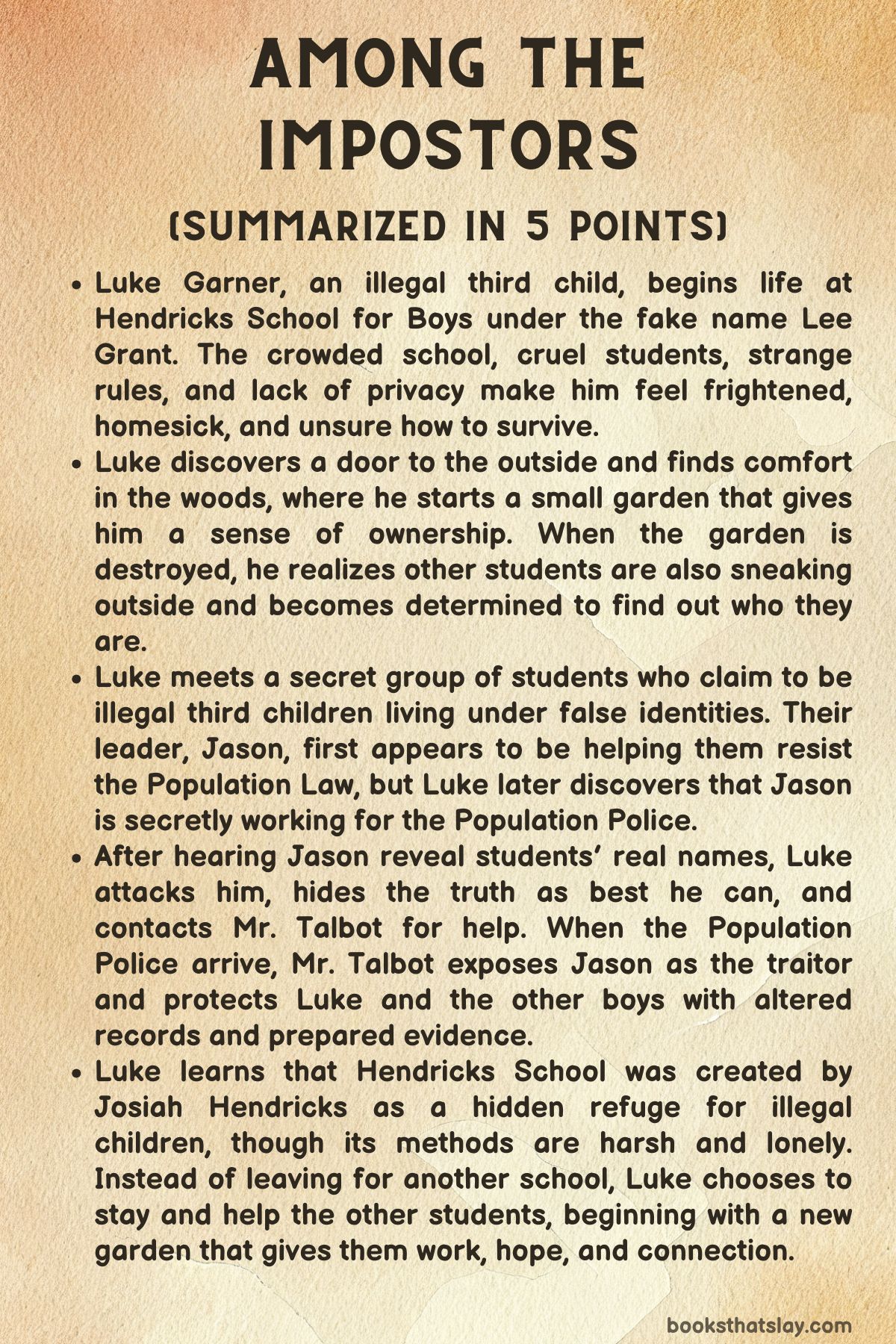
Among the Impostors begins with Luke Garner arriving at Hendricks School for Boys under the fake identity of Lee Grant. Luke is an illegal third child in a society ruled by the Population Law, which forbids families from having more than two children.
For most of his life, Luke has hidden from the government. Now, after the death of his friend Jen Talbot, he has been given a forged identity and sent away from home so he can live more openly.
But the school is nothing like the freedom he imagined.
From the start, Luke feels lost and frightened. The school is large, crowded, and confusing.
He is used to being unseen, so the noise and number of boys overwhelm him. He misses his parents, his brothers, and the safety of his home.
George Talbot, Jen’s father, helps him enter the school and secretly gives him a note before leaving. Luke believes the note will explain everything, but he cannot find a private place to read it.
Luke’s first guide at school is Rolly Sturgeon, who treats him cruelly. Luke is pushed, mocked, and confused by rules he does not understand.
He earns demerits without knowing what they mean. His bedroom has many beds, leaving him no privacy.
A boy Luke thinks of as “jackal boy” becomes his main tormentor, forcing him into humiliating tasks and calling him strange insults such as exnay, fonrol, and lecker. Luke understands that these words are meant to hurt him, but he does not yet know what they mean.
The school itself feels unnatural. There are no windows anywhere.
The halls are watched by monitors, the bathrooms are open, and the teachers seem distant and ineffective. Luke goes through the days trying to copy everyone else.
He repeats his real name to himself at night as a quiet act of resistance, but he feels increasingly alone. He worries that becoming Lee Grant means losing Luke Garner forever.
One day, Luke notices a door leading outside. He slips through it and finds himself in the woods.
The fresh air reminds him of home and gives him a sense of relief. There, he finally reads Mr. Talbot’s note.
It says only, “blend in.” Luke is angry and disappointed. He had expected guidance, not a vague command.
Still, being outside changes him. He realizes he can escape the school building for short periods and return without being caught.
The woods become Luke’s private refuge. He begins watching the school more carefully.
He notices that some students rock back and forth, while others stare directly at him. He starts to see patterns he had missed while trying to stay invisible.
The school, which once seemed impossible to understand, slowly becomes something he can study. Luke also starts a small garden in the woods.
He plants beans, raspberries, and potatoes, using seeds and scraps from meals. Growing food gives him joy and a sense of ownership.
It is the first thing at Hendricks that feels truly his.
Then Luke finds the garden destroyed. Footprints show that other students have been in the woods.
Luke is devastated and furious. He realizes that he is not the only one sneaking outside.
He decides to discover who the others are and why they ruined what he had made.
That night, Luke follows whispers into the woods and finds a secret group of students gathered around a lantern. Among them is jackal boy.
Luke learns that the group has been watching him and discussing whether he might be like them. They talk about illegal children, fake names, and the way they tested Luke by leaving the outside door open.
Luke steps out from hiding and confronts them.
The group is shocked, and Luke accuses them of destroying his garden. They deny doing it on purpose, and some laugh at him.
Jackal boy explains some of the insults. “Exnay” means a third child living under a fake identity, “fonrol” means any third child, and “lecker” means someone from the country.
Jackal boy also reveals that his school name is Scott Renault, but his real name in the group is Jason.
Jason tells Luke that all of them are third children hiding behind false identities. He says his bullying was meant to toughen Luke up because many hidden children panic after entering the outside world.
Jason claims the group wants to fight the Population Law. When Luke mentions that he knew Jen Talbot, the others become fascinated.
Jen has become a legend to them because she died trying to win rights for third children. Luke tells them about her bravery but keeps his own real name secret.
After this, Luke becomes part of the group. He feels safer with them, though he still has questions.
He learns that Hendricks was originally created as a school for children with disabilities and fears, but it also shelters illegal third children. The lack of windows and strange routines were supposedly designed for students with autism and agoraphobia.
Luke begins to understand that the school hides many secrets behind its disorder.
Jason gains Luke’s trust by giving him his class schedule and claiming he can fix grades through computer hacking, just as Jen once used computers to help third children. Luke, however, wants to learn honestly.
He studies hard for finals, wanting to prove that he belongs and that his new identity is not wasted. While the others rely on Jason, Luke grows suspicious.
One night, he sees Jason leave the bedroom and follows him.
Luke discovers Jason talking on a portable phone. At first, Luke thinks Jason may be planning action against the government.
Then he hears Jason giving the real names of students to the Population Police. Jason admits over the phone that he works for them.
Luke reacts quickly. He grabs the phone, smashes it, and fights Jason, eventually knocking him unconscious.
Now Luke must act fast. He pretends Jason has had a seizure and takes him to the nurse, hoping to keep him quiet.
He then realizes the phone has disappeared, which means someone else may know what happened. The lives of the students Jason named are in danger.
Luke decides his only hope is to contact Mr. Talbot.
Luke breaks into the school office and searches his file for Mr. Talbot’s number. He finds falsified records, altered photographs, and fake reports about Lee Grant.
The documents make him fear that his real self could vanish beneath the false identity. When he calls Mr. Talbot, he tries to speak in code, warning him that there is an emergency involving several students.
Mr. Talbot seems not to understand and tells Luke to handle his own problems. Luke feels abandoned.
The next morning, the Population Police arrive at the dining hall. An officer announces that illegal children have been found and that the punishment is death.
Just as he prepares to name the students, Mr. Talbot enters with Jason in handcuffs. Jason tries to expose Luke and four other boys, but Mr. Talbot has prepared evidence to protect them.
The boys give different names, and the files support those new identities. Mr. Talbot also shows a doctored family photograph proving that he has supposedly known “Lee” since childhood.
Jason’s accusations fall apart, and he is taken away.
Afterward, Luke is brought to meet Josiah Hendricks, the founder of the school. Mr. Hendricks explains that he created the schools partly out of guilt.
During the Great Famines, the government considered letting vulnerable people die, and later it passed the Population Law. Mr. Hendricks used his wealth to create a place where some illegal children could live outside hiding.
The confusion at the school is intentional. If no one knows exactly who is illegal and who is not, betrayal becomes harder.
Luke is angry that the students have been left lonely, frightened, and badly taught. Mr. Hendricks argues that the school is meant to help hidden children adjust gradually to the outside world.
Mr. Talbot explains that Jason and Nina, a girl at the companion school, were not true third children but plants working for the Population Police. Luke realizes Jason’s bullying was never meant to help him; it was meant to break him.
Mr. Talbot plans to move Luke to another school for safety, but Luke refuses. He decides his work at Hendricks is not finished.
He wants to help the other students, not run from them. By the end of Among the Impostors, Luke is outside planting a new garden with other boys.
He is still unsure how long he will stay or exactly who he is becoming, but he chooses to use both his past and his false identity to build something useful. When a boy asks his name, Luke says to call him “L,” a name that holds both Luke and Lee together.
Characters
Luke Garner / Lee Grant
Luke Garner is the emotional and moral center of the story, and his character is shaped by fear, secrecy, guilt, and a growing need to act. As an illegal third child, he has spent most of his life hiding, so entering Hendricks School under the false name Lee Grant forces him into a world that feels unbearable at first.
He is frightened by crowds, confused by school routines, and deeply homesick. His first instinct is to avoid attention because survival has always meant staying unseen.
Yet Luke is not passive. Even when he is terrified, he observes carefully, asks questions, and slowly begins to understand the hidden structure of the school.
His garden becomes a symbol of his inner life: he wants something real, useful, and his own in a place built on false identities. By the end of Among the Impostors, Luke has changed from a boy trying only to survive into someone willing to protect others.
His decision to stay at Hendricks shows that he no longer sees courage as something only Jen had. He begins to recognize courage in his own choices.
Jason / Scott Renault
Jason is one of the most complex characters because he presents himself as a protector while secretly acting as a threat. At first, Luke sees him as a cruel bully, calling him “jackal boy” in his mind because of the way he torments him.
Jason’s abuse seems pointless and personal, but later he explains it as a method of toughening new illegal children so they do not panic and expose themselves. This explanation makes him appear more layered, even useful, because he seems to understand the fear that hidden children carry.
He also becomes a leader among the secret group in the woods, speaking confidently about resistance and rebellion. However, this image is false.
Jason’s real role is to gather information for the Population Police. His betrayal is especially damaging because he uses the children’s need for trust against them.
He studies their fear, encourages them to reveal themselves, and turns their desire for friendship into a weapon. Jason represents the danger of false leadership and shows how cruelty can hide behind language that sounds protective or revolutionary.
George Talbot
George Talbot is both a rescuer and a distant authority figure. He gives Luke the false identity of Lee Grant and helps place him at Hendricks, but he does not offer the kind of comfort or explanation Luke badly needs.
His note telling Luke to “blend in” feels cold and inadequate, especially because Luke is overwhelmed and alone. Yet Mr. Talbot is not careless.
He operates in a dangerous political world where direct speech can put lives at risk. His behavior often seems frustrating because he must think in codes, forged records, and calculated risks.
When the Population Police arrive, his intelligence and preparation become clear. He protects Luke and the other boys by manipulating evidence and turning suspicion onto Jason.
Mr. Talbot’s character shows the cost of resistance in a police state. He has lost his daughter, works under constant danger, and must often appear detached in order to keep others alive.
He is not openly affectionate, but his actions prove his commitment.
Jen Talbot
Jen does not appear alive in the present action, but her influence is everywhere. She is Luke’s dead friend, the girl who helped him imagine that illegal third children had a right to exist and deserved to fight for that right.
To Luke, Jen represents boldness, defiance, and possibility. He often compares himself to her and feels that he falls short of her courage.
This comparison can make him feel weak, but it also pushes him forward. Among the other hidden children, Jen has become almost legendary because of her attempt to organize a rally against the Population Law.
Her death gives the story a strong emotional background, showing that rebellion can carry a terrible cost. Jen’s importance lies not only in what she did but in what she awakened in Luke.
Before knowing her, Luke had accepted much of the world’s judgment against him. After knowing her, he cannot fully return to silence.
Her memory becomes a challenge that helps him act when others are in danger.
Josiah Hendricks
Josiah Hendricks is a morally complicated figure because his school is both a refuge and a place of suffering. He is wealthy and physically disabled, and his past experiences with the government’s cruelty shape his choices.
He understands that society is willing to discard people it considers inconvenient, whether they are disabled, poor, unwanted, or illegal. His decision to create the schools comes from guilt and compassion, and he does provide a place where third children can live outside complete hiding.
At the same time, Hendricks School is lonely, confusing, and poorly run. The lack of warmth is not accidental; Mr. Hendricks believes the children must adjust slowly to the outside world.
This reasoning may have practical value, but it also leaves children like Luke frightened and unsupported. Mr. Hendricks is not a villain, but he is not fully heroic either.
He represents the limits of good intentions when those intentions are carried out through systems that still neglect emotional needs.
Trey
Trey helps show how deeply hiding has damaged many illegal third children. Unlike Luke, who had some access to the outdoors and family life, Trey spent years confined to one room.
His fear of the outside world is not weakness; it is the result of being forced to live unnaturally for survival. Through Trey, the story broadens the reader’s understanding of third children.
Luke begins to realize that his own hidden life, painful as it was, gave him more freedom than some others had. Trey’s nervousness, hesitation, and dependence on others reflect the long-term effects of isolation.
He also gives Luke a chance to become more empathetic. Instead of seeing himself only as a victim, Luke starts to see that other children need help too.
Trey’s later presence in the garden matters because it suggests that healing can begin through shared work, fresh air, and trust.
Rolly Sturgeon
Rolly Sturgeon serves as Luke’s first direct experience of school cruelty. He is supposed to guide Luke, but instead he scares him, steals from him, and helps make Hendricks feel unsafe from the beginning.
Rolly’s role is brief compared with Jason’s, but he helps establish the social order Luke enters. The school is not a nurturing place where adults carefully protect vulnerable students.
Boys like Rolly can use confusion and fear to dominate newcomers. His behavior also shows how quickly Luke’s new identity becomes a test.
Luke must respond without revealing how little he understands about ordinary school life. Rolly is not explored as deeply as the central characters, but he is important because he introduces Luke to the daily humiliations and dangers of being trapped in a place where he cannot explain himself honestly.
Mr. Dirk
Mr. Dirk appears as part of the school’s rigid and confusing authority structure, but he later proves to be more aware than he first seems. Early on, he looks like just another adult enforcing pointless rules and handing out demerits.
From Luke’s point of view, adults at Hendricks seem either indifferent, incompetent, or threatening. Mr. Dirk fits that pattern until the later revelation that some staff members know limited pieces of the school’s real purpose.
His role in escorting Luke to meet Mr. Hendricks shows that he is connected to the hidden system protecting illegal children. He is not warm or open, and the story does not present him as a comforting mentor.
Instead, he represents controlled secrecy. He knows enough to help at key moments, but not enough to make Hendricks feel safe or humane.
The Nurse
The nurse is a minor but important figure because Luke’s interaction with her becomes part of the crisis surrounding Jason. When Luke brings Jason to her after knocking him unconscious, he must lie quickly and convincingly.
The nurse notices details, asks questions, and records what happened, making her seem more attentive than many other adults at the school. At the same time, she does not fully uncover the truth in that moment.
Her presence raises the tension because Luke’s story could collapse if she becomes too suspicious. She also indirectly helps expose Jason because the situation in the nurse’s office draws attention to his hidden phone.
The nurse therefore functions as a practical part of the plot, but she also reflects the strange nature of Hendricks: even ordinary adult supervision is surrounded by secrecy, fear, and half-truths.
Nina
Nina is important even though she remains mostly outside Luke’s direct experience. She is Jason’s counterpart at the girls’ school and, like him, is connected to the Population Police.
Her presence shows that Jason’s betrayal is not an isolated accident but part of a larger strategy. The government has begun placing informers inside spaces meant to protect illegal children, which means the danger has become more organized and harder to detect.
Nina also complicates the idea of identity. At first, Luke assumes the girl in the woods may be another hidden child using a false name, but later it becomes clear that she is part of the system hunting them.
Her character expands the threat beyond Hendricks School for Boys and suggests that other children in other places are also vulnerable.
Luke’s Family
Luke’s family remains physically absent for most of the story, but they shape his thoughts and values. His parents and brothers represent the home he has lost, as well as the identity he fears losing.
Memories of his mother’s food, his father’s carefulness, and his brothers’ ordinary activities remind him of a life that was restricted but still loving. His family also gives him a moral foundation.
Luke knows that returning home would endanger them, so he must carry his homesickness without acting on it. Their absence makes his loneliness sharper, but it also shows his growth.
He moves from longing only for home to understanding that he can create purpose somewhere else. In Among the Impostors, Luke’s family is not simply a memory of safety; they are part of the reason he learns responsibility.
Themes
Identity and the Fear of Being Erased
Luke’s false identity as Lee Grant creates a constant struggle between survival and selfhood. The fake name protects him from the Population Police, but it also threatens to swallow the life he had before Hendricks.
This fear becomes especially strong when Luke finds altered photographs and false records in his school file. The documents do not simply lie about where he came from; they create a complete official version of him that has little connection to the truth.
For a child who has already been told by law that he should not exist, this is deeply frightening. Luke wants safety, but he does not want safety at the price of becoming unreal.
His habit of whispering his real name at night shows how strongly he clings to Luke Garner as a private truth. Yet the story does not treat identity as simple.
By the end, Luke does not reject Lee Grant entirely, because that name has also allowed him to learn, act, and protect others. When he chooses to call himself “L,” he accepts that he is living between two names.
His identity becomes something he must shape for himself rather than something the government, his file, or even his past can fully define.
Courage as Growth, Not Fearlessness
Courage in the story is not shown as the absence of fear. Luke is afraid almost constantly: afraid of crowds, exposure, punishment, betrayal, and failure.
What changes is not that his fear disappears, but that he learns to move through it. At first, he thinks of courage mainly through Jen, whose boldness seems far beyond anything he can do.
This comparison makes him feel small, as if real bravery belongs to someone else. But Luke’s actions gradually prove otherwise.
He goes outside even though he risks discovery. He studies the school instead of surrendering to confusion.
He confronts the secret group in the woods. Most importantly, he acts when he discovers Jason’s betrayal, even though he has no plan and no guarantee that anyone will believe him.
His bravery is messy, frightened, and imperfect, but it saves lives. Among the Impostors presents courage as a process of becoming useful under pressure.
Luke does not transform into Jen, and he does not need to. His courage is quieter and more practical.
It grows from observation, loyalty, anger at injustice, and the realization that doing nothing can be more dangerous than acting.
Trust, Betrayal, and Hidden Motives
The world of the story makes trust painfully difficult. Almost everyone is hiding something, and secrecy is necessary for survival.
Luke lies about his name, Mr. Talbot speaks in code, Mr. Hendricks conceals the school’s real purpose, and the students in the woods use false identities even with one another. In such a world, the difference between protective secrecy and dangerous deception becomes hard to recognize.
Jason takes advantage of that confusion. He presents himself as someone who understands illegal children, gives explanations for his cruelty, and claims to be organizing resistance.
Because the children are lonely and desperate for connection, they want to believe him. His betrayal hurts because it uses their hope against them.
At the same time, the story shows that trust cannot be abandoned completely. Luke must trust Mr. Talbot enough to call him, and he must eventually trust that some adults at Hendricks are trying to protect the students.
The theme is not that trust is foolish, but that trust must be tested through actions rather than confident words. Jason talks about bravery and rebellion, while Luke proves his loyalty by risking himself for others.
The contrast teaches Luke to judge people by what they protect, not by what they claim.
Freedom, Confinement, and Learning to Live Outside Hiding
Hendricks School is supposed to offer illegal children more freedom than hiding at home, but it often feels like another form of confinement. The building has no windows, the doors are watched or locked, and the students move through routines that make little sense.
For Luke, this creates a painful contradiction. He has technically left hiding, yet he still cannot live openly as himself.
The school forces him into crowds but gives him no real emotional freedom. The woods become important because they offer the first space where Luke can breathe, think, and choose.
His garden deepens that freedom because it lets him create rather than merely endure. Still, the story makes clear that freedom is not only physical space.
Trey has been so shaped by confinement that the outdoors frightens him. Other children also struggle because years of secrecy have taught them to fear ordinary life.
Mr. Hendricks believes the school helps them adjust gradually, but Luke sees that survival is not enough. Children need purpose, learning, trust, and contact with the natural world.
The final garden suggests a better kind of freedom: not escape from responsibility, but a shared space where hidden children can begin to live as people with skills, names, and futures.