An Actor Prepares Summary and Analysis
An Actor Prepares by Constantin Stanislavski is a classic work on acting, presented as the training diary of a young student named Kostya. Rather than reading like a dry manual, the book turns acting theory into a classroom story, where students learn through mistakes, exercises, and sharp guidance from their teacher, Tortsov.
It explains how an actor can move beyond imitation and forced emotion toward truthful stage life. The book’s central concern is craft: how imagination, attention, action, belief, memory, and discipline help the actor create a role that feels alive.
Summary
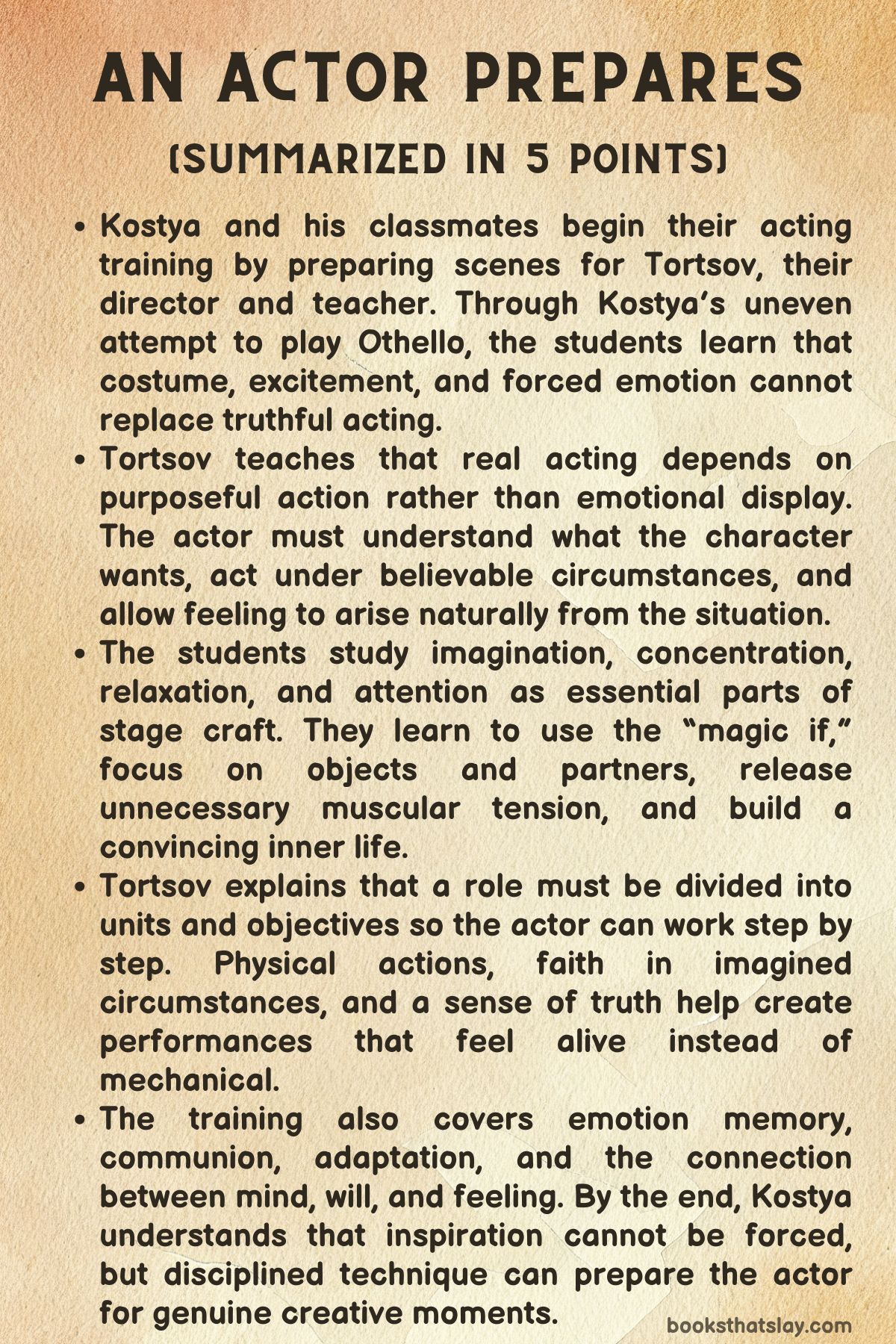
An Actor Prepares follows Kostya, a young acting student, as he enters a demanding theatre school and learns the principles of truthful performance under the direction of Tortsov. The book begins with Kostya and his classmates preparing scenes to show their teacher what they can do.
Kostya chooses to play Othello, while his friend Paul plays Iago. At home, Kostya becomes excited by his own idea of the role.
He experiments with costume, props, movement, and mood, but his excitement leads him into careless habits. He oversleeps, arrives late, and disrupts rehearsal.
This early failure teaches him that inspiration alone is unreliable and that discipline is part of art.
When Kostya finally rehearses, he finds that the role he imagined so vividly at home does not live so easily onstage. Words, movements, costume, makeup, and the empty theatre distract him.
He tries to force intensity, then enjoys one successful emotional moment during the performance. At first he feels proud, but after watching another student break down in a similar burst of emotion, he begins to see that his own success was accidental.
Tortsov explains that a real actor cannot depend on chance. The actor must live the part each time, not merely repeat an outer shape or imitate feelings.
Tortsov then begins to separate true acting from false forms of acting. He criticizes mechanical acting, overacting, imitation, and self-display.
Some students copy gestures, some show off their beauty or personality, and others use familiar stage tricks to suggest emotion. Tortsov insists that these habits do not create living art.
The actor’s task is not to pretend to feel, but to build the conditions in which real feeling may arise. This requires inner life, purpose, and truth.
The first major lesson is action. Tortsov asks Maria simply to sit onstage, and the class discovers that doing nothing without purpose is dull, while stillness with inner purpose can hold attention.
He teaches that every stage action must have a reason. An actor should not try to feel sadness, rage, or joy directly.
Emotion is not the target; it is the result. The actor must ask what the character wants and what the character would do under the given circumstances.
Through exercises with lost objects, imaginary danger, and ordinary physical tasks, the students learn that believable action begins with clear motivation.
This leads to the “magic if.” Tortsov shows the class how asking “what if” helps the actor enter imaginary circumstances without lying to himself. The actor does not need to believe that a paper fireplace is real.
Instead, he asks what he would do if it were real in the world of the play. This question awakens imagination.
Tortsov teaches that the playwright often leaves many details unsaid, and the actor must fill those gaps with logical, vivid inner pictures. Kostya struggles at first because his imagination is passive or illogical, but he gradually learns that imagined circumstances must be specific and connected.
The next challenge is concentration. The students are easily distracted by the auditorium and the imagined presence of an audience.
Tortsov teaches them to focus on objects, scene partners, and inner images. He introduces circles of attention, beginning with a small area and widening as the actor gains control.
The aim is public solitude: the ability to be watched while remaining absorbed in the world of the stage. Observation in daily life also becomes important, because the actor must collect details of behavior, objects, moods, and people to feed the imagination.
Kostya then learns the importance of muscular relaxation. After he injures himself during an exercise, Tortsov explains that physical tension blocks inner work.
An actor’s body must be trained like an instrument. Kostya studies his cat and notices how naturally it uses only the muscles it needs.
The class practices relaxing unnecessary tension while sitting, standing, moving, and making gestures. They learn that strained bodies cannot express subtle feeling and that physical freedom supports creative truth.
Tortsov later teaches units and objectives. A play cannot be swallowed whole; it must be divided into manageable sections, each with a purpose.
Every unit contains an objective, and each objective must be expressed as an active wish. Instead of thinking, “I am jealous” or “I am powerful,” the actor must think in playable actions, such as wanting to win, hide, persuade, protect, or obtain.
These objectives give the actor something to do, and doing leads to life.
The class then studies faith and truth. Tortsov explains that theatrical truth is not the same as everyday fact.
A stage object may be false, but the actor’s belief in the imagined circumstances must be sincere. When Kostya mimes counting money, Tortsov forces him to make every detail precise.
Small physical truths create belief, and belief opens the way to deeper feeling. Larger dramatic moments must be broken into smaller truthful actions.
Through this process, the body of the role begins to create the soul of the role.
Emotion memory becomes another important step. Kostya reflects on how memories change over time, especially after witnessing a terrible accident.
Tortsov explains that actors draw on remembered sensations and emotions, but not by simply forcing themselves to relive pain. Time reshapes memory, and the actor uses these transformed feelings in service of the role.
Personal experience can help, but it must be adapted to the character’s circumstances through imagination, objectives, and action.
Tortsov also teaches communion, the exchange between actor and object, actor and partner, actor and self, or actor and audience. Acting requires continuous contact.
A performer must listen, see, receive, and respond, not merely wait to speak. The students learn that communication can happen through words, silence, eyes, posture, and inner attention.
Adaptation builds on this idea. To achieve an objective, an actor must adjust tactics depending on the person, situation, mood, and resistance.
These adjustments may be conscious or spontaneous, but they must serve the objective rather than distract from it.
As the training advances, Tortsov identifies the actor’s inner motive forces: feeling, mind, and will. These forces work together.
If emotion fails, thought or will may help awaken the creative process. The students then learn about the unbroken line of a role.
A performance must not be a series of disconnected moments. Each objective must connect to a larger movement, and that movement must lead toward the super-objective: the character’s central desire across the whole play.
Near the end, Tortsov explains that the system cannot manufacture inspiration. It can only prepare the conditions in which inspiration may appear.
The actor must build the role through action, imagination, concentration, relaxation, truth, communion, adaptation, objectives, and a clear through line. When these elements work together, they can lead the actor toward the subconscious, where living creation may arise naturally.
By the close of An Actor Prepares, Kostya has not become a finished artist, but he has changed. He begins as an eager student who confuses excitement, imitation, and display with acting.
Through Tortsov’s training, he learns that art requires patience, humility, technique, and faith in truthful action. The book ends as both a story of education and a practical guide to the actor’s inner craft.
Key People
Kostya
Kostya is the central student-figure and the reader’s main way into An Actor Prepares. He is eager, imaginative, insecure, and often too quick to mistake excitement for artistic achievement.
At the beginning, he believes that costume, makeup, dramatic movement, and emotional intensity can bring a role to life, but his early attempts expose the weakness of relying on surface impressions. His journey is valuable because he makes nearly every mistake an actor can make: he imitates, forces emotion, loses concentration, overuses physical tension, becomes distracted by the audience, and confuses accidental inspiration with reliable craft.
Yet he is also sincere and observant. He learns from embarrassment, injury, criticism, and repeated exercises.
Kostya’s growth is not shown as sudden mastery but as a gradual sharpening of awareness. He begins to understand that acting depends on truthful action, imagination, relaxation, objectives, attention, and belief.
His importance lies in his unfinishedness: he represents the serious beginner who must be trained away from vanity and toward disciplined inner life.
Tortsov
Tortsov is the teacher, director, and moral center of the acting school. He is demanding, precise, theatrical in his teaching methods, and deeply committed to artistic truth.
Rather than simply lecture, he creates situations that force the students to discover principles through experience. He lets them fail, then explains why the failure matters.
His lessons often begin with ordinary actions, such as sitting, searching, counting, looking, or moving furniture, because he wants the actors to understand that truthful performance begins with purpose rather than display. Tortsov is strict, but his strictness is not cruelty.
He wants his students to respect the stage as a serious art form. He attacks vanity, imitation, mechanical acting, and emotional showing-off because he believes they reduce theatre to empty exhibition.
He also serves as the voice of the acting system, guiding the class from external habits toward inner justification. His authority comes from knowledge, patience, and his ability to turn even confusion into training.
Paul Shustov
Paul Shustov is Kostya’s friend and acting partner, especially important in the early work on Othello and Iago. Paul is more prepared than Kostya in certain practical ways, such as memorizing lines, but he also falls into a major artistic trap: representational acting.
His rehearsal before a mirror and his habit of copying mannerisms show that he is drawn to controlled external form. Paul wants to understand the role, but he initially treats that understanding as preparation for a repeatable performance rather than as something that must be freshly lived each time.
His character helps clarify the difference between careful imitation and genuine creative life. He is not foolish or unserious; in fact, his problem comes partly from effort and intelligence being directed toward the wrong end.
Through Paul, the book shows that even polished acting can be spiritually empty if it lacks inner renewal. He also functions as Kostya’s companion in the learning process, often bringing news, exercises, and explanations when Kostya is away from class.
Maria Maloletkova
Maria is one of the most revealing students because her vulnerability makes the principles of acting visible. She often begins in nervousness or emotional excess, but under Tortsov’s guidance she discovers the difference between acting emotion and acting with purpose.
When she is asked simply to sit, her discomfort shows how difficult natural behavior becomes once it is placed onstage. When she searches for a lost object under imagined circumstances, she first performs distress, but later becomes more truthful when she concentrates on the task itself.
Maria’s strength is her capacity to respond honestly once she stops trying to impress. She represents the actor who has emotional sensitivity but must learn control, structure, and objective.
Her development shows that feeling alone is not enough; emotion becomes useful only when it grows out of believable circumstances and directed action. Maria also helps demonstrate how truth onstage is not a matter of copying life exactly, but of choosing what is necessary and convincing.
Grisha Govorkov
Grisha is the skeptic and challenger within the class. He frequently resists Tortsov’s teaching, especially when the system emphasizes small physical actions, relaxation, truth, and detailed circumstances.
Grisha wants acting to feel grand, free, and emotionally expansive, so he becomes impatient with exercises that appear ordinary or technical. His resistance is important because it gives voice to a common misunderstanding: that technique limits inspiration.
In reality, Tortsov uses Grisha to show that technique is what protects the actor from false passion. Grisha often believes he is deeply emotional onstage, but Tortsov identifies his work as mechanical or lacking real inner life.
This does not make Grisha worthless as an actor. He has energy, conviction, and a strong will, but those qualities are uncontrolled.
His arguments force Tortsov to define the system more clearly. Grisha’s character represents artistic pride before discipline, and his tension with Tortsov helps reveal why truthful acting requires humility.
Sonya Veliaminova
Sonya represents the danger of using the stage for self-display. Early in the training, Tortsov criticizes her for showing herself rather than serving the role.
Her beauty and stage presence become temptations, because they allow her to attract attention without doing the deeper work of acting. Yet Sonya is not presented only as vain.
Later, she shows real ability, especially when she responds naturally and uses adaptation to speak for the group. She also reveals a talent for comedy when a tragic exercise takes a comic turn in her hands.
Sonya’s character shows that an actor may possess charm, instinct, and physical appeal, but these gifts must be governed by purpose. Without discipline, charm becomes exhibitionism.
With discipline, it can become part of truthful performance. Her development suggests that actors must know their natural strengths but should not hide behind them.
Sonya must learn to serve the scene, not herself.
Vanya Vyuntsov
Vanya is energetic, playful, and prone to exaggeration. Tortsov identifies his early work as overacting, which makes him a useful example of unrestrained theatrical behavior.
Vanya’s instinct is to enlarge everything, to push action and expression beyond necessity. This makes him funny and noticeable, but it also makes him false when the situation demands truth.
His later exercises in adaptation show both his cleverness and his danger. When he pretends to injure himself in order to leave class, he proves that he understands how behavior can be adjusted to influence others.
But when Tortsov ignores him, Vanya’s tactics grow too broad and he shifts from pursuing his objective to entertaining the class. His character illustrates the fine line between adaptability and clowning.
Vanya has imagination and boldness, but he must learn restraint. He shows that an actor’s energy is valuable only when it remains connected to a real objective.
Leo
Leo is a supporting student who often appears as a messenger, observer, and example. He visits Kostya, reports on class exercises, and helps connect Kostya’s private reflections with the group’s ongoing training.
Leo’s personality seems less combative than Grisha’s and less central than Paul’s, but he plays a useful role in demonstrating the unevenness of student imagination. At times, he appears passive or unimaginative, as when his imagined scenario lacks richness.
Yet he also becomes helpful in physical exercises, especially when he demonstrates how a justified action can make even an awkward body appear truthful. Leo’s presence reminds the reader that acting training is communal.
Students learn not only from the teacher but also from watching each other succeed, fail, and try again. Leo is not a dramatic rival to Kostya; he is part of the classroom fabric that allows principles to be tested through different temperaments.
Rakhmanov
Rakhmanov, the assistant director, is a figure of order, discipline, and practical training. His first major impact comes when he reprimands Kostya for arriving late, making clear that artistic eagerness does not excuse irresponsibility.
This moment establishes a crucial standard: the actor’s creative life depends on respect for rehearsal, colleagues, and timing. Rakhmanov also conducts exercises, especially in attention and muscular relaxation, though his manner can be brisk and less nurturing than Tortsov’s.
He sometimes rushes the students, making their difficulties more visible. As a teacherly presence, he is not as philosophically rich as Tortsov, but he reinforces the idea that craft requires routine and control.
Rakhmanov represents the practical side of theatre: punctuality, repetition, physical discipline, and rehearsal structure. His role shows that artistic training is not only about inspiration but also about habits that protect the work.
Dasha
Dasha is one of the most emotionally significant students because her work raises questions about personal memory and artistic transformation. Her performance involving a dead child affects the class strongly because it appears to draw from real grief.
Tortsov’s response is careful: he recognizes the power of personal emotion but also teaches that raw memory alone cannot be the actor’s method. Dasha must learn to connect feeling to physical action, imagined circumstances, and belief in the object before her.
Her example shows that lived pain can become part of art, but only when shaped through craft. If the actor merely suffers, the stage becomes private emotional exposure.
If the actor gives that emotion form through action and circumstance, it becomes communicable. Dasha’s character therefore illuminates both the promise and danger of emotion memory.
She shows that the deepest feeling still needs structure.
Nicholas
Nicholas is a minor student, but his role is useful because he carries partial information to Kostya during the discussion of muscular relaxation. He tells Kostya that complete relaxation is impossible, which initially sounds contradictory until Paul later clarifies the idea.
Nicholas represents one of the common difficulties of training: students often understand only part of a principle before repeating it. Through him, the book shows that acting concepts can be misunderstood when separated from practice and full explanation.
His brief presence also helps show Kostya’s dependence on classmates while he is recovering. Nicholas does not have a large personal arc, but he contributes to the shared learning environment and to the gradual unfolding of the system.
Vassili
Vassili appears briefly but meaningfully in the discussion of communion. When Tortsov asks him with whom or what he is in contact, Vassili’s answer opens a wider lesson about the actor’s constant relationship with objects, people, memories, thoughts, and the audience.
His importance comes less from personal development and more from his function in the classroom structure. Vassili becomes the starting point for a major idea: onstage, no actor is truly isolated.
Even silence involves contact, and even an object can carry meaning if the actor gives and receives attention from it. Vassili’s brief moment helps shift the class from thinking about acting as individual expression to understanding it as exchange.
Paul’s Uncle
Paul’s uncle, a famous actor, appears through Kostya’s account of a meal at Paul’s house. His explanation of units through the carving of a turkey is memorable because it turns an abstract acting principle into something concrete.
By comparing a play to a large meal that must be divided into manageable parts, he helps Kostya understand why actors cannot work effectively if they treat a whole role as one enormous emotional burden. His role is small, but his teaching image is central.
He stands as another example of practical theatrical wisdom, showing that serious technique can be explained through ordinary life. In An Actor Prepares, such moments matter because the system repeatedly turns daily experience into artistic method.
Themes
Artistic Truth and Belief
Truth in the book is not treated as simple realism or literal accuracy. A prop may be fake, a set may be artificial, and the circumstances may be invented, but the actor’s belief must be sincere within that created world.
This distinction is central because theatre always involves make-believe, yet the audience must feel that something living is happening. Tortsov teaches that truth begins when the actor can believe in the action being performed, even if the objects and setting are not real.
The actor must therefore avoid generalized emotion and replace it with specific, believable behavior. Counting imaginary money, searching for a lost object, sitting still, or lighting a false fire can all become truthful if the actor gives the action clear circumstances and purpose.
Falsehood appears when the actor tries to display truth rather than live through it. This theme also changes how dramatic moments are understood.
Great emotion does not require grand gestures. It often emerges through small, precise physical actions.
The actor’s belief in those actions creates the foundation for the audience’s belief.
Action, Objective, and Purpose
The idea of purposeful action gives the training its strongest practical shape. Tortsov repeatedly teaches that actors should not aim directly at emotion, because emotion cannot be commanded in a reliable way.
Instead, they must ask what the character wants and what action will help achieve that want. This shifts acting away from vague feeling and toward playable objectives.
When Maria searches for the brooch, the exercise becomes truthful only when she understands what finding it means. When Kostya moves furniture without purpose, the action is empty; when a situation gives him a reason, the same action begins to live.
Objectives also help divide a role into manageable parts. Rather than facing an entire play as one overwhelming task, the actor breaks it into units, each driven by a specific wish.
This creates continuity and prevents the performance from becoming a series of disconnected emotional displays. Purpose gives the actor something to hold onto when inspiration fails.
It also keeps the actor connected to partners, circumstances, and the living movement of the scene.
Imagination as Discipline
Imagination is presented not as random fantasy but as disciplined creative work. The actor must fill in what the playwright does not state, but those additions must be logical, specific, and useful.
Tortsov distinguishes between empty invention and circumstances that could exist within the world of the role. The “if” becomes the actor’s gateway into that world.
By asking what he would do if a situation were true, the actor avoids forcing belief and instead activates personal response. This matters because the actor cannot simply decide to feel like a character.
He must build a chain of images, conditions, relationships, memories, and purposes that make the character’s life meaningful. Kostya’s failures show that imagination becomes weak when it is passive or unsupported by logic.
Paul’s tree exercise shows that even a seemingly static image can become active when surrounded by detailed circumstances. In An Actor Prepares, imagination is therefore a craft skill, not a decorative gift.
It must be trained through questioning, observation, memory, and repeated practice until the actor can enter the imaginary life with confidence.
The Actor’s Body and Inner Life
The book treats the body and inner life as inseparable. Tortsov’s system does not allow the actor to live only in thought or feeling, because physical tension, poor movement, and careless gesture can block the role’s inner truth.
Kostya’s injury makes this lesson concrete. His strained body does not support concentration; it disrupts it.
The exercises in relaxation show that the actor must learn to identify unnecessary tension and release it, not because relaxation is an end in itself, but because the body must become available to the role. The same is true of gestures and poses.
A pose without justification is empty, but a physically simple act with inner reason can become powerful. This theme also challenges the idea that psychological acting is separate from physical craft.
Tortsov teaches that physical actions can awaken feeling when they are specific and truthfully motivated. The body becomes the actor’s instrument, but not in a mechanical sense.
It is the visible part of the inner process. When trained properly, it carries thought, will, emotion, attention, and belief into stage life.