Analects of Confucius Summary and Analysis
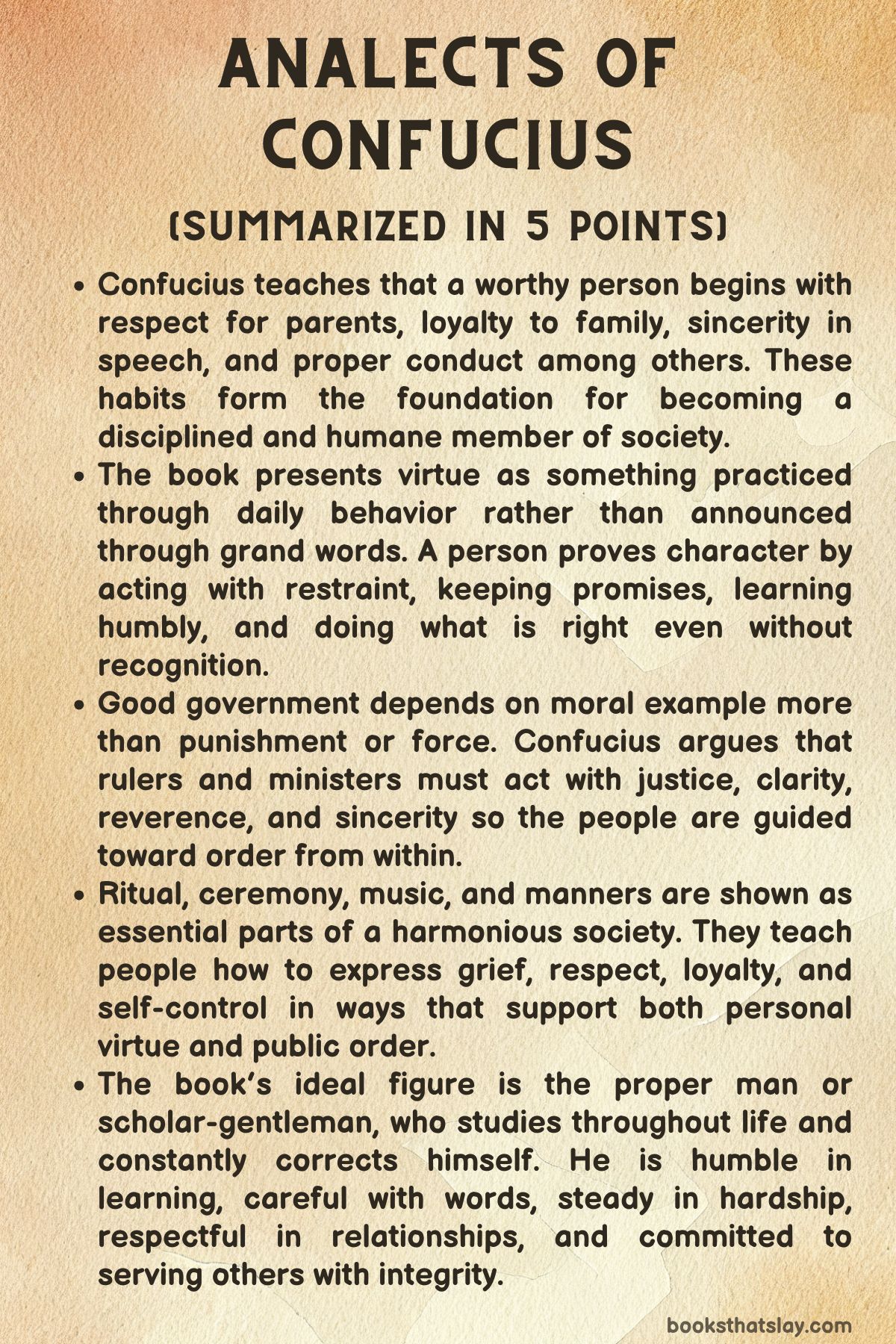
Analects of Confucius is a foundational work of Chinese thought, presenting Confucius’s teachings on moral conduct, social order, education, ritual, and government. Rather than telling a conventional story, the book gathers sayings, conversations, judgments, and examples that define the character of the “proper man” or gentleman.
Its central concern is how people become humane, disciplined, respectful, and useful within family, community, and state. Confucius teaches that virtue is not abstract; it is built through daily conduct, reverence for elders, sincerity in speech, respect for rites, and leadership guided by example rather than force.
Summary
Analects of Confucius is not a plot-driven book in the usual sense. It develops through a sequence of teachings, remarks, examples, and responses that build a moral vision of human life.
Its main movement is the gradual clarification of what makes a person worthy, how society should be ordered, and how rulers should govern. The work presents Confucius as a teacher who is concerned less with fame or power than with character, conduct, and the disciplined habits that allow people to live well together.
The book begins by setting out the qualities needed for a respectable person. A young person must learn filial respect, care for elders, brotherly conduct, gentleness, and reliability in speech.
Confucius treats family duties as the first school of virtue. Respect within the home prepares a person for proper conduct outside it.
A person who cannot honor parents, elders, and peers cannot be trusted to serve society well. The ideal person does not merely speak well but acts correctly.
Words matter, yet they must be tied to justice, sincerity, and conduct.
From there, Confucius connects personal virtue with government. He argues that punishment alone cannot create a good society.
If rulers govern mainly through fear, people may obey outwardly while avoiding responsibility inwardly. Better rule comes when leaders act with moral seriousness and guide people through rites, example, and conscience.
When people develop a sense of shame and right conduct, order becomes more stable. Government, in this view, is not only law and administration; it is moral education.
A ruler must promote the just, teach those who lack understanding, and behave in a way that encourages people to improve.
The book repeatedly returns to filial piety, showing that it must be more than material support. Feeding parents is not enough if reverence is absent.
True filial conduct includes care, honor, emotional attention, and social respect. Confucius extends this idea into politics: the habits of respect between parent and child, elder and younger, ruler and minister, form the structure of a peaceful society.
A person does not need an official post to serve government; by practicing proper family and social conduct, one already contributes to public order.
Rites, music, and ceremony become central to this vision. Confucius treats ritual not as empty form but as the visible shape of moral life.
Proper ceremonies teach people how to express respect, grief, loyalty, and gratitude. Music, too, reflects the character of a society.
Harmonious music and fitting ceremony represent a well-ordered community, where each part has its place. A prince should treat ministers according to ritual, and ministers should serve with sincerity.
Without reverence, rites lose their value. Without moral purpose, beauty alone is incomplete.
Confucius also describes the formation of moral character, often called “manhood”. This quality is not simply masculinity but full human excellence: discipline, humility, courage, sympathy, reliability, restraint, and concern for others.
A person’s environment matters because people are shaped by their companions and community. Confucius advises people to live among humane people and learn from those who act rightly.
Faults reveal the influences surrounding a person, while good conduct shows steady self-cultivation.
Many sections present judgments of students, officials, and historical figures. These examples help define virtue in practical terms.
A proper person is reverent in personal behavior, honorable in service, considerate toward the people, and just in assigning work. Such a person loves study and is not ashamed to ask questions, even from those considered lower in status.
Confucius values humility in learning. The accomplished person does not pretend to know everything but seeks correction and improvement.
Hardship is also used to test character. Confucius praises those who remain content and steady despite poverty or obscurity.
A person of real merit does not collapse because of difficult living conditions, lack of recognition, or delayed employment. The proper person worries less about being known and more about becoming worthy of being known.
Strength lies in continuing the work of self-cultivation even when success is uncertain. If one lacks the strength to continue, one stops halfway and becomes trapped by one’s own weakness.
Confucius insists that people should learn from anyone. When walking with others, one can find a teacher among them: follow what is right and correct oneself when seeing what is wrong.
This humility supports the book’s larger message that virtue grows through attention, practice, and comparison. No one becomes good through pride.
Excellence comes through observing conduct, choosing better habits, and remaining open to instruction.
The book also gives models for rulers and officials. A good leader is modest, frugal, resolute, and devoted to the welfare of the people.
Confucius praises figures who use their energy for public works and show reverence in ceremonial life while avoiding luxury in private life. Officials must carry heavy responsibilities over a long path.
They need courage, patience, and moral weight. To govern well, they must be more than skilled administrators; they must be examples of disciplined conduct.
At times Confucius acknowledges human limitation. A person may face situations where knowledge or ability is lacking.
The answer is not despair but steadiness. One should take a position rooted in loyalty, friendship, filial respect, and moral purpose.
Even incomplete effort has value when it is directed toward what is right. The image of building a mountain basket by basket suggests that moral life is gradual.
Perfection may not come at once, but the person must keep adding to the work.
Detailed descriptions of daily behavior show how virtue appears in ordinary life. Proper speech in court, respectful conduct in temples, restraint at meals, silence while eating or resting, and care for a friend’s funeral all reveal moral training.
Confucius’s ideal person does not separate public virtue from private habits. The way one eats, speaks, mourns, serves, and receives others all belong to the same moral order.
The work also considers death and mourning. Confucius does not encourage speculation about spirits before understanding life.
Service to the living comes first. Yet mourning matters because it expresses genuine attachment and reverence.
Excess is usually avoided, but sincere grief has its place. A state, like a funeral, must be managed with ceremony, proportion, and respect.
A minister should serve honestly and withdraw when service can no longer be honorable.
A major teaching is that humanity begins with the self but is expressed through rites. If a person can return to proper conduct even for a day, the wider world moves closer to moral order.
Confucius advises avoiding what is contrary to rites in sight, hearing, speech, and action. He also stresses the importance of social roles: ruler, minister, father, and son must each fulfill their proper responsibilities.
When names and roles lose meaning, society becomes unstable.
Language itself becomes a political concern. Confucius argues that words must be precise because unclear words lead to failed action.
If terms do not match reality, ceremonies, music, duties, and government lose direction. A proper person uses words that can be carried into effect.
Speech should correspond to action and not exceed it. This connects to the theme of shame: it is shameful to seek salary without moral concern, and a proper person is cautious about speaking more than he can perform.
The later teachings emphasize sympathy as a lifelong guide. The central rule is to avoid doing to others what one would not want done to oneself.
This principle shapes conversation, friendship, work, and self-judgment. One should not waste people by failing to speak when speech is needed, nor waste words when speech is useless.
The proper person is more troubled by personal limitations than by lack of recognition.
Confucius also distinguishes helpful pleasures from harmful ones. Appreciation of rites and music, admiration of others’ excellence, and friendship with talented people support growth.
Vanity, idleness, and corrupt pleasure weaken character. Practice is essential because people may be born similar, but habits create difference.
Sobriety, magnanimity, keeping one’s word, attention to duty, and kindness can improve the whole realm when practiced widely.
The book closes by gathering its political and ethical lessons. The good ruler is considerate without complaint, desirous without greed, honorable without arrogance, and protective without cruelty.
The evils of rule include punishing people without teaching them, demanding results without warning, giving late orders and expecting exact completion, and failing to understand rites or words. Analects of Confucius finally presents moral life as a disciplined practice in which family reverence, truthful speech, ritual order, lifelong study, and humane government all support one another.
Key People
Confucius
Confucius is the central speaking presence and moral authority of Analects of Confucius. He is not presented as a conventional hero moving through a plot, but as a teacher whose personality emerges through sayings, judgments, corrections, and examples.
His main concern is the formation of a morally serious person who can live responsibly within family, society, and government. He values conduct more than display, and he repeatedly measures people by whether their actions match their words.
Confucius appears practical rather than abstract: he speaks about food, mourning, music, office, speech, friendship, learning, and ritual because he believes virtue must be visible in ordinary behavior. He is also demanding without being merely harsh.
He praises humility, careful speech, sincerity, and perseverance, while criticizing greed, empty words, arrogance, and government based on fear. His role is that of a guide who teaches that personal discipline and public order are inseparable.
The Proper Man or Gentleman
The proper man, often described as the gentleman or the person of “manhood,” is the moral ideal toward which the book directs its teachings. He is not defined by birth, wealth, or status, but by cultivated behavior.
He respects elders, keeps his word, studies throughout life, practices self-restraint, and acts according to what each situation requires. In Analects of Confucius, this figure becomes the model for both private life and public service.
He does not seek recognition as his first goal; he worries instead about being worthy of responsibility. He is ashamed of speaking beyond his actions, and he does not confuse clever language with moral strength.
His greatness lies in balance: he is firm without cruelty, respectful without weakness, humble without passivity, and courageous without aggression. He also understands that virtue is not achieved in a single moment.
It is practiced through repeated choices, proper habits, and steady correction of the self.
Young Men
Young men represent the beginning stage of moral formation. Confucius treats youth as the period when the most basic habits of character must be shaped: respect for parents, brotherly conduct among peers, caution in speech, and sincerity in promises.
They are not expected to begin as fully formed moral persons, but they are expected to practice the foundations of good conduct. Through them, the book shows that virtue begins close to home.
A young man who learns reverence in the family and reliability among friends is preparing himself for a larger social role. Confucius does not separate private manners from public virtue; the discipline learned in youth becomes the basis for future conduct as a citizen, minister, scholar, or ruler.
The People
The people are often discussed in relation to government, education, and moral influence. Confucius does not portray them as naturally wicked or as needing only punishment to remain orderly.
Instead, he believes they respond to the conduct of those above them. If leaders love justice, sincerity, and ritual, the people are likely to follow that example.
If rulers rely only on punishments, the people may obey outwardly while losing any inner sense of shame. The people therefore reveal the moral quality of government.
Their condition depends not only on laws or material provisions but also on the example set by rulers and officials. Confucius sees them as capable of order when they are taught, respected, and led through upright conduct.
The Prince or Ruler
The prince or ruler represents political authority, but Confucius judges him by moral responsibility rather than power alone. A ruler must know his proper role, respect ceremony, use ministers correctly, and guide the people through example.
He should not govern through fear when education, ritual, and moral conduct can produce deeper order. A ruler who acts with sincerity and justice strengthens the entire state, while one who behaves selfishly or carelessly damages the relation between office and duty.
Confucius’s ruler is expected to be disciplined, reverent, and attentive to the moral effects of his decisions. The position is honorable only when it is filled by a person who understands that leadership begins with self-command.
Ministers
Ministers are the servants of government, but not in the sense of blind obedience. Confucius expects them to serve the prince honestly, carry out duties sincerely, and withdraw when they cannot serve honorably.
Their loyalty must be tied to moral judgment. A great minister is not merely efficient; he understands when service supports justice and when continued service would become compromise.
Ministers must also observe proper ceremony, because political order depends on each person fulfilling his role with clarity and respect. Their character matters because they stand between ruler and people.
If they are sincere, disciplined, and precise in action, they help preserve order. If they flatter, deceive, or act without principle, they weaken the state.
Chi K’ang
Chi K’ang appears as a political figure who receives advice from Confucius about how to govern. Through him, the book presents one of its clearest political teachings: people are best ruled through seriousness, respect, justice, and instruction rather than coercion alone.
Chi K’ang’s role is important because he allows Confucius to explain that rulers should promote the just and teach those who lack ability. The conversation suggests that political authority must be educational.
A ruler or official should not simply punish failure; he should create conditions where people learn to act rightly. Chi K’ang therefore serves as a representative of practical political power being brought under Confucius’s moral standard.
Tze-Ch’an
Tze-Ch’an is used as an example of proper conduct in public responsibility. Confucius identifies several qualities in his way of acting: reverence in personal conduct, honorable service to the prince, consideration in caring for the people, and justice in employing them.
His significance lies in the fact that virtue is shown through administration, not only through private reflection. Tze-Ch’an demonstrates that a morally serious person must be measured in personal behavior and fair in public dealings.
His example suggests that governing well requires more than intelligence; it requires respect, empathy, discipline, and a sense of proportion. He stands as a practical model of the proper person in office.
Kung-Wan
Kung-Wan is presented as an accomplished person because he loves study and is not ashamed to ask questions of those considered beneath him. His importance lies in his humility.
Confucius values learning not as a display of superiority but as a lifelong willingness to be corrected. Kung-Wan shows that true accomplishment does not require pride.
In fact, pride would prevent the very learning that makes accomplishment possible. His character helps define the scholar-gentleman as someone who remains open, curious, and morally alert.
The ability to question inferiors shows that wisdom is not limited by rank. For Confucius, this humility is a sign of genuine refinement.
Yuan Sze
Yuan Sze is remembered for declining a grant of grain after being made governor. Confucius corrects this refusal by suggesting that the grain could have benefited towns and villages.
Yuan Sze’s example shows that moral conduct is not always a simple matter of personal modesty. Refusing wealth may seem virtuous, but if acceptance would allow one to help others, refusal can become misplaced.
Through Yuan Sze, Confucius teaches that virtue requires judgment. A proper person must know when to refuse and when to accept for the common good.
The episode also shows that public office changes the meaning of personal choices. What belongs to the official may become a resource for the community.
Hui or Yen Yuan
Hui, also called Yen Yuan, is one of the most admired figures in the summaries. He is praised for his solid talent and his ability to remain content in poverty.
Living with little food, little drink, and poor surroundings, he does not lose his joy or steadiness. His character represents inner strength.
He is not dependent on comfort, recognition, or outward success in order to remain committed to virtue. Confucius’s grief at his death also reveals the depth of his value as a student and moral companion.
Hui stands for perseverance, simplicity, and spiritual steadiness. He shows that the cultivated person can endure hardship without resentment or collapse.
Kung-tze
Kung-tze is presented through his daily actions, which make him an example of disciplined conduct. He speaks properly in court and temple, eats with restraint, avoids excess, observes sacrifice respectfully, and takes responsibility for a friend’s funeral when no one else can do so.
His character matters because he shows virtue in small acts. Confucius’s moral world does not treat everyday behavior as trivial.
The way a person eats, speaks, mourns, and honors others reveals the quality of his training. Kung-tze embodies the idea that ritual and respect must become natural habits.
His life shows that moral refinement is not occasional performance but steady attention to what is fitting.
Chi Lu
Chi Lu is significant because he asks about serving ghosts and spirits, then about death. Confucius responds by turning him back toward life and service to the living.
Chi Lu’s questions allow the book to clarify its priorities. Confucius does not deny the importance of death or ritual, but he insists that one must first understand human duty in the present world.
Chi Lu therefore represents the student who seeks answers about ultimate matters but is reminded that moral life begins with practical responsibility. His exchange with Confucius shows that speculation is less urgent than becoming useful, respectful, and clear in one’s duties toward living people.
Chi Tze-zan
Chi Tze-zan appears in a teaching about the great minister. Confucius tells him that a great minister serves the prince honestly and retires when he cannot.
This makes Chi Tze-zan important as the receiver of a lesson about principled service. Through him, the book defines loyalty as something higher than remaining in office at any cost.
A minister must not cling to position when honest service is no longer possible. Chi Tze-zan’s role helps show that withdrawal can be an honorable act.
In Confucius’s view, a person’s relation to power must always be governed by moral limits.
Tze-kung
Tze-kung asks whether there is one word that can guide a whole life. Confucius answers with the principle of sympathy: do not impose on others what one would not want for oneself.
Tze-kung’s importance lies in drawing out one of the most concentrated ethical teachings in the work. His question asks for simplicity, and Confucius gives a principle broad enough to govern speech, friendship, service, and social conduct.
Tze-kung represents the thoughtful student who seeks a practical rule for life. Through him, Confucius presents moral conduct as something that can be tested by one’s own experience of harm, fairness, and respect.
Shun and Yu
Shun and Yu represent admired models of ancient rule. Yu is praised especially for frugality, reverence, modest dress in ordinary life, ceremonial elegance when required, and devotion to public works such as irrigation and drainage.
These figures show what Confucius values in leadership: not luxury, display, or domination, but public usefulness, humility, ritual seriousness, and service. Yu’s greatness lies in directing energy toward the needs of the people while maintaining reverence toward spiritual and ceremonial obligations.
Shun and Yu stand as historical examples of rulers whose authority is justified by conduct. They help define the ideal ruler as someone who serves the common order before personal comfort.
Liu-Hsia
Liu-Hsia is a judge who is dismissed several times because he refuses to join corruption. His character represents integrity under pressure.
Rather than abandon his homeland or become crooked to preserve his career, he accepts dismissal as the cost of remaining straight. Confucius uses him to show that moral steadiness may bring worldly loss, especially in a corrupt state.
Liu-Hsia is also important as an example for younger generations. His conduct teaches that one must preserve honesty even when society rewards compromise.
He demonstrates that public duty is meaningful only when it is joined to principle. His failures in office are actually signs of moral success.
The Scholar-Gentleman
The scholar-gentleman is the mature form of the learner. He is daily aware of what he lacks, does not forget what he can put into practice, sharpens his questions, and remains close to what he truly thinks.
This figure joins study with moral discipline. He does not learn for ornament or reputation but to improve conduct.
His word matters because people trust him when he keeps promises; without that trust, even correction or advice may be taken as insult. The scholar-gentleman is therefore both intellectual and ethical.
His learning strengthens his character, and his character gives force to his words. He is one of Confucius’s clearest models of lifelong self-cultivation.
Themes
Moral Character as Daily Practice
Virtue in Analects of Confucius is never treated as a vague feeling or a public label. It is built through repeated conduct: speaking carefully, honoring parents, serving sincerely, mourning properly, eating with restraint, learning humbly, and acting according to the demands of each situation.
The book’s moral ideal is not formed by grand declarations but by habits that become steady over time. A person proves character by what he does when there is no reward, when he is poor, when he is ignored, or when speaking would be easier than acting.
This is why Confucius is so suspicious of empty words. Words must match deeds, and deeds must be shaped by justice, reverence, and self-control.
Moral growth is also shown as a gradual process. People are not born complete; practice creates distance between the careless person and the cultivated one.
The proper person keeps studying, correcting himself, and observing others. Even hardship becomes a test of discipline.
The truly cultivated person does not depend on comfort or recognition to remain steady. Character is made visible in ordinary life, and the ordinary is where moral greatness begins.
Family Respect and Social Order
Family conduct forms the root of social and political life. Respect for parents, care for elders, and proper relations between older and younger people are not presented as private customs alone.
They are the first training in reverence, restraint, duty, and gratitude. Confucius argues that filial piety must be more than feeding or supporting parents.
Without reverence, material care is incomplete. This distinction is important because it shows that moral action requires the right attitude as well as the right outward form.
The family becomes the first place where a person learns how to recognize obligation. Once that habit is formed, it can extend outward into friendships, community relations, and government service.
The relation between elder and younger, father and son, ruler and minister, all depend on people understanding their roles and fulfilling them sincerely. When these roles are respected, society becomes more stable because conduct is guided by responsibility rather than impulse.
The book does not treat social order as something imposed only from above. It begins in the home, grows through habit, and reaches public life through people who have learned how to honor others properly.
Government Through Example Rather Than Fear
Confucius’s political thought rests on the belief that rulers shape the people through their own conduct. Punishments may produce outward obedience, but they do not create inner shame or moral understanding.
A government that depends only on fear teaches people how to avoid punishment, not how to become just. The better ruler acts with seriousness, promotes the upright, teaches those who lack understanding, and observes ritual propriety.
Such leadership encourages people to regulate themselves because they see justice and sincerity embodied above them. This theme gives moral weight to political office.
A ruler is not simply an administrator, and a minister is not merely an agent of power. Both must understand that public order depends on personal virtue.
Confucius also emphasizes clarity in language because confused words lead to confused duties. If titles and roles lose their meaning, government itself becomes unstable.
The ruler must be ruler, the minister must be minister, and each must act according to the responsibility named by the role. Good government therefore begins with moral example, precise speech, proper roles, and education before punishment.
Ritual, Restraint, and the Shape of Civilized Life
Ritual is treated as one of the main ways human beings learn proportion. Ceremonies, mourning practices, music, court behavior, and daily manners give visible form to respect.
Confucius does not value ritual as empty performance. A rite without reverence is hollow, and beauty without moral goodness is incomplete.
The purpose of ritual is to train people to act fittingly: to grieve when grief is called for, to serve with sincerity, to speak with respect, to eat without greed, and to honor the dead without neglecting the living. Restraint is central to this theme.
The proper person does not take more than is appropriate, does not speak beyond what can be done, and does not use office for arrogance or profit. Ritual gives structure to emotion and conduct so that people do not act only from appetite, vanity, or impulse.
It also connects individuals to a shared moral order. When ceremonies, music, and manners are practiced with sincerity, they help society express harmony.
In this sense, ritual is not separate from ethics; it is one of the chief methods by which ethics becomes lived behavior.