American Scripture Summary and Analysis
American Scripture: Making the Declaration of Independence by Pauline Maier is a historical study of the Declaration of Independence, but it treats the document less as a monument and more as something made by people under pressure. Maier explains how colonial anger, English political traditions, public debate, congressional editing, and later American memory shaped the Declaration’s meaning.
The book challenges the idea that Thomas Jefferson alone created it and shows how many voices helped form both the document and its later reputation. It also traces how the Declaration became a near-sacred national text, especially through debates over equality, slavery, and Abraham Lincoln’s interpretation.
Summary
American Scripture begins with the modern reverence surrounding the Declaration of Independence. Pauline Maier describes the National Archives, where the Declaration, the Constitution, and the Bill of Rights are preserved as the “Charters of Freedom.” These documents are treated almost like sacred objects, guarded, displayed, and studied with great care.
Yet Maier points out that the Declaration was not always handled with such respect. For many years it was moved, copied, displayed, and damaged in ways that reveal how ordinary it once seemed.
This contrast sets up the book’s main concern: how a practical political document became a national scripture.
Maier then turns to the events of 1775 and 1776. The Second Continental Congress met while the conflict between Britain and the colonies was worsening.
At first, many delegates did not want independence. They hoped for reconciliation and believed they were defending traditional British rights against abuses by Parliament and the king’s ministers.
Congress took on the duties of a wartime government, but unity was fragile. Delegates had to balance military needs, local politics, and the fear that moving too quickly would split the colonies.
The situation changed as Britain hardened its position. King George III rejected petitions from the colonists, treated them as rebels, and supported military force against them.
Parliament passed measures that harmed colonial trade and allowed American ships to be seized. News that the king intended to use foreign troops against the colonies deeply angered Americans.
These events convinced many moderates that reconciliation was impossible. Thomas Paine’s Common Sense also helped shift public debate by attacking monarchy itself and arguing for republican government, though Maier stresses that Paine was not the sole cause of the move toward independence.
Across the colonies, local towns, county meetings, conventions, and state governments began issuing instructions and resolutions. These documents often explained why independence had become necessary.
They accused the king of betrayal, violence, and tyranny. They also showed that Americans were beginning to think of themselves as part of a common political community.
Maier argues that these “other” declarations are essential because they reveal the public voice behind Congress’s action. The Declaration of Independence did not appear suddenly from one man’s mind.
It grew out of a broad movement of argument, pressure, and consent.
English political tradition shaped these American documents. Colonists were familiar with petitions, addresses, declarations, and bills of rights.
The English Declaration of Rights of 1689 provided an important model: it listed royal abuses and justified a change in government. American colonists adapted this tradition to their own circumstances.
They argued that a ruler who violated the rights of the people could lose his authority. By the spring and summer of 1776, this argument was no longer theoretical.
Many Americans believed George III had broken his bond with them.
When Congress moved toward independence, it appointed a committee to draft a formal declaration. The committee included Thomas Jefferson, John Adams, Benjamin Franklin, Roger Sherman, and Robert Livingston.
Jefferson was chosen to prepare the draft largely because he was a strong writer, a Virginian, and less controversial than Adams. Maier gives Jefferson real credit, but she rejects the myth that he alone “authored” the Declaration in the modern sense.
Jefferson drew on earlier documents, including his own draft for Virginia’s constitution and George Mason’s draft of the Virginia Declaration of Rights. He worked within familiar political language and adapted phrases and structures already circulating in revolutionary America.
Jefferson’s draft contained a powerful opening statement and a long list of charges against King George III. These charges were meant to prove that the king had become a tyrant and that separation was justified.
Some charges were clear references to recent events, such as the use of foreign mercenaries and the waging of war against the colonies. Others were broad and less easy to connect to specific incidents.
Maier explains that this vagueness later made the Declaration vulnerable to criticism by Loyalists, but it also helped present the grievances of different colonies as shared American grievances.
Congress then edited Jefferson’s draft. The edits were extensive.
Some changes improved rhythm, accuracy, and force. Other changes removed passages that delegates considered excessive or politically dangerous.
Congress deleted Jefferson’s condemnation of the slave trade, partly because it exposed a deep contradiction within the revolutionary cause: Americans were claiming liberty while slavery continued. Jefferson disliked many of the edits, but Maier argues that Congress’s role was crucial.
The final Declaration was not private literature. It was a public act, speaking in the name of the United States.
Its authority came from collective approval.
After Congress approved independence and the Declaration, the document was read aloud to soldiers and civilians. Americans celebrated by firing guns, lighting bonfires, and destroying symbols of royal authority.
The Declaration helped break remaining ties of loyalty to the king and gave the war a clearer purpose. Still, Maier emphasizes that the Declaration was not immediately treated as a masterpiece.
During and after the Revolution, most Americans saw it as a useful political instrument whose main job had already been done. Independence itself mattered more than the written text.
Over time, the Declaration’s reputation changed. In the early years of the republic, it was not central to public memory.
But party politics altered its meaning. Jefferson’s Republican supporters praised the Declaration as an expression of founding principles and elevated Jefferson as its great writer.
Federalists were more skeptical and reminded people that the document was collaborative and derivative. As the revolutionary generation aged and died, Americans began to celebrate the founding era with greater emotion.
Paintings, biographies, public ceremonies, and anniversary celebrations helped transform the Declaration into a symbol of national identity.
Thomas Jefferson’s own later life contributed to this transformation. He came to view the Declaration as one of his greatest achievements and helped shape public memory of its creation.
Although his recollections were not always accurate, they strengthened the idea that he was the document’s author. John Adams resented this imbalance because he believed the push for independence and the political substance behind the Declaration mattered more than style.
Yet by the time Jefferson and Adams died on July 4, 1826, the Declaration had already gained a special symbolic status.
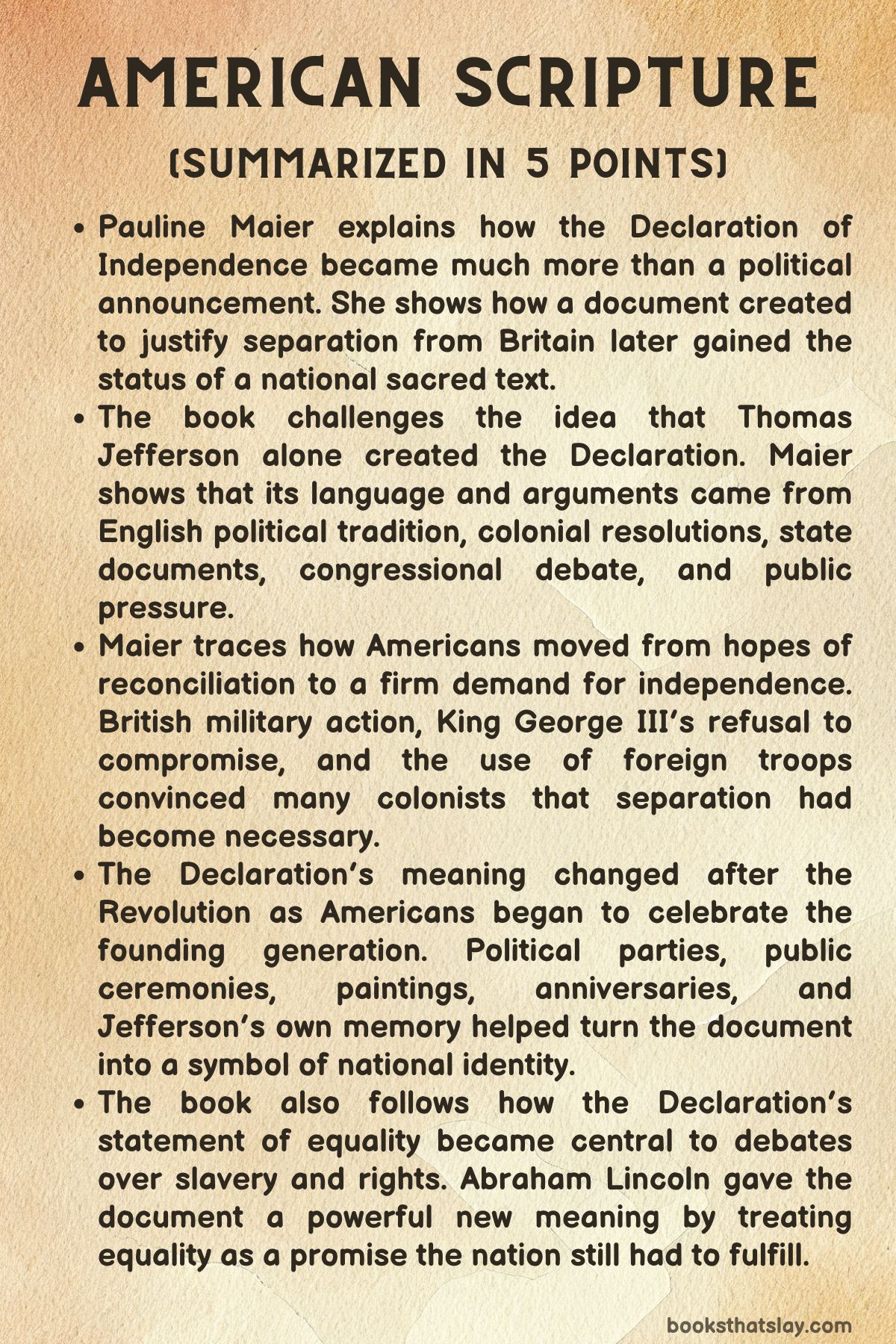
The book then follows the Declaration into the debates over slavery and equality. The phrase “all men are created equal” became increasingly important, even though the original Declaration was mainly a justification for separation from Britain.
Abolitionists used its language to expose the hypocrisy of a slaveholding republic. Pro-slavery politicians tried to limit its meaning, arguing that the founders did not intend equality to include Black people.
The same text could support sharply different arguments, and those conflicts made the Declaration even more central to American public life.
Abraham Lincoln gave the Declaration one of its most influential interpretations. In his debates with Stephen Douglas and later during the Civil War, Lincoln treated the Declaration as a statement of national purpose.
He argued that equality was not fully achieved in 1776, but it was set forth as a goal for future generations. This reading turned the Declaration into a living promise rather than a document limited to its original political moment.
In the Gettysburg Address, Lincoln linked the survival of the Union to the principle of human equality, giving the Declaration renewed moral force.
In the end, American Scripture argues that the Declaration’s creation and later meaning were collective achievements. Jefferson mattered, but so did Congress, state and local communities, earlier English traditions, later activists, political parties, abolitionists, and Lincoln.
The Declaration became powerful because Americans kept returning to it, arguing over it, and applying it to new crises. Maier’s book shows that the document is not fixed in one moment.
It is part of an ongoing national argument about liberty, equality, government, and the meaning of the United States.
Key People
Pauline Maier
Pauline Maier functions as the guiding intelligence of American Scripture, not as a detached narrator but as a historian correcting a national habit of oversimplification. She approaches the Declaration of Independence as both a physical artifact and a political text whose meaning changed across generations.
Her role is investigative: she questions the sacred aura surrounding the document, studies how it was created, and challenges the familiar belief that Thomas Jefferson alone deserves credit for it. Maier’s voice is analytical, skeptical, and historically grounded.
She is especially interested in collective action, showing that documents, reputations, and national myths are formed through public debate, institutional decisions, memory, and later reinterpretation.
Thomas Jefferson
Thomas Jefferson is central to the story because he drafted much of the Declaration of Independence, but Maier presents him as a gifted draftsman rather than a solitary creator. He had a strong command of political language and could adapt existing ideas into memorable prose.
His draft drew from English constitutional tradition, George Mason’s language on rights, and his own earlier writings for Virginia. Jefferson’s strengths were style, structure, and rhetorical force.
At the same time, Maier complicates his image by showing that many of his charges against King George were vague and that Congress improved parts of his draft. Jefferson also becomes important later because he helped shape the memory of the Declaration, eventually embracing the title of author more than mere draftsman.
John Adams
John Adams appears as one of the most forceful advocates for independence and one of the most important figures behind the Declaration’s creation. Unlike Jefferson, Adams was not loved by many delegates, but he had energy, conviction, and political clarity.
He understood that independence required public readiness, colonial unity, and practical institutional support. Adams pushed Congress toward decisive action and recognized Jefferson’s usefulness as the person best suited to draft the declaration.
Later, Adams becomes a critic of the mythology surrounding Jefferson. His resentment is not simply personal jealousy; it reflects his belief that the Revolution was a collective political achievement, not the product of one elegant writer.
George III
George III is portrayed less as a rounded private individual and more as the political figure whose actions made reconciliation impossible. To the colonists, his refusal to respond meaningfully to petitions, his support for military force, and his willingness to use foreign troops confirmed that he had violated the bond between ruler and people.
Maier shows how the king’s image changed in American argument. Earlier colonial complaints often blamed Parliament or royal advisers, but by 1776 the king himself became the center of accusation.
In the Declaration and in many state and local resolutions, George III becomes the tyrant whose conduct justifies independence.
Thomas Paine
Thomas Paine plays an important but carefully limited role. His pamphlet Common Sense helped move public debate away from reconciliation and toward independence by attacking monarchy and hereditary rule.
Paine gave ordinary readers a clear argument for republican government and helped them imagine life outside the British imperial system. Still, Maier resists giving him too much credit.
She argues that many Americans supported independence for reasons different from Paine’s. Their resolutions focused more on the king’s recent actions, military threats, and the necessity of foreign alliances than on Paine’s broader theory of monarchy.
Paine helped sharpen debate, but he did not single-handedly create the independence movement.
Benjamin Franklin
Benjamin Franklin appears as a senior statesman whose influence is quieter but important. As a member of the drafting committee, he reviewed Jefferson’s draft and contributed to the shaping of the Declaration before it went to Congress.
Franklin’s role reflects judgment, wit, and political tact rather than dramatic authorship. He also appears later in the book’s discussion of rights declarations, especially through his connection to Pennsylvania’s political language and his influence in France.
Franklin represents the practical and international dimensions of the revolutionary cause: he understood persuasion, diplomacy, and the value of presenting American arguments in forms that others could respect.
Richard Henry Lee
Richard Henry Lee is crucial because he formally moved the resolutions that pushed Congress toward independence, foreign alliances, and confederation. He does not dominate the cultural memory of the Declaration as Jefferson does, but his political role was decisive.
Lee’s motion gave Congress a concrete path forward. In Maier’s account, he represents the importance of legislative action behind famous texts.
The Declaration did not arise because a writer decided to express ideals in isolation; it followed a political resolution, public pressure, and the need for Congress to explain an official decision already underway.
George Mason
George Mason is significant because his language on rights helped shape Jefferson’s famous opening principles. Mason’s draft of the Virginia Declaration of Rights supplied ideas about equality, natural rights, government by consent, and the people’s right to alter government.
Maier uses Mason to weaken the myth of Jeffersonian originality. His presence reminds readers that revolutionary language circulated widely before the Declaration and that some of its most memorable ideas had identifiable sources.
Mason’s importance also extends beyond 1776 because state bills of rights often drew more directly from his language than from Congress’s Declaration.
Samuel Adams
Samuel Adams is shown as a determined revolutionary organizer and one of the figures associated with building support for independence. Historians have often credited him with political strategy, especially in pushing opinion beyond Massachusetts.
Maier gives him importance but avoids turning him into the master planner of independence. His influence was real, yet the movement depended on timing, public anger, local resolutions, and other colonies’ actions, especially Virginia’s.
Samuel Adams represents the radical pressure that helped keep Congress moving, but his role is part of a broader political process rather than the single cause of American consensus.
John Hancock
John Hancock’s role is both symbolic and practical. As president of Congress, he became the public face of the Declaration’s official announcement.
He informed state governments and military leaders of Congress’s decision and helped ensure that the document reached soldiers and civilians. Hancock’s importance lies in transmission: once Congress adopted independence, the decision had to be communicated across the new states.
His position gave institutional weight to the Declaration. In public memory, his signature became famous, but Maier’s account emphasizes his responsibility in spreading the news and making Congress’s decision visible to the people.
The Second Continental Congress
The Second Continental Congress is one of the most important collective characters in American Scripture. It begins as a chaotic wartime assembly and gradually becomes the first national American government.
Congress had to manage war, diplomacy, internal disagreement, public opinion, and the problem of colonial unity. Maier presents Congress not as a background institution but as an active creator of the Declaration.
It appointed the drafting committee, debated independence, edited Jefferson’s draft, removed controversial passages, sharpened language, and approved the final text. Its collective authority gave the Declaration its public legitimacy.
The American People
The American people are not passive recipients of revolutionary leadership. Maier treats local communities, county meetings, state conventions, town assemblies, soldiers, and ordinary citizens as essential participants in the movement toward independence.
Their instructions and resolutions show how public opinion developed, hardened, and reached Congress. They did not all arrive at independence for identical philosophical reasons, but many concluded that British actions had made separation necessary.
Later, the American people also shaped the Declaration’s reputation by reading it, celebrating it, arguing over it, and using it to define national values. They are central to Maier’s idea that the Declaration’s meaning is collective.
Abraham Lincoln
Abraham Lincoln appears as the figure who gave the Declaration one of its most lasting reinterpretations. He treated its statement of equality not as a completed fact from 1776 but as a promise to be realized over time.
In his debates with Stephen Douglas and later during the Civil War, Lincoln used the Declaration to argue that the United States had a moral purpose larger than preserving territory or political order. Maier notes that Lincoln’s historical reading was not always the most literal, but his statesmanship lay in making the Declaration speak powerfully to the crisis of slavery and union.
Stephen Douglas
Stephen Douglas serves as Lincoln’s major opponent in the debate over the Declaration’s meaning. He argued that the founders did not intend the phrase about equality to include Black people and that local voters should decide whether slavery would exist in new territories.
Douglas’s interpretation was narrower and more historically literal in some respects, but it reduced the Declaration’s moral reach. In Maier’s account, Douglas matters because his arguments forced Lincoln to clarify a broader national reading of the text.
Their conflict shows how the Declaration became a living political weapon in debates over slavery.
William Lloyd Garrison
William Lloyd Garrison represents the radical abolitionist use of the Declaration. He attacked the hypocrisy of Americans who celebrated liberty while maintaining slavery.
For Garrison, the Declaration’s language exposed a moral failure at the center of the republic. He did not merely ask Americans to admire revolutionary principles; he demanded that they live by them.
His position was severe because he believed the existing Union had betrayed its founding ideals. Maier uses Garrison to show how activists transformed the Declaration from a statement of separation into a standard by which the nation itself could be judged.
John Dickinson
John Dickinson represents caution, moderation, and attachment to reconciliation. He believed colonial resistance could be justified within British constitutional tradition without immediately requiring separation.
Dickinson’s hesitation shows that independence was not inevitable from the beginning. Many Americans feared the risks of war, disunion, foreign alliances, and republican instability.
His presence helps Maier explain why Congress moved slowly and why radicals had to wait for public opinion and political circumstances to change. Dickinson is not treated as cowardly; rather, he embodies the genuine uncertainty many colonists felt before Britain’s actions made compromise seem impossible.
George Washington
George Washington’s role is limited but meaningful. He receives the Declaration as commander of the Continental Army and is responsible for communicating it to the troops.
Through Washington, the Declaration becomes more than a congressional document; it becomes a military and emotional instrument. It releases soldiers from lingering loyalty to the king and gives clearer meaning to their fight.
Washington’s presence also reminds readers that the Declaration had practical wartime uses. It had to motivate people, justify sacrifice, and explain why the conflict had become a war for independence.
Themes
The Collective Creation of History
Maier repeatedly challenges the habit of assigning great historical change to a single heroic individual. The Declaration of Independence is often remembered as Jefferson’s achievement, but the book shows that it grew from many sources: English political tradition, colonial grievances, local resolutions, state instructions, congressional debate, committee review, and public pressure.
Jefferson’s prose mattered, but it did not stand alone. Congress edited his draft, removed sections, added language, and turned a private draft into an official public document.
Even later interpretations of the Declaration were collective. Jefferson, Adams, political parties, abolitionists, Lincoln, public commemorations, and ordinary citizens all changed how Americans understood it.
This theme is important because it replaces a simple author-centered story with a more democratic one. National memory often prefers clean legends, but Maier shows that political meaning is made through argument, revision, and repeated use.
The Declaration’s power comes not only from its wording but from the many people who claimed, contested, preserved, and reinterpreted it across time.
The Transformation of a Political Document into a Sacred Text
The Declaration began as a practical announcement explaining why Congress had chosen independence. It was meant to justify separation, rally support, and help the new states present themselves to the world.
At first, Americans did not treat it as a sacred national object. Its words were read publicly, but the document itself was not immediately celebrated as a masterpiece.
Over decades, that changed. Revolutionary memory became more emotional as the founding generation aged, died, and passed into legend.
Paintings, public readings, anniversary rituals, biographies, memorials, and preservation efforts gave the Declaration a special place in American culture. In American Scripture, this transformation is shown as both powerful and risky.
Reverence can preserve a document, but it can also freeze it into myth. Maier is interested in the gap between the Declaration’s original function and its later status.
The book asks readers to respect the document without forgetting that it was made in conflict, edited by politicians, and later reshaped by national desire.
The Changing Meaning of Equality
The phrase “all men are created equal” became far more influential after the Revolution than it had been at the moment of independence. In 1776, the Declaration was primarily a justification for ending British rule, not a full program for social equality.
Many of the men who approved its language accepted slavery and assumed political equality mainly applied to white men. Yet later generations seized on the phrase because it gave moral authority to arguments for broader rights.
Abolitionists used it to condemn slavery. Pro-slavery politicians tried to narrow its meaning.
Lincoln transformed it into a national promise that had not yet been fulfilled. This theme shows how language can exceed the intentions of those who first used it.
Maier does not pretend the founders fully lived up to the principle of equality, but she shows that the Declaration gave later Americans words with which to challenge injustice. Its meaning expanded because people in new historical situations forced it to answer new moral questions.
Memory, Myth, and National Identity
The book is deeply concerned with how nations remember their origins. American memory turned the Declaration, Jefferson, Adams, and other revolutionary figures into objects of reverence.
This process helped create unity and gave later generations a sense of connection to the founding. At the same time, Maier shows that memory often simplifies.
Jefferson became the celebrated author, while Congress’s edits and the influence of state and local declarations faded from public view. The Declaration became a symbol of liberty, even though its history included political compromise, exclusion, slavery, and later disagreement.
National identity, in Maier’s account, is not built only from facts; it is built from stories people choose to tell about facts. Those stories can inspire citizens, but they can also hide complexity.
The book’s treatment of memorials, public rituals, and preservation efforts shows that Americans continually remake the founding to meet present needs. The Declaration remains important because each generation uses it to ask what the United States has been and what it should become.