Amusing Ourselves to Death Summary and Analysis
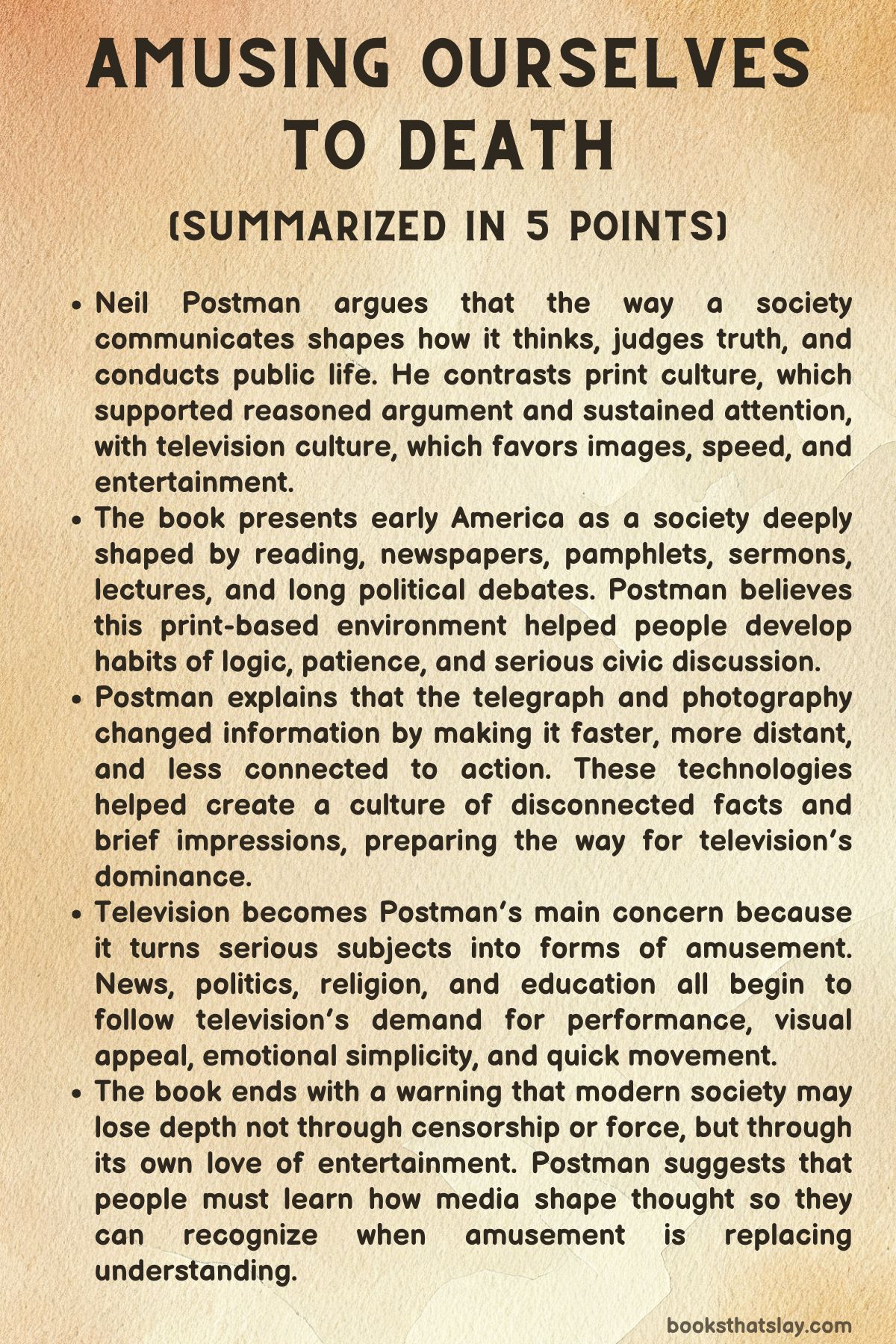
Amusing Ourselves to Death: Public Discourse in the Age of Show Business by Neil Postman is a cultural criticism book about how television reshaped public life in America. Postman argues that every medium changes the way people think, speak, learn, worship, vote, and understand truth.
His main concern is not that television offers entertainment, but that it turns serious matters into entertainment too. He contrasts a print-based culture, which encouraged reasoned debate and sustained attention, with a television-based culture built around images, speed, and performance. The book warns that people may lose intellectual depth not through oppression, but through pleasure and distraction.
Summary
Neil Postman’s Amusing Ourselves to Death begins by comparing two famous warnings about the future: George Orwell’s fear that people would be controlled by force, censorship, and state power, and Aldous Huxley’s fear that people would surrender freedom because they loved comfort, amusement, and distraction. Postman argues that Huxley’s fear better describes modern America.
The danger is not mainly that books will be banned or truth will be hidden by tyrants. The greater danger is that people will stop caring about serious thought because public life has been turned into entertainment.
Postman’s central argument is that a culture is shaped by its dominant medium of communication. He says that the form through which ideas are expressed affects the ideas themselves.
A message delivered in print is not the same as a message delivered through television, because each medium favors different habits of mind. Print encourages order, logic, argument, patience, and sustained attention.
Television favors images, speed, personality, emotional appeal, and entertainment. Postman adapts Marshall McLuhan’s phrase “the medium is the message” by saying that the medium is a metaphor: it creates a way of seeing the world.
He explains that technologies are never neutral. A clock does more than tell time; it changes how people understand time.
Writing does more than record words; it makes ideas permanent, open to criticism, and available for complex reasoning. Each medium carries hidden assumptions about what counts as knowledge, truth, and importance.
Postman calls this connection between communication and knowledge “media epistemology.” In a society based on speech, truth may be tied to memory, proverbs, and oral performance. In a society based on writing, truth is expected to appear in documents, arguments, records, and evidence.
His claim is that when television becomes dominant, a society begins to treat truth as something that must be visually appealing and entertaining.
Postman then describes early America as a print-centered culture. From the colonial period onward, Americans were deeply attached to books, pamphlets, newspapers, sermons, and public lectures.
Literacy rates were high, especially in New England, and reading was part of religious, political, and civic life. The Bible shaped early communities, public schooling supported literacy, and printed material was widely available.
Political documents such as Thomas Paine’s Common Sense and the Federalist essays reached large audiences and helped shape national debate. Newspapers and pamphlets were central to political life, and public lectures drew large crowds.
This print culture produced what Postman calls a typographic mind. People were used to long arguments and could follow extended chains of reasoning.
He uses the Lincoln-Douglas debates as an example: audiences listened for hours to speeches filled with argument, evidence, and complex structure. Religion, law, education, and advertising all reflected this print-based habit of thought.
Religious leaders made intellectual arguments. Lawyers were expected to have broad learning.
Advertisements often made claims through detailed language rather than relying mainly on images. Public figures were known primarily through their words, not their appearance.
The change began when the telegraph separated communication from transportation. Before the telegraph, information traveled only as fast as a person, horse, train, or ship could carry it.
News was usually local and connected to people’s lives. The telegraph made it possible to send information quickly across great distances, but this also created a flood of disconnected facts.
People began receiving news about events that did not affect their daily actions and that they could not meaningfully respond to. Postman calls this a decline in the “information-action ratio.” Information became faster, more abundant, and less useful.
Photography added another major change. Unlike language, which can explain, compare, define, and argue, photography shows particular images.
It captures fragments of reality but cannot easily express abstract ideas on its own. Combined with the telegraph, photography helped create a world of brief impressions: images and facts appearing for a moment and then disappearing.
Postman describes this as a “peek-a-boo” world, where events appear, attract attention briefly, and are quickly replaced. This prepared the way for television, which made entertainment the dominant form of public discourse.
Postman argues that television does not extend print culture; it attacks it. Television is excellent at entertainment because it works through moving images, performance, and constant visual change.
The problem is not that entertainment exists. The problem is that every serious subject must adapt itself to television’s demand to entertain.
News, religion, politics, education, medicine, and law all become television material, and therefore all must become visually attractive, brief, dramatic, and easy to consume.
Television news is one of Postman’s main examples. He criticizes the phrase “now .
. .
this” because it shows how television joins unrelated stories without context or consequence. A murder, a war, a political scandal, a weather report, and a commercial can follow one another in rapid sequence.
The viewer is not asked to think deeply or act meaningfully. Instead, the news becomes a show.
Newscasters must look appealing and trustworthy, music creates mood, stories are brief, images change constantly, and commercial breaks interrupt even tragic events. The result is that viewers may feel informed while actually receiving disconnected fragments.
Postman also argues that television produces “disinformation,” not necessarily false information spread intentionally, but misleading knowledge that gives people the illusion of understanding. For example, heavy coverage of an international crisis may leave viewers with strong opinions but little real knowledge of the history, language, religion, or politics involved.
Television news creates familiarity without depth.
Religion is also changed by television. Postman argues that televised religion cannot reproduce the experience of worship in a sacred space.
The home, the studio, the commercial break, and the screen all change the meaning of religious practice. Television places attention on the preacher’s face and personality, often making performance more important than theology.
The message must be pleasing, visually attractive, and suited to audience expectations. Instead of religion challenging believers, it risks becoming another consumer product.
Postman’s concern is that television does not merely carry religion; it reshapes religion into television.
Politics undergoes a similar transformation. Television turns candidates into images and campaigns into advertising.
Commercials replace serious political argument with emotional appeal, mood, and personal branding. Candidates are sold like products, and voters are encouraged to respond to impressions rather than policies.
Postman contrasts this with an older political culture in which parties, platforms, speeches, and written arguments mattered more. He does not claim that earlier politics was perfect, but he insists that television makes it difficult for voters to judge candidates through reasoned analysis.
Political discourse becomes closer to marketing than debate.
Education is another target of Postman’s criticism. He discusses educational television, especially Sesame Street, and argues that it teaches children to love television more than school.
Television presents learning as easy, fun, self-contained, and free from confusion. But real education often requires effort, sequence, background knowledge, discipline, and periods of uncertainty.
Television’s rules are opposed to these demands: it avoids prerequisites, avoids difficulty, and avoids extended explanation. When schools try to imitate television, education becomes entertainment, and subjects are chosen or shaped according to what can be dramatized.
In the final section, Postman returns to Huxley’s warning. The danger is not that people are forced into ignorance, but that they choose distraction so often that serious culture weakens.
Television does not need to ban books; it only needs to displace them. History, reason, and public argument fade because they do not fit easily into entertaining forms.
Postman does not believe television can simply be removed from society. Instead, he suggests that people must learn how media work.
They need to ask what kinds of information different media create, how those forms shape thought, and whether each medium carries moral and intellectual biases. He thinks schools may be the best place to teach this awareness.
Amusing Ourselves to Death is therefore a warning about the cost of a culture that treats amusement as the measure of value. Postman’s argument is not that television is evil or that entertainment is worthless.
His claim is sharper: when entertainment becomes the form of all public communication, a society loses the habits needed for serious thought. The book asks readers to notice how media shape reality before they quietly reshape the mind.
Key People
Neil Postman
Neil Postman is the central intellectual presence in Amusing Ourselves to Death, even though he is not a character in a fictional sense. He appears as a cultural critic, teacher, and concerned observer of American public life.
His voice is direct, skeptical, and often sharp, but his argument is not based on simple nostalgia for the past. He is interested in how forms of communication change the way people think.
Postman presents himself as someone trying to warn readers that television has quietly changed public discourse by making entertainment the standard form of expression. He does not argue that television is useless or evil; rather, he believes that serious subjects lose depth when they are forced into television’s fast, image-centered format.
His role is that of a guide who asks readers to notice the hidden rules of media and to question whether modern culture has confused amusement with knowledge.
Aldous Huxley
Aldous Huxley functions as one of the book’s most important prophetic figures. Postman presents him as the thinker who better understood the danger facing modern society.
Huxley’s warning is not about people being crushed by force, but about people willingly accepting distraction, pleasure, and comfort until they lose the desire for serious thought. In Postman’s reading, Huxley becomes the figure who explains why entertainment can be more dangerous than censorship.
His importance lies in the idea that a society may destroy its own seriousness without needing an obvious oppressor. Huxley’s vision shapes the book’s central fear: people may become passive not because truth is hidden from them, but because they are too amused to care about it.
George Orwell
George Orwell appears as a contrasting figure to Huxley. Postman treats Orwell with respect, but he argues that Orwell’s fear of authoritarian control does not fully describe the American condition he is analyzing.
Orwell represents the fear of surveillance, censorship, political force, and state domination. His vision depends on people being deprived of information and freedom against their will.
Postman’s argument shifts attention away from that model and toward a softer danger: the loss of thought through entertainment. Orwell’s presence is important because it helps Postman clarify what kind of crisis he believes America faces.
The problem is not mainly that people are forbidden to read, argue, or think. The problem is that many no longer feel much need to do so.
Marshall McLuhan
Marshall McLuhan is an intellectual influence whose famous idea about media becomes a foundation for Postman’s argument. McLuhan’s phrase about the medium shaping the message helps Postman explain that communication is never only a container for content.
The form itself changes meaning. Postman modifies this idea by describing the medium as a metaphor, meaning that it creates a framework through which people understand reality.
McLuhan’s role is not that of a direct opponent or guide, but of a predecessor whose insight gives Postman a way to discuss television, print, photography, and the telegraph. Through McLuhan, the book shows that media are not passive tools.
They carry assumptions about time, truth, attention, and value.
The American Public
The American public is one of the book’s most important collective figures. Postman portrays Americans as people who once lived inside a culture shaped by print, argument, and sustained attention, but who later adjusted to a culture dominated by speed, images, and amusement.
The public is not shown as foolish in a simple way. Instead, it is shown as vulnerable to the habits created by its dominant media.
In the age of print, citizens could follow long speeches, read pamphlets, engage with political arguments, and value literacy as part of democratic life. Under television, the same public becomes trained to expect brief segments, visual pleasure, emotional signals, and quick transitions.
This collective character reveals the book’s broader concern: culture changes when people’s habits of attention change.
Television
Television is treated almost like a powerful character because it actively shapes the society around it. In Amusing Ourselves to Death, television is not merely a machine sitting in a living room.
It is a medium with its own logic, and that logic favors entertainment. It rewards visual appeal, speed, performance, and emotional simplicity.
Television changes news into spectacle, politics into advertising, religion into performance, and education into amusement. Postman does not blame television for being entertaining when it presents entertainment.
His criticism is that television turns nearly every subject into entertainment, even when the subject requires seriousness, patience, and context. Television’s “character” is therefore seductive rather than openly violent.
It wins by making everything easier to watch and harder to think through.
Print Culture
Print culture appears as the older force against which television is measured. Postman presents it as disciplined, rational, and demanding.
It favors linear thought, careful reading, extended argument, and the ability to follow complex ideas over time. In early America, print culture shaped religion, politics, law, advertising, and public debate.
It helped create citizens who could listen to long speeches and read serious political writing. Print culture is not presented as perfect, but it stands for a way of thinking that public life once depended on.
Its decline matters because Postman believes democratic discourse requires habits that print supports better than television does. Print culture represents patience, memory, evidence, and reasoned judgment.
Newscasters
Newscasters serve as representatives of how television changes public information. Postman describes them as figures who must appear attractive, calm, credible, and reassuring.
Their role is not simply to present facts; they must perform the news in a way that fits television’s expectations. Their appearance, tone, and composure become part of the message.
Even when they report war, murder, disaster, or political crisis, the format requires smooth transitions and emotional control. This turns news into a staged experience rather than a serious encounter with public reality.
Newscasters therefore reveal Postman’s concern that television makes credibility look like performance. The viewer may trust the face on the screen without gaining real understanding of the event being reported.
Politicians
Politicians are presented as figures transformed by television into products and celebrities. Postman argues that television encourages voters to judge candidates through image, style, personality, and emotional appeal rather than through sustained arguments or policy knowledge.
Political commercials become central because they are brief, memorable, and visually persuasive. This changes what citizens expect from politics.
A candidate must appear likable and reassuring, much like a brand in an advertisement. Postman does not claim that earlier politics was pure or ideal, but he suggests that television weakens the conditions necessary for serious democratic choice.
Politicians become symbols designed for quick consumption, and public debate becomes less about reasoning than about image management.
Televangelists
Televangelists represent the effect of television on religion. Postman presents them as performers shaped by the medium in which they appear.
Their sermons, sets, gestures, and appeals must work on screen, which means they must compete with other forms of entertainment. In this setting, the sacred space of worship is replaced by the domestic space of television viewing, and the preacher’s face becomes the center of attention.
Postman’s criticism is not only directed at individual preachers; it is aimed at the medium that changes the religious message. Televangelists reveal how television can make spiritual life more dependent on personality, spectacle, and audience satisfaction.
Religion risks becoming less demanding and more marketable.
Educators and Students
Educators and students represent the pressure television places on learning. Postman argues that television teaches children to expect education to be entertaining, easy, and free of difficulty.
Students become accustomed to lessons that require no prerequisites, create little confusion, and move quickly from one appealing moment to another. Educators then face pressure to make classrooms resemble television, even though serious learning often requires effort, sequence, repetition, and discomfort.
This does not mean that teachers oppose creativity or engaging instruction. Postman’s concern is that television changes the definition of good teaching into something closer to amusement.
Educators and students therefore show how deeply media can affect expectations about knowledge.
Themes
Media Shape Thought
Communication forms do more than deliver information; they train the mind to receive reality in certain ways. A culture based on print tends to value sequence, logic, evidence, and sustained attention because print itself demands those habits.
A reader must move through sentences in order, hold ideas in memory, compare claims, and follow arguments. Television creates a different mental environment.
It favors images, quick movement, emotional cues, and immediate appeal. Postman’s point is that the same subject changes when it moves from one medium to another.
Politics in a pamphlet is not the same as politics in a campaign commercial. Religion in a church is not the same as religion formatted for a screen.
News in a detailed article is not the same as news broken into short visual segments. The medium quietly sets the rules for what can be said, how seriously it can be taken, and what kind of response it asks from the audience.
This theme gives the book its main intellectual force: culture is not only shaped by ideas, but by the technologies through which ideas are expressed.
Entertainment as Public Discourse
Entertainment becomes dangerous when it stops being one part of culture and becomes the standard for all public communication. Postman is not against pleasure, humor, drama, or amusement.
His concern is that serious subjects lose their proper weight when they must be presented as entertaining in order to be accepted. News becomes a show, politics becomes advertising, religion becomes performance, and education becomes a program designed to hold attention rather than build understanding.
The problem is not that people laugh or relax; the problem is that they begin to expect every public matter to be easy, brief, and visually pleasing. Under this condition, complexity feels boring, argument feels too slow, and difficulty feels like failure.
A society shaped by amusement may still have access to information, but it may lose the habits needed to interpret that information responsibly. In Amusing Ourselves to Death, the threat is not silence but noise, not ignorance caused by lack of access, but confusion caused by a flood of disconnected entertainment.
The Decline of Print-Based Reason
Postman presents print culture as a historical foundation of serious American public life. In the world of print, citizens were trained to read long arguments, listen to extended debates, and value language as a tool for reasoning.
Political pamphlets, sermons, newspapers, lectures, and legal arguments shaped a public that could tolerate complexity. This does not mean the past was flawless, but it did create a different expectation of public discourse.
People were more likely to judge ideas by structure, evidence, and verbal clarity. The decline of print-based reason matters because democratic life depends on citizens who can follow arguments and think beyond impressions.
Television weakens this discipline by replacing exposition with images and performance. When public figures become known more by appearance than by words, the standards of judgment change.
A culture may still speak about freedom, citizenship, and knowledge, but if its dominant medium discourages sustained reasoning, those ideals become harder to protect. The theme shows Postman’s fear that democracy may weaken when attention becomes too fragmented for serious judgment.
The Illusion of Being Informed
Modern media can give people the feeling of knowledge without giving them real understanding. Television news, in Postman’s analysis, presents viewers with a rapid sequence of stories that often lack context, continuity, or practical relevance.
A viewer may hear about wars, disasters, elections, crimes, scandals, and foreign crises, yet remain unable to explain their causes or significance. This produces a condition in which people have opinions without depth.
They recognize names, images, and headlines, but they may not understand the history or systems behind them. Postman calls attention to the gap between receiving information and being meaningfully informed.
Information becomes a kind of spectacle, something consumed rather than used. The commercial structure of television adds to this problem by interrupting serious matters with advertisements, suggesting that even tragedy is part of a larger entertainment package.
The result is a public that may feel alert and engaged while actually being trained in passivity. This theme remains powerful because it questions whether more information automatically leads to better understanding.