Amsterdam by Ian McEwan Summary, Characters and Themes
Amsterdam is a dark comic novel by Ian McEwan about friendship, vanity, moral failure, and revenge. It follows two successful men, composer Clive Linley and newspaper editor Vernon Halliday, after the death of Molly Lane, a woman both once loved.
Her death leaves them shaken, but it also exposes how shallow their loyalties and principles can be when ambition, fear, and pride take over. The book is sharp, controlled, and unsparing, showing how people who think of themselves as ethical can quickly become cruel when their self-image is threatened.
Summary
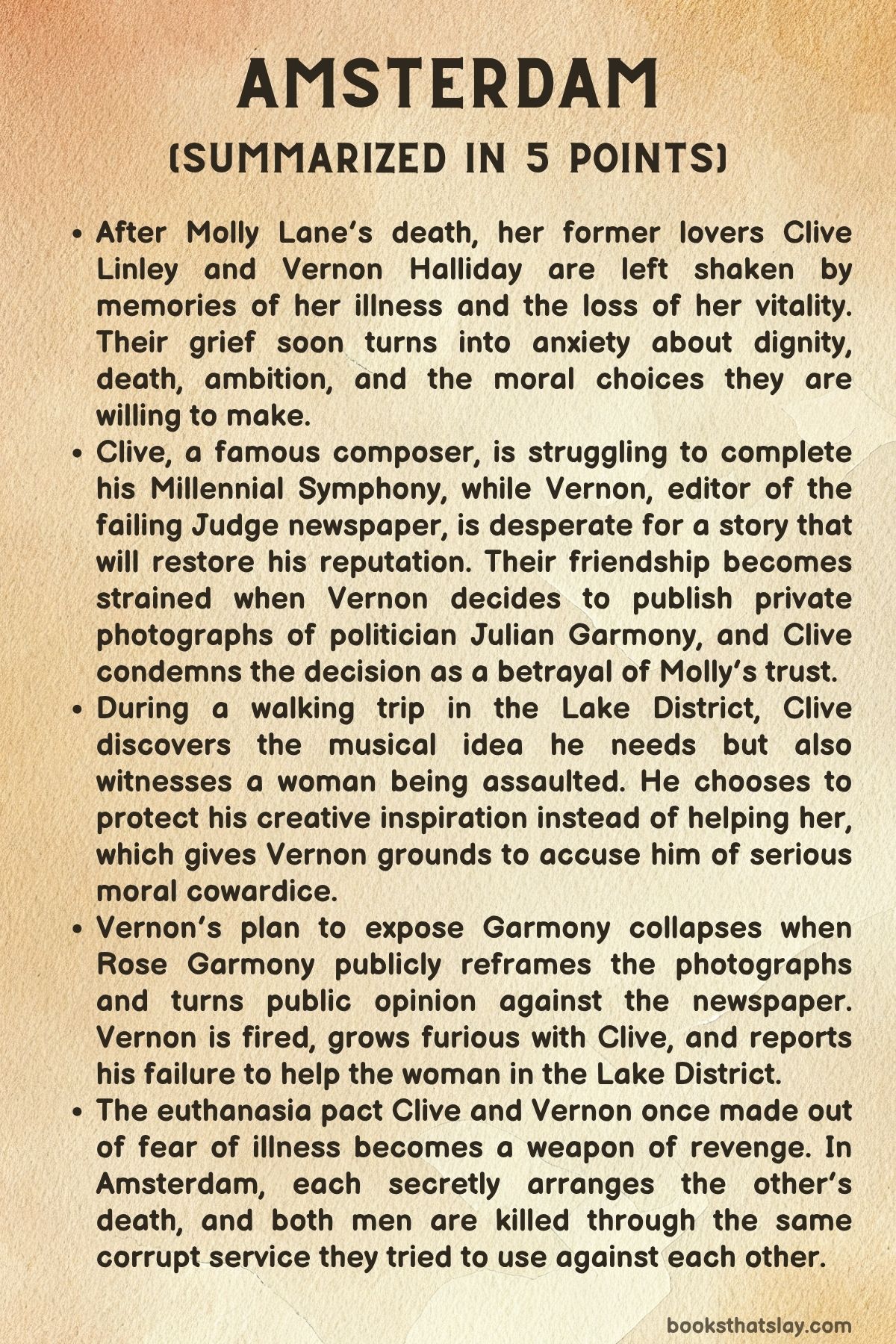
Amsterdam opens after the funeral of Molly Lane, a lively restaurant critic and photographer whose final illness was sudden and humiliating. Two of her former lovers, Clive Linley and Vernon Halliday, stand outside the crematorium chapel in London and reflect on her decline.
Clive, a famous composer, believes Molly would have chosen euthanasia rather than endure the last stages of her illness, when she lost control over her body and mind. Vernon, the editor of a struggling newspaper called the Judge, shares Clive’s grief, though both men are also occupied by their own fears and grievances.
They both dislike Molly’s husband, George Lane, a wealthy publisher who controlled access to Molly during her illness and kept many of her old friends and lovers away. Another former lover, Julian Garmony, is now foreign secretary and a right-wing politician whose views Clive and Vernon despise.
At the funeral, Clive is forced into a public exchange with Garmony, who humiliates him privately while pretending friendship for the cameras. The encounter deepens Clive’s disgust with the political world and its falseness.
After the funeral, Clive returns home and tries to work on his Millennial Symphony, a major commission that could seal his artistic reputation. He has found one promising musical phrase but still lacks the central idea needed to complete the piece.
That night, he feels a numbness in his hand and panics because it reminds him of Molly’s first symptoms. His fear of illness and helplessness leads him to imagine the same kind of decline happening to him.
Vernon is facing a different crisis. The Judge is losing readers, and he is under pressure to make it more dramatic and commercially successful.
George contacts him and says he has photographs that could save the paper. Before Vernon sees them, Clive asks him to visit.
Clive, still disturbed by Molly’s death and his own possible symptoms, asks Vernon to make a pact: if either of them becomes terminally ill and mentally or physically incapacitated, the other must help him die. Vernon is shocked but later agrees, adding that the promise must be mutual.
Vernon then goes to George’s house, where George shows him photographs taken by Molly of Julian Garmony cross-dressing. George owns the rights to the images through Molly’s estate and wants Vernon to publish them.
Vernon immediately sees their value. The Judge could regain attention, and Garmony’s political career could be ruined.
Vernon convinces himself that publishing the photographs would serve a public good by exposing hypocrisy and preventing a dangerous politician from rising higher.
Clive strongly disagrees. When Vernon shows him the photographs, Clive sees them as private images made in a context of intimacy and trust.
He believes Molly would have destroyed them if she had known they might be used this way. Clive argues that publishing them would betray Molly’s memory and violate Garmony’s privacy, even if Garmony is a political opponent.
Vernon insists that the public has a right to know and that Garmony’s public morality makes him fair game. Their argument becomes bitter.
Vernon accuses Clive of living above ordinary moral pressures because of his wealth and artistic status, while Clive accuses Vernon of becoming a tool of George’s revenge.
Clive leaves for the Lake District, hoping the landscape will help him finish his symphony. His mood is foul at first, and he resents Vernon more with every small irritation.
During a walk in the hills, he finally hears a birdcall that gives him the musical solution he has been seeking. At that same moment, he sees a man assaulting a woman.
The man throws her backpack into the water and drags her away. Clive hesitates.
He knows he should intervene or seek help, but he is terrified of losing the musical idea. He chooses his work over the woman’s safety, withdraws from the scene, writes down the melody, and later convinces himself that his decision was necessary for art.
Back in London, Vernon moves ahead with the Garmony story. The Judge builds anticipation around the photographs, and circulation begins to rise.
Vernon’s staff, who had been divided over his leadership, now starts to praise him. He feels vindicated and powerful.
George has forced a bidding war over the photographs, but Vernon secures them. Though some people object to the invasion of privacy, Vernon believes he is on the edge of a major triumph.
At the same time, Rose Garmony, Julian’s wife and a respected pediatric heart surgeon, acts before Vernon can publish. She appears with her husband and children, presents their marriage as loving and secure, explains Julian’s cross-dressing as a private habit she accepts, and displays the photograph herself.
By doing so, she removes its shock value and turns public anger toward Vernon. She denounces him as a blackmailer, and the Judge’s planned scoop collapses.
Vernon’s enemies at the paper abandon him. The board fires him, and Frank Dibben, a younger colleague who had pretended to support him, replaces him.
Vernon’s fall makes him angrier at Clive. He remembers that Clive mentioned seeing an attack in the Lake District and connects it to news reports about a serial attacker.
He confronts Clive by phone and demands that he go to the police. Clive refuses, saying he cannot risk the disruption while his symphony remains unfinished.
Vernon is appalled and threatens to report him. Clive fires back that Vernon has no right to lecture anyone after trying to destroy Garmony through private photographs.
Their friendship collapses completely.
Clive’s own life begins to unravel. Vernon’s call destroys his concentration, and the final variation he needs for the symphony slips away.
He drinks, rages, and sends Vernon a postcard saying he deserved to be sacked. Vernon receives it after losing his job and believes Clive sent it as a cruel celebration of his downfall.
He retaliates by reporting Clive to the police as a witness who failed to come forward.
Both men now turn the euthanasia pact into a weapon. Clive travels to Amsterdam for rehearsals of his symphony and arranges for a Dutch doctor to kill Vernon, claiming his friend has become unstable and destructive.
Vernon, meanwhile, makes similar arrangements against Clive. Each man believes he is acting within the spirit of their pact, but each is really motivated by revenge.
At the Amsterdam rehearsal, Clive hears his symphony and realizes the work is not the masterpiece he had imagined. Without the missing variation, it sounds derivative, especially of Beethoven.
His confidence collapses. Later, at a drinks reception, both Clive and Vernon prepare drugged champagne for each other.
A confused exchange of glasses and an interruption by a rude critic briefly delay the plan, but the two old friends then seem to reconcile. Their apologies are hollow because each has already arranged the other’s death.
In separate hotel rooms, each man is visited by a doctor and nurse from the euthanasia service. Under the effects of drugs, Clive hallucinates Molly and a critic, while Vernon hallucinates a newspaper meeting.
Each signs consent forms without understanding what he is doing. Each receives a lethal injection.
Vernon has a final moment of clarity and realizes Clive has betrayed him.
After their deaths, George and Julian Garmony travel to Amsterdam to collect the bodies. Garmony’s own political career has also ended after a cabinet reshuffle, but he survives.
The authorities explain that Clive and Vernon did not die in a double suicide but in a mutual murder arranged through a rogue euthanasia service. George returns to England satisfied.
All his rivals for Molly’s affection are gone. He imagines a memorial service for Molly at which he alone will speak, and he plans to ask Vernon’s widow to dinner.
Characters
Clive Linley
Clive Linley is a celebrated composer whose public identity depends on discipline, solitude, and artistic seriousness. He sees himself as a man devoted to higher values, especially music, and he often treats this devotion as proof of moral refinement.
Yet the novel steadily exposes the selfishness beneath that self-image. His grief for Molly is real, and his fear of illness after her death makes him vulnerable, but he also turns that fear into a demand that Vernon promise to help him die if he ever loses control of his body or mind.
This request sounds dignified at first, but it later becomes part of the story’s darkest irony, because the pact is transformed from an act of friendship into a tool of murder. Clive’s greatest moral failure occurs in the Lake District, where he witnesses a woman being assaulted and chooses not to intervene because he wants to preserve a musical idea.
He convinces himself that the symphony matters more than the immediate danger before him. This decision reveals the dangerous side of his artistic pride: he values beauty and achievement, but when forced to act, he protects his work rather than another human being.
By the end, his confidence collapses when he realizes that his symphony is artistically weak. His death in Amsterdam is both a punishment for his arrogance and a bleak confirmation that his friendship with Vernon has decayed into rivalry and revenge.
Vernon Halliday
Vernon Halliday is the editor of the Judge, a newspaper in decline, and his character is shaped by professional insecurity, political resentment, and a craving for public relevance. Like Clive, he thinks of himself as principled, but his principles shift whenever ambition offers him a reward.
He initially appears more socially engaged than Clive because he works in journalism and claims to care about public life. However, his decision to publish private photographs of Julian Garmony shows how easily he confuses public interest with sensationalism.
Vernon tells himself that exposing Garmony will protect the country from a dangerous politician, but he is also trying to save his failing newspaper and restore his own authority. His hypocrisy becomes clear because he once supported sexual freedom, yet he is willing to shame Garmony for private behavior that harms no one.
Vernon’s outrage at Clive’s failure in the Lake District is morally justified, but it is also contaminated by personal anger. Once Clive insults him after his dismissal, Vernon uses the police report and the euthanasia pact as instruments of revenge.
His final moments reveal the full ruin of his judgment: he realizes too late that the agreement he once accepted as an act of trust has been turned against him. Vernon is not simply a corrupt journalist; he is a man who loses the ability to separate justice from humiliation, and that failure destroys him.
Molly Lane
Molly Lane is dead before the main action begins, but she remains the emotional and moral center of the novel. The men around her define themselves through their memories of her, yet those memories are partial, possessive, and often self-serving.
To Clive and Vernon, she represents youth, pleasure, warmth, and a freer period of their lives. To George, she is a possession whose memory he continues to control even after her death.
To Garmony, she is part of a private past that later threatens his political future. Molly’s illness also shapes the novel’s treatment of dignity and bodily decline.
Her rapid deterioration terrifies Clive and Vernon because it forces them to imagine the collapse of their own power and self-command. The euthanasia pact grows directly from this fear.
Molly also matters because of the photographs she took of Garmony. Since she is not alive to explain what she intended, others impose their own motives on her work.
Vernon treats the photographs as political evidence, George treats them as weapons, and Clive sees them as private tokens of trust. In that sense, Molly becomes a figure whom everyone claims but no one can truly possess.
Her absence exposes the vanity, jealousy, and moral weakness of the men who once loved her.
George Lane
George Lane is Molly’s widower, a wealthy publisher whose grief is inseparable from possessiveness and revenge. During Molly’s illness, he controls who can see her, keeping Clive, Vernon, and Garmony at a distance.
This control suggests that he wants to dominate not only Molly’s final days but also the memory of her life. After her death, George uses the photographs of Garmony to manipulate Vernon and damage one of Molly’s former lovers.
His conduct is cold and calculated. He presents the photographs as a chance for Vernon to save the Judge, but he is also pursuing a private vendetta against men he sees as rivals.
George rarely acts openly. Instead, he pushes others into compromising positions and watches them destroy themselves.
His final satisfaction after Clive and Vernon die shows the full extent of his bitterness. He regards their deaths less as a tragedy than as the removal of competitors for Molly’s affection.
His plan to speak alone at Molly’s memorial service shows how deeply he wants to own the story of her life. George is one of the novel’s most quietly sinister figures because he rarely seems impulsive.
His cruelty is patient, social, and strategic.
Julian Garmony
Julian Garmony is a powerful conservative politician whose public image depends on authority, discipline, and moral confidence. He is introduced as someone Clive and Vernon dislike for political reasons, especially because of his hardline views.
At Molly’s funeral, he shows a private nastiness when he threatens Clive with humiliation while maintaining a friendly pose for the press. This moment reveals his talent for public performance and intimidation.
Yet Garmony is also a victim of Vernon and George’s attempt to use his private life against him. His cross-dressing is treated by Vernon as proof of hypocrisy, but the novel complicates that assumption.
The real hypocrisy lies less in Garmony’s private behavior than in the public hunger to turn it into scandal. Garmony’s survival depends largely on Rose, whose intelligence and composure protect him from complete disgrace.
Although his political career is eventually damaged, he is not destroyed in the way Vernon expects. Garmony functions as a morally unpleasant man who still deserves privacy.
That tension is important because it prevents the reader from accepting Vernon’s justification too easily. A person may be objectionable in public life without every private detail becoming fair material for punishment.
Rose Garmony
Rose Garmony is one of the most capable and composed characters in the novel. As a distinguished pediatric heart surgeon, she is associated with precision, discipline, and genuine public service.
Her professional life contrasts sharply with the vanity and self-interest of Clive, Vernon, George, and Julian. When the newspaper prepares to expose her husband, Rose acts with remarkable control.
She frames Julian’s cross-dressing as a harmless private matter within a loving marriage, displays the photograph herself, and turns Vernon’s planned revelation into an act of cruelty rather than journalism. Her response is not sentimental; it is tactical, intelligent, and public-facing.
She understands media logic better than Vernon does, which is why she defeats him before his story can land. Rose is also not presented as purely gentle.
Her private thought that she is glad Molly is dead shows jealousy, resentment, and emotional complexity. She loves or at least protects Julian, but she also knows exactly how to manage appearances.
Her strength lies in her ability to combine emotional discipline with public strategy. In a novel filled with men who misjudge themselves, Rose stands out as someone who sees the situation clearly and acts effectively.
Frank Dibben
Frank Dibben is Vernon’s younger colleague at the Judge and represents opportunism inside professional institutions. At first, he appears subordinate and apologetic, especially when he smooths over tensions after challenging Vernon in a meeting.
Later, he becomes Vernon’s secret ally during the internal conflict at the paper, feeding him information and helping him gather support for the Garmony story. His stated motive is modernization: he claims the newspaper must change to survive and that the older staff is resisting necessary reform.
Yet Frank’s loyalty is shallow. Once Vernon’s plan fails and public opinion turns against him, Frank benefits directly by becoming editor.
His rise shows how quickly institutional loyalty can shift when power changes hands. Frank is not as central as Clive or Vernon, but he is important because he reflects the cynical environment in which Vernon operates.
The newspaper is not a noble arena of truth; it is a workplace shaped by ambition, factions, and career calculation. Frank’s smooth transition into Vernon’s job confirms that Vernon was never as indispensable as he believed.
Mandy Halliday
Mandy Halliday, Vernon’s wife, appears in a smaller role, but she helps reveal Vernon’s domestic isolation and emotional decline. Her argument with Vernon after his dismissal shows that his professional collapse has entered his private life.
Vernon’s humiliation is not contained within the newsroom; it affects his marriage and his sense of masculine pride. Mandy also becomes part of George’s final thoughts when he plans to ask her to dinner after Vernon’s death.
This chilling detail shows how George continues to view women and relationships through possession, opportunity, and rivalry. Mandy is not developed as fully as Molly or Rose, but her presence matters because she shows the human cost around Vernon’s downfall and becomes another figure whom George imagines moving toward after the removal of his rivals.
Susie Marcellan
Susie Marcellan is Clive’s girlfriend, who lives in New York and visits him only occasionally. Her limited presence reflects Clive’s preference for solitude and emotional distance.
Clive’s life is arranged around his work, his routines, and his need for privacy, and Susie’s distance suits that arrangement. She helps define him as a man who can maintain a relationship only when it does not demand too much from him.
Unlike Molly, whose memory stirs deep feeling and nostalgia, Susie is part of Clive’s present but not a strong emotional force in the plot. Her role emphasizes how isolated Clive has become.
He may have status, wealth, and romantic connection, but his real intimacy is with his art and his self-image.
Jean
Jean, Vernon’s secretary, is a minor but useful character because she places Vernon within the everyday machinery of the newspaper. She interrupts him during moments of anxiety, reminds him of schedules, and keeps the practical world moving around him.
Her presence highlights the gap between Vernon’s private panic and the professional role he must perform. While Vernon sees himself as a major public figure making large moral decisions, Jean represents the ordinary routines that continue regardless of his crisis.
She also interrupts one of his confrontations with Clive to tell him about Rose Garmony’s press conference, a moment that marks the beginning of his public defeat. Jean’s role is not emotionally central, but she helps anchor Vernon’s storyline in the pressures and rhythms of newsroom life.
Tony Montano
Tony Montano is the managing director and lawyer connected to the Judge, and he represents the corporate and legal side of the newspaper. His questions about the Garmony injunction show that Vernon’s editorial choices are never purely personal or political; they carry legal and business consequences.
Tony’s presence also reminds the reader that the Judge is an institution with owners, board members, and financial interests. Vernon may imagine himself as the central moral actor, but people like Tony measure risk, liability, and survival.
Later, Tony observes the new editorial direction under Frank, suggesting that the organization quickly adapts after Vernon’s removal. His character shows how institutions absorb scandal, replace failed leaders, and continue with little sentiment.
Hart Pullman
Hart Pullman, the Beat poet who claims to have known Molly when she was young, appears briefly but sharply. His claim of a sexual past with Molly disgusts Clive, who sees it as crude and exploitative, especially at her funeral.
Pullman’s presence introduces one of the novel’s recurring concerns: how the dead become vulnerable to the stories others tell about them. Because Molly cannot confirm, deny, or correct anything, men can use her memory to flatter themselves, provoke others, or claim intimacy.
Pullman may or may not be telling the truth, but his behavior feels indecent because it turns mourning into performance. His brief appearance also intensifies Clive’s grief and possessiveness, showing that even Clive’s love for Molly contains pride and jealousy.
Paul Lanark
Paul Lanark is the music critic who appears during the Amsterdam reception and unsettles Clive with dismissive comments about his work. He represents the public judgment that Clive fears most: the possibility that his art is not original or great.
By the time Lanark appears, Clive has already begun to suspect that his symphony is derivative, so the critic’s presence intensifies an existing insecurity. Lanark also becomes part of the confusion around the poisoned champagne and later appears in Clive’s hallucination as a figure associated with judgment and death.
His role is brief but symbolically important. He embodies the external verdict that Clive cannot control, and his presence helps push Clive’s artistic self-confidence into collapse.
Themes
Moral Self-Deception
The characters repeatedly make selfish or cruel choices while describing those choices in noble language. Clive abandons a woman in danger, but he tells himself that the musical idea in his mind is too valuable to lose.
Vernon prepares to publish private photographs, but he claims he is defending the public from political hypocrisy. George presents the photographs as a newspaper opportunity, though his deeper motive is revenge against Molly’s former lovers.
Even the euthanasia pact, which begins as a response to fear and suffering, becomes a way for Clive and Vernon to justify murder. The disturbing pattern is not that these characters lack moral vocabulary.
They have plenty of it. The problem is that they use moral language to protect themselves from seeing their own motives.
Amsterdam shows how easily intelligence can become a tool of self-excuse. The more articulate the characters are, the more skilled they become at making corruption sound reasonable.
This theme gives the novel much of its bitter comedy, because the characters often appear most certain of their virtue when they are behaving at their worst.
Privacy, Public Exposure, and Power
The planned publication of Garmony’s photographs raises a difficult question about where public accountability ends and private cruelty begins. Garmony is a public figure with harsh political views, so Vernon argues that exposing him is justified.
Yet the photographs do not reveal corruption, violence, or abuse of office. They reveal a private sexual or personal habit that his wife already knows about and accepts.
Vernon’s decision therefore becomes less an act of democratic scrutiny than an attempt to use embarrassment as punishment. George understands this power and uses Vernon as a weapon against a romantic rival.
Rose defeats them because she recognizes that shame works only when it remains hidden. By presenting the photograph herself and framing it as harmless within her marriage, she removes the newspaper’s control over the story.
The theme is especially sharp because the novel does not ask readers to admire Garmony. Instead, it asks whether dislike of a person is enough to justify violating their privacy.
The answer is clearly no. Public life requires scrutiny, but scrutiny without ethical limits becomes another form of domination.
Friendship, Rivalry, and Betrayal
Clive and Vernon begin as old friends bound by shared memories, especially their love for Molly and their youth together. Their friendship appears intimate enough to support a life-and-death promise, but the novel gradually reveals how fragile it is.
Beneath the affection lie resentment, envy, and judgment. Clive sees Vernon as vulgar, compromised, and trapped in the dirty world of journalism.
Vernon sees Clive as privileged, detached, and protected from real consequences. Their disagreement over the Garmony photographs exposes these buried tensions.
The later conflict over the Lake District assault destroys whatever trust remains. Each man is partly right about the other, which makes the betrayal more severe.
Vernon is right that Clive’s inaction is morally appalling. Clive is right that Vernon’s newspaper plan is unethical.
But neither can accept criticism without turning it into personal injury. Their friendship fails because each uses morality as a weapon rather than a standard he must also obey.
By the time they reach Amsterdam, reconciliation is only a performance. Their final exchange of apologies cannot undo the fact that both have already arranged the other’s death.
Death, Dignity, and Control
Molly’s death leaves Clive and Vernon terrified not only of dying, but of losing dignity before death. Her illness is described as a collapse of physical and mental control, and this image haunts both men.
The euthanasia pact emerges from that fear. At first, it seems to express trust: each friend promises to spare the other from helpless suffering.
Yet the pact also reveals their obsession with control. They cannot bear the thought of becoming dependent, diminished, or exposed.
As the plot develops, the language of mercy is stripped of its dignity. Clive and Vernon both exploit the pact to eliminate a rival who has wounded their pride.
What began as a response to Molly’s suffering becomes a grotesque legal and medical procedure used for revenge. The rogue euthanasia service adds a cold bureaucratic layer to the theme: forms are signed, symptoms are invented, and murder is disguised as treatment.
The novel’s handling of death is therefore deeply ironic. The characters seek control over death to preserve dignity, but their need for control leads them to die in confusion, deception, and moral disgrace.