Anarchy, State, and Utopia Summary and Analysis
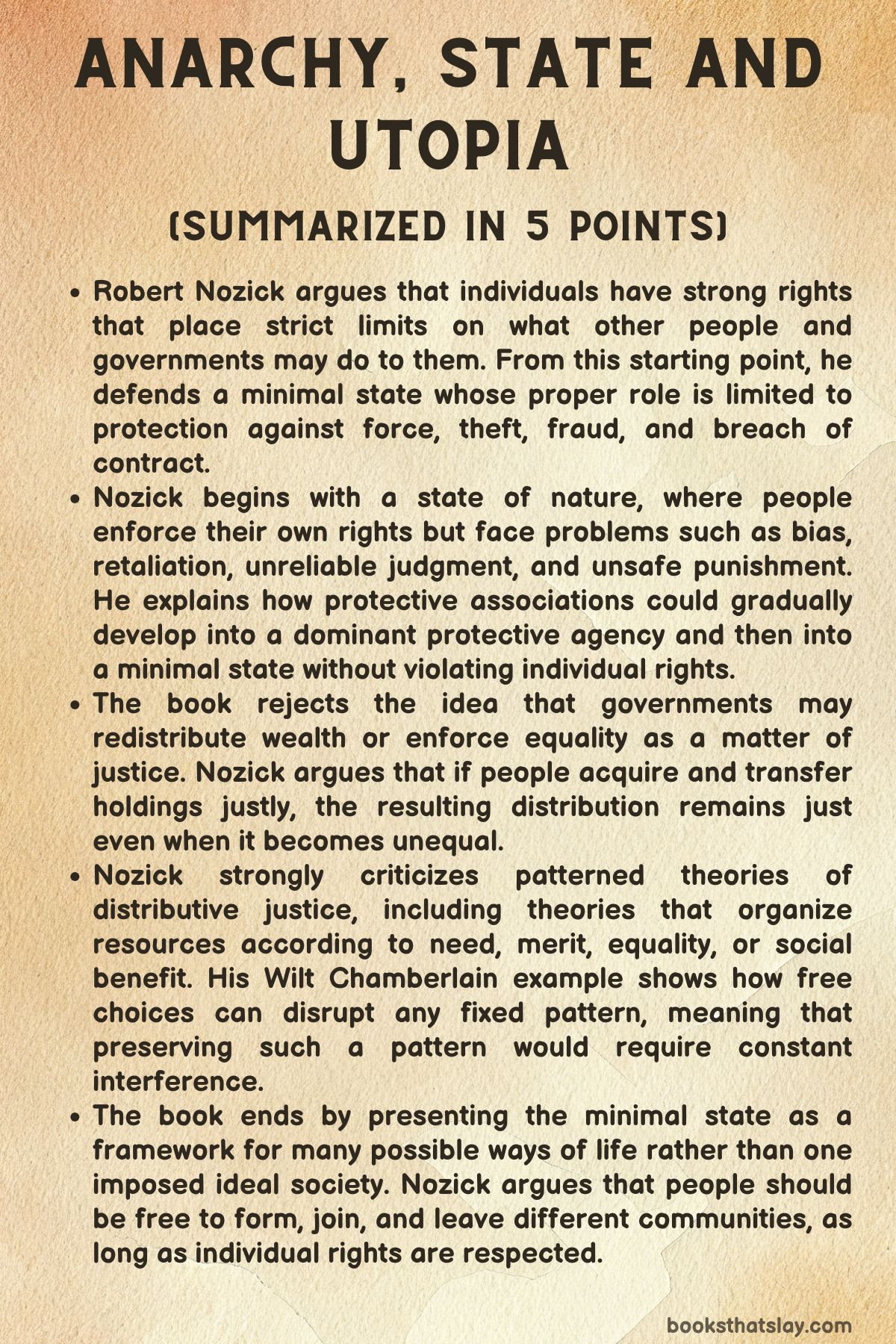
Anarchy, State, and Utopia by Robert Nozick is a major work of political philosophy that defends libertarianism and argues for the moral legitimacy of only a minimal state. Nozick begins with the idea that individuals have rights so strong that neither other people nor governments may violate them for social goals.
He challenges anarchism by explaining how a state could arise without violating rights, then challenges welfare-state theories by arguing that redistribution and enforced equality overstep legitimate authority. The book also answers John Rawls’s theory of justice and ends by presenting the minimal state as a framework in which many different communities and life plans can coexist.
Summary
Anarchy, State, and Utopia is not a narrative work with a conventional plot, but it has a clear argumentative progression. Robert Nozick sets out to answer one central question: what kind of state, if any, can be morally justified?
His answer is that a minimal state is justified, but any state that goes beyond protecting people against force, theft, fraud, and breach of contract violates individual rights.
The book begins with Nozick’s rejection of the assumption that political authority should be taken for granted. He asks readers to imagine a state of nature, a situation without government, in order to test whether the state is necessary and whether it can arise morally.
Drawing on John Locke, he describes people as having natural rights to life, liberty, and possessions. In this condition, people may defend themselves and punish wrongdoers, but several problems appear.
Individuals may judge their own cases unfairly, punish too harshly, or become caught in cycles of retaliation.
To solve these problems, people begin to form protective associations. These groups defend members, settle disputes, and enforce claims.
Over time, protection becomes specialized. Some agencies become stronger than others, and one agency may become dominant in a territory.
Nozick explains this development through an invisible-hand process: no one needs to plan the creation of a state, but individual choices for safety and reliability can produce a state-like institution. The dominant agency has power, but at first it is not yet a full state, because it protects only those who pay for its services and does not necessarily protect everyone in its territory.
Nozick then examines what rights limit such an agency. He rejects utilitarian thinking when it allows one person’s rights to be sacrificed for the benefit of others.
Instead, he presents rights as side constraints: they set moral boundaries on what may be done to people. This view rests on the idea that each person has a separate life and may not be used merely as a tool for another person’s good or for a collective purpose.
He also uses the famous experience machine thought experiment to argue that human beings want more than pleasurable experiences. People want real action, real agency, and real contact with the world.
The next part of the argument asks how a dominant protective agency may treat independents, those who refuse to join it and want to enforce their own rights. Nozick argues that independent enforcement can put the agency’s clients at risk if the independents use unreliable or unfair procedures.
The agency may therefore prohibit those procedures, but doing so disadvantages the independents. Because the agency imposes this disadvantage, it must compensate them, usually by providing protection or access to fair procedures.
In this way, the dominant agency becomes a minimal state: it has a practical monopoly over enforcement and protects everyone in its territory. Nozick’s point is that the minimal state can arise without violating rights, so anarchism is not the only morally acceptable position.
After defending the minimal state against anarchism, Nozick turns against more extensive states. He argues that the state may not use taxation, redistribution, or social planning to enforce a preferred pattern of equality.
His theory of justice is the entitlement theory. It has three parts: justice in acquisition, justice in transfer, and rectification of past injustice.
A person is entitled to a holding if it was justly acquired, voluntarily transferred, or properly corrected after injustice. For Nozick, justice depends on history, not on whether the final distribution matches a pattern such as equality, need, merit, or usefulness.
This leads to his criticism of patterned theories of distributive justice. Nozick argues that liberty disrupts patterns.
Even if society begins with an equal distribution, voluntary choices will soon create inequality. His Wilt Chamberlain example illustrates this point.
If many people voluntarily pay a small amount to watch a talented basketball player, he becomes much richer. Since each person chose freely, the new unequal distribution cannot be called unjust merely because it is unequal.
To preserve a pattern, the state would have to keep interfering with voluntary exchanges. Nozick sees that interference as a violation of liberty.
A major target of Nozick’s criticism is John Rawls’s theory of justice. Rawls argues that inequalities are justified only if they benefit the least advantaged.
Nozick respects Rawls’s work but rejects its foundation. He argues that Rawls treats natural talents and social advantages as if they are collective assets to be managed for society.
Nozick objects that people are entitled to themselves, their abilities, and the results of voluntary exchanges involving those abilities. He also questions why equality should be the default position needing no justification, while inequality must always be defended.
Nozick then considers related arguments for equality, opportunity, workers’ control, and anti-exploitation policies. He argues that equality of opportunity often requires taking resources from some people to improve the position of others, which violates entitlement.
He also examines envy, self-esteem, meaningful work, and Marxist exploitation. Although he recognizes that people may value meaningful work or cooperative workplaces, he insists that these goals should be pursued voluntarily rather than imposed by the state.
Workers and consumers may choose cooperative firms, philanthropy, or social experiments, but the government may not force people into redistributive schemes.
In another argument, Nozick uses the idea of demoktesis, or ownership of the people by the people, to criticize democratic control over individual rights. He imagines a society where everyone owns a share in everyone else’s rights and decisions are made collectively.
Although this may look democratic, Nozick argues that it reduces personal autonomy. His “Tale of the Slave” shows a person gaining more voting power and participation over time while still lacking true self-ownership.
The lesson is that even democratic decision-making can violate rights if it gives others authority over a person’s life.
The book ends with a defense of the minimal state as a framework for utopia. Nozick accepts that the minimal state may seem uninspiring compared with grand visions of social perfection.
He answers by redefining utopia. Because people differ deeply in values, no single ideal society can suit everyone.
A real utopia must allow many communities, lifestyles, and experiments. People should be free to join, leave, and form associations that match their values, so long as they respect others’ rights.
The minimal state makes this possible because it protects rights without imposing one vision of the good life.
By the end, Anarchy, State, and Utopia presents the minimal state not as a cold compromise but as the only political structure that respects individual dignity while allowing human diversity. Nozick’s argument moves from anarchy to the minimal state, then from the minimal state to a libertarian idea of utopia.
The state is justified only when it protects rights; once it tries to create equality, manage talents, or direct people’s lives for collective purposes, it becomes unjust.
Key People
Robert Nozick
Robert Nozick is the central intellectual presence of Anarchy, State, and Utopia, not as a fictional character but as the guiding thinker whose arguments shape the entire work. He appears as a philosopher committed to individual rights, personal liberty, and strict limits on state power.
His role is to challenge both anarchists and defenders of expanded government. Against anarchists, he argues that a minimal state can arise without violating anyone’s rights.
Against welfare-state theorists, he argues that redistribution, enforced equality, and broad social planning violate the moral boundaries around individuals. Nozick’s voice is exploratory rather than dogmatic; he often admits where arguments remain incomplete or where moral problems require further thought.
This makes him a distinctive figure: firm in his conclusions, but willing to test his ideas through thought experiments, objections, and unusual examples. His philosophical personality is marked by skepticism toward collective authority and a deep concern for the separateness of each person’s life.
John Locke
John Locke functions as one of Nozick’s most important philosophical ancestors. His state-of-nature theory gives Nozick a starting point for asking whether political authority can be justified.
Locke’s idea that individuals possess natural rights to life, liberty, and possessions becomes central to Nozick’s account of moral boundaries. At the same time, Locke is not treated as someone whose views must be accepted without question.
Nozick uses Locke’s framework but revises it, especially when discussing private enforcement, punishment, property acquisition, and the limits of consent. Locke’s theory of property, based on labor and original acquisition, becomes especially important when Nozick develops the entitlement theory.
Locke represents the classical liberal tradition that Nozick inherits, but Nozick reshapes that tradition into a more radical libertarian argument. Locke’s presence shows that the book is not rejecting all political order; instead, it is asking whether order can be built from individual rights rather than imposed above them.
John Rawls
John Rawls is Nozick’s most significant philosophical opponent. He represents the modern egalitarian view that a just society may require state action to correct inequalities and protect the least advantaged.
Nozick treats Rawls with respect, recognizing the importance of his theory, but he strongly rejects Rawls’s conclusions. Rawls’s idea of choosing principles of justice from behind a veil of ignorance is criticized because Nozick believes it ignores the real history of how people acquire, transfer, and hold property.
For Nozick, Rawls’s approach treats talents and advantages as if they are social resources rather than parts of individual lives. Rawls therefore becomes the figure against whom Nozick defines his own entitlement theory.
The contrast between them is not merely about economics; it is about the moral status of persons. Rawls emphasizes fairness in social structure, while Nozick emphasizes the inviolability of individual rights and voluntary exchange.
The Individual Anarchist
The individual anarchist represents the strongest objection to the state from the direction of absolute independence. This figure believes that any state monopoly over force is morally suspicious because it restricts people who wish to enforce their own rights without joining a political system.
For Nozick, the individual anarchist is not a villain or a careless opponent; this figure raises a serious challenge. If people have natural rights, why may a dominant agency prevent them from using their own judgment in matters of justice?
Nozick answers by arguing that private enforcement can place others at risk when it uses unreliable procedures. The individual anarchist is important because this figure forces Nozick to prove that even the minimal state does not violate the rights of those who refuse to join it.
Through this figure, the argument becomes more precise: the state must justify not only protection but also prohibition and compensation.
The Dominant Protective Agency
The dominant protective agency is one of the most important conceptual figures in the argument. It begins as a private association that protects paying clients in a state of nature, but it gradually takes on state-like features.
Its development shows how a state may arise without anyone planning to create one. People seek safety, reliability, and fair procedures, and this demand gives one agency a dominant position.
Yet Nozick does not allow the agency to become legitimate simply because it is powerful. Its authority must be limited by rights.
It may prevent independents from using dangerous or unreliable enforcement methods, but it must compensate them for the disadvantage it imposes. The agency therefore represents the bridge between anarchy and the minimal state.
It is not a ruler in the traditional sense; it is a rights-enforcing institution whose legitimacy depends on whether it respects the moral boundaries of all individuals.
The Independent
The independent is the person who lives within the territory of a dominant protective agency but refuses to become its client. This figure is essential because Nozick’s defense of the minimal state must account for people who do not consent to its authority.
The independent wants to preserve the natural right to punish wrongdoers and enforce justice personally. Nozick recognizes that this position has moral force, because a state cannot simply erase a person’s rights for administrative convenience.
However, independents can create risks for others if their methods are biased, excessive, or unreliable. The problem is not independence itself, but unsafe enforcement.
Nozick’s solution is that the dominant agency may prohibit risky procedures while compensating independents for the loss of their enforcement powers. The independent therefore reveals the careful balance Nozick wants: liberty must be protected, but liberty cannot include the right to expose others to serious procedural danger.
The Client of the Protective Agency
The client of the protective agency represents the ordinary person seeking security in the state of nature. This figure is not interested in abstract political theory as much as protection against violence, fraud, theft, and unfair punishment.
The client’s choices help explain how political order develops from private action. By joining an agency, the client gives support to a system of enforcement that promises more reliability than personal retaliation.
Yet the client also creates a moral complication: if the agency protects clients from independents, it may restrict the independents’ liberty. The client therefore stands at the center of Nozick’s practical problem.
People have a right to safety and fair procedures, but their protection must not become a reason to violate the rights of outsiders. Through the client, Nozick shows how the demand for security can lead to a minimal state without requiring a grand social contract.
Wilt Chamberlain
Wilt Chamberlain appears as an example rather than as a developed human personality, but he plays a powerful role in Nozick’s case against patterned distributive justice. He represents talent, voluntary exchange, and the inequality that can result from free choices.
In Nozick’s example, many people willingly pay a small amount to watch Chamberlain play basketball, and he becomes much richer than others. Nozick uses this scenario to argue that an unequal distribution can be just if it arises from voluntary transfers.
Chamberlain’s importance lies in the pressure he places on theories of equality. If people begin with a distribution that a theory considers just, and then freely choose to give money to one person, must the state interfere to restore the original pattern?
For Nozick, the answer is no. Chamberlain shows that liberty naturally changes distributions, and preserving equality may require constant interference with personal choice.
The Person in the Experience Machine
The person in the experience machine represents Nozick’s challenge to the idea that pleasure or internal satisfaction is all that matters. This figure is offered a simulated life filled with whatever experiences they desire, while their body remains connected to a machine.
The question is whether such a life would be worth choosing. Nozick argues that most people would refuse because they want more than pleasant mental states.
They want to act, to become a certain kind of person, and to be connected to reality. This figure is important because it expands the moral argument beyond politics.
It shows that human beings value agency, authenticity, and real contact with the world. The experience machine also supports Nozick’s broader view of persons as active beings with life plans, not containers for happiness that may be managed by others for a social goal.
The Hypothetical Superior Beings
The hypothetical superior beings appear in Nozick’s discussion of moral constraints and the treatment of animals. They serve as a disturbing mirror for human moral reasoning.
If humans justify sacrificing animals because animals are less rational or less morally developed, then beings superior to humans might use the same logic against us. This example forces readers to question whether intelligence, rationality, or moral agency alone can determine who may be sacrificed for others.
These beings are not characters in a story, but they expose a weakness in simple hierarchical moral theories. Their role is to make human beings imagine themselves as vulnerable subjects rather than as the highest judges of moral value.
Through them, Nozick raises questions about whether moral side constraints apply only to humans or whether other beings also deserve protection from being used merely as instruments.
The Slave in the Tale of the Slave
The slave in Nozick’s thought experiment is one of the strongest figures in his criticism of democratic authority. This person begins under direct domination and gradually receives more freedoms, more participation, and eventually a vote in collective decisions.
Yet Nozick’s point is that even after these improvements, the person may still not possess true self-ownership if others retain authority over his life. The slave represents Nozick’s fear that democracy can disguise domination when collective decision-making controls individual rights.
A person may participate in a system and still be subject to decisions that should never have belonged to others in the first place. This figure helps Nozick argue that political legitimacy cannot be reduced to voting or majority rule.
Real freedom requires that certain rights remain outside collective control.
The Shareholders in Demoktesis
The shareholders in demoktesis represent a society where everyone owns a share in everyone else’s rights. At first, this arrangement may seem equal because no single person dominates all others.
Everyone has a say, and everyone is subject to the same system. Nozick, however, presents this equality as deeply troubling.
If each person’s rights are partly owned by others, then personal autonomy has been replaced by collective ownership. The shareholders show how a society can be formally democratic while still denying self-ownership.
Their importance lies in the contrast between equal participation and genuine freedom. Nozick wants readers to see that giving everyone a vote over everyone else’s life does not solve the moral problem of control.
The shareholders represent the danger of turning rights into social property.
The Members of Utopian Communities
The members of utopian communities represent Nozick’s final and more hopeful vision of political life in Anarchy, State, and Utopia. These people are diverse in values, beliefs, ambitions, and preferred ways of living.
Nozick does not imagine one perfect society that satisfies all of them. Instead, he imagines a framework in which people may join or leave different communities according to their own ideals.
Some may choose religious communities, others socialist cooperatives, others capitalist arrangements, and others forms of life not yet imagined. Their importance is that they show why the minimal state can be inspiring rather than merely restrictive.
It does not impose one vision of the good life; it protects the conditions under which many visions can exist. These members make Nozick’s utopia plural, voluntary, and grounded in choice.
Themes
Individual Rights and Moral Boundaries
Individual rights form the foundation of Nozick’s political philosophy. Rights are not treated as goals that society should try to promote when convenient; they are moral boundaries that others may not cross.
This is why Nozick rejects utilitarian reasoning when it permits sacrificing one person for the benefit of many. A person is not a resource available for collective use, even if the result would increase overall happiness or social efficiency.
This view depends on the separateness of persons. Each individual has a life of their own, with plans, choices, agency, and moral standing.
Because of this, state power must be limited from the beginning. The government may protect people against force, theft, fraud, and breach of contract, but it may not treat some citizens as tools for improving the condition of others.
The theme also explains Nozick’s interest in consent. If a person voluntarily agrees to an exchange, that action has moral weight.
If the state forces the same result, the moral status changes completely. Rights therefore create the boundary between protection and domination.
The Minimal State as the Only Justified State
Nozick’s defense of the minimal state is built through a careful movement from anarchy to political order. He does not begin by assuming that the state has authority.
Instead, he asks whether a state could arise from voluntary protective arrangements without violating rights. In the state of nature, individuals may enforce their own rights, but this creates problems of bias, unreliable judgment, excessive punishment, and fear.
Protective associations develop as practical solutions. Over time, one agency becomes dominant because people prefer stable and effective protection.
The key moral issue is how this agency treats independents who refuse to join. Nozick argues that it may prohibit unsafe enforcement procedures, but only if it compensates those disadvantaged by the prohibition.
This produces a minimal state that protects everyone while remaining restricted in function. The argument matters because it answers anarchists without giving unlimited power to government.
Anarchy, State, and Utopia presents the minimal state as justified not because it creates equality or social perfection, but because it protects rights without exceeding them.
Justice in Holdings and Voluntary Exchange
Nozick’s entitlement theory changes the focus of justice from patterns to history. Instead of asking whether wealth is distributed equally or according to need, talent, or merit, he asks how people came to hold what they hold.
A distribution is just if it arises through just acquisition, voluntary transfer, and rectification of past wrongs. This historical approach rejects the idea that society has a central stock of goods to distribute.
People acquire things, exchange them, give them away, inherit them, sell them, and use them according to their choices. The Wilt Chamberlain example makes this theme vivid.
If many people freely pay to watch a gifted athlete, the resulting inequality is not unjust simply because it disrupts an earlier pattern. To restore the pattern, the state would have to interfere with voluntary decisions.
Nozick’s point is that liberty changes holdings. Any theory that demands a fixed pattern must either restrict choice before exchanges happen or correct outcomes afterward through coercion.
Justice, for Nozick, rests on legitimate process rather than preferred results.
Utopia, Diversity, and Voluntary Association
Nozick’s idea of utopia rejects the dream of one perfect society for all people. Human beings differ too much in values, temperaments, ambitions, beliefs, and life plans for a single social model to satisfy everyone.
A society designed around one ideal would inevitably frustrate those who do not share it. Nozick therefore presents utopia as a framework rather than a final blueprint.
In this framework, people may form communities, join them, leave them, reshape them, and search for arrangements that suit their own values. Some communities may be strict, some permissive, some religious, some secular, some cooperative, and some market-based.
The crucial condition is that membership must be voluntary and rights must be protected. This theme gives the minimal state its positive meaning.
It is not merely a state that refuses to act; it creates the conditions under which many forms of life can be attempted. Nozick’s utopia is based on choice, movement, experiment, and respect for difference rather than enforced unity.