An Anthropologist on Mars Summary and Analysis
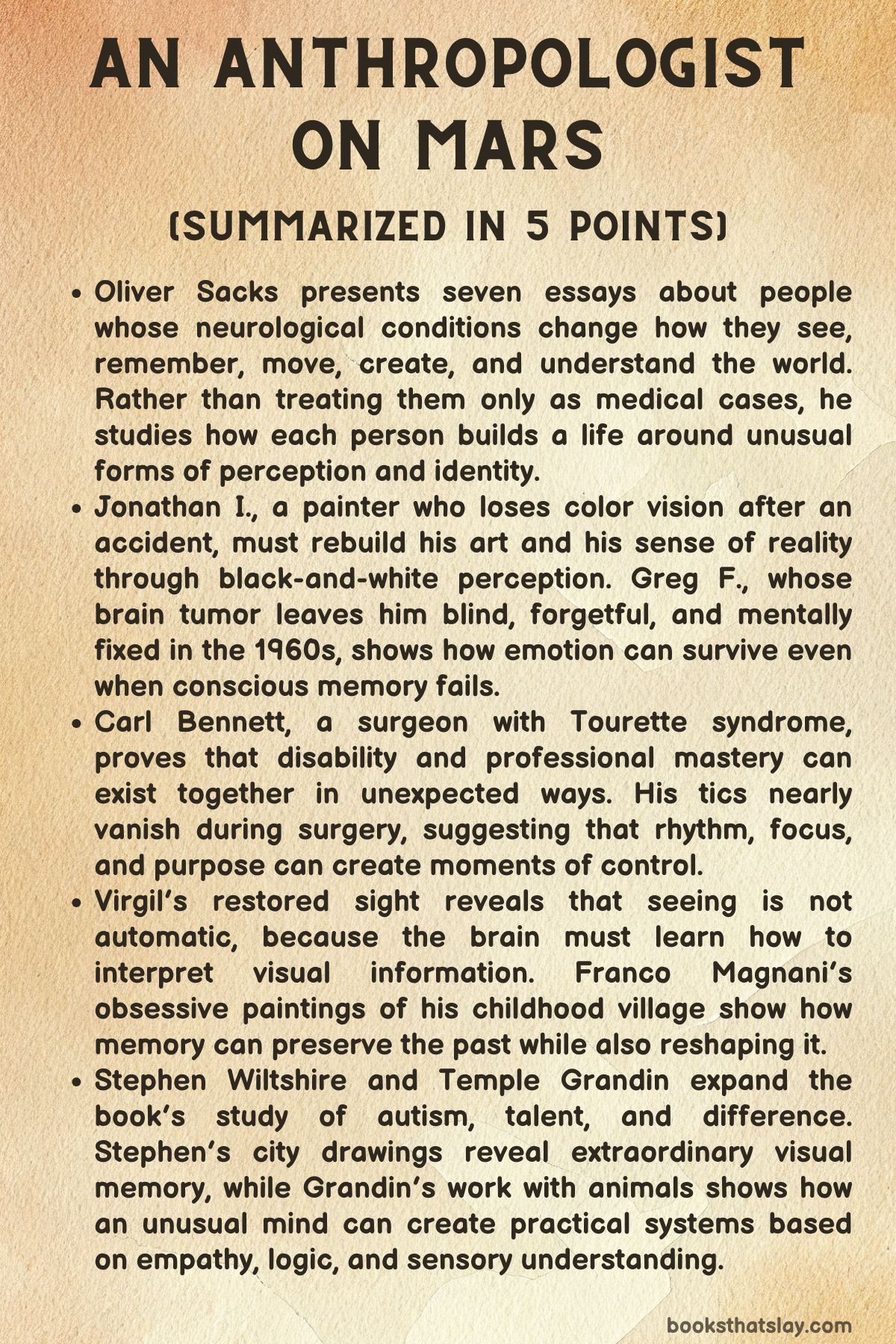
An Anthropologist on Mars by Oliver Sacks is a collection of seven essays about people whose neurological conditions reshape the way they experience reality. Sacks writes as both doctor and observer, moving beyond hospitals into homes, workplaces, studios, and public spaces to understand his subjects as whole people rather than as medical cases.
The book studies color blindness, memory loss, Tourette syndrome, restored sight, artistic obsession, autistic talent, and animal-science genius. Its central idea is that the brain can adapt in surprising ways, and that illness or difference can alter identity without erasing human dignity.
Summary
The Color-Blind Painter
The book begins with an artist who loses his ability to see color after a car accident. Before the accident, color had been central to his life, work, memory, and sense of beauty.
Afterward, the world becomes strange and unpleasant to him, not simply gray, but visually wrong in a way ordinary language cannot describe. He can remember what colors should be, but he cannot experience them.
Food, faces, streets, paintings, and even his own reflection become disturbing.
Sacks and an ophthalmologist study his condition and conclude that the problem lies not in his eyes but in the brain’s processing of color. For a painter, this loss is devastating.
His early attempts to continue using color fail because the results make no visual sense to him or to others. Gradually, however, he turns toward black-and-white art.
At first, his work reflects despair and anger, but over time it becomes more controlled, inventive, and powerful.
The artist’s life changes further as he begins to prefer the night, where his new visual strengths give him advantages over people with ordinary sight. He develops a fresh artistic order and eventually refuses a possible attempt to retrain his color vision.
His case shows one of the book’s major ideas: the brain may lose one form of reality but create another.
The Man Suspended in the Sixties
Another essay follows Greg, a young man who joins the Hare Krishna movement during the late 1960s. While living in a temple, he slowly loses his sight, but the people around him interpret his condition as spiritual development rather than illness.
When his parents finally visit, they find him blind, physically changed, passive, and mentally detached from ordinary time.
Doctors discover a tumor that has damaged parts of his brain connected to vision, memory, hormones, and motivation. Although the tumor is removed, the damage cannot be undone.
Greg lives in a chronic-care hospital, where Sacks meets him. He remembers the culture and music of the 1960s vividly, especially the Grateful Dead, but he cannot form lasting new memories.
He also does not recognize that he is blind.
Greg often seems empty when left alone, yet becomes witty and lively when someone speaks to him. His joking manner is linked to frontal-lobe damage.
At first, Sacks wonders whether Greg still has a deeper emotional life, because his responses are so brief and his memory so fragile. Over the years, however, signs of feeling appear.
When his father dies, Greg forgets the news almost immediately, yet his mood and behavior change afterward. Sacks sees this as proof that grief can exist beneath damaged memory.
Sacks later takes Greg to a Grateful Dead concert. Greg responds joyfully to older songs from his remembered past, but the next day he cannot retain the new event.
The essay presents a man whose identity survives in fragments: music, old memories, humor, and hidden emotion.
The Surgeon with Tourette Syndrome
Sacks then studies Carl Bennett, a surgeon with Tourette syndrome. Bennett has tics, compulsions, and sudden gestures, including touching objects symmetrically and making repeated movements.
These symptoms might seem incompatible with surgery, a profession that demands steadiness and precision. Yet Bennett has built a successful medical career.
Sacks visits him in British Columbia and watches how Tourette syndrome shapes his daily life. Bennett’s tics appear strongly during ordinary pauses, such as waiting at a red light, but fade when he is absorbed in demanding tasks.
In the hospital, colleagues and patients know his condition, and many trust him deeply. His directness, courage, and skill make him a respected physician.
The most striking moment comes when Sacks observes Bennett performing surgery. Before the operation, his tics intensify.
Once the procedure begins, they vanish. The rhythm, attention, and flow of surgery allow Bennett to act with complete control.
For him, operating is not a place where Tourette syndrome threatens his identity; it is where he feels most fully himself.
The essay complicates simple ideas of illness. Bennett’s syndrome is not separate from him, but neither does it define all of him.
He has learned to live with it, resist it, use discipline against it, and find activities where his mind and body work in harmony.
The Man Who Regained Sight
Virgil, blind since childhood, receives surgery to remove cataracts in adulthood. His fiancée hopes that restored sight will open the world to him.
At first, the surgery seems miraculous because he can detect color, movement, and light. Yet Sacks soon discovers that seeing is not the same as understanding what is seen.
Because Virgil has lived almost his whole life as a blind person, his brain has not learned how to organize visual information. Faces, rooms, objects, distance, shadows, and printed words confuse him.
He can identify some details, but he struggles to recognize wholes. A grocery store overwhelms him.
Stairs become frightening. He loses the confidence he once had when moving by touch.
Sacks observes that Virgil is trapped between blindness and sight. His old skills are disrupted, while his new vision never becomes reliable enough to replace them.
His fiancée and family want him to become a sighted man, but the transition demands an enormous change in identity. He often closes his eyes to work as a massage therapist because touch gives him certainty that vision cannot.
Virgil’s health later declines after serious illness, and his remaining vision worsens. What looked like a gift becomes a burden.
Sacks suggests that losing sight again may bring Virgil relief, because it returns him to a world he knows how to inhabit. The essay argues that perception is learned, embodied, and tied to selfhood.
The Painter of a Lost Village
Franco Magnani, an Italian immigrant living in San Francisco, becomes obsessed with painting Pontito, the Tuscan village of his childhood. After a mysterious illness, he begins having intense dreams and waking visions of the village, which he has not visited for decades.
Though he has little formal training, he paints Pontito again and again with remarkable detail.
Sacks investigates whether Magnani’s art comes from extraordinary memory, neurological disturbance, emotional longing, or all of these together. Magnani’s paintings are often accurate, but they also enlarge and transform the village.
They preserve not simply a place but a childhood world shaped by war, loss, family, and nostalgia.
Magnani’s relationship to Pontito is conflicted. He longs to return, yet fears that the real village will damage the image in his mind.
When he finally goes back, he is welcomed, but the visit unsettles him. The present-day village both matches and contradicts his memories.
For a time, his inner image is disturbed, and he cannot paint.
Later, he resumes his work, but with a changed awareness. He knows his Pontito is partly real and partly reconstructed.
Sacks presents Magnani’s art as an attempt to protect memory from time, while also showing that memory is never a simple copy of the past.
The Autistic Artist
Sacks next writes about Stephen Wiltshire, an autistic artist with an extraordinary ability to draw buildings and cityscapes from memory. As a child, Stephen has delayed development, limited speech, social difficulty, and intense focus on visual forms.
His teacher recognizes his unusual drawing talent and encourages it, helping him gain attention through exhibitions, documentaries, and published collections.
Stephen can glance at a building and reproduce it with remarkable accuracy and energy. Yet his abilities raise difficult questions for Sacks.
Is this art the expression of a full inner self, or is it a special visual gift operating apart from ordinary emotional development? Sacks is wary of reducing Stephen to either disability or talent.
As Stephen travels to New York, Moscow, San Francisco, and the American Southwest, he records buildings and landscapes with astonishing skill. He can imitate voices and mannerisms, and later develops musical ability.
At moments, music seems to free him from some of his autistic withdrawal. Still, Sacks often feels unable to reach Stephen’s inner world.
The essay explores savant talent, memory, autism, and creativity. Stephen’s gifts are real, but so are his limitations.
His art allows him to engage with the world in a way that speech and social exchange often do not.
The Animal Scientist
The final essay centers on Temple Grandin, an autistic scientist, writer, and designer of livestock facilities. Grandin thinks visually rather than verbally and uses this strength to understand animals and improve the design of farms and slaughterhouses.
She tells Sacks that she feels like an observer studying human behavior from a foreign planet, which gives the book its title.
Grandin’s childhood was marked by sensory overload, fear of touch, delayed speech, and social confusion. With education and effort, she learns to function in the world, though many social cues remain difficult for her.
She explains that she understands animals partly because their fear, sensory responses, and need for firm pressure resemble aspects of her own experience.
Sacks visits her workplace, home, farms, and a slaughterhouse she designed. He sees her “squeeze machine,” which gives calming pressure without the unpredictability of human touch.
He also sees how carefully she designs systems to reduce animal fear before death. Though Sacks is disturbed by the slaughterhouse, he recognizes Grandin’s moral seriousness.
Grandin cannot easily understand romance, social play, or emotional subtlety, but she has strong convictions, deep commitments, and a clear sense of purpose. She would not choose to give up her autism, because it is inseparable from her mind and achievements.
Her essay closes the book by showing neurological difference not as a simple defect, but as another form of being human.
Key People
Oliver Sacks
Oliver Sacks functions as both observer and participant in An Anthropologist on Mars. He is not a detached clinician who reduces people to diagnoses; instead, he tries to understand how each person lives inside a changed or unusual neurological reality.
His method is personal, patient, and deeply attentive. He visits homes, hospitals, workplaces, studios, farms, concerts, and public spaces because he believes that a person cannot be fully understood through tests alone.
Sacks is also intellectually restless. He connects each case to medicine, philosophy, art, psychology, and history, yet he repeatedly checks his own assumptions when the people he studies surprise him.
His greatest strength as a narrator is his willingness to see neurological difference as part of identity rather than only as damage. At the same time, he is not naïve about suffering.
He recognizes pain, loss, confusion, and disability, but he also notices adaptation, talent, dignity, and new forms of selfhood.
Jonathan I.
Jonathan I. is an artist whose life is transformed after a car accident leaves him unable to perceive color. His character is shaped by loss first, because color was not a decorative part of his life; it was central to his art, memory, emotional experience, and daily reality.
After the accident, the world becomes visually alien to him. He does not merely see in gray; he experiences a world stripped of qualities that once gave it meaning.
Food looks repellent, faces become strange, and his own paintings no longer communicate what he once intended. His early grief shows how deeply perception is tied to identity.
Yet Jonathan is also one of the clearest examples of adaptation in the book. He gradually turns away from failed attempts to recover his former art and begins creating powerful black-and-white work.
Over time, his condition becomes not only something he survives but something he uses. By the end of his account, he has built a new visual order and even refuses a possible intervention that might disturb it.
Jonathan’s development shows that recovery is not always a return to the past; sometimes it is the creation of a new way to live.
Greg F.
Greg F. is one of the most tragic figures in the book because his damage affects memory, sight, motivation, and self-awareness. Once a young man caught up in the counterculture of the 1960s, he becomes mentally fixed in that era after a brain tumor destroys important regions of his brain.
His blindness is made more haunting by the fact that he does not understand that he is blind. He cannot form lasting new memories, and his sense of time is severely broken.
On the surface, Greg often appears passive, cheerful, and oddly humorous, but Sacks gradually discovers that this surface does not tell the whole truth. Greg’s love of music, especially songs from his youth, becomes one of the few strong links to his earlier self.
His response to his father’s death is especially revealing: although he forgets the news almost immediately, his mood changes afterward. This suggests that emotional knowledge can survive even when conscious memory fails.
Greg’s character raises painful questions about what remains of a person when memory, ambition, and self-knowledge are damaged. He is diminished, but he is not empty.
Carl Bennett
Carl Bennett is a surgeon with Tourette syndrome, and his character challenges easy assumptions about control, skill, and disability. In ordinary settings, his tics and compulsions are visible and sometimes dramatic.
He touches objects repeatedly, responds physically to spatial stimuli, and must manage sudden urges that interrupt everyday actions. Yet when he enters the operating room, his symptoms recede.
Surgery gives him a focused rhythm in which his body and mind become steady. Bennett’s profession is important to his characterization because it seems, at first, to be the least likely career for someone with his condition.
His success shows not that Tourette syndrome disappears, but that identity is larger than diagnosis. Bennett has built a life through discipline, courage, and professional excellence.
He is also emotionally complex. Sacks senses buried anxiety and strain beneath his capable exterior.
Bennett’s warmth with patients, his honesty about his condition, and his confidence in high-pressure situations make him one of the book’s strongest examples of a person who has not defeated illness in a simple way, but has made room for it inside a meaningful life.
Virgil
Virgil is a man who regains partial sight after decades of blindness, only to find that vision can be confusing, frightening, and destabilizing. His story is powerful because it overturns the assumption that restored sight automatically brings freedom.
Virgil has lived as a blind person for most of his life, and his skills, confidence, work, and identity are built around touch, sound, memory, and bodily knowledge. When surgery gives him visual input, his brain cannot easily organize it.
He sees colors, shapes, and movement, but he cannot reliably understand faces, objects, space, or depth. This makes him less confident than before.
His character is marked by vulnerability and displacement; he belongs neither fully to blindness nor to sight. The pressure from others, especially the hope that he will become a fully sighted man, adds emotional weight to his struggle.
Virgil’s decline after illness makes his story even sadder. His eventual return toward blindness is presented not simply as failure, but as a return to a world he knows how to navigate.
He shows that perception is not just biological; it is learned through a lifetime.
Amy
Amy, Virgil’s fiancée and later wife, is driven by hope, love, and a strong desire to change Virgil’s life. She sees the possibility of sight as a chance for him to become more independent and more fully engaged with the world.
Her intentions are caring, but her role is complicated because she sometimes imagines restored vision as a simpler blessing than it proves to be. Amy’s optimism places pressure on Virgil, who must not only learn to see but also meet the expectations of someone who wants transformation for him.
She records his early progress with excitement and continues to believe in the value of the surgery even when Sacks and other doctors see how difficult his adjustment has become. Amy represents the emotional force of family and romantic attachment in medical decisions.
She is not portrayed as cruel or foolish; rather, she shows how love can be mixed with projection. Her hopes for Virgil are sincere, but they sometimes conflict with the reality of his lived experience.
Franco Magnani
Franco Magnani is defined by memory, longing, and artistic compulsion. After a mysterious illness, he begins to experience vivid images of the Italian village where he spent his childhood.
These images become so forceful that he feels compelled to paint them repeatedly. His art is not simply nostalgic decoration; it is an attempt to preserve a vanished world.
Pontito, for him, becomes a place of memory, family, loss, war, and emotional origin. Magnani’s character is divided between present life in San Francisco and an inner life fixed on the village of his childhood.
This division gives his art power but also costs him peace. He wants to return to Pontito, yet fears that the real village will damage the image he carries inside him.
When he finally does return, the experience unsettles him because reality both confirms and disrupts memory. Magnani shows how memory can become creative, but also how it can imprison a person.
His paintings are acts of devotion, but they are also attempts to control time, loss, and change.
Stephen Wiltshire
Stephen Wiltshire is an autistic artist with an extraordinary ability to draw buildings and cityscapes from memory. His character is shaped by a striking contrast between artistic brilliance and social limitation.
As a child, he has difficulty speaking, relating to others, and understanding ordinary social life. Yet his visual memory is astonishing.
He can look briefly at buildings and reproduce them with energy, precision, and style. Sacks is fascinated by Stephen but also unsettled by the question of what kind of inner life lies behind the drawings.
Stephen’s art is not mechanical, but his emotional responses are often hard to read. He can imitate voices and gestures, respond intensely to places, and later show musical gifts, yet he remains difficult for others to fully understand.
Stephen’s development depends greatly on people who support and encourage him, especially teachers and advocates who recognize his gift without ignoring his disabilities. His character resists a simple label.
He is neither only a genius nor only a disabled child. He is a person whose contact with the world comes most powerfully through visual form.
Chris Marris
Chris Marris is important because he sees Stephen’s talent early and helps create the conditions in which it can grow. As a teacher, Marris does more than praise Stephen’s drawings; he protects them, encourages them, and uses them as a way to build communication.
He understands that Stephen’s art is not a hobby but a vital channel of expression. Marris also recognizes Stephen’s limitations, sometimes more strongly than Sacks does.
This creates a useful tension between the teacher’s practical knowledge and the neurologist’s wonder. Marris knows the daily reality of Stephen’s autism, while Sacks is drawn to the mystery and beauty of his talent.
Through Marris, the book shows how crucial patient, attentive education can be for children whose abilities do not appear in conventional forms. He is not the center of the essay, but without him Stephen’s public career and artistic confidence might never have developed in the same way.
Margaret Hewson
Margaret Hewson plays a major role in Stephen’s later artistic life. As his literary agent and supporter, she encourages his travels, commissions, and publications.
She helps open the world to him by taking him to cities and landscapes that stimulate his drawing. Her importance lies not only in professional management but in emotional and practical care.
Stephen often needs others to structure opportunities around him, and Margaret becomes one of the people who allows his talent to remain active. She also tends to see more emotional and spiritual depth in Stephen’s responses than Sacks sometimes feels able to confirm.
This difference matters because it shows how difficult it is to interpret the inner life of someone whose expression is unusual. Margaret’s belief in Stephen helps protect him from being reduced to test results or clinical categories.
She treats his talent as meaningful and worth sharing.
Temple Grandin
Temple Grandin is the final and most self-aware subject in An Anthropologist on Mars. She is autistic, but unlike some other figures in the book, she can explain much of her own experience with unusual clarity.
She thinks visually, struggles with ordinary social intuition, and often feels like an outsider studying human behavior. Her work with animals grows directly from this difference.
Because she understands fear, sensory overload, pressure, and concrete visual experience, she is able to design livestock systems that reduce animal stress. Grandin’s character is practical, disciplined, morally serious, and intellectually original.
She does not sentimentalize herself or animals, but she cares deeply about reducing suffering. Her squeeze machine reveals both her difficulty with human touch and her need for calming pressure, making her one of the book’s clearest examples of adaptation through invention.
Grandin also complicates narrow ideas of emotion. She may not experience romance, social ease, or symbolic language in typical ways, but she has strong ethics, ambition, tenderness toward animals, and a desire for her ideas to outlive her.
Themes
Neurological Difference and the Shape of Identity
Identity in An Anthropologist on Mars is never treated as fixed or simple. The people Sacks studies are changed by injury, illness, autism, Tourette syndrome, memory loss, blindness, or unusual perception, but they are not reduced to those conditions.
Jonathan loses color and becomes a different kind of artist. Greg loses memory and self-awareness, yet traces of grief and joy remain.
Bennett lives with tics but becomes most controlled while performing surgery. Virgil gains sight but loses confidence because his established blind identity is disrupted.
These cases suggest that the self is not a single untouched core hidden behind the brain. Instead, it is shaped through perception, memory, body, habit, work, relationships, and environment.
When one part of the nervous system changes, the person’s whole way of being may change with it. Sacks avoids the easy idea that medicine’s only goal is to restore a former self.
Some people do want restoration, but others adapt into a new order. The theme becomes especially complex because neurological change can bring suffering and ability at the same time.
Difference may limit a person, but it may also create new forms of attention, creativity, discipline, or understanding.
Adaptation as Survival and Creation
The people in the book survive not only by enduring their conditions but by reorganizing their lives around them. Adaptation appears in many forms: artistic, bodily, emotional, professional, and social.
Jonathan’s shift to black-and-white painting is one of the clearest examples. He does not recover color, but he eventually builds a new artistic language from what remains available to him.
Bennett adapts by finding situations of rhythm and concentration where his Tourette syndrome loses force. Temple Grandin adapts by turning her visual thinking and sensory sensitivities into tools for designing humane livestock systems.
Even Virgil, whose story is more painful, reveals the importance of adaptation because his blindness had already given him a working relationship with the world before surgery unsettled it. The book treats adaptation as more than compensation.
It is a creative act through which people rebuild order after disruption. At the same time, adaptation is not romanticized.
It can be exhausting, incomplete, and dependent on support from others. Some adaptations come at a cost, such as Magnani’s life being dominated by memory or Greg’s existence being narrowed by brain damage.
Still, the repeated pattern is clear: human beings search for usable forms of life even when ordinary routes are blocked.
Perception and Reality
Reality in the book depends heavily on the brain’s ability to organize sensation. Sacks repeatedly shows that seeing, remembering, touching, hearing, and recognizing are not passive acts.
They require interpretation. Jonathan’s eyes can still detect light, but the loss of color processing changes the entire emotional and visual world.
Virgil’s surgery proves that sight is not merely the opening of the eyes. He receives visual information, yet his brain cannot easily turn it into meaningful space, objects, faces, or movement.
Magnani’s paintings show another side of perception: memory can be so vivid that an absent village becomes more powerful than the present. Stephen Wiltshire’s city drawings suggest a visual reality of extraordinary precision, while Temple Grandin’s thinking shows a world structured through concrete images rather than abstract language.
These cases challenge the assumption that everyone inhabits the same reality in the same way. The physical world may be shared, but each person’s nervous system selects, arranges, and gives meaning to it differently.
Sacks uses these differences to make ordinary perception seem less ordinary. What most people call reality is partly a neurological achievement, built through development, memory, and habit.
The Limits and Responsibilities of Medical Observation
Sacks’s role as physician raises a central ethical question: how should one study another person without reducing that person to a case? The book repeatedly shows the limits of clinical labels.
Terms such as autism, Tourette syndrome, achromatopsia, amnesia, or agnosia are useful, but they cannot fully explain a life. Sacks therefore moves outside the clinic.
He watches Bennett operate, Grandin work with cattle, Stephen draw cities, Virgil move through his home, and Magnani return to the village of his memory. These settings reveal truths that tests alone could not show.
The responsibility of observation, then, is to combine science with humility. A doctor must ask what is damaged, but also what is preserved, what has changed, what the person values, and how that person understands their own condition.
Sacks sometimes admits uncertainty, especially when trying to interpret Stephen’s emotions or Grandin’s inner life. That uncertainty is important because it prevents false authority.
The theme also warns against outsiders imposing their wishes on patients. Virgil’s story shows how medical success can become personal distress if the patient’s lived reality is misunderstood.
Good observation requires knowledge, but also patience, imagination, and respect.