Anansi Boys Summary, Characters and Themes
Anansi Boys is a comic fantasy novel by Neil Gaiman about family, identity, stories, and the strange inheritance people receive from their parents. At its center is Fat Charlie Nancy, an ordinary, anxious man whose life changes after the death of his outrageous father, Mr. Nancy.
Charlie soon learns that his father was the trickster god Anansi, and that he has a brother named Spider who inherited the family’s supernatural gifts. What begins as an embarrassing family problem grows into a conflict involving gods, ghosts, old bargains, buried secrets, and Charlie’s search for his own voice. It’s the 2nd book of the American Gods series, the first one being the book American Gods itself.
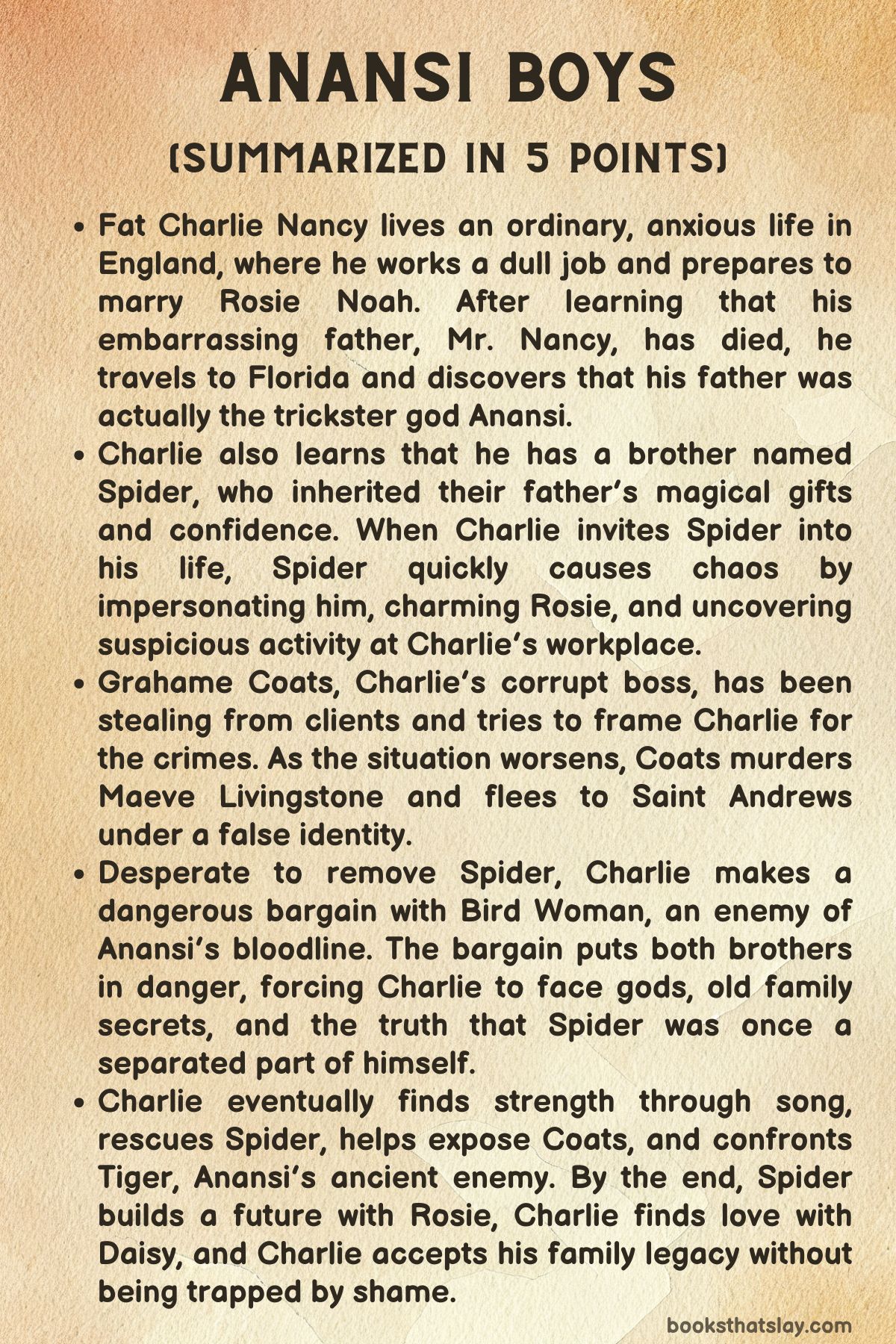
Summary
Fat Charlie Nancy has spent most of his life trying to escape the shadow of his father, Mr. Nancy. His father was charming, loud, unpredictable, and endlessly embarrassing.
He had a talent for giving names that stuck, and “Fat Charlie” became one of the worst of them, even though Charlie was no longer fat. Charlie lives in England, works unhappily for the Grahame Coats Agency, and is engaged to Rosie Noah, a kind woman whose controlling mother does not approve of him.
When Rosie asks him to invite his father to their wedding, Charlie reluctantly contacts an old family friend in Florida, Mrs. Higgler. Instead of helping him reconnect, she tells him that Mr. Nancy has died.
Charlie travels to Florida for the funeral, where confusion immediately follows him. He first joins the wrong funeral party, gives a speech for a stranger, and then has to be redirected to his father’s grave.
After the service, Mrs. Higgler and her friends bring him into the world his father left behind. They reveal that Mr. Nancy was not simply an eccentric old man, but Anansi, a trickster god linked with spiders, songs, stories, and mischief.
Charlie also learns that he has a brother named Spider, who received the magical gifts Charlie never knew he lacked. Mrs. Higgler tells Charlie that if he wants to meet Spider, he should speak to a spider.
Back in England, Charlie does exactly that. After Rosie finds a spider in his flat, Charlie carries it outside and jokingly asks it to invite his brother.
Soon Spider arrives at Charlie’s door. He is confident, stylish, magical, and everything Charlie thinks he is not.
Spider learns of their father’s death and begins to enter Charlie’s life with careless enthusiasm. At first Charlie is fascinated, but Spider’s presence quickly creates trouble.
He takes Charlie out drinking, charms everyone he meets, and then begins impersonating Charlie. He visits Charlie’s office, charms Rosie, and discovers that Charlie’s employer, Grahame Coats, has been hiding money through criminal financial schemes.
Spider’s interference causes Charlie’s life to fall apart. Rosie, believing Spider is Charlie, becomes more attracted to him than she has ever been to her fiancé.
Charlie feels humiliated and betrayed when he sees them kissing. At the same time, Grahame Coats recognizes the threat Spider poses and begins altering records to frame Charlie for the crimes.
Detective Constable Daisy Day, whom Charlie met by accident after a drunken night, becomes involved in the investigation. Grahame Coats tries to guide her suspicion toward Charlie, while preparing to flee with stolen money.
Desperate to get Spider out of his life, Charlie returns to Florida and asks Mrs. Higgler and the other women for help. They send him through a ritual into the realm of gods.
There he meets powerful beings, many of whom still resent Anansi for old tricks. Charlie finally reaches Bird Woman, an enemy of Anansi’s line.
She agrees to help him, but demands “Anansi’s bloodline” in exchange. Charlie accepts, thinking mainly of Spider, and receives one of her feathers as part of the bargain.
He does not fully understand that the bargain also endangers himself.
Bird Woman soon acts against Spider. Disguised as Rosie, she confronts him, and birds begin attacking him.
Charlie returns to England and finds that the situation has worsened. Rosie learns that Spider has deceived her and breaks with both brothers.
Charlie is arrested after Grahame Coats successfully frames him. Spider, now feeling real guilt, helps Charlie escape his cell briefly through magic.
The brothers travel across different places while pursued by birds, and Charlie admits that he made a bargain with Bird Woman. Spider realizes they are both in danger because both are Anansi’s bloodline.
Meanwhile, Grahame Coats becomes more dangerous. Maeve Livingstone, a client who has been trying to recover payments owed to her late husband, confronts him about missing money.
Coats pretends to negotiate, then murders her in his secret vault and escapes to the island of Saint Andrews under a false identity. Maeve becomes a ghost, unable to move on because she wants justice.
Her path eventually crosses Anansi himself, who helps her understand what has happened and points her toward the unfinished business that keeps her in the world.
Charlie is released from immediate suspicion after Daisy begins to see that Grahame Coats is the real criminal. Charlie tells her about the secret vault, and they discover Maeve’s body.
Daisy and Charlie grow closer, and Charlie begins to show more courage than he ever expected from himself. Spider, meanwhile, is captured and delivered into the hands of Tiger, an ancient enemy of Anansi.
Tiger once owned the world’s stories, and his stories were cruel, dark, and violent. Anansi changed the world by winning stories away from Tiger, making room for wit, laughter, and survival.
Tiger now wants revenge.
Charlie goes to Saint Andrews after learning that Mrs. Higgler has taken Bird Woman’s feather there. By coincidence and fate, many of the main characters are drawn to the same island.
Daisy arrives while following Grahame Coats. Rosie and her mother are also there on a holiday cruise and meet Coats, who recognizes the danger of being exposed.
He traps Rosie and Mrs. Noah in a storage room at his house. At the same time, Charlie searches for Mrs. Higgler and tries to understand how to save Spider.
At a hotel restaurant, Charlie and Daisy encounter Grahame Coats, who threatens them with a gun and plans to take them to his house. For the first time, Charlie does not collapse under fear.
He draws attention to himself by agreeing to sing. Performing “Under the Boardwalk,” he discovers the power of his own voice.
The performance helps protect Daisy from Coats and marks a turning point in Charlie’s life. He is no longer merely the embarrassed son of Anansi or the weaker brother of Spider.
He is Charlie Nancy, and song becomes his strength.
Charlie retrieves Bird Woman’s feather and returns to the realm of gods. He meets Anansi, who helps him understand his family and his own nature.
Charlie learns that he and Spider were once connected more deeply than ordinary brothers. As children, after Charlie broke one of Mrs. Dunwiddy’s ornaments, she magically separated his troublesome, mischievous side from him.
Because of Anansi’s blood, that separated part became Spider. Charlie and Spider are therefore brothers, but also divided parts of one original self.
Charlie searches the other world for Spider. On the way, he faces threats and begins using intelligence, confidence, and song to survive.
He confronts Bird Woman and trades back her feather for Spider’s tongue, which she had torn out. Charlie reaches Spider and restores his speech.
The brothers return together, stronger now that they understand each other better.
At Grahame Coats’s house, Rosie and Mrs. Noah manage to fight back. Coats is injured, and Tiger enters him, turning him into a vessel for his rage.
Maeve’s ghost arrives and confronts Coats, stripping away his confidence and helping bring his crimes to light. Daisy and the police arrive, and Rosie and her mother are saved.
Maeve, having seen justice begin, is finally able to join her dead husband.
The final conflict moves beyond the human world. Mrs. Noah is badly hurt, and Charlie decides to help save her.
He and Spider return to the realm of gods, where Charlie sings before the assembled powers. His song celebrates his family, his world, and his own identity.
When Tiger tries to dominate him with fear, Charlie uses humor and song to reduce Tiger’s power. The gods laugh at Tiger, and Spider seals him away.
Charlie also sings a long life for Mrs. Noah, allowing her to recover.
By the end, the brothers have both changed. Spider becomes more responsible and builds a life with Rosie.
Charlie finds love with Daisy and becomes a successful singer. Grahame Coats, reduced to the form of a small animal, is trapped with Tiger and repeatedly killed and restored as punishment.
Anansi rests in his grave, still somehow present in the world of stories. Charlie, once ashamed of his father and afraid of attention, accepts his inheritance in his own way.
Anansi Boys ends with him walking on a beach with his son, looking for mermaids, finally able to carry both wonder and family history without fear.
Characters
Fat Charlie Nancy
Fat Charlie Nancy begins as a man shaped by embarrassment. His nickname is one of the clearest signs of his father’s power over him: even after he is no longer fat, the name continues to define how he sees himself.
He is cautious, socially awkward, afraid of public attention, and deeply resentful of the humiliations his father caused throughout his childhood. His engagement to Rosie and his dull job at the Grahame Coats Agency suggest that he has built an ordinary life by keeping risk and disorder away.
Yet this ordinary life is not satisfying. He is not truly confident at work, not fully secure in love, and not at peace with his family history.
His development depends on being forced to confront everything he has avoided. Spider’s arrival exposes Charlie’s suppressed desires: charm, boldness, pleasure, freedom, and mischief.
At first, Spider seems like an enemy because he disrupts Charlie’s life, takes over his space, and threatens his relationship with Rosie. Gradually, Charlie learns that Spider is not just a separate brother but also a missing part of himself.
This revelation changes Charlie’s self-understanding. He is not simply weak or ordinary; he has been divided from a part of his own nature.
Charlie’s growth becomes clearest when he discovers his singing voice. Singing represents confidence, identity, magic, and inheritance.
Unlike Spider, Charlie does not become powerful through casual charm or manipulation. His power comes when he accepts himself without shame.
By the end of Anansi Boys, Charlie has moved from hiding in embarrassment to standing before gods and using song as an expression of courage. He becomes a fuller person by accepting both his human vulnerability and his divine inheritance.
Spider
Spider is Charlie’s opposite in almost every visible way. He is stylish, confident, seductive, magical, and careless.
Where Charlie worries about consequences, Spider assumes the world will bend around him. He can charm people, alter reality, and move through life as if rules are minor inconveniences.
At first, he appears selfish and irresponsible, especially when he impersonates Charlie, interferes with his job, and begins a relationship with Rosie under false pretenses. His charisma makes him attractive, but his lack of moral discipline makes him dangerous.
Yet Spider is not merely a troublemaker. His carelessness comes partly from never having had to live as an ordinary person.
He has power but little emotional maturity. His first real growth begins when he experiences guilt.
His feelings for Rosie also complicate him. He could force love through magic, but he understands that such love would be false.
This awareness marks an important change: Spider begins to recognize the difference between possession and genuine connection.
Spider’s captivity under Bird Woman and Tiger strips away his usual ease. Without his normal freedom and speech, he becomes vulnerable.
This vulnerability allows the story to test whether he is more than charm. He survives through intelligence, persistence, and the help of others, especially Charlie.
By the end, Spider learns responsibility without losing his playful energy. His relationship with Charlie becomes less competitive and more fraternal.
He remains magical and mischievous, but he is no longer only a disruptive force; he becomes someone capable of love, loyalty, and change.
Mr. Nancy / Anansi
Mr. Nancy, who is also Anansi, dominates the story even after death. In Charlie’s memory, he is embarrassing, theatrical, irresponsible, and impossible to control.
He turns serious moments into performances and seems to care more about jokes, music, and style than about his son’s dignity. Charlie’s resentment toward him is understandable because Mr. Nancy’s behavior repeatedly made him feel small.
Yet the later revelations show that Mr. Nancy’s identity is larger than Charlie’s childhood grievances. He is a trickster god, a figure of stories, songs, survival, and transformation.
Anansi’s trickster nature is morally complicated. He is not presented as purely good.
He lies, cheats, humiliates, seduces, and outsmarts others for his own amusement or advantage. At the same time, his tricks have a liberating function.
Against Tiger’s brutal world, Anansi represents wit as a form of resistance. His stories give weaker beings a way to survive stronger ones.
He changes the tone of existence from violence alone to cleverness, humor, and possibility.
As a father, Anansi is both damaging and strangely generous. He wounds Charlie through ridicule, but he also leaves behind an inheritance that Charlie must learn to claim.
His presence in the realm of gods suggests that death has not erased him from the story’s moral and imaginative structure. He remains a guide, a source of conflict, and a symbol of how family legacy can be both burden and gift.
Rosie Noah
Rosie Noah is introduced as Charlie’s fiancée, but her role is more complex than simply being the woman between two brothers. She is kind, patient, and morally sincere, but she is also sheltered by her mother’s influence and uncertain about what she truly wants.
Her decision not to sleep with Charlie before marriage reflects her values, yet her attraction to Spider reveals that her relationship with Charlie lacks passion and emotional certainty. She is not cruel for realizing this; instead, she is forced to confront a truth she had avoided.
Rosie’s confusion after Spider’s deception is important because it places her in a painful moral position. She has been emotionally and physically misled, and her anger is justified.
Her rejection of both brothers at that moment shows self-respect. She refuses to let either Charlie’s passivity or Spider’s charm determine her future.
Her later feelings for Spider are not simple forgiveness; they develop after she knows the truth and after Spider begins to change.
Rosie also grows under pressure. When Grahame Coats traps her and her mother, she must face danger directly.
Her fear is real, but she does not collapse into helplessness. She thinks, acts, and survives.
By the end, she chooses Spider with greater awareness than before. Her character arc is about learning to separate politeness, duty, desire, and self-protection.
Daisy Day
Daisy Day brings practicality and moral clarity into the story. She first appears in Charlie’s life through comic confusion, but she soon becomes one of the most grounded characters.
As a detective, she is trained to examine evidence, question appearances, and resist easy conclusions. This makes her especially important in a story filled with illusion, disguise, divine interference, and mistaken identity.
Unlike many characters, Daisy does not accept the most convenient explanation simply because it is offered to her.
Her investigation into Grahame Coats reveals her intelligence and independence. Although Coats tries to manipulate the police narrative and frame Charlie, Daisy senses that the case does not fit neatly.
Her willingness to reconsider Charlie’s guilt allows the truth to surface. She is not dazzled by magical charm in the way others often are, but she is also not closed-minded.
She gradually adjusts to the strange reality around Charlie without losing her practical nature.
Daisy’s relationship with Charlie works because she sees him at moments when he is awkward, frightened, and confused, but also when he begins to act bravely. She does not need him to be Spider-like.
Her presence supports Charlie’s growth into his own version of confidence. By the end, Daisy represents a future based on honesty rather than performance.
Grahame Coats
Grahame Coats is the story’s human villain, and his evil is rooted in greed, vanity, cowardice, and predation. On the surface, he is a professional man running a literary agency, but beneath that respectable exterior he has built a long-running system of theft.
He steals from clients, hides money, manipulates records, and protects himself by blaming others. His attempt to frame Charlie shows how easily he sacrifices the powerless when his own comfort is threatened.
What makes Coats especially disturbing is the gap between his polished public behavior and his private cruelty. He speaks smoothly, plans carefully, and hides behind bureaucracy and legal complexity.
When Maeve confronts him, he first tries negotiation and intimidation, then resorts to murder. His violence is not sudden madness but an extension of his selfishness.
Once he feels cornered, other people become obstacles to remove.
Coats’s connection with Tiger deepens his symbolic role. He is already predatory before Tiger enters him, and Tiger’s presence gives mythic shape to what is already inside him.
Coats belongs to a world of appetite without conscience. His final punishment, trapped in a small animal form with Tiger, is fitting because it reduces his grand self-image to helpless repetition.
He becomes prey in the kind of brutal world he served.
Maeve Livingstone
Maeve Livingstone begins as a grieving widow seeking financial answers, but she becomes one of the story’s strongest figures of justice. Her concern over her late husband’s missing earnings is not merely about money.
It is about dignity, memory, and the refusal to let a loved one’s work be exploited. Her confrontation with Grahame Coats shows courage, especially because she faces a man who controls the records and understands how to bury wrongdoing beneath procedure.
Her murder transforms her role rather than ending it. As a ghost, Maeve is confused, angry, and unable to accept the rules of death.
Her conversations with Morris and her inability to leave show that justice matters more to her than peace. She is not ready to move on while Coats remains unexposed.
This gives her ghostly presence emotional force: she is not simply haunting the world, but insisting that truth be recognized.
Maeve’s final confrontation with Coats is powerful because she attacks his self-image. She sees through his sophistication and names his smallness.
In doing so, she helps break the authority he has tried to maintain over others. Her eventual reunion with Morris gives her arc closure, but it is earned only after she helps bring hidden violence into the open.
Mrs. Higgler
Mrs. Higgler acts as one of Charlie’s links to his father’s hidden world. She is practical, warm, secretive, and rooted in traditions Charlie barely understands.
Her home and her circle of older women represent a community that has long known the truth about Anansi, Spider, and Charlie. She is not a conventional mentor because she does not explain everything clearly or solve Charlie’s problems for him.
Instead, she gives partial guidance and pushes him toward experiences he must interpret himself.
Her affection for Charlie is real, but she can also be frustrating. She withholds information, participates in rituals whose consequences are uncertain, and sometimes leaves Charlie feeling manipulated.
This makes her more believable than a simple wise helper. She belongs to a world where magic, gossip, memory, and practical domestic life sit side by side.
Her knowledge is valuable, but it is not always orderly.
Mrs. Higgler also reflects the importance of community memory. She remembers Anansi’s life, Charlie’s childhood, and the hidden history of the brothers’ separation.
Through her, the story shows that family truth is often preserved not by official records but by people who were present, watching, talking, and remembering.
Mrs. Dunwiddy
Mrs. Dunwiddy is one of the most consequential secondary characters because her past action shapes the lives of both Charlie and Spider. As a child, Charlie feared her, and the later revelation gives that fear a strong foundation.
She was the one who separated Charlie’s mischievous side from him after he broke her ornament. What might have seemed like a small magical punishment had enormous consequences, creating Spider as a separate being and leaving Charlie emotionally diminished.
Her character is stern, strange, and morally ambiguous. She does not act out of pure cruelty, but her use of power is careless in its own way.
Like many figures connected to magic in the story, she does something that seems manageable at the time but carries results far beyond her control. Her dying confession becomes essential because it gives Charlie the truth he needs to understand himself.
Mrs. Dunwiddy represents the older generation’s power over children’s identities. Adults name children, punish them, tell stories about them, and sometimes divide them from parts of themselves.
Her role forces Charlie to see that his sense of inadequacy was not natural or inevitable; it was made. That knowledge helps him begin to heal.
Mrs. Noah
Mrs. Noah is controlling, judgmental, and often comic, but she is not a flat obstacle. As Rosie’s mother, she distrusts Charlie and believes he is not good enough for her daughter.
Her suspicion can be harsh, but it comes from a desire to protect Rosie. She is socially forceful and often intrusive, especially in wedding planning, where her opinions dominate.
Her presence makes Rosie’s struggle for independence more visible.
Her resistance to Spider’s charm is especially important. Many people are drawn to Spider almost instantly, but Mrs. Noah is harder to fool.
This makes her sharper than she first appears. She may be overbearing, but she has instincts that often detect danger or falseness.
Her later imprisonment with Rosie also changes how she is seen. In danger, her love for her daughter becomes more important than her comic flaws.
Mrs. Noah’s injury and recovery give Charlie a chance to use his power for healing rather than escape or self-defense. Saving her also helps resolve tensions between characters.
She remains meddlesome and difficult even afterward, but the story allows her to be both ridiculous and brave.
Bird Woman
Bird Woman is an ancient enemy of Anansi’s line and one of the story’s most dangerous supernatural figures. She is associated with revenge, bargains, hunger, and the long memory of injury.
Her hatred of Anansi and spiders comes from old trickster conflict, and she carries that hostility into the present by targeting Spider and Charlie. She is not moved by ordinary human appeals because she operates through mythic logic: debts, exchanges, bloodlines, and old rivalries.
Her bargain with Charlie reveals the danger of making deals without understanding their full meaning. Charlie asks for help against Spider, but the phrase “Anansi’s bloodline” is broader than he realizes.
Bird Woman exploits that ignorance. Her actions show how resentment can become generational.
She punishes descendants for the offenses of the ancestor, turning family inheritance into danger.
Yet Bird Woman is not chaotic. She follows rules of exchange, which means Charlie can eventually confront her within the terms of her own system.
When he returns her feather and demands Spider’s tongue, he has learned to act with more strength and precision. She functions as a test of Charlie’s maturity: he must stop being passive and negotiate with power.
Tiger
Tiger represents violence, domination, and the old order of fear. Before Anansi claimed the world’s stories, Tiger’s stories were marked by blood, cruelty, and power without mercy.
He wants to reclaim that lost authority. His conflict with Anansi is not merely personal; it is a struggle between two ways of understanding life.
Tiger believes in terror and force. Anansi believes in wit, song, mockery, and survival through cleverness.
Tiger’s threat becomes more immediate when Spider is delivered to him and when Grahame Coats allows Tiger into his body. This connection between mythic predator and human criminal is meaningful.
Coats’s greed and cruelty make him a suitable vessel for Tiger because both operate through appetite. Tiger gives supernatural shape to the violence already present in human systems of exploitation.
Charlie’s final victory over Tiger is not achieved through greater physical force. He defeats Tiger through song, ridicule, and communal laughter.
This is central to the story’s moral vision. Fear loses power when it is named, mocked, and answered with imagination.
Tiger is dangerous, but he is not invincible. His defeat confirms the value of Anansi’s legacy.
Themes
Identity and the Divided Self
Charlie’s journey is built around the painful question of who he is when the names, judgments, and humiliations placed on him by others begin to fall away. His nickname keeps him trapped in a childhood version of himself, while Spider’s arrival forces him to face the qualities he believes he lacks.
Spider is not only a brother but also a living form of Charlie’s separated boldness, mischief, and appetite for life. This makes their conflict more than sibling rivalry.
Charlie is fighting with an external version of his own suppressed self. His early life has taught him to avoid attention, apologize for existing, and expect embarrassment, while Spider lives with almost no restraint.
Neither is complete at first. Charlie has conscience but little confidence; Spider has confidence but little responsibility.
Their eventual reconciliation suggests that identity is not found by rejecting the difficult parts of the self, but by bringing them into balance. In Anansi Boys, becoming whole means accepting fear, desire, memory, humor, weakness, and power as parts of one life.
Story, Song, and Power
Stories and songs are not decorative elements in the novel; they are sources of power. Anansi’s importance comes from his connection to storytelling, and the contrast between Anansi and Tiger shows that the kind of stories people inherit shapes the kind of world they inhabit.
Tiger’s stories are built on fear, blood, and domination. Anansi’s stories create room for cleverness, comedy, escape, and reversal.
This gives storytelling a moral force. A joke can weaken a tyrant.
A song can heal, reveal, or protect. Charlie’s development is closely tied to finding his voice, first literally through singing and then more deeply through self-expression.
For much of his life, he has been silent in the face of stronger personalities: his father, Spider, Grahame Coats, and even Rosie’s mother. When he sings in public, he claims space without pretending to be someone else.
His final song before the gods completes this movement. Language, rhythm, and performance become tools through which the vulnerable resist fear and reshape reality.
Family Inheritance and Reconciliation
Family inheritance in the novel is both a burden and a gift. Charlie inherits embarrassment, resentment, and confusion from his father, but he also inherits music, magic, imagination, and divine ancestry.
At first, he wants distance from Mr. Nancy because he remembers him mainly as a source of humiliation. The discovery that his father was Anansi complicates this resentment without erasing it.
Anansi was powerful and culturally significant, but he was also a difficult parent. The novel does not ask Charlie to pretend that his pain was false.
Instead, it asks him to understand his father more fully. The same pattern appears in Charlie’s relationship with Spider.
Spider ruins parts of Charlie’s life, but he is also family and, in a deeper sense, part of Charlie himself. Reconciliation here is not simple forgiveness.
It requires truth, anger, apology, and action. Charlie and Spider can only move forward after both recognize the harm they have caused and the bond they share.
Family becomes meaningful not because it is easy, but because it forces hidden truths into the open.
Trickery, Justice, and Moral Consequences
Trickery appears throughout the novel, but it is not treated as automatically good or bad. Anansi’s tricks often expose greed, pride, and brutality, while Spider’s early tricks are selfish and careless.
Grahame Coats also uses deception, but his version is rooted in exploitation rather than play. This contrast matters.
Trickery becomes morally acceptable when it challenges power, protects the vulnerable, or reveals truth. It becomes corrupt when it steals, manipulates, or destroys others for private gain.
Coats is the clearest example of deception without conscience. He hides theft behind professional respectability, frames Charlie, murders Maeve, and tries to escape under a false identity.
His punishment is severe because his whole life has been built on predatory lies. Charlie’s growth involves learning a different kind of cunning.
He does not become cruel, but he learns to think quickly, negotiate with Bird Woman, distract Coats, and stand against Tiger. The novel suggests that cleverness must be joined to responsibility.
Wit without ethics becomes harm; wit used with courage can become justice.