The Life Impossible Summary, Characters and Themes
The Life Impossible by Matt Haig is a contemporary novel that blends grief, mystery, wonder, and late-life transformation. At its center is Grace Winters, a retired math teacher in her seventies who feels emotionally stranded after years of loss, guilt, and loneliness.
When she unexpectedly inherits a house in Ibiza from a former colleague, she leaves England and steps into a place that begins to challenge everything she believes about herself and the world. The novel mixes emotional realism with speculative elements, asking what it means to go on living after pain, how people remain connected to one another, and whether renewal can arrive when a person least expects it.
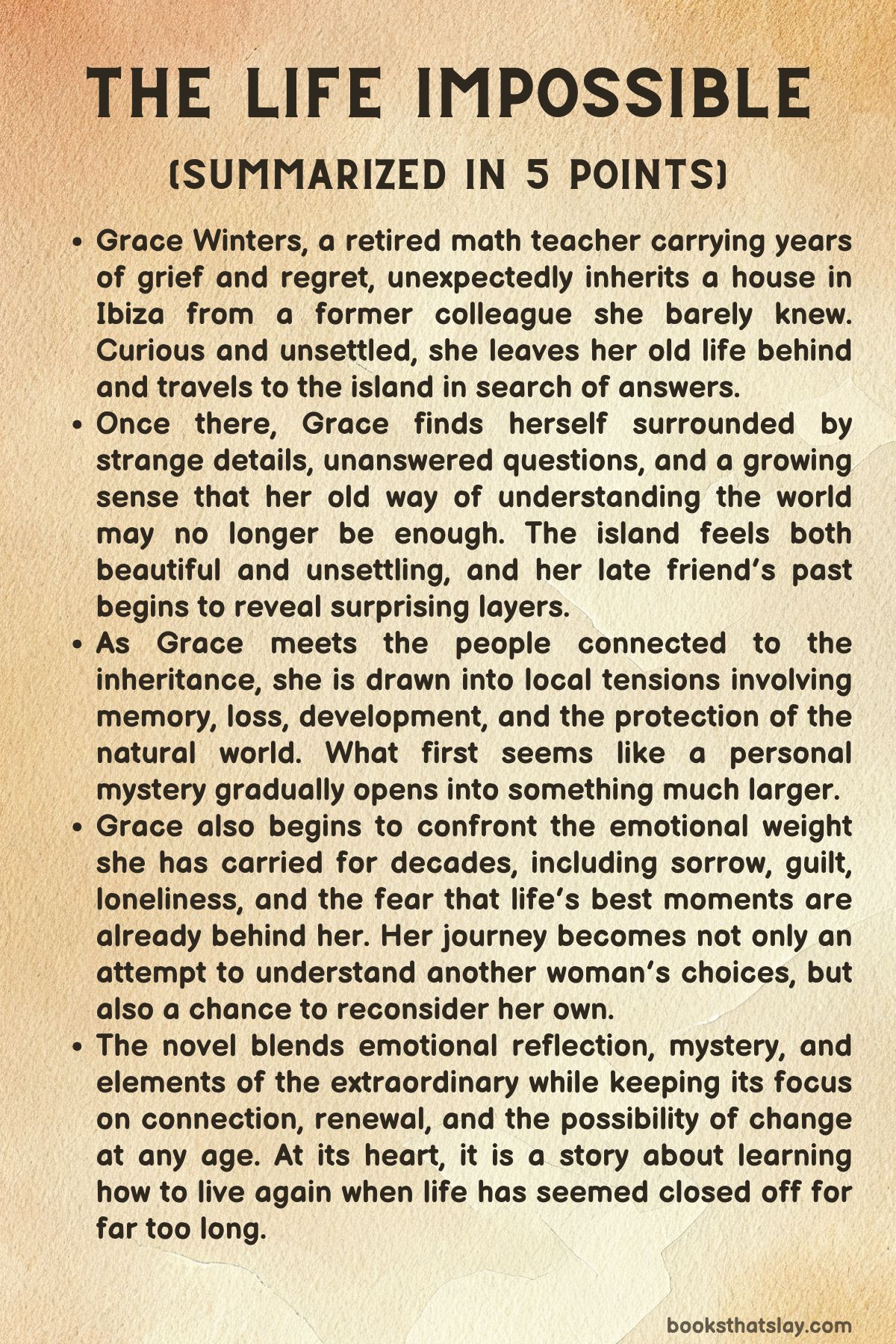
Summary
Grace Winters, a seventy-two-year-old retired mathematics teacher, is living a narrow and sorrowful life in Lincolnshire. Since the death of her husband Karl, her days have become repetitive and muted.
She visits graves, attends medical appointments, volunteers at a charity shop, and fills the rest of her time with television and puzzles. Beneath this routine sits a much older wound: the death of her son Daniel decades earlier.
Grace has never forgiven herself for that loss and carries the belief that she caused it. She also lives with shame over a past affair and the humiliation of having recently lost her savings to a scam.
When her former student Maurice writes to her in distress after his mother’s death, Grace decides to answer him by telling the story of what happened to her in Ibiza.
The turning point begins when Grace receives a letter from a solicitor informing her that a former colleague, Christina van der Berg, has left her a house in Ibiza. Grace barely knew Christina, apart from one significant Christmas many years earlier when she offered her warmth, encouragement, and a pendant at a moment when Christina needed kindness.
Even so, the inheritance makes little sense to her, especially when she learns that Christina died under suspicious circumstances at sea. Drawn by confusion as much as curiosity, Grace travels to Ibiza, despite feeling old, awkward, and out of place.
When she arrives, the island unsettles and attracts her at the same time. Christina’s house is not glamorous, and the signs of modern development nearby suggest a place under pressure.
Inside the house, Grace finds traces of Christina’s life and a letter waiting for her. In it, Christina says she knew she was going to die and urges Grace to enjoy the island, visit certain places, and use the house and car as her own.
The strange tone of the letter deepens Grace’s suspicion that something more than an ordinary death has occurred.
As Grace starts asking questions, she learns that Christina had become known locally as a psychic. She had a complicated family life, including a daughter named Lieke, who is now a successful singer and DJ.
Grace also hears warnings about Alberto Ribas, a diver and marine biologist connected to Christina’s final days. At the same time, odd events begin taking place in the house.
A jar of olives seems to refill itself with seawater, a supposedly extinct flower appears outside, and Grace feels a growing sense that reality is behaving in ways her rational mind cannot explain. Because she trusts mathematics and order more than superstition, she resists these signs, but she cannot ignore them.
Grace eventually meets Alberto, who is eccentric, intense, and difficult to read. He promises that if she dives with him near the seagrass meadows off Es Vedrà, she will understand what happened to Christina.
Though frightened and skeptical, Grace agrees. During the midnight dive, she sees Christina’s pendant underwater, the lights on their equipment fail, and then the sea erupts into extraordinary light.
A mysterious force, which Alberto later calls La Presencia, seems to reach toward her. Grace loses consciousness and wakes up in a hospital.
After this encounter, Grace discovers that she has changed. Her senses become heightened to an almost unbearable degree.
Food tastes astonishingly vivid, music feels new, and the physical world appears full of richness she had long stopped noticing. More startling still, she begins to read thoughts, sense emotions, foresee events, and understand things she has never learned, including Spanish.
She can look at strangers and feel their inner lives. She can touch objects and access memories linked to them.
For a woman who had spent years numb with grief, this flood of sensation feels both miraculous and destabilizing.
Alberto explains that Grace has been touched by La Presencia, an otherworldly intelligence linked to the sea and to a place called Salacia. According to him, Christina had the same gift, which gave her clairvoyant abilities and let her foresee danger.
He claims Christina is not exactly dead in the usual sense, but has crossed into another realm. Grace does not fully believe him, yet the evidence of her own transformation keeps mounting.
As she moves through Ibiza in this altered state, she starts to feel not only the lives of other people but also the life of the island itself. Nature, memory, and consciousness begin to seem connected.
Grace’s investigation into Christina’s fate reveals a wider conflict on Ibiza. Christina had been fighting a luxury development project backed by a ruthless businessman named Art Butler, whose plans threaten Es Vedrà and its surrounding ecosystem.
The island’s seagrass meadows, wildlife, and fragile beauty are all at risk. Grace learns that Christina feared she would be killed because of her activism, and a recorded message from Christina confirms it.
In the video, Christina asks Grace to enjoy life again, use her powers to help others, and find the person responsible.
Grace’s emotional life changes as dramatically as her supernatural one. For the first time in years, she feels joy, appetite, curiosity, and desire to participate in the world.
She forms close bonds with Alberto and his daughter Marta, and she begins to understand Christina with greater compassion. Her meeting with Lieke is especially important.
Although Lieke is initially guarded and resentful toward her mother, Grace can feel the pain and love beneath that distance. Again and again, Grace’s new powers reveal that human beings are rarely as simple as they appear from the outside.
At the same time, she struggles with the ethical burden of her abilities. She interferes in other minds, sometimes to protect and sometimes in anger, and sees how dangerous that can be.
The novel makes clear that insight is not the same thing as wisdom. Grace has been given expanded perception, but she must still decide how to use it.
The environmental and political conflict intensifies when Grace, Alberto, and Marta try to stop the development. They confront a politician, Sofía Torres, who appears sympathetic but compromised.
A deal is proposed: if they can raise money and bring enough people to a protest, Sofía will withdraw support for the project. In response, the trio pull together a risky and improbable plan.
Lieke uses her nightclub performance to rally thousands of people. Grace then helps secure money at a casino, where she finally confronts Art Butler directly.
This meeting reveals the darkest twist in the story. Art, too, encountered La Presencia as a child and gained unusual powers, but his life bent toward bitterness, control, and cruelty.
He uses his abilities to dominate others rather than connect with them. In him, the novel presents a mirror opposite to Grace: two people touched by something beyond ordinary life, one drawn toward care and the other toward exploitation.
Their conflict becomes the story’s central struggle.
Before the final confrontation, Grace undergoes an even deeper healing. Through dreamlike experiences in Salacia, she encounters Christina again, and more importantly, she meets the memories of Karl and Daniel in ways that force her to release the guilt she has carried for years.
Karl tells her the truth about their imperfect marriage and urges her to stop living as if one mistake erased a whole life. Daniel tells her his death was not her fault.
These moments free Grace from the emotional prison she has built around herself.
At the public protest, Art attempts to maintain control through fear and psychic force. Grace collapses and enters Salacia once more, where her son’s reassurance gives her the strength to return.
When she wakes, she embraces the connection she has resisted and calls upon the island’s living world. Birds, animals, and natural forces gather.
In the chaos, Art dies, not through Grace’s deliberate revenge but through the larger power of the life he tried to dominate. The development deal collapses, and Es Vedrà is saved.
The final part of the novel turns away from conflict and toward acceptance. Alberto’s cancer worsens, and he chooses not to escape death through supernatural means.
Instead, he decides to live his remaining days fully and die naturally. His death is painful for Grace and Marta, but it is no longer filtered through despair alone.
They grieve him with love, memory, and gratitude.
By the end, Grace remains in Ibiza. She cares for Christina’s house, deepens her friendship with Marta, visits Formentera, gardens, dances, and opens herself to ordinary pleasures that now feel extraordinary.
She even marks her body with Daniel’s bluebird drawing, turning memory into something living rather than punishing. The story she sends Maurice is not simply an account of mystery and magic.
It is a testimony about choosing life after sorrow, accepting imperfection, and understanding that no one is truly separate from anyone else. In telling it, Grace offers Maurice the same gift Christina once gave her: the possibility that even after great pain, a person can begin again.
Characters
Grace Winters
Grace Winters is the emotional and philosophical center of The Life Impossible. At the beginning, she is a woman narrowed by grief, guilt, routine, and self-punishment.
She has outlived the most meaningful parts of her former life, and although she continues moving through the motions of daily existence, she is not truly living. Her son Daniel’s death has shaped her inner world for decades, and she has built her identity around blame.
She also carries the burden of moral shame from her affair and the recent humiliation of being scammed, which together deepen her belief that she is foolish, damaged, and beyond renewal. What makes Grace compelling is not simply that she is sad, but that she has accepted sadness as a final truth about herself.
Her background as a mathematics teacher is central to her characterization. She prefers logic, structure, and proof, and she leans on numerical thinking as a defense against emotional chaos.
Numbers calm her because they suggest order in a world that has often felt cruel and senseless. This trait gives her voice a distinct quality: observant, dry, intelligent, and often self-correcting.
It also makes her transformation more striking. The story does not ask her to become less intelligent or less rational; instead, it forces her to expand her idea of reality.
She must learn that mystery and reason are not always enemies, and that a meaningful life cannot be lived through analysis alone.
Grace’s arc is one of recovery, but not in a simplistic sense. She does not merely “move on” from grief.
Rather, she learns to see her pain without allowing it to define the total meaning of her life. Her supernatural awakening brings her intense sensory pleasure, emotional openness, and psychic connection, but these are not just fantasy elements.
They dramatize her return to feeling. For years, she has been cut off from joy, beauty, appetite, music, spontaneity, and human connection.
Once those capacities return, Grace begins to experience the world as something alive rather than something to endure. Her pleasure in fruit, music, weather, and movement becomes evidence that she has re-entered existence.
Another important dimension of Grace is her moral struggle. She is given unusual powers, but she is not immediately wise in using them.
She intrudes, reacts, misjudges, and sometimes causes harm. This keeps her from becoming a saintly figure.
She remains flawed, frightened, and often unsure. The novel respects her age without reducing her to frailty, and it respects her pain without romanticizing it.
By the end, Grace becomes powerful not because she dominates others, but because she learns compassion, interdependence, and acceptance. Her final state is not perfection but aliveness.
She ends as someone who can remember the dead with love rather than as punishment, and that is the deepest measure of her change.
Maurice Augustine
Maurice serves as both recipient and catalyst. Although he is physically distant from most of the action, his presence matters because the story is addressed to him.
He begins as a young man in despair, overwhelmed by his mother’s death, by his fear of having failed her, and by a broader sense that life itself may be too broken to bear. He is intelligent, sensitive, and emotionally stranded.
His decision to write to Grace reveals something important about him: even in suffering, he still reaches outward. That instinct toward connection makes him more hopeful than he knows.
Maurice’s role is partly structural, but he is more than a framing device. He represents the kind of grief that is early, raw, and still searching for language.
In contrast to Grace, whose pain has hardened into identity over decades, Maurice is at the beginning of that dangerous process. Grace recognizes in him the risk of becoming trapped in self-reproach and numbness.
By telling him her story, she is not only explaining her own transformation but also trying to interrupt his collapse. In that sense, Maurice becomes the inheritor of hard-won wisdom.
His interest in mathematics creates a subtle bond with Grace. It suggests that he shares her attraction to order and certainty, which makes her eventual message more pointed.
She is speaking to someone who might understand her former reliance on abstraction, and so her testimony carries special weight. Maurice is also marked by humility.
He does not approach Grace with entitlement; he writes from vulnerability, confusion, and trust. This gives the correspondence emotional credibility.
By the end, Maurice has changed through listening. He does not dominate the narrative, yet his growth is implied in his gratitude, his willingness to visit Grace, and his acceptance of the gift she offers him, both emotionally and materially.
He stands for the future that Grace almost lost faith in. Through him, the novel suggests that stories matter because they can reach someone at the exact moment when despair is beginning to settle into permanence.
Christina van der Berg
Christina is the absent presence around whom much of the story revolves. Though dead or missing for most of the plot, she is one of its most influential figures.
She begins in Grace’s memory as a former colleague who briefly entered her life long ago, but gradually emerges as a much richer figure: ambitious, intuitive, wounded, generous, unconventional, and spiritually open. The contrast between Grace’s limited early memory of Christina and the fuller reality Grace later uncovers is significant.
It shows how one act of kindness can remain alive inside another person for decades, even when the giver never sees its consequences.
Christina embodies reinvention. She moved beyond her earlier life, developed psychic gifts, and became someone deeply tied to Ibiza’s natural and spiritual force.
Yet she is not presented as serene or uncomplicated. Her relationship with her daughter Lieke is strained, and her life contains loneliness as well as charisma.
This complexity keeps her from becoming a mystical cliché. She is visionary, but she is also human, and the pain within her family suggests that insight does not automatically repair intimacy.
Her decision to leave the house to Grace is one of the story’s key acts of faith. Christina sees in Grace something Grace herself cannot see.
She recognizes buried capacity in an older woman who has almost given up on life. That choice makes Christina not just a benefactor but a kind of initiator.
She becomes the one who opens the door to Grace’s second life. Her video messages and letters extend this role, positioning her as both guide and challenge.
She asks Grace not only to investigate danger but to become more fully herself.
Christina also represents a moral use of unusual power. Unlike Art, she treats her gifts as a responsibility rather than a weapon.
She wants to protect the island, defend vulnerable life, and awaken others to possibility. Even after crossing into another realm, she continues to help.
In thematic terms, she stands for the enduring force of generosity: one compassionate gesture in the past leads to an entire chain of transformation in the present.
Alberto Ribas
Alberto is the bridge between the ordinary and the inexplicable. At first, he appears eccentric, evasive, and possibly dangerous.
Grace’s suspicion of him is understandable because he speaks in riddles, behaves theatrically, and seems already immersed in a reality she cannot accept. Yet beneath that dramatic surface is a man shaped by grief, addiction, love, and hard-earned wonder.
His strangeness turns out to be part performance, part conviction, and part defense against the loneliness of having seen too much for ordinary language to contain.
One of the strongest aspects of Alberto’s character is that he is not written as a perfect spiritual guide. He is careless at times, withholding at others, and clearly flawed in judgment.
He believes deeply in what he has experienced, but he is not always good at translating it for someone else. That makes his relationship with Grace more interesting than a simple mentor-student dynamic.
He helps awaken her, but he also frustrates and confuses her. Their bond grows through friction as much as through trust.
His past gives him emotional depth. After his wife Julia died, he drifted into alcoholism and isolation.
His encounter with the mysterious force beneath the sea did not erase his suffering, but it gave him a way back into life. That recovery allowed him to reconnect with his daughter Marta, which becomes one of the clearest signs of his humanity.
For all his talk of cosmic presence and underwater worlds, what matters most is that he learned how to love and remain present after loss.
Alberto’s illness adds poignancy and moral weight to his role. He knows he is dying, yet he does not use his access to mystery as an excuse to flee mortality.
In the end, he chooses a human death rather than escape into transcendence. This choice defines him.
He believes in more than the visible world, but he also honors the dignity of finite life. His final stance turns him into one of the novel’s clearest expressions of courage: a man who has seen wonder and still accepts death without surrendering joy.
Daniel Winters
Daniel is central despite appearing mainly through memory and vision. For most of the story, he exists as the wound at the center of Grace’s life.
He is the child whose death froze his mother emotionally and reshaped her marriage, her sense of self, and her relationship to happiness. In that way, Daniel functions first as absence, but later becomes more than a symbol of loss.
When Grace finally encounters him in a more direct and healing form, he emerges as a loving and forgiving presence rather than a fixed trauma.
His characterization matters because it revises Grace’s narrative. She has turned him into proof of her own unforgivable failure.
But Daniel’s own perspective releases her from that false story. He was a real child with his own emotions, choices, anger, and vulnerability.
His death was tragic, but it was not the single moral equation Grace has repeated to herself for years. This shift restores Daniel’s personhood.
He is no longer only the object of her guilt; he becomes a son who still loves his mother and wants her to live.
Daniel also represents innocence without sentimentality. He is remembered through specific images, especially the bluebird drawing, which gives his memory a living texture.
The bluebird later becomes a mark Grace carries on her body, turning Daniel from a source of endless punishment into a source of tender continuity. He remains gone, but his place in her life changes.
He becomes memory as blessing rather than memory as sentence.
Karl Winters
Karl begins as another absence, the recently dead husband whose loss has intensified Grace’s loneliness. Yet as the story unfolds, he becomes more layered than the idealized dead often are.
Grace has been speaking to him internally and carrying regret about betraying him, but later revelations show that their marriage was more complex, more mutual, and more imperfect than she allowed herself to admit. This complexity is crucial because it frees him from becoming a saint and frees Grace from being the sole sinner.
Karl represents companionship, ordinary history, and the life Grace once inhabited before grief reduced it. His memory is tied to domesticity, shared habits, irritations, and a long marriage shaped by both loyalty and imperfection.
When Grace finally confronts the truth that both of them had failed each other in some ways, she is able to recover the larger truth that they also loved each other deeply. This balance matters.
Love in the story is not presented as spotless moral purity but as something real enough to survive human flaws.
His role in Grace’s healing is profound. He helps her understand that guilt can become a way of clinging to the dead while avoiding the fuller truth of a shared life.
By releasing her from the fantasy that one betrayal defines everything, he restores proportion to memory. He becomes an agent of mercy, not by denying pain, but by placing it inside a larger field of love, error, and mutual humanity.
Marta Ribas
Marta represents intelligence, practicality, and emotional bravery. As Alberto’s daughter, she stands close to the world of mystery without fully sharing its gifts, which makes her perspective particularly valuable.
She is not clairvoyant in the same way Grace and Alberto are, but she is perceptive and emotionally acute. Her presence grounds the more extraordinary parts of the plot because she responds to them with a mixture of openness, realism, and urgency.
She is also a figure of action. Whereas Grace begins the story trapped in inwardness, Marta is already oriented toward public struggle.
She cares deeply about protecting the island and is willing to organize, confront power, and take personal risks to resist environmental destruction. Her commitment gives the story political force.
She is not waiting for rescue; she is already involved in the fight. That makes her an important counterpart to Grace, whose awakening gradually shifts from personal healing toward collective responsibility.
Marta’s relationship with Alberto is tender and painful, especially once his illness becomes unavoidable. Through her, the narrative explores anticipatory grief and filial love.
She is strong, but not emotionally sealed off. Her bond with Grace grows in part because Grace is able to understand this sorrow without condescension.
By the end, Marta and Grace form a chosen family shaped by shared loss and shared purpose. Marta helps draw Grace into the future, and Grace helps hold Marta through bereavement.
Lieke
Lieke is one of the most emotionally guarded characters in the story. As Christina’s daughter, she carries unresolved anger, disappointment, and distance.
She has built a public identity as a successful performer, but underneath that visibility lies a daughter still shaped by a difficult maternal bond. Her initial interactions with Grace are marked by skepticism and emotional defensiveness.
She does not want easy sentiment or convenient reconciliation, and this resistance gives her credibility.
What makes Lieke compelling is that she is neither cruel nor soft. She is wounded, and she protects herself by maintaining a sharp edge.
She understands that Christina’s gifts and missions often drew her outward, and she likely experienced that as inconsistency or abandonment. Her warning that Grace may simply be the next person recruited into Christina’s orbit reveals insight as well as hurt.
She sees charisma clearly and does not romanticize it.
At the same time, Lieke is not closed to truth. When Grace communicates Christina’s love in a way that feels genuine, Lieke responds.
Her decision to use her platform to rally people to the protest becomes one of the most important acts in the public struggle. This choice suggests that beneath her distance lies a strong moral core and a continuing, if conflicted, connection to her mother’s values.
Lieke thus becomes a character in whom private pain and public action meet. Her emotional complexity deepens the novel’s treatment of family, showing that love can exist even where ease and harmony do not.
Art Butler
Art Butler is the principal antagonist, but he is not presented as evil in a flat or empty way. He is dangerous because he combines power, wealth, psychic ability, and emotional corruption.
His development project threatens the island’s natural life, and his willingness to intimidate, manipulate, and kill marks him as a figure of domination. Yet the story also traces his damage back to childhood.
He, too, encountered the mysterious force connected to the sea. He, too, was changed by it.
The difference lies in what he made of that encounter.
Art channels pain into control. Rather than becoming more connected to life, he becomes more resentful, entitled, and destructive.
He experiences shame, fear, and inner fracture, but instead of being softened by vulnerability, he hardens into predation. This makes him a dark mirror to Grace.
Both characters are wounded, both are transformed by contact with something beyond the ordinary, and both must decide how to live afterward. Grace moves toward compassion; Art moves toward domination.
His relationship to nature is also telling. He treats the island as something to possess and exploit.
In a story so invested in interconnection, Art stands for the fantasy of separation: the belief that one can use the world without belonging to it. His downfall is therefore morally fitting.
He is opposed not just by individuals, but by the life he has tried to bend to his own will. He is a believable antagonist because he is spiritually empty in a recognizably human way: not a monster from outside the world, but someone who has severed himself from wonder, humility, and reciprocity.
Sofía Torres
Sofía Torres is a politically complex character who embodies compromise, fear, and institutional weakness. She is not as openly malicious as Art, but she is vulnerable to intimidation and unable to hold firmly to principle when power presses against her.
This makes her a useful contrast to both heroes and villains. She occupies the morally unstable middle ground where many real harms are enabled: not through conviction alone, but through anxiety, self-protection, and surrender.
Grace’s access to Sofía’s thoughts reveals that she understands the stakes better than she initially admits. She is not ignorant of ecological damage or political corruption.
She knows the danger represented by the development and by the man behind it. But knowledge without courage is one of the story’s recurring concerns, and Sofía exemplifies that problem.
Her failure is not one of perception but of action.
Even so, she is not written as beyond redemption. Her hesitation and fear make her frustrating, but also human.
She shows how systems of power distort conscience, and how people who are not entirely corrupt can still participate in wrongdoing. In character terms, she broadens the moral landscape by showing that harm often depends on the compliance of the frightened, not only on the ambition of the ruthless.
Rosella
Rosella appears briefly, but she plays an important role as one of Grace’s first gateways into Christina’s hidden life. She is socially observant, rooted in local knowledge, and immediately more aware than Grace of the unusual currents surrounding Christina’s death.
Through Rosella, the island begins to feel like a place where stories, warnings, reputations, and intuitions circulate beneath the surface of ordinary conversation.
Her presence also helps establish that Christina mattered to people. She is not remembered only as a mystery but as someone who participated in a living community.
Rosella offers information without excessive drama, which gives her a practical authority. Characters like her help the world feel inhabited and connected, and she serves as one of the early reminders that Grace has stepped into an environment where rational explanations alone may not be enough.
Sabine
In The Life Impossible, Sabine represents community memory and activist continuity. She knew Christina, understood her commitment to protecting the island, and helps Grace see that Christina’s death may be tied to forces larger than personal misfortune.
Her role strengthens the political dimension of the story by placing Christina within a network of resistance rather than treating her as an isolated eccentric.
Sabine’s importance lies in what she confirms: Christina was not simply strange or gifted, but committed. She wanted to help people and defend the island from destruction.
That testimony matters because it gives Grace a moral path forward. Sabine helps transform the mystery from a private puzzle into a public struggle.
Through her, Grace begins to see that understanding Christina will require understanding what Christina was trying to save.
Themes
Grief, Guilt, and the Long Work of Self-Forgiveness
Grace’s emotional life is shaped by grief that has lasted so long it has become part of her identity. She is not simply mourning the deaths of her son and husband; she is living inside a private system of punishment.
The loss of Daniel becomes, in her mind, the central fact of her life, and from that belief she builds a harsh moral verdict against herself. She does not remember the past as a field of mixed experiences, love, error, and survival.
Instead, she reduces it to a single accusation. This is what gives the novel its emotional force.
It presents grief not only as sadness, but as a way of thinking that can narrow reality, flatten memory, and make a person believe they no longer deserve joy. Grace’s sorrow is intensified by shame over her affair and by the ordinary humiliations of aging, loneliness, and financial betrayal.
Her suffering therefore feels layered, cumulative, and very human.
What makes this theme especially powerful is that healing does not come through denial. Grace is not asked to pretend that loss is unreal or that pain can be erased.
The movement of the story is toward a more truthful relationship with memory. She must accept that love and failure can exist together, that one mistake does not define an entire life, and that surviving tragedy does not make happiness a form of betrayal.
Her encounters with Daniel and Karl matter because they break the logic of self-condemnation she has repeated for decades. They return complexity to her understanding of the past.
Daniel’s death was not a simple equation with Grace as the sole cause. Her marriage was not destroyed by one secret while everything else was false.
By allowing these truths back in, the novel presents forgiveness as an act of moral clarity rather than emotional convenience.
The theme also extends beyond Grace to Maurice, who is at risk of building the same kind of prison inside himself after his mother’s death. That parallel broadens the novel’s message.
Grief can become a devotion to pain, a way of staying loyal to the dead by refusing life. Against that instinct, the story argues that remembrance does not have to be punitive.
Love for the dead can remain strong without requiring endless self-erasure. In that sense, self-forgiveness becomes a necessary condition for continuing to live with honesty, tenderness, and openness.
The Recovery of Wonder and the Return to Life
One of the most striking ideas in the novel is that despair is not only emotional but sensory. Before her transformation, Grace exists in a state of reduced feeling.
Food, music, travel, beauty, and conversation no longer reach her in a meaningful way. She can still observe the world, but she cannot fully receive it.
This makes her later awakening far more significant than a simple supernatural development. When she begins to experience taste, color, sound, and touch with overwhelming intensity, the novel is dramatizing a return to life itself.
Orange juice, fruit, sea air, flowers, dance, and sound all become evidence that existence contains richness she had stopped believing in. These moments are not decorative details.
They are central to the book’s moral vision. The ability to feel pleasure is shown as something profound, not trivial, especially for a person who has been emotionally numb for years.
This theme works because it is tied to age. Grace is in her seventies, and the story resists the assumption that major transformation belongs only to the young.
Her rediscovery of joy carries special weight because it happens after long disappointment, not before it. She is not beginning life in the ordinary sense, but she is beginning again in a deeper one.
The novel therefore treats wonder as a renewable human capacity. It can lie dormant, but it does not disappear.
A person can return to the world after years of withdrawal and still find intensity, surprise, appetite, and delight. That is one of the most hopeful ideas in the book.
At the same time, wonder is not presented as childish innocence or escapism. Grace’s renewed sensitivity brings difficulty as well as pleasure.
She becomes flooded by other people’s feelings, by beauty, by pain, by information, by the sheer density of existence. This prevents the theme from becoming sentimental.
To be awake to life means being vulnerable to both ecstasy and sorrow. The novel suggests that numbness may feel protective, but it is also a form of absence.
Real living requires permeability. By the end, Grace’s recovery is not defined only by mystical power or dramatic events.
It is visible in smaller choices: gardening, walking in rain, listening to music, sharing food, dancing, caring for a house, and wanting more days. Wonder becomes the daily practice of noticing that life is still here.
Human Interconnection and the Illusion of Isolation
Grace begins from a position of emotional separation. She sees herself as cut off from others by age, grief, shame, and temperament.
Her pain feels private, and her intelligence often reinforces that privacy because she analyzes rather than joins. As her powers develop, that sense of separateness begins to collapse.
She can hear thoughts, feel emotions, enter memories, and understand hidden wounds in strangers, friends, and even animals. On the surface, this is a supernatural ability, but at the thematic level it gives form to an idea the novel cares deeply about: people are never as isolated as they imagine themselves to be.
Every person is carrying fear, longing, memory, embarrassment, regret, tenderness, and private struggle. Grace’s new awareness reveals that inner life exists everywhere, even in people she might once have dismissed, misunderstood, or ignored.
This theme matters because it changes Grace ethically. As long as she sees herself as alone, her world remains dominated by self-judgment.
Once she begins to perceive the emotional reality of others, her attention shifts outward. She sees brokenness not as her own unique burden, but as part of being human.
That realization does not erase suffering, but it changes its meaning. If pain is shared, then compassion becomes more possible than shame.
Her encounters with Lieke, Marta, Alberto, and even strangers in public spaces show that lives are always more complicated than appearances suggest. Anger often hides grief.
Distance may hide love. Confidence may hide fear.
The novel builds its emotional intelligence through these recognitions.
The island setting strengthens this theme by turning connection into something larger than human society alone. Grace’s sense of relation expands toward landscapes, wildlife, seagrass, and sea.
The natural world is not background scenery but part of a living field of being. This is why the environmental conflict carries such moral weight.
To damage the island is not merely to alter property or scenery; it is to violate a web of life to which human beings already belong. The story rejects the fantasy that any person, corporation, or political system can stand apart from consequence.
That same idea governs the personal plot. Grace cannot seal herself away from love without also sealing herself away from renewal.
The more fully she accepts connection, the more fully she returns to life. The novel’s vision of selfhood is therefore relational rather than isolated: a person becomes more fully themselves not by withdrawing from others, but by recognizing how deeply bound they already are to them.
Power, Responsibility, and the Moral Choice Between Care and Control
The novel places unusual power in the hands of multiple characters and then asks what kind of person each one becomes because of it. Grace, Christina, Alberto, and Art are all changed by contact with a force beyond ordinary experience, but that contact does not produce the same outcome in each case.
This is what gives the theme its depth. Power is not presented as automatically noble, corrupting, or liberating.
Instead, it magnifies what a person chooses to value. Christina uses her gifts to guide, protect, and warn.
Alberto uses his knowledge to heal, connect, and defend what he loves, even if he is imperfect in method. Grace receives power in the middle of a moral rebirth, and much of her journey consists of learning that insight alone does not guarantee wisdom.
Art, by contrast, uses extraordinary ability to dominate, manipulate, and exploit. The contrast among these figures turns the story into a meditation on how power reveals character.
Grace’s arc is especially important here because she makes mistakes. She invades minds impulsively, affects others in anger, and struggles to manage what she has been given.
The novel refuses the idea that good intentions automatically make power safe. Instead, it insists on restraint, humility, and moral growth.
Grace must learn that to understand another person is not the same as having the right to control them. Her best moments come when she acts in protection of life rather than from ego, panic, or self-importance.
This distinction becomes crucial in the conflict with Art, whose entire approach to power is built on mastery. He wants to bend reality, politics, people, and landscape to his own appetite.
He treats ability as permission.
The theme also expands into the political and environmental plot. Wealth, influence, and psychic force all become versions of the same question: will power be used to protect the vulnerable or to consume them?
The development threat against the island is not just an external conflict but an expression of the same moral logic that governs Art’s inner life. He sees the world as material for possession.
Against him, the novel sets a different model rooted in stewardship, mutuality, and respect. Even Alberto’s final decision to face death naturally rather than escape it reflects this ethic.
He does not turn mystery into entitlement. He accepts limits.
In that sense, the story argues that the highest use of power is not conquest but care. What matters most is not what a person can do, but whether they remain answerable to life beyond themselves.