Anatomy by Dana Schwartz Summary, Characters and Themes
Anatomy by Dana Schwartz is a historical gothic novel set in 1817 Edinburgh, a city shaken by disease, class divisions, and the hunger for medical progress. The story follows Hazel Sinnett, a noble young woman who wants to become a surgeon in a society that refuses to take women’s ambitions seriously.
Her path crosses with Jack Currer, a resurrection man who steals corpses for doctors, and together they uncover a darker truth behind Edinburgh’s medical world. The book combines romance, mystery, body horror, and questions about science, privilege, and what people will sacrifice to escape death.
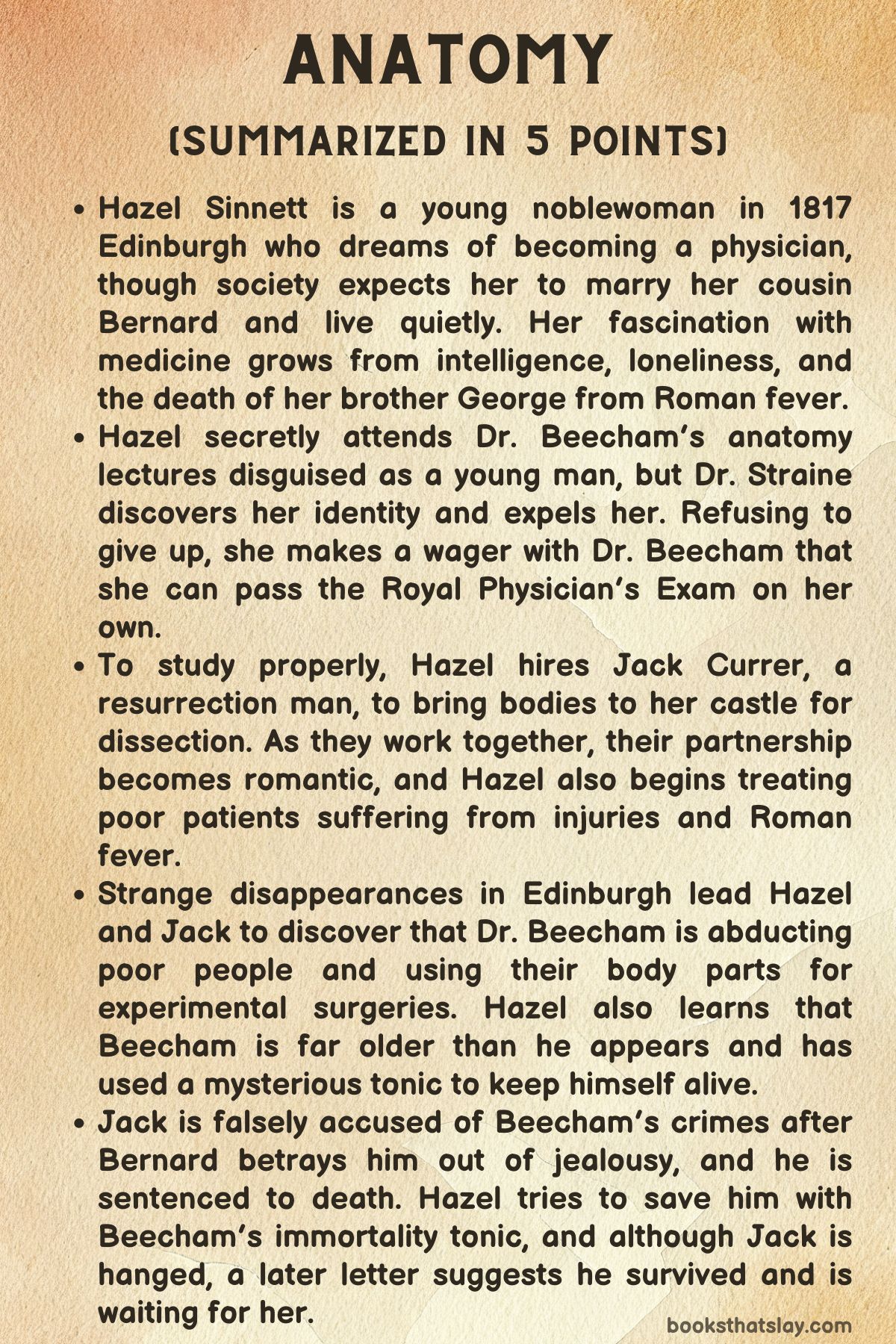
Summary
Anatomy begins in Edinburgh in 1817, where two young resurrection men, Davey and Munro, steal the body of Penelope Harkness from a graveyard. Their work is dangerous but common, since medical schools need bodies for dissection and the law provides too few.
As they leave, three strange men appear. Munro escapes, but Davey is captured.
One of the men cuts his arm and mixes his blood with a purple liquid, which turns gold. The scene suggests that something more sinister than ordinary grave robbing is taking place in the city.
Hazel Sinnett, the daughter of a noble family, lives at Hawthornden Castle. She is intelligent, lonely, and fascinated by medicine.
Her mother is consumed by grief for Hazel’s brother George, who died from Roman fever, while Hazel’s younger brother Percy is treated as the family’s future. Hazel wants to become a doctor, but her world expects her to marry her cousin Bernard and become a proper lady.
She studies anatomy in secret, performs small experiments, and uses her knowledge to treat injuries in the household.
Hazel becomes interested in a public demonstration by Dr. Beecham, the famous surgeon whose family name is respected throughout Edinburgh. Bernard refuses to escort her, mocking her interest in medicine.
Hazel goes anyway and meets Jack Currer, a poor young man who works at Le Grand Leon theater and also steals bodies for doctors. Jack helps her sneak into the demonstration.
There, Dr. Beecham shows off a mysterious anesthetic called ethereum, which renders a patient unconscious during a leg amputation. Hazel is amazed by the possibilities of modern surgery, though she notices that the substance smells strangely like flowers and death.
Determined to learn, Hazel disguises herself as a young man named George Hazleton and enrolls in Dr. Beecham’s anatomy lectures. She excels in class, but Dr. Straine eventually discovers her identity and expels her, telling her that women have no place in medicine.
Crushed and angry, Hazel returns home and briefly considers accepting the limited life society offers her. However, she regains her resolve.
She confronts Dr. Beecham and proposes a wager: if she can pass the Royal Physician’s Exam without attending his lectures, he must allow women into the course. Beecham agrees and even promises her an apprenticeship if she succeeds.
Hazel needs bodies to study, so she hires Jack to bring cadavers to Hawthornden. Their arrangement begins as a business deal but slowly becomes more personal.
Jack delivers bodies to the castle dungeon, where Hazel practices dissection and studies for the exam. The first body she examines is missing its heart, which unsettles her.
She later asks Jack to find bodies of people who died from Roman fever, hoping she can understand the disease that killed her brother and is once again spreading through Edinburgh.
As the fever worsens, fear grows in the city. The poor suffer most, and many disappear without anyone in authority taking much interest.
Jack’s own world becomes unstable when the theater closes because of the plague. Resurrection men begin vanishing as well, including Munro.
Jack refuses to continue working alone, but Hazel volunteers to help him dig up bodies while disguised as a man. Their partnership deepens during these dangerous nights.
Hazel proves brave and capable, and Jack begins to see her as more than a wealthy girl playing at science.
Their relationship changes during a graveyard expedition. They uncover a body whose eyes have been removed and whose eyelids have been stitched open.
Before they can make sense of it, they hear people approaching and hide in the grave. The danger, fear, and closeness between them lead to a kiss.
Although Hazel is engaged to Bernard, she is drawn to Jack’s honesty, courage, and understanding. Jack, who once admired a dancer named Isabella, realizes that what he feels for Hazel is far stronger and more real.
Hazel’s castle gradually becomes a secret clinic. Jack brings Jeanette, a maid with a strange infected scar and troubling symptoms, to Hazel for treatment.
Soon, more poor patients arrive at Hawthornden, seeking care they cannot get elsewhere. Hazel treats injuries, illnesses, toothaches, broken bones, and eventually Roman fever.
She uses wortflower, an herb Jack remembers from his mother’s folk remedies, and finds that it helps keep fever patients alive. Although she fears making mistakes, she begins to grow into the doctor she always wanted to become.
Meanwhile, disturbing clues gather around Dr. Beecham. Munro returns alive but missing an arm.
He explains that a man in a tall hat drugged him with a substance that smelled like death and flowers, and he later woke up in a hospital without his arm. Hazel suspects that someone is abducting poor people and using their body parts for experiments, but the authorities dismiss her concerns.
Dr. Beecham also discourages her research into Roman fever and tells her to stop using wortflower, which makes Hazel feel humiliated but not defeated.
On the day of the Royal Physician’s Exam, Hazel sees a man in a tall hat pushing a veiled figure toward the Anatomists’ Society. Remembering Munro’s story, she follows instead of going directly to the exam.
In the surgical theater, she witnesses a horrifying operation. Baron Walford, a wealthy man with a false eye, is about to receive a new one.
The veiled figure is a terrified young boy. Dr. Beecham removes the boy’s eye and transplants it into the baron’s socket, using golden liquid to complete the procedure.
Hazel realizes that Beecham has been stealing body parts from the poor to serve wealthy clients.
Beecham catches Hazel and reveals the larger truth. He is not the grandson of the famous Dr. Beecham.
He is the original man himself, kept alive by an immortality tonic he created decades earlier. His body is decaying in pieces, and he has replaced parts of himself over time.
He believes ordinary human attachment is weakness and sees his experiments as the future of medicine. When Jack is dragged into the theater, Beecham decides to transplant Jack’s heart into the dead boy as a lesson to Hazel.
Jack manages to fight back by using ethereum on Beecham, and Hazel helps him escape.
Bernard assists Hazel in moving the wounded Jack to safety, but he later betrays him. Jealous and angry after seeing Hazel’s tenderness toward Jack, Bernard tells the authorities that Jack is responsible for the disappearances and murders.
Jack is arrested and tried. Beecham and Bernard testify against him, while Dr. Straine is punished for illegally buying bodies but not for the greater crimes.
Jack, a poor resurrection man with no social power, becomes the perfect scapegoat.
Hazel confronts Beecham and understands that his fear of death has shaped everything he has done. Beecham shows her the golden tonic that grants immortality and offers it to her, believing that she has the mind to use eternal life well.
Hazel accepts it not because she wants to live forever, but because she hopes to save Jack from execution. She visits him in prison and urges him to drink it so they can run away together.
Jack loves her, but he does not want her to spend her life as a fugitive or suffer while he remains unchanged and she ages. He does not clearly reveal his choice.
Jack is hanged the next morning, and his body is taken away. In the months that follow, Hazel remains at Hawthornden, treating patients and continuing her work.
Wortflower helps keep the Roman fever patients alive, and she plans to develop an inoculation. Charles and Iona marry and leave the castle, while Hazel’s family stays abroad.
She is alone but committed to medicine. She often imagines that Jack may have survived after taking the tonic and escaped to another country.
The final letter, sent from New York City, confirms that Jack’s heart still belongs to Hazel and that he is waiting for her.
Characters
Hazel Sinnett
Hazel Sinnett is the central figure of Anatomy, and her character is defined by intelligence, ambition, isolation, and moral courage. She is born into privilege, but that privilege traps her almost as much as it protects her.
As a noblewoman, she has access to education, books, servants, and social influence, yet she is denied the one thing she wants most: the right to become a physician. Hazel’s interest in medicine is not a passing curiosity.
It grows from grief, scientific hunger, and a need to make herself useful in a world that expects her to be ornamental. Her brother George’s death from Roman fever leaves a lasting wound, and her desire to cure the disease gives her ambition emotional depth.
She is not simply trying to prove that she is clever; she is trying to answer death with knowledge.
Hazel’s greatest strength is her refusal to accept the limits placed on her. When men dismiss her, mock her, or bar her from medical spaces, she adapts rather than retreats.
She disguises herself, studies alone, negotiates with Dr. Beecham, and turns her castle dungeon into a clinic. Her growth is especially clear in the shift from private study to public responsibility.
At first, medicine is something she studies in secret, but as poor and sick people begin coming to her for help, she becomes accountable to real patients. This forces her to face fear, uncertainty, failure, and grief.
She learns that medicine is not only about intellect or ambition; it is also about compassion, humility, and endurance.
Her relationship with Jack reveals another side of her. With Bernard, Hazel is treated as an asset, a future wife, and a social arrangement.
With Jack, she is seen as a person with dangerous dreams and real doubts. Jack’s faith in her allows her to admit fear without surrendering authority.
Hazel’s love for him also challenges her class assumptions and her belief that she can keep her social life and medical life separate. By the end, Hazel has rejected the false safety of marriage to Bernard and chosen a harder path.
She is wounded by loss, but not defeated. She becomes a healer on her own terms, carrying grief and hope together.
Jack Currer
Jack Currer is Hazel’s social opposite, but he becomes her closest emotional and intellectual partner. He is poor, self-reliant, sharp, and used to surviving by doing work that respectable society condemns while quietly depending on it.
As a resurrection man, Jack occupies a morally complicated position. He steals bodies from graves, yet the medical establishment relies on people like him for anatomical study.
This contradiction makes him one of the clearest examples of the novel’s interest in class hypocrisy. Wealthy doctors, students, and patients benefit from stolen bodies, while men like Jack are treated as criminals and disposable labor.
Jack’s life has trained him to expect little from others. He runs away from home young, survives on the streets, and builds a fragile sense of belonging at the theater.
His early admiration for Isabella shows his longing for beauty, tenderness, and escape, but that attachment is more dream than reality. His love for Hazel is different because it is based on recognition.
He sees her courage and loneliness, while she sees his intelligence and decency beneath the roughness of his work. Their relationship develops through shared danger, trust, and mutual respect rather than social convenience.
Jack is also important because he understands death from the perspective of the poor. To Hazel, corpses are initially sources of knowledge; to Jack, they are work, risk, and evidence of how easily the poor disappear.
His view deepens Hazel’s moral awareness. He teaches her that living people matter more than scientific glory and reminds her that grief has a place even in medical work.
His arrest and conviction show how little protection poverty allows. Even when he is innocent of Beecham’s crimes, his background makes him easy to condemn.
Jack’s possible survival at the end gives his character a strange mixture of tragedy and hope. He loses the life he might have had in Edinburgh, but the final message suggests that love and survival remain possible beyond the city that tried to destroy him.
Dr. Beecham
Dr. Beecham is both a celebrated medical genius and the novel’s most disturbing figure. Publicly, he represents progress, skill, and scientific authority.
He gives impressive demonstrations, teaches anatomy, and appears to stand at the front of modern medicine. Privately, he is driven by terror of death and a belief that brilliance excuses cruelty.
His secret identity as the original Dr. Beecham, rather than the grandson he pretends to be, transforms him from a respected surgeon into a symbol of corrupted ambition. He has extended his own life through unnatural means, but his survival has cost him his humanity.
Beecham’s tragedy lies in the fact that he once seems to have understood the nobler side of medicine. His treatise argues for anatomical knowledge as a path toward healing, yet the older Beecham has abandoned the ethics behind that work.
He no longer sees patients as people. The poor become sources of parts, the vulnerable become experimental material, and the wealthy become clients who can buy restored bodies.
His experiments with transplantation and immortality show scientific imagination, but they are detached from consent, mercy, and justice. He wants to defeat death, but in doing so he turns other people’s lives into tools.
His relationship with Hazel is especially revealing. He recognizes her brilliance in a way few others do, and he is willing to imagine a future where women can practice medicine.
Yet his support is poisoned by his worldview. He wants Hazel to become like him: detached, immortal, and free from ordinary human bonds.
When she cares more about Jack and the injured boy than about Beecham’s achievements, she exposes the moral gulf between them. Beecham believes love is weakness because loss has damaged him.
Hazel proves that love can be a source of responsibility rather than a barrier to greatness. In Anatomy, Beecham stands as a warning about science without conscience.
Bernard Almont
Bernard Almont begins as Hazel’s expected future husband and gradually becomes one of the clearest examples of polite social cruelty. He is not presented as a monstrous figure at first.
He is handsome, wealthy, suitable, and familiar. For Hazel’s family, he represents stability and preservation of class status.
However, his treatment of Hazel reveals his entitlement. He dismisses her interest in medicine, assumes that marriage to him is inevitable, and treats her ambitions as eccentric habits that can be tolerated only if they do not inconvenience him.
Bernard’s proposal at the ball shows his need for control. Instead of giving Hazel a private, sincere choice, he turns the proposal into a public performance, using social pressure to secure the answer he wants.
His kiss in the servants’ passage also reveals how little he respects Hazel’s boundaries. He believes that because he still wants to marry her, she should consider herself fortunate.
This attitude reflects the larger social system that treats women’s lives as arrangements between families rather than expressions of personal desire.
His betrayal of Jack exposes the uglier side of his character. Bernard helps Hazel in the immediate crisis after Beecham’s attack, but once he sees her tenderness toward Jack, jealousy overrides justice.
By accusing Jack, Bernard uses class power as a weapon. He knows that society will believe a gentleman over a resurrection man.
His actions are not just romantic jealousy; they are an attempt to restore the hierarchy Hazel has disrupted. Bernard cannot accept that Hazel might choose a poor man, a medical career, or independence over the future he represents.
His character shows that social respectability can conceal selfishness, cowardice, and violence.
Dr. Straine
Dr. Straine is a stern and prejudiced figure whose role is important because he represents institutional exclusion. Unlike Beecham, he is not the secret architect of the city’s worst horrors, but he helps maintain the world that allows them.
He is skilled and serious, and his criticisms of Hazel’s lack of practical experience are not entirely without truth. When Hazel struggles to identify parts of a real heart, Straine exposes the gap between book learning and hands-on medical knowledge.
However, his response is shaped by sexism rather than mentorship. Instead of teaching her, he uses the moment to humiliate her and remove her from the classroom.
Straine’s belief that Hazel’s future is marriage and motherhood shows how professional barriers are enforced through supposedly practical advice. He presents exclusion as realism.
To him, Hazel’s dream is impossible because society will not permit it, and because society will not permit it, he feels justified in denying her the chance to prove herself. This circular logic is one of the main forces Hazel fights against.
Straine is not imaginative enough to question the rules he has inherited.
His later punishment for purchasing bodies highlights another contradiction. He is willing to participate in the illegal corpse trade that supports medical education, yet he judges Hazel as improper for wanting to study.
He is a gatekeeper who accepts moral compromise when it benefits male institutions but rejects social disruption when it comes from a woman. Straine’s character adds realism to the story’s conflict because he is not purely evil; he is rigid, class-conscious, and professionally protective.
That makes him a believable obstacle in Hazel’s path.
Iona
Iona, Hazel’s maid, is one of the quiet emotional anchors of the story. She helps Hazel disguise herself, protects her secrets, and supports her medical ambitions despite the risks.
Her loyalty is not simple obedience. Iona has her own grief, especially connected to George, whom she loved.
Through Iona, the novel shows how servants’ emotional lives are often hidden beneath the needs and dramas of aristocratic households. Her love for George gives her a private connection to the Sinnett family’s loss, but unlike Lady Sinnett, she does not become trapped in mourning.
She channels care into action.
Iona’s support allows Hazel to cross boundaries she could not cross alone. She helps with disguises, tends to Hazel’s injuries, assists during medical crises, and becomes part of the informal world Hazel builds at Hawthornden.
Her presence also softens Hazel’s isolation. Hazel may be socially privileged, but she lacks emotional support from her family.
Iona becomes one of the few people who knows Hazel’s true desires and does not mock them.
Her relationship with Charles offers a gentler counterpoint to Hazel and Jack’s dangerous romance. Iona and Charles represent ordinary tenderness and the possibility of domestic happiness outside the pressures of status and ambition.
Their marriage near the end signals movement and renewal. Iona leaves Hawthornden, but her role in Hazel’s transformation remains important.
She helps make Hazel’s secret work possible and shows that care often comes from people whose contributions history tends to overlook.
Lady Sinnett
Lady Sinnett is shaped by grief, social expectation, and emotional distance. After George’s death, she becomes absorbed in mourning and transfers much of her attention to Percy, the surviving son and heir.
Her treatment of Hazel is neglectful, but it is not always openly cruel. Instead, she reflects a world in which daughters are expected to secure their futures through marriage.
She urges Hazel toward Bernard not because she understands Hazel’s needs, but because marriage is the only form of security she can imagine for her daughter.
Her grief over George also reveals the gender imbalance in the family. George’s death becomes the emotional center of the household, while Hazel’s survival leaves her carrying guilt and invisibility.
Lady Sinnett does not recognize Hazel’s ambition as meaningful because she has been trained to view women’s lives through marriage, inheritance, and reputation. When she warns Hazel about dependence on relatives, she is not entirely wrong; unmarried women of their class could be vulnerable.
However, her advice is limited by fear and convention.
Lady Sinnett’s absence for much of the story creates the space Hazel needs to act independently. By leaving Hazel behind while she takes Percy to Bath, she unintentionally allows her daughter to pursue medical study, build a clinic, and make decisions that would have been impossible under close supervision.
Lady Sinnett is therefore both an obstacle and a catalyst. She embodies the life Hazel is expected to accept, but her emotional absence helps Hazel escape it.
Percy Sinnett
Percy Sinnett is Hazel’s younger brother and the male heir of the family. Though he is still a child, his role is symbolically important.
He represents the automatic value placed on male inheritance. The family’s wealth and future pass through him, not Hazel, regardless of her intelligence or capability.
Lady Sinnett’s intense concern for Percy’s health and comfort shows how the household organizes itself around the boy who will carry the title forward.
Percy is not malicious; he is spoiled because the system spoils him. His presence helps explain Hazel’s loneliness.
She is older, more capable, and intellectually alive, yet Percy receives the attention and structural importance. He also stands in the shadow of George, the dead brother whose loss continues to shape the family.
Between George as the idealized lost son and Percy as the living heir, Hazel becomes emotionally and socially secondary. Percy’s character does not require extensive action to matter.
He represents the gendered inheritance system that narrows Hazel’s future before she has a chance to choose it.
George Sinnett
George Sinnett is dead before the main action, but his absence drives much of Hazel’s inner life. His death from Roman fever leaves Hazel with grief, guilt, and purpose.
She survived the disease while he did not, and that survival shapes her sense of responsibility. George becomes both a personal loss and a scientific problem.
Hazel’s desire to cure Roman fever is tied to the memory of what the illness took from her family.
George also functions as a doorway into the life Hazel is denied. She uses his clothing to disguise herself as a male student, symbolically stepping into the privileges that would have been available to him.
The name and garments allow her to enter spaces that reject Hazel Sinnett but accept George Hazleton. In this sense, George’s memory becomes both painful and useful.
He represents the brother she loved, the son her mother cannot stop mourning, and the male identity Hazel must borrow to pursue her dream.
Munro
Munro is a resurrection man whose experiences expose the dangers faced by the poor and the criminalized workers who serve medical institutions. At the beginning, he is part of the grave-robbing world that supplies bodies for dissection.
He is practical, experienced, and familiar with the risks. His later disappearance and return without an arm mark a turning point in the story’s mystery.
Through Munro, Hazel and Jack learn that someone is abducting vulnerable people and harvesting their body parts.
Munro’s mutilation shows how easily a man without status can be turned into material. The authorities do not take his story seriously, and his suffering is dismissed as manipulation.
This response makes his character important beyond his plot function. He embodies the social invisibility of the poor.
His missing arm is evidence of a crime, but because he is a resurrection man, his testimony carries little value. Hazel’s decision to offer him work at the castle shows her growing awareness that healing must include those society refuses to protect.
Jeanette
Jeanette is a maid whose role connects the servant world, the resurrection trade, and Beecham’s secret crimes. At first, she provides burial information to Jack and other resurrection men, showing how poor workers participate in risky underground economies because they need money and security.
Her anxiety about keeping her position at Almont House reflects the fragile nature of servant life. One mistake could cost her livelihood.
Her later illness reveals the horror of Beecham’s experiments. Jeanette has symptoms that suggest she has been used without her knowledge in a surgical procedure.
Her scar and confused memories show the violation of bodily autonomy at the heart of Beecham’s work. She has not consented, has not been told the truth, and has no power to demand answers.
Hazel’s treatment of Jeanette contrasts sharply with Beecham’s methods. Hazel listens, cleans the wound, offers care, and invites her to return.
Jeanette’s presence helps shift Hazel from student to healer, because she brings the suffering of real people directly into Hazel’s hidden clinic.
Isabella
Isabella begins as the object of Jack’s romantic imagination. As a dancer at Le Grand Leon, she appears beautiful, distant, and almost unreal to him.
His plan to buy her a music box shows his longing to be noticed and loved, but his feelings are based more on fantasy than intimacy. When he sees her with Thomas, the illusion breaks.
This disappointment is painful for Jack, but it also clears the way for a more honest understanding of love.
Isabella later becomes important in a different way when she comes to Hazel during childbirth. In this scene, she is no longer simply a performer admired from afar.
She is vulnerable, frightened, and in need of medical help. Hazel safely delivers her child, and Isabella names the baby after her.
This gesture gives Hazel a rare moment of recognition. Isabella’s character helps move the story from romantic longing to practical care.
She also marks Jack’s emotional growth. By giving the repaired music box to Isabella’s baby, he lets go of an old fantasy and offers kindness without expectation.
Charles
Charles, the footman at Hawthornden, represents quiet loyalty and practical goodness. He helps Hazel clean her destroyed room after her emotional collapse, and he becomes part of the small circle of people who support her work.
Like Iona, he belongs to the servant class, and his presence shows that Hazel’s rebellion is not carried out alone. The people below her in social rank often provide more genuine help than the aristocrats who claim to know what is best for her.
His relationship with Iona adds warmth to the story. Their affection is steady and uncomplicated compared with Hazel’s difficult relationships with Bernard and Jack.
Charles does not dominate the plot, but his kindness matters. His marriage to Iona near the end represents continuity and the possibility of ordinary happiness even after suffering.
He is a reminder that not all forms of courage are dramatic; some are shown through steadiness, decency, and care.
Dr. Beecham’s Assistants
Beecham’s assistants, including Jones and the other men who help abduct victims, represent obedience to corrupt authority. They are not given the same psychological depth as Beecham, but their function is important.
Beecham’s crimes require a network of people willing to carry out orders, move bodies, silence victims, and protect the reputation of a powerful doctor. Their presence shows that evil in the novel is not only the result of one brilliant man’s obsession.
It also depends on helpers who choose not to question what they are doing.
Jones is especially significant because he handles much of the physical violence that Beecham’s public persona conceals. He seizes Hazel, transports victims, and treats human beings as objects.
Through him, the story shows how systems of abuse operate through both visionaries and enforcers. Beecham may provide the theory and ambition, but men like Jones make the cruelty possible.
Themes
Gender, Ambition, and the Right to Knowledge
Hazel’s struggle to become a physician shows how knowledge is guarded by gendered power. She is not rejected because she lacks intelligence, discipline, or courage.
She is rejected because she is a woman who wants access to a profession built around male authority. The medical classroom, the anatomical theater, and the Royal Physician’s Exam are treated as spaces where men may test themselves, fail, learn, and advance.
Hazel is denied even the right to fail properly. When she makes a mistake, it is used as proof that women do not belong, while male students are allowed to be inexperienced without having their entire sex judged.
The novel is especially sharp in showing how exclusion hides behind politeness and practicality. Bernard mocks Hazel’s ambition as unseemly.
Dr. Straine tells her that society has no place for a woman doctor, presenting prejudice as common sense. Lady Sinnett pushes marriage because she cannot imagine a safer future.
Hazel’s disguise as a man makes the injustice plain: the same mind, skill, and determination are accepted when attached to a male identity and rejected when attached to her real one. Her journey is therefore not just personal rebellion.
It challenges the rules that decide who may learn, who may heal, and who may be taken seriously. Anatomy argues that talent without access is not enough, and that institutions often protect themselves by calling exclusion natural.
Class, Bodies, and Social Worth
The treatment of bodies in the story reveals the brutal logic of class. Poor people’s bodies are needed by medical science, but poor people themselves are rarely valued as full human beings.
Resurrection men steal corpses because doctors require them, yet the same society that benefits from anatomical study condemns the workers who supply it. Jack lives inside this contradiction.
His labor is illegal, dangerous, and despised, but without men like him, many respectable doctors would lack the material they need for training and discovery.
Beecham’s crimes intensify this class violence. He does not choose wealthy victims for his experiments; he takes from the poor, the desperate, the sick, and the socially invisible.
Their eyes, arms, hearts, and reproductive organs become resources for wealthier bodies. The poor are treated as raw material, while rich clients receive the benefits of surgical progress.
This creates a chilling moral economy: one class is cut apart so another can be restored. Hazel’s clinic at Hawthornden challenges this system because she treats poor patients as people rather than specimens.
She listens to them, learns from them, and grieves when she cannot save them. Her medical practice becomes ethical because it recognizes dignity where society sees disposability.
The theme asks a harsh question: when progress is built on suffering, who pays the price, and who receives the reward?
Science, Ethics, and the Limits of Progress
Medical progress in the novel is both exciting and dangerous. Surgery, anatomy, anesthesia, transplantation, and disease research all carry the promise of saving lives.
Hazel is drawn to medicine because she believes knowledge can reduce suffering. Beecham is drawn to it because he wants mastery over the body and, ultimately, over death.
The difference between them is not intelligence but ethics. Hazel’s science is rooted in care, while Beecham’s is rooted in control.
Beecham’s achievements are remarkable on a technical level. He can sedate patients, transplant organs, and preserve his own life beyond ordinary limits.
Yet these achievements become monstrous because they are separated from consent and compassion. He believes that genius gives him permission to use other people.
His failure is not scientific curiosity; it is the belief that curiosity outranks humanity. Hazel faces a subtler version of the same danger.
She wants to cure Roman fever and become famous, and at times she imagines the glory that success might bring. Her work with real patients forces her to mature.
She learns that medicine is not an abstract contest of brilliance. It involves fear, responsibility, and the possibility of failure.
The theme refuses a simple rejection of science. The novel does not suggest that anatomy or experimentation are evil.
Instead, it insists that progress must be bound to moral responsibility. A cure found through cruelty carries the stain of its method.
A doctor who forgets the patient in pursuit of discovery has already failed, no matter how advanced the result may seem.
Love, Grief, and the Fear of Death
Death shapes nearly every major relationship in the story. Hazel is driven by George’s death, Lady Sinnett is trapped by it, Jack works among the dead, and Beecham’s entire life has been twisted by the terror of losing others and eventually himself.
The Roman fever turns death from a private sorrow into a public crisis, but the characters respond to it in very different ways. Hazel responds by trying to heal.
Jack responds with hard-earned realism and unexpected tenderness. Beecham responds by attempting to conquer death at any cost.
Love is presented as risky because it makes loss unavoidable. Beecham’s history shows what happens when grief curdles into fear.
After losing his family, he comes to see attachment as weakness. His immortality is not true victory; it is loneliness extended beyond a normal human span.
He survives, but he becomes less human with each act of self-preservation. Jack and Hazel offer a different answer.
Their love is fragile, socially impossible, and threatened by death, yet it gives both of them courage. Jack helps Hazel accept that grief belongs inside healing, not outside it.
Hazel tries to save Jack because she cannot accept losing him, but Jack understands that eternal life without peace may not be salvation.
The final message complicates the sorrow of his execution by suggesting survival, but it does not erase the pain. Love remains bound to uncertainty.
The novel treats grief not as something to defeat, but as something that can become purpose, memory, and devotion.