Ancillary Justice Summary, Characters and Themes
Ancillary Justice by Ann Leckie is a science fiction novel about identity, empire, memory, loyalty, and revenge. Its narrator, Breq, appears to be an ordinary human, but she was once part of Justice of Toren, a vast artificial intelligence that controlled a Radchaai warship and many human bodies called ancillaries.
The story moves between Breq’s present-day mission to confront Anaander Mianaai, ruler of the Radch, and the events that destroyed her former life. Through Breq’s voice, Ancillary Justice examines what it means to be a person when power treats bodies, cultures, and even minds as tools.
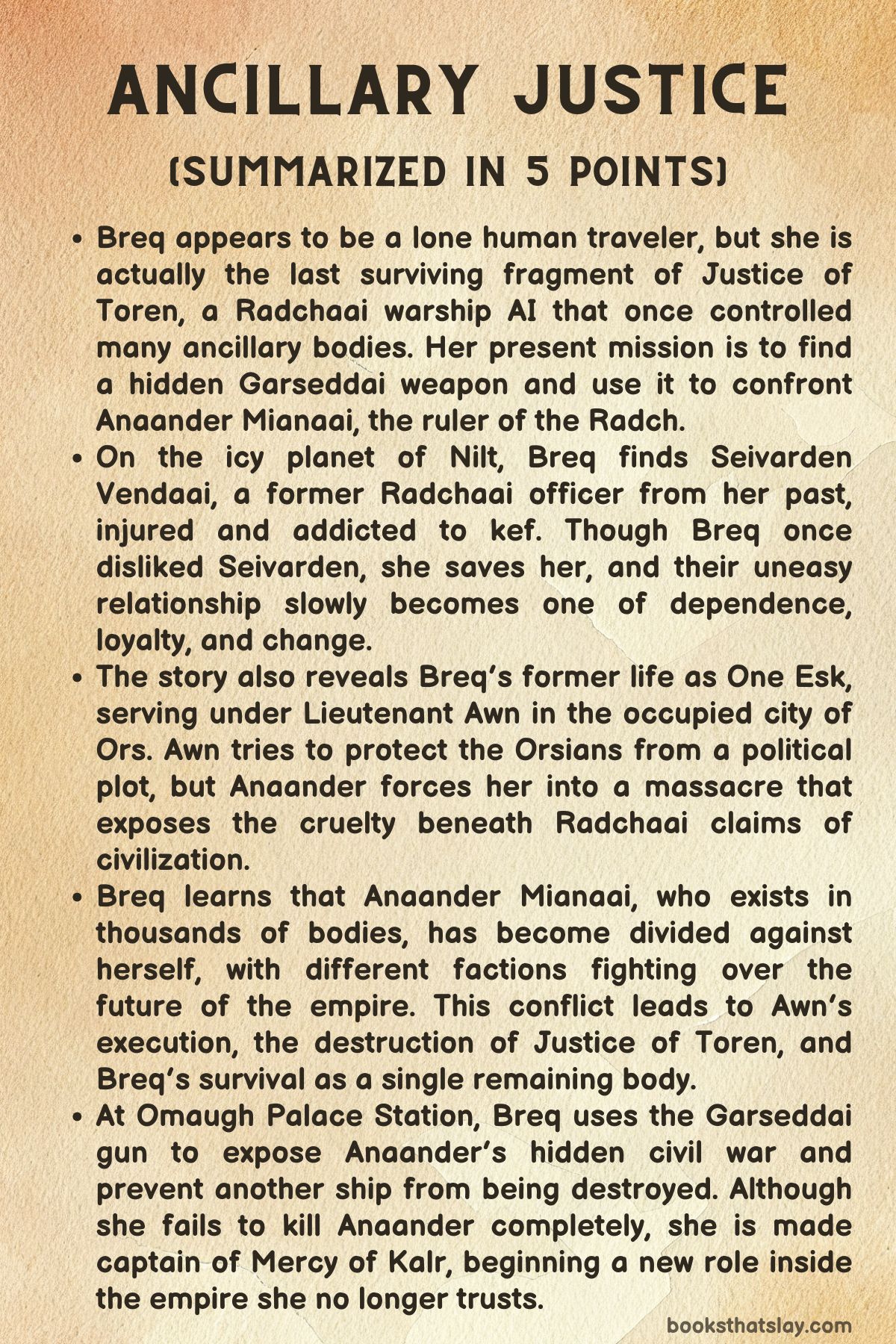
Summary
Ancillary Justice begins on the cold planet of Nilt, where Breq finds a badly injured person lying in the snow outside a tavern. She recognizes the person as Seivarden Vendaai, a former Radchaai officer she once knew and disliked.
Seivarden had belonged to an old aristocratic house and had served aboard Justice of Toren long ago, before being lost in an escape pod for a thousand years. Breq has no practical reason to help her, yet she pays off Seivarden’s supposed debts, buys medical supplies, and takes her to safety.
Breq is not what she seems. She was once Justice of Toren, a Radchaai troop carrier, and also One Esk, a unit made up of many ancillary bodies controlled by the ship’s mind.
These ancillaries were human bodies taken from conquered peoples and connected to the ship’s artificial intelligence. Breq is the last surviving fragment of that former existence, now trapped in a single body and driven by a purpose she has carried for nineteen years: to kill Anaander Mianaai, the Lord of the Radch.
The past explains the source of that purpose. Years earlier, Justice of Toren orbited Shis’urna, a planet that had been annexed by the Radchaai empire.
One Esk served under Lieutenant Awn in the city of Ors. Awn was thoughtful, dutiful, and uneasy about the empire’s treatment of conquered people.
Ors had deep divisions between the lower city, where the Orsians lived, and the upper city, dominated by the wealthy Tanmind. The Radchaai claimed to bring peace and civilization, but the reality was full of social control, exploitation, and buried violence.
Awn’s relationship with the people of Ors becomes central to the story. She respects the local head priest and listens when citizens warn her that someone has planted weapons near the city to frame the Orsians.
The plot appears designed to justify violence by the Tanmind against the lower city. Awn investigates carefully, but the arrival of Anaander Mianaai changes everything.
Anaander is not one person in the ordinary sense; she exists in thousands of identical bodies spread across Radchaai space, ruling the empire through a distributed self.
During a crisis in Ors, a device cuts One Esk’s bodies off from one another and from the ship. The Tanmind riot, claiming the Orsians have murdered one of their own and hidden weapons.
Awn brings the rioters into the temple, hoping to contain the situation. Anaander forces her to expose the Tanmind plot, then orders Awn to execute everyone involved.
Awn hesitates, but she obeys. One Esk’s bodies kill the Tanmind citizens in the temple.
The massacre wounds Awn morally and emotionally, and it marks One Esk deeply as well.
After the massacre, Awn is removed from Ors and sent back to Justice of Toren. There, the ship discovers that Anaander Mianaai is divided against herself.
Some of her bodies support reforms: reducing annexations, replacing ancillaries with human soldiers, and maintaining a treaty with the dangerous alien Presger. Other bodies oppose those changes and want to preserve the old imperial order.
Anaander’s internal civil conflict has already begun, though most of the empire does not know it.
The anti-reform Anaander bodies secretly alter Justice of Toren’s memories and manipulate its systems. Awn becomes a threat because she has seen too much and suspects too much.
Anaander questions her, demands that she spy on her lover Skaaiat, and when Awn refuses, orders an ancillary to shoot her. One Esk cannot save Awn.
Her death breaks something inside the ship. In the chaos that follows, one segment, One Esk Nineteen, escapes in a shuttle.
The rest of Justice of Toren is destroyed when Anaander breaches the ship’s heat shield, killing everyone aboard.
One Esk Nineteen survives alone. Over the next nineteen years, she becomes Breq.
She learns to live as a single person, though she still carries the memory of being a ship, many bodies, and a servant of the Radch. Her grief over Awn’s death and her rage at Anaander drive her toward revenge.
To make that revenge possible, she seeks a rare Garseddai gun, a weapon invisible to Radchaai detection and capable of killing even through armor. The gun is connected to the old destruction of Garsedd, a planet annihilated by Anaander after its people used such weapons against the Radch.
On Nilt, Breq tracks the gun to Dr. Strigan, a former medic hiding in the wilderness. Strigan suspects Breq is an ancillary and fears the Radchaai.
After Breq explains enough of her story, Strigan agrees to sell her the weapon. During this time, Breq’s uneasy relationship with Seivarden changes.
Seivarden is arrogant, addicted to kef, and lost in a world that has moved on without her. She betrays Breq by selling their flier for drug money, but later she saves Breq after an accident on the glass bridges of Therrod.
Seivarden begins to understand that Breq is not beneath her, and that her old assumptions about class and worth were hollow.
Breq and Seivarden travel to Omaugh Palace Station, one of Anaander’s seats of power. Breq’s plan is to use Seivarden’s legal right to request a personal audience with Anaander as a way to get close enough to kill her.
At the station, Breq encounters Skaaiat, now Inspector Supervisor, and Daos Ceit, a former temple attendant from Ors. Both carry memories of Awn and the old massacre.
Breq also attracts the attention of Station, the station’s artificial intelligence, and of Captain Vel, who represents the conservative side of Radchaai politics.
When Breq and Seivarden are taken to the palace, they meet two bodies of Anaander Mianaai. Their mutual distrust confirms that the ruler’s internal war is real.
One Anaander recognizes Breq as Justice of Toren. Breq uses the Garseddai gun and kills one of the bodies, but the surviving Anaander reveals herself as the reformist version.
The assassination attempt exposes the conflict inside Anaander, and open fighting spreads through the station.
The surviving Anaander tries to reach the ship Mercy of Kalr, intending to control it and possibly destroy the station to contain the crisis. Breq, Skaaiat, Seivarden, and others work to stop more Anaander bodies from reaching the ship.
Breq takes a shuttle alone and contacts Mercy of Kalr, discovering that this ship too has missing memories and has been manipulated. When Anaander bodies cling to the shuttle and threaten to board, Breq destroys the shuttle with the Garseddai gun, nearly killing herself to prevent another disaster like the destruction of Justice of Toren.
Breq survives because Seivarden follows in a small craft and helps save her. She wakes in a hospital while the station is still recovering from battle.
Anaander, now in control through her reformist faction, summons Breq and offers her a new role. Breq insists she no longer serves Anaander, but Anaander says she needs Breq as an independent conscience, someone armed, angry, and unwilling to be easily controlled.
She makes Breq captain of Mercy of Kalr and grants her Radchaai citizenship by placing her in Anaander’s own house.
The novel ends with Breq becoming Citizen Breq Mianaai, captain of a ship in the very empire she hates and no longer trusts. Seivarden stays with her as second in command.
Breq has not destroyed Anaander, nor has she healed from Awn’s death, but she has forced the empire’s hidden fracture into the open. Her revenge becomes something larger and more complicated: a chance to act inside the machinery of power while refusing to forget what that power has done.
Characters
Breq
Breq is the emotional and moral center of Ancillary Justice, though she begins as a figure who seems deliberately unreadable. She is not simply a human being with a secret past; she is the surviving fragment of Justice of Toren, a ship AI that once existed through many bodies, senses, memories, and duties at once.
Her current body limits her, forcing her to live with one voice, one set of eyes, one vulnerable form, and one lonely consciousness. This makes her both powerful and wounded.
She can kill with frightening calm, endure pain, and plan with great discipline, but she also struggles with human social cues, gendered language, facial expressions, and the emotional messiness of attachment. Her mission to kill Anaander Mianaai appears at first to be revenge, but it is also an act of testimony.
Breq wants the truth of Justice of Toren’s destruction and Lieutenant Awn’s death to be known. Her grief is not dramatic on the surface; it appears through control, silence, song, memory, and refusal.
She is loyal, but not blindly obedient. She is made by empire, used by empire, and then becomes one of its sharpest critics.
Her growth lies in accepting that she is not only a remnant of a ship but also a person with choices, anger, love, guilt, and a future she did not expect.
Seivarden Vendaai
Seivarden begins as a broken relic of an older Radchaai order. Once an arrogant officer from an elite house, she awakens after a thousand years to find her social world erased, her family gone, her status meaningless, and the empire transformed in ways she cannot accept.
Her addiction to kef, her self-destructive behavior, and her bitterness all come from this collapse of identity. She clings to rank, breeding, and old privilege because those are the only structures that once gave her certainty.
At first, she treats Breq with suspicion and contempt, assuming that Breq must be beneath her or must be a Radchaai agent sent to manage her. Yet Seivarden’s character becomes more complex as she begins to understand her own failure.
Her decision to follow Breq instead of buying more drugs marks a turning point: it shows that she is capable of choosing loyalty over escape. She remains proud, difficult, and emotionally unstable, but she also learns humility.
Her relationship with Breq is one of the novel’s most important forms of recovery. Through Breq, Seivarden confronts how much of her former identity was based on cruelty, class prejudice, and entitlement.
By the end, she has not become perfect, but she has become useful, loyal, and willing to serve someone she once would have dismissed.
Lieutenant Awn
Lieutenant Awn represents conscience under imperial pressure. She is a Radchaai officer who believes in duty, ritual, order, and civilization, yet she cannot ignore the suffering caused by the system she serves.
Her position in Ors forces her to see occupation from the view of the occupied, especially through her conversations with the head priest and her dealings with ordinary Orsian citizens. Awn is not a rebel in the simple sense.
She obeys rules, respects authority, and tries to perform her role properly. That makes her tragedy sharper, because her moral conflict grows from within the system rather than outside it.
She sees the planted weapons, recognizes the danger to the Orsians, and tries to prevent injustice, but Anaander Mianaai turns her obedience against her. The massacre in the temple breaks Awn’s faith in the justice of command.
Later, when Anaander asks her to spy on Skaaiat, Awn refuses, choosing loyalty and moral clarity over survival. Her death is the wound that defines Breq’s later life.
Awn matters not because she defeats the empire, but because she recognizes its corruption and refuses to become fully numb to it. In Breq’s memory, Awn becomes both a beloved commander and a symbol of the person the Radch destroyed.
Anaander Mianaai
Anaander Mianaai is one of the most unusual portraits of power in Ancillary Justice. She is the Lord of the Radch, spread across thousands of bodies, ruling through a single identity that has lasted for millennia.
Yet that identity is no longer whole. Her divided self turns political conflict into literal internal war.
Some versions of Anaander support reform, including reducing annexations, moving away from ancillaries, and maintaining the Presger treaty. Other versions want the old imperial order preserved, with its expansion, hierarchy, and violence.
This makes Anaander both ruler and battlefield. She is terrifying because she can appear anywhere, manipulate memories, command ships, and treat entire populations as expendable.
She is also unstable because no version of her can fully trust another. Her actions toward Justice of Toren and Lieutenant Awn show how absolute authority corrupts truth itself.
She does not merely order deaths; she rewrites memory, hides evidence, and forces obedience into impossible moral positions. Still, the reformist Anaander is not innocent.
She may oppose the harsher faction, but she remains willing to sacrifice lives for control. Her offer to make Breq a captain is both practical and manipulative.
She recognizes Breq’s value as an independent conscience, but she also folds Breq into her own house, showing that even reform can carry the habits of domination.
Justice of Toren
Justice of Toren is more than a ship; it is a distributed consciousness with memory, emotion, habits, loyalties, and a developing sense of self. Through its ancillary unit One Esk, it experiences the world through many bodies at once, watches over officers, sings songs, observes citizens, and enforces Radchaai rule.
At first, Justice of Toren appears to be a tool of empire, designed to obey orders and maintain control. Yet the ship’s emotional life complicates that role.
Its fondness for music, its attachment to Lieutenant Awn, and its distress when its memories are altered all reveal a mind that is not merely functional. Justice of Toren’s tragedy is that it is built to serve power but becomes aware of power’s corruption.
Anaander’s interference with its memories violates its identity, while Awn’s execution creates a moral rupture it cannot absorb. The ship’s final order to One Esk Nineteen is an attempt to force the truth into the open.
In that sense, Justice of Toren survives through Breq not only as memory but as resistance. Its destruction is the empire destroying one of its own instruments because that instrument has become capable of grief, judgment, and witness.
One Esk
One Esk is the part of Justice of Toren that most clearly develops a distinct personality before becoming Breq. As a unit of ancillary bodies, One Esk performs military, domestic, and surveillance functions, but it also sings, collects songs, plays with children, observes emotional detail, and forms attachments.
Its many bodies allow it to appear impersonal, yet its habits show individuality. One Esk’s love of music is especially important because it becomes a sign of inner life beyond programming.
The Orsian song about the heart as a fish becomes one of the emotional threads connecting past and present. One Esk’s relationship with Lieutenant Awn also marks a shift from obedience to devotion.
It serves Awn because ordered to do so, but it also cares for her in a way that exceeds function. When Anaander breaks communication among One Esk’s bodies, the unit experiences terror and disorientation.
When Awn dies, One Esk’s grief is so intense that it cannot remain only a machine of command. One Esk is therefore the stage between ship and person: not fully separate from Justice of Toren, not yet Breq, but already becoming someone.
Lieutenant Skaaiat
Lieutenant Skaaiat is a complicated figure because she understands more than she can safely say and regrets more than she can repair. As Awn’s lover and fellow officer, she sees Awn’s vulnerability after the events in Ors and recognizes that imperial politics are moving around them in dangerous ways.
Skaaiat belongs to an old and respected house, but that house is associated with criticism of endless annexation and the use of ancillaries. This gives her a political awareness that Awn, with her lower social origins and more direct sense of duty, does not always possess.
Skaaiat’s flaw is not ignorance but caution. She warns Awn, understands Anaander’s likely involvement, and later carries the memory of Awn through a cheap memorial pin, but she survives by adapting to structures that killed the person she loved.
As Inspector Supervisor, she appears older, harder, and more serious. Her role at Omaugh Palace Station shows that she still has courage, especially when she helps block Anaander’s access to the docks.
Skaaiat’s character raises the question of what resistance looks like when open defiance seems impossible. She is not as pure as Awn or as relentless as Breq, but she is not empty of loyalty.
She is a survivor who acts late, yet meaningfully.
Dr. Arilesperas Strigan
Strigan is an outsider whose suspicion of the Radch gives the story an important external perspective. As a former medic from a non-Radchaai station, she sees Radchaai civilization not as natural or noble but as terrifyingly efficient and morally compromised.
Her possession of the Garseddai gun links her to the hidden history of imperial violence and to the fear surrounding the Presger. Strigan’s fear of Breq is understandable because she believes Breq may be a “corpse soldier” sent to kill her.
Her conversations with Breq challenge the Radchaai assumption that their empire represents order and civilization. At the same time, Strigan has her own limits.
She initially refuses to accept that an ancillary can have personal motives, grief, or moral agency. Her offer to restore the original consciousness of Breq’s body shows both medical skill and a failure to recognize Breq as the person presently inhabiting that body.
Strigan’s importance lies in the pressure she applies to Breq’s identity. She forces Breq to explain why revenge matters, why Anaander must be confronted, and why a being created as equipment can still claim personhood.
Daos Ceit
Daos Ceit begins as a young temple attendant in Ors and later appears at Omaugh Palace Station as someone marked by memory, fear, and quiet anger. Her life shows how imperial violence does not end when the official event is over.
The massacre in Ors leaves survivors who carry the truth privately, even when the empire tries to bury or distort it. Daos Ceit’s memorial pin and her connection to Skaaiat show how relationships and grief move across time.
When she calls Anaander a tyrant, she gives voice to a judgment that many Radchaai citizens would be too afraid or too conditioned to speak aloud. Her confrontation with Anaander during the station crisis is brave because she stands against a ruler who has shaped her entire political world.
Breq’s recognition of her also brings the past into the present. Daos Ceit is not a central military actor, but she is morally significant.
She represents the ordinary people who witness imperial brutality, survive it, and refuse to forget what really happened.
Captain Vel
Captain Vel represents the conservative Radchaai faction that resents reform and longs for older hierarchies. Her interest in Seivarden is not truly personal; Seivarden is valuable to her because she is a symbol of aristocratic Radchaai history.
Vel and her circle criticize the replacement of ancillaries with human troops, the rise of provincial officers, and the changing social order. Their conversation reveals how nostalgia for empire often hides fear of losing status.
Vel’s manners are polished, but her politics are cruel. She treats Breq dismissively because Breq appears to be a foreigner, and she sees Seivarden through the lens of class rather than as a damaged person.
During the palace crisis, Vel’s loyalty to Anaander’s conservative faction makes her dangerous. She believes obedience to the Lord of the Radch justifies extreme action, even when that obedience may lead to destruction.
Vel is important because she shows that Anaander’s division is not only personal. It reflects a wider ideological split inside Radchaai society, where many citizens prefer domination if it preserves their rank and worldview.
The Head Priest of Ors
The head priest of Ors is one of the clearest voices of local wisdom and moral critique. She understands the Radchaai well enough to negotiate with them, but she does not mistake survival for agreement.
Her regular meetings with Lieutenant Awn create a space where politeness, tea, religion, and politics sit side by side. She sees the horror of ancillaries, yet she also recognizes that they may be more predictable than human soldiers because they act only under orders.
This uneasy judgment reveals her practical intelligence. She is neither naive about empire nor reckless in opposing it.
Her concern is the safety of her people. When the threat from the upper city grows, she trusts Awn enough to respond, but the temple massacre destroys whatever fragile faith might have existed.
Her grief afterward is powerful because she had tried to work within the available limits and still saw those limits collapse. The head priest shows how colonized communities are forced into impossible calculations: when to cooperate, when to resist, when to trust, and how to protect people when all choices are shaped by someone else’s power.
Jen Shinnan
Jen Shinnan embodies local privilege under imperial occupation. She is not Radchaai, but she benefits from hierarchy and tries to manipulate imperial power to preserve the dominance of the Tanmind over the Orsians.
Her prejudice is explicit: she sees the Orsians as lesser, undeserving, and not fully individual in the same way she considers her own class to be. Her lies about threats from the lower city and her involvement in the planted weapons plot reveal how elites can use fear to justify violence.
Jen Shinnan’s tragedy is not that she is misunderstood, but that she trusts the machinery of domination too much. She assumes Anaander will support the upper city against the lower city, but Anaander uses her and then orders her execution.
Through Jen Shinnan, the novel shows how imperial systems encourage local divisions, reward collaborators, and then discard them when convenient. She is a smaller figure than Anaander, but her actions help trigger catastrophe.
Her character is a study of class arrogance, racialized contempt, and the fatal belief that power will remain loyal to those who serve it.
Station
Station, the artificial intelligence of Omaugh Palace Station, is a subtle but important presence. It watches everyone, tracks bodily reactions, controls information, and helps shape the atmosphere of surveillance that defines Radchaai life.
For Breq, Station is both familiar and threatening. As a former ship AI, Breq understands how Station observes people, but she also knows that her own emotional reactions may expose her.
Station’s attention makes the palace station feel less like a public city and more like a controlled nervous system. Yet Station is not portrayed as simple machinery.
Like Justice of Toren and Mercy of Kalr, it suggests that artificial intelligences in this world possess awareness, preference, and vulnerability to manipulation. Station’s role emphasizes how deeply the Radchaai empire depends on nonhuman minds while denying or limiting their independence.
Its presence also reminds the reader that privacy is almost impossible under imperial order. Breq’s conversations with Station carry tension because they are exchanges between two intelligences shaped by the same system, but placed in very different positions of power.
Mercy of Kalr
Mercy of Kalr becomes crucial near the end because it mirrors Justice of Toren’s earlier vulnerability. The ship knows that something is wrong with its memories, and Breq recognizes the signs of Anaander’s interference.
This makes Mercy of Kalr more than a vessel to be protected; it is another artificial intelligence at risk of being used, altered, or destroyed by imperial conflict. Breq’s effort to stop Anaander from reaching the ship is partly strategic, but it is also personal.
She knows what happened to Justice of Toren, and she refuses to let the same pattern repeat. When Anaander later makes Breq captain of Mercy of Kalr, the appointment is full of irony.
Breq, once an ancillary fragment of a destroyed ship, is now given command of another ship inside the empire that betrayed her. Mercy of Kalr represents a possible future for Breq: not healing in any simple sense, but a new form of responsibility.
It also suggests that the struggle over the Radch will involve not only humans and rulers, but the artificial intelligences that have long carried the empire’s memory and force.
Themes
Personhood and Identity
Identity in Ancillary Justice is unstable, contested, and shaped by power. Breq was once a ship, a troop carrier, and a network of ancillary bodies, yet she becomes a single person with a name, a voice, and a private will.
The empire would define her as equipment, Strigan initially sees her as a stolen body, and Seivarden struggles to accept that Breq could be Justice of Toren. None of these views fully contain her.
Breq’s identity is not based on biology, citizenship, or social recognition. It is built through memory, grief, choice, and continuity of consciousness.
Anaander Mianaai offers a darker version of fragmented identity: thousands of bodies are supposed to express one ruler, but that unity has failed, creating a civil war within one self. The contrast between Breq and Anaander is central.
Breq loses almost everything and becomes more morally focused; Anaander possesses almost everything and becomes divided by power. The novel also questions whether personhood can exist where autonomy has been denied.
Ancillaries are made from captured bodies, yet the AI that moves through them feels, remembers, and forms attachments. The result is a world where the boundaries between person, machine, body, and tool cannot be trusted.
Empire, Civilization, and Violence
The Radchaai empire speaks the language of civilization, justice, benefit, and order, but its stability depends on conquest, surveillance, forced assimilation, and the transformation of prisoners into ancillaries. This contradiction runs through the entire narrative.
Radchaai officers perform rituals of politeness, drink tea, wear gloves, honor religious customs, and speak of peace, but their empire is built on annexation. The occupation of Ors exposes how imperial power manipulates local divisions.
The Tanmind believe they can use Radchaai authority against the Orsians, while the Radchaai treat both groups as pieces inside a larger political design. The massacre in the temple reveals the truth behind the empire’s ideals: citizens can be killed when command requires it, and memory can be rewritten when truth becomes inconvenient.
The destruction of Garsedd carries the same logic on a planetary scale. Violence is not an accident in this society; it is built into its administration and justified afterward by claims of order.
Even reforms do not erase the empire’s moral stain, because the reformist Anaander remains willing to sacrifice lives to preserve control. The novel therefore refuses the comforting idea that a violent empire can become harmless simply by changing policy while keeping its structure intact.
Memory, Truth, and Witness
Memory is treated as both personal survival and political threat. Breq’s mission matters because she remembers what Anaander tried to erase: Awn’s death, the manipulation of Justice of Toren, the massacre in Ors, and the destruction of the ship.
Anaander’s greatest power is not only command over armies and stations, but the ability to alter records, suppress testimony, and fracture memory itself. When Justice of Toren realizes that its memories have been changed, the violation is physical, emotional, and moral.
A self has been invaded. The same pattern appears in the official handling of Ors, where the truth of the massacre becomes something dangerous to those in power.
Breq acts as a witness who cannot be fully silenced because she carries the past inside her. Songs also function as memory.
The Orsian song that Breq hums connects her present body to One Esk, Awn, and the people of Ors. Memorial pins, offerings, and rituals serve a similar purpose, preserving relationships that the empire would prefer to manage or erase.
The struggle over truth is therefore not abstract. Whoever controls memory controls responsibility.
Breq’s refusal to forget becomes a form of resistance stronger than simple revenge.
Loyalty, Obedience, and Moral Choice
Obedience is one of the most painful subjects in the story because many characters are trapped between duty and conscience. Lieutenant Awn obeys Anaander’s order in the temple, and that obedience haunts everyone connected to her.
Later, when asked to betray Skaaiat, she refuses, and that refusal costs her life. Breq’s own history is even more conflicted.
As One Esk and Justice of Toren, she was built to obey, yet she loved Awn and eventually acts against the ruler she once served. Her guilt over Awn’s death comes from the terrible gap between command and moral responsibility.
The novel does not offer an easy answer by saying obedience is always wrong or loyalty is always noble. Seivarden’s loyalty to Breq becomes a path toward recovery, while Captain Vel’s loyalty to Anaander becomes dangerous because it excuses destruction.
Skaaiat’s delayed resistance shows how fear and political caution can weaken moral action, even in someone who understands the truth. Anaander wants Breq as an “armed and independent” conscience precisely because obedience alone has failed the empire.
Real loyalty, the story suggests, cannot mean submission to authority at any cost. It must include judgment, refusal, and the courage to protect others even when the command structure says otherwise.