The Amulet of Samarkand Summary, Characters and Themes
The Amulet of Samarkand by Jonathan Stroud is a fantasy novel about power, revenge, slavery, class, and moral compromise in a version of London ruled by magicians. The story follows Nathaniel, a gifted but angry apprentice, and Bartimaeus, the witty djinni he summons to steal a dangerous artifact from Simon Lovelace.
What begins as a private act of revenge soon exposes a wider political conspiracy involving murder, magical weapons, rebellion, and a plan to overthrow the government. The book balances sharp humor with darker questions about authority, exploitation, and what ambition can do to a child. It’s the 1st book of the Bartimaeus series.
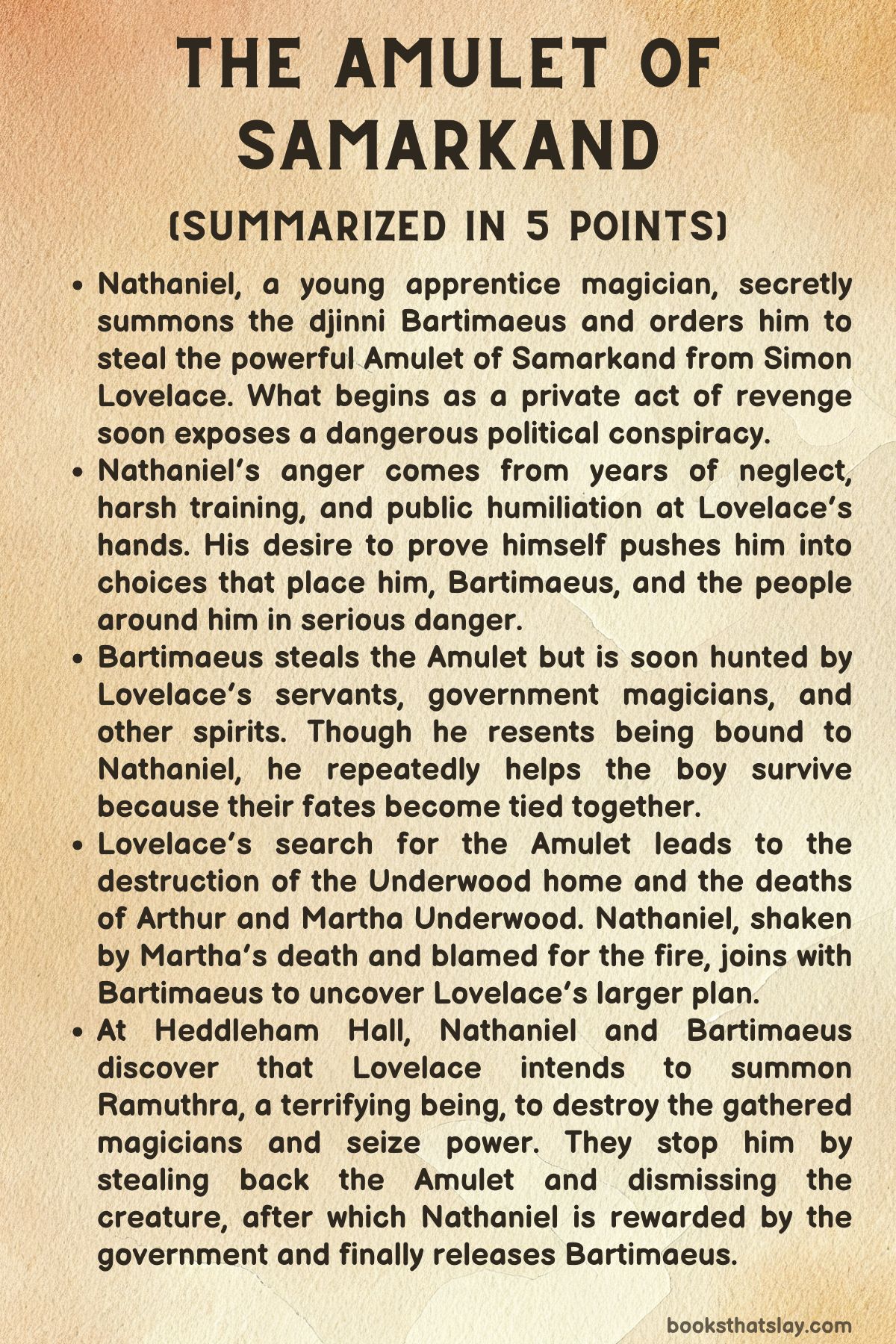
Summary
Nathaniel is a 12-year-old apprentice magician who secretly summons Bartimaeus, a powerful and sarcastic djinni, and binds him to his service. Though Bartimaeus tries to frighten him and resist his orders, Nathaniel proves more prepared than expected.
He commands the djinni to steal the Amulet of Samarkand from Simon Lovelace, an ambitious master magician. The Amulet is a rare magical artifact that can protect its wearer from magical attack, and Nathaniel wants it because he has a personal grudge against Lovelace.
Bartimaeus enters Lovelace’s house by transforming into small animals and insects, avoiding layers of magical defenses spread across several planes of perception. He slips inside while Lovelace entertains a woman and speaks about an important event at her estate.
In a heavily protected room, Bartimaeus finds several powerful artifacts, including a true summoning horn and the Amulet itself. When he steals it, Lovelace’s servants, the djinn Jabor and Faquarl, pursue him.
Bartimaeus escapes through speed, trickery, and magic, but he knows the theft will bring dangerous attention.
The story then reveals Nathaniel’s past. As a young child, he was given up by his parents to the government and taken in by Arthur Underwood, a middling magician who becomes his master.
Arthur is cold, unimaginative, and often dismissive, while his wife Martha treats Nathaniel with kindness. Nathaniel is raised to become a magician in a society where magical power is tied to government authority, and commoners are treated as inferior.
His education is strict, political, and lonely. He learns languages, history, drawing, and the techniques needed to summon spirits.
Nathaniel’s early life with Arthur leaves him damaged. Arthur once traps him in a study with bound spirits to teach him about demons, leaving the child terrified and humiliated.
Nathaniel’s fear gradually turns into anger and ambition. He longs for power not only because he admires famous magicians, but because he has learned that weakness invites cruelty.
The event that shapes his hatred of Simon Lovelace happens when Arthur presents him to other magicians. Lovelace tests Nathaniel’s knowledge, then insults him even after the boy answers well.
Nathaniel calls him a sore loser, and Lovelace retaliates by using a spirit to humiliate and hurt him in front of the adults. Arthur does nothing to defend him.
Nathaniel later releases mites on Lovelace and the others, but Lovelace discovers him and has him beaten unconscious. Ms. Lutyens, Nathaniel’s sympathetic drawing teacher, tries to protect him and is dismissed as a result.
From then on, Nathaniel secretly plans revenge.
Nathaniel advances far beyond Arthur’s lessons and secretly summons a minor imp, which he binds into a scrying glass. He uses it to spy on Lovelace and sees a mysterious exchange in which Lovelace receives the Amulet.
Nathaniel learns enough to believe Lovelace has obtained it illegally, so he summons Bartimaeus and orders the theft.
After stealing the Amulet, Bartimaeus is ordered to hide it in Arthur Underwood’s magical repository. He realizes Nathaniel may be trying to frame his own master, but Nathaniel insists no one will find it.
While carrying out the order, Bartimaeus overhears Nathaniel’s birth name, a dangerous secret for any magician. Since knowledge of a magician’s true name gives a spirit leverage, Bartimaeus gains a weapon against him.
When Bartimaeus later confronts Nathaniel, he uses the name during a fight and nearly kills him. Nathaniel counters by threatening Bartimaeus with an Indefinite Confinement spell tied to a tin of rosemary thrown into the Thames.
If Nathaniel dies or fails to cancel the spell, Bartimaeus will be trapped for centuries. The djinni is forced to continue helping him.
Nathaniel undergoes his Naming ceremony and takes the magician name John Mandrake. Around the same time, he and Arthur attend a state address at Parliament.
There, Nathaniel observes the political world of magicians: rivalries, social rank, insecurity, and the prime minister’s concern about the Resistance, a group of commoners who steal magical artifacts and oppose magician rule. During the address, an intruder detonates an elemental sphere, causing chaos.
Nathaniel sees the attacker and later hears adults discussing the Resistance’s involvement.
Meanwhile, Bartimaeus investigates Lovelace. He follows a messenger imp and learns of Lovelace’s connection to Sholto Pinn, the owner of a magical artifact shop.
Disguised as an imp, Bartimaeus questions Pinn’s assistant, Simpkin, and learns that the Amulet was government property and that its guardian was murdered. Before he can learn everything, Pinn returns, exposes Bartimaeus, and captures him with a Snare spell.
Bartimaeus wakes imprisoned in the Tower of London inside a shrinking magical orb. Jessica Whitwell, a powerful government magician, and Sholto Pinn interrogate him about his master and the Amulet.
Bartimaeus refuses to answer because he fears both Nathaniel’s spell and the magicians’ likely punishment. Nathaniel tries to summon him, but the prison blocks the summons.
Bartimaeus survives by changing forms as the orb contracts. He is eventually freed by Faquarl, though not out of kindness.
Faquarl is working for Lovelace and wants information. Bartimaeus escapes him after a chase, using wit and a moment of distraction.
Nathaniel’s secret activities are discovered by Arthur, who finds evidence of summoning in his room. Arthur is furious and threatens to ruin Nathaniel’s future.
Soon after, Lovelace arrives at the Underwood home, searching for the Amulet. Arthur believes he is being framed and refuses to cooperate at first.
Nathaniel, realizing that Martha and Arthur may be killed, admits that he stole the Amulet. Lovelace then reveals that he intends to kill them all anyway.
Arthur tries to save himself by offering Nathaniel up, showing his cowardice at the worst possible moment.
Jabor sets the house on fire. Bartimaeus rescues Nathaniel, but Arthur and Martha die in the blaze.
Nathaniel is devastated, especially by Martha’s death, because she was the one person in the household who truly cared for him. The official newspaper reports the fire as an accident and names Nathaniel as the suspected arsonist.
Now hunted and alone, Nathaniel hides with Bartimaeus in an abandoned library. They argue over blame, responsibility, and survival.
Nathaniel wants justice, while Bartimaeus wants freedom. They strike a new bargain: Bartimaeus will help expose Lovelace, and Nathaniel will release him before the confinement spell begins.
Together they work out that Lovelace is planning something at Heddleham Hall, an estate where a conference of important magicians will be held. Nathaniel suspects Lovelace means to overthrow the government.
Bartimaeus scouts the estate, and the pair travel there in disguise. They hijack a grocer’s delivery truck and enter the grounds by pretending to be suppliers.
Bartimaeus notices Faquarl disguised as a chef, which confirms that Lovelace has placed spirits throughout the estate. Nathaniel changes into a servant’s uniform and moves among the guests.
Inside the estate, Nathaniel follows Lovelace but is discovered. Lovelace confirms that he plans to overthrow the prime minister.
His old master, Schyler, offers Nathaniel a chance to join them, but Nathaniel refuses. Schyler attacks him with magic.
Nathaniel survives by using artifacts in the room, including Prague Cubes, and kills Schyler in the struggle. Shaken by the death, Nathaniel discovers the hidden summoning setup and realizes Lovelace intends to summon a massive spirit to destroy the assembled magicians.
Nathaniel summons Bartimaeus, and they rush to the auditorium. Lovelace begins his presentation while the prime minister and many powerful magicians watch.
A huge summoning pentacle is revealed under the glass floor. Lovelace blows the summoning horn, opening a rift to the Other Place.
A terrifying being called Ramuthra begins to enter the world. The Amulet protects Lovelace from magical attacks, and the magicians cannot stop the creature.
Their spells fail, bend away, or are absorbed.
Lovelace commands Ramuthra to kill everyone except himself. Nathaniel and Bartimaeus try to reach him.
Bartimaeus distracts Lovelace while Nathaniel goes for the Amulet. Jabor attacks, but the unstable rift destroys him.
Bartimaeus then tricks Lovelace by taking Amanda’s form, exploiting the wording of Lovelace’s command. He steals the summoning horn, and Ramuthra turns on Lovelace, consuming him.
With Lovelace gone, Ramuthra still has to be dismissed. The other magicians are too weak, frightened, or confused to act.
Nathaniel, though young and exhausted, attempts the dismissal himself. He calms his mind by remembering the Underwoods’ garden, the one peaceful place from his childhood, and succeeds in sending Ramuthra away.
Afterward, he hands the Amulet to the prime minister.
The government covers up much of the truth. Nathaniel gives a carefully shaped account that presents Arthur and Martha as heroes and himself as a humble apprentice.
He is rewarded rather than punished, placed under Jessica Whitwell’s supervision, and gains a new position within the magician world. Bartimaeus reminds him that the official story is false and asks to be released.
Nathaniel hesitates because Bartimaeus still knows his birth name, but the djinni threatens to reveal the real events if necessary. Nathaniel finally frees him.
Before leaving, Bartimaeus warns him not to let other magicians crush his spirit and also to guard his conscience. Then the djinni disappears, leaving Nathaniel alive, promoted, and morally changed by everything he has done.
Characters
Nathaniel
Nathaniel is the central human figure in the book, and his character is shaped by neglect, humiliation, intelligence, and hunger for recognition. He begins as a gifted apprentice who has been trained to believe that magicians are superior to commoners, yet his own life shows how cruel that system can be even to those inside it.
Given away by his parents, raised by a cold master, and denied ordinary affection, Nathaniel develops an intense need to prove himself. His pride is not simple vanity; it grows from years of being ignored, belittled, and made powerless.
Lovelace’s public humiliation of him becomes the spark that turns his ambition into revenge. He is brave, resourceful, and unusually skilled for his age, but he is also secretive, resentful, and willing to take dangerous risks without fully understanding the consequences.
His decision to steal the Amulet begins as a personal act, but it exposes a deadly conspiracy. Nathaniel’s grief after Martha’s death reveals that he is not emotionally empty, though he often tries to act controlled and superior.
By the end of The Amulet of Samarkand, he has saved the government and gained status, but the book leaves him in a morally uncertain position. He has learned courage and responsibility, yet he has also learned how easily truth can be managed for political benefit.
Bartimaeus
Bartimaeus is one of the most vivid characters in the story because he combines wit, ancient experience, bitterness, and reluctant loyalty. As a djinni, he has served many masters across centuries, and this long memory gives him a sharp view of human arrogance.
He mocks magicians constantly, not only because he enjoys insulting them, but because he understands that their power depends on enslaving spirits like him. His humor is a defense against captivity and danger.
He resents Nathaniel from the beginning, especially because the boy binds him and threatens him with a cruel spell, but his attitude changes as he sees Nathaniel’s youth, pain, and courage. Bartimaeus is not sentimental.
He wants freedom above all else, and he often reminds Nathaniel that their relationship is built on coercion rather than trust. Yet his actions show a complicated sense of honor.
He saves Nathaniel repeatedly, protects a young girl during his escape from Faquarl, and helps stop Lovelace even when the situation places him at great risk. In The Amulet of Samarkand, Bartimaeus acts as both comic voice and moral observer.
Through him, the reader sees the hypocrisy of magicians and the suffering hidden beneath their power.
Simon Lovelace
Simon Lovelace is the main antagonist, and his danger comes from the fact that he combines charm, intelligence, cruelty, and political ambition. In public, he appears polished and confident, a rising magician with influence and social standing.
In private, he is ruthless enough to arrange murder, steal government property, manipulate allies, and sacrifice an entire room of magicians to seize power. His treatment of Nathaniel shows his casual sadism.
He humiliates a child not because he needs to, but because he can. That scene reveals the deeper nature of his character: he enjoys dominance and expects others to submit.
Lovelace’s plot to summon Ramuthra shows a mind that is both bold and reckless. He believes that the Amulet and the horn make him untouchable, but his plan depends on controlling forces he does not truly understand.
His downfall comes through arrogance as much as opposition. He underestimates Nathaniel, Bartimaeus, Amanda’s anger, and the danger of careless wording in magic.
In the book, Lovelace represents ambition without conscience, a magician who sees politics as conquest and other lives as tools.
Arthur Underwood
Arthur Underwood is Nathaniel’s master, but he fails in almost every meaningful duty attached to that role. He is not portrayed as a great villain in the same way Lovelace is, yet his weakness and selfishness cause deep harm.
As a magician, Arthur is mediocre, insecure, and rigid. He relies on rules, status, and old methods because he lacks imagination and courage.
His treatment of Nathaniel is cold and often cruel, especially when he exposes the boy to frightening spirits as a lesson. He does not nurture Nathaniel’s talent, nor does he protect him when Lovelace humiliates him.
That failure becomes one of the defining wounds in Nathaniel’s life. Arthur’s final actions confirm his moral weakness.
When Lovelace threatens the household, Arthur tries to hand Nathaniel over to save himself. His death is tragic, but it is not heroic in the immediate truth of events.
Later, Nathaniel reshapes the story to make Arthur appear noble, which says as much about Nathaniel’s political instincts as it does about Arthur’s reputation. Arthur is important because he shows how ordinary cowardice can damage a child as deeply as open cruelty.
Martha Underwood
Martha Underwood is the emotional center of Nathaniel’s early life, even though she has little power within the magician world. Unlike Arthur, she treats Nathaniel as a child rather than merely as an apprentice or investment.
Her kindness is practical and quiet: she helps him with homework, speaks to him gently, worries about his health, and notices when something is wrong. She is not able to save Nathaniel from Arthur’s system of training, and she sometimes sides with her husband because she lives within that household structure, but her affection still matters deeply.
Nathaniel’s attachment to her shows that he wants care even when he tries to hide vulnerability beneath pride. Her death in the fire is one of the story’s major emotional turning points.
It transforms Nathaniel’s revenge into a demand for justice and gives him a personal reason to stop Lovelace beyond wounded pride. Martha’s role in the book is also symbolic.
She represents the ordinary human warmth that the magician world suppresses, and her loss pushes Nathaniel further into a world where tenderness is often treated as weakness.
Ms. Lutyens
Ms. Lutyens is Nathaniel’s drawing teacher and one of the few adults who encourages independent thought in him. Her importance lies not in magical power, but in moral perspective.
She teaches him a skill necessary for magic, yet she also questions the political ideas that his education tries to impose. When she speaks about the unfairness of magician rule and challenges Nathaniel’s assumptions about commoners, she plants doubts that he does not fully accept at the time.
Her dismissal after she tries to defend him from Lovelace’s cruelty becomes another lesson in how the system punishes compassion. For Nathaniel, losing Ms. Lutyens confirms that kindness is fragile and that authority usually protects itself.
She also stands in contrast to Arthur: where Arthur teaches fear and obedience, Ms. Lutyens encourages thought and self-respect. Her influence remains subtle, but it matters.
Later, when Nathaniel must act against Lovelace, some part of his resistance to corruption can be traced back to the adults who treated him as more than a tool.
Jessica Whitwell
Jessica Whitwell is a powerful government magician associated with law, order, and official authority. She is competent, controlled, and intimidating, especially when she interrogates Bartimaeus at the Tower of London.
Her role shows the strength of the state and the hard edge of its institutions. She does not appear personally cruel in the same theatrical way as Lovelace, but she operates within a system that imprisons, questions, and uses spirits as instruments.
Her suspicion of Bartimaeus is reasonable from the government’s point of view, yet the scene also reinforces how little concern magicians show for the suffering of bound beings. At the end, Whitwell becomes Nathaniel’s new master, which is a major change in his fortunes.
She represents a path into higher government service and greater power. For Nathaniel, being placed with her is a reward, but it is also a warning.
He is moving deeper into the same political structure that produced Lovelace, Arthur, and the cover-up. Whitwell’s presence suggests that Nathaniel’s future will be shaped by discipline, ambition, and state power.
Faquarl
Faquarl is one of Bartimaeus’s most dangerous spirit rivals. He is clever, persistent, and far more than a simple servant carrying out orders.
Because he and Bartimaeus know each other from earlier times, their confrontations carry a sense of old hostility and professional recognition. Faquarl pressures Bartimaeus for information, tries to recruit him to Lovelace’s side, and later appears in disguise at Heddleham Hall.
He understands strategy and deception, which makes him a strong match for Bartimaeus. Unlike Jabor, who often feels more direct and forceful, Faquarl is patient and manipulative.
His presence also expands the reader’s understanding of spirits as thinking beings with rivalries, memories, and personalities of their own. Though he serves Lovelace, his motivations are not the same as a human magician’s.
He is trapped within a structure of command, yet he still seeks advantage where he can. In the story, Faquarl sharpens the danger around Bartimaeus because he can anticipate tricks and respond with tricks of his own.
Jabor
Jabor is a violent and forceful djinni bound to Lovelace’s service. He functions as a physical threat throughout the book, especially during the theft of the Amulet, the attack on the Underwood home, and the final confrontation.
While Faquarl is marked by cunning, Jabor is marked by aggression. He pursues, attacks, burns, and destroys.
His role during the house fire is especially important because he becomes the direct instrument of the disaster that kills Arthur and Martha. For Nathaniel, Jabor is part of the nightmare unleashed by his own revenge.
For Bartimaeus, Jabor is a dangerous opponent whose strength cannot be dismissed. Yet Jabor is also another bound spirit, which complicates his villainy.
He commits terrible acts, but he does so under a magician’s command. His death in the chaos of Ramuthra’s arrival reinforces one of the book’s recurring ideas: magicians unleash powers that can consume servants and enemies alike.
Jabor’s brutality makes Lovelace’s cruelty visible in action.
Schyler
Schyler is Lovelace’s old master and an important figure behind the conspiracy. As an older magician, he represents the generational transfer of ambition, secrecy, and contempt.
He is not merely a passive supporter of Lovelace’s plan; he helps prepare the summoning and is willing to have Nathaniel killed when the boy refuses to join them. His offer to Nathaniel is revealing because it shows how conspirators recruit through ambition.
Schyler assumes that a talented, angry apprentice might be tempted by power if given the chance. Nathaniel’s refusal marks an important moral boundary, even though Nathaniel is far from innocent himself.
Schyler’s death also forces Nathaniel across a psychological line. Until that moment, Nathaniel has caused danger indirectly, but killing Schyler makes the cost of his path immediate and physical.
Schyler’s role in The Amulet of Samarkand is brief compared with Lovelace’s, but he helps show that corruption is not isolated to one ambitious man. It belongs to a wider culture of magicians who see power as entitlement.
Amanda
Amanda is connected to Lovelace socially and romantically, and her estate becomes the setting for the planned political massacre. At first, she seems mainly part of Lovelace’s public world: elegant, connected, and useful to his ambitions.
Her home gives him access to the gathered elite, and her event provides the perfect cover for his scheme. Yet Amanda is not simply a decorative figure.
During the final confrontation, she reacts with anger when she understands Lovelace’s treachery. Her accusation helps create the distraction Nathaniel and Bartimaeus need.
Even though Bartimaeus later exploits her form in a crucial trick, Amanda’s own response matters because it shows that Lovelace’s betrayal cuts through personal as well as political bonds. He is willing to sacrifice even those close to him.
Amanda’s character helps reveal Lovelace’s emptiness: he treats intimacy, hospitality, and trust as tools. Through her, the book shows how ambition corrupts private relationships as well as public institutions.
The Resistance Girl
The girl associated with the group of children who attack Bartimaeus and later take Nathaniel’s scrying glass represents a force outside the magician hierarchy. She is brave, observant, and unusually capable, especially because she and the other children can notice magical objects and beings in ways ordinary commoners usually cannot.
Her group is young, but they are not helpless. They move through London’s streets with purpose, stealing and confronting danger despite the threat of the Night Police and magical retaliation.
From Nathaniel’s point of view, they are irritating and threatening because they expose his vulnerability when he lacks official protection. From the wider perspective of the story, they suggest that commoners are not as powerless or ignorant as magicians claim.
The girl’s presence complicates the political world of the book. The Resistance may use theft and violence, but its existence points to real injustice.
Through her, the story introduces the idea that rebellion is not merely criminal disorder; it may be a response to a society built on magical domination.
Sholto Pinn
Sholto Pinn is the owner of Pinn’s Accoutrements, a magical artifact shop, and he represents the commercial side of the magician world. His shop is filled with dangerous and valuable objects, and his connections to Lovelace show how politics, crime, and magical trade overlap.
Pinn is proud, suspicious, and quick to defend his interests. His treatment of Simpkin, the spirit who assists him, also reflects the casual enslavement on which magician society depends.
Pinn may not be the central villain, but he benefits from the same system that allows men like Lovelace to flourish. When Bartimaeus questions Simpkin, the scene reveals how much important information is hidden in networks of dealers, servants, and private exchanges.
Pinn’s role shows that corruption does not exist only in Parliament or among conspirators. It also sits in shops, business arrangements, and the everyday handling of magical property.
Simpkin
Simpkin is a lesser spirit serving Sholto Pinn, and his character gives a smaller but memorable view of enslavement among spirits. He takes pride in his position as an assistant, which disgusts Bartimaeus because it suggests how deeply servitude can shape a being’s self-image.
Simpkin is eager to talk when Bartimaeus flatters and manipulates him, and through him, key information about the Amulet emerges. His vulnerability lies in his desire for importance.
He wants to seem knowledgeable and valued, even though he remains bound to a master who controls him. Simpkin’s presence adds texture to the spirit world by showing that not all spirits respond to captivity in the same way.
Some rage against it, some scheme within it, and some cling to the small status they are allowed. His character helps deepen the book’s critique of magical society by showing how domination can distort both the powerful and the powerless.
Themes
Power and Its Moral Cost
Power in The Amulet of Samarkand is never presented as clean or harmless. Magicians appear powerful because they command spirits, hold government offices, control the police, and shape public truth, but that power depends on fear, secrecy, and exploitation.
Nathaniel wants power because he has been humiliated and neglected; to him, magical skill promises safety and respect. Yet the more power he gains, the more morally dangerous his choices become.
His theft of the Amulet begins as revenge, but it leads to murder, arson, political cover-up, and a near catastrophe. Lovelace shows the extreme end of the same hunger.
He does not want protection or dignity; he wants domination. The Amulet itself becomes a symbol of power separated from responsibility, shielding its wearer while others suffer the consequences.
Even the government’s power is morally compromised, since it hides the truth after the final crisis. The story suggests that power may be necessary to survive in a cruel system, but it always demands a choice: whether to use it for justice, self-protection, ambition, or control.
Enslavement, Freedom, and the Spirit World
The relationship between magicians and spirits is built on coercion. Magicians call beings from the Other Place, trap them in forms, bind them with pentacles, and force them to carry out commands.
Bartimaeus’s humor often makes his suffering easier to overlook, but the book repeatedly reminds the reader that he is not free. He serves because he must.
Nathaniel’s control over him is especially uncomfortable because Nathaniel is himself a child shaped by mistreatment, yet he repeats the same logic of domination when dealing with Bartimaeus. The djinni’s desire for release is not a side issue; it is central to the moral structure of the story.
His anger at magicians comes from centuries of use, pain, and forced obedience. Lesser spirits such as Simpkin show another side of captivity, where a servant may become proud of a role that still depends on bondage.
By making spirits intelligent, funny, fearful, resentful, and loyal in complicated ways, the story challenges the magician view that they are merely tools. Freedom becomes more than Bartimaeus’s personal wish; it becomes a judgment on the entire magical order.
Class, Government, and Rebellion
The society of the story is sharply divided between magicians and commoners. Magicians rule the state, control education, command magical forces, and describe commoner rule as unthinkable.
Nathaniel is trained to accept this hierarchy, but the events around him reveal its instability. The Resistance exists because commoners are not passive.
They steal artifacts, attack Parliament, and organize through young people who understand more about magic than the ruling class expects. The government describes them as criminals and threats, and their methods can be dangerous, but their existence points to a deeper injustice.
The magician elite maintains order through surveillance, police power, propaganda, and fear. Even the newspaper report after the Underwood fire shows how public information is shaped to serve authority.
Nathaniel’s own rise depends partly on accepting this world’s habits: controlled storytelling, useful lies, and political reward. The book does not present rebellion as simple heroism or government as simple stability.
Instead, it shows a society where inequality creates resistance, and where those in power treat any challenge as proof that harsher control is needed.
Childhood, Humiliation, and the Making of Identity
Nathaniel’s identity is formed through repeated experiences of abandonment and humiliation. His parents give him up, Arthur trains him without warmth, and Lovelace publicly degrades him while other adults fail to intervene.
These moments do not merely hurt him; they teach him how the world works. He learns that weakness is punished, that adults protect status more readily than children, and that intelligence matters only when backed by power.
His choice of the name John Mandrake marks a formal step into magician society, but it also reflects a deeper split between the vulnerable child Nathaniel and the ambitious magician he is trying to become. The secrecy surrounding his birth name shows how identity itself becomes dangerous in this world.
Bartimaeus’s knowledge of that name threatens him because it exposes the self beneath the constructed role. Martha and Ms. Lutyens offer gentler versions of who Nathaniel might have become, while Arthur and Lovelace push him toward pride and calculation.
By the end, Nathaniel has survived and succeeded, but the question remains whether he has protected his conscience or begun to bury it beneath the identity that power rewards.