Emily Wilde’s Map of the Otherlands Summary, Characters and Themes
Emily Wilde’s Map of the Otherlands by Heather Fawcett is the second novel in the Emily Wilde series, blending fantasy, scholarship, danger, and romance through the voice of its famously practical heroine. Emily is a dryadologist, a scholar of faerie lore, and she approaches the impossible with the habits of a careful academic: observation, notes, and stubborn persistence.
In this installment, her work expands from cataloguing faeries to charting the hidden realms they inhabit. At the same time, her bond with the charming and secretive Wendell Bambleby grows more complicated. The novel balances academic curiosity with peril, offering a story about loyalty, power, and choosing what kind of life to build.
Summary
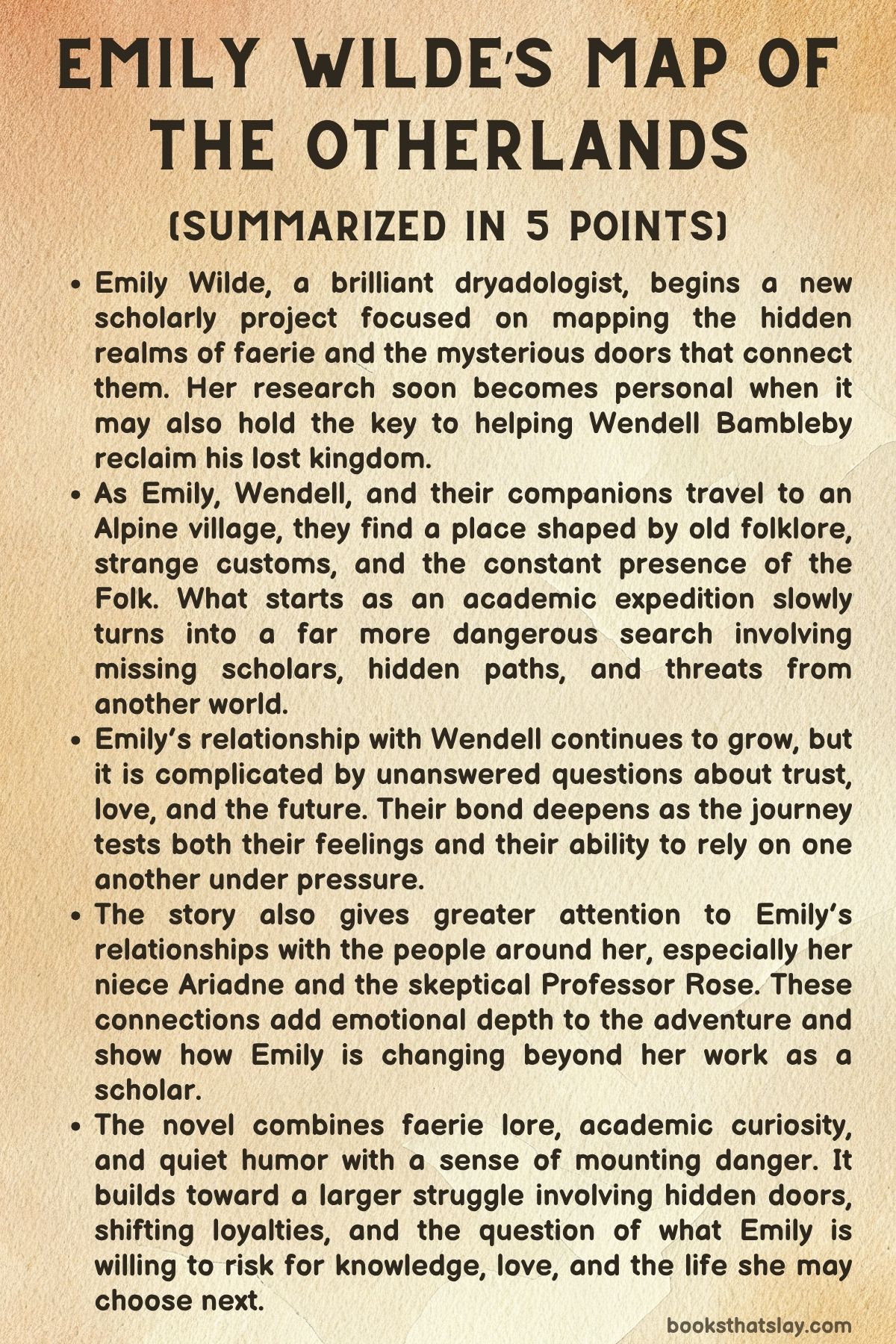
Emily Wilde has secured her place at Cambridge after the success of her encyclopaedia on faeries, and she turns her attention to a new scholarly task: creating a map of the known faerie realms and the doors that lead into them. Her research is not only academic.
It is deeply tied to Wendell Bambleby, her fellow scholar, dearest companion, and a faerie king in hiding. Wendell needs to find a hidden route into his own realm so he can return without alerting the stepmother who stole his throne and wants him dead.
Emily has not yet given him an answer to his marriage proposal, but their lives have already become closely bound.
That fragile routine is broken when strange threats begin closing in. A mysterious man covered in ribbons appears to Emily and speaks in unsettling riddles.
Soon after, Emily and Wendell are confronted by suspicion at Cambridge from Professor Rose, who believes their past research is fraudulent. Before that conflict can fully unfold, Wendell’s enemies strike.
Assassins sent from faerie attack at the university, forcing Emily and Wendell to defend themselves openly. Rose witnesses enough to understand that something far more dangerous than academic dishonesty is at work.
Wendell’s magic is powerful, but something is wrong with it. He has been poisoned, and the poison leaves him weakened and makes his magic unstable.
Emily’s research points toward the Austrian Alps, where a vanished scholar named Danielle de Grey had once searched for faerie pathways. Emily believes the region may contain a hidden nexus connected to Wendell’s realm.
She sets out for St. Liesl with Wendell, her niece Ariadne, and the unwilling but curious Rose. Ariadne has come to study at Cambridge and eagerly joins Emily as an assistant, though Emily is often awkward in showing affection or trust.
Rose, meanwhile, joins partly out of suspicion and partly because his own expertise may be useful.
In St. Liesl, the group finds a town shaped by old customs meant to survive the presence of the Folk. The locals tie ribbons to mark paths and warnings, prepare offerings at night, and fear the woods after dark.
Emily begins her search through maps, folklore, and fieldwork. She and her companions locate many faerie doors, yet none lead to the place Wendell needs.
Even so, the expedition changes the relationships within the group. Wendell places absolute faith in Emily’s skill, and she begins to imagine what it would mean to enter his world and decide whether she can truly share a life with him.
Rose, though still skeptical, begins to respect Emily’s judgement. At the same time, he warns her that loving one of the Folk can end in ruin.
The dangers in the mountains prove very real. Emily’s confidence in her methods sometimes leads her to underestimate the threat around them.
Rose is badly injured during one excursion when local fox faeries attack, and Emily is forced to confront the fact that her choices can harm others. Wendell heals Rose, though not perfectly, and his efforts cost him more of his strength.
Not long after, the ribboned man appears again, and Emily finally understands that he is Professor Eichorn, another scholar who disappeared decades earlier while searching for Danielle de Grey. He is trapped in the Otherlands, the strange border spaces between faerie realms, and he begs Emily to help him find Dani.
As Wendell’s condition worsens, the search takes on new urgency. Emily learns that the local sightings of Eichorn and Danielle are not mere ghost stories.
They are real echoes of two people lost between worlds. She also discovers that the tree fauns connected to Wendell’s realm are more dangerous than expected.
During another expedition, Wendell and the others are hunted by deadly faerie riders sent by his stepmother. He uses enormous reserves of magic to protect the group, but the effort nearly destroys him.
Emily sees ominous signs of death moving across his skin and realizes the poison may soon kill him.
Determined to save him, Emily seeks help from old allies among lesser faeries. She finds Poe, who gives her enchanted food that eases Wendell’s symptoms for a short time.
Her growing awareness of the small, overlooked beings around her becomes an important thread in the story. Emily respects these beings in a way that many grander faeries do not, and that respect is often returned.
She also continues to follow the signs left by Eichorn and Danielle, even when doing so leads her into darkness, confusion, and the risk of becoming lost herself. In one such moment, Wendell finds her in the forest, and the closeness between them finally becomes physical.
Their love is no longer theoretical or postponed. It is real, tender, and tied to everything they now stand to lose.
Emily eventually helps pull Eichorn out of the Otherlands, but the cost to Wendell is severe. The group pieces together the truth: Danielle, Eichorn, and Emily each possess parts of a tree faun, and those pieces have been trying to reunite.
When Danielle herself finally appears, it becomes possible to understand how the nexus works. Wendell, though barely able to stand, helps bring her back as well.
Emily at last accepts his marriage proposal, but there is little time for happiness. She becomes convinced that the cure for Wendell lies in his own realm, and specifically with his cat, Orga.
To save him, Emily must enter the nexus and travel into Wendell’s kingdom. Ariadne insists on coming with her, refusing to be left behind.
The journey into faerie is dangerous and disorienting, full of shifting roads, deceptive signs, and hostile creatures. They are aided by Snowbell, a fox faerie whose loyalty Emily has earned through fairness and care.
They also carry gifts and clues from friends Emily has made along the way. These details matter because they show how Emily succeeds: not through grandeur, but through patience, memory, scholarship, and decency.
Once inside Wendell’s realm, Emily reaches his castle by pretending to be an enchanted mortal scholar. There she encounters Callum Thomas, a human man attached to the faerie court, and gains help from an unexpected ally.
Emily searches Wendell’s former rooms, finds Orga, and uses poison taken from the tree faun horn in an attempt to strike at Wendell’s stepmother. The queen proves cunning and dangerous, but Emily escapes with the cat and flees through the castle gardens, pursued by monstrous guardians.
Emily returns to the mortal world far more quickly than expected, because time moves differently across these spaces. Orga attacks the poison afflicting Wendell, dragging blackbird-like manifestations of it from his body and destroying them.
Wendell survives. Their reunion is deeply emotional, and he admits how much he admires Emily for what she has done.
When the queen’s gargoyle servants arrive, Wendell confronts them and forces a resolution that leaves them unwilling to continue the fight, though the route back into his realm remains blocked.
In the aftermath, the expedition’s human relationships settle into clearer forms. Ariadne and Emily repair the distance that had grown between them, and Emily openly acknowledges her as family.
Rose becomes not merely a critic but a true ally, offering mentorship and professional respect. The townspeople, once fearful and angry, are partly reconciled with the scholars after the local threats are reduced.
Emily also recognizes that much of their success came from allies others might ignore: little ones, common faeries, villagers, and loyal animals.
By the end of the book, Emily and Wendell are preparing for the next stage of their lives. Wendell believes his stepmother is likely dead from the poison, though the struggle for his throne is not yet finished.
Emily agrees to take a long sabbatical from Cambridge so they can reopen the nexus, return to his kingdom, and claim his rule together as husband and wife. She does not abandon scholarship; instead, she carries it with her into this new future.
Her work on mapping faerie realms continues, now enriched by direct experience, stronger friendships, and a wider understanding of power. The novel closes with the sense that Emily is no longer only recording the edges of the Otherlands.
She is stepping into them fully, on her own terms.
Characters
Emily Wilde
Emily Wilde remains the intellectual center of Emily Wilde’s Map of the Otherlands, and her character is defined by the tension between brilliance and emotional reserve. She is a scholar first in instinct, someone who approaches danger, mystery, and even affection through evidence, pattern, and observation.
That habit makes her deeply original as a fantasy heroine. She is not led by prophecy, social charm, or instinctive heroism, but by study, discipline, and persistence.
At the same time, this practical nature does not make her cold in any simple sense. Emily cares very deeply, yet she often expresses that care through work, protection, and problem-solving rather than through easy warmth.
Her growth in this story comes from learning that knowledge alone is not always enough, especially when the people around her need trust, openness, and shared responsibility.
A major strength of Emily’s characterization is that her flaws are as active as her gifts. She is capable, courageous, and usually correct in her reasoning, but she can also be impatient, controlling, and so focused on a goal that she underestimates the risk to others.
Her mistakes in the mountains, especially when Rose is injured and later when the townspeople are endangered, reveal that her confidence can become recklessness. The novel does not excuse these failures, which makes her more believable.
She is forced to confront the fact that being the cleverest person in the room does not spare her from poor judgement. What makes her compelling is not perfection, but the fact that she reflects, feels guilt, and tries to do better.
She does not enjoy emotional exposure, yet she slowly becomes more accountable to the people who depend on her.
Her emotional arc is closely tied to love, family, and belonging. Her relationship with Wendell pushes her to imagine a future larger than scholarship alone, while her interactions with Ariadne show how uneasy she is with overt affection even when she loves someone deeply.
Emily’s gradual willingness to admit that she wants companionship, marriage, and a life beyond academic isolation marks real development. By the end, she is still recognizably herself: observant, dry, stubborn, and scholarly.
But she is also more open to partnership, more aware of the value of overlooked allies, and more willing to see herself as part of a family rather than only as an outsider recording the world.
Wendell Bambleby
Wendell is written as both a romantic figure and a political one, and the novel deepens him by showing how much strain lies beneath his effortless charm. On the surface, he is witty, graceful, vain, and theatrically delightful, often using humor and beauty to shape the mood around him.
He appears at ease in almost every situation, and his manner can make him seem frivolous. Yet this book reveals more clearly that the performance is partly defensive.
Wendell is living under threat, hunted by a stepmother who has stolen his throne and wants him dead, and poisoned in a way that steadily strips him of power and safety. The ease with which he usually moves through the world becomes more poignant because it is repeatedly interrupted by pain, exhaustion, and the knowledge that his life may be short.
What makes Wendell effective as a character is that he is not simply the dazzling magical love interest. He is deeply powerful, but he is also vulnerable in ways that matter.
His poison is not only a physical affliction; it also destabilizes his identity, because his magic, which is one of the clearest expressions of who he is, becomes unreliable. He remains generous and funny, but he is no longer in full control of himself.
This allows the story to show his dependence on Emily without reducing him. He trusts her absolutely, and that trust is central to their relationship.
Rather than trying to dominate events, he places his fate in her hands, which gives their bond an unusual balance. He may be a king, but he is willing to be helped, questioned, corrected, and even saved.
Wendell’s emotional depth also comes through in his seriousness about Emily. He is flirtatious by nature, but his love for her is not casual.
He wants her as an equal, not as an ornament to his courtly life. His proposal is not a passing whim, and his tenderness with her often appears in small, attentive gestures.
He understands her strangeness better than many others do and seems to admire the exact qualities that make her difficult to conventional society. At the same time, the novel does not let him remain untouched by criticism.
Emily sees that he has blind spots, especially in the way courtly faeries dismiss lesser beings, and one measure of his worth is that he listens. By the end, he appears not only as a charming prince in exile, but as someone capable of becoming a better ruler because of what he has learned from her.
Ariadne
Ariadne plays an important role as both family and contrast to Emily. She arrives as a younger scholar eager to assist, and at first she seems to occupy the familiar place of an enthusiastic apprentice.
Yet she quickly becomes more than that. Ariadne is intelligent, observant, and brave, but unlike Emily she is socially responsive and emotionally expressive.
This difference matters because it exposes Emily’s weaknesses in an intimate way. Emily often assumes that competence should be enough to communicate care, while Ariadne needs recognition, trust, and warmth.
Their strained dynamic is one of the more grounded emotional threads in the novel, since it reflects a believable conflict between affection and frustration across generations of women in the same family.
Ariadne is also important because she is not merely there to admire her aunt. She pushes back, feels hurt, forms her own opinions, and seeks connection where she can find it, including with Wendell.
Her growing distance from Emily is not petty; it arises from Emily’s constant correction and inability to offer praise at the right moments. That gives Ariadne dignity as a character.
She is not passive, and her emotional responses are not treated as trivial. She wants to contribute meaningfully, and when she is sidelined or overmanaged, she reacts as a real person would.
This tension adds depth to Emily as well, because Ariadne’s disappointment reveals the cost of Emily’s habits.
By the later parts of the story, Ariadne proves her courage and loyalty through action. She insists on joining the dangerous journey into faerie, refuses to be left behind, and repeatedly shows that she is more capable than Emily sometimes allows.
Her role in the quest demonstrates that she is not just a student but a participant in shaping events. The eventual softening between her and Emily is satisfying because it is based on recognition rather than sentimentality.
Ariadne becomes one of the clearest signs that Emily is learning how to love people openly. As a result, Ariadne emerges as one of the most emotionally important secondary characters in Emily Wilde’s Map of the Otherlands, representing family, trust, and the future of scholarship beyond Emily herself.
Professor Rose
Professor Rose begins as an academic rival and skeptic, but he develops into one of the richest supporting characters in the novel. At first, he seems poised to serve as a narrow-minded obstacle: suspicious of Emily and Wendell, resentful of their work, and dismissive of their methods.
Yet the story gradually complicates him. Rose is rigid, but not stupid; cautious, but not cowardly; proud, but still capable of growth.
His objections often come from genuine concern about danger and discipline rather than simple malice. This makes him more convincing than a standard antagonistic colleague.
He represents an older scholarly mindset, one that values distance, order, and control, and his clashes with Emily are as much methodological as personal.
One of the most interesting aspects of Rose is how the novel uses him to challenge Emily ethically. He sees risks she ignores and voices warnings she does not want to hear.
At times he is wrong, especially when he reduces Wendell to an object of study, but he is not wholly wrong about the danger of entanglement with the Folk. His caution has emotional roots as well.
The story he shares about a man destroyed by his love for a faerie suggests that Rose’s skepticism is informed by pain and perhaps old guilt. That background gives weight to his severity.
He is not arguing from abstract theory alone; he has seen what enchantment can cost.
His injury marks a turning point. Once Rose suffers directly from the dangers Emily has underestimated, the relationship between them changes.
Emily’s guilt makes her more aware of him as a person rather than merely an irritant, and Rose in turn begins to respect her intelligence and leadership. Their eventual rapport is one of the most rewarding developments in the book.
He moves from adversary to ally without losing his distinct personality. He remains sharp, opinionated, and somewhat severe, but he also becomes supportive, even generous.
His offer of mentorship and professional recognition near the end shows a man capable of humility and admiration. Rose ultimately adds emotional texture to the expedition by serving as critic, witness, survivor, and friend.
Danielle de Grey
Danielle de Grey functions for much of the novel as an absence, a mystery, and a scholarly legend, which gives her an almost mythic presence before she fully returns to the story. She represents the earlier generation of female scholarship, someone who pursued dangerous knowledge and vanished into it.
For Emily, Dani is both research subject and model, a reminder that women have long worked at the edges of accepted knowledge and often paid a high price for doing so. Because of this, Danielle’s importance extends beyond her individual personality.
She symbolizes unfinished academic history, the stories of brilliant women whose work is interrupted, erased, or turned into rumor.
When she finally reappears, Danielle becomes more human and less legendary. She is exhausted by what she has endured and no longer driven by the same relentless need to keep searching.
This is an effective choice, because it refuses the simplistic idea that a lost scholar should emerge unchanged and still hungry for discovery. Her long time in the Otherlands has altered her priorities.
She and Eichorn have suffered enough that survival itself matters more than ambition. That gives her return a note of realism within the fantasy frame.
She is not preserved as an icon of endless curiosity; she is a person who has lived through prolonged uncertainty and wants rest.
Danielle’s role in the plot is also crucial because she holds part of the knowledge Emily needs, especially concerning the nexus and the tree faun relics. Yet even here she is not reduced to a mere source of information.
Her presence reminds the reader of the cost of obsession and of the thin line between scholarship and disappearance. She stands as a kind of mirror for Emily, showing what can happen when pursuit of knowledge carries someone too far from ordinary life.
That parallel quietly deepens Emily’s choices by forcing her to imagine not just intellectual success, but what kind of life she wants to preserve around her work.
Professor Eichorn
Professor Eichorn is introduced as a haunting figure before becoming a tragic and strangely tender character. His ribbon-covered appearances are eerie and unsettling, but once Emily understands who he is, he becomes one of the book’s clearest examples of prolonged loss.
Eichorn has been trapped in the spaces between worlds, clinging to fragments of self and to the hope of finding Danielle. His repeated calls, his confusion, and his desperation create a portrait of a man suspended outside normal time, damaged but not emptied of devotion.
This gives him a ghostlike quality without making him unreal. He is a scholar consumed by the consequences of seeking too far and waiting too long.
What defines Eichorn most is fidelity. He is still trying to find Dani after decades of separation, and that loyalty gives emotional force to his character.
He could easily have become a figure of pure madness, but the novel preserves his purpose. Even in confusion, he remains oriented toward someone he loves and toward a task he cannot abandon.
That makes him both admirable and heartbreaking. His condition also broadens the novel’s treatment of scholarship.
Through him, research is not only intellectual work but a force that can isolate, obsess, and transform.
Once restored to the mortal world, Eichorn helps move the story forward, yet he carries with him the weariness of someone who has been altered beyond full repair. He and Danielle are not presented as triumphantly recovered explorers ready to resume their former lives.
Instead, they feel like survivors. Eichorn’s presence therefore adds gravity to the story’s romantic and adventurous elements.
He shows that the boundary between discovery and ruin is thin, and that devotion can sustain a person but also trap him in endless repetition. In that sense, he is both warning and witness.
Shadow
Shadow, Emily’s dog, is more than a beloved companion. He is a living extension of her emotional life, especially the parts of it she does not easily articulate.
Emily’s care for Shadow is one of the clearest signs of her tenderness, and the attention she gives to his age, pain, and comfort reveals a gentleness that she often struggles to show with people. He provides warmth and steadiness in a world full of deception, and his bond with Emily is one of the purest relationships in the novel.
Because Emily is often awkward in human intimacy, Shadow becomes an important emotional anchor.
At the same time, Shadow is not merely comforting. His grim nature reminds the reader that even loyal creatures can contain frightening power.
When enhanced by magic, he becomes dangerous in ways that shock Emily herself. This moment matters because it complicates the easy affection attached to him.
Shadow is not reduced to a cute companion or simple protector. He becomes part of the book’s wider concern with responsibility and unintended harm.
Emily’s horror after he injures a local man shows that love does not erase accountability.
His later behavior, marked by shame and renewed affection, gives him unusual emotional texture for an animal companion in fantasy. He is treated as a being with feeling, memory, and moral presence, not just as a useful familiar.
Shadow’s role therefore combines comfort, danger, and loyalty. He embodies the instinctive trust Emily places in very few living things, and through him the novel explores both devotion and fear.
Orga
Orga, Wendell’s cat, appears late but carries strong symbolic and practical importance. Long before she enters the story directly, she is described by Wendell with an intimacy that makes clear how much she matters to him.
That early mention prepares the reader to understand that Orga is not incidental. She belongs to his home, his past, and the part of his life that exile has cut him off from.
In that sense, she represents something deeply personal and irreplaceable, more revealing than any political emblem or royal possession.
When Emily finally finds Orga, the cat remains fittingly difficult to trust. Orga is not sentimentalized.
She is elusive, self-possessed, and catlike in the most useful way, moving through danger with an air of private knowledge. Emily’s decision to capture rather than simply believe in her shows both Emily’s caution and the uncertainty surrounding every creature tied to faerie.
Yet Orga proves essential, ultimately becoming the means by which Wendell is freed from the poison. Her importance transforms her from anecdotal detail into a figure of restoration.
Orga also serves as a reminder that healing in the novel does not come only from grand acts of power. It comes through old bonds, overlooked creatures, and forms of knowledge that are intimate rather than scholarly.
As Wendell’s trusted companion, Orga becomes part of the emotional architecture of his character, while also giving the narrative one of its most satisfying solutions. Her friction with Shadow afterward adds a welcome note of domestic comedy, grounding the story after so much danger.
Poe
Poe continues to represent a different mode of faerie existence from the glamorous and aristocratic world associated with Wendell. He is generous, practical, and quietly resourceful, a figure whose kindness never feels weak or ornamental.
Emily’s relationship with Poe reflects one of her most admirable qualities: she does not measure worth according to status. She values intelligence, reliability, and reciprocity wherever she finds them, and Poe responds to that respect.
Their connection strengthens the novel’s moral pattern, which repeatedly shows that those dismissed as lesser or peripheral may be the most dependable allies.
Poe’s role in the story is modest in terms of page time, but large in structural importance. He provides food that helps Wendell, carries news, and acts as a bridge across worlds.
More importantly, he helps reveal one of Wendell’s limitations. Wendell comes from a courtly culture that tends to underestimate small beings, and Emily’s insistence on Poe’s worth becomes part of the larger lesson Wendell must learn if he is to become a better ruler.
Poe is therefore not only helpful; he is thematically important.
As a character, Poe offers warmth without sentimentality. He is not idealized into perfect innocence, but he is portrayed as capable of care, memory, and reciprocity.
His presence broadens the emotional landscape of the novel by showing that friendship can cross enormous differences in power and status. He is one of the clearest examples of the book’s belief that respect matters more than grandeur.
Snowbell
Snowbell begins as one of the local fox faeries, a category already associated with danger and mischief, yet develops into a valuable ally through Emily’s fairness and attentiveness. This evolution is one of the story’s most satisfying uses of faerie logic.
Snowbell does not become trustworthy because he is secretly human-like in morality. Instead, he responds to debt, naming, treatment, and relationship in ways consistent with the world’s rules.
Emily earns his help by observing those rules properly and by extending care in practical forms. That makes their alliance feel earned rather than convenient.
As a character, Snowbell adds liveliness, unpredictability, and sly intelligence to the narrative. He is neither noble nor tame, and that is precisely why he works so well.
He belongs to the category of beings that established systems overlook or dismiss, yet he becomes essential when Emily and Ariadne travel through Wendell’s realm. He knows roads, shortcuts, dangers, and signs that more exalted beings do not bother to explain.
Through him, the novel continues to insist that survival often depends on respecting the small, the local, and the underestimated.
Snowbell also reflects Emily’s growth. Earlier in the story, she is still somewhat prone to treating discoveries as research objects first and relationships second.
By the time Snowbell becomes her ally, she is acting with more reciprocity and more awareness of what others may want from her besides classification. His presence is playful, but his role is serious.
He helps carry the book’s moral argument about attention, respect, and the limits of hierarchy.
Wendell’s Stepmother
Wendell’s stepmother remains a somewhat distant figure for much of the story, yet she is effective precisely because she is felt before she is fully seen. Her influence reaches across realms through assassins, poison, huntsmen, and political instability.
She is the force that makes exile deadly rather than merely inconvenient. This indirect presence gives her authority.
She does not need constant scenes to dominate the narrative because her will shapes events long before she appears in person.
When she does emerge more clearly, she proves formidable not only in magical power but in intelligence. She understands Emily more quickly than Wendell expects, and she recognizes that Emily may be the more dangerous opponent.
This is an important detail because it raises her above the level of a purely wicked usurper. She is strategic, perceptive, and politically alert.
She sees that power depends not only on brute force but on understanding where true threats lie. Her half-Folk identity also adds a layer of complexity, suggesting a figure shaped by both proximity and exclusion, though the novel does not fully center her interior life.
As an antagonist, she functions as a dark mirror to rulership. She governs through fear, surveillance, and predation, whereas Wendell’s possible future as king increasingly depends on coalition, humility, and regard for those below the courtly level.
Her threat therefore is not only personal but ideological. She represents a version of faerie power that feeds on hierarchy and disposable lives.
Even from a distance, she casts a long shadow over the story’s questions about what it means to rule and who deserves loyalty.
Callum Thomas
Callum Thomas enters late, but he makes a strong impression because he introduces a rare human perspective from inside the faerie court. He immediately recognizes that Emily is performing a role and responds with intelligence rather than panic.
This marks him as adaptable, perceptive, and seasoned by proximity to danger. In only a short space, he suggests the complicated compromises required to survive in such an environment.
He is not dazzled into stupidity, nor is he broken into passivity.
What makes Callum memorable is his sense of composure. He understands courtly performance and helps Emily navigate it, which indicates both courage and social fluency.
His presence also expands the world by showing that not all humans tied to faerie are victims or fools. Some learn how to endure, negotiate, and even build attachments within that system.
His relationship with his faerie fiancé hints at a broader range of human-faerie bonds than the cautionary tales Rose describes.
Though brief, Callum’s role matters because he helps Emily at a critical moment and offers a glimpse of another possible life shaped by faerie politics. He stands at an angle to the main romance, quietly suggesting that intimacy across worlds can take many forms, not all of them doomed or naive.
That small expansion enriches the social world of Emily Wilde’s Map of the Otherlands.
Julia Haas and Roland Haas
Julia Haas and Roland Haas are important not because they dominate the plot, but because they root the story in local knowledge. Julia, as the keeper of the guesthouse and a woman familiar with the region’s customs, represents practical wisdom passed through community rather than through formal scholarship.
Her warnings, offerings, and observations are based on survival. The novel treats this kind of knowledge seriously, which is essential to its worldview.
Emily is a great scholar, but she does not know everything, and figures like Julia remind the reader that lived tradition can be as valuable as academic theory.
Roland serves a similar function in the field. His understanding of the ribbon system and the landscape transforms the mountains from abstract map space into inhabited territory.
He knows how travel, warning, and memory operate in a place shaped by faerie danger. Through him, the novel shows that systems of navigation and folklore are not quaint details but active technologies of survival.
He stands in productive contrast to the scholars, who may have more theoretical language but not always better judgement.
Together, Julia and Roland embody communal endurance. They are the human counterweight to grand magical conflict, showing how ordinary people adapt to the presence of the uncanny through ritual, caution, and shared memory.
Their role helps prevent the setting from becoming a mere backdrop. Instead, St. Liesl feels inhabited by people whose knowledge deserves respect.
Agnes and the Townspeople
Agnes and the wider townspeople are collectively important because they provide the moral check on the scholars’ actions. Too often in adventure narratives, local communities exist only to offer folklore or atmosphere.
Here, the townspeople react, judge, rescue, and suffer consequences. Agnes in particular represents the voice of practical warning that Emily ignores at her peril.
When Emily dismisses local caution and a disaster follows, the novel makes clear that expertise without humility can become harmful.
The townspeople also broaden the ethical frame of the story by showing that faerie danger is not an abstract puzzle. It affects ordinary lives, homes, and customs.
Their fear is not superstition but memory. When one of them is injured because of Emily’s poor decision, the cost of the expedition becomes immediate and social rather than merely personal.
This gives the narrative more weight and prevents it from romanticizing scholarly intrusion into dangerous spaces.
Their eventual willingness to continue helping, especially after explanations and shifting circumstances, suggests a community that is cautious but not cruel. They are capable of anger, mercy, and practical cooperation.
In that sense, they mirror one of the novel’s central ideas: that survival depends not on individual brilliance alone, but on relationships built with respect.
Themes
Scholarship as a Way of Seeing the World
In Emily Wilde’s Map of the Otherlands, knowledge is not presented as dry background material or as a decorative trait meant to make the heroine seem unusual. Scholarship shapes how Emily sees, judges, and survives.
She approaches the world through evidence, classification, field notes, maps, language, and comparison. This gives the novel a distinctive intellectual energy because the unknown is not answered by destiny or vague intuition, but by study.
Emily’s academic habits are not separate from the action. They are the action.
Her research into doors, local customs, vanished scholars, and faerie behavior drives every major turn in the story. The novel takes her mind seriously, and that matters because it treats curiosity as a discipline rather than as a personality quirk.
At the same time, the story is careful not to flatter scholarship as automatically superior. Emily’s learning gives her precision, but it can also make her overconfident.
She often believes careful observation will protect her from danger, and sometimes she is right. Yet the narrative repeatedly shows the limits of knowledge when it is detached from humility, feeling, or local experience.
She can identify patterns in folklore and geography, but she still misjudges situations in the field and places others at risk. This tension gives the theme real force.
Learning is valuable, but it does not free anyone from error. The book respects intellect without romanticizing it.
The contrast between Emily and Rose deepens this idea. Both are scholars, but they represent different academic instincts.
Rose values caution, hierarchy, and traditional methods, while Emily is more inventive, more empirical in the field, and more willing to cross boundaries. Their disagreements are not just personal; they reflect competing ideas about what scholarship should be.
Is it meant to preserve distance, or should it move closer to lived reality even when that is dangerous? The novel never offers a simplistic answer.
Instead, it suggests that good scholarship requires rigor and adaptability together. Emily’s work succeeds not because she rejects method, but because she combines method with courage and revision.
The presence of Danielle de Grey and Eichorn adds another layer. They stand for earlier scholars whose pursuit of knowledge carried them too far, until research became disappearance.
Through them, the story asks where the line lies between dedication and self-erasure. Emily sees in them both inspiration and warning.
By the end, the novel suggests that scholarship is at its best when it remains connected to life, responsibility, and relationship. Knowledge matters, but it cannot be allowed to consume the person seeking it.
Love, Trust, and the Risk of Intimacy
The emotional center of Emily Wilde’s Map of the Otherlands rests on the difficult work of trust. Love in this novel is not built through grand declarations alone.
It grows through repeated acts of faith, practical devotion, and the willingness to place one’s life in another person’s hands. Emily and Wendell are already deeply attached when the story begins, yet their bond is still unsettled.
His marriage proposal remains unanswered, and Emily has not fully decided what it would mean to join herself to someone who belongs not only to another world, but to power, danger, and a different order of being. The tension is not whether she feels for him.
She clearly does. The tension is whether she can trust love enough to let it reorder her life.
What makes this theme especially strong is that Emily is not written as someone naturally fluent in intimacy. She is brilliant, observant, and loyal, but she is not emotionally effortless.
She often shows care through action rather than speech, through problem-solving rather than tenderness. This means that love becomes a form of translation for her.
She has to learn how to interpret her own feelings and how to communicate them in ways others can receive. Her connection with Wendell gains weight because he understands much of what she cannot easily say.
He sees the affection inside her reserve and responds to the parts of her that others might find strange or difficult. Their relationship feels persuasive because it is built on recognition rather than idealization.
Yet the novel also insists that trust is risky, especially where faeries are concerned. Rose’s warnings are not treated as foolish prejudice.
They remind the reader that love across these boundaries can involve misreading, imbalance, and harm. Wendell may love Emily sincerely, but he still comes from a world where power works differently and where danger follows him everywhere.
Emily is not wrong to hesitate. Her hesitation is part of what gives the relationship seriousness.
She is not being coy; she is testing whether affection can survive reality.
The theme expands beyond romance through Emily’s bond with Ariadne. There too, trust must be built and rebuilt.
Emily cannot assume that competence alone communicates love. She has to learn that people need warmth, acknowledgement, and openness.
In this sense, intimacy in the novel is not only romantic but relational in a broader sense. It is about allowing oneself to be known and about taking other people’s needs seriously even when that feels uncomfortable.
By the end, love is shown not as an escape from danger but as a reason to face it more honestly. Emily’s eventual acceptance of Wendell’s proposal is meaningful because it comes after she has seen the risks clearly.
She chooses him with more knowledge, not less. The novel therefore presents intimacy as an act of courage grounded in trust, realism, and mutual regard.
Power, Rule, and the Ethics of Leadership
Power in Emily Wilde’s Map of the Otherlands is never treated as glamorous by default. The story includes kingship, courts, magical violence, and battles for a throne, but it is more interested in the moral habits behind rule than in spectacle alone.
Wendell’s exile gives political conflict an immediate shape, since his stepmother has taken control of his realm and is willing to kill to keep it. Her rule is felt long before she appears directly, through poison, assassins, fear, and predation.
She governs through force and surveillance, and that establishes one model of authority: power that protects itself by making everyone else vulnerable.
Against that stands the uncertain possibility of Wendell’s return. What kind of ruler will he be if he regains his kingdom?
That question matters more than the fact of victory. The novel quietly argues that legitimacy is not only hereditary.
It is ethical. Wendell’s growth is tied to his willingness to listen, to be corrected, and to value those his courtly culture has overlooked.
Emily repeatedly challenges his assumptions about lesser faeries and common beings, and these moments are not incidental. They show that rulership requires more than charm, beauty, or magical strength.
It requires attention to those who are easy to dismiss.
This theme becomes especially clear in the pattern of alliances that shapes the plot. The people and creatures who help Emily and Wendell are often not the grand figures of faerie nobility.
They are villagers, fox faeries, small allies, local guides, a cat, and others whose worth lies in loyalty, knowledge, or earned trust rather than status. The novel’s political vision emerges through this structure.
Enduring power depends on how a leader relates to the overlooked, the vulnerable, and the useful but disregarded. Emily understands this earlier and more clearly than Wendell does, which is why she becomes essential not only as his beloved but as a corrective to the culture he comes from.
The antagonist strengthens the theme by acting as Wendell’s opposite. His stepmother recognizes Emily as dangerous because she understands that intelligence joined to moral seriousness can threaten inherited systems of domination.
Her own power is strategic and sharp, but it is empty of reciprocity. She inspires fear, not loyalty.
That distinction matters. The novel suggests that rule founded only on force becomes brittle, even if it appears overwhelming.
Emily herself also enters this theme because marrying Wendell would place her within structures of power she never sought. Her hesitation is partly emotional, but it is also political.
She must consider what it means to become part of a realm, a throne, and a future larger than personal happiness. By the close, leadership is imagined as partnership rather than solitary command.
Rule, at its best, is linked to accountability, respect, and the ability to learn from those outside elite systems of authority.
Borders, Thresholds, and the Pull of the Unknown
The novel is filled with doors, crossroads, maps, borderlands, hidden passages, and shifting routes, and these are not merely fantasy devices. They express a larger concern with thresholds of every kind.
Physical borders between the mortal world and faerie are central to the plot, but the story also cares about emotional, intellectual, and social thresholds. Emily is constantly standing at edges: between scholarship and lived experience, between solitude and partnership, between Cambridge and another realm, between observation and participation.
The image of the door becomes powerful because it speaks to all of these states at once.
Emily’s new scholarly project, mapping faerie realms and the doors that lead to them, reflects an effort to impose order on spaces defined by uncertainty. A map suggests knowledge, orientation, and control.
Yet the very places she is trying to map resist stability. The Otherlands shift, echo, mislead, and distort time.
This creates a productive tension between the scholar’s desire to name and organize and the world’s refusal to remain fixed. The theme therefore is not just about discovery.
It is about what happens when the unknown can only be partly known. Emily’s work becomes meaningful not because she masters these realms completely, but because she keeps trying to understand them while accepting their instability.
These thresholds are deeply tied to identity. Wendell belongs to faerie but lives among humans.
Emily belongs to the academic world but is increasingly drawn beyond it. Ariadne stands at the threshold between youth and experience, studenthood and real participation.
Danielle and Eichorn have been suspended at the border between worlds for decades, becoming nearly spectral through prolonged displacement. Each of these figures shows a different version of what it means to live between states.
The border is not only a place of wonder. It can also be a place of confusion, risk, and partial self-loss.
The theme also shapes the emotional movement of the story. Emily’s hesitation over marriage is really a hesitation at a threshold.
To accept Wendell fully would mean passing into a new life that cannot be mapped in advance. The same is true of her gradual shift from recording the margins of faerie to stepping into its political and personal consequences.
Every crossing asks for change. The door is never just a passage outward; it also alters the person who enters.
By the end, borders are not erased, but Emily relates to them differently. She is no longer content simply to document from a safe distance.
She chooses to cross knowingly. That choice gives the theme its final shape.
Thresholds are frightening because they unsettle certainty, but they also make transformation possible. The novel suggests that a meaningful life may require not the refusal of borders, but the courage to approach them with open eyes.