The Amityville Horror Summary, Characters and Themes
The Amityville Horror by Jay Anson is a horror book presented as a documentary-style account of the Lutz family’s brief stay at 112 Ocean Avenue in Amityville, Long Island. After moving into a house where Ronald DeFeo had murdered his family, George and Kathy Lutz, their three children, and their priest become linked to a series of violent, unnatural events.
The book builds its terror through domestic detail: cold rooms, strange odors, broken doors, invisible forces, and the family’s slow loss of safety inside their own home.
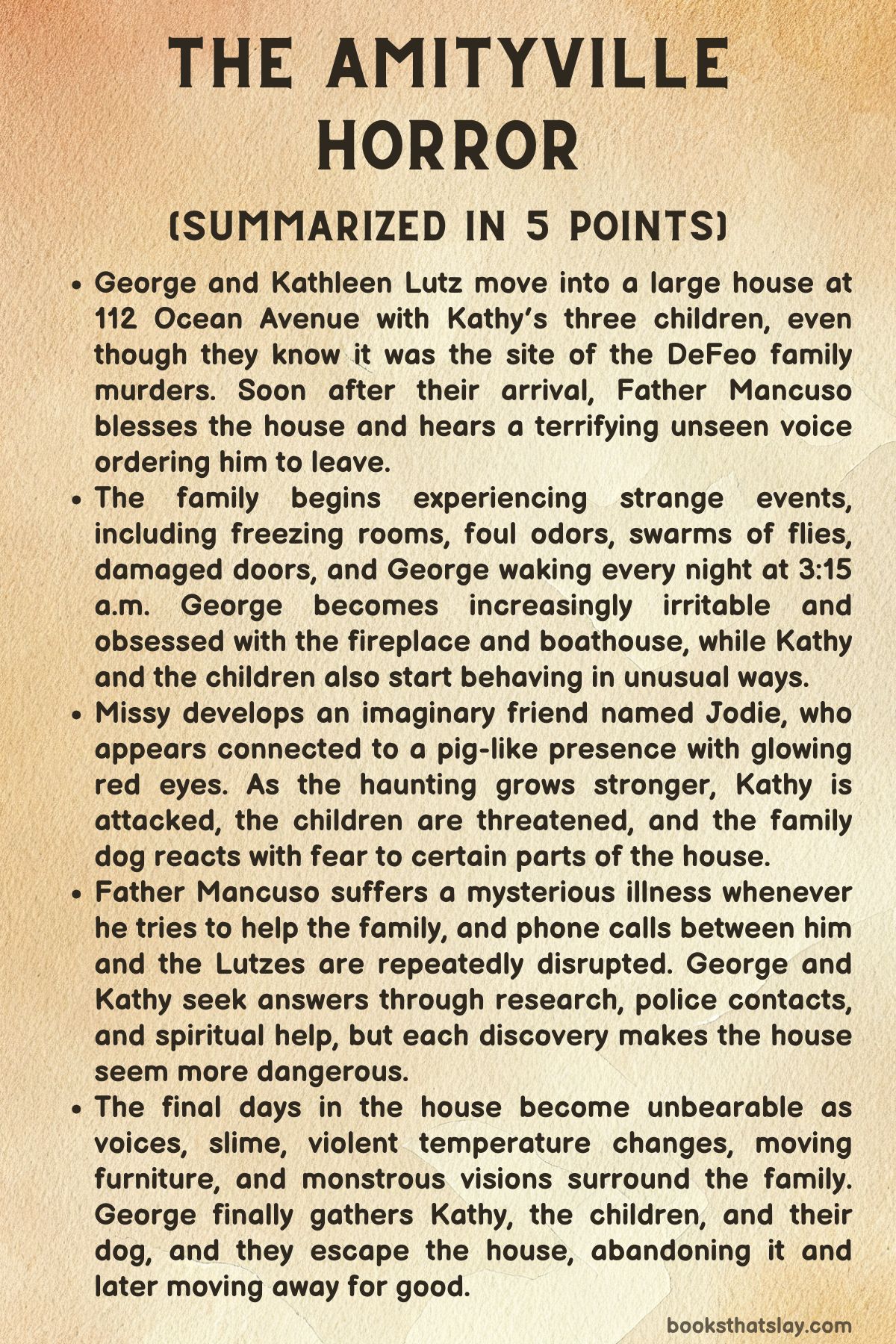
Summary
The Amityville Horror begins by framing itself as a true account rather than a conventional horror novel. A preface by Reverend John Nicola argues that science and religion can both be used to understand events like those reported by the Lutz family.
The opening material also reminds the reader of the house’s violent history: in November 1974, Ronald DeFeo murdered his parents and siblings in their home at 112 Ocean Avenue in Amityville, Long Island. About a year later, George and Kathleen Lutz buy the same Dutch Colonial house, despite knowing what happened there.
The property is large, attractive, and unusually affordable, and the Lutzes choose to move in with Kathy’s three children, Danny, Chris, and Missy.
The family arrives in December 1975. George is a land surveyor, Kathy is trying to create a stable family home, and the children are young enough to be vulnerable to the atmosphere around them.
Their dog, Harry, also comes with them. Father Mancuso, a Catholic priest connected to the family, visits the house to bless it.
Almost immediately, he feels a terrible sense of dread. While blessing an upstairs room, he hears a powerful unseen voice telling him to get out.
He does not tell the family what has happened, but when he leaves, his car suffers strange mechanical problems. This marks the beginning of a pattern in which anyone who tries to help the Lutzes seems to be harmed, blocked, or frightened away.
Inside the house, the family begins to notice that something is wrong. The rooms are cold in a way that the heating system cannot fix.
George, in particular, becomes obsessed with keeping the fireplace burning. He wakes every night at 3:15 a.m., the same time associated with the DeFeo murders, and repeatedly checks the boathouse door, which keeps opening by itself.
His mood changes. He becomes irritable, withdrawn, and careless with his work and appearance.
Kathy also begins to feel strained and trapped. The children grow unsettled, and the parents behave with sudden cruelty when they punish them.
The house seems to be changing the family’s habits, emotions, and judgment.
The strange events become more direct. Kathy feels an unseen presence touch her.
Toilets turn black and produce a foul smell, while another room fills with an overpoweringly sweet perfume. Flies appear in the sewing room despite the winter weather.
Doors are damaged from the inside, crucifixes turn upside down, and the family dog behaves fearfully. Missy begins speaking of an imaginary friend named Jodie, whom she describes as a pig.
George later sees a pig-like face with glowing red eyes behind Missy at her window, though when he reaches her room she is asleep and her rocking chair is moving on its own.
Father Mancuso suffers from a mysterious illness away from the house. He develops fever, chills, and painful sores on his hands.
Whenever he tries to contact the family, phone calls break up with static or are cut off. He senses that the sewing room is especially dangerous, but he cannot properly warn them.
His physical suffering appears linked to the force in the house, as if the presence there is punishing him for his attempt to bless it.
Christmas does not bring relief. Kathy has a nightmare connected to the DeFeo murders and reveals details she should not know.
George grows increasingly unstable. The family’s visitors also sense danger.
Kathy’s Aunt Theresa, a former nun, refuses to enter certain rooms and warns of evil. A neighborhood boy avoids the upstairs.
Kathy’s brother Jimmy loses a large sum of cash in the house, and the money cannot be found. The house starts to feel less like a home and more like a trap that confuses, frightens, and separates everyone who enters it.
George and Kathy discover a hidden red room behind a basement panel. The room smells like blood and gives off a strong impression of evil.
George glimpses a face there that he later connects to Ronnie DeFeo. Wanting answers, he researches the property and the murders.
He learns about claims that the land had a grim history before the house was built, including stories of sickness, death, and witchcraft connected to the area. Though he keeps trying to think rationally, the events around him become harder to dismiss.
The disturbances grow more violent. A ceramic lion statue moves on its own and injures George, leaving marks like bite wounds.
Kathy sees a demonic figure burned into the fireplace soot. Windows burst open, even when they should be secure.
Hoofprints appear in the snow outside the house. Kathy is attacked by an unseen force and left with injuries.
Doors, furniture, and locks are damaged by forces that seem too strong to be natural. The police are called more than once, but official explanations cannot fully account for what is happening.
The house also seems to target the children. Danny and Chris fight with unusual aggression.
Danny’s hand is crushed by a window, though his bones are not broken. Missy becomes more attached to Jodie, who tells her that she will live in the house forever.
This frightens Kathy because Missy’s innocence makes her especially open to whatever presence is using Jodie as a mask. Harry, the dog, is also deeply affected.
He becomes lethargic and terrified of certain parts of the house, especially the basement red room, Missy’s bedroom, and the sewing room.
George and Kathy attempt to fight back. They try to bless the house themselves with a crucifix and prayer, but the effort is met by a rising chorus of voices telling them to stop.
The walls ooze green slime. The temperature swings between extreme heat and extreme cold.
Furniture moves, windows open, and unseen forces seem to control the house at will. George’s anger becomes more dangerous, and his sense of self begins to break down.
He has nightmares of a hooded figure with his own disfigured face, suggesting that the house may be trying to make him resemble the earlier murderer.
Father Mancuso is ordered by his superiors not to return to the house. The Church advises the Lutzes to leave, and psychical investigators are suggested.
A medium named Francine visits and senses many spirits. In the sewing room, she falls into a trance and speaks in a voice George recognizes as Father Mancuso’s, urging an exorcism.
She and her companion leave in terror. Another investigator arranges a visit, but by this point the family is already close to collapse.
The final crisis comes in mid-January. George sees visions of a figure threatening Chris.
The family tries to leave, but the phone dies, the van stalls, the power goes out, and a storm erupts. Green slime seeps from the playroom, the house becomes unbearably hot and then freezing, and objects move around them.
George is paralyzed and feels a huge hooved force trampling him. The boys see a faceless monster.
George finally gathers Kathy, the children, and Harry, gets them into the van, and escapes. As they leave, the front door tears away from its hinges.
The family reaches Kathy’s mother’s home, but the terror does not entirely stop. George and Kathy later feel themselves levitating in bed and see greenish-black slime moving toward them, suggesting that the force may have followed them.
In the aftermath, investigators, including Ed and Lorraine Warren, examine the house and conclude that it contains a demonic, non-human presence. The Lutzes abandon the house and their belongings, move to California, and never return.
Father Mancuso recovers from illness and is transferred, but the events leave everyone marked by what happened at 112 Ocean Avenue.
Characters
George Lutz
George Lutz is the central human figure through whom much of the book’s fear is filtered. At the beginning of The Amityville Horror, he appears practical, ambitious, and eager to establish a comfortable life for his blended family.
His decision to buy the house despite its violent past suggests both confidence and a willingness to overlook danger when a good opportunity appears. As the story progresses, George becomes the person most visibly altered by the house.
He grows obsessed with the cold, the fireplace, and the boathouse, and his nightly waking at 3:15 a.m. links him symbolically to the murders that once occurred there.
His physical decline, irritability, neglect of work, and sudden rages suggest that the house is attacking not only his safety but also his identity. The resemblance between George and Ronnie DeFeo deepens this threat, because the book repeatedly hints that the same destructive pattern might repeat through him.
George is not presented as a simple victim or hero. He is frightened, stubborn, protective, reckless, skeptical, and at times dangerous.
His struggle is powerful because he keeps trying to explain events rationally even after rational explanation has become impossible. By the end, his decision to flee shows that his strongest instinct is not pride but survival, especially the survival of his family.
Kathleen Lutz
Kathleen Lutz, often called Kathy, is the emotional center of the household. She enters the house hoping to build a secure family life with George and her three children, but the home soon turns against her in deeply personal ways.
Kathy is affected through sensation, memory, motherhood, and bodily vulnerability. She feels invisible embraces, smells the strange perfume, sees disturbing images, and suffers direct attacks.
Her nightmares about Louise DeFeo are especially important because they connect her to the previous mother of the house, as if the past is trying to force itself into the present through her. Kathy’s role as a mother makes the danger sharper.
She watches her children change, sees Missy become attached to Jodie, and eventually realizes that staying in the house may destroy them. The book also shows her moments of confusion and weakness, especially when the house seems to comfort her before frightening her.
This makes her experience more unsettling, because the evil does not always appear only as violence; sometimes it arrives as false reassurance. Kathy’s final insistence that the family must leave shows her clarity.
While George often tries to investigate, repair, or confront the house, Kathy understands more directly that the home itself has become unsafe.
Father Mancuso
Father Mancuso is the spiritual witness of the book and one of its most tormented characters. His first visit to the house establishes the religious conflict at the heart of the story.
He enters as a priest performing a blessing, but the command to get out immediately shows that the force in the house recognizes him as an enemy. Afterward, his illness becomes one of the clearest signs that the evil is not limited to the physical boundaries of 112 Ocean Avenue.
Fever, sores, weakness, and repeated interference with his phone calls make him suffer from a distance. In The Amityville Horror, Father Mancuso represents faith under pressure, but he is not portrayed as invincible.
He is frightened, physically damaged, and eventually forbidden by Church authorities from returning to the house. This creates a painful conflict between duty and obedience.
He wants to help the Lutzes, yet his own body and his superiors stop him. His inability to fully intervene increases the family’s isolation.
The book uses him to show that evil can attack spiritual authority as well as ordinary family life. His survival and later transfer suggest recovery, but not triumph.
He escapes the crisis, yet his experience leaves the impression of a man who has seen something far beyond routine religious work.
Missy Lutz
Missy Lutz is the youngest child, and her innocence makes her one of the most vulnerable figures in the story. Her relationship with Jodie, the pig-like imaginary friend, is one of the book’s most disturbing elements because she does not understand the threat behind it.
To Missy, Jodie appears friendly, protective, and angelic. To the adults, Jodie becomes a sign that something in the house is trying to claim her.
Missy’s youth allows the presence to reach her in a form she can accept. Her rocking chair, her conversations about angels, and her calm belief that Jodie wants her to stay forever all create a frightening contrast between childish trust and supernatural danger.
Missy is not developed through adult decisions but through what she reveals about the house’s strategy. The force does not only attack through fear; it also seduces through companionship.
Missy’s role shows how children can become targets because they are open, lonely, imaginative, and eager to believe. Her drawing of Jodie after the family leaves is important because it confirms that Jodie was not merely an ordinary childhood invention.
Through Missy, the book turns imaginary friendship into a sign of possession, manipulation, and possible entrapment.
Danny Lutz
Danny Lutz is one of Kathy’s sons and represents the effect of the house on the children’s behavior and safety. At nine years old, he is old enough to react with fear and aggression, but still too young to understand the full danger around him.
He and Chris become increasingly violent with each other, suggesting that the house feeds anger inside the family and pushes ordinary sibling conflict into something more disturbing. Danny is also physically harmed when a window slams onto his hand, flattening his fingers without breaking them.
This injury shows the strange cruelty of the force in the house: it can cause pain and terror while leaving behind evidence that does not fully match ordinary explanation. Danny’s presence is also tied to Kathy’s role as a mother, because her fear for him helps move the family toward escape.
He is not given the same symbolic connection to the supernatural as Missy, but he is important because he shows how the house damages ordinary childhood. Games, sleep, sibling relationships, and daily routines become unsafe.
Danny’s fear helps reveal that the home has failed in its most basic purpose, which is to protect the children living inside it.
Chris Lutz
Chris Lutz, Kathy’s younger son, is closely linked with Danny throughout the book. His character is shaped by fear, sibling conflict, and the repeated invasion of the children’s rooms.
Like Danny, Chris becomes part of the house’s campaign against the family unit. His fights with his brother feel unusually intense, and his bedroom becomes part of the final stage of terror when George believes something is threatening him.
The vision of Chris being taken by a shadowy figure is especially important because it pushes George closer to the decision to leave. Chris functions as a reminder that the children are not merely witnesses to the haunting; they are potential victims.
The house attacks them through cold, open windows, physical injury, nightmares, and the presence of monstrous figures. Chris does not control the action, but his vulnerability shapes the adults’ choices.
His fear makes the danger immediate and concrete. In a book filled with strange smells, voices, apparitions, and historical research, Chris brings the focus back to the family’s most urgent question: can the children survive if they remain in the house?
Harry
Harry, the family’s Malamute, is important because animals in horror often sense danger before humans fully accept it. From the beginning, Harry behaves as though the property is hostile.
He nearly strangles himself trying to escape near the boathouse, becomes lethargic, and shows terror in specific rooms. His reactions help confirm that the disturbances are not only psychological or caused by family stress.
Harry has no reason to understand the history of the house, the DeFeo murders, or the religious meaning of the events, so his fear works as instinctive evidence. When he refuses to go upstairs and reacts badly to the basement red room, Missy’s bedroom, and the sewing room, he maps the most dangerous areas of the house through animal perception.
His suffering also shows that the house attacks every member of the household, not only the humans. Harry is silent, but his behavior is one of the book’s strongest signals that something is wrong on a level beyond ordinary explanation.
Ronald DeFeo
Ronald DeFeo is not a present-day member of the Lutz household, yet his shadow hangs over the entire story. He is the murderer whose crime gives the house its terrible reputation.
The memory of his violence shapes how readers understand every strange event that follows. George’s resemblance to him and the face George sees in the red room create the frightening possibility that the house may influence certain men toward violence.
Ronnie is both a historical figure in the book’s background and a symbolic warning. He represents what can happen when evil, madness, rage, or possession destroys a family from within.
The story does not treat him only as a criminal from the past; it makes him feel like part of the house’s continuing threat. His presence is strongest when George begins to change, because the reader is invited to fear that the past may repeat itself.
In The Amityville Horror, Ronnie DeFeo functions as the human proof that the house has already been connected to family destruction once before.
Jodie
Jodie is one of the most disturbing figures in the book because it appears first as a child’s imaginary friend and then becomes something far more threatening. Missy describes Jodie as a pig and believes it is kind, even angelic.
George and Kathy, however, see glowing red eyes and a pig-like presence that turns Jodie into a sign of danger. Jodie’s power lies in deception.
It does not approach the family first as a monster but as a companion to the youngest child. This makes it especially frightening because it uses innocence as an entry point.
Jodie’s promise that Missy will live in the house forever suggests possession, entrapment, or death disguised as friendship. The figure also connects to the hoofprints in the snow and the sense of an animal-like demonic force moving around the property.
Jodie is not fully explained, and that uncertainty strengthens its effect. It may be a demon, a spirit, a mask worn by the house, or a form taken by the force to reach Missy.
Whatever its exact nature, Jodie turns childhood imagination into a channel for evil.
Sergeant Al Gionfriddo
Sergeant Al Gionfriddo represents the outside world of law, order, and practical investigation. His role is important because the Lutzes’ experiences could easily be dismissed as private fear or family hysteria, but his observations give the events a public witness.
He sees George behaving strangely outside the house, learns details connected to the DeFeo murders, and becomes part of the broader network of people troubled by the property. As a police officer, he belongs to a rational system based on evidence, reports, and procedure.
Yet the events surrounding the house disturb even that system. His presence helps create tension between official skepticism and private unease.
He cannot solve the haunting, but he confirms that something about the house affects people beyond the family. The police connection also keeps the DeFeo murders present in the reader’s mind, reminding us that the Lutzes are living inside a place already marked by real violence.
Francine
Francine, the medium, enters the book as someone more open to supernatural explanation than George or the police. Her visit is significant because she immediately senses that the house is spiritually crowded and dangerous.
Unlike George, who keeps seeking physical causes, repairs, history, and documentation, Francine responds through intuition and trance. In the sewing room, she becomes a channel for a voice that George recognizes as Father Mancuso’s, urging an exorcism.
This moment is frightening because it suggests that the house can manipulate voices, identities, and spiritual communication. Francine’s terror after the trance also matters.
She does not stay to prove herself or investigate further; she leaves quickly, showing that her sensitivity makes her more aware of the danger but not more protected from it. Her character widens the book’s spiritual field.
Through her, the haunting is no longer just a family crisis, a priest’s concern, or a police mystery. It becomes a case that psychical and spiritual investigators recognize as deeply threatening.
Themes
The Collapse of Domestic Safety
A home is supposed to offer shelter, routine, privacy, and emotional security, but the house at 112 Ocean Avenue reverses all of those expectations. Ordinary household spaces become threatening: bedrooms are invaded by cold, windows attack children, bathrooms produce black stains and foul smells, the basement hides a red room, and the sewing room becomes one of the most feared places in the building.
This makes the horror especially effective because danger does not come from a distant monster or an unfamiliar wilderness. It comes from doors, furniture, beds, stairs, fireplaces, and rooms the family must use every day.
The Lutzes cannot relax because the house turns daily life into a test of endurance. Eating, sleeping, praying, making phone calls, caring for children, and even keeping warm become difficult.
The family’s decision to abandon their belongings shows how completely the meaning of home has been destroyed. Possessions no longer matter once the place meant to contain them becomes hostile.
In The Amityville Horror, domestic comfort is stripped away piece by piece until escape becomes the only form of safety left.
Evil as Contagion
The force in the story does not remain still or attack in only one way. It spreads across bodies, relationships, objects, machines, weather, animals, and spiritual connections.
Father Mancuso becomes sick after blessing the house, even when he is physically elsewhere. George’s personality changes as he becomes angrier, colder, and more obsessed.
Kathy is touched, attacked, marked, and pulled into memories that seem connected to the house’s past. The children become more violent or more vulnerable, while Harry reacts with fear and weakness.
Even cars, phones, doors, windows, and locks fail at key moments, as though the evil has entered the systems people depend on. This theme matters because the family cannot simply identify one haunted room and avoid it.
The danger keeps moving. It contaminates communication, faith, memory, and trust.
The final suggestion that the force follows George and Kathy after they leave makes the theme even darker. Evil is not treated as a stain limited to one address; it behaves like an infection that can attach itself to people and travel with them.
The Battle Between Faith and Fear
Religion is present from the beginning through Father Mancuso’s blessing, prayers, crucifixes, Mass, Church authorities, and talk of exorcism. Yet the book does not present faith as an easy shield that instantly defeats evil.
Instead, spiritual action provokes resistance. The unseen voice orders the priest out, the phone lines fail when he tries to help, his body becomes marked by illness, and the family’s attempt to bless the house is met by hostile voices.
This creates a tense and uncertain picture of faith. Prayer has power, but using it draws danger.
Father Mancuso believes in spiritual duty, yet he is frightened and eventually restrained by Church hierarchy. George and Kathy turn to prayer when ordinary explanations fail, but their attempt is desperate rather than calm.
The theme gains strength from this struggle. Faith is not shown as decorative belief or simple comfort; it is shown as a force that must face terror directly.
Fear does not cancel faith, but it tests whether faith can survive when the world feels controlled by something cruel, intelligent, and unseen.
The Past Refusing to Stay Buried
The house’s past is never truly past. The DeFeo murders shape the atmosphere before the Lutzes even move in, and the timing, dreams, visions, and repeated signs keep bringing that crime back into the present.
Kathy’s dream of Louise DeFeo, George’s resemblance to Ronnie, the face in the red room, and the nightly waking at 3:15 a.m. all suggest that violence has left an active mark on the property.
The historical research into earlier claims about the land also expands this idea. The house is not haunted only by one crime; it appears built upon layers of fear, death, rumor, and spiritual corruption.
The hidden red room becomes a symbol of this buried history. It is physically concealed, but its influence leaks into the rest of the home.
The theme shows that ignoring the past does not erase it. George and Kathy know about the murders but believe they can live normally anyway.
The story punishes that assumption. What happened before their arrival continues to speak through smells, sounds, visions, behavior, and violence, until the family understands that some places carry histories too powerful to dismiss.