The Andromeda Strain Summary, Characters and Themes
The Andromeda Strain by Michael Crichton is a science-fiction thriller about a biological emergency caused by an alien microorganism brought back to Earth by a secret military satellite. The book presents the crisis through a cool, report-like style, mixing suspense with scientific procedure, government secrecy, and technical detail.
Instead of relying on monsters or space battles, it builds fear from laboratories, protocols, human error, and the limits of knowledge. The story asks what happens when brilliant people face something that does not follow the rules of life as they understand them.
Summary
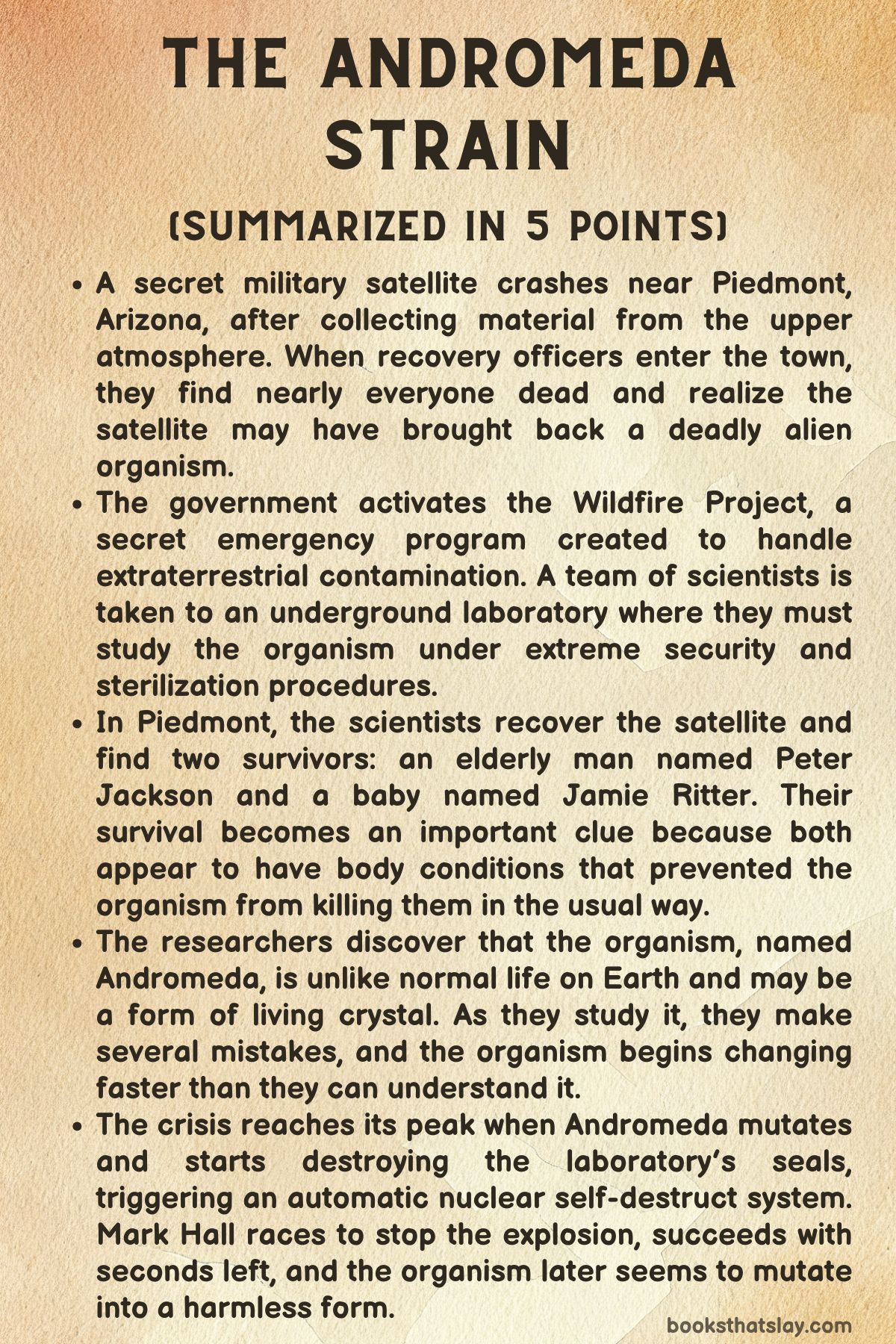
Michael Crichton’s The Andromeda Strain begins with a secret government satellite crashing near the small town of Piedmont, Arizona. The satellite is part of a classified program designed to collect organisms from the upper atmosphere.
Officially, the program has scientific purposes, but its hidden goal is connected to biological weapons research. When the satellite returns unexpectedly and lands near Piedmont, two military recovery men, Lieutenant Roger Shawn and technician Lewis Crane, are sent to retrieve it.
As Shawn and Crane approach the town, they notice that something is terribly wrong. Piedmont is silent.
Birds circle over the buildings, and the streets seem deserted. When they enter the town, they find bodies lying outside homes and in the streets.
The people appear to have died suddenly. Some seem calm, while others show signs of terror or madness.
The men radio their findings back to the military base, but their transmission ends abruptly after they encounter a living man in a robe walking among the dead.
Major Arthur Manchek, who is on duty at the base, realizes the situation may be far more serious than a routine recovery mission. He gathers data from the scene, sends reconnaissance aircraft over Piedmont, and confirms that most of the town is dead.
The photographs and readings show bodies everywhere, yet one man is still alive. Since Manchek is aware of a secret emergency plan called Wildfire, he activates it.
Wildfire is designed to respond to possible contamination by extraterrestrial organisms.
The emergency brings together a team of scientists who had previously warned the government about the danger of alien microbes returning to Earth on spacecraft or satellites. The leading scientist is Jeremy Stone, a brilliant and influential researcher who helped create the Wildfire Project.
He is joined by Charles Burton, a pathologist; Peter Leavitt, a microbiologist; and Mark Hall, a surgeon. Another member, Professor Kirke, is unavailable due to illness.
The team is brought to a hidden underground facility in Nevada, built to contain and study dangerous extraterrestrial life.
Before going to the facility, Stone and Burton are sent into Piedmont in sealed protective suits. They see the full horror of the disaster.
Bodies are spread across the town. Some residents seem to have died instantly from clotting blood, while others appear to have gone mad and killed themselves.
The scientists discover that the satellite capsule was taken into the home of Dr. Alan Benedict, the town doctor, who opened it with tools before dying at his desk. Stone and Burton recover the satellite and search the town for survivors.
They find two. One is an infant named Jamie Ritter, who seems completely healthy despite being exposed to whatever killed the town.
The other is Peter Jackson, an elderly man who is sick, confused, and coughing blood, but still alive. The survival of these two people becomes one of the central mysteries of the crisis.
Stone orders the implementation of a directive that calls for a nuclear bomb to destroy the contaminated area, but the president delays the order and instead seals off the region.
The scientists descend through the levels of the Wildfire facility, undergoing increasingly strict decontamination. Each level is more secure than the last.
Their clothes are destroyed, their bodies are examined and sterilized, and they are prepared for work in the deepest level. Hall learns that he has a special role in the facility.
Because he is unmarried, he has been selected as the “Odd Man,” the one person authorized to stop the facility’s self-destruct system. If contamination escapes, the underground base is programmed to destroy itself with a nuclear device.
Only Hall has the key that can cancel the explosion.
Once the team reaches the deepest level, they begin studying the recovered satellite and the organism found inside it. Tests show that the agent can kill laboratory animals almost instantly.
A rat and a monkey die as soon as they are exposed. The scientists examine the satellite with robotic arms and discover a tiny black piece of rock and strange green patches that sometimes shift toward purple.
The organism grows quickly and appears unlike any life on Earth.
Burton performs autopsies and discovers that the organism causes blood to clot throughout the body, beginning in the lungs. This explains why most of the people in Piedmont died so suddenly.
However, the suicides and acts of violence suggest that in some cases the organism may affect the brain instead. Burton’s work is slowed by exhaustion and by the emotional burden of what he saw in Piedmont.
He makes mistakes and misses important clues.
Hall focuses on the two survivors. Jamie Ritter appears normal, which puzzles him.
Peter Jackson, however, has unusual body chemistry. Hall learns that Jackson has a stomach ulcer and has been taking large amounts of aspirin, along with alcohol and other substances.
His blood chemistry is abnormally acidic. This may have helped him survive exposure.
Later, Hall also learns that a highway patrolman passed through Piedmont after the satellite landed. The patrolman later killed several people in a diner before taking his own life.
He had diabetes and did not properly manage his insulin. Hall begins to suspect that blood acidity and body chemistry are important to whether the organism kills, affects the brain, or fails to grow.
Meanwhile, the scientists become increasingly concerned by missed communications. A paper jam in the facility’s message system prevents the team from receiving crucial updates.
They do not know immediately that the nuclear strike on Piedmont was delayed. They also do not know about a plane that crashed after flying near the contaminated area.
The crash suggests that the organism may be changing. Something appears to have attacked a synthetic material in the plane, leaving behind strange damage.
As Stone and Leavitt study the organism, they realize it may not be a normal microbe at all. It seems to have a precise crystalline structure, made of hexagonal forms that reproduce with extraordinary speed.
It has no ordinary biological components and does not behave like known bacteria or viruses. The scientists consider the possibility that it is a form of living crystal.
They also discuss whether it could be part of a larger alien communication process, though they cannot prove this.
The situation becomes more dangerous when Leavitt’s hidden medical condition affects his work. He has been experiencing blackouts and seizures but has not told the team.
During a contamination emergency, he freezes and suffers a seizure, making it harder for the others to respond. At the same time, Burton becomes trapped in an autopsy lab after a seal failure suggests contamination.
Stone and Hall watch him through cameras, expecting him to die, but Burton survives longer than expected. This forces Hall to reconsider what they think they know about the organism.
Hall concludes that the organism can grow only within a narrow range of human blood chemistry. If a person’s blood is too acidic or too alkaline, the organism cannot kill in the usual way.
He tells Burton to breathe rapidly in order to alter his blood chemistry and survive. This appears to help, but the scientists soon learn that they have misunderstood the greater danger.
The organism has mutated. It no longer attacks humans in the same way.
Instead, it begins attacking rubber and plastic seals inside the facility.
As the gaskets fail, the Wildfire facility detects contamination and automatically starts the countdown to nuclear self-destruction. The bomb, meant to protect the outside world, now threatens to spread the organism by giving it energy and blasting it into the atmosphere.
Hall is trapped away from a key station, and only he can stop the detonation. With only minutes left, he cuts through barriers, climbs through dangerous service areas, passes through gas clouds, and is struck by sedative darts.
Nearly unconscious, he reaches a key station with the help of a technician and stops the explosion just in time.
Afterward, Hall wakes and learns that the organism has spread beyond the facility, but nothing disastrous happens. Stone believes it has mutated again into a harmless form.
The immediate crisis seems to be over, though the scientists still do not fully understand what they have encountered. The ending shows that spaceflight has been suspended after another spacecraft crash, and Stone is part of the investigation.
The final mood is uncertain. Humanity has survived one encounter with alien life, but the book leaves open the possibility that the danger has not truly ended.
Characters
Jeremy Stone
Jeremy Stone is the intellectual force behind the Wildfire Project and one of the central figures in The Andromeda Strain. He is brilliant, respected, and accustomed to being listened to, which gives him authority during the crisis.
Stone’s strength lies in his ability to think in large systems: government policy, scientific theory, contamination procedures, and planetary risk. He understood before many others that returning spacecraft might carry unknown biological threats, and his warnings helped create the secret facility that becomes the main defense against the organism.
Yet Stone’s confidence is also one of his weaknesses. He often assumes that careful planning and superior intelligence can control a situation, even when the organism keeps changing faster than his expectations.
His leadership is disciplined and mostly rational, but he can become rigid under pressure. He represents the power of scientific preparation, while also showing how expertise can become dangerous when it hardens into certainty.
Mark Hall
Mark Hall begins as the least celebrated member of the team, but he becomes one of the most important characters in The Andromeda Strain. He is a surgeon rather than a famous theoretician, and he initially seems less impressive than Stone, Leavitt, or Burton.
His selection for Wildfire is partly based on the Odd Man rule, which treats his unmarried status as a psychological advantage in a crisis. This makes him feel used by a system he does not fully trust.
Yet Hall’s practical habits become essential. He pays attention to patients, symptoms, body chemistry, and small contradictions that the others miss.
His work with Peter Jackson, Jamie Ritter, and the highway patrolman leads him toward the key idea that the organism’s effect depends on internal physical conditions. Hall is also the one who must act when theory is no longer enough.
His desperate climb to stop the nuclear device shows courage, endurance, and moral responsibility under extreme pressure.
Charles Burton
Charles Burton is a skilled pathologist whose role in the book is to examine death closely and translate it into scientific knowledge. He is experienced, intelligent, and useful, but he is also careless in ways that matter.
His untidy habits and distracted methods contrast with the strict control demanded by the Wildfire facility. Burton is deeply affected by the bodies in Piedmont, and the shock of what he has seen follows him into the lab.
This emotional disturbance contributes to mistakes in his work. He fails to examine certain evidence quickly enough, including the brain-related effects of the organism, and this delay narrows the team’s understanding at a critical time.
Burton is not incompetent; instead, he shows how even trained experts can be weakened by exhaustion, horror, and pressure. His contamination scare also helps reveal that the organism is changing.
Through Burton, the book shows that science depends not only on knowledge, but also on attention, discipline, and timing.
Peter Leavitt
Peter Leavitt is a microbiologist whose intelligence and imagination make him valuable to the Wildfire team. He is capable of thinking beyond conventional categories, which helps the group consider that the organism may not be ordinary life.
His ideas about alien intelligence, biological communication, and unfamiliar forms of existence expand the scientific scope of the story. At the same time, Leavitt is compromised by a serious private weakness: he has epilepsy and experiences blackouts, yet he hides this from the others.
His secrecy is dangerous because the crisis requires complete honesty from every member of the team. When he has a seizure during an emergency, his condition becomes more than a personal flaw; it becomes a threat to the group’s response.
Leavitt is one of the clearest examples of the book’s interest in human error. His mind is powerful, but his pride and fear of exposure prevent him from admitting a vulnerability that could have been managed.
Peter Jackson
Peter Jackson is one of the two survivors of the Piedmont disaster, and his survival gives the scientists one of their most important clues. At first, he seems like an unlikely source of scientific insight: an elderly man in poor health, confused, frightened, and physically unstable.
Yet his body holds information that the laboratory cannot ignore. His ulcer, heavy aspirin use, and abnormal acidity create internal conditions that help protect him from the organism’s usual lethal effect.
Jackson’s personality also matters. He is suspicious, disoriented, and reluctant to speak, but his fragmented memories help Hall reconstruct what happened in Piedmont.
He remembers the baby crying, the townspeople gathering around the fallen satellite, and the highway patrolman passing through town. Jackson represents the value of the ordinary person inside a highly technical crisis.
The scientists may have machines and theories, but one sick old man’s survival and memory become essential to understanding the threat.
Jamie Ritter
Jamie Ritter, the surviving infant, is one of the book’s most mysterious figures because he lives through an event that kills nearly everyone around him. Unlike Peter Jackson, he cannot explain what happened or describe his symptoms.
His importance lies entirely in his body’s response. Hall finds that the baby appears healthy, which makes his survival even more puzzling.
Jamie forces the scientists to confront the fact that their first assumptions are incomplete. If the organism killed everyone in the same way, the infant should be dead.
Because he is alive, the team must search for a condition that protects certain people from infection. As a baby, Jamie also adds a quiet emotional pressure to the story.
He is helpless, innocent, and unaware of the scientific crisis surrounding him. His survival suggests that the answer may not come from strength or intelligence, but from biological conditions that no one chose or planned.
Major Arthur Manchek
Major Arthur Manchek is the military officer whose caution helps prevent the Piedmont disaster from being dismissed too quickly. He is tired and irritable when the crisis begins, but these qualities oddly help him.
Instead of rushing to a simple explanation, he moves carefully, checks evidence, and eliminates possibilities. His decision to activate Wildfire is crucial because it brings the scientific team into action.
Manchek is not the main scientist and does not solve the biological mystery, but he is an important link between military procedure and scientific response. He also shows the limits of bureaucratic systems.
He sends messages, follows protocols, and waits for decisions, but delays and communication failures reduce the effectiveness of the response. Manchek’s role in the story reminds readers that large crises are shaped not only by discoveries in laboratories, but also by the decisions of people working under pressure inside institutions.
Roger Shawn and Lewis Crane
Roger Shawn and Lewis Crane are among the first direct victims of the organism, and their brief role establishes the danger before the scientists fully understand it. Their job is routine at first: locate the returning satellite and recover it.
They enter Piedmont with instruments, procedures, and a sense of uneasy professionalism. Their discovery of bodies in the street turns a technical assignment into a biological emergency.
Because their radio transmission is cut off after they encounter Peter Jackson, their deaths become part of the mystery that draws the larger response into motion. Shawn and Crane matter because they represent the vulnerable human edge of secret technology.
They are not the people who designed the satellite or the Wildfire facility, but they are the ones sent into danger first. Their fate shows how quickly a hidden government project can place ordinary personnel in situations far beyond their control.
Dr. Alan Benedict
Dr. Alan Benedict, the physician in Piedmont, plays a small but important role in the disaster. He is the person who opens the recovered satellite, unknowingly exposing the town to the organism.
As a doctor, he might normally represent knowledge, care, and protection, but in this situation his curiosity and limited information become fatal. Benedict cannot know what he is handling, and he lacks the equipment or warning needed to treat the capsule as a serious contamination threat.
His death at his desk, surrounded by books and tools, is one of the book’s sharpest images of human knowledge failing at the point of contact with the unknown. He is not foolish in a simple sense; he behaves like an educated person trying to understand an unusual object.
The tragedy is that ordinary intelligence is not enough. Benedict shows how dangerous secrecy can be when people outside the system encounter what the system has hidden.
Themes
Scientific Knowledge and Its Limits
The scientists in The Andromeda Strain are highly trained, well equipped, and supported by one of the most advanced research facilities imaginable, yet they repeatedly confront facts that do not fit their assumptions. The organism does not behave like a familiar bacterium or virus.
It appears crystalline, grows quickly, changes color, reacts to conditions, and mutates in ways that make earlier conclusions unreliable. This creates a central tension between scientific confidence and scientific humility.
The book respects disciplined inquiry: careful testing, autopsies, spectrometry, microscopy, and patient observation all matter. At the same time, it shows that knowledge is always incomplete when the subject is genuinely new.
The team’s intelligence does not protect them from wrong turns. They misread data, overlook clues, and sometimes trust theories too soon.
The danger is not science itself, but the belief that science can instantly master every unknown. The crisis teaches that discovery is often messy, pressured, and dependent on recognizing when certainty has become a risk.
Human Error Inside Advanced Systems
The Wildfire facility is designed to remove chance from a biological emergency. It has sealed levels, sterilization procedures, robotic handling systems, computer analysis, automatic warnings, and a nuclear self-destruct mechanism.
Yet the crisis worsens because human error remains present inside every system. A misspelled name delays contact with the team.
A paper jam blocks crucial messages. Leavitt hides his epilepsy.
Burton misses important evidence because he is tired and shaken. Stone assumes the nuclear strike has happened when it has not.
These mistakes are not dramatic acts of villainy; they are small failures that gather force. This makes the story especially unsettling.
Disaster does not require one evil person or one foolish decision. It can emerge from ordinary delays, pride, fatigue, fear, and overconfidence.
The book suggests that technology can reduce certain risks but cannot remove the human element. Any system built by people will carry human weakness within it, even when it looks perfectly controlled.
Government Secrecy and Moral Responsibility
The crisis begins with a secret satellite program whose public purpose hides a military interest in biological weapons. This secrecy shapes nearly every later disaster.
The people of Piedmont do not know what has landed near them. Dr. Benedict opens the satellite without any understanding of the danger.
Recovery personnel are sent into a town where the risk is far greater than they realize. Even within official channels, information moves slowly, is restricted, or is blocked by procedure.
The book raises serious questions about who has the right to create danger in secret and who pays the price when that danger escapes control. The Wildfire Project itself is both necessary and troubling.
It exists because scientists anticipated a real threat, but it is tied to the same government structure that helped create the threat. The moral problem is not simple.
Secrecy may protect national security, but it also prevents informed caution. The story shows how classified knowledge can become a public danger when accountability is missing.
Mutation, Adaptation, and Survival
The organism’s most frightening quality is not only that it kills, but that it changes. At first, it appears to attack human blood, causing fatal clotting.
Then it seems capable of producing brain effects in people whose bodies prevent clotting. Later, it mutates again and begins attacking synthetic materials instead of humans.
By the end, it may have changed into a harmless form. This constant adaptation challenges the human desire for stable answers.
The scientists want to define the organism, name it, classify it, and control it, but the organism keeps moving beyond the latest explanation. Survival in the book depends on adaptation as well.
Peter Jackson survives because of abnormal body chemistry. Jamie Ritter survives for reasons connected to his physical condition.
Hall survives because he changes course under pressure and acts when the established system becomes dangerous. The theme suggests that life, whether earthly or alien, is not fixed.
It responds to conditions, and survival often belongs not to the strongest plan, but to the form that can change quickly enough.