And The Band Played On Summary and Analysis
And The Band Played On by Randy Shilts is a nonfiction account of the early years of the AIDS epidemic in the United States and Europe. Based on the provided summaries, the book follows doctors, activists, patients, researchers, public officials, journalists, and politicians as they confront a frightening new disease while institutions delay, deny, or argue over responsibility.
Shilts presents AIDS not only as a medical crisis, but also as a political and social failure shaped by prejudice, fear, funding battles, and public silence. The result is a sharp record of how delay and indifference cost lives.
Summary
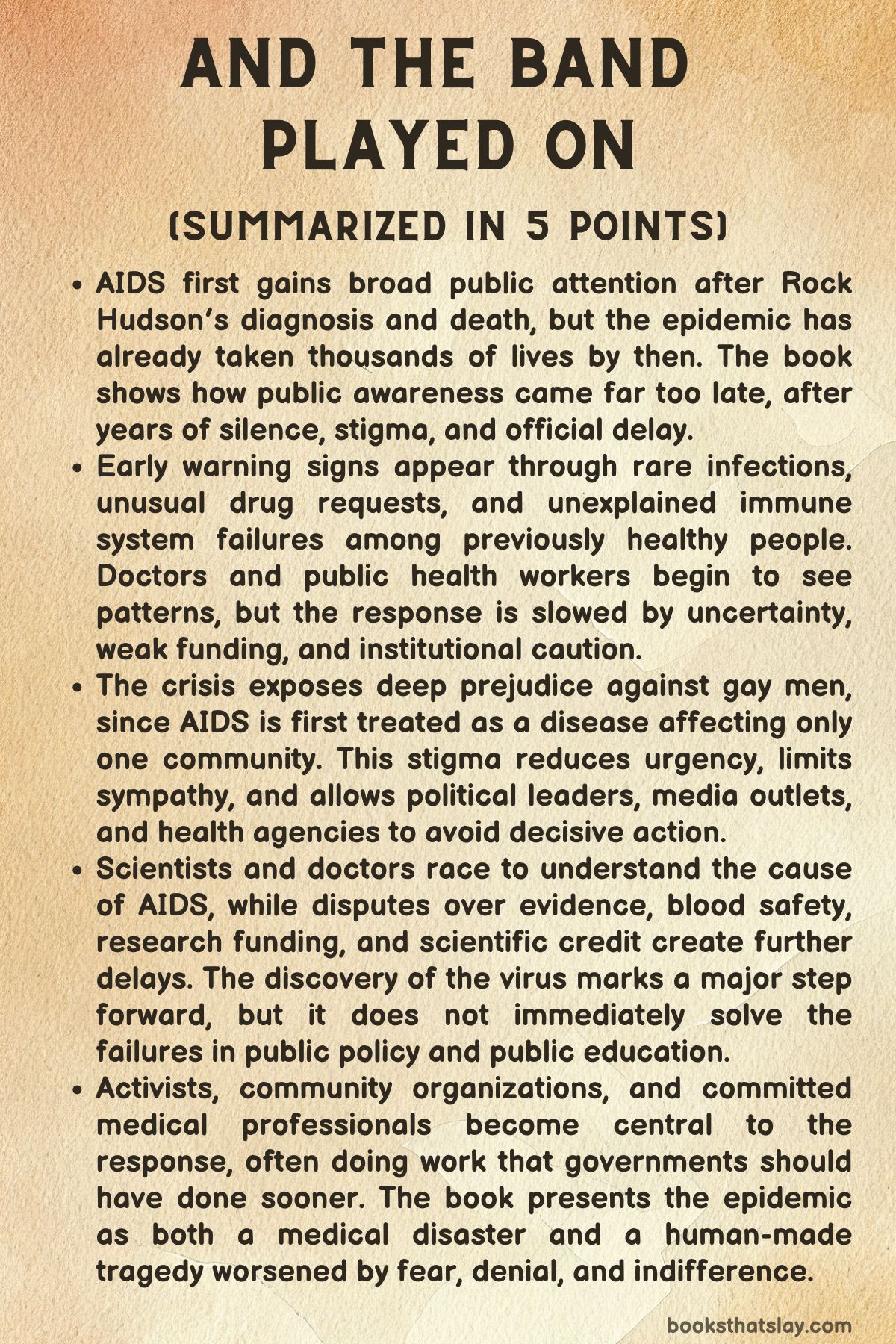
And The Band Played On begins by showing how Rock Hudson’s death changed public awareness of AIDS. Before his diagnosis became widely known, the disease had already killed or weakened thousands of people, while many more were infected.
The illness had spread for years before most Americans understood its scale. The public often treated AIDS as a problem limited to gay men, and that prejudice shaped the slow response from government, medicine, media, and society.
Shilts frames the epidemic as a story of courage and failure: some people worked urgently to understand and stop the disease, while many institutions avoided responsibility until the crisis could no longer be ignored.
The book then moves back to the early days of gay liberation, especially in San Francisco, where the gay community had gained visibility, political strength, and a sense of freedom after years of harassment and secrecy. Activists such as Bill Kraus and Cleve Jones are shown within a community proud of its progress but also facing new risks.
Bathhouses and sex clubs had become major parts of gay social life, creating concern among some doctors and health workers who feared that sexually transmitted infections were already spreading too easily. At this stage, however, no one yet understands that a far more dangerous illness is emerging.
At the Centers for Disease Control, small clues begin to appear. Sandra Ford notices unusual requests for pentamidine, a drug rarely used except to treat Pneumocystis pneumonia.
The requests come from doctors treating adult male patients with unexplained infections. Because the disease should respond to treatment and disappear, the repeated orders seem strange.
Around the same time, doctors in different cities begin encountering illnesses that should almost never appear in healthy young men. One patient is diagnosed with cryptococcosis, a rare infection associated with weakened immunity.
These scattered cases suggest that something is damaging the immune systems of previously healthy people.
The crisis grows more complicated when doctors begin to suspect that the disease may not be limited to gay men. Hemophiliacs, who rely on Factor VIII to help their blood clot, begin showing signs of the same strange immune collapse.
A Miami physician reports a case that raises fear that blood products may be spreading the illness. Public health experts at the CDC worry that transfusions and blood products could become major routes of infection, but the evidence is still incomplete.
At the same time, European doctors begin seeing similar cases, and researchers in France start tracking the pattern across hospitals.
Government agencies respond slowly. Requests for research funding are ignored or delayed, even as doctors and scientists warn that the illness is spreading.
The National Institutes of Health and other federal bodies fail to act with the urgency the situation requires. In New York, gay activists and community leaders create the Gay Men’s Health Crisis to raise money, support patients, and push for research.
Their work fills a gap left by official agencies. The organization reflects the larger reality of the epidemic: much of the early response comes from affected communities rather than from the institutions with the greatest resources.
As cases increase, the fight over the blood supply becomes one of the book’s central conflicts. CDC officials warn blood bank leaders that AIDS may be transmitted through transfusions.
Don Francis presses the issue directly, asking how many people must die before action is taken. Yet blood banking officials resist screening measures, arguing that the evidence is not strong enough.
Behind their caution are financial concerns, fear of public panic, and worries about discouraging donors. Some experts propose surrogate testing, such as screening for hepatitis core antibodies, to reduce risk, but industry leaders object.
Their resistance allows preventable infections to continue.
Meanwhile, researchers race to identify the cause of AIDS. French scientists at the Pasteur Institute, including Françoise Barré-Sinoussi and Luc Montagnier, investigate whether the disease is caused by a retrovirus.
In the United States, Robert Gallo and his team also pursue the viral agent. The search becomes marked not only by scientific urgency but also by rivalry, pride, and disputes over credit.
Eventually, both French and American researchers produce evidence that a retrovirus is responsible. The virus is named differently by different teams, with the American side calling it HTLV-III and the French side calling it LAV.
The discovery should mark a turning point, but public health action still lags behind scientific knowledge.
The human cost becomes increasingly severe. Hospitals in New York and other cities fill with AIDS patients, often without enough beds, staff, or specialized wards.
Children born to infected mothers or drug users arrive with symptoms of AIDS, and many are abandoned or orphaned. Doctors such as Arye Rubenstein try to create better care systems for these children, but government support remains limited.
Officials often appear more concerned with spending as little as politically possible than with building the medical infrastructure needed for a widening epidemic.
The disease also spreads beyond the groups first associated with it. Wives of hemophiliacs, blood transfusion recipients, prostitutes, and heterosexual patients begin appearing in reports.
These cases challenge the false belief that AIDS belongs to one community. Yet stigma remains powerful.
A woman who receives AIDS through a blood transfusion becomes the subject of media attention, while another patient’s diagnosis is treated as scandal rather than tragedy. The public discussion often focuses on blame, fear, and spectacle instead of prevention, care, and honest education.
Activists continue to pressure officials. Larry Kramer meets with federal agencies and sees how bureaucratic rivalries slow progress.
He also recognizes the damage caused by closeted gay officials who fear public association with the epidemic. In San Francisco, political anger remains tied to the memory of Harvey Milk’s assassination and the release of Dan White.
Cleve Jones, once energized by activism, begins to experience symptoms that suggest the epidemic has entered his own life. The book presents activism not as abstract politics, but as a struggle carried out by people who are watching friends, lovers, and community members die.
The Reagan administration’s silence becomes one of the book’s harshest criticisms. For years, the epidemic grows while the president avoids a direct public address on AIDS.
Funding battles continue between Congress and the administration, and public health agencies struggle for support. Surgeon General C. Everett Koop eventually produces a report that treats AIDS as a public health crisis rather than a moral issue.
He recommends broad education, including education for children, and openly supports condom use, confidentiality, and protection against discrimination. His report breaks through the evasive language surrounding the disease and forces the country to speak more plainly.
By the time national attention finally increases, the epidemic has already caused enormous damage. And The Band Played On shows that AIDS was not only a biological disaster but also a failure of leadership.
Scientists argued, agencies delayed, politicians avoided controversy, the media underreported the crisis, and prejudice shaped public policy. Against this, doctors, activists, patients, and community organizers fought to save lives with limited support.
Shilts’s account makes clear that the tragedy was worsened by choices: denial, fear, and institutional caution allowed the disease to spread further than it might have. The book stands as a warning about what happens when a society treats some lives as less urgent than others.
Key People
Randy Shilts
Randy Shilts is not a character in the ordinary fictional sense, but his presence shapes the entire work as the investigating voice behind And The Band Played On. He acts as historian, reporter, critic, and moral witness.
His role is to connect medical evidence, political decisions, social prejudice, and personal suffering into one clear account of the AIDS crisis. Shilts does not treat the epidemic as an accident that simply happened to vulnerable people.
Instead, he presents it as a disaster made worse by human choices: delayed funding, weak leadership, media silence, institutional rivalry, and public fear of homosexuality. His narrative voice is direct and accusatory when necessary, but it also makes room for compassion.
Through him, the reader sees how individuals in hospitals, laboratories, gay communities, government offices, and media rooms were linked by the same crisis, even when they refused to acknowledge it.
Rock Hudson
Rock Hudson becomes a symbolic figure because his illness forces mainstream America to confront AIDS in a way it had avoided for years. He is important less for his actions in the narrative and more for what his diagnosis represents.
As a famous actor, Hudson brings public attention to a disease that had already killed thousands but had been treated with distance and discomfort. His death exposes the gap between public awareness and reality.
By the time many Americans began paying attention, the epidemic was already far advanced. Hudson’s role reveals how celebrity can change public perception, but it also shows the cruelty of delayed recognition.
Countless unknown patients had suffered before him without receiving the same attention. In that sense, Hudson becomes both a doorway into public understanding and a reminder of the lives ignored before AIDS became visible to the wider world.
Bill Kraus
Bill Kraus represents political intelligence, gay pride, and the complicated tensions within the gay community during the early AIDS years. As a strategist and leader connected to gay Democratic politics, he stands in a moment when gay men in San Francisco feel newly visible and powerful.
His confidence reflects the achievements of the gay liberation movement, especially the belief that hiding is no longer necessary. Yet Kraus also reflects the community’s internal conflicts.
His disagreement with Kico Govantes about bathhouses shows how hard it was for many gay men to separate sexual freedom from public health danger. For Kraus, criticism of bathhouses could feel like an attack on the freedom gay people had only recently won.
This makes him a deeply human figure: politically sharp and emotionally invested, but also defensive in the face of warnings that threaten a hard-won sense of liberation.
Kico Govantes
Kico Govantes appears as a more intimate and skeptical figure within the social world of San Francisco’s gay community. His relationship with Bill Kraus reveals personal affection, but also disagreement over what freedom should mean.
Kico’s discomfort with bathhouses is not simply moral judgment; it reflects a concern that the commercialization of sex has become disconnected from love, intimacy, and care. Through him, the narrative shows that the gay community was not united in its view of sexual culture.
Some saw bathhouses as symbols of freedom after repression, while others saw them as places where health risks and emotional emptiness were being ignored. Kico’s role gives the epidemic a personal dimension before it becomes fully understood as a medical catastrophe.
He helps show how private relationships were shaped by public debates over sexuality, safety, identity, and responsibility.
Cleve Jones
Cleve Jones is presented as an activist shaped by both pride and exhaustion. His history connects him to the fight for gay rights, especially through his involvement in protests after the assassination of Harvey Milk.
He begins as someone tied to public action, anger, and political visibility. Yet as the AIDS crisis grows, his body becomes part of the story.
His fatigue, night sweats, and physical decline suggest that the epidemic is not only something he is organizing against; it is something that may be entering his own life. This makes his character especially powerful.
He embodies the transition from activism as public protest to activism as survival. Through Jones, the narrative shows how AIDS attacked a generation of gay men who had only recently begun to claim space, power, and dignity.
His character carries both the memory of earlier political battles and the fear of a new, more devastating one.
Dr. Dan William
Dr. Dan William represents the medical professionals who were close enough to the gay community to see the danger early. As the medical director of the New York Gay Men’s Health Project, he occupies a difficult position between medicine and community life.
He understands that sexual health is not an abstract issue; it is tied to identity, freedom, shame, and trust. His presence at a conference for gay physicians shows that some doctors were already aware that patterns of disease among gay men required serious attention.
At the same time, he is part of a medical world that lacks the resources, authority, and public backing needed to respond quickly. His character reflects the early medical struggle to name, track, and explain a disease that was appearing in scattered forms before institutions were ready to recognize its scale.
David Ostrow
David Ostrow, director of the Howard Brown Memorial Clinic, represents community-based health work during a period when official institutions were slow to respond. His role places him among those trying to understand health risks in gay communities before AIDS is fully known or accepted as a national emergency.
Ostrow’s importance lies in his connection to practical medical care. Clinics serving gay men were often closer to the crisis than major government agencies because they saw patients directly and understood the sexual and social realities of the community.
His presence highlights a key problem in the epidemic: those with the clearest view of emerging danger did not always have the power or funding to force a larger response. Ostrow’s character shows the gap between local knowledge and national action.
Sandra Ford
Sandra Ford is one of the first people to notice that something unusual is happening. Her work at the CDC involves handling requests for rare drugs, and her attention to repeated orders for pentamidine becomes an early sign of the epidemic.
She is not a famous scientist or politician, but her careful observation matters. Her character shows how crises often begin as small irregularities noticed by people doing routine jobs well.
Ford’s importance lies in her alertness. She recognizes that repeated cases of Pneumocystis in adult men do not fit normal expectations.
Through her, the book shows that the earliest warnings were present before the public knew anything about AIDS. Her role also reveals how easily such warnings could have been ignored if no one had paid attention to the pattern.
Tim Westmoreland
Tim Westmoreland represents the political staffers who understood that public health depended on budgets, hearings, and federal priorities. As chief counsel to a House health subcommittee, he sees early that the Reagan administration’s approach to health spending will make the AIDS response harder.
His character connects the epidemic to government finance and political will. Westmoreland understands that disease control is not only a medical issue; it requires money, leadership, and public pressure.
He also appears in connection with Larry Kramer’s encounters with federal agencies, where bureaucratic rivalry and hidden personal fear weaken the response. Westmoreland’s role shows how government inaction can occur not only through open hostility but also through delay, underfunding, and administrative caution.
He stands as someone who recognizes the machinery of politics and the damage caused when that machinery moves too slowly.
Ken Horne
Ken Horne is significant as one of the early patients whose illness signals that a strange immune disorder is spreading. His diagnosis with cryptococcosis alarms his doctor because the infection is usually associated with severely weakened immunity.
Horne’s role is deeply important because he represents the patients whose bodies became evidence before the disease had a clear name. He is not treated merely as a statistic; his case helps doctors understand that something unusual and dangerous is happening.
Through him, the narrative shows the frightening uncertainty of the early epidemic, when patients developed rare infections that did not make sense according to ordinary medical expectations. Horne stands for the many early AIDS patients who suffered while medicine was still trying to understand what it was seeing.
Jim Groundwater
Jim Groundwater is the doctor who diagnoses Ken Horne and recognizes the seriousness of the unusual infection. His role shows the importance of clinical attention in the early years of AIDS.
Before the disease was fully identified, doctors had to rely on their ability to notice when symptoms did not fit familiar patterns. Groundwater’s alarm over cryptococcosis reveals how medical knowledge begins with close observation.
He is important because he does not dismiss the illness as ordinary or isolated. Through him, the book presents the first stage of medical recognition: a doctor sees a rare infection, understands that it should not appear in a healthy person, and senses that a larger problem may be present.
His character reminds the reader that early detection depends on both knowledge and concern.
Bruce Evatt
Bruce Evatt represents the CDC experts who recognized the threat AIDS posed to hemophiliacs and the blood supply. As a specialist in hemophilia, he understands the importance of Factor VIII and the vulnerability of people who depend on blood products.
When a physician reports a suspicious death, Evatt becomes connected to one of the epidemic’s most disturbing possibilities: that medical treatment itself may be spreading the disease. His character shows the fear and responsibility faced by public health officials when evidence is incomplete but the consequences of inaction could be fatal.
Evatt’s role also exposes the difficulty of proving transmission patterns quickly enough to prevent harm. He stands at the intersection of science, uncertainty, and public safety.
Don Francis
Don Francis is one of the strongest figures of urgency in the narrative. As a CDC official, he presses blood bank leaders and public health authorities to take AIDS seriously before perfect proof is available.
His question about how many people must die captures the moral force of his character. Francis understands that waiting for absolute certainty can become a form of negligence when lives are at risk.
He is frustrated by the blood industry’s resistance, government hesitation, and institutional self-protection. His character represents public health at its most direct: identify the danger, reduce risk, and save lives.
Francis is not shown as calm in the face of delay; his anger is part of his integrity. He becomes a voice for action in a system too willing to debate while the epidemic spreads.
Dr. Bygbjerg
Dr. Bygbjerg expands the story beyond the United States by showing that AIDS was being noticed in Europe as well. His recognition of repeated cases suggests that the disease is not an isolated American problem.
By connecting one patient’s illness to the death of another doctor, he begins to see a pattern where others might see separate tragedies. His role emphasizes the international nature of the epidemic and the shared uncertainty among physicians in different countries.
Bygbjerg’s character also shows how early AIDS cases were often described through vague and stigmatizing language before the disease had a firm scientific identity. He represents the doctors who tried to connect scattered evidence across borders and hospitals, even when the illness was still surrounded by confusion.
Dr. Rask
Dr. Rask is important as a figure whose death helps other doctors recognize the pattern of AIDS in Europe. Though he appears through memory and connection rather than extended action, his illness becomes part of the evidence that the disease has crossed boundaries of place and identity.
His role shows how early patients often became clues in a larger investigation only after great suffering. Dr. Rask’s position as a medical professional also adds weight to the crisis.
AIDS is not just affecting anonymous patients outside the medical system; it is touching people within medicine itself. His character reminds the reader that before the disease was understood, even doctors could become part of the mystery they were trying to solve.
Dr. Jean-Claude Leibowitch
Dr. Jean-Claude Leibowitch represents the French medical effort to identify and track the new disease. His work with Dr. Rozenbaum in Paris shows that AIDS research was not limited to American institutions.
He is part of a network of doctors who begin organizing cases, studying symptoms, and searching for explanations. His character matters because he helps show the value of international observation.
While American agencies struggle with politics, funding, and rivalry, French doctors are also building evidence from their own hospitals. Leibowitch’s role contributes to the larger scientific movement toward identifying the cause of AIDS.
He stands for careful medical tracking in a time when naming and understanding the disease were essential steps toward action.
Dr. Willy Rozenbaum
Dr. Willy Rozenbaum is one of the central French medical figures in the search for the cause of AIDS. He helps track cases in Paris and later sends a sample from an infected patient to researchers who investigate whether a retrovirus is responsible.
His importance lies in his ability to connect clinical observation with laboratory research. Rozenbaum sees patients and understands that their illnesses require deeper scientific study.
By passing material to researchers at the Pasteur Institute, he helps move the investigation from bedside observation to viral discovery. His character shows that progress against AIDS required cooperation between doctors and laboratory scientists.
He is practical, alert, and essential to the chain of discovery that eventually identifies the virus.
Françoise Barré-Sinoussi
Françoise Barré-Sinoussi represents the laboratory scientists whose work helped identify the virus responsible for AIDS. As a researcher at the Pasteur Institute, she studies samples from infected patients and considers the possibility that the disease is caused by a retrovirus.
Her role is crucial because the identification of the virus changes the scientific understanding of AIDS. She works in a field shaped by competition, especially because American researchers are also pursuing the cause.
Yet her character is not defined only by rivalry. She represents methodical scientific work, careful testing, and the importance of evidence.
Through her, the narrative shows that the path to understanding AIDS required technical skill and persistence at a time when political and social systems were failing patients.
Luc Montagnier
Luc Montagnier is another major figure in the French scientific investigation. Working with Barré-Sinoussi, he pursues the theory that AIDS is caused by a retrovirus.
His role places him at the center of the discovery that becomes one of the most important scientific developments in the epidemic. Montagnier’s character represents the value of open scientific inquiry and the willingness to follow evidence even when the disease is still poorly understood.
He is also part of the conflict over recognition and naming, as French and American researchers compete over the virus. Through Montagnier, the book shows how scientific achievement can be both life-saving and politically contested.
The discovery of the virus offers hope, but the struggle over credit reveals the human flaws within science.
Robert Gallo
Robert Gallo is portrayed as a brilliant but controversial scientist whose work becomes central to the identification of the AIDS virus. He isolates what he calls HTLV-III and seeks enough cultures to prove that the retrovirus causes AIDS.
Gallo’s character represents ambition, scientific skill, and rivalry. His research is important, but it exists within a competitive environment where naming, proof, priority, and reputation matter deeply.
Through Gallo, the narrative shows that science is not free from ego or institutional pressure. The urgent need to identify the virus is complicated by disputes between American and French researchers.
Gallo is therefore both a key contributor to understanding AIDS and a symbol of how personal and national competition can complicate scientific progress during a public health emergency.
Paul Popham
Paul Popham plays a major role in the community response to AIDS through the Gay Men’s Health Crisis. As president of the organization, he represents gay men who turned grief and fear into organized action.
His work is important because official institutions were slow to provide funding, education, and support. Popham helps create a structure for raising money, assisting patients, and advocating for research.
His character shows the strength of community leadership during abandonment. He also reflects the emotional burden carried by activists who had to respond to a medical disaster while also fighting stigma.
Popham’s role makes clear that the early AIDS response was built not only in laboratories and government offices but also through volunteer work, mutual aid, and political pressure.
Dr. Mathilde Krim
Dr. Mathilde Krim represents scientific credibility joined with public advocacy. As a cancer researcher who organizes the AIDS Medical Foundation, she responds to the absence of serious institutional planning in New York.
Her work comes from recognizing that hospitals and governments are not preparing adequately for the number of patients who need care. Krim’s efforts to meet political leaders and build support show both determination and frustration.
Even when she secures promises from officials, those promises do not always lead to action. Her character reveals the gap between public statements and real policy.
Krim stands as one of the figures who understood that AIDS required organized medical infrastructure, funding, and public education, not symbolic concern.
Arye Rubenstein
Arye Rubenstein represents the doctors caring for children with AIDS, one of the most painful parts of the epidemic. His immunology clinic treats babies born to infected mothers, many of whom are abandoned in hospitals or left without stable care.
Rubenstein’s desire to create a center for these children shows his practical compassion. He sees that the crisis is not only medical but also social: sick children need treatment, shelter, and dignity.
His frustration with government spending priorities reveals how little support was offered even when vulnerable children were suffering. Through him, the book shows that AIDS affected families, infants, hospitals, and city budgets, not only the adult communities first associated with the disease.
David Sencer
David Sencer represents public officials who attempt to manage public perception during the epidemic. As health commissioner, he tries to reassure people that cases are decreasing and that AIDS is not highly infectious.
His role shows the danger of minimizing a crisis before the evidence supports reassurance. Sencer’s character reflects a broader pattern in the book: officials often prefer calm public messaging to urgent public action.
His response may be shaped by a desire to prevent panic, but it risks creating false confidence. Through Sencer, the narrative critiques the tendency of institutions to protect appearances rather than confront uncomfortable realities.
His character shows how public health communication can either help control a crisis or make delay easier.
Margaret Heckler
Margaret Heckler, as Secretary of Health and Human Services, represents the federal government’s public-facing response to AIDS. Her attempt to reassure people about the blood supply by demonstrating the self-deferral system reflects the administration’s desire to calm fear without fully addressing risk.
Heckler’s role is important because she stands for official confidence at a time when evidence suggests that confidence may be dangerous. Her actions reveal how government leaders often tried to manage public anxiety instead of confronting the deeper failures in blood safety, research funding, and education.
She is not presented as a villain in simple terms, but as part of a system more concerned with political control than rapid prevention.
Larry Kramer
Larry Kramer is one of the most forceful activist figures in the narrative. He is angry, direct, and unwilling to soften his criticism of institutions that delay action.
His meetings with federal agencies expose rivalries, fear, and bureaucratic excuses. Kramer understands that politeness will not save lives when the government, media, and medical institutions are moving too slowly.
His character is also shaped by frustration with closeted gay officials whose fear of exposure weakens their public response to AIDS. Kramer’s anger is not random; it comes from watching a community die while powerful people avoid responsibility.
He represents the moral pressure of activism, the kind that makes comfort impossible for those who prefer silence.
Dr. C. Everett Koop
Dr. C. Everett Koop becomes a surprising and important public health figure. Because of his conservative religious background, some might expect him to approach AIDS through moral judgment.
Instead, his report treats the epidemic as a public health crisis requiring direct education, condom use, confidentiality, testing protections, and nondiscrimination. Koop’s character is significant because he separates medical responsibility from political discomfort.
He refuses to let euphemism and prejudice control the conversation. His report gives the public clearer language and pushes the Reagan administration toward a more direct position after years of silence.
Koop represents the possibility that professional ethics can overcome ideological expectation. In And The Band Played On, his role shows how much difference one honest official voice can make when the truth has been avoided for too long.
Themes
Institutional Failure and Delayed Responsibility
Institutional failure runs through the AIDS crisis as a repeated pattern of hesitation, denial, and misdirected priorities. Public health agencies notice warning signs, doctors report strange infections, and researchers request funding, yet the response remains slow and fragmented.
Government bodies often treat AIDS as politically inconvenient rather than medically urgent. The Reagan administration’s silence becomes especially damaging because national leadership could have shaped public awareness, funding, and prevention early.
Blood banks resist screening measures because the evidence is not yet absolute and because financial and logistical concerns threaten their existing systems. The media also fails to act as a strong public watchdog, leaving affected communities to carry the burden of warning others.
This theme shows that disaster can grow not only because a disease is powerful, but because institutions protect themselves from discomfort. In And The Band Played On, delay becomes a form of harm.
The tragedy is not simply that people did not know enough at first; it is that many people with authority refused to act on what was already becoming clear.
Stigma, Prejudice, and the Politics of Whose Lives Matter
AIDS is repeatedly shaped by the belief that the disease belongs to gay men and therefore does not deserve urgent national attention. This stigma affects funding, media coverage, public sympathy, and medical response.
Because AIDS is labeled a “homosexual affliction,” many leaders treat it as a moral or social problem rather than a public health emergency. The result is a hierarchy of concern, where some lives are treated as less worthy of protection.
Gay patients suffer not only from illness but also from shame, blame, and political neglect. When cases appear among hemophiliacs, transfusion recipients, women, children, and heterosexual people, public concern begins to shift, revealing the prejudice at the center of earlier indifference.
The disease was never limited by moral categories, but society’s response was. This theme exposes how stigma can distort science and policy.
Instead of asking how to prevent infection and care for the sick, many people first ask who deserves sympathy. That delay costs lives and deepens suffering.
Activism as Survival
Activism in the book is not presented as a distant political exercise. It becomes a survival strategy for communities abandoned by official systems.
Gay activists, community doctors, volunteers, and organizations such as the Gay Men’s Health Crisis step into roles that government and major institutions fail to fill. They raise money, support patients, demand research, challenge silence, and pressure officials to respond.
Figures such as Larry Kramer, Paul Popham, Bill Kraus, Cleve Jones, and Mathilde Krim show different forms of activism, from public anger to organizational work to medical advocacy. Their efforts are driven by grief, fear, loyalty, and moral urgency.
Activism also carries emotional cost. Many activists are not fighting for an abstract cause; they are watching friends and partners become sick, and some face symptoms themselves.
This theme shows that when institutions fail, affected people are often forced to become educators, fundraisers, caregivers, and political strategists at once. Their work is courageous, but the need for it also reveals the depth of abandonment.
Science, Rivalry, and the Search for Truth
The search for the cause of AIDS shows both the power and the limits of science. Doctors first recognize unusual infections, then epidemiologists trace patterns, and laboratory researchers search for the virus.
This process requires careful observation, shared evidence, and technical skill. The work of French and American researchers eventually helps identify the retrovirus responsible for AIDS, creating a foundation for testing and future treatment.
Yet science is not shown as pure or simple. Rivalry between institutions, competition for credit, naming disputes, and professional ambition complicate the search.
Robert Gallo and the Pasteur Institute researchers contribute to a major discovery, but the urgency of saving lives exists alongside battles over recognition. This theme shows that scientific truth may depend on cooperation, but scientists remain human beings working within systems of pride, funding, reputation, and national interest.
The book respects scientific discovery while also criticizing the delays and conflicts that weaken its public benefit. Knowledge matters most when it is used quickly and responsibly to protect people.