And Still We Rise Summary and Analysis
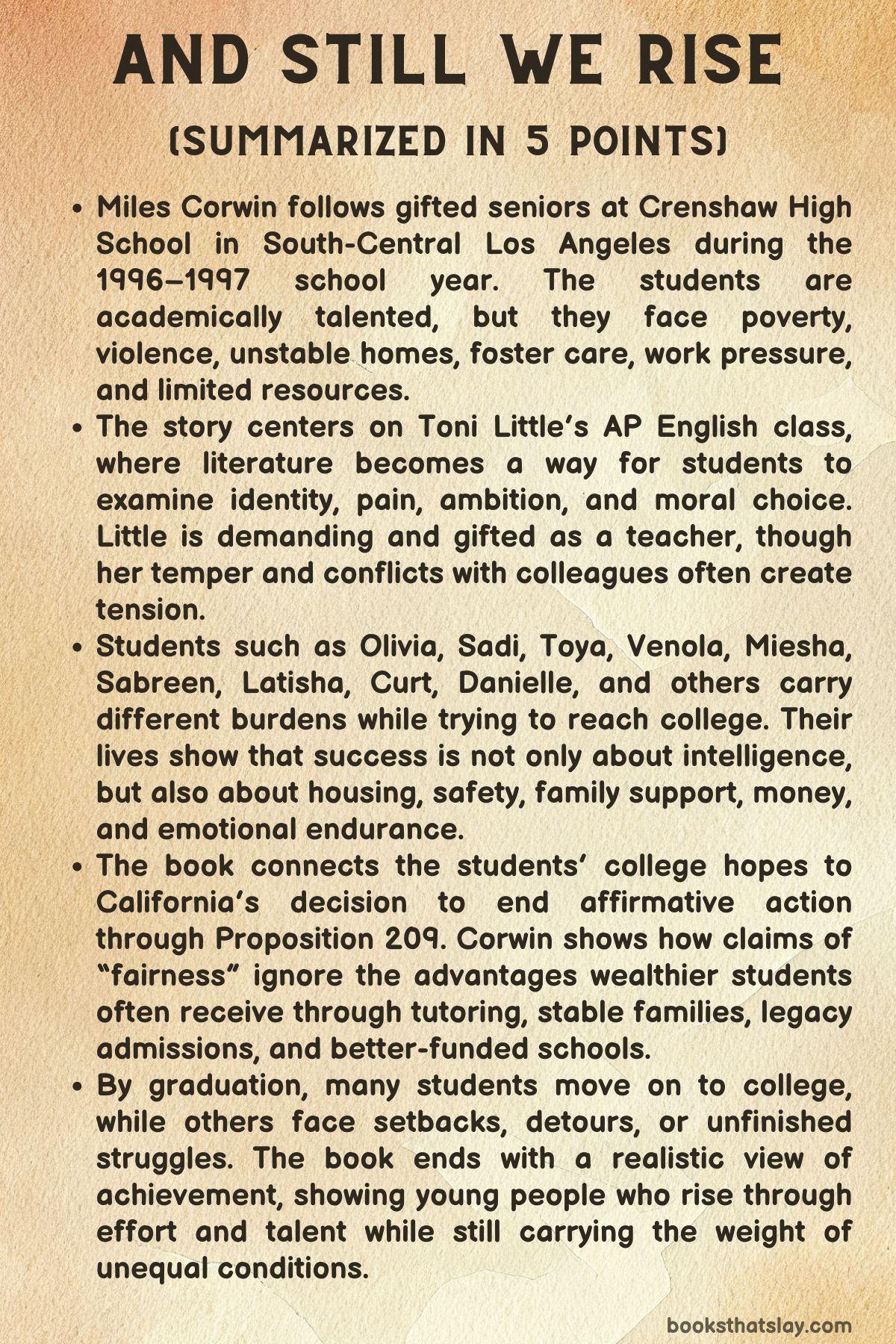
And Still We Rise: The Trials and Triumphs of Twelve Gifted Inner-City Students by Miles Corwin is a nonfiction account of gifted high school seniors at Crenshaw High School in South-Central Los Angeles during the 1996–1997 school year. The book follows students who are brilliant, ambitious, and often burdened by poverty, foster care, family violence, gang pressure, work, parenthood, and unstable housing.
Corwin uses their AP English classroom as the center of the story, while also showing the larger debate over affirmative action in California. The book is not a simple success story; it is a clear-eyed look at talent trying to survive unequal conditions.
Summary
And Still We Rise begins with a death that changes the direction of Miles Corwin’s reporting. A teenage boy is killed in a South-Central Los Angeles drive-by shooting and, at first, detectives assume he is just another gang victim.
Then they find a carefully folded French Revolution exam in his pocket. The boy turns out to be a gifted student, not a gang member.
His death pushes Corwin to look more closely at the students in South-Central who are achieving at high levels while living in conditions that many outsiders reduce to stereotypes.
Corwin chooses to follow the senior class in Crenshaw High School’s gifted magnet program. The school stands in a neighborhood marked by poverty, gang violence, underfunded schools, and limited access to the advantages that wealthier students often take for granted.
At the same time, the gifted program has strong academic results and sends most of its students to college. The school year also unfolds as California voters approve Proposition 209, ending race-based affirmative action in public university admissions.
That political change gives the students’ college hopes a sharper meaning.
The central classroom is Toni Little’s AP English class. Little is talented, demanding, and deeply attached to literature, but she is also volatile and often difficult.
She can encourage students with real care, then wound them with harsh words. She clashes repeatedly with Mama Moultrie, another English teacher in the gifted program.
Moultrie is warm, religious, culturally rooted, and committed to giving students a sense of Black history and pride. Little values rigorous preparation for the AP exam; Moultrie believes students must understand the social forces that shaped their lives.
Their conflict becomes one of the school year’s recurring tensions.
Among the students, Olivia becomes one of the strongest examples of promise under pressure. She has survived severe abuse by her mother and has lived in many group homes and foster homes.
School is the only place where she has felt safe. Yet her senior year is chaotic.
She works long hours, moves through unstable placements, keeps a broken-down car as one of her few possessions, and struggles to keep up with assignments. She is exceptionally smart and often earns top grades, but her need for money and independence leads her into trouble, including involvement in a check-cashing scam.
Even when teachers and administrators argue that she belongs in college, the juvenile court system treats her harshly because she lacks family support.
Sadi, another student, carries a different kind of conflict. He once had ties to gang life and lost friends to violence, but he turns toward Islam, poetry, and speech competitions.
He is gifted with language and admired for his voice, yet he still has trouble staying focused in classes that do not interest him. His mother wants him to win a scholarship and leave the dangers around him behind.
Through Sadi, the book shows how hard it can be for a Black male student to be accepted as both intelligent and tough in a neighborhood where survival has its own code.
Toya’s story shows how quickly a gifted student’s path can be interrupted. She survived childhood abuse and the murder of her mother by her stepfather.
She once dreamed of Harvard and medical school, but she becomes a teenage mother and disappears from school. Scott Braxton, the head of the gifted program, tries to find childcare and keep her connected to Crenshaw.
Toya wants to return, but poverty, housing problems, and the responsibilities of caring for her baby make every step difficult. When she finally comes back, the simple fact of being in school again feels like a victory.
Venola is quiet, disciplined, and deeply religious. Her family moved to Los Angeles from Kentucky and lived through serious hardship.
Her mother works constantly, and Venola helps manage bills while also working as a nurse’s aide. She studies wherever she can, reads constantly, and looks for colleges that can offer financial aid.
Miesha also works long hours while competing for top academic honors. Her older brother Raymond acts as her main support and pushes her toward school success.
Both girls show how much labor sits behind the phrase “good student.”
Other students add to the larger picture. Sabreen, abandoned and pushed through the foster system, is ranked near the top of the class but drops out while trying to gain control over her own life.
Latisha, who survived sexual abuse and her mother’s drug addiction, finds a way to write about her past and begins to connect deeply with literature. Curt comes from a more stable and educated family than many classmates, but even he faces racial assumptions when he attends a Stanford summer program.
Danielle, the daughter of Olympic athlete Tommie Smith, is quiet but strong, eventually becoming valedictorian. Naila, a standout athlete headed to Stanford, shows another version of achievement, balancing sports, academics, and family expectations.
As the year moves forward, college applications, SAT scores, AP exams, and scholarship hopes create constant pressure. Corwin contrasts Crenshaw students’ lives with those of wealthier students who can afford tutors, stable homes, test preparation, and parents who know how to manage the admissions process.
The debate over affirmative action is therefore not abstract. For these students, admissions policies can affect whether their talent is recognized in a system already tilted against them.
The school itself is under strain. Gang violence reaches the edges of campus.
Teachers lack books, copies, and basic resources. Administrators such as Braxton carry the emotional weight of trying to protect students from systems that often fail them.
Braxton works especially hard for students like Olivia, Toya, Sabreen, Claudia, and Sadi, but he cannot solve every crisis. The book refuses to make any adult a savior.
Teachers help, but the students remain the center of the story.
By graduation, many students have made it through the year, though not without losses and unfinished struggles. Little reads a letter to her AP class, telling them how much they have given her.
The students thank her for sharpening their minds and helping them love literature, even though their AP exam results are disappointing. Danielle gives the valedictorian speech and connects the class’s survival to Maya Angelou’s “And Still I Rise.” Families gather, including relatives who have been absent or struggling, and the ceremony becomes both an ending and a measure of what the students have overcome.
The epilogue shows mixed outcomes. Some students go on to four-year colleges: Miesha attends USC, Sadi goes to Clark, Danielle studies at Pitzer, Venola attends Colby, Curt goes to UCLA, Princess attends UC Santa Barbara, and Naila studies at Stanford.
Others face detours. Toya earns a GED and hopes for college.
Sabreen leaves an abusive marriage and tries to begin again. Latisha returns to Los Angeles and takes community college classes.
The teachers also move on, with Little remaining controversial and Moultrie continuing her work in education.
In the end, And Still We Rise presents success as real but never easy. It shows gifted students fighting for futures while carrying burdens no exam score can measure.
The book’s power comes from its insistence that these students are not symbols, statistics, or inspirational decorations. They are complicated young people with intelligence, anger, humor, ambition, mistakes, and hope.
Key People
Olivia
Olivia is one of the most complex students in the narrative because her intelligence exists beside deep emotional damage and a strong instinct for survival. She has grown up with abuse, rejection, foster homes, group homes, unstable housing, and the constant absence of dependable parental care.
Her mother’s refusal to claim her leaves a wound that shapes much of Olivia’s behavior. School becomes her safest space, but even there she cannot fully separate herself from the pressure of needing money, transportation, shelter, and control over her own life.
Her entrepreneurial side shows up early, whether she is selling snacks, working, or trying to build a path toward business school. Yet the same independence that helps her survive also leads her into risky choices, including illegal workarounds and the check-cashing scheme.
Olivia’s tragedy is that she is often punished for adapting to a world that has given her very few safe options. Her sharp mind, humor, pride, and hunger for education make her unforgettable, but her story also shows how talent can be nearly crushed when no stable adult structure exists around it.
Sadikifu
Sadikifu, often called Sadi, represents the struggle between intellectual promise and the pull of neighborhood identity. He is thoughtful, poetic, religious, and politically aware, yet his past connection to gang life follows him.
His father’s absence, his mother’s fierce expectations, and the deaths and arrests around him create a divided inner life. He knows that education can offer a future, but he also knows that masculinity in his environment is often measured by toughness, loyalty, and street reputation.
His poetry becomes the space where he turns anger into language. Through speech contests and classroom discussions, he builds a public voice that allows him to be respected for something other than violence.
Sadi’s intelligence is not neat or obedient; it is argumentative, spiritual, wounded, and proud. He challenges teachers, questions racial history, and refuses to accept easy answers.
His development lies in his attempt to move from reaction to purpose. He is not simply leaving gang life behind; he is trying to create an identity strong enough to survive without it.
Toya
Toya’s character is shaped by loss at an age when she should have been protected. Her stepfather’s abuse, the murder of her mother, and her early responsibility for her younger sister force her into adulthood before she is ready.
She is academically gifted and once imagines a future that includes elite colleges and medical school, but teenage motherhood changes the terms of her life. Toya is not presented as someone who gives up on learning; in fact, she continues to value school intensely.
Her difficulty is practical: childcare, housing, money, and guardianship problems keep blocking her return. Her love for her son is clear, but motherhood also narrows her freedom.
Toya’s character shows how a student can remain intellectually capable while being pushed away from opportunity by daily survival needs. Her return to school is important because it is not glamorous; it is tiring, fragile, and uncertain.
Still, her desire to keep studying reveals a resilient mind that refuses to accept that one crisis should define her entire future.
Venola
Venola is quiet, disciplined, and deeply sincere in her pursuit of learning. Unlike some students who mask pain with defiance or humor, Venola carries hardship with calm seriousness.
Her family’s move to Los Angeles brings poverty, unstable housing, and the need for her mother to work constantly. Venola takes on adult responsibilities at home, including managing bills and working in a convalescent home, but she still protects her academic life with unusual focus.
She reads constantly, studies during lunch, helps classmates, and treats education as both a moral duty and a practical route forward. Her faith matters to her, but she is not passive; she believes people must think for themselves and make responsible choices.
Venola’s power as a character comes from steadiness. She is not the loudest student, but she is one of the clearest examples of sustained effort.
She also exposes how unfair it is that students with so much promise must depend on financial aid decisions, bus schedules, and work hours to determine how far their talent can go.
Miesha
Miesha is driven by perseverance, and that quality defines nearly every part of her character. Her brother Raymond becomes her central authority figure, filling a parental role and pushing her to avoid the mistakes he believes he made.
Miesha’s early attitude in class can be confrontational, but beneath that defensiveness is a student who wants to be respected and challenged. Once she commits herself, she becomes one of the highest achievers in the class, even while working punishing hours to help with family finances.
Her cheerleading also matters because it gives her a space for confidence, discipline, and public presence outside the classroom. Miesha’s strength is practical rather than sentimental.
She knows success requires work, and she is willing to do it, even when exhaustion threatens her. Her character also shows how a young person can be both vulnerable and forceful.
She carries private pain, including abuse, but she does not let that pain erase her ambition. Her full scholarship and academic success feel earned because the reader sees the labor behind them.
Sabreen
Sabreen is one of the clearest examples of how institutional systems can fail a gifted child. She is academically strong, ranked near the top of her class, and capable of succeeding in a demanding school environment.
Yet her life outside school is marked by rejection, abuse, unstable housing, foster care, long work hours, and the emotional cost of having to act like an adult too soon. Her statement that she has gone from child to adult with nothing in between captures the center of her character.
Sabreen does not lack intelligence or ambition; she lacks safety. Her decision to leave school and seek emancipation is painful because it is both understandable and damaging.
She wants control over her own life, but the options available to her are limited and often unsafe. Her later marriage and the abuse she faces show how the search for stability can lead into another form of danger.
Sabreen’s character challenges simple definitions of success and failure. Her exit from school is not laziness; it is the result of pressure no student should have to carry alone.
Latisha
Latisha’s character is marked by voice. She has endured sexual abuse, her mother’s drug addiction, displacement, and the burden of painful memory, yet literature gives her a way to name what has happened to her.
Her response to James Joyce is especially important because she sees her own damaged childhood reflected in literary form. Writing becomes a release, not because it fixes her past, but because it allows her to face it with language instead of silence.
Latisha is also socially visible: she is on the cheerleading squad, works on the school newspaper, and becomes homecoming queen. This public confidence sits beside private trauma, making her more layered than a simple image of success.
Her speech style is sometimes judged or noticed by others, but it also reveals her refusal to abandon the language of her own community. Latisha’s ambition to study journalism fits her character because she is learning how to turn experience into expression.
Her path after graduation is uneven, but her voice remains her strongest tool.
Claudia
Claudia is a quieter but deeply revealing character because her conflict is internal. She is intellectually curious and capable, but she begins withholding her work and damaging her own academic record.
Her refusal to submit assignments is not a sign that she cannot do the work; it is a sign that something emotional has interrupted her sense of direction. The discovery of family losses in her mother’s past helps explain the pressure surrounding her.
Claudia has grown up under intense protection, and that protection carries grief she did not fully understand. Her academic withdrawal becomes a form of resistance, though it also threatens her future.
She frustrates the adults around her because they can see her ability but cannot force her to use it. Claudia’s character shows that gifted students do not always express pain through visible crisis.
Sometimes the crisis appears as silence, refusal, or self-sabotage. Her later recovery suggests that her lost motivation was not permanent, but during the school year she embodies the danger of emotional pressure that remains hidden beneath good grades and quiet behavior.
Curt
Curt stands apart from many of his classmates because he has more stable family support and comes from a more professionally secure background. His parents value education, and his mother especially teaches him manners, proper speech, and academic seriousness.
Yet Curt’s relative privilege does not protect him from racial assumptions or neighborhood dangers. At Stanford’s summer program, white students question whether he belongs there because of his race, pushing him to prove himself even harder.
At Crenshaw, he also learns that clothing and color can carry dangerous gang meanings. Curt’s character complicates the idea that all Black students in the gifted program share the same background.
He has advantages that others do not, but he still faces racism, pressure, and the burden of representation. His academic success is real, and Little’s confidence in him reflects his skill.
At the same time, his later struggle at UCLA shows that even prepared students can feel isolated in college settings. Curt’s journey is about belonging: in his neighborhood, in elite academic spaces, and in his own idea of manhood.
Willie
Willie’s character is shaped by longing for his mother and by the steady influence of his father. His mother’s crack addiction breaks the family structure and leaves him with grief that he cannot simply outgrow.
Seeing her in a degraded condition after prison hurts him deeply because it forces him to confront the distance between the mother he loves and the reality of her illness. His father, though busy with night-shift work, offers guidance and encourages him to value education over football.
That advice becomes important because Willie is popular and athletic, but he must decide what kind of future he wants. His interest in Morehouse shows his desire for a place where Black male achievement is not treated as unusual.
Willie’s election as homecoming king reflects his social warmth, but his private sadness gives him depth. He is not only a likable student; he is a young man trying to honor both his family pain and his own possibility.
His move toward business studies shows a practical, hopeful vision of adulthood.
Naila Mosely
Naila represents athletic excellence paired with academic seriousness. As an all-American basketball player with a scholarship to Stanford, she could easily be seen only through sports, but her character resists that narrowing.
Her parents want her to receive the education they did not have, and she grows up with a strong awareness that athletics should not replace intellectual development. Her path is different from that of the gifted magnet students because she is in another program, but she shares their discipline and drive.
Naila’s story also shows the physical and emotional demands placed on young athletes, especially Black girls whose talent can become a public expectation. Her later decision to leave the basketball team is significant because it suggests that identity must remain larger than performance.
She has the right to change direction, even after being celebrated for one skill. Her interest in hospital administration points toward a future based on leadership and service rather than public applause.
Naila’s character expands the book’s idea of achievement beyond test scores and classroom rankings.
Danielle
Danielle is quiet, highly capable, and ultimately one of the clearest symbols of achievement in the graduating class. As Tommie Smith’s daughter, she carries a connection to civil rights history and athletic protest, but she is not merely defined by her father’s fame.
Her academic success, including becoming valedictorian, reflects her own discipline and intelligence. She often appears shy, but her final speech reveals confidence and maturity.
Her words about survival and success capture the collective meaning of the class’s journey. Danielle also shows concern for Little when the teacher appears emotionally unstable, which reveals her sensitivity and emotional awareness.
She is not one of the most turbulent students in the narrative, but her steadiness matters. Her later studies in sociology and Black studies, along with leadership in the Black Student Union and time in Ghana, show that she continues to connect personal achievement with cultural and social awareness.
Danielle’s character represents quiet leadership: she does not dominate the classroom, but when she speaks at the end, she gives shape to what the class has endured.
Princess
Princess appears less centrally than some classmates, but she adds an important dimension to the group. She is socially visible, stylish, and connected to the rites of senior year, including prom and school recognition.
Her response to literature, especially her connection with the Elephant Man, shows that she sees suffering and dignity beneath outward appearances. That response suggests emotional intelligence and a concern with how people are judged.
Her later path toward communications and a desire to become a news reporter fits this sensitivity to image, story, and public voice. Princess is important because she reminds the reader that not every student’s significance comes from a dramatic crisis.
Some characters matter because they show the ordinary hopes of adolescence: wanting to dress beautifully, be seen, celebrate senior year, and imagine a career. In a school environment often defined by danger and pressure, Princess’s presence helps preserve the students’ youth.
She is part of the class’s social life, but she is also someone building a future through communication and self-presentation.
Robert
Robert is not as heavily developed as the central students, but his outcome gives him significance. He is one of the few students who passes the AP exam, which shows that he has strong academic ability and that his preparation meets the formal standard the class is aiming for.
His later studies in African American history and his desire to work as a community organizer suggest a young man who connects education to social responsibility. Robert’s role is quieter, but it supports one of the narrative’s larger claims: students from Crenshaw are not only trying to escape their community; some are trying to understand it, serve it, and change it.
His academic direction matters because it points back toward history, identity, and public action. While he does not receive the same narrative attention as Olivia, Sadi, or Toya, Robert represents a form of success grounded in civic purpose.
He shows that intellectual achievement can become community commitment rather than private advancement alone.
Toni Little
Toni Little is one of the most contradictory adults in the narrative. She is a gifted teacher who can make literature feel urgent, alive, and morally serious.
Her students often respond to her intensity, and many develop a lasting love of books because of her. Yet she is also emotionally volatile, sharp-tongued, and often damaging in her conflicts with colleagues and students.
She wants her students to compete with privileged students, but her methods are uneven. She can offer rides, open her home, and support students after school, then turn around and humiliate someone in class.
Her feud with Moultrie reveals her insecurity and her belief that AP preparation is being weakened by approaches she does not respect. Little’s whiteness at Crenshaw also shapes her self-understanding; she sometimes sees herself as a victim of racial hostility, even while failing to fully recognize how her own behavior contributes to conflict.
Her character is compelling because she is neither savior nor villain. She changes students’ lives, but she also needs discipline, humility, and self-awareness.
Mama Moultrie
Mama Moultrie is nurturing, organized, religious, culturally grounded, and deeply invested in her students’ dignity. She teaches literature through history, community, race, manners, and moral instruction.
Where Little often emphasizes competition and formal literary training, Moultrie emphasizes identity and survival. She wants students to understand the Black experience, respect themselves, speak well, and carry themselves with authority in a world that may judge them quickly.
Her classroom style is expansive and personal; she moves between teacher, preacher, mother figure, and cultural guide. Little sees some of her methods as insufficient preparation for the AP exam, but Moultrie’s strength lies in making literature relevant to students’ lives.
She treats education as a calling, not just a profession. Her flaws are less centered than Little’s, but she too is firm and proud, and she refuses to let Little define her teaching.
Moultrie represents an educational philosophy rooted in care, cultural memory, and practical preparation for racism. Her students need grammar and essays, but she believes they also need a sense of who they are.
Scott Braxton
Scott Braxton carries much of the emotional weight of the school year. As head of the gifted program, he is part counselor, administrator, advocate, crisis manager, and protector.
He tracks missing students, searches for childcare, negotiates with teachers, calls social workers, worries about court cases, and tries to keep fragile students attached to school. His relationship with Olivia, Toya, Sabreen, Claudia, and Sadi shows his commitment, but also his limits.
Braxton cannot repair foster care, poverty, court decisions, or family violence. His exhaustion matters because it shows how much pressure falls on dedicated educators in under-resourced schools.
He is not romanticized; he becomes frustrated, overwhelmed, and sometimes unable to stop bad outcomes. Yet his importance is undeniable.
For many students, he is one of the few adults who sees both their brilliance and their danger. His character shows that care in such an environment requires more than good intentions.
It requires time, persistence, practical problem-solving, and the painful acceptance that some students may still be hurt by forces beyond the school’s control.
Yvonne Noble
Yvonne Noble, the principal, represents the difficult work of leading a school under constant pressure. She must manage gifted education, campus safety, teacher conflict, district expectations, and the public image of a school surrounded by negative assumptions.
Her decision to allow Sadi back into the gifted program is important because it shows both caution and belief in second chances. She understands the risks of gang presence and school violence, but she also recognizes that students can change.
Noble’s role is often administrative, but the emotional toll on her is clear. The conflict involving Little becomes especially draining, and the stress affects her health.
Noble’s character shows that school leadership in such a setting is not simply about discipline or policy. It involves constant judgment calls, limited resources, and the need to protect students while managing adults who are sometimes just as difficult as the young people they teach.
She is not always foregrounded, but her presence shapes the conditions under which everyone else works.
Miles Corwin
Miles Corwin functions as reporter, observer, narrator, and occasional participant. His original interest begins with the death of a gifted student mistaken for a gang member, and this leads him to follow Crenshaw’s senior class.
He is careful not to make the story only about heroic teachers or perfect students. Instead, he tries to show how real people behave under pressure.
His role is important because he frames the students’ lives within larger debates about affirmative action, school funding, race, poverty, and public perception. At times, he crosses the boundary between observer and helper, especially when he drives students or becomes involved in moments of crisis.
That involvement raises questions about journalistic distance, but it also reflects the human difficulty of watching young people struggle without responding. Corwin’s character, though less emotionally central than the students, shapes the reader’s access to the whole story.
His attention insists that these students deserve to be seen in full, not reduced to statistics, headlines, or political talking points.
John Doe Number 27
John Doe Number 27 appears only at the beginning, but his role is essential. He is the murdered gifted student whose French Revolution exam forces adults to reconsider their assumptions.
The first response to his death is shaped by stereotype: a teenage boy killed in South-Central is presumed to be connected to gangs. The exam in his pocket changes that reading.
It reveals thoughtfulness, discipline, and academic promise. He becomes a symbol of all the unseen ability in the neighborhood, but he is also a reminder of how easily a young life can be misread after death.
His absence haunts the narrative because he would have belonged to the graduating class being followed. He stands for the students who do not get the chance to prove themselves beyond the limited stories outsiders attach to them.
His brief presence gives the whole work its moral starting point: intelligence can exist in places society has trained itself not to look.
Raymond
Raymond, Miesha’s older brother, is a crucial supporting figure because he becomes the authority and caretaker she trusts most. He prepares meals, rewards her grades, attends to her school behavior, and pushes her to avoid the wasted potential he sees in his own life.
Raymond’s character shows that family support does not always come from parents. In Miesha’s case, a sibling becomes the stabilizing force.
He is practical, protective, and demanding, and his influence gives Miesha a model of accountability. His investment in her cheerleading as well as her grades shows that he wants her to develop confidence in more than one area.
Raymond’s own regrets make him especially determined that Miesha succeed. He does not have the institutional power of Braxton or the classroom authority of Little, but his role is just as personal.
Through him, the narrative shows how young people often survive because one person in the family decides to take responsibility, even when that person is still young himself.
Thelma
Thelma, Sadi’s mother, is one of the strongest parental figures in the narrative. Her past includes hardship, mistakes, and prison, but she builds a new life through Islam and directs enormous energy toward her son’s future.
She understands the dangers surrounding Sadi because she has lived close to them herself. Her parenting is intense, sometimes more like a peer relationship than a traditional mother-son structure, but her commitment is firm.
She refuses to accept that Sadi’s intelligence should be wasted by gang life, anger, or poor discipline. Her pressure can frustrate him, yet it also keeps him tied to education when he might otherwise drift further into danger.
Thelma’s character matters because she complicates easy judgments about parents in poor communities. She is not perfect, but she is fiercely present.
Her later death adds weight to Sadi’s path, showing how much of his motivation was connected to her belief in him. She represents parental love shaped by experience, fear, faith, and determination.
Paula
Paula, Venola’s mother, is defined by labor and sacrifice. She moves her children from Kentucky to Los Angeles in search of a better life, only to face poverty, bad housing, and exhausting work.
She cooks without proper utilities, works multiple jobs, and does everything she can to keep her children safe. Although she does not have time to supervise every detail of Venola’s schoolwork, she creates the conditions that allow Venola to value learning.
Her habit of taking Venola to the library is especially important because it gives her daughter a relationship with books that later becomes central to her identity. Paula’s character shows that parental support is not always visible through school meetings, tutoring, or college knowledge.
Sometimes it appears as walking a child to the library, paying bills, working nights, and refusing to surrender to despair. She is proud of Venola, and her pride becomes part of Venola’s discipline.
Paula’s life is difficult, but she gives her daughter a model of endurance with purpose.
Tommie Smith
Tommie Smith appears as Danielle’s father and as a living link to a major moment in Black protest history. His classroom visit gives the students a direct encounter with moral courage, sacrifice, and the cost of public conviction.
He is not presented simply as a famous athlete; he speaks as someone who paid a price for standing by his beliefs. His message that education matters more than athletics is especially important in a school environment where sports can appear to offer a rare route out.
For Danielle, his presence adds another layer to her identity, but he does not overshadow her. For the students, he becomes an example of how personal success must be measured by truthfulness and purpose, not applause alone.
His character reinforces the connection between history and the present. The students are not isolated from the struggles of earlier generations; they inherit both the burden and the strength of those who challenged racial injustice before them.
Themes
Education as Refuge, Weapon, and Uncertain Escape
Education in And Still We Rise is never presented as a simple ladder that automatically carries students out of hardship. For many of the students, school is first a refuge.
Olivia treats school as the only safe place in a life marked by abuse, foster homes, and rejection. Sabreen also sees school as protection from family instability, while Toya fights to return because being in class allows her to feel like a student again rather than only a young mother.
At the same time, education is a weapon. Literature teaches the students to argue, interpret, remember, and name their pain.
Little’s class gives them language for alienation, moral choice, love, betrayal, and identity. Moultrie’s teaching gives them historical context and cultural pride.
Yet education remains uncertain because grades and talent do not erase poverty, court systems, childcare needs, standardized testing gaps, or college costs. The students’ intelligence is clear, but the route from intelligence to opportunity is filled with barriers.
This theme is powerful because it rejects both cynicism and easy optimism. School matters deeply, but it cannot carry the full burden of repairing social inequality by itself.
Inequality Behind the Idea of Fair Competition
The debate over affirmative action reveals how misleading the language of fairness can become when students begin from unequal starting points. Wealthier students often have parents who understand admissions systems, money for test preparation, quiet homes, stable transportation, tutors, and time to study.
Crenshaw students often take the SAT without preparation while working long hours, caring for children, moving between foster homes, or coping with violence. When opponents of affirmative action argue that race should not matter in admissions, the narrative shows that race and class have already shaped the conditions under which students compete.
The students are not asking for achievement to be ignored; they are asking for their achievement to be understood in context. A high grade earned after a work shift, a strong essay written in a group home, or a college application completed without parental guidance carries a different weight.
The theme exposes how public systems often reward advantages that appear neutral because they are attached to money, family knowledge, and neighborhood resources. The book asks whether competition can be called fair when some students arrive at the starting line already exhausted.
Survival Without Sentimental Heroism
The students survive through intelligence, humor, pride, work, faith, anger, and stubbornness, but the narrative avoids making survival look clean or noble at every moment. Olivia lies, works risky jobs, and becomes involved in a criminal scheme.
Sadi has a gang past and still struggles with discipline. Sabreen leaves school in search of control.
Toya becomes a mother and has to rebuild her academic path. These actions do not erase their promise; they reveal the pressure under which that promise exists.
Survival in the book often means making imperfect choices in situations where no safe choice is available. This theme matters because it resists turning disadvantaged students into inspirational objects.
The students are not valuable because they behave perfectly. They are valuable because they are full people, with contradictions and desires that cannot be reduced to a scholarship story.
Their mistakes are part of the truth, not interruptions of it. The adults also survive imperfectly.
Little teaches brilliantly but behaves badly. Braxton helps many students but cannot save all of them.
Survival is shown as effort under strain, not moral purity.
The Power and Limits of Adult Care
Adults shape the students’ lives in powerful ways, but care is shown as limited, uneven, and sometimes flawed. Braxton works tirelessly to keep students in school, find childcare, communicate with social workers, and prevent crises from becoming permanent losses.
Little gives students a love of literature and often supports them personally, yet her anger and insecurity can harm the same students she wants to help. Moultrie offers cultural grounding, discipline, and maternal warmth, giving students a sense of dignity that reaches beyond exams.
Family members such as Raymond, Thelma, and Paula show that support can come from siblings and parents who have their own burdens. Yet even the best adults cannot fully protect students from poverty, racism, court rulings, foster care instability, addiction, or violence.
This theme is important because it refuses the fantasy of the lone savior teacher. Dedicated adults matter enormously, but institutions and social conditions still decide too much.
The book honors care without exaggerating its power. It shows that young people need mentors, teachers, counselors, and family advocates, but they also need systems that do not force those adults to perform miracles every day.