And The Earth Did Not Devour Him Summary, Characters and Themes
And The Earth Did Not Devour Him by Tomás Rivera is a short, fragmented novel about Mexican American migrant workers moving between Texas and the Midwest in search of farm labor. Rather than following one smooth storyline, the book presents memories, prayers, conversations, and brief episodes from a child’s point of view and from the wider community around him.
It shows poverty, racism, dangerous work, family love, religious fear, childhood confusion, and the struggle to keep dignity under harsh conditions. The book’s power comes from its plain, direct style and its attention to people who are often ignored.
Summary
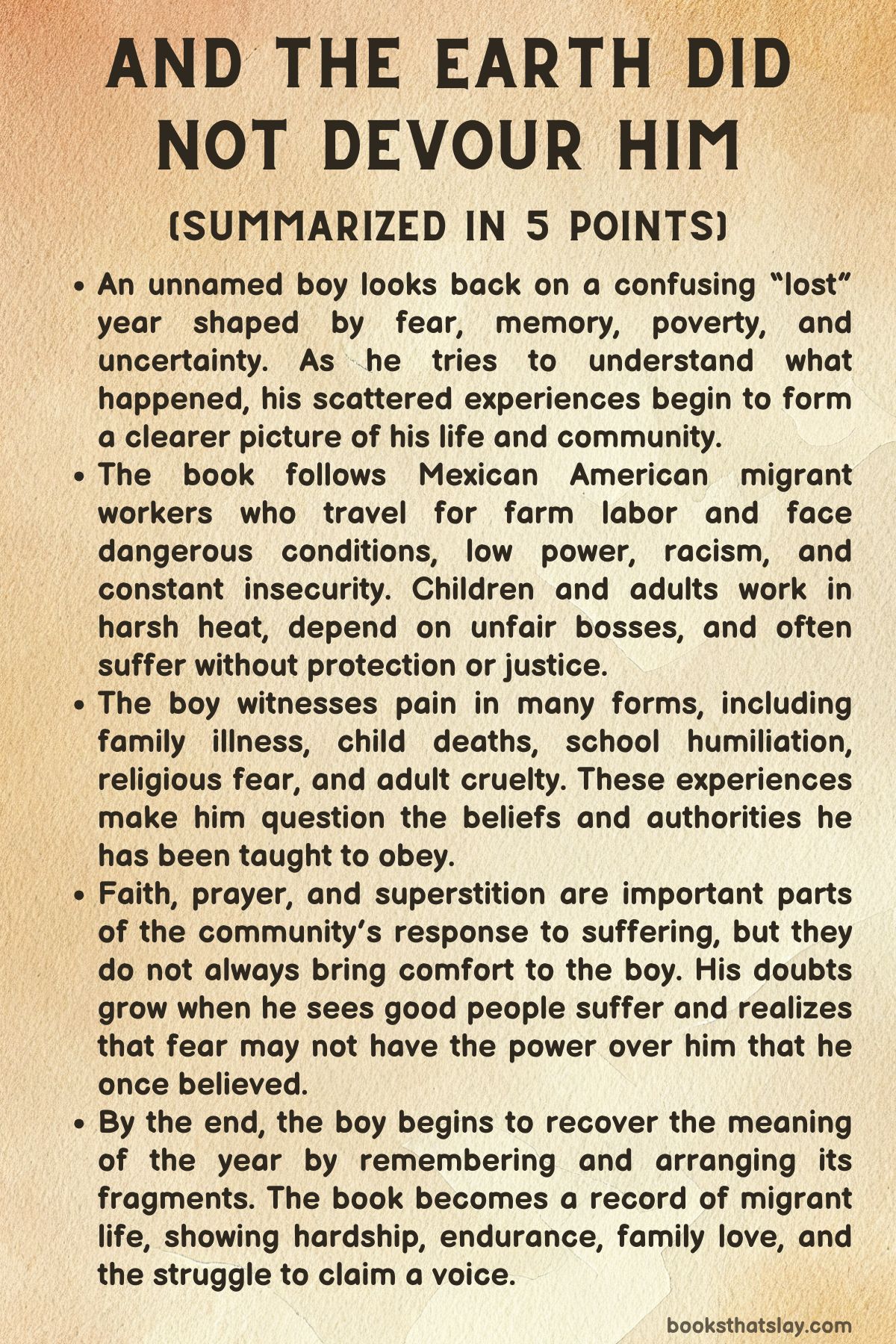
And The Earth Did Not Devour Him follows an unnamed boy and the Mexican American migrant community around him through a series of connected memories. The boy looks back on a “lost” year, a time that feels unclear to him because memory, dreams, fear, and reality have mixed together.
He cannot always tell what truly happened and what he imagined. This uncertainty becomes part of the book’s structure.
The story moves through incidents, voices, prayers, and conversations, building a picture of a community worn down by hard labor but still held together by family, talk, belief, humor, and survival.
The boy’s world is shaped by migrant farm work. Families travel north for seasonal jobs and return south when the work is done.
Their lives depend on bosses, crops, weather, and transportation. In the fields, children often work beside adults.
One episode shows children suffering in extreme heat while waiting for water. The boss brings water only rarely and threatens to withhold pay if workers stop to drink.
Children try to sneak water from a cattle tank, but the boss decides to scare them with a shotgun. He accidentally kills a child.
The workers later discuss how the boss avoided punishment but lost his money and sanity. The event shows how little protection the workers have and how easily their suffering is treated as ordinary.
War also reaches the community. Mothers wait for news from sons serving in Korea.
One mother prays desperately for her son’s safety, remembering him as a gentle child and asking God and the Virgin Mary to shield him from bullets and enemies. Another family receives word that a son is missing in action.
Through these moments, the book shows how poor families give their children not only to the fields but also to the military, while parents are left with fear, faith, and silence.
The boy’s education is another source of pain. At school, he faces racism and humiliation.
After a white boy says he dislikes Mexicans because they steal, the boy fights back and is expelled. He worries about telling his parents because they want him to stay in school and hope education will give him a better future.
The school does not protect him; instead, adults describe him as “the Mexican kid” and treat his removal as convenient because farm bosses need him in the fields. His shame grows from many experiences: being checked for lice, being made to strip for an exam, being mocked, and being unable to read in class.
Education is held out as hope, yet the school itself becomes a place of exclusion.
The boy also encounters danger within the community. He stays with Don Laíto and Doña Bone while his parents are away.
At first they seem kind, and people like them, but their home becomes frightening. They feed him bad food, scare him, make him work, and pressure him to steal.
The situation turns horrifying when the boy discovers the body of a man in his bed. Don Laíto and Doña Bone force him to help bury the body and threaten to blame him for the murder.
Later they give him the dead man’s ring, leaving him with lasting terror. This episode adds another kind of fear to the boy’s life: not only bosses and racism, but also adults who can exploit a child’s helplessness.
Religion appears throughout the book as both comfort and burden. The boy watches adults pray, seek blessings, and ask spiritual figures for answers.
Yet he also begins to question what he has been taught. One night, he tries to summon the devil.
He is afraid, but he wants proof. If the devil appears, then perhaps everything he has learned is true; if the devil does not appear, then perhaps there is no devil, no punishment, and maybe no God.
No devil comes. The boy feels disappointed and bold, but also troubled.
He realizes that what may drive people mad is not seeing the devil, but calling and receiving no answer.
The title episode marks a major change in the boy’s inner life. He sees his mother cry over the deaths of relatives, and later his father collapses from sunstroke after field work.
His father suffers for days, praying for mercy. The boy grows furious.
He cannot understand why good people must suffer so much while prayer seems to change nothing. When his younger brother also collapses from the heat, the boy carries him home and curses God.
He fears the earth will swallow him for his blasphemy, but nothing happens. The ground remains firm.
Instead of punishment, he feels calm and free. The next day his father and brother improve.
The boy does not tell anyone what he said, but he feels stronger, as if he has discovered that fear does not have to rule him.
Other episodes show the daily losses and small hopes of migrant families. A family leaves young children at home while the parents work because the boss does not want children in the fields.
A stove explosion kills two of the children, leaving only one alive. In another episode, a young man named Ramón dies by suicide after a failed romance, causing a town blackout.
A truck carrying workers crashes after being hit by a drunk Anglo woman, killing sixteen people. These tragedies are told in a direct manner, as part of the community’s memory, showing how death is never far from ordinary life.
The book also gives attention to moments of embarrassment, misunderstanding, and longing. A boy is refused service at a barber shop and then made to leave a movie theater.
Doña María, wanting to buy Christmas toys for her children, forces herself to go downtown alone despite severe anxiety. In the crowded store, she panics, places toys in her bag, and is arrested for stealing.
Her husband explains her condition and brings her home. They decide not to destroy the children’s belief in Christmas hope, though the children eventually understand enough not to ask why no toys came.
The community is often cheated by people who take advantage of their grief and trust. Portrait salesmen promise enlarged portraits and take money from families.
Don Mateo gives them the only photograph of his son Chuy, who died in Korea. When the portraits never arrive and the photos are found ruined, Don Mateo searches for the swindler and forces him to recreate his son’s image from memory.
The scene shows both exploitation and a father’s refusal to let his son vanish completely.
Near the end, migrant workers are trapped on a broken-down truck on the way to Des Moines. Their private thoughts reveal exhaustion, hunger, debt, shame, and hope.
Some dream of better jobs, cars, or a life beyond the fields. One worker reflects that they never truly arrive, because each destination only leads to more labor and another journey.
This idea captures the migrant condition in the book: movement without security, arrival without rest.
The final scene returns to the boy hiding under a house because he does not want to go to school. In the darkness, he thinks through the events of the year: deaths, humiliations, fears, stories, and family grief.
Others think he may be losing his mind, but he feels the opposite. He believes he has recovered something by putting the pieces together.
He comes out, returns home, climbs a tree, and sees a palm tree in the distance. He imagines someone there and waves.
The ending suggests that by remembering and arranging the fragments, the boy gains a clearer sense of himself and his world.
Characters
The Unnamed Boy
The unnamed boy is the central consciousness of And The Earth Did Not Devour Him. He is not presented as a conventional hero with a single clear journey, but as a child trying to understand fear, injustice, religion, family suffering, and memory.
His mind is active and restless. He thinks deeply about things adults often accept without question: why people suffer, why God allows pain, why workers are treated badly, and why children are expected to endure hunger, heat, shame, and silence.
His “lost” year is important because it shows a mind trying to recover meaning from scattered experiences. He is sensitive, observant, and often frightened, but he is not passive.
When his father and brother suffer from heat and exhaustion, his anger becomes a form of awakening. By cursing God and realizing that the earth does not punish him, he gains a new sense of inner power.
His development is less about becoming happy and more about becoming aware. He learns that fear can be questioned, that authority is not always moral, and that memory can help him reclaim himself.
The Boy’s Mother
The boy’s mother represents care, endurance, religious faith, and emotional pain. She carries the burdens of poverty and family responsibility while trying to keep her household together.
Her grief over death, her worry for her husband, and her reliance on prayer show a woman who has few material resources but still searches for protection through faith. She is not weak; rather, she survives by holding onto beliefs that give structure to suffering.
When the boy questions God, she is terrified because his anger seems dangerous to her spiritual understanding of the world. Her fear is not only religious but maternal.
She worries that her son’s anger may isolate him from the values that have helped the family endure hardship. She also shows quiet tenderness through ordinary acts, such as leaving water under the bed for spirits.
To the boy, she is both loving and limited: she comforts him, but she cannot fully answer the questions that trouble him.
The Boy’s Father
The boy’s father is a figure of labor, sacrifice, and physical vulnerability. He wants his son to go to school and become something other than a field worker, which shows that he understands the cost of migrant labor and hopes for a different life for his child.
Yet his own body is trapped in the system he wants his son to escape. His sunstroke and intense suffering expose the brutal demands placed on workers.
He is a good man, but goodness does not protect him from exhaustion, illness, or poverty. His prayers during sickness disturb the boy because they seem to show helplessness rather than relief.
The father’s importance lies in this painful contrast: he is respected and loved, but he is also broken down by work. Through him, the boy sees how labor can reduce a person’s strength while leaving their dignity intact.
The Migrant Workers
The migrant workers function as a collective character. Their thoughts, conversations, fears, jokes, and complaints create the larger social world of the novel.
They are not shown as a faceless group; each has private hopes and worries. Some dream of better jobs, some calculate debts, some think about food, children, or the humiliation of traveling in unsafe conditions.
Their lives are marked by repeated movement without real arrival. They travel for work, but each destination brings new forms of uncertainty.
They depend on bosses, crops, trucks, weather, and wages they may not fully receive. Still, they maintain a sense of community through speech, shared memory, gossip, and mutual recognition.
Their collective voice gives the book its broad human force. It shows that the boy’s experiences are personal, but they are also part of a larger pattern of exploitation and survival.
The Boss
The boss is one of the clearest representations of cruel power. He controls water, wages, and discipline in the fields, and he treats the workers’ basic needs as interruptions to productivity.
His decision to scare thirsty children with a shotgun shows both recklessness and contempt. The child’s death is not presented as a random accident alone; it comes from a system in which the boss’s authority is unchecked and the workers’ lives are undervalued.
His later decline into madness does not erase his guilt, but it complicates him slightly by showing that violence can also destroy the person who commits it. Even so, he remains a symbol of the kind of power that places profit above human life.
The Mother Praying for Her Son
The mother praying for her son in Korea embodies fear, devotion, and helpless love. Her prayer is intimate and desperate.
She remembers her son as a baby and asks divine figures to protect him from war. Her language shows how war enters the emotional lives of families far from the battlefield.
She cannot protect her son directly, so she gives everything she has: memory, prayer, and willingness to suffer in his place. Her character also reveals how mothers are forced to live with uncertainty.
Not hearing from a child becomes a form of torment. She stands for many parents whose children are taken by forces larger than the family: war, poverty, labor, and national demands.
Julianito’s Mother
Julianito’s mother is another figure of anxious waiting. After receiving word that her son is missing in action, she seeks comfort from a woman who channels spirits.
Her need to know what happened to him shows the emotional damage caused by uncertainty. She does not simply want information; she wants hope made believable.
When she is told that her son is fine and will return, the moment reveals the community’s dependence on alternative forms of comfort when official institutions provide only fear and absence. Her character shows how grief can begin before death is confirmed.
The Woman Who Channels the Spirit
The woman who channels the spirit occupies an important place in the community because she provides answers where ordinary life provides none. Her role is not judged in a simple way.
Whether or not her claims are true, she serves a social and emotional function. People come to her because they are frightened, poor, grieving, and ignored by formal systems.
She offers reassurance, especially to a mother terrified about her son. Her character reflects the community’s search for meaning beyond official religion and government notices.
She also shows how belief can be shaped by need. In a world where people have little control, even uncertain comfort has value.
The White Boy at School
The white boy at school represents everyday racism as it appears in childhood. His insult that Mexicans steal is not an isolated childish remark; it reflects a wider prejudice that the school environment allows to continue.
By attacking the narrator and then becoming part of the situation that leads to the narrator’s expulsion, he exposes how racial power works even among children. The boy’s whiteness protects him, while the Mexican American child is treated as the problem.
His character is small in terms of page presence but important in meaning. He shows how racism enters the narrator’s life early and teaches him that institutions may punish the victim more harshly than the aggressor.
The School Janitor and Administrators
The janitor and school authorities represent institutional bias. They do not try to understand the narrator’s experience or the racism that led to the fight.
Instead, they reduce him to “the Mexican kid” and treat his expulsion as ordinary. Their willingness to align with the interests of farm bosses shows that the school is not separate from the labor system.
Education is supposed to offer escape, but these adults help push the boy back toward the fields. Their characters are important because they show that discrimination does not require dramatic cruelty.
It can operate through casual language, assumptions, paperwork, and indifference.
Don Laíto
Don Laíto is one of the most disturbing adult figures in the novel. Publicly, he is accepted by both Mexican and Anglo communities, which gives him a mask of respectability.
Privately, he is corrupt, dangerous, and manipulative. He steals, sells illegal goods, abuses the boy’s trust, and participates in murder.
His treatment of the boy is especially cruel because he understands the child’s vulnerability. By forcing the boy to help bury a body and threatening to accuse him, Don Laíto turns childhood fear into a tool of control.
He shows that danger does not come only from outsiders or bosses; it can also exist inside the community, hidden behind charm and familiarity.
Doña Bone
Doña Bone is frightening because her cruelty often appears playful on the surface. She scares the boy, helps create an unsafe home, and takes part in the murder plot.
Her behavior unsettles the boundary between domestic care and danger. As a woman entrusted with housing a child, she should provide protection, but instead she helps exploit him.
Her role in the killing and burial shows that she is not merely Don Laíto’s companion; she is an active participant in violence. She also represents the way poverty and moral corruption can exist together without one excusing the other.
Her character leaves the boy with lasting fear and distrust.
The Murdered Man
The murdered man is significant less as a developed personality than as a symbol of how easily a vulnerable person can disappear. He appears to be alone, with money and no one to worry about him, which makes him a target.
His death shows the cold calculations behind Don Laíto and Doña Bone’s actions. The ring later given to the boy becomes a physical reminder of guilt, fear, and forced silence.
Through this man, the novel shows how violence leaves traces even when the dead person’s full story remains unknown.
Don Rayos
Don Rayos influences the boy’s imagination through his role as the devil in religious plays. His warnings about summoning the devil help shape the boy’s fear and curiosity.
He represents the older generation’s use of religious storytelling to teach caution, obedience, and awe. Yet his stories also push the boy toward testing belief for himself.
Don Rayos is not cruel; his importance lies in how his performance and warnings enter the child’s mind. He helps create the symbolic world the boy later questions.
The Protestant Minister
The Protestant minister represents false promise and shallow charity. He tells the workers that someone will teach them carpentry so they can escape field labor, offering hope for practical change.
Yet the plan collapses into hypocrisy when the man sent to help runs away with the minister’s wife. This episode makes the minister’s promise look empty.
His character suggests that outsiders may speak of helping the poor without truly understanding or committing to their needs. The workers’ excitement makes the disappointment sharper because their desire for a better life is real.
The Minister’s Wife and the Carpenter
The minister’s wife and the carpenter are minor but revealing figures. They arrive with the appearance of usefulness, but their actions turn the promised training into a scandal.
Their private desire takes priority over the workers’ need for opportunity. They expose the gap between public moral language and private behavior.
For the workers, the episode becomes another example of hope being raised and then withdrawn. Their characters are almost comic, but the result is bitter because the men remain trapped in the same labor conditions.
The Grandfather
The grandfather is a figure of hard-earned wisdom. After suffering paralysis, he listens to his grandson say that he wants the next ten years to pass quickly so he can know what will happen in life.
The grandfather’s harsh reaction comes from knowledge the younger man does not yet have: time should not be wished away, because life’s answers often come with pain, loss, and regret. His character adds a generational perspective.
He understands that impatience can be foolish because the future is not simply a place of fulfillment. It may also bring suffering.
The Grandson
The grandson represents youthful impatience and the desire to see life’s outcome before living through it. At twenty, he thinks of the future as a mystery he wants solved quickly.
By thirty, he understands his grandfather’s anger. His character shows how wisdom often comes too late to be borrowed fully from elders.
He must experience time himself before he understands its cost. His small story echoes the boy’s larger process of learning through difficult experience.
The Nun
The nun shapes the child’s fear of sin, confession, and hell. Her teaching emphasizes punishment and complete confession, especially around bodily sin.
To a child, her warnings create intense anxiety rather than moral clarity. She does not intend to harm him, but her religious instruction becomes psychologically overwhelming.
The boy’s fear of hell is made stronger by his memory of being burned, so her words become physically vivid to him. Her character represents religious authority when it is presented through fear rather than understanding.
The Priest
The priest appears in more than one social role. As a religious authority, he receives confession and is connected with rituals of faith.
Yet the priest who charges migrant workers for blessings before they travel north is also linked to exploitation. He collects money from poor people seeking protection, then uses it for personal travel.
His inability to understand the parishioners’ markings on his postcards shows distance between him and the community he serves. He represents a church that offers comfort but can also become detached, transactional, and blind to the people’s own forms of expression.
The Boy at First Communion
The boy preparing for first communion is another version of childhood consciousness under religious pressure. He wants to do the right thing but cannot understand adult categories of sin.
After accidentally seeing a sexual scene, he feels guilty even though he has done nothing wrong. His confusion shows how children can internalize shame before they understand desire, morality, or adult behavior.
His experience changes the way he sees priests, nuns, parents, and the adult world. Innocence is not simply lost; it becomes confused by secrecy and fear.
The Teacher
The teacher who receives a button from a young boy is one of the gentler figures in the book. Her need for a button becomes a moment of unexpected generosity when the child tears one from what may be his only shirt.
Her reaction shows that she recognizes the emotional intensity behind the act, though she does not fully understand it. She wonders whether the child is motivated by helpfulness, belonging, or love.
Her character matters because she notices the child’s inner life. Unlike the school authorities who reduce children to racial categories or disciplinary problems, she pauses to consider feeling and intention.
Don Efraín García
Don Efraín García is a loving father whose dreams for his children are shaped by poverty. He enjoys watching them box and imagines that one of them might become successful.
His hope is touching because it comes from wanting his children to defend themselves and perhaps escape hardship. Yet his family’s tragedy shows the cruel limits of parental love under unsafe living conditions.
He and his wife must leave the children at home while they work because the boss does not want them in the fields. Don Efraín loves his children deeply, but love cannot protect them from dangerous housing, poverty, and forced absence.
Doña Chona García
Doña Chona García is a mother caught between work and care. She dislikes the children’s boxing because it leads to conflict, and she worries about them, but economic necessity forces her into the fields.
Her tragedy lies in being unable to be present when her children need protection. Like many parents in the novel, she is not negligent; she is trapped by conditions that make safe parenting almost impossible.
Her grief after the fire reflects the unbearable cost of poverty. Through her, the story shows how labor systems damage family life by separating parents from children even when parents are deeply devoted.
Raulito García
Raulito is the surviving García child, and his survival is marked by trauma. He imitates what he has seen in the boxing movie and what his father encouraged at home, putting gloves on his younger siblings and rubbing alcohol on their chests.
His actions are innocent, but they become part of the fatal accident. Raulito represents childhood imitation in an unsafe world.
Children copy adults, films, rituals, and games, but poverty turns play into danger. His survival is not simple relief; it leaves him connected forever to the deaths of his siblings.
Juan and María García
Juan and María García are the young victims of a preventable tragedy. They are not developed through long dialogue, but their deaths carry great emotional weight.
Their vulnerability shows the danger of leaving children alone in poor housing, yet the story makes clear that the parents’ absence is caused by work demands. The fact that the boxing gloves do not burn while the children do makes the scene especially painful.
Objects survive where children do not. Juan and María represent the innocent lives lost because poverty removes ordinary protections.
Ramón
Ramón is a young man overwhelmed by romantic pain, pride, and despair. His love for Juanita becomes possessive, and when he believes she has betrayed him, he cannot manage the humiliation.
His drinking, threats, and final act show a person trapped in emotional extremity. The town’s discussion of his death suggests both sympathy and gossip.
Ramón is not shown as purely noble or purely foolish. He is vulnerable, wounded, and dangerous to himself.
His death also reveals how private heartbreak can become a public event, marked by the blackout that affects the whole town.
Juanita
Juanita is seen mainly through the community’s talk and Ramón’s pain, which means her full inner life remains distant. She wants to finish school and appears to resist being controlled by Ramón.
Whether she truly betrays him is less important than the way people talk about her and judge her. She becomes the center of male jealousy and public gossip.
Her refusal to obey Ramón at the dance shows independence, but the story also places her in a social world where a young woman’s choices are watched and interpreted by others. She represents the limited freedom available to women under community pressure.
Ramiro
Ramiro functions as the rival figure in Ramón’s story. He is less a fully developed character than a trigger for Ramón’s jealousy and public humiliation.
His presence shows how romantic conflict can be intensified by rumor. The community’s focus on him reveals how quickly private relationships become public material for discussion.
He matters because he helps expose Ramón’s possessiveness and the social atmosphere surrounding Juanita.
Doña María
Doña María is one of the most sympathetic adult characters. She wants to give her children toys for Christmas, not because toys are necessary for survival, but because she wants them to feel joy and belonging.
Her anxiety makes the trip downtown terrifying. The crowded store overwhelms her, and her panic leads to her arrest.
Her character shows how poverty and mental distress can turn a simple errand into a crisis. She is not a thief in intention; she is a frightened mother trying to fulfill a wish.
Her husband’s later decision to keep hope alive for the children shows how much Doña María’s love shapes the family’s emotional life.
Doña María’s Husband
Doña María’s husband is practical, protective, and tired. He works extremely long hours and understands his wife’s anxiety, even if his solution is to keep her within the safety of home and yard.
After her arrest, he explains her condition and brings her home. His first impulse is to tell the children there is no Santa Claus so they will stop asking for toys, but he accepts his wife’s argument that hope matters.
He represents the pressure placed on working fathers who must provide materially while also managing the family’s disappointments. His realism is softened by love.
Doña María’s Children
Doña María’s children represent innocent desire under poverty. Their wish for toys is ordinary, but in their family it becomes painful because even small gifts are difficult to afford.
When they ask whether they receive no presents because they are bad, they reveal how children often interpret poverty as personal failure. Later, when they stop asking why no toys came, their silence suggests early emotional maturity.
They begin to understand hardship before they can fully explain it. Their characters show how poverty teaches children restraint, shame, and quiet acceptance.
Don Mateo
Don Mateo is a grieving father who refuses to let his dead son be erased. When portrait salesmen lose the only photograph of Chuy, Don Mateo’s anger is not mainly about money.
It is about memory. The photograph is a fragile link to his son, and its destruction feels like a second loss.
His search for the swindler shows determination and paternal devotion. By forcing the man to create a portrait from memory, Don Mateo tries to rebuild what has been taken.
His character shows how memory becomes sacred when families have little else left of the dead.
Chuy
Chuy is absent because he has died in Korea, yet his absence shapes his parents’ grief. The single photograph of him becomes precious because it holds the family’s remaining visual memory.
Chuy represents the young men lost to war and the families left with objects, memories, and longing. His character is important precisely because he cannot speak.
The silence around him reflects the finality of death and the difficulty of preserving a life through fragments.
The Portrait Salesmen
The portrait salesmen represent exploitation disguised as service. They arrive when workers return with some cash and offer a product tied to memory, grief, and family pride.
By taking money and losing treasured photographs, they harm people emotionally as well as financially. Their crime is especially cruel because they profit from love for the dead.
They show how poor communities are targeted by people who understand their needs and use those needs against them.
Figueroa
Figueroa appears through conversation, rumor, and suspicion. His story reflects the community’s interest in scandal, racial boundaries, sexuality, illness, and punishment.
The fact that people discuss who turned him in and speculate about his relationship with an underage white girl shows how racial and social rules shape judgment. Figueroa is less important as an individual than as an example of how reputation circulates.
His character shows the power of gossip and the fear surrounding contact between Mexican American men and white society.
Bartolo
Bartolo is the community poet, and his role is vital in And The Earth Did Not Devour Him because he turns local lives into spoken memory. He writes poems about the townspeople and sells them when workers return from the north.
His readings are serious communal events, suggesting that art is not separate from ordinary life. For people whose experiences are ignored by official culture, Bartolo’s poems give recognition.
He understands spoken words as a source of connection in darkness. Through him, storytelling becomes a way of preserving identity and giving dignity to people who are otherwise treated as disposable.
The Truck Driver
The truck driver is a morally uneasy figure. He transports migrant workers but thinks about abandoning them when the truck breaks down.
His thoughts reveal the fragility of the workers’ situation: their movement depends on someone who may not feel responsible for them. He is anxious about the crop, the truck, and the police, but his willingness to imagine leaving the workers behind shows selfishness and detachment.
He represents another layer of dependence in migrant life. Workers are not only vulnerable in the fields; they are vulnerable on the road as well.
The Worker Who Says They Never Arrive
The worker who reflects that they never truly arrive gives voice to one of the book’s central insights. His exhaustion is physical, emotional, and spiritual.
For him, travel does not mean progress; it means repetition. Each destination promises work, but not stability.
His statement captures the migrant condition as endless motion without secure belonging. He is important because he names what others may feel but not express so clearly.
His thought turns a broken truck into a larger statement about a life spent moving toward places that never become home.
The Woman Under Whose House the Boy Hides
The woman who sees the boy emerge from under the house represents the community’s worried gaze. She interprets his hiding as a sign that his family is troubled and that he may be losing his mind.
Her reaction shows how the boy’s inward process can be misunderstood by outsiders. While he feels he is recovering and arranging his memories, others see disorder.
Her character helps create the contrast between external judgment and internal discovery. She reminds the reader that growth may look strange to people who cannot see what is happening inside a child’s mind.
Themes
Migrant Labor and the Cost of Survival
Work in And The Earth Did Not Devour Him is not presented as a path to dignity in any simple sense. It is necessary for survival, but it also damages bodies, separates families, and keeps people in constant uncertainty.
Adults and children labor in fields under dangerous heat, often without enough water or protection. The workers’ dependence on bosses gives those bosses enormous power over wages, movement, rest, and even physical safety.
The child killed by the boss’s shotgun, the father suffering from sunstroke, and the workers packed into unsafe transportation all show how the labor system treats migrant bodies as replaceable. Survival requires movement, but movement does not guarantee improvement.
The workers travel north with hopes of earning money, yet the journey itself is exhausting, humiliating, and risky. Even when they reach a destination, they remain vulnerable to crop failure, debt, poor housing, and discrimination.
The repeated sense of not truly arriving shows that migrant labor traps families in a cycle where work is endless but security remains out of reach. The theme becomes especially powerful because the workers are not lazy or defeated; they are hardworking people whose effort is continually exploited by systems built to benefit others.
Childhood, Fear, and Awakening
Childhood in the novel is filled with confusion, responsibility, and fear. Children are expected to work, obey, endure racism, understand religion, and carry secrets far beyond their age.
The unnamed boy’s growth does not come through comfort or guidance, but through frightening encounters with death, injustice, adult hypocrisy, and silence. He sees a child killed in the fields, experiences racial humiliation at school, is threatened after witnessing murder, and watches family members suffer from labor and illness.
These events force him to think in ways that adults around him often avoid. Fear becomes one of his main teachers.
He fears punishment from parents, rejection from school, the devil, hell, the police, and God. Yet his awakening begins when he tests the boundaries of that fear.
When he calls for the devil and receives no answer, and later when he curses God and the earth does not swallow him, he begins to understand that fear can be challenged. This does not make his world safe, but it changes his relationship to it.
He starts to see that some beliefs may be used to control people, and that asking forbidden questions can become a form of inner freedom.
Faith, Doubt, and Religious Authority
Religion is both a source of comfort and a source of fear. For many adults, prayer offers the only available response to suffering that cannot be controlled.
Mothers pray for sons at war, families seek blessings before dangerous journeys, and spiritual practices help people face uncertainty. Faith gives language to grief and creates hope where official answers are absent.
At the same time, the novel shows how religious authority can become frightening, confusing, or exploitative. Children are taught to fear hell and sin before they understand adult life.
Priests charge poor workers for blessings, and religious figures sometimes appear distant from the people they claim to serve. The unnamed boy’s doubt grows from watching good people suffer despite prayer.
His anger is not shallow rebellion; it is a moral response to pain. He cannot accept that his parents, who are kind and hardworking, should suffer while divine help remains uncertain.
His rejection of fear-based belief becomes a turning point. The novel does not simply dismiss religion, because faith clearly matters to the community.
Instead, it presents a serious conflict between inherited belief and lived experience, asking what happens when suffering makes traditional answers feel insufficient.
Memory, Storytelling, and Community Identity
Memory is the force that holds the fragmented structure together. The boy’s “lost” year is not lost because nothing happened; it is lost because too much happened, and the experiences are difficult to arrange.
The novel’s form mirrors the way trauma and community history are often remembered: through scenes, overheard conversations, prayers, rumors, and images that return out of order. Storytelling becomes a way to recover what poverty and discrimination try to erase.
The migrant community may lack institutional power, but it preserves experience through speech. People discuss deaths, accidents, scandals, dreams, and disappointments.
Bartolo’s poems make this function explicit by turning ordinary townspeople into subjects worthy of being remembered. Don Mateo’s search for a recreated portrait of his dead son also shows the emotional need to preserve memory when physical traces are lost.
For the unnamed boy, remembering is a form of self-repair. When others think he is losing his mind, he feels that he is actually putting pieces together.
The final movement toward recognition suggests that memory can create identity even when life feels scattered. Through remembered fragments, individual pain becomes part of a shared history, and the community gains a voice against silence.