An Essay Concerning Human Understanding Summary and Analysis
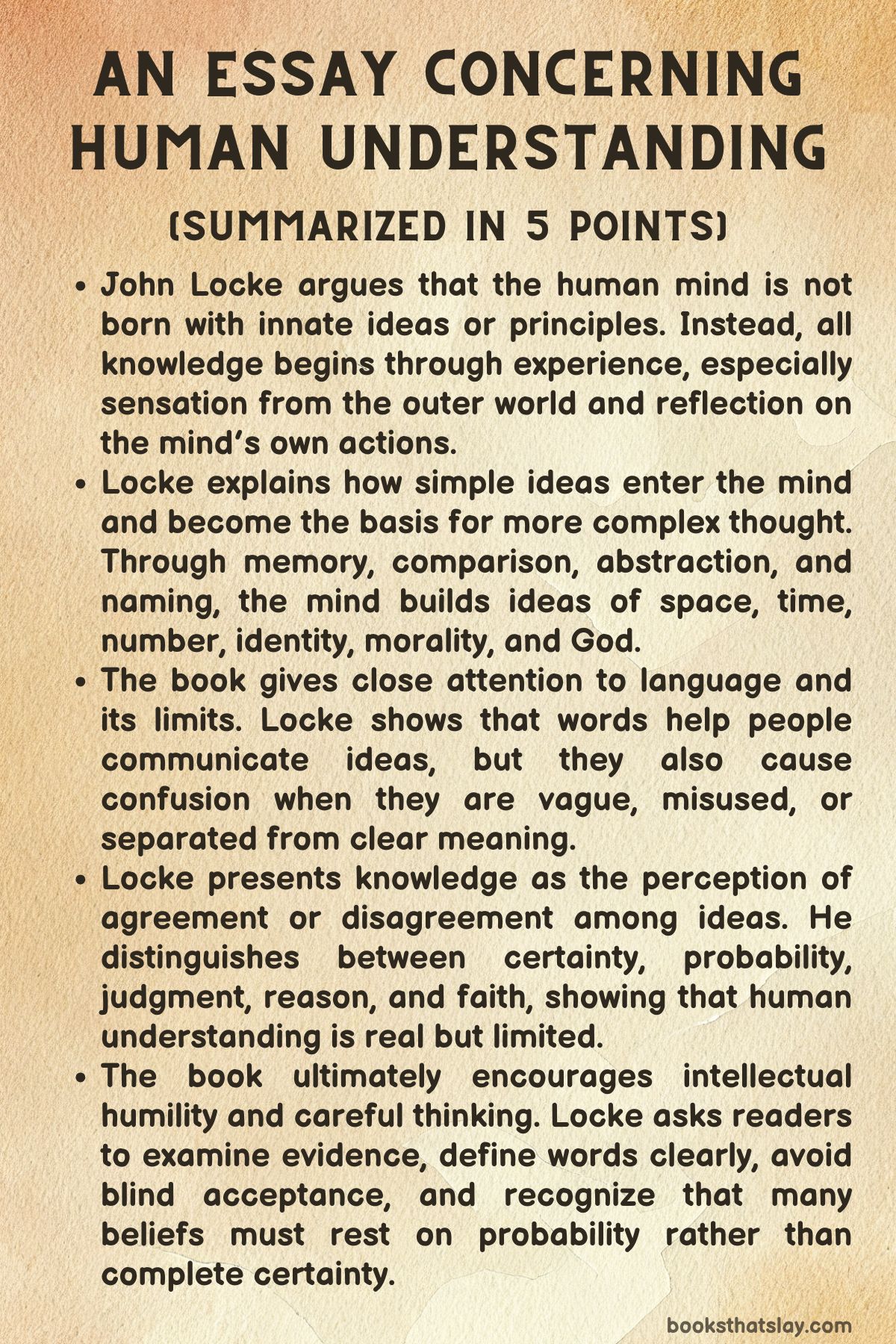
An Essay Concerning Human Understanding is John Locke’s major work on how people come to know anything at all. Rather than treating knowledge as something planted in the mind from birth, Locke argues that the mind begins empty and is shaped by experience.
He examines sensation, reflection, ideas, language, truth, belief, reason, faith, and the limits of certainty. The book is not a story-driven work but a philosophical investigation into the origin and boundaries of human understanding. It asks how the mind forms ideas, how words help or hinder thought, and how people should judge truth when certainty is limited.
Summary
An Essay Concerning Human Understanding begins with Locke explaining why he has written the work. He presents it as an inquiry into the powers and limits of the human mind.
His goal is not to claim perfect certainty for his own arguments, but to invite readers to think carefully about how knowledge is formed. He wants people to examine their own minds instead of accepting inherited doctrines without question.
The central concern of the book is understanding itself: where ideas come from, how they are stored, how they are named, and how far human beings can trust what they think they know.
Locke first rejects the theory of innate ideas. Many thinkers before him argued that certain truths are born within the mind, present before experience.
Locke challenges this by asking whether any principle is truly accepted by all people. He points out that children, people with limited education, and people in different cultures do not all possess the same abstract principles.
Even ideas that seem self-evident, such as identity, morality, mathematical truths, or belief in God, are learned and clarified over time. For Locke, the absence of universal agreement is strong evidence against innate knowledge.
He also argues that reason cannot prove ideas are innate. Reason discovers truths, compares ideas, and draws conclusions, but discovery is not the same as birth.
A truth reached through reasoning has been acquired, not uncovered as something already fully present in the mind. Children may learn to distinguish sweetness from bitterness before they know the names for those experiences, but this only shows early sensory learning, not innate principle.
The mind begins as a blank surface, and experience writes upon it.
Locke then explains the two sources of all ideas: sensation and reflection. Sensation brings information from the external world through the senses.
Reflection occurs when the mind turns inward and notices its own operations, such as thinking, doubting, willing, believing, remembering, and reasoning. Every idea, whether simple or complex, comes from one or both of these sources.
Knowledge begins when the mind receives impressions, pays attention to them, stores them, compares them, and gives them names.
Simple ideas are the most basic materials of thought. They may come from one sense, such as color, sound, taste, heat, or cold.
Some come through several senses together, such as space, shape, motion, and rest. Others arise from reflection, including perception and willing.
Some ideas, such as pleasure, pain, existence, unity, and power, are connected to both sensation and reflection. The mind does not create simple ideas from nothing; it receives them.
Once received, however, it can work with them in many ways.
Complex ideas are formed when the mind combines simple ideas. Locke divides them into modes, substances, and relations.
Modes are ideas that do not exist independently, such as gratitude, murder, obligation, or beauty. Substances are ideas of things that appear to exist on their own, such as a person, a tree, gold, or a horse.
Relations arise when the mind compares one idea with another, as in father and son, cause and effect, identity and difference, young and old, strong and weak.
Locke gives special attention to space, duration, number, infinity, pleasure, pain, and power. Space is understood through sight and touch, while duration comes from the mind’s awareness of succession, one idea following another.
Number begins with the simple idea of one and grows through repetition. Infinity is not fully grasped as a completed reality but formed by the mind’s ability to keep adding more number, space, or time without reaching an end.
Pleasure and pain guide human desire and action, shaping ideas of good and evil. Power leads Locke to discuss will, liberty, choice, and desire.
He argues that liberty concerns the ability to act according to one’s will, while the will itself is shaped by uneasiness, desire, and the pursuit of happiness.
Locke also explores memory, perception, judgment, discernment, comparison, composition, and abstraction. Perception is the mind’s reception of ideas.
Memory retains ideas and allows them to return. Discernment separates one idea from another.
Comparison notices likeness and difference. Composition joins simple ideas into complex ones.
Abstraction allows the mind to form general ideas that apply to many individual things. These operations explain how people move from direct experience to broader thought.
The book then turns to identity. Locke argues that personal identity is tied to consciousness rather than merely to the body or soul considered in isolation.
A person remains the same person through continuity of awareness and memory. If consciousness could move from one body to another, personal identity would follow consciousness.
This view makes identity a matter of lived awareness, responsibility, and remembered experience.
Language becomes the next major subject. Locke argues that words are signs of ideas.
People use language to record their own thoughts and communicate them to others. Yet words are imperfect because different people attach different ideas to the same terms.
General terms are necessary because it would be impossible and useless to name every individual object. A farmer does not need a separate name for every sheep; the general word is enough.
Still, general words can mislead when people use them without clear ideas.
Locke distinguishes between names of simple ideas, names of mixed modes, names of substances, particles of language, and abstract terms. Simple ideas are difficult to define because they must ultimately be known through experience.
A person cannot fully understand whiteness or bitterness through words alone. Mixed modes, such as justice or murder, are formed by combining ideas and giving them a name.
Substances are harder because their real inner nature is often hidden. People may know gold by its color, weight, and other observed qualities, but they do not fully know its inner constitution.
This makes language especially uncertain in science and philosophy.
Locke criticizes the abuse of words. People often use words without clear meanings, shift meanings without notice, rely on vague abstractions, or use language to confuse rather than clarify.
He does not reject artistic or figurative expression, but he insists that serious inquiry requires careful speech. Those seeking truth should connect words to clear ideas, use terms consistently, follow common usage where possible, and define terms when needed.
For Locke, many disputes arise not from real disagreement but from unclear language.
The final part of An Essay Concerning Human Understanding examines knowledge, truth, probability, reason, faith, and error. Locke defines knowledge as the perception of agreement or disagreement among ideas.
The mind knows when it sees that ideas are identical or different, related or unrelated, coexisting or not, real or unreal. Knowledge may be intuitive, when the mind sees truth immediately; demonstrative, when truth is shown through intermediate steps; or sensitive, when the senses convince us of the existence of external things.
Locke argues that human knowledge is real but limited. People know their own existence intuitively.
They know God’s existence through reasoning from existence, causation, and creation. They know other things through sensation.
Yet much remains uncertain, especially in natural science, because humans do not fully know the inner structures of substances. They can observe qualities and patterns, but they cannot always explain why things behave as they do.
Truth, for Locke, depends on the agreement of ideas and the proper use of words. Universal propositions and maxims may seem certain, but they often add little to knowledge unless the terms are clear.
Statements that merely repeat themselves, such as saying a thing is itself, may be true but unhelpful. Real improvement in knowledge comes from clear ideas, careful comparison, precise definitions, and disciplined reasoning.
Since certainty is limited, human beings must often rely on probability. Probability is based on experience, testimony, consistency, and the agreement of evidence.
People give assent in degrees, depending on how strong the evidence appears. Locke warns that people often accept false beliefs because of habit, education, prejudice, pride, or emotional attachment.
Error usually comes not from knowledge itself but from poor judgment: lack of evidence, inability to use evidence, unwillingness to examine evidence, or wrong standards of probability.
Locke closes by considering reason and faith. Reason helps discover truth, organize evidence, and regulate belief.
Faith depends on revelation, but it should not contradict reason. Enthusiasm, or claiming certainty from strong feeling alone, is dangerous because it can lead people to treat private conviction as divine truth.
True belief must be tested by evidence, reason, and humility. In the end, An Essay Concerning Human Understanding presents the human mind as powerful but limited: capable of knowledge, yet dependent on experience, language, judgment, and careful self-correction.
Key Figures
John Locke
John Locke is the central guiding presence in An Essay Concerning Human Understanding. The book is shaped by his voice as a philosopher who is determined to examine the mind with patience, discipline, and skepticism.
Locke appears as a thinker who refuses to accept inherited assumptions simply because they have authority or tradition behind them. His rejection of innate ideas reveals his commitment to experience as the foundation of knowledge.
He is careful, methodical, and often corrective, repeatedly warning against unclear terms, careless reasoning, and overconfidence. Locke’s role is not to tell a story but to lead the reader through a structured investigation of how ideas form, how knowledge develops, and where human certainty ends.
His intellectual character is defined by humility as much as confidence: he believes the mind can understand much, but he also insists that human beings must recognize the boundaries of their understanding.
The Reader
The reader is an important implied figure in the book because Locke repeatedly writes with an awareness of someone who may doubt, resist, or test his arguments. Rather than asking the reader to accept his ideas passively, he encourages independent thought.
The reader is treated as a thinking participant, not as a student expected to memorize doctrine. This gives the book a conversational quality even when the subject is abstract.
Locke imagines the reader as someone capable of self-examination, someone who can turn attention inward and consider how the mind receives ideas, compares them, remembers them, and names them. The reader also represents the broader public of thoughtful people who may be trapped by accepted phrases, inherited beliefs, or philosophical habits.
In An Essay Concerning Human Understanding, the reader’s role is to test Locke’s claims against personal experience and mental observation. The reader becomes a partner in the search for clearer judgment, better language, and more responsible belief.
The Human Mind
The human mind functions almost like a central figure in the book. Locke studies it as the place where sensation, reflection, memory, comparison, abstraction, judgment, and knowledge all occur.
At the beginning, the mind is described as empty of innate principles, not because it is weak, but because its strength comes through experience. The mind receives simple ideas from the senses, then works upon them through reflection.
It combines ideas, separates them, compares them, stores them, and gives them general meaning. This makes the mind active and passive at once.
It passively receives simple impressions, yet actively builds complex ideas from them. Locke presents the mind as powerful but limited.
It can form ideas of space, time, number, infinity, morality, God, and identity, but it cannot know everything with certainty. Its greatness lies in its capacity to reason; its danger lies in confusion, prejudice, and careless assent.
Children
Children are significant figures in Locke’s argument because they help him challenge the claim that knowledge is innate. He returns to children because their mental development shows that ideas grow through experience rather than appearing fully formed at birth.
A child may distinguish sweetness from bitterness before knowing the words for those experiences, but this only proves that sensory learning begins early. It does not prove that abstract truths are present in the mind from the beginning.
Children also show how language, memory, identity, morality, and reasoning develop gradually. Their limited understanding of mathematical principles, moral laws, or theological ideas becomes important evidence against universal innate knowledge.
Locke’s use of children is not sentimental; it is philosophical. They are living examples of the mind acquiring ideas over time.
Through them, the book argues that knowledge begins with contact, attention, repetition, naming, and reflection.
God
God is not treated as a character, but God is a major presence in Locke’s philosophical world. Locke rejects the idea that God places innate principles directly into the human mind, yet he does not reject God’s existence or importance.
Instead, he argues that God gives human beings the faculties by which knowledge becomes possible: sensation, reflection, perception, reason, and judgment. God is also the ultimate source of order in creation.
Human beings come to know God not by innate certainty but through reasoning from their own existence and from the impossibility of something coming from nothing. God represents the highest reality, but Locke is careful to show that human knowledge of divine nature remains limited.
In An Essay Concerning Human Understanding, God is connected to reason rather than blind assertion. Faith and reason are not enemies; faith must be examined through the rational powers that God has given to humankind.
Rationalist Philosophers
Rationalist philosophers serve as Locke’s main intellectual opponents. They are not presented as personal enemies, but as representatives of a tradition Locke wants to correct.
Their belief in innate principles gives Locke the starting point for his argument. They claim that certain truths must be born in the mind because many people accept them as universal.
Locke challenges this by showing that supposed universal truths are not actually known by everyone and often require education, language, experience, and reasoning before they become clear. These philosophers represent the danger of mistaking familiar ideas for natural ones.
In the book, they also reveal how powerful intellectual habits can be. Their arguments push Locke to sharpen his own view that knowledge must be traced back to sensation and reflection.
Without them, Locke’s philosophy would have less force, because his own position develops through direct opposition to their assumptions.
Philosophers and Scholars
Philosophers and scholars appear as a wider intellectual group that Locke both respects and criticizes. He values the search for truth, but he is deeply concerned with the way learned people misuse language.
They often rely on vague words, abstract expressions, and technical terms that hide uncertainty rather than clarify it. Locke believes that philosophy should make thought clearer, not more obscure.
Scholars are therefore presented as figures with great responsibility. If they use words carelessly, they spread confusion and slow the progress of knowledge.
If they define terms carefully, connect words to clear ideas, and avoid empty disputes, they can help improve human understanding. Locke’s criticism of scholars is firm but not dismissive.
He wants philosophy to become more honest, precise, and useful. Learned people are valuable when they discipline their minds and dangerous when they mistake verbal cleverness for truth.
Humankind
Humankind is the broadest figure in the book. Locke writes about human beings as creatures who desire happiness, avoid misery, seek truth imperfectly, and often make errors in judgment.
People are capable of knowledge, but they are also vulnerable to prejudice, habit, emotion, pride, and social pressure. They form ideas from experience, use language to communicate, and rely on probability when certainty is unavailable.
Humankind is neither hopelessly ignorant nor fully wise. Locke’s view is balanced: people can reason, compare, reflect, and improve their understanding, but they must accept that much of reality lies beyond their reach.
Human beings must therefore live by judgment as well as knowledge. They must weigh evidence, listen to testimony, examine their assumptions, and avoid giving assent too quickly.
Locke’s portrait of humankind is practical and moral, centered on the need for intellectual humility.
Users of Language
The users of language form an important collective figure because language is one of Locke’s chief concerns. People need words to communicate ideas, record thoughts, and build shared knowledge.
Yet they also misuse words constantly. They use terms without clear meanings, assume others understand them in the same way, change definitions without warning, or hide weak ideas behind impressive language.
Locke sees this as one of the main causes of human disagreement. The problem is not language itself, since speech is necessary for social life and intellectual progress.
The problem is careless speech. Users of language must therefore become more responsible.
They should know what ideas their words signify, define terms when needed, and avoid empty verbal disputes. In Locke’s view, clearer language leads to clearer thought, and clearer thought leads to better judgment.
Witnesses and Communities
Witnesses and communities matter most in Locke’s discussion of probability and assent. Since human beings cannot have certainty about everything, they often depend on the testimony of others.
A claim becomes more probable when several reliable witnesses support it, especially when those witnesses have no obvious reason to deceive. Communities also shape belief through education, custom, and shared opinion.
This influence can be useful, but it can also be dangerous. People often accept ideas because others accept them, not because they have examined the evidence.
Communities can preserve knowledge, but they can also preserve prejudice. Locke’s treatment of witnesses and groups shows that knowledge is not only private.
Human understanding develops socially through language, testimony, education, and agreement, but each person remains responsible for judging whether assent is reasonable.
Themes
Experience as the Foundation of Knowledge
Locke’s philosophy rests on the claim that knowledge begins with experience. The mind does not arrive in the world already filled with principles, moral truths, mathematical certainty, or religious doctrine.
Instead, it receives simple ideas through sensation and reflection. Sensation brings impressions from the external world, while reflection allows the mind to notice its own activities, such as thinking, willing, doubting, remembering, and judging.
This theme gives An Essay Concerning Human Understanding its central argument: every idea must be traced to experience in some form. Locke’s position changes the way knowledge is understood.
Rather than treating the mind as a storehouse of hidden truths, he treats it as a living power that grows through contact with the world. This also gives human learning a gradual quality.
Ideas become clearer through repetition, attention, comparison, and naming. Experience is not simple exposure; it must be processed by the mind.
Locke’s view gives dignity to observation and reflection while also limiting human certainty. People can know only what their faculties allow them to receive and examine.
The Limits of Human Understanding
Locke repeatedly reminds readers that the mind is powerful but not unlimited. Human beings can form ideas, compare them, reason from them, and reach real knowledge, but they cannot know everything.
This limitation is especially clear in discussions of substances. People may observe qualities of gold, bodies, plants, animals, and other substances, but they do not fully grasp their inner constitution.
The senses provide real information, yet they do not reveal the complete nature of things. This theme prevents Locke’s philosophy from becoming overconfident.
He does not deny truth; he denies that human beings possess total access to it. Much of life must be guided by probability rather than certainty.
Judgment becomes necessary because knowledge often stops before action does. People must still choose, believe, speak, and live even when evidence is incomplete.
Locke’s emphasis on limitation is also ethical. It teaches intellectual modesty.
A person who recognizes the boundary of understanding is less likely to cling stubbornly to error, misuse language, or force private opinions on others.
Language, Clarity, and Confusion
Language is presented as one of humanity’s greatest tools and one of its most common sources of error. Words allow people to communicate ideas, preserve thoughts, teach others, and form communities of knowledge.
Yet words are not ideas themselves; they are signs of ideas. Because of this, language can fail whenever words are used without clear mental content.
Locke is especially concerned with abstract terms, philosophical vocabulary, and moral language, because these can be repeated confidently even when the speaker has no precise idea attached to them. Confusion often arises when people assume that the same word produces the same idea in every mind.
Locke’s concern is not merely grammatical. For him, unclear language damages thought itself.
If words are vague, reasoning becomes unstable. If reasoning is unstable, disputes multiply and truth becomes harder to reach.
The remedy is disciplined speech: use words consistently, define them when necessary, connect them to clear ideas, and avoid pretending to know more than one does.
Reason, Faith, and Responsible Belief
Locke treats belief as a serious moral and intellectual act. People should not give assent merely because an idea feels powerful, because others accept it, or because tradition supports it.
Assent should be proportioned to evidence. Reason helps the mind discover truth, arrange proofs, compare ideas, and judge probability.
Faith also has a place, but Locke refuses to separate it from reason. Revelation may guide belief, yet it should not be used as an excuse to reject rational examination.
This theme becomes especially important in Locke’s criticism of enthusiasm. Strong feeling can deceive people into mistaking personal conviction for truth.
Responsible belief requires patience, evidence, humility, and self-command. Locke does not demand certainty in every matter, because he knows that human beings often must act on probability.
Still, probability must be judged carefully. Testimony, experience, consistency, and the character of witnesses all matter.
Through this theme, Locke presents belief as something accountable. To believe well is to respect truth enough to examine the grounds of one’s own assent.