An Ideal Husband Summary, Characters and Themes
An Ideal Husband is a social comedy by Oscar Wilde about public honour, private weakness, marriage, ambition, and forgiveness. Set among London’s political and upper-class circles, the play follows Sir Robert Chiltern, a respected politician whose spotless reputation is threatened by a secret from his youth.
Wilde uses sharp dialogue and elegant social satire to question the idea of moral perfection, especially within marriage. The story shows how easily admiration can become judgment, and how love must make room for human failure. At its centre, An Ideal Husband asks whether a person should be defined forever by one wrong act.
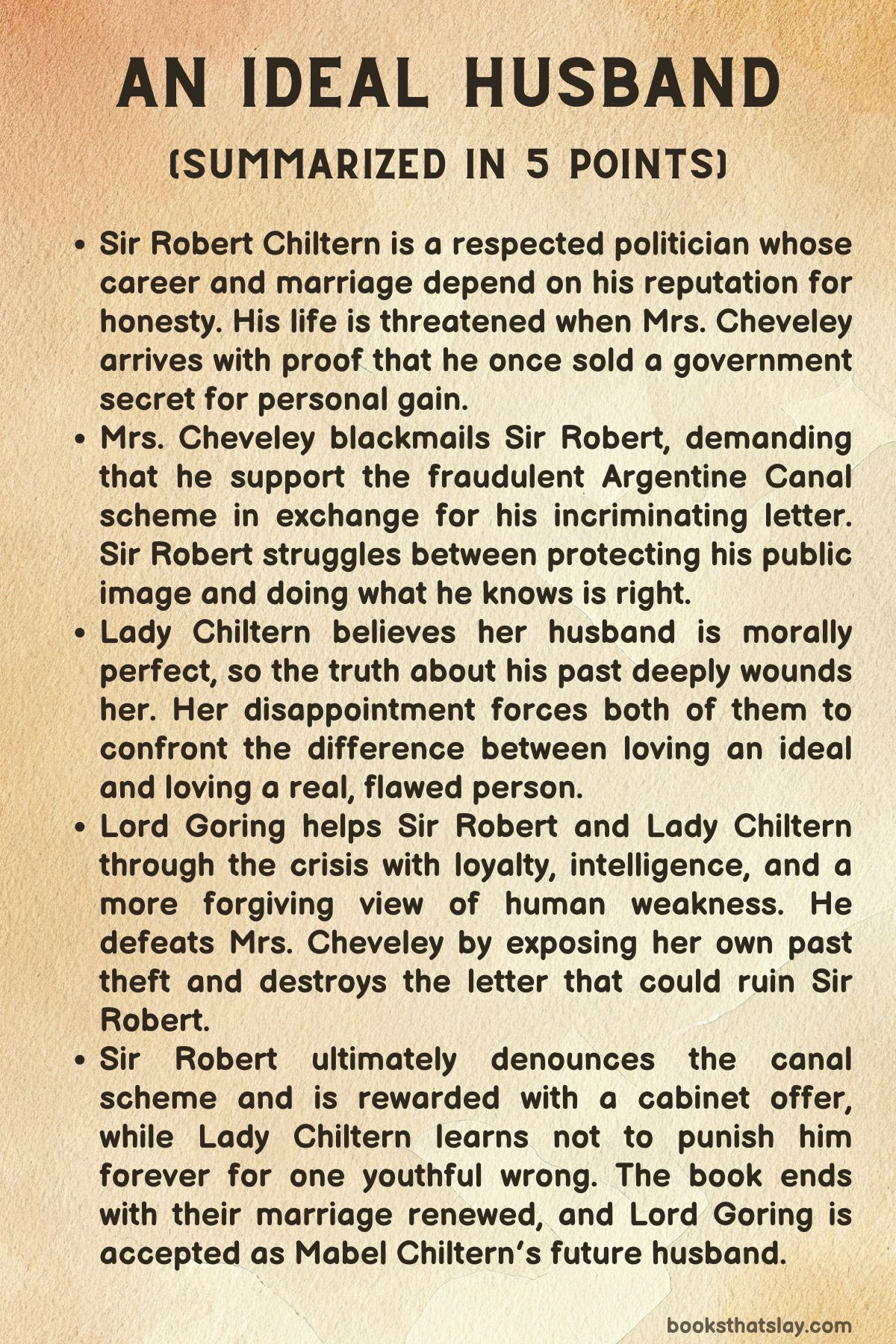
Summary
The plot begins at the home of Sir Robert Chiltern and his wife, Lady Chiltern, during a fashionable evening party. Sir Robert is a admired member of Parliament, known for his honesty, intelligence, and strong public principles.
Lady Chiltern loves him deeply and believes his moral character is the foundation of their marriage. To her, he is not only a husband but a model of integrity.
Their home is filled with guests from London society, including Mabel Chiltern, Sir Robert’s lively sister, Lord Goring, a charming bachelor and close friend of the family, and Lord Caversham, Lord Goring’s stern father.
Among the guests is Mrs. Cheveley, a clever and dangerous woman from Lady Chiltern’s past. Lady Chiltern remembers her from school and distrusts her immediately, since Mrs. Cheveley had once been caught stealing.
Mrs. Cheveley has come to London with a specific purpose. She has invested money in the Argentine Canal Company, a scheme that needs political approval to succeed.
Sir Robert is expected to give a speech in Parliament rejecting the project as dishonest and impractical. Mrs. Cheveley wants him to reverse his position and support it.
When she speaks privately with Sir Robert, she reveals her power over him. Years earlier, when he was young and ambitious, Sir Robert sold a government secret to Baron Arnheim, allowing the baron to profit from advance knowledge about the Suez Canal.
That act gave Sir Robert the fortune that helped build his career. Mrs. Cheveley possesses a letter proving his guilt.
She offers to give it back if he supports the Argentine Canal. If he refuses, she will expose him and ruin his public life, his reputation, and possibly his marriage.
Sir Robert is horrified. He knows the Argentine Canal is a fraud, but he also knows that exposure would destroy everything he has built.
When Mrs. Cheveley leaves, she lets Lady Chiltern think that Sir Robert has agreed to support the canal. Lady Chiltern is shocked and questions her husband.
Because she sees him as morally perfect, she cannot imagine him knowingly supporting a corrupt scheme. She demands that he write to Mrs. Cheveley and withdraw any promise of support.
Under pressure, Sir Robert writes the letter, even though he knows this may bring disaster. Lady Chiltern tells him that she loves him because he is noble and honest, and that if he were not the man she believes him to be, her love would be deeply wounded.
Sir Robert turns to Lord Goring for help. He confesses the truth and explains how his youthful ambition led him to commit the act that now threatens him.
Lord Goring does not excuse the wrongdoing, but he treats Sir Robert with understanding. He urges him to tell Lady Chiltern the truth, arguing that marriage cannot rest on worship or impossible standards.
Sir Robert refuses, convinced that his wife would never forgive him. Lord Goring also reveals that he once knew Mrs. Cheveley well and had even been briefly engaged to her.
The two men decide to look for some weakness in Mrs. Cheveley’s own past that might be used against her.
Meanwhile, Lord Goring tries to persuade Lady Chiltern to be more forgiving toward human flaws. He speaks in general terms, hoping she will see that even good people can make serious mistakes.
Lady Chiltern resists the idea. She believes her husband is above such weakness and insists that public honour must remain unstained.
Her ideal image of Sir Robert leaves no room for error.
Mrs. Cheveley visits Lady Chiltern and attempts to reveal Sir Robert’s secret. Sir Robert enters and demands that she leave, but the damage is done.
Lady Chiltern realizes there is truth behind the accusation and begs her husband to deny it. He cannot.
She is devastated and tells him he is no longer the man she loved. Sir Robert, wounded by her judgment, argues that she loved an image rather than the real man.
He says true love should accept weakness as well as strength. In despair, Lady Chiltern is left alone, shaken by the collapse of her belief in him.
Lady Chiltern then writes a short note to Lord Goring, telling him she needs him, trusts him, and is coming to him. Lord Goring understands that she has learned the truth and prepares to receive her privately so he can advise her.
Before she arrives, however, his father visits to lecture him about marriage. During this delay, Mrs. Cheveley comes to Lord Goring’s house.
His servant, misunderstanding his instructions, places her in the drawing room. Lord Goring does not realize she is there.
Sir Robert also arrives, distressed after his quarrel with Lady Chiltern. Lord Goring tries to guide him toward forgiveness and reconciliation, mistakenly believing Lady Chiltern is listening from the next room.
Sir Robert hears a sound, enters the room, and sees Mrs. Cheveley there. He assumes Lord Goring has betrayed him or is secretly involved with her.
Furious, he leaves before Lord Goring can explain.
When Lord Goring finally confronts Mrs. Cheveley, she makes a new proposal. She will give him Sir Robert’s incriminating letter if he agrees to marry her.
She claims that he is the only man she has truly cared for. Lord Goring refuses.
He condemns her attempt to ruin the Chilterns and recognizes that she is acting out of selfishness, not love. He then uses an object found earlier at the Chiltern party: a diamond brooch that Mrs. Cheveley had lost.
Lord Goring knows the brooch was stolen years before from his cousin. He fastens it on her wrist in a way she cannot remove and threatens to call the police unless she gives him Sir Robert’s letter.
Cornered, Mrs. Cheveley hands it over.
Lord Goring destroys the letter, saving Sir Robert from public disgrace. But Mrs. Cheveley steals Lady Chiltern’s note to Lord Goring and plans to send it to Sir Robert as false evidence that Lady Chiltern and Lord Goring are having an affair.
Her final attempt at revenge threatens to damage the marriage from another direction.
The next day, Lord Goring goes to the Chiltern home. Sir Robert has delivered his speech in Parliament and has denounced the Argentine Canal, earning great praise.
This means he has chosen public honesty despite the risk of exposure. Lord Goring is relieved.
He also proposes to Mabel Chiltern, who gladly accepts him. Their light, playful love offers a contrast to the serious moral crisis faced by Sir Robert and Lady Chiltern.
Lord Goring tells Lady Chiltern that Sir Robert’s incriminating letter has been destroyed, but that Mrs. Cheveley now has her note. They worry that the note will be misunderstood.
Sir Robert enters holding the note, but he has misread it as a message of reconciliation meant for him. Lady Chiltern does not correct him, and the danger passes.
Sir Robert, now free from Mrs. Cheveley’s blackmail, considers leaving politics because of his past. Lady Chiltern initially agrees, believing resignation would be a form of moral atonement.
Lord Goring challenges her view. He points out that forcing Sir Robert to abandon his career would be similar to Mrs. Cheveley’s demand: both would make his whole future a punishment for one youthful sin.
Lady Chiltern sees that she has been too severe. When Sir Robert prepares to reject a cabinet position he has been offered, she tears up the refusal and encourages him to continue his public life.
Lord Goring then asks Sir Robert for permission to marry Mabel. Sir Robert refuses at first because he still believes Lord Goring may be connected to Mrs. Cheveley.
Lady Chiltern finally explains the truth: the note was hers, and Lord Goring had expected her that night, not Mrs. Cheveley. Sir Robert understands and withdraws his objection.
Lord Goring and Mabel are accepted as a couple.
The play ends with Sir Robert and Lady Chiltern reconciled. Their marriage has changed.
Lady Chiltern no longer sees her husband as a flawless ideal, and Sir Robert no longer has to hide behind a perfect public image. They move forward with a more honest understanding of love, one that allows for weakness, repentance, loyalty, and forgiveness.
An Ideal Husband closes by suggesting that an ideal marriage is not built on perfection, but on mercy and truth.
Characters
Sir Robert Chiltern
Sir Robert Chiltern is the central moral figure in An Ideal Husband, and his character is built around the tension between public honour and private guilt. In society, he is respected as a brilliant politician, a principled member of Parliament, and a man whose career appears to rest on honesty.
His wife worships him almost as a moral ideal, and that admiration becomes both his pride and his burden. Beneath this polished reputation, however, lies a secret from his youth: he once sold a government secret for personal gain, using the money and influence from that act to build the life he now enjoys.
This past mistake does not make him purely corrupt, but it shows that his success has a compromised foundation.
Sir Robert’s greatest conflict comes from his fear of losing everything that gives his life meaning: his career, his public name, and Lady Chiltern’s love. When Mrs. Cheveley blackmails him, he is not only afraid of scandal; he is afraid of being seen truthfully by the person who believes in him most.
His weakness is not simply ambition, but the desire to preserve an image of perfection long after that image has become false. At the same time, his refusal to support the Argentine Canal scheme in the end shows that he is not trapped permanently by his past.
He chooses truth in the present, even when exposure seems possible.
Sir Robert is also important because he challenges the idea that a person’s worst act should define his whole life. He has done wrong, but he has also spent years serving the public with ability and seriousness.
His pain comes from knowing that society often allows no space between virtue and disgrace. Through him, the play asks whether repentance, later conduct, and human growth should matter.
By the end, Sir Robert becomes a more complete figure because he no longer stands as a perfect idol. He becomes a flawed man who can still be loved, trusted, and useful.
Lady Chiltern
Lady Chiltern is one of the play’s most morally serious characters, and her strength comes from her belief in goodness, truth, and public duty. She loves Sir Robert deeply, but her love is shaped by idealization.
She does not merely admire him as a husband; she sees him as a symbol of purity and honour. This makes her devotion intense, but also fragile.
Her view of love depends on the belief that Sir Robert is almost without fault. When she learns that he once acted dishonestly, her emotional world collapses because the man she loves no longer matches the image she has built in her mind.
Her first reaction to Sir Robert’s secret is severe judgment. She feels betrayed not only by the act itself, but by the gap between his public identity and his hidden past.
Her disappointment is understandable, especially because she has built her marriage on trust. Yet the play also shows the danger of her moral rigidity.
She expects perfection from her husband, and this expectation leaves little room for weakness, fear, or regret. Her love, at first, is noble but incomplete because it has not learned mercy.
Lady Chiltern’s growth is one of the most important emotional movements in An Ideal Husband. She slowly comes to understand that loving someone does not mean believing they are flawless.
Her change does not require her to excuse wrongdoing; rather, it allows her to separate a past sin from a person’s entire worth. When she decides not to force Sir Robert out of public life, she recognizes that punishment is not always the same as justice.
By the end, Lady Chiltern becomes wiser because her love becomes more human. She moves from worship to understanding, and that shift makes reconciliation possible.
Lord Goring
Lord Goring appears at first to be a witty, fashionable, and carefree gentleman, but he becomes the clearest voice of emotional intelligence in the play. Society treats him as idle and unserious, especially through the disapproving eyes of his father, Lord Caversham.
His polished manners, elegant dress, and playful conversation make him seem detached from real responsibility. Yet when the crisis surrounding Sir Robert begins, Lord Goring proves to be the most practical, loyal, and morally balanced person in the story.
His strength lies in his understanding of human imperfection. Unlike Lady Chiltern, he does not believe that love should depend on moral perfection.
Unlike Mrs. Cheveley, he does not use weakness as a weapon. He recognizes that people make mistakes, hide shame, and fear judgment.
This makes him an effective adviser to both Sir Robert and Lady Chiltern. He urges honesty, forgiveness, and proportion.
He does not deny that Sir Robert did wrong, but he refuses to treat one act as the whole truth of a man’s character.
Lord Goring’s past connection with Mrs. Cheveley adds depth to him. His former engagement to her suggests that he too has misjudged character and lived through emotional disappointment.
This history helps explain his calm but firm response to her later manipulation. His handling of the stolen brooch shows his intelligence and courage.
He defeats Mrs. Cheveley not through force, but through knowledge, timing, and moral confidence. In An Ideal Husband, Lord Goring represents the kind of wisdom that hides behind social ease.
He may seem unserious, but he understands love, friendship, and forgiveness better than the characters who speak most loudly about virtue.
Mrs. Cheveley
Mrs. Cheveley is the main force of disruption in the play, and she represents intelligence without conscience. She is stylish, clever, socially skilled, and fully aware of how power works.
Her return to London is not casual; she arrives with a plan to profit from the Argentine Canal scheme by forcing Sir Robert to support it. She understands that reputation is everything in political society, and she uses that knowledge ruthlessly.
Her possession of Sir Robert’s letter gives her power, but her true danger lies in her ability to read people’s fears and use them against them.
She is not a simple villain because her charm and wit make her socially effective. She knows how to perform politeness while carrying out cruelty.
Her conversation is sharp, and she often exposes the hypocrisy of the society around her. Yet unlike Wilde’s more harmless witty figures, her wit serves selfish ends.
She treats truth not as a moral value but as a tool. If a secret can be sold, traded, or used to control someone, she will use it.
Mrs. Cheveley also acts as a dark mirror to several other characters. Like Sir Robert, she has a compromised past.
Like Lord Goring, she is intelligent and skilled in conversation. Like Lady Chiltern, she understands the power of judgment.
But where Sir Robert feels shame, Lord Goring shows loyalty, and Lady Chiltern learns mercy, Mrs. Cheveley refuses moral growth. Her attempt to force Lord Goring into marriage shows that even love, for her, becomes a bargain.
By the end, she is defeated because her own past theft becomes a weapon against her. Her downfall suggests that a life built on manipulation eventually creates its own traps.
Mabel Chiltern
Mabel Chiltern brings lightness, humour, and freshness to the play. She is Sir Robert’s sister, but she is very different from the more burdened figures around her.
While Sir Robert and Lady Chiltern are caught in questions of honour, guilt, and forgiveness, Mabel moves through society with playful confidence. Her wit is quick, but it is rarely cruel.
She teases Lord Goring, rejects unwanted proposals from Tommy Trafford, and speaks with a freedom that makes her one of the most charming characters in the story.
Mabel’s importance should not be underestimated simply because her role is comic. She represents a healthier approach to love than the idealized marriage of Sir Robert and Lady Chiltern.
She does not want a perfect husband in the solemn sense. She loves Lord Goring with an awareness of his habits, absurdities, and social reputation.
She is amused by him, not blinded by him. This makes their relationship feel more flexible and realistic.
Her love does not demand that Lord Goring become a moral statue; it allows him to be human.
Through Mabel, the play offers a gentler alternative to the pressure of perfection. She does not carry the heavy moral language that defines Lady Chiltern’s early view of marriage.
Instead, she values affection, humour, and companionship. Her acceptance of Lord Goring suggests that a successful relationship may depend less on worship and more on ease, honesty, and mutual delight.
She also helps soften the ending, giving the story a sense of renewal beyond the repair of Sir Robert and Lady Chiltern’s marriage.
Lord Caversham
Lord Caversham is Lord Goring’s father and serves as a comic representative of traditional authority. He is impatient, blunt, and constantly dissatisfied with his son’s bachelor life.
To him, Lord Goring appears useless because he does not fit the expected model of masculine seriousness, career ambition, or conventional duty. Lord Caversham repeatedly urges him to marry and behave more responsibly, creating many humorous exchanges between father and son.
Although he often seems narrow in judgment, Lord Caversham is not malicious. He reflects the older generation’s belief in respectability, marriage, and public standing.
His criticism of Lord Goring shows how society often mistakes appearance for character. He assumes his son is shallow because Lord Goring dresses elegantly and speaks lightly.
In reality, Lord Goring is one of the most morally capable people in the play. This contrast makes Lord Caversham’s judgments comic, but it also supports a larger point: people are often misread because society values surface signs of seriousness more than actual wisdom.
Lord Caversham also helps move the plot toward resolution. His announcement that Sir Robert has been offered a cabinet position raises the stakes of Sir Robert’s decision about whether to remain in politics.
His presence at the end helps restore public order after private chaos. He may not fully understand the emotional crises happening around him, but his role as a social and paternal figure helps frame the world in which these characters must protect, lose, or rebuild their reputations.
Lady Markby
Lady Markby is a comic social figure who represents the manners and assumptions of upper-class London. She is talkative, conventional, and often unaware of the deeper tensions around her.
Her role may seem minor, but she is useful because she brings Mrs. Cheveley into the Chiltern household and later accompanies her during another important visit. In doing so, she unknowingly helps Mrs. Cheveley gain access to the people she intends to manipulate.
Lady Markby’s conversation often centers on marriage, society, and the expected roles of men and women. She belongs to a world of polite calls, social introductions, and surface respectability.
Unlike Lady Chiltern, she is not deeply invested in women’s education or political seriousness. This contrast allows the play to show different kinds of women within the same social class.
Lady Markby is not dangerous, but her lack of perception makes her easy for more calculating people to use.
Her importance lies in the social atmosphere she creates. She shows how dangerous secrets can move through polite spaces because society values appearances so strongly.
A person like Mrs. Cheveley can enter respectable homes under the protection of someone like Lady Markby. In this way, Lady Markby helps reveal the weakness of a society that trusts introductions, manners, and status more than character.
Lady Basildon
Lady Basildon is one of the witty society women who appears in the party scenes. Her role is mainly comic, but her remarks help establish the social world of the play.
She speaks lightly about marriage, boredom, and fashionable life, suggesting that many people in this society treat serious institutions as sources of amusement or complaint. Her claim that she has a perfect husband and regrets it adds humour while also supporting one of the play’s central questions: whether perfection is actually desirable in marriage.
Lady Basildon’s presence helps create the atmosphere of polished emptiness that surrounds the main moral crisis. While Sir Robert faces possible ruin and Lady Chiltern confronts painful truths, characters like Lady Basildon move through the same rooms with little awareness of the hidden drama.
This contrast is important. It shows how public society can remain bright, witty, and superficial even while private lives are under severe strain.
She also contributes to Wilde’s satire of fashionable conversation. Her lines are not designed to reveal deep personal suffering, but to show how people in this world use cleverness as a social performance.
Through Lady Basildon, the play shows a society that can joke about marriage without necessarily understanding love, loyalty, or sacrifice.
Mrs. Marchmont
Mrs. Marchmont, like Lady Basildon, is part of the comic social background of the play. She helps establish the tone of the opening party and represents the boredom and artificiality of fashionable society.
Her remarks about the people around her show a world where guests attend parties while complaining about the company, and where conversation often becomes a game of elegant dissatisfaction.
Her role is small, but she contributes to the social satire. Mrs. Marchmont shows how people in elite circles often perform weariness as a sign of sophistication.
She is not central to the moral action, but her presence matters because she helps define the world that Sir Robert is afraid to fall from. Reputation matters so much because this society is always watching, speaking, judging, and laughing.
Mrs. Marchmont also helps balance the seriousness of the plot. Her light dialogue, along with Lady Basildon’s, creates a contrast with the blackmail and emotional distress that soon follow.
This contrast is part of the play’s design: comedy and danger exist in the same rooms, and beneath the polished surface of society there are secrets capable of destroying lives.
Phipps
Phipps, Lord Goring’s butler, is a small but memorable comic character. He represents the perfect servant in a highly polished household: discreet, controlled, and almost mechanically proper.
His calmness contrasts with the confusion unfolding around him. While Lord Goring worries about visitors, secrets, and timing, Phipps carries out instructions with formal precision, even when those instructions lead to misunderstanding.
His most important function is connected to the mistaken identity at Lord Goring’s house. Because Phipps admits Mrs. Cheveley while Lord Goring expects Lady Chiltern, a serious misunderstanding develops.
Sir Robert later sees Mrs. Cheveley in Lord Goring’s drawing room and wrongly believes that Lord Goring has betrayed him. Phipps does not intend harm, but his ordinary obedience helps create one of the play’s major complications.
Phipps also strengthens the comic portrait of Lord Goring’s world. His controlled manner reflects his master’s elegance and taste for style.
In a story filled with moral exposure, Phipps remains a figure of restraint and surface order. He is not emotionally involved in the crisis, but he helps show how much of this society depends on appearances, rituals, and carefully managed entrances and exits.
Vicomte de Nanjac
Vicomte de Nanjac is a minor guest in the Chiltern household, and his role is mostly social and atmospheric. He belongs to the fashionable international circle that surrounds the main characters.
His presence helps show that the Chilterns occupy a world of political influence, wealth, culture, and European connections. This matters because Sir Robert’s reputation is not merely private or domestic; it exists before a wide and elite audience.
His interaction with Mabel also helps highlight her charm and social position. When he asks her to accompany him to the music room, her disappointment at Lord Goring’s refusal to join them makes her feelings for Lord Goring more visible.
In this sense, the Vicomte helps reveal Mabel’s romantic preference without becoming a serious rival.
Though he does not shape the central conflict, he adds to the crowded social setting in which the drama begins. His presence reminds the reader that the events of the play unfold in a world where people are constantly observed.
Even minor guests matter because reputation depends on what is seen, heard, repeated, and assumed.
Baron Arnheim
Baron Arnheim never appears directly in the action, but his influence is crucial. He is the man who tempted the young Sir Robert into selling a government secret.
Through him, the play introduces the connection between wealth, politics, and moral compromise. Baron Arnheim understood Sir Robert’s ambition and offered him a path to power through dishonesty.
His role in the past becomes the root of the present crisis.
He represents a corrupt philosophy of success. To Sir Robert, Baron Arnheim once seemed worldly, powerful, and persuasive.
He taught him that modern life could be won through boldness, calculation, and the use of hidden information. Sir Robert’s later remark that he fought his age with its own weapons reflects the influence of this thinking.
Baron Arnheim’s temptation was not only financial; it was ideological. He made corruption appear intelligent and necessary.
Although absent, Baron Arnheim shapes the play’s moral landscape. His influence shows how one powerful figure can alter the course of another person’s life.
He also helps explain that Sir Robert’s wrongdoing did not arise from simple greed alone. It came from ambition, insecurity, and a desire to rise quickly in a society that rewards success while condemning the methods sometimes used to obtain it.
Themes
Public Reputation and Private Guilt
Reputation in An Ideal Husband is treated as both a social asset and a personal prison. Sir Robert Chiltern’s public identity depends on the belief that he is honourable, principled, and morally reliable.
His career, marriage, and social standing all rest on this image. Yet the play shows that reputation can hide a more complicated truth.
Sir Robert’s past act of selling a government secret does not match the noble image others have of him, and this gap creates the central crisis. Mrs. Cheveley understands the power of reputation better than almost anyone else.
She does not need to physically harm Sir Robert; she only needs to threaten the story society tells about him. Once that story changes, his life could collapse.
The theme is powerful because the play does not present reputation as meaningless. Public trust matters, especially for a politician.
At the same time, it questions a world where one old sin can erase years of service. The fear of exposure becomes almost as destructive as the guilt itself.
Sir Robert’s suffering comes from wrongdoing, but also from living in a society that allows little room for confession, growth, or repair.
The Danger of Moral Perfection
Lady Chiltern’s love for Sir Robert is sincere, but it is also shaped by an impossible standard. She believes he is morally flawless, and this belief makes their marriage vulnerable.
When she learns about his past, she feels as if the entire foundation of their relationship has been destroyed. The play uses her reaction to examine the danger of turning a loved person into an ideal.
Moral admiration can be beautiful, but when it becomes rigid, it stops being love and becomes judgment. Sir Robert does not ask Lady Chiltern to approve of his past action; he asks her to see him as a complete human being.
That distinction matters. A person can be guilty of wrongdoing and still be capable of loyalty, courage, and goodness later in life.
Lady Chiltern’s growth comes when she understands that forgiveness is not weakness. Her earlier view leaves no space for human failure, while her later view allows love to become more honest.
This theme applies not only to marriage but also to public life. People often want leaders, spouses, and friends to be symbols rather than human beings.
The play argues that such expectations can become cruel, even when they come from noble values.
Marriage, Love, and Forgiveness
Marriage in the play is shown through contrast. Sir Robert and Lady Chiltern’s marriage begins with admiration but must survive disillusionment.
Lord Goring and Mabel’s relationship, by contrast, is lighter, more playful, and less burdened by ideals. Through these two relationships, the story suggests that love cannot depend on perfection.
Lady Chiltern initially loves Sir Robert as an ideal husband, but she must learn to love him as a flawed man. Sir Robert, too, must learn that concealment cannot protect a marriage forever.
His fear of losing his wife leads him to hide the truth, but secrecy only deepens the danger. Lord Goring becomes the voice of a more forgiving kind of love.
He believes that marriage should include truth, mercy, and the ability to accept weakness without surrendering moral judgment. Mabel’s acceptance of Lord Goring also supports this theme.
She does not demand solemn greatness from him; she enjoys him as he is. By the end, the repaired marriage between Sir Robert and Lady Chiltern is stronger because it is less dependent on illusion.
Forgiveness does not erase the past, but it allows the characters to build a future that is more honest than the life they had before.
Power, Blackmail, and Social Hypocrisy
Power in the play often comes from hidden knowledge. Mrs. Cheveley controls Sir Robert because she possesses proof of his past corruption.
Her weapon is not physical force but information. This makes the play feel sharply aware of how elite society works: reputation is public, but power often operates through secrets.
Mrs. Cheveley’s blackmail exposes the hypocrisy of a world that praises honour while being fascinated by scandal. The same society that celebrates Sir Robert would quickly condemn him if his secret became public, even though many of its members are shallow, self-interested, or morally careless in smaller ways.
Mrs. Cheveley herself is a hypocritical figure because she condemns Sir Robert’s corruption while using corruption for her own profit. She is not interested in justice; she is interested in leverage.
Lord Goring’s defeat of her through the stolen brooch reverses the power dynamic. The blackmailer becomes vulnerable to exposure, showing that those who weaponize secrets may also be trapped by their own past.
This theme reveals a society built on appearances, where morality is often performed in public but negotiated in private. The play criticizes not only individual wrongdoing but also the social systems that make secrecy so valuable.