Anil’s Ghost Summary, Characters and Themes
Anil’s Ghost by Michael Ondaatje is a literary novel about war, memory, evidence, and the fragile search for truth in a country shaped by fear. Set in Sri Lanka during civil conflict, it follows Anil Tissera, a forensic pathologist sent by an international human rights group to investigate political violence.
Her work with archaeologist Sarath Diyasena leads to the discovery of a recent murder hidden among ancient remains. The novel is not only about solving a crime; it is about what truth costs, who gets to speak it, and how the dead remain present among the living.
Summary
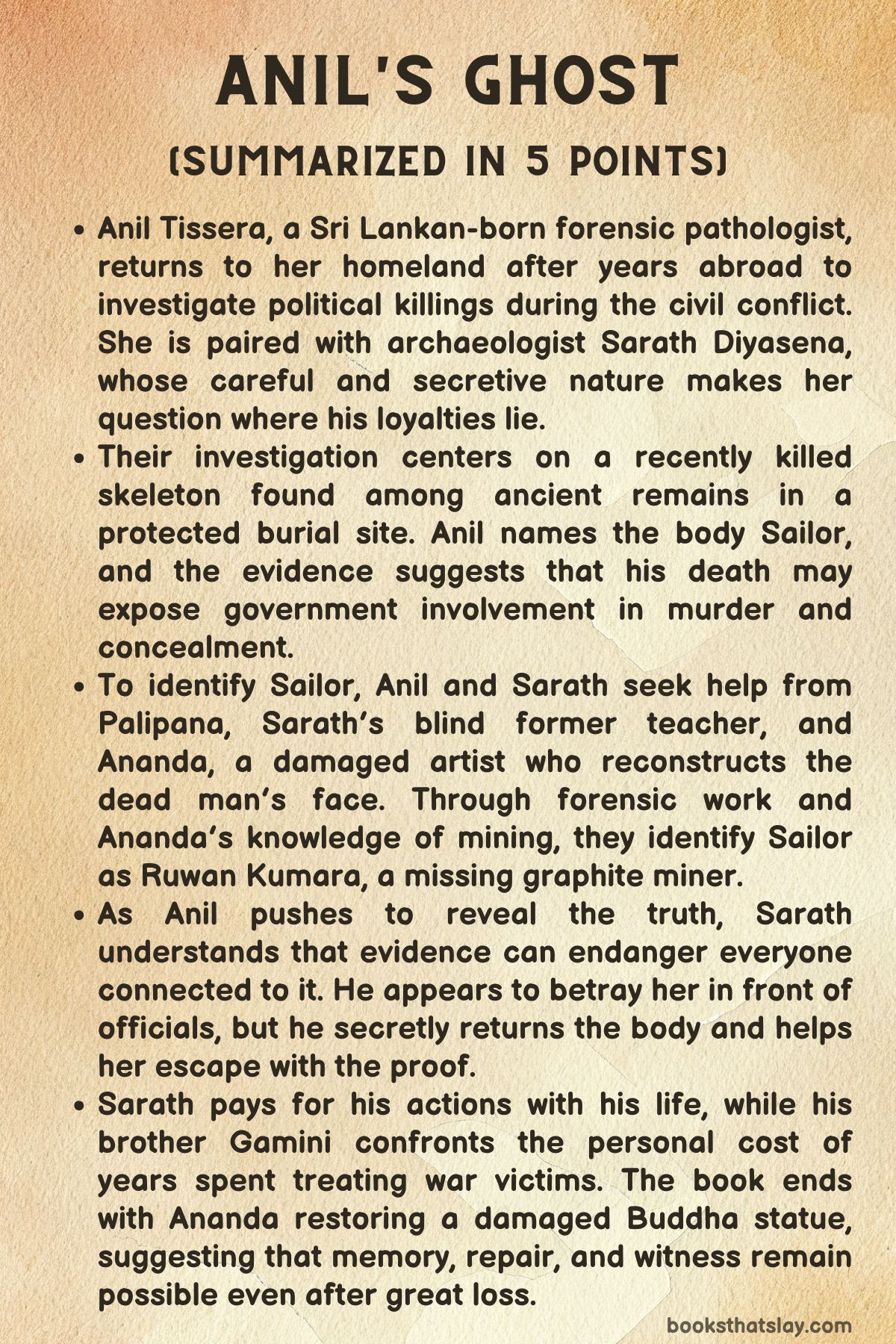
Anil’s Ghost follows Anil Tissera, a Sri Lankan-born forensic pathologist who returns to her homeland after 15 years abroad. She comes as a representative of an international human rights organization, tasked with investigating political killings during Sri Lanka’s civil conflict.
Anil has lived much of her adult life outside the country, working in places marked by mass death and political violence. Her training has taught her to read bones, wounds, and soil as evidence, but Sri Lanka confronts her with something more personal: the country she left has become a place where truth is dangerous, and where every side has blood on its hands.
Anil is paired with Sarath Diyasena, a Sri Lankan archaeologist whose loyalties are uncertain to her from the beginning. Sarath is intelligent, reserved, and careful, with connections to official institutions.
Anil worries that he may be aligned with the government, or that he may at least be too cautious to challenge it. Their work begins with skeletal remains found in a protected ancient burial site.
Some of the bones belong to old religious remains, but one skeleton is clearly recent. Anil names this body Sailor.
The discovery matters because the burial site is controlled by the government. If Sailor was killed recently and hidden there, his body may prove that government forces were involved in murder and concealment.
Anil approaches the case with scientific urgency. She wants proof, identity, and accountability.
Sarath understands the danger more deeply. He knows that evidence does not exist apart from power.
In Sri Lanka, to identify a body can endanger the living as much as honor the dead. As Anil studies Sailor, she determines that he was likely killed elsewhere and later moved to the ancient site.
The body becomes the center of her investigation, but also a symbol of countless victims who have vanished without explanation.
Sarath takes Anil to meet his former teacher, Palipana, a once-famous scholar who now lives in isolation in a forest monastery. Palipana had fallen from academic respect after accusations that he invented evidence to support his theories about the past.
Blind and withdrawn from public life, he remains a figure of strange authority. He examines Sailor and recognizes that the skull has been recently removed from the body, something Sarath has done for practical reasons.
Palipana suggests that they need an artist who can reconstruct the dead man’s face. Through him, the novel links archaeology, forensic science, and art: all are ways of trying to restore what violence has damaged or erased.
The artist they seek is Ananda Udugama, a former eye-painter of sacred statues and a miner whose life has been broken by war. His wife, Sirissa, disappeared after witnessing a terrible scene of political violence.
Since then, Ananda has lived with grief, drink, and silence. Anil doubts him at first, worried that he cannot be trusted with such important work.
Yet as she watches him handle Sailor’s skull, she sees that his attention is not careless. His work is intimate and respectful.
He does not treat the remains as an object. He treats them as the trace of a person.
While Ananda reconstructs Sailor’s head, Anil continues examining the skeleton. She notices physical signs in the bones that suggest Sailor’s occupation.
Watching Ananda crouch in the manner of a miner helps her make the connection: Sailor was likely a graphite miner. This clue leads Anil and Sarath closer to his identity.
Eventually, they identify him as Ruwan Kumara, a missing plumbago-graphite miner. The case now has a name, not just a body.
This is a major step for Anil, because forensic truth depends on turning anonymous remains back into a known human being.
Yet Ananda’s reconstruction does not satisfy Anil at first. Rather than creating a strictly accurate face, he gives Sailor an expression of peace.
Sarath explains that Ananda has made the dead man look at rest. This choice frustrates Anil, whose work depends on accuracy, but it also opens a different kind of truth.
Ananda is not only rebuilding a face for identification; he is giving dignity to someone whose death was meant to erase him. Anil begins to understand that grief, art, and evidence all answer violence in different ways.
Running beside Anil and Sarath’s investigation is the story of Sarath’s brother, Gamini, a doctor exhausted by years of treating war casualties. Gamini works in hospitals where the wounded arrive endlessly, and where even medical spaces are not safe from political violence.
He uses pills to stay awake and tries to lose himself in work. He and Sarath are distant from each other, divided by temperament and by their responses to the war.
Gamini sees suffering at close range but avoids political meaning. Sarath, by contrast, understands history and evidence, but moves with secrecy and caution.
Their relationship carries old pain, including Gamini’s love for Sarath’s wife, who died by suicide during the war years.
Anil’s own past also shapes the story. She remembers her career abroad, her friendship with Leaf, her failed marriage, and her affair with Cullis, a married photojournalist.
These memories show her as someone who has built a life around distance and discipline. She chose her own name, left her country, and trained herself to rely on facts rather than attachment.
Yet in Sri Lanka, her independence is tested. She cannot remain only an outside investigator because the violence she studies belongs to the country that formed her.
After Sailor is identified, Sarath leaves for Colombo, saying he needs stronger evidence before they move forward. When he does not return for several days, Anil grows anxious.
She contacts Dr. Perera, but almost immediately fears she has exposed their location. Soon officials arrive, seize control of Sailor’s skeleton, and take Anil back to Colombo.
She is brought before a group of government and military figures, where she tries to present the evidence. But without control of the body, she is vulnerable.
Sarath appears and publicly challenges her, questioning her findings and cutting down her authority. To Anil, it looks like betrayal.
Outside, Sarath confronts her and tells her she has been reckless. He warns her that she will not get her research back and orders her to return to the lab.
His harshness seems cruel, but when Anil arrives there, she finds that he has secretly returned Sailor’s remains to her. He has also left instructions urging her to finish her report and leave the country the next morning.
Sarath’s apparent betrayal was a cover. By discrediting her in public, he bought her a chance to escape with the evidence.
The cost is devastating. Gamini later sees Sarath’s dead body in the hospital.
Sarath has been killed, and Gamini, in shock and grief, tries to tend to his brother as though medical care could undo death. Around him, more victims arrive after a bombing that kills the president and many others.
The machinery of violence continues, swallowing public figures and ordinary people alike.
The novel ends with Ananda restoring an ancient Buddha statue damaged not by armies but by desperate people scavenging materials to survive. He gives work to locals, hoping to protect the statue by making restoration part of the community’s survival.
When he prepares to paint the Buddha’s eyes, he wears Sarath’s shirt beneath his ceremonial clothing. The gesture quietly honors Sarath and connects the work of repair to the dead.
As Ananda completes the ritual, the restored statue looks out over a damaged land. The ending does not offer justice in a simple sense.
Instead, Anil’s Ghost leaves the reader with acts of witness: Anil’s report, Sarath’s sacrifice, Gamini’s care for the wounded, and Ananda’s restoration of sight to a figure that has endured centuries of human suffering.
Characters
Anil Tissera
Anil Tissera is the central figure of Anil’s Ghost, a Sri Lankan-born forensic pathologist who returns to her homeland after 15 years abroad. She is intelligent, disciplined, skeptical, and emotionally guarded, shaped by years of working with the dead in places scarred by political violence.
Her profession gives her a way to deal with horror through evidence: bones, wounds, dates, soil, and injuries speak more clearly to her than public statements or official denials. Yet her return to Sri Lanka unsettles the distance she has built around herself.
She is not simply an outside investigator, because the country she studies is also the country of her childhood, family, language, and memories. Her self-possession is visible even in her chosen name; she fought to claim “Anil” as her own, rejecting expectations attached to gender and family.
This act reflects her larger personality: she wants control over identity, truth, and meaning. However, the book also shows her limits.
She sometimes underestimates the danger of seeking truth in a place where truth can get people killed. Her suspicion of Sarath is understandable, but it also blinds her to the possibility that caution may be a form of protection rather than cowardice.
Anil’s character is defined by a powerful need to restore names to the dead, but she learns that evidence alone cannot protect the living.
Sarath Diyasena
Sarath Diyasena is one of the most morally complex figures in the book. An archaeologist assigned to work with Anil, he appears restrained, evasive, and difficult to read.
His connections to government institutions make Anil doubt him, and his guarded speech often seems like compromise or betrayal. Yet Sarath’s caution comes from a deep understanding of Sri Lanka’s political reality.
He knows that evidence has consequences, and that to expose a murder is not merely to solve a case but to challenge forces capable of killing again. As an archaeologist, Sarath is trained to uncover the past, but he also understands concealment, silence, and timing.
His relationship with Anil is marked by tension because she demands directness while he works through indirection. His final actions reveal the depth of his courage.
By publicly challenging Anil, he appears to discredit her, but he is actually creating a path for her to escape with the evidence. Sarath’s sacrifice gives the novel one of its strongest moral turns: he is not the weak or compromised man Anil fears, but someone who chooses a dangerous, lonely form of loyalty.
His death shows how costly truth becomes when power controls not only institutions but also bodies, records, and public speech.
Gamini Diyasena
Gamini Diyasena, Sarath’s brother, represents another response to war: endurance through work. A doctor in Colombo, he has spent years treating victims of bombings, shootings, and other forms of political violence.
He is exhausted, dependent on pills to stay awake, and almost entirely consumed by the hospital. His nickname, “Mouse,” reflects his quietness and his childhood habit of remaining unnoticed, but as an adult this quality becomes a way of surviving emotional devastation.
Gamini does not seek public truth in the way Anil does, nor historical meaning in the way Sarath does. Instead, he focuses on the body directly before him.
If someone is bleeding, he treats the wound. If someone is dying, he tries to keep them alive.
This practical devotion makes him noble, but also damaged. His refusal to engage with the larger meaning of violence does not free him from it; it only traps him in endless repetition.
His love for Sarath’s wife adds private grief to public trauma, making his relationship with Sarath strained and painful. When he sees Sarath’s dead body, his instinct is still medical, as if repairing a broken leg could bring his brother back.
Gamini’s tragedy lies in his ability to heal others while being unable to heal himself.
Ananda Udugama
Ananda Udugama is an artist, a former eye-painter of sacred statues, and a man broken by the disappearance of his wife, Sirissa. At first, Anil sees him as unreliable because of his drinking and emotional instability, but the book gradually reveals his depth.
Ananda’s grief is not loud or argumentative; it lives in his body, habits, silence, and near self-destruction. His task of reconstructing Sailor’s face becomes one of the most meaningful acts in the novel.
Anil expects a forensic likeness that can help identify the dead man, but Ananda creates a face marked by peace. This choice frustrates her because it seems scientifically inaccurate, yet it also expresses a truth Anil’s methods cannot fully reach.
Ananda understands the dead not only as evidence but as human beings in need of dignity. His work joins art, mourning, and restoration.
Later, when he repairs the damaged Buddha statue and prepares to paint its eyes, his role expands from private grief to cultural repair. Wearing Sarath’s shirt beneath his ceremonial clothing, Ananda silently honors sacrifice and survival.
In Anil’s Ghost, he becomes a figure of damaged faith: he may not fully believe in sacred restoration, yet he performs it with care because the world still needs acts of repair.
Palipana
Palipana is Sarath’s former teacher, a once-respected scholar who now lives in isolation after being accused of fabricating historical evidence. Blind, severe, and intellectually powerful, he is a character who complicates the idea of truth.
His academic fall suggests that he may have crossed the line between interpretation and invention, but the book does not reduce him to fraud. Instead, it presents him as someone who resisted colonial and Western methods of defining Sri Lanka’s past, even if his resistance damaged his credibility.
Palipana’s blindness gives him symbolic force: he can no longer see in a physical sense, yet he perceives patterns, motives, and meanings that others miss. When Sarath and Anil bring Sailor to him, he quickly understands that the skull has been recently removed and that the body carries danger.
His advice to seek an artist is central to the investigation, because it brings Ananda into the story and moves the search beyond laboratory science. Palipana’s character stands at the meeting point of history, myth, scholarship, and exile.
He shows that the past is never neutral in a wounded country; it can be evidence, comfort, weapon, or refuge.
Sailor / Ruwan Kumara
Sailor, later identified as Ruwan Kumara, is physically dead for the whole story, yet he is one of the book’s most important presences. At first he is an unnamed skeleton discovered among ancient remains, but Anil’s decision to call him Sailor gives him a temporary identity before his real one is restored.
His body is the central evidence in the investigation, and his hidden burial suggests a deliberate attempt to erase a political killing. As the forensic work progresses, Sailor becomes more than proof of state violence.
His bones reveal occupation, movement, injury, and the conditions of his death. When Anil and Sarath identify him as a graphite miner, he regains part of his social existence: he was not an abstract victim but a worker, a man with a place in the world.
His importance lies in the fact that he stands for many disappeared people without becoming merely symbolic. The novel insists that mass violence must be understood through individual lives.
Sailor’s body asks the living to answer a moral question: what does it mean to know the truth about a death when powerful people want that truth buried?
Sirissa
Sirissa, Ananda’s missing wife, is absent from most of the direct action, but her absence shapes Ananda’s entire character. She worked as a cleaner at a school and tried to educate herself informally by listening and observing from the margins.
This detail makes her especially moving, because she is someone who seeks knowledge despite being denied formal access to it. Her disappearance follows her exposure to horrifying political violence, and she becomes one of the many people swallowed by the conflict without explanation.
For Ananda, Sirissa is not simply gone; she remains unresolved. Her fate is unknown, and that uncertainty is its own kind of torment.
The book uses her character to show how disappearance differs from confirmed death. When there is no body, no explanation, and no ritual closure, grief cannot settle.
Sirissa’s story also mirrors the broader condition of the country, where families wait without answers and where private life is repeatedly invaded by public terror. Though she appears briefly, she gives emotional depth to Ananda’s despair and helps explain why the reconstruction of Sailor’s face becomes so personal for him.
Palipana’s Niece
Palipana’s niece is a quiet but memorable figure, shaped by early trauma after the murder of her parents. Palipana takes her into the forest monastery, where she grows into a life removed from ordinary society.
She is loyal to him, attentive to his needs, and connected to the landscape around them in a way that feels almost outside formal civilization. Her character shows one result of violence that is not often described through public events: a child survives, but her relationship to the world is permanently altered.
She does not return to normal social life; instead, she becomes part of Palipana’s secluded existence. Her silence and watchfulness contrast with Anil’s professional language and Sarath’s controlled speech.
She preserves memory through presence rather than argument. After Palipana’s death, her act of carving one of his sayings into rock suggests that she has inherited his relationship with history, inscription, and hidden meaning.
She is not a major speaker in the book, but she carries the emotional afterlife of violence, showing how trauma can push a person away from society while still leaving them with forms of devotion and memory.
Leaf
Leaf is Anil’s American friend and fellow forensic pathologist, connected to Anil’s life outside Sri Lanka. Their friendship is based on shared professional habits, humor, and a fascination with detail.
Leaf helps reveal a more relaxed side of Anil, one formed in laboratories, bowling alleys, and conversations with people who understand the strange mental world of forensic work. Yet Leaf also brings another kind of loss into the novel.
Her early onset Alzheimer’s disease frightens Anil because it threatens memory, identity, and continuity. For a character like Anil, who depends on exact observation and evidence, the loss of memory is deeply unsettling.
Leaf’s condition contrasts with the forensic mission at the center of the book. Anil tries to recover the identities of the dead, while Leaf is slowly losing access to her own life.
Through Leaf, the book widens its meditation on disappearance. People can vanish through war, secrecy, death, exile, or illness.
Leaf is not directly involved in the Sri Lankan investigation, but she helps explain Anil’s loneliness and her fear that even the most careful mind can lose its hold on the past.
Cullis Wright
Cullis Wright is the married photojournalist with whom Anil had an affair. He belongs to her earlier life of movement across countries marked by conflict, and his relationship with her reveals both intimacy and emotional danger.
Cullis is drawn to Anil, but he also tries to claim knowledge of her in ways she resists. Their affair is passionate but unstable, shaped by imbalance, secrecy, and the limits of being involved with someone who already has another life.
Anil’s eventual act of stabbing him in the arm when he refuses to let her go is extreme, but it reflects her fierce need for autonomy. She will not be possessed, trapped, or emotionally cornered.
Cullis also represents a kind of outsider who witnesses violence professionally through images, whereas Anil works through bodies and remains. His comment about not wanting his body handled by clumsy forensic scientists shows his discomfort with the physical reality behind the work.
In the book, Cullis helps illuminate Anil’s guardedness. She can desire closeness, but when closeness threatens control, she chooses escape.
Lalitha
Lalitha, Anil’s former nanny, connects Anil to the childhood she left behind. Their meeting is emotionally significant because it exposes how much has changed during Anil’s absence.
They no longer share an easy language, and communication must pass through Lalitha’s granddaughter. This barrier is more than linguistic.
It shows Anil’s distance from her own past and from the local world she once belonged to. Lalitha represents memory, care, and domestic history, but the reunion is not simple or sentimental.
The granddaughter’s resentment suggests that Anil’s return may look privileged or foreign to those who remained in Sri Lanka through years of danger. Lalitha’s presence reminds the reader that Anil is both native and outsider.
She has roots in the country, but she cannot simply reclaim belonging after a long absence. Through Lalitha, the novel quietly examines exile, class, language, and the emotional cost of leaving.
Dr. Perera
Dr. Perera is the senior medical officer Anil meets in Colombo, and he represents the local medical establishment operating under conditions of fear and overload. He knows Anil’s family background and remembers her father, which immediately places Anil within a Sri Lankan network of professional and personal memory.
His role is not as central as Sarath’s or Gamini’s, but he matters because he shows how institutions continue functioning during national breakdown. Hospitals, offices, and laboratories still exist, but they are surrounded by pressure, suspicion, and violence.
Anil’s brief contact with him later in the story becomes dangerous because any disclosure can expose the investigation. Dr. Perera’s character helps create the atmosphere of a country where ordinary professional exchanges are never entirely safe.
Knowledge moves through people, and people are vulnerable.
Gunesena
Gunesena is the injured man Anil and Sarath find nailed to the ground on the road. His presence is brief, but it is one of the book’s starkest examples of bodily punishment used as public terror.
He is not introduced through background, family, or speech; he appears first as a wounded body that must be rescued. This is important because the book often shows how political violence reduces people to signs meant to frighten others.
Sarath and Anil’s decision to take him to Gamini gives the scene moral urgency. Gunesena shows the reader that Sailor’s death is not an isolated case.
The country is full of bodies marked by warning, revenge, and fear. His character also brings Anil’s forensic world into contact with immediate suffering.
She is trained to read the dead, but Gunesena is still alive, and his survival depends on urgent care rather than later evidence.
President Katugala
President Katugala is less a developed private character than a figure of political power and denial. His public refusal to acknowledge the true scale of the conflict creates the official atmosphere against which Anil’s investigation takes place.
The state’s denial matters because it turns evidence into a threat. If the government claims there is no real war, then bodies like Sailor’s become dangerous records of what power wants to erase.
Katugala’s later death in a bombing does not bring resolution. Instead, it shows that even those at the top of public authority are not outside the violence they deny or manage.
His character represents the political world in which language is controlled, responsibility is avoided, and human suffering is turned into something deniable. In Anil’s Ghost, he helps define the danger surrounding Anil and Sarath’s work: the truth is not hidden because it is unclear, but because powerful systems depend on keeping it hidden.
Themes
Truth, Evidence, and the Cost of Witnessing
Truth in Anil’s Ghost is never treated as a simple matter of discovering facts and presenting them to the world. Anil believes in forensic certainty.
To her, bones can establish time, cause of death, identity, and responsibility. This faith in evidence gives her strength, but the book places that faith under pressure.
In a peaceful system, proof might lead to justice; in a violent political system, proof can lead to intimidation, disappearance, or death. Sailor’s skeleton matters because it can expose a hidden crime, but the moment it becomes meaningful, it also becomes dangerous.
Sarath understands this before Anil does. His caution is not a rejection of truth, but a recognition that truth must travel through institutions controlled by those who may be guilty.
The book asks whether witnessing is still valuable when justice is uncertain. Its answer is serious but not hopeless.
Anil’s report, Sarath’s sacrifice, and the restoration of Sailor’s identity all suggest that truth matters even when it cannot repair everything. To witness is to refuse erasure.
It may not save the dead, and it may not punish the guilty, but it keeps violence from having the final word.
War and the Destruction of Ordinary Life
War in the novel is not shown only through battlefields or official conflict. Its deepest horror lies in how it enters ordinary spaces: hospitals, roads, schools, homes, trains, villages, and family relationships.
People continue working, cooking, studying, driving, and caring for others, but violence can break into any of these routines without warning. Sirissa’s walk to the school, Gunesena’s tortured body on the road, Gamini’s endless hospital shifts, and the unidentified dead all show how public conflict becomes private devastation.
The book is especially attentive to the way fear changes behavior. Villagers see a man taken away and do nothing, not because they lack feeling, but because terror has taught them that action may bring more death.
Doctors treat victims while knowing that armed men may enter hospitals to finish killings. Families wait for missing people without answers.
This portrayal of war rejects neat divisions between front line and civilian life. Everyone becomes a participant, victim, witness, or survivor in some form.
The damage is physical, emotional, moral, and cultural. The book shows a society where violence does not only kill people; it changes how the living speak, remember, trust, and move through the world.
Identity, Exile, and Belonging
Anil’s return to Sri Lanka raises difficult questions about identity and belonging. She was born there, but she has spent 15 years abroad, building a career in foreign institutions and living mostly in English.
When she comes back, she is both insider and outsider. Her childhood fame as a swimmer, her family connections, and her memories tie her to the country, yet her professional role and long absence separate her from those who remained.
This divided identity affects how others see her and how she sees herself. She wants to act with moral clarity, but she does not always understand the local consequences of that clarity.
Her chosen name is important in this context. By taking “Anil” for herself, she created an identity through will and defiance rather than passive inheritance.
That same independence has shaped her career and personal life, but Sri Lanka forces her to face the limits of self-invention. No one belongs only by choice; belonging also involves history, language, loss, and responsibility.
Sarath, Gamini, Ananda, and Palipana each represent different forms of remaining in the country and carrying its burdens. Through Anil’s uneasy return, the book explores how exile can protect a person, but also leave them estranged from the very place that formed them.
Art, Restoration, and Memory
Art in the book is not decorative or separate from suffering. It becomes a way of restoring presence where violence has caused damage.
Ananda’s reconstruction of Sailor’s face is the clearest example. Anil wants a face that will help identify a victim, but Ananda gives the face peace, dignity, and human stillness.
His work suggests that the dead require more than classification; they require recognition. The same idea appears in the restoration of the Buddha statue.
The statue has survived across centuries, through periods of faith, conflict, neglect, and need. Repairing it does not erase the violence that damaged it, but it creates a counteraction to destruction.
Ananda’s role as an eye-painter is especially meaningful because painting the eyes gives the statue its sacred presence. In a land filled with unseen crimes and hidden bodies, the act of giving sight carries moral weight.
Art preserves memory differently from science. Science identifies; art mourns, honors, and restores symbolic life.
The book does not claim that art can solve political violence, but it shows that restoration matters because destruction is not only physical. War damages meaning, faith, beauty, and continuity.
Art answers by rebuilding forms through which people can remember and endure.