Animal Liberation Summary and Analysis
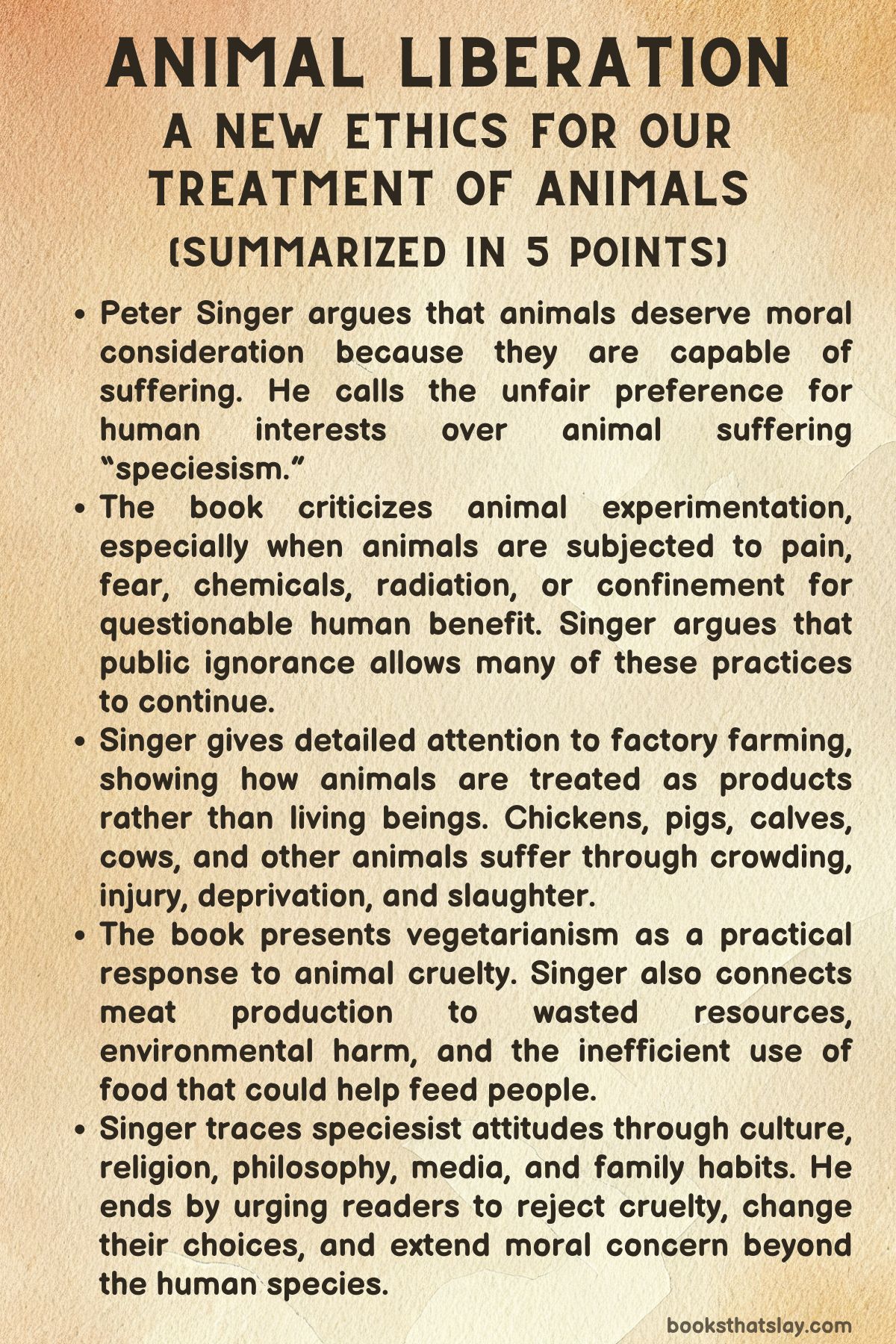
Animal Liberation by Peter Singer is a major work of moral philosophy and animal advocacy. First published in 1975 and later updated, the book argues that human beings should give serious moral consideration to animals because animals can suffer.
Singer calls the habit of valuing human interests over animal suffering “speciesism,” comparing it to other forms of discrimination. Rather than asking readers only to feel sympathy for animals, he builds a rational case against factory farming, animal testing, and everyday habits that support cruelty. The book is both an ethical argument and a practical call for change.
Summary
Animal Liberation presents Peter Singer’s case that the way human beings treat animals is morally indefensible. The book begins from a simple ethical idea: suffering matters, no matter who experiences it.
Singer argues that humans often deny animals fair consideration not because animals do not suffer, but because humans belong to a different species and have built systems that hide animal pain from public view. This prejudice, which he calls speciesism, allows people to accept cruelty when the victims are animals, even though similar treatment of humans would be condemned.
Singer first explains that equality does not mean identical treatment. Human beings differ in intelligence, strength, abilities, needs, and social roles, yet these differences do not justify ignoring their interests.
The basis of equality is not sameness but equal consideration. From this point, he argues that animals should also receive equal consideration where their interests are involved.
Since animals can feel pain, fear, and distress, their suffering must count morally. They do not need to speak, vote, reason like humans, or understand moral arguments in order to have an interest in avoiding pain.
This principle leads Singer to reject the idea that humans may use animals however they wish. He challenges the belief that animals exist primarily for human benefit, whether as food, experimental material, clothing, entertainment, or objects of convenience.
He also argues that the inability of animals to describe their suffering does not make their pain less real. A baby cannot explain pain in language either, but people do not therefore dismiss the baby’s suffering.
For Singer, the same basic logic applies to animals.
The book then turns to animal experimentation. Singer describes research settings in which animals are subjected to radiation, poisoning, electric shocks, starvation, injury, fear, and psychological distress.
He discusses military experiments, toxicity tests, and product testing, including the use of animals in cosmetics research. These experiments often cause severe suffering while producing results of limited value, especially because reactions in one species may not reliably predict reactions in another.
Singer argues that public support for such research often depends on ignorance. When people learn about specific experiments, especially those involving animals they know as companions, they tend to object strongly.
Singer also criticizes the institutions that support animal testing. Scientists, funding bodies, government agencies, and the media all help maintain the system, either by defending it, ignoring it, or failing to expose it clearly.
He does not claim that every experiment is equally useless, but he insists that many are cruel, repetitive, unnecessary, or aimed at trivial human benefits. He urges society to reduce and replace animal experiments, especially when the substances being tested are not essential to human life.
The largest section of the book focuses on factory farming. Singer argues that modern farming has moved far away from the older image of animals living outdoors under the care of farmers.
Industrial agriculture is built around efficiency, profit, and maximum output, often at the cost of intense animal suffering. Chickens, pigs, cows, calves, turkeys, and egg-laying hens are confined in systems designed to produce meat, milk, and eggs cheaply, not to allow animals to live according to their needs.
Singer describes broiler chickens kept in crowded sheds where rapid growth, poor air, disease, and stress are common. Because crowding can lead birds to peck and injure one another, producers often remove part of their beaks instead of giving them more space.
Egg-laying hens are kept in battery cages so small that they cannot spread their wings or move normally. Male chicks, useless to the egg industry, are killed soon after birth.
These practices, Singer argues, are not rare abuses but normal parts of industrial production.
Pigs also suffer under confinement. They may be kept in restrictive stalls, deprived of stimulation, and subjected to procedures such as tail docking because stress and boredom cause them to bite one another.
Calves raised for veal are confined in narrow crates, fed restricted diets, and prevented from moving normally so their flesh meets market expectations. Dairy cows and other farm animals are likewise treated as production units rather than sentient beings.
Singer stresses that these systems are not accidental; they are designed to turn animals into products as cheaply as possible.
After showing the cruelty behind animal products, Singer presents vegetarianism as a direct ethical response. He argues that refusing to eat meat is one of the clearest ways individuals can withdraw support from animal exploitation.
He encourages readers not only to change their diets but also to explain their reasons, vote, protest, write to representatives, and challenge public ignorance. For Singer, vegetarianism is not a private preference but a practical boycott of an industry built on suffering.
Singer also gives environmental and economic reasons for moving away from meat. Raising animals for food consumes large amounts of grain, land, water, and energy.
Plant foods can provide protein and other nutrients more efficiently than animal agriculture. He argues that food resources used to raise animals could be used more effectively to feed human beings directly.
He also discusses the damage caused by overfishing and the suffering of fish, extending his ethical concern beyond mammals and birds.
The book then looks at the historical roots of speciesism, especially in Western thought. Singer examines religious and philosophical traditions that placed humans above animals and treated animals as tools for human use.
He discusses the influence of Greek philosophy, Judaism, Christianity, and later thinkers who defended human dominion over animals. While some religious ideas can be read as stewardship rather than exploitation, Singer argues that Western culture often developed in a direction that justified using animals with little concern for their pain.
At the same time, Singer notes that concern for animals has appeared throughout history. Reformers, writers, philosophers, and activists have challenged cruelty, and legal protections for animals gradually began to emerge.
Still, he argues that these reforms have usually been limited. Humans often condemn cruelty when it is obvious or unnecessary, but continue to support animal suffering when it serves food habits, scientific interests, profit, or convenience.
In the final part of Animal Liberation, Singer considers why speciesism remains so powerful. He argues that children are often taught contradictory lessons: animals in stories are friends, but animals on plates are food.
Parents, schools, advertising, and media help hide the reality of slaughter and factory farming. Words such as “harvest” can make killing sound natural and harmless, concealing the fact that sentient beings are being used as objects.
Singer also responds to common objections. He rejects the claim that human problems must always come first, noting that many people who fought for animals also supported movements against racism, sexism, slavery, and child abuse.
Moral concern is not a limited resource; caring about animals does not require abandoning concern for humans. He also answers the argument that plants might feel pain by stating that there is no strong basis for treating plants as sentient in the same way animals are.
The book ends with a call for moral consistency and action. Singer believes that once people understand what animals endure, they can no longer honestly defend speciesism.
The issue is not sentimentality but justice. Since animals suffer, their suffering must count.
Animal Liberation asks readers to change their habits, challenge institutions, and expand their moral concern beyond the human species.
Key Figures
Peter Singer
Peter Singer is the central voice and guiding presence in Animal Liberation. Since the book is nonfiction, he is not a character in the fictional sense, but he functions as the main moral thinker, critic, and persuader.
His role is to challenge the reader’s assumptions about human superiority and to show how ordinary habits can rest on hidden cruelty. Singer’s voice is calm, argumentative, and evidence-driven rather than sentimental.
He does not ask readers merely to love animals; he asks them to reason consistently. His main concern is suffering, and he builds his argument around the idea that any being capable of pain deserves moral consideration.
Singer’s character as an author is marked by persistence, directness, and a willingness to confront socially accepted practices. He criticizes farming, science, religion, consumer culture, and everyday diets, but he does so through ethical reasoning rather than outrage alone.
His strength lies in making readers feel that animal suffering is not a private preference issue but a serious moral problem.
Animals
Animals are the moral center of the book, even though they do not speak for themselves. They appear as victims of systems created by humans: laboratories, factory farms, slaughterhouses, cages, crates, and consumer markets.
Singer presents them not as symbols or background figures, but as sentient beings with interests of their own. Their most important shared trait is their capacity to suffer.
Chickens, pigs, cows, calves, monkeys, dogs, fish, and other animals are shown as beings whose pain is often ignored because they cannot argue for themselves in human language. In Animal Liberation, animals expose the failure of human morality when compassion stops at the boundary of species.
Their silence becomes one of the book’s strongest ethical pressures. They cannot defend themselves against confinement, testing, mutilation, or slaughter, which makes human responsibility even greater.
Singer’s treatment of animals asks readers to see them not as products, tools, or research material, but as living beings whose pain has moral weight.
Factory Farmers and the Meat Industry
Factory farmers and the meat industry represent organized cruelty made ordinary through business, habit, and distance. They are not presented as individual villains in a simple sense; rather, they stand for a system that rewards efficiency while reducing animals to units of production.
Their decisions are shaped by profit, output, and market demand, but the result is severe suffering for animals. The book shows how chickens are crowded into sheds, hens are confined in battery cages, pigs are kept in restrictive spaces, and calves are raised under harsh conditions for veal.
The industry’s character is defined by its refusal to treat animals as beings with needs beyond growth, weight, and sale value. Its moral failure lies not only in direct violence but also in the normalization of that violence.
By turning suffering into routine procedure, the meat industry hides cruelty behind packaging, advertising, and the familiar language of food.
Scientists and Experimenters
Scientists and experimenters in the book represent another form of human power over animals. Singer does not portray them as uniformly cruel people who enjoy causing pain, but he strongly criticizes the institutions and habits that allow them to cause suffering while seeing their work as necessary or respectable.
In laboratories, animals are exposed to radiation, chemicals, electric shocks, deprivation, and psychological distress. The experimenters often justify this treatment in the name of research, safety, or human benefit.
Singer’s analysis suggests that professional training and institutional approval can dull moral awareness. When suffering becomes part of a research method, the animal’s experience can disappear behind technical language.
These figures show how intelligence and education do not automatically lead to compassion. In the book, their role is to reveal how cruelty can survive inside respected systems when the victims are considered less important than the goals of those in power.
Consumers
Consumers are among the most important human figures in Animal Liberation because they connect private choices to public cruelty. They are not shown as monsters, but as people who often participate in animal suffering through ignorance, convenience, tradition, and habit.
Most consumers do not see the farms, cages, laboratories, trucks, or slaughterhouses behind the products they buy. This distance allows them to think of meat, eggs, milk, cosmetics, and other goods as ordinary parts of life rather than as results of animal suffering.
Singer treats consumers as morally responsible because they help sustain these industries with their money. At the same time, he also treats them as capable of change.
Once they understand what happens behind the scenes, they can withdraw support, become vegetarian or vegan, speak publicly, vote, protest, and influence others. The consumer therefore becomes both part of the problem and a possible agent of reform.
Animal Rights Activists and Reformers
Animal rights activists and reformers serve as the book’s examples of moral resistance. They challenge the systems that most people accept without question.
Singer presents them as figures who expose hidden cruelty, pressure governments and companies, influence public opinion, and push for changes in law and practice. Their work includes campaigns against animal testing, opposition to factory farming, efforts to ban cruel confinement systems, and attempts to educate the public.
These activists matter because they break through the ignorance that allows speciesism to continue. In the book, reformers are also connected to broader traditions of justice.
Singer notes that concern for animals has often existed alongside movements against slavery, racism, sexism, and child abuse. This connection gives activists a wider moral significance.
They are not merely people who care about animals; they are people who question unjust power wherever it appears.
Religious and Philosophical Authorities
Religious and philosophical authorities appear as figures who helped shape human attitudes toward animals. Singer discusses traditions and thinkers that placed human beings above other creatures and justified the use of animals for human purposes.
Some religious ideas suggest guardianship and responsibility, but many later interpretations support domination. Thinkers such as Aristotle, Aquinas, and Descartes are important because their ideas contributed to the belief that animals are tools, property, or beings of lesser moral importance.
These figures show that cruelty is not only a practical issue but also an intellectual inheritance. Ideas about human uniqueness, divine authority, reason, and the soul have all been used to separate humans from animals.
Singer’s treatment of these authorities is critical because he believes such traditions helped make speciesism seem natural. Their presence in the book shows how philosophy and religion can either enlarge moral concern or restrict it.
Children and Parents
Children and parents appear in the book as figures shaped by social teaching. Singer suggests that children often sense a contradiction in the way animals are presented to them.
Stories, toys, and cartoons may encourage affection toward animals, while meals and customs teach them to accept eating animals. Parents often soften this contradiction by offering comforting images of happy farms or by avoiding the truth about slaughter and confinement.
Children matter because they show that speciesism is learned rather than inevitable. Their discomfort with eating animals can be seen as an early moral response before society trains it away.
Parents, meanwhile, represent the passing down of cultural habits. They may not intend harm, but they help preserve the distance between affection for some animals and indifference toward others.
Through children and parents, Singer shows how moral blindness is taught through everyday family life.
The Media
The media functions as a powerful public character in the book because it controls what people see, ignore, and discuss. Singer argues that animal suffering often continues because the public is not shown enough of it.
When footage or reports of cruelty become visible, people frequently react with anger and concern. This suggests that ignorance, not total indifference, protects abusive systems.
The media’s failure is therefore serious: by neglecting animal experimentation, factory farming, and slaughterhouse realities, it helps keep consumers emotionally and morally distant from the consequences of their choices. At its best, however, the media can expose hidden abuse and force public debate.
Its character is divided between silence and revelation. Singer’s criticism of the media shows that cruelty depends not only on those who commit it, but also on those who fail to bring it into public view.
Themes
Speciesism and Moral Equality
Speciesism is the central ethical problem that Singer attacks. The book argues that humans often treat animal suffering as less important simply because the sufferer is not human.
This bias resembles other forms of discrimination because it gives greater moral weight to one group’s interests while dismissing another’s. Singer does not claim that animals and humans are identical, nor does he argue that animals should have the same rights in every situation.
Instead, he argues that equal consideration means taking similar interests seriously. A pig’s interest in avoiding pain, for example, should not be ignored simply because a pig cannot vote, speak, or reason like a human adult.
The theme challenges readers to separate moral worth from intelligence, language, social usefulness, and species membership. By focusing on suffering, Singer forces a shift in ethical attention.
The question becomes not whether animals are like humans in every way, but whether their pain matters. His answer is clear: any being capable of suffering deserves consideration.
Hidden Cruelty and Public Ignorance
Cruelty in the book survives largely because it is hidden. Factory farms, laboratories, and slaughterhouses are physically and emotionally removed from the ordinary consumer’s life.
People see clean packages, finished meals, medical claims, and familiar products, but they rarely see the confinement, fear, injury, and death behind them. Singer repeatedly suggests that many people would object if they truly understood what happens to animals.
This makes ignorance one of the strongest supports of speciesism. The theme is not just about lack of information; it is about organized distance.
Industries benefit when consumers do not ask questions. Scientific institutions benefit when experiments are described in technical terms rather than in terms of animal pain.
Food companies benefit when farms are advertised as peaceful and natural while industrial systems remain out of sight. The book treats knowledge as a moral turning point.
Once cruelty becomes visible, ordinary habits become harder to defend, and personal responsibility becomes impossible to avoid.
The Ethics of Food and Consumption
Food is treated as a moral choice rather than a neutral preference. Singer argues that eating animals is not simply a matter of taste, tradition, or convenience when modern meat production depends on severe suffering.
The decision to buy meat, eggs, or dairy supports industries that confine, mutilate, transport, and kill animals for human benefit. This theme is powerful because it brings ethics into daily life.
A person may oppose cruelty in theory while still funding it through ordinary meals. Singer’s discussion of vegetarianism is therefore practical as well as philosophical.
He presents dietary change as a direct way to stop cooperating with animal exploitation. He also connects food choices to environmental damage, inefficient use of land and grain, water consumption, and global hunger.
In Animal Liberation, consumption becomes a test of moral consistency. The reader is asked to consider whether pleasure, habit, and convenience can justify the suffering of beings who are capable of pain.
Human Power, Tradition, and Responsibility
Human beings in the book hold overwhelming power over animals, and Singer asks what moral responsibility should come with that power. Animals are bred, confined, experimented upon, transported, killed, eaten, and sold under systems humans created.
Tradition often makes this domination seem natural. Religion, philosophy, family habits, advertising, and education all help preserve the belief that animals exist for human use.
Singer challenges that inheritance by showing that old beliefs are not automatically moral ones. The fact that a practice has been accepted for centuries does not make it just.
This theme also shows how responsibility grows with awareness. Once humans recognize that animals suffer, they cannot honestly claim innocence while continuing to support avoidable cruelty.
Power becomes morally dangerous when it is joined with convenience and denial. Singer’s argument asks humans to move from domination to restraint, from entitlement to accountability, and from inherited habits to conscious ethical action.