An Immense World Summary and Analysis
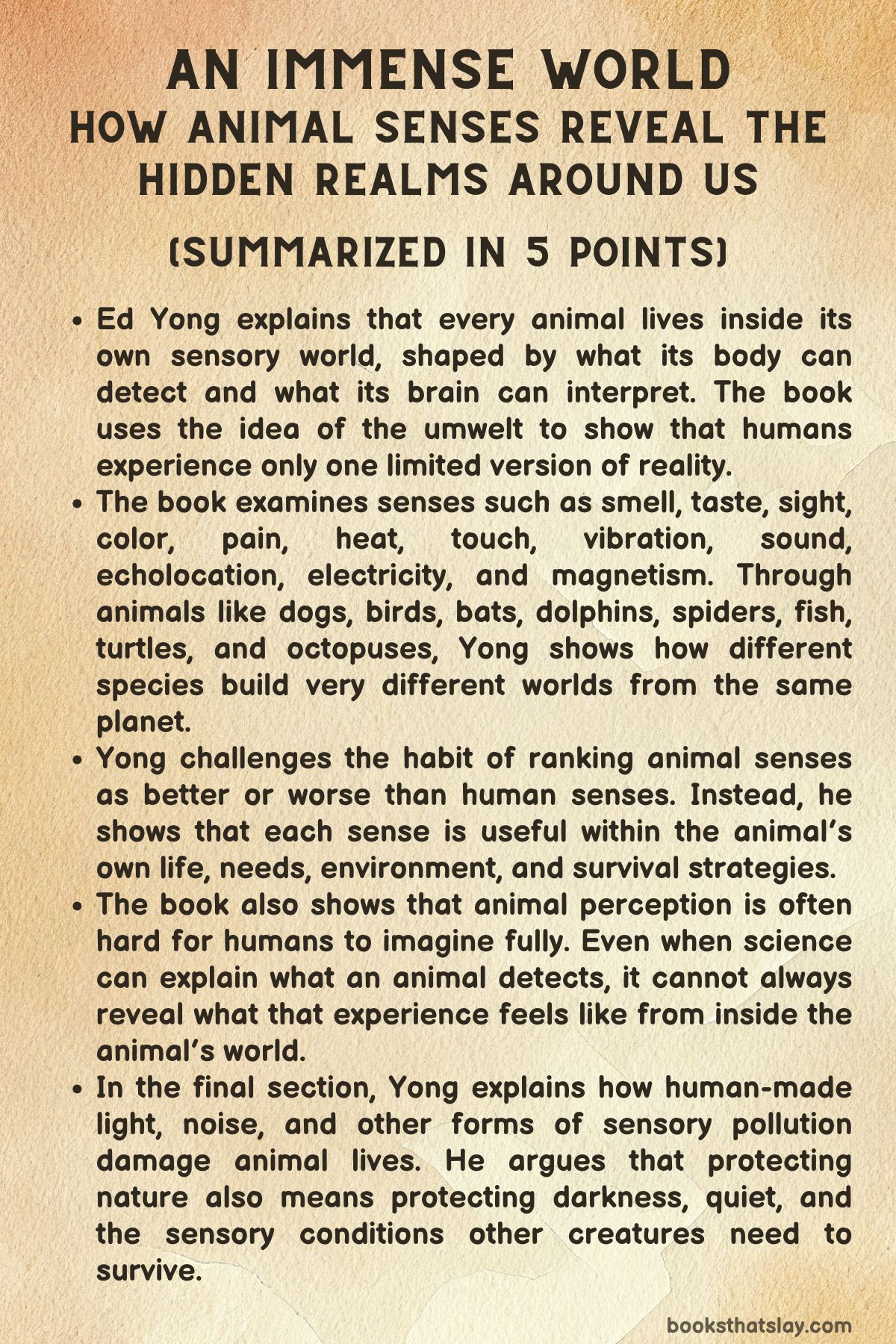
An Immense World: How Animal Senses Reveal the Hidden Realms Around Us by Ed Yong is a nonfiction exploration of animal perception: how creatures sense smells, colors, heat, pain, sound, vibrations, electric fields, magnetic fields, and more. Its central idea is the umwelt, the unique sensory world each species lives inside.
Yong challenges the human habit of treating our senses as the default measure of reality. Instead, he presents animals as beings whose bodies open different doors onto the world. The book invites readers to recognize that reality is not one shared stage, but many partial worlds shaped by the senses that make survival, movement, communication, and meaning possible.
Summary
An Immense World begins with the idea of the umwelt, a term associated with Jakob von Uexkull. An umwelt is the sensory world an animal inhabits: the slice of reality available to it through its particular senses.
Yong uses this idea to guide the whole book. He argues that humans do not experience the world as it truly is, but only as human bodies and brains allow.
Other animals live in equally real worlds that may be filled with smells, vibrations, heat, electric fields, or magnetic cues that humans barely notice or cannot sense at all.
The book’s main purpose is not to rank animals by whose senses are “better.” Instead, it shows that each species’ senses match its needs. A dog’s smell, a bird’s color vision, a fish’s lateral line, or a bat’s echolocation is not a party trick.
Each is a way of building a world. Yong repeatedly warns against forcing animal senses into human terms, because doing so reduces animals to tools or curiosities rather than recognizing them as living beings with their own perceptual realities.
The discussion starts with smell and taste. Dogs are famous for their strong sense of smell, but Yong does more than repeat that familiar fact.
He explains that a dog’s nose is built to preserve and analyze scent trails, sending air toward scent-processing regions while still allowing breathing. Humans often use dogs’ noses for our own purposes, such as detection work, yet we rarely ask what smell means to the dog.
Yong also challenges the idea that humans are poor smellers, showing that this belief comes partly from old prejudices about smell as primitive or animal-like. Smell, in many species, is a major source of information.
Ants, elephants, birds, and snakes all show different ways that chemical sensing can shape behavior. Taste is treated as a simpler but still important sense, usually tied to quick judgments about food.
Some animals taste with feet or legs; others have lost tastes that no longer matter to their diets. The lesson is that absence is not inferiority.
It is adaptation.
Vision comes next, beginning with the surprising variety of eyes. Jumping spiders have different eye pairs for different tasks.
Birds may see almost all around themselves. Scallops have many eyes, though their sight may function less like scene-making and more like detection.
Yong explains that all vision begins with light and photoreceptors, especially opsins, but eyes are built to gather different kinds of information. Some animals have sharp vision, while others sacrifice detail for sensitivity in darkness.
Flies process visual information much faster than humans, so the world may seem slower to them. What looks like a quick swat to us may appear very different to a fly.
The book then turns to color. Yong explains that color is not a property sitting inside objects but a sensation created by nervous systems comparing wavelengths of light.
Humans have three types of cones, while dogs are dichromats and see a more limited range. Many birds are tetrachromats and can see ultraviolet light, opening color worlds humans cannot imagine.
Flowers and feathers may contain patterns invisible to us but vivid to pollinators or other birds. The point is not simply that some animals see “more” color, but that color itself is species-specific.
What one animal sees as plain may be bright with signals to another.
Pain is treated with special care because it raises ethical questions. Yong distinguishes nociception, the detection of harmful stimuli, from pain, the suffering that may follow.
Many animals have nociceptors, but they do not necessarily experience pain in the same way. Naked mole rats, for example, can tolerate conditions that would harm or distress many other animals.
This distinction matters when humans experiment on animals, trap them, kill them, or prepare them for food. Pain is not just a biological topic; it is a moral one.
Heat introduces another way animals define the world differently. Temperature sensors vary across species, so “hot” and “cold” are not universal experiences.
Animals that live in extreme environments have sensory systems tuned to their conditions. Some creatures can sense heat at a distance.
Fire beetles, for instance, detect the heat of forest fires from far away. Parasites such as ticks may use body heat to find hosts.
Yong shows that warmth, which humans usually think of as a physical condition, can also be a signal that structures an animal’s choices and movements.
Touch is expanded beyond direct contact. Sea otters, despite having paws that look simple to humans, are extremely good at distinguishing textures quickly.
Star-nosed moles use a strange, fleshy organ as a fast touch system. Bird beaks, which may seem hard and lifeless, can be sensitive tools.
Crocodiles detect tiny pressure changes through sensors across their bodies. Fish use the lateral line to sense movement in water, allowing them to detect predators and coordinate in schools.
Yong’s larger point is that touch can operate through skin, whiskers, beaks, water flow, and air movement. It is not limited to human fingertips.
Surface vibrations form another sensory world that humans often overlook. Many insects communicate through vibrations traveling along plants.
Scorpions detect prey through vibrations in sand. Worms sense digging moles and move away, while some predators exploit that response by imitating those signals.
Spiders offer one of Yong’s most memorable examples. Their webs are not merely traps; they are sensing structures.
Vibrations in the silk tell a spider what has landed, where it is, and perhaps what it is doing. By adjusting the tension and structure of the web, a spider changes how it receives information.
The web becomes part of the animal’s sensing and thinking.
Sound is then explored as pressure waves moving through air or water. Owls show how hearing can guide action with extraordinary precision.
Their facial structure and asymmetrical ears help them locate prey without needing to see it. Yong also explains that ears differ widely across animals.
Mammals usually have two ears on the head, while insects may have ears in many body locations, if they hear at all. Some birds process sound faster than humans, and their songs may mean something different to them than people assume.
Low-frequency sounds, such as whale calls, can travel huge distances through oceans, while high-frequency sounds allow small animals such as rodents to communicate privately over short ranges.
Echolocation receives its own treatment because it is an active sense. Bats and dolphins send signals into the world and read the returning echoes.
Bats emit loud calls, then listen for tiny delays that reveal the position and shape of prey. As they close in, they call faster, gathering more precise information.
Different bats use different forms of sonar depending on what they hunt and where. Dolphins also echolocate, but water changes the possibilities.
Sound can penetrate objects underwater, allowing dolphins to sense internal structures. Echolocation is not just hearing.
It is a way of examining the world by sending energy outward and reading what returns.
Electric senses reveal still stranger worlds. Electric eels use powerful shocks to expose and subdue prey, but many fish are only weakly electric.
They create electric fields for navigation and communication, sensing how objects alter those fields. For them, conductors and insulators may appear almost like bright and shadowed forms.
Sharks and rays use passive electroreception, detecting the faint electric fields produced by other animals. Yong also shows that electricity may matter outside water.
Bees carry electric charges that interact with flowers, and spiders may use atmospheric electricity when they travel through the air on silk.
Magnetoreception is one of the least understood senses in the book. Many migrating animals respond to Earth’s magnetic field.
Birds show directional restlessness when migration season arrives, even in captivity. Turtles appear to use magnetic information like a map, reading inclination and intensity as location cues.
Yet scientists still do not know where the relevant receptors are or exactly how this sense works. Magnetic fields pass through bodies, so the sensory organ could be almost anywhere.
This uncertainty reminds readers that animal perception still contains many mysteries.
Yong then brings the senses together. No animal lives through one sense alone.
A body must separate signals from the outside world from signals caused by its own movements. This distinction between self-produced and other-produced sensation helps animals move without being overwhelmed.
It explains why people cannot tickle themselves and why fish can sense water movement caused by others while ignoring much of the disturbance caused by their own swimming. Yong links this ability to the foundations of sentience: animals must make sense of themselves in order to make sense of the world.
The octopus becomes a final example of sensory complexity. Its arms contain networks of nerves that allow them to act with partial independence from the central brain.
The suckers taste and touch, while the head relies strongly on vision. Yong suggests that an octopus may not have one unified sensory world in the way humans imagine, but something divided between head and arms.
Its flexible body, color-changing skin, and distributed nervous system challenge human assumptions about what a self is.
The book closes by examining how human activity damages animal sensory worlds. Light pollution disrupts insects, birds, and other animals that depend on darkness.
Noise pollution shrinks the range over which animals can hear natural sounds or communicate. Artificial stimuli do not merely annoy wildlife; they can destroy the sensory conditions animals need to survive.
Yong argues that sensory pollution is also one of the most solvable environmental harms. Lights can be dimmed, redirected, changed, or turned off.
Noise can be reduced. By recognizing other umwelten, humans can make choices that leave more room for other beings to live in their own worlds.
Key Figures
Ed Yong
Ed Yong is the guiding human presence in An Immense World. He functions as the book’s interpreter, teacher, and observer, leading readers through animal perception without making humans the center of the natural world.
His role is defined by curiosity, restraint, and humility. Rather than presenting animal senses as a parade of strange abilities, he asks readers to respect those senses as the foundations of complete lived worlds.
Yong’s voice is important because he repeatedly challenges the assumption that human perception is the standard by which all other perception should be measured. He does not treat animals as failed versions of people or as machines built for human use.
Instead, he encourages readers to accept that every species experiences only part of reality, and that the human part is not the most complete one. His character in the book is therefore that of a careful translator, someone who knows that translation is always incomplete but still valuable.
Through him, the reader learns to approach animals with wonder, but also with intellectual discipline.
Jakob von Uexkull
Jakob von Uexkull is one of the most important intellectual figures in the book because his idea of the umwelt gives the work its central framework. His importance lies less in personal biography and more in the way his thinking shapes the entire argument.
Uexkull’s concept suggests that every animal lives inside its own sensory bubble, created by the information its body can detect and its brain can process. This idea changes how readers understand animals.
A tick, a dog, a spider, a bird, and a whale do not merely occupy the same world in different ways; each inhabits a meaningful world built from its own senses. Uexkull’s presence in the book gives Yong a philosophical base from which to discuss science.
He helps move the subject away from simple comparison and toward a deeper question: what does reality feel like to another kind of body? Uexkull’s role is therefore foundational.
He is the thinker who makes it possible for the book to treat perception not as a technical topic alone, but as a way of understanding life itself.
Dogs
Dogs are among the most familiar animal figures in An Immense World, and Yong uses them to correct both casual assumptions and scientific arrogance. Humans often praise dogs for their sense of smell, but the book asks readers to go beyond admiration and consider what smell means from the dog’s side of experience.
A dog does not merely smell better than a human; it lives in a world where scent carries history, identity, direction, and emotional information. Its nose is not just a stronger version of ours.
It is built differently, with structures that help preserve scent trails and separate smelling from ordinary breathing. Dogs also appear in the discussion of color, where Yong challenges the old claim that they are color-blind.
They do see color, but not in the same range humans do. In this sense, dogs represent one of the book’s recurring lessons: closeness does not equal understanding.
Humans live with dogs, train them, name them, and love them, yet still often misunderstand the world dogs actually inhabit.
Humans
Humans are treated in the book not as the default species, but as one sensory animal among many. This is one of Yong’s most important choices.
Human beings appear as creatures with strong visual abilities, limited night vision, a modest range of hearing, a neglected sense of smell, and a tendency to mistake their own perception for reality itself. The book repeatedly shows that humans are not sensory rulers of the planet.
They are specialists, like every other species. Their sharp sight helps them in some contexts but leaves them weak in darkness.
Their color vision seems rich until compared with birds that can see ultraviolet patterns. Their hearing seems adequate until measured against whales, bats, owls, or mice.
Humans also become morally important because they are the animals most capable of damaging other animals’ sensory worlds. Through artificial light, industrial noise, and other forms of sensory pollution, humans alter environments in ways that many species cannot survive.
In this role, humans are both limited perceivers and powerful disruptors. The book asks them to become more aware of both facts.
Dogs, Ants, Elephants, Snakes, Bees, and Mosquitoes as Chemical-Sensing Animals
The animals connected with smell and taste form a broad group of figures that show how chemical information can structure life. Ants use chemical signals to organize collective movement and social behavior.
Elephants rely on smell in ways that reveal the richness of their emotional and environmental awareness. Snakes complicate the boundary between smell and taste because they gather chemical information with their tongues, showing that human categories do not always fit animal bodies.
Bees and mosquitoes demonstrate that taste may operate through body parts humans do not associate with tasting at all. Bees can taste what they stand on, while mosquitoes detect bitter chemicals such as DEET through their feet.
These animals are important because they overturn familiar assumptions about where senses belong. A tongue need not be only for taste, a foot need not be only for walking, and a nose need not be the only gateway to chemical knowledge.
Together, they show that the body itself can be arranged around sensory needs in ways humans rarely imagine.
Jumping Spiders
Jumping spiders are small but powerful figures in the book’s treatment of vision. Their eyes are not arranged like human eyes, and they do not use vision as humans do.
Their main eyes provide focused detail, while their secondary eyes are tuned to motion. This division of labor makes them a clear example of how vision is not one unified ability.
Seeing can mean detecting movement, identifying shape, judging distance, or responding to light, and different eyes can serve different purposes. Jumping spiders matter because they reveal the mistake of thinking that eyes exist to produce a human-like picture of the world.
Their visual world is built around their needs as hunters and movers. They also help establish a major principle of the book: even within one sense, animal experience can vary enormously.
Vision is not simply present or absent, good or bad. It is a set of specialized tools shaped by survival.
Birds
Birds appear throughout the book as some of the most sensory-rich animals, especially in relation to sight, color, hearing, and magnetic navigation. Their vision often exceeds human vision in both field and color range.
Many birds can see ultraviolet light, which means feathers, flowers, and landscapes may contain signals invisible to people. Some birds have panoramic visual fields, allowing them to see in directions humans cannot manage at once.
Their hearing also challenges human assumptions. Birdsong may sound patterned to people in one way, but birds may attend to details humans miss or ignore sequences humans think are important.
Migratory birds are also central to the discussion of magnetoreception, since they can orient themselves using Earth’s magnetic field. In the book, birds represent a world of perception that is brilliant, fast, directional, seasonal, and deeply tuned to movement.
They also become victims of human sensory pollution when artificial lights disrupt their navigation and lead to fatal collisions.
Naked Mole Rats
Naked mole rats are among the book’s most unusual figures because they challenge assumptions about pain, survival, and bodily limits. They can withstand conditions that would be extreme or dangerous for many other animals, including low oxygen.
More importantly, they do not appear to experience certain acids as painful in the way many animals do. This makes them central to Yong’s distinction between nociception and pain.
A body may detect harmful stimuli without producing the same kind of suffering humans associate with pain. Naked mole rats therefore raise scientific and ethical questions at the same time.
They show that pain is not a universal experience in one simple form, even when the biological machinery for detecting harm exists. Their role in the book is to make readers more careful.
One cannot assume that another animal suffers exactly as humans do, but one also cannot assume that difference means absence of feeling. The naked mole rat becomes a reminder that animal experience requires both evidence and humility.
Fire Beetles, Ticks, and Heat-Sensing Animals
Fire beetles and ticks show that heat is not merely a background condition but a source of information. Fire beetles can detect heat from distant fires and move toward burned areas that suit their reproductive needs.
This makes them striking examples of thermosensation at a distance. Ticks, meanwhile, use heat to find warm-blooded hosts.
Their world is partly organized by the presence of body warmth, which guides them toward animals they can feed on. These creatures matter because they show that heat can function almost like sight or smell, directing action across space.
Yong uses them to expand the reader’s understanding of what counts as a sense. For humans, heat is often felt only when close to the skin.
For other animals, it can be a map, a signal, or a target. These animals also show how one creature’s body becomes part of another creature’s sensory world.
Sea Otters
Sea otters are important figures in the book’s treatment of touch because they challenge the human tendency to judge animal bodies by appearance. Their paws may look blunt or mitten-like to people, but they are extremely sensitive tools.
Sea otters can distinguish textures quickly and accurately while searching for food underwater. Their sense of touch is not crude simply because their hands do not look like human hands.
This example reveals how easily humans misread other bodies when they measure them against their own. The sea otter’s role is to show that sensitivity does not always announce itself through familiar shapes.
A body part that seems clumsy to a human observer may be finely adapted to the animal’s needs. In this way, the sea otter becomes a quiet but effective correction to human bias.
It asks readers to respect function over appearance.
Star-Nosed Moles
Star-nosed moles are among the most remarkable touch-based animals in the book. Their star-shaped nose looks strange from a human perspective, but it is a highly refined sensory organ.
It works less like a nose for smell and more like a fast-moving hand or scanning device. The mole uses it to press, lift, test, and interpret its surroundings with extraordinary speed.
This animal matters because it blurs the boundaries humans place between senses. The star seems almost visual in its speed and scanning function, even though it operates through contact.
The mole’s world is not built around looking from a distance but around rapid tactile exploration. Its presence in the book helps readers understand that touch can be active, quick, and world-building.
It is not secondary to vision; for some animals, it is the main way reality becomes known.
Crocodiles
Crocodiles appear as animals whose sensitivity is easy to underestimate. Their armored bodies may seem hard and blunt, but they carry pressure sensors that can detect tiny changes in water.
These sensors allow crocodiles to notice movement around them with impressive precision. This contrast between appearance and sensitivity is central to their role in the book.
Humans may see a crocodile as a rough, ancient predator, but its body is also a finely tuned sensory surface. Yong uses crocodiles to show that touch can extend across the whole body and operate through pressure rather than direct handling.
Their sensory world is closely tied to water, where small disturbances can reveal the presence and motion of prey. The crocodile becomes an example of hidden delicacy inside a body humans might wrongly imagine as only powerful and harsh.
Fish
Fish play several important roles in the book, especially through the lateral line and electric perception. The lateral line allows fish to sense water movement around them, giving them a form of distant touch.
This helps them detect predators, coordinate schooling, and respond to changes in their surroundings. Some fish also create weak electric fields, using them to navigate and communicate.
Their bodies can detect how objects alter those fields, allowing them to sense conductors and insulators in their environment. Fish therefore represent sensory worlds that are difficult for humans to imagine because they depend on water as a medium.
Flow, pressure, and electricity become sources of awareness. In An Immense World, fish show that perception is not locked inside familiar organs such as eyes and ears.
A whole body can become a sensing surface, and the surrounding environment can become part of the sensory system.
Spiders
Spiders are some of the most conceptually important animals in the book because their webs complicate the boundary between body, tool, and mind. A spider’s web is not only a trap for prey.
It is also a sensory structure through which the spider receives information. Vibrations moving through silk reveal what has touched the web, where it is, and sometimes what kind of movement it makes.
The spider can alter the web’s tension and structure, effectively changing how information reaches it. This makes the web feel like an extension of the spider’s senses and perhaps even its thinking.
Spiders matter because they force readers to rethink where an animal ends. If the web helps the spider sense and respond, then the animal’s world includes material it has made outside its own body.
The spider is not simply sitting on a web; it is living through it.
Owls
Owls are major figures in the discussion of sound because they show how hearing can guide action with astonishing accuracy. Their faces help collect sound, and their asymmetrical ears allow them to locate prey both horizontally and vertically.
Unlike humans, who often hear a sound and then look for its source, owls can use hearing itself as a precise locating system. Their role in the book is to demonstrate that sound is spatial.
It does not merely announce that something has happened; it can reveal where something is. Owls also challenge the assumption that vision is always the primary sense of hunters.
For them, hearing can be enough to strike. Their sensory world is shaped by darkness, silence, and tiny movements made audible.
In that world, a rustle or squeak is not background noise but location, opportunity, and survival.
Whales and Dolphins
Whales and dolphins represent large, complex sound worlds, especially underwater. Whales use low-frequency sounds that can travel enormous distances, making the ocean a space of long-range communication and possibly navigation.
Their sense of scale is difficult for humans to imagine because echoes and calls may operate across vast distances and slower time frames. Dolphins, by contrast, are especially important in Yong’s discussion of echolocation.
They send sound outward and receive returning information through their jaws. In water, sound can penetrate objects, so dolphins may detect internal structures as well as external shapes.
This gives them access to information humans would need machines to obtain. These animals show that sound can be more than hearing.
It can become a way of examining space, bodies, and objects. Their role in the book expands the reader’s idea of what perception can do.
Bats
Bats are central to the book’s treatment of echolocation. They send high-frequency calls into the air and read the returning echoes to navigate and hunt.
Their ability is not vague or general; it can be incredibly precise, allowing them to detect tiny differences in timing and distance. As bats approach prey, they increase the rate of their calls, gathering more information at the critical moment.
Yong also shows that bats do not all echolocate in the same way. Some use brief frequency-changing calls, while others use longer calls at steady frequencies to detect particular echo patterns.
Bats matter because they demonstrate active sensing. They do not simply receive the world; they question it by sending sound into it.
Their world is built from returning answers. This makes them one of the clearest examples of perception as action rather than passive awareness.
Electric Eels, Weakly Electric Fish, Sharks, and Rays
Electric animals show some of the strangest sensory possibilities in the book. Electric eels use strong discharges to expose and stun prey, turning electricity into a weapon and detection system.
Weakly electric fish use gentler electric fields for navigation and communication. Their bodies sense changes in voltage across the skin, allowing them to detect nearby objects without relying on light.
Sharks and rays use passive electroreception, sensing the faint electrical signals produced by other animals. Together, these creatures create a world in which electricity is not hidden or abstract but immediate and meaningful.
They also show that senses can be active or passive. Some animals generate the field they read, while others detect fields already present.
These figures help readers understand that reality contains signals humans usually ignore, and that other bodies can turn those signals into maps, messages, and hunting tools.
Turtles
Turtles are important in the book because they help explain magnetic sensing. They appear to use Earth’s magnetic field not only as a compass but also as a kind of map.
By responding to differences in magnetic inclination and intensity, turtles can orient themselves across large distances. Their role is especially striking because magnetoreception remains mysterious to science.
Researchers know that some animals respond to magnetic fields, but they do not fully understand how or where the sensing happens. Turtles therefore stand at the edge of human knowledge.
They show that animals may possess reliable access to information that humans can discuss scientifically but cannot experience directly. In the book, turtles represent navigation beyond ordinary human imagination: a way of knowing location through a planetary field that is always present but mostly unavailable to human senses.
Octopuses
Octopuses are among the most fascinating figures in the book because they challenge ideas about the body, the brain, and the self. Their nervous systems are distributed, with much of their neural processing located in their arms.
Each arm has a degree of independence, and the suckers can taste and touch as they explore. The central brain can coordinate the arms, but the arms are not simply passive tools under command.
This creates the possibility of a sensory life divided between different parts of the body. The head may rely strongly on vision, while the arms live through taste and touch.
Octopuses also have bodies of extreme flexibility and can change color and texture, making them unlike animals whose forms are more fixed. Their role in the book is to question whether one body must mean one unified experience.
They suggest that an animal’s self may be more distributed, fluid, and unfamiliar than humans usually assume.
Themes
The Limits of Human Perception
Human perception is treated as powerful but narrow. People often behave as if the world they see, hear, smell, and touch is the world itself, yet the book repeatedly shows that human experience is only one version of reality.
Humans cannot see ultraviolet markings that may matter deeply to birds or pollinators. They cannot naturally detect electric fields as fish do, or magnetic fields as turtles and migrating birds seem to do.
They cannot hear the lowest whale calls or the highest rodent sounds. Even familiar senses, such as smell and touch, are shaped by human bodies in ways that differ from other animals.
This theme forces a change in perspective. The world is not poor because humans cannot sense parts of it; human perception is simply partial.
An Immense World asks readers to accept that every animal, including the human animal, lives inside limits. The value of this recognition is not humiliation but humility.
Once people stop treating their senses as the measure of reality, they can begin to understand that other creatures are not living in a lesser world. They are living in different worlds, many of which are richer in directions humans cannot directly imagine.
Difference Without Superiority
The book strongly resists ranking animals according to human ideas of better and worse. A dog’s sense of smell is not simply superior to a human’s in every meaningful way; it is more important to the dog’s way of life.
A bird’s color vision may reveal patterns humans cannot see, but that does not make birds universally more advanced. A scallop may have many eyes without seeing scenes as humans do.
A naked mole rat may lack certain pain responses, not because it is incomplete, but because its body is adapted to different conditions. This theme matters because human beings often turn difference into hierarchy.
If an animal lacks something humans value, people may call it deficient. If an animal exceeds humans in one ability, people may treat it as extraordinary only in relation to human usefulness.
Yong’s approach rejects both habits. Each sense must be understood in the context of the animal’s life.
A sensory system exists because it helps a creature move, feed, avoid danger, find mates, communicate, or survive in a particular environment. Difference is therefore not a ladder.
It is a set of solutions to different problems. The book’s ethical force comes from this idea: animals deserve attention not because they resemble humans, but because their own ways of being are complete on their own terms.
Senses as World-Makers
The senses in the book do not merely collect information; they build reality for each animal. Smell gives dogs access to histories and trails that humans miss.
Surface vibrations allow spiders and insects to receive messages through silk, sand, or plants. Echolocation allows bats and dolphins to examine space by sending sound outward and reading its return.
Electric fish create fields that let them sense objects around their bodies. These examples show that a sense is not just a biological tool but a way of forming meaning.
The same physical environment may contain completely different worlds depending on the body moving through it. A flower may be a colored object to a human, a UV-marked signal to a bee, and an electric presence to a pollinator.
A dark cave may seem visually empty to a person but detailed and navigable to a bat. This theme shifts the reader’s idea of reality from something singular to something relational.
The world an animal knows depends on what its body can detect and what its nervous system can interpret. Sensing is therefore creative as well as receptive.
Animals do not passively sit before reality; they actively construct a livable world from the signals available to them.
Human Responsibility Toward Other Sensory Worlds
The book’s final movement turns scientific wonder into responsibility. Human beings do not merely misunderstand other animals’ sensory worlds; they often damage them.
Artificial light can confuse insects, disorient birds, and erase darkness that many species need. Noise pollution can prevent animals from hearing mates, predators, prey, or environmental cues.
Ocean noise can reduce the range of whale communication, while urban sound can shrink the usable worlds of many land animals. These harms are serious because they attack perception itself.
An animal may still occupy a physical habitat, but if it can no longer sense properly within that habitat, its world has been reduced. This theme broadens environmental thinking.
Conservation is not only about preserving land, water, or numbers of species. It is also about preserving darkness, quiet, chemical signals, vibrational spaces, and other sensory conditions that allow animals to live.
Yong’s argument is hopeful because some sensory pollution can be reduced quickly. Lights can be dimmed, redirected, or changed.
Noise can be limited. Human responsibility begins with noticing that other animals need conditions suited to their senses, not merely spaces left over after human convenience has been served.