An Inspector Calls Summary, Characters and Themes
An Inspector Calls is a moral drama by J.B. Priestley about wealth, responsibility, and the damage caused when powerful people treat others as disposable. Set in an English industrial town in 1912, the play begins with a wealthy family celebrating an engagement, only for the evening to be broken by the arrival of a mysterious inspector.
Through his questions, the family’s polished respectability is stripped away. Each person is forced to face how their choices harmed a young working-class woman, Eva Smith. The play uses one family’s crisis to challenge selfishness, class prejudice, and social indifference.
Summary
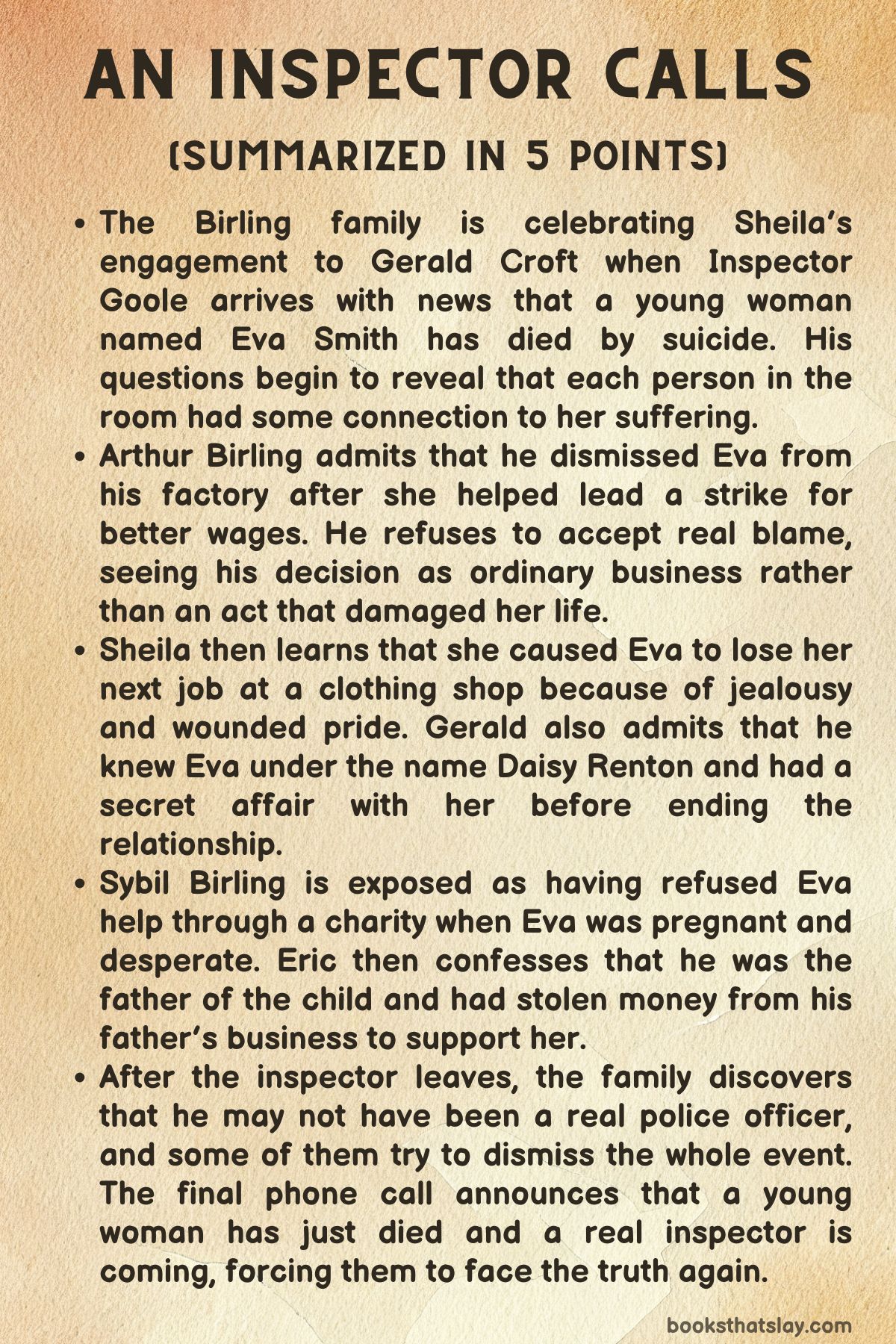
An Inspector Calls begins in the comfortable home of the Birling family, where a celebration is taking place. Arthur Birling, a wealthy factory owner, and his wife Sybil are hosting a dinner to mark the engagement of their daughter Sheila to Gerald Croft.
Gerald comes from a socially superior family, and his father owns a rival manufacturing business. Arthur is pleased with the match not only because Sheila seems happy, but also because it may bring the two business families closer together.
The mood at the dinner is confident and self-satisfied. Arthur speaks proudly about the future, insisting that business will prosper and that fears about war, labor unrest, and political change are exaggerated.
He believes strongly in individual success and sees no need for people to concern themselves too much with the lives of others. He advises Gerald and his son Eric that a man should look after himself and his family, not society as a whole.
His opinions reveal his dislike of socialism and his belief that wealth and status are signs of wisdom and authority.
The evening changes when Edna, the maid, announces the arrival of a police inspector. The visitor introduces himself as Inspector Goole and says he is investigating the death of a young woman named Eva Smith.
She has died by suicide after drinking disinfectant. The news shocks the family, though Arthur at first treats the matter as unfortunate but distant from them.
The inspector shows Arthur a photograph and asks if he recognizes her. Arthur admits that Eva once worked in his factory.
Arthur explains that Eva was one of his employees until he dismissed her. She had been part of a group of workers asking for a small wage increase.
When the workers went on strike, Arthur refused their demand. After the strike failed, most of the workers were allowed back, but Eva was not.
Arthur considered her a troublemaker and felt justified in firing her. He insists that he only acted as any businessman would.
Inspector Goole challenges this, suggesting that Arthur’s decision was the first step in a chain of harm that led to Eva’s death.
Sheila enters and soon learns that Eva was later employed at a clothing shop. The inspector shows Sheila the photograph, and Sheila reacts with distress because she recognizes the young woman.
She admits that she once visited the shop and tried on a dress that did not suit her. She believed Eva had smiled at her and felt mocked.
Already jealous of Eva’s beauty, Sheila complained to the manager and threatened not to return unless Eva was dismissed. Eva lost her job as a result.
Sheila is immediately ashamed and accepts that her behavior was cruel and petty. Unlike her father, she begins to understand that her actions had serious consequences.
The inspector then reveals that after losing her shop job, Eva changed her name to Daisy Renton. This name affects Gerald, and Sheila notices his reaction.
When they are briefly alone, she questions him. Gerald admits that he knew Daisy Renton and had a relationship with her during the previous summer, at the same time he had claimed to be busy with work.
Sheila realizes that he had been hiding an affair from her.
Under questioning, Gerald explains that he met Daisy at a bar. She seemed vulnerable and was being harassed by an older man.
Gerald helped her and arranged for her to stay in a friend’s empty rooms. Their connection turned into a romantic and sexual relationship that lasted for several months.
Gerald knew it could not last, and eventually he ended it. He insists that he treated Daisy kindly, and in some ways he did provide her with comfort and shelter.
Still, his story reveals that he used his position and privilege to enjoy her company while knowing she could never truly be part of his world. Sheila returns his engagement ring, saying that if they are ever to marry, they must begin again honestly.
The inspector next turns to Sybil Birling. Sybil is proud, cold, and certain of her own moral superiority.
She is involved with a women’s charity, and the inspector reveals that Eva, pregnant and desperate, came to the charity for help. Sybil at first denies recognizing her, but the inspector exposes her lie.
Eva had approached the charity under the name Mrs. Birling. Sybil took offense at this and judged her harshly.
She decided the young woman was impertinent and undeserving, then used her influence to have Eva’s request rejected.
Sybil refuses to accept blame. She argues that the father of Eva’s unborn child should have taken responsibility.
Through the inspector’s questions, she condemns this unknown man, saying he should be held accountable. As she speaks, Sheila begins to understand what her mother does not yet see: the father is likely Eric.
Sybil continues to insist that the man who abandoned Eva is guilty, unaware that she is condemning her own son. When Eric returns, the family’s attention shifts to him.
Eric confesses that he met Eva while drunk. He followed her home and forced himself into her life.
Their relationship continued for a short time, and she became pregnant. When she needed help, Eric stole money from his father’s business to give to her.
Eva eventually refused the money after realizing it had been stolen. Eric is devastated when he learns that his mother turned Eva away from the charity.
He blames Sybil for leaving Eva with nowhere to go and accuses her of helping cause the death.
Inspector Goole then gathers the family’s guilt into a single moral judgment. Arthur dismissed Eva from the factory because she asked for fairer wages.
Sheila caused her second dismissal out of jealousy and wounded pride. Gerald gave her temporary protection but abandoned her when the relationship no longer suited him.
Eric exploited her, left her pregnant, and stole money in a desperate attempt to help. Sybil refused her assistance when she was at her lowest point.
Each person, in a different way, treated Eva as less important than their comfort, pride, reputation, or pleasure.
Before leaving, the inspector delivers a warning. He says that people do not live alone and cannot act as if their choices affect only themselves.
There are many people like Eva Smith, people with little power who suffer because those above them refuse to care. If society does not learn responsibility and compassion, it will face suffering and conflict.
His words directly challenge Arthur’s earlier belief that everyone should look after only themselves.
After the inspector leaves, the family begins to divide. Sheila and Eric are shaken and accept the moral truth of what has happened.
They know their actions were wrong, regardless of legal consequences. Arthur and Sybil, however, are more worried about public scandal than about Eva.
Arthur fears that his reputation, business standing, and possible knighthood may be ruined. He tries to reduce the issue to whether Inspector Goole was a real police officer.
Gerald returns and says he has spoken to a police sergeant who does not know of any Inspector Goole. Arthur calls the police and confirms that no inspector by that name works there.
Gerald then suggests that the inspector may have shown each person a different photograph, meaning that their stories may not have involved the same woman. He calls the hospital and learns that no young woman has recently died there from drinking disinfectant.
Arthur and Sybil are relieved. They decide the family has been tricked and try to treat the night as an embarrassing false alarm.
Sheila and Eric refuse to accept this easy escape. They argue that the facts of their behavior remain unchanged.
Whether or not the inspector was official, whether or not the woman was the same in every story, each of them still acted selfishly or cruelly. Sheila sees that her parents want to erase the lesson because they have avoided exposure.
Eric also remains angry and ashamed, especially about his mother’s refusal to help Eva.
Just as Arthur and Sybil begin to relax, the telephone rings. Arthur answers and receives shocking news: a young woman has died by suicide after drinking disinfectant, and a police inspector is on his way to question the family.
The ending leaves the Birlings facing the possibility that the earlier interrogation was a warning, a test, or something stranger. More importantly, it shows that their guilt cannot be dismissed by technicalities.
An Inspector Calls ends by forcing the family, and the audience, to confront the cost of denying responsibility for others.
Characters
Inspector Goole
Inspector Goole is the moral center of the play, even though his true identity remains uncertain. He arrives at the Birling home as a police inspector, but his manner is unlike that of an ordinary officer.
He does not simply collect facts; he forces each person to face the human cost of their actions. He is calm, controlled, and relentless, and he questions the family in an order that reveals their guilt step by step.
His power comes from his knowledge and from the way he refuses to be intimidated by wealth, social position, or political influence. Arthur Birling tries to impress him with his connections, but Goole remains unmoved.
Sybil Birling tries to dismiss him as rude and improper, but he continues with his questions. Through him, the play challenges the idea that respectability is the same as goodness.
Goole also functions as a voice of social conscience. He believes that people are responsible for one another, especially when the powerful harm the vulnerable.
His final speech makes clear that Eva Smith’s death is not only a private tragedy but also a symbol of a wider social problem. His name suggests that he may be more than a normal inspector, since “Goole” sounds like “ghoul,” hinting at something ghostly or supernatural.
Whether he is a real policeman, a messenger, or a moral force, his role is to expose truth. In An Inspector Calls, he tears away the family’s comfortable illusions and leaves them with a lesson they cannot easily escape.
Arthur Birling
Arthur Birling is a wealthy manufacturer who represents capitalist confidence, social ambition, and moral blindness. At the start of the play, he is proud of his success and eager to display his opinions.
He believes in business, profit, and personal advancement. His speech to Eric and Gerald reveals his worldview clearly: a man should look after himself and his family, not worry about society as a whole.
This belief shapes his treatment of Eva Smith. When Eva and other workers ask for higher wages, Arthur refuses and later dismisses her because he sees her as a threat to his authority.
He does not view her as a struggling young woman but as a worker who challenged the smooth running of his business.
Arthur’s main weakness is his inability to understand responsibility beyond reputation. Even when he learns of Eva’s death, he does not truly consider her suffering.
He is more concerned about scandal, his public image, and the possibility of losing a knighthood. He repeatedly tries to use status as a shield, mentioning his connections and his role in local government.
His confidence also makes him look foolish because his predictions about the future are wrong. He dismisses the possibility of war, labor unrest, and disaster, showing how limited his understanding is.
By the end, when he thinks the inspector may have been false, Arthur quickly tries to avoid guilt. His character shows how wealth and power can make a person more interested in self-protection than moral truth.
Sybil Birling
Sybil Birling is Arthur’s wife and the coldest member of the family in many ways. She is proud, formal, and deeply conscious of class.
She sees herself as respectable and morally superior, but her behavior shows a lack of compassion. Her role in Eva Smith’s suffering comes through her work with a charity organization.
When Eva, pregnant and desperate, asks for help, Sybil refuses her. Her decision is not based on careful justice but on personal dislike and class prejudice.
She is offended because Eva uses the name Mrs. Birling, and this insult to her status matters more to her than the young woman’s need.
Sybil’s character exposes the cruelty that can hide behind charity when charity is controlled by pride and judgment. She believes she is doing good work, yet she uses her influence to deny help to someone with no protection.
Even when the inspector reveals that Eva was pregnant, Sybil does not soften. Instead, she insists that the father of the child should be blamed.
The tragic irony is that the father is her own son, Eric. Her refusal to see this until it is too late shows how little she understands her family.
Unlike Sheila and Eric, Sybil does not truly accept guilt. When it seems the inspector may not be real, she is relieved and ready to forget the whole matter.
Her character represents upper-class hypocrisy, especially the kind that appears respectable while refusing real human sympathy.
Sheila Birling
Sheila Birling begins the play as a young woman enjoying her engagement and the comforts of wealth. At first, she seems playful, sheltered, and somewhat childish.
However, she becomes one of the most important characters because she changes more than most of her family. Her connection to Eva Smith comes from a moment of jealousy and wounded pride.
In a clothing shop, Sheila thinks Eva has laughed at her while she is trying on a dress. Because Eva is pretty and Sheila feels insecure, she complains to the manager and causes Eva to lose her job.
This act shows that Sheila has been careless with the power her class gives her.
What makes Sheila different from her parents is her response to guilt. Once she understands what she has done, she is genuinely ashamed.
She does not try to excuse herself for long or hide behind respectability. She begins to see the inspector’s method clearly and warns the others that he already knows more than they realize.
Her intelligence and emotional honesty grow throughout the story. She also questions Gerald after learning about Daisy Renton and returns his ring, not out of simple anger but because she understands that their relationship has been built partly on concealment.
By the end of An Inspector Calls, Sheila represents the possibility of moral growth. She cannot undo her cruelty, but she can learn from it, and she refuses to pretend that guilt disappears just because public scandal may be avoided.
Eric Birling
Eric Birling is Arthur and Sybil’s son, and he is presented as restless, troubled, and emotionally unstable. From the beginning, there are hints that something is wrong with him.
He drinks too much, behaves awkwardly, and seems uncomfortable within his family. His parents do not fully understand him, and Sybil in particular refuses to acknowledge his drinking.
Eric’s role in Eva Smith’s tragedy is severe. He meets her while drunk, forces himself into her life, and later learns that she is pregnant.
His behavior is abusive and irresponsible, yet his reaction afterward is more complicated than simple villainy. He tries to give Eva money, but the money is stolen from his father’s business, which adds another layer of wrongdoing.
Eric’s character shows the damage caused by emotional neglect, privilege, and lack of moral guidance. He has grown up in a wealthy household, but he does not seem loved or understood.
His father treats him with impatience, and his mother refuses to see his flaws until they are exposed. Unlike Arthur and Sybil, Eric does feel guilt.
When he discovers that his mother refused Eva help, he is furious and horrified. He recognizes that the family’s actions helped destroy her.
Eric’s guilt does not erase his wrongdoing, but it gives him a level of moral awareness that his parents lack. Like Sheila, he belongs to the younger generation, and his shame suggests that change is possible if people are willing to face the truth.
Gerald Croft
Gerald Croft is Sheila’s fiancé and the son of a wealthy business rival of Arthur Birling. He is charming, polite, and socially confident, and his engagement to Sheila is important to both families because it may unite two powerful business interests.
Gerald’s conduct toward Eva Smith, whom he knows as Daisy Renton, is more complicated than the actions of some other characters. He meets her when she is vulnerable and helps her escape an unpleasant situation.
He gives her a place to stay and offers her comfort. However, his kindness is mixed with privilege and self-interest.
He begins an affair with her while knowing that the relationship has no real future.
Gerald is not as openly selfish as Arthur or as cold as Sybil, but he still benefits from an unequal social system. Daisy depends on him, while he remains free to leave when the affair becomes inconvenient.
He feels some tenderness for her, yet he also keeps the relationship hidden from Sheila and returns to his ordinary life afterward. When the possibility arises that the inspector may not be real, Gerald is quick to investigate and help dismantle the case.
This shows that, although he can admit certain facts, his moral change is limited. He is relieved by the chance to escape consequences.
Gerald represents a polished form of privilege: courteous, attractive, and sometimes kind, but still unwilling to fully challenge the system that protects him.
Eva Smith
Eva Smith is the absent character around whom the whole play is built. She never appears on stage, but her presence controls the entire action.
Through the inspector’s questioning, the audience learns about her suffering, her work, her loss of employment, her change of name, her relationship with Gerald, her pregnancy, and her final despair. She represents working-class women who have little protection in a society ruled by wealth, gender inequality, and class prejudice.
Her name is deliberately ordinary. “Smith” suggests that she stands for many people rather than only one individual.
Eva is not presented as weak in spirit. She asks for better wages, tries to find work, accepts help when she needs it, and refuses stolen money when she realizes where it came from.
These details suggest dignity and moral strength, even though her life becomes increasingly desperate. She is harmed by each member of the Birling household or their circle, but each person sees only one part of her story.
The inspector forces them to understand that separate acts of selfishness can combine into devastating consequences. Eva’s absence makes her even more powerful as a symbol.
In An Inspector Calls, she becomes the voice of those who are ignored, exploited, judged, and discarded by people who rarely have to answer for what they do.
Edna
Edna is the Birling family’s maid, and although she has a small role, her presence is important. She represents the working class within the Birling household itself.
While the family celebrates, drinks, and discusses marriage, business, and social advancement, Edna serves them quietly. She answers the door, announces visitors, and performs her duties without being included in the family’s world.
Her position reminds the reader that the comfort of the Birlings depends on the labor of people beneath them in the social hierarchy.
Edna does not have the dramatic influence of the inspector or the emotional development of Sheila and Eric, but she helps establish the class structure of the story. The family barely notices her as a person, which reflects the same social blindness that allows them to mistreat Eva Smith.
Edna’s limited speech also matters. She is present, but she is not given power in the household.
This silence reflects the way working-class voices are often pushed aside. Through Edna, the play quietly shows that Eva is not an isolated case.
There are other working people all around the wealthy characters, serving them and depending on their decisions, yet rarely being treated as equals.
Themes
Social Responsibility
The question of responsibility stands at the center of An Inspector Calls. Arthur Birling begins with a speech that celebrates self-interest.
He believes that each person should look after himself and his family, and he mocks the idea that people owe duties to wider society. Inspector Goole’s arrival challenges this belief completely.
Through Eva Smith’s story, the play shows that no action exists in isolation. Arthur’s decision to fire Eva, Sheila’s complaint, Gerald’s affair, Eric’s abuse, and Sybil’s refusal of charity may seem separate at first, but together they form a pattern of harm.
The play argues that people with power must think about how their choices affect those with less protection. Responsibility is not treated as a matter of law alone.
Some characters may avoid punishment, but that does not make them innocent. Sheila and Eric understand this more clearly than their parents.
They recognize that moral guilt remains even if the inspector’s identity is uncertain. The ending strengthens this idea by refusing to let the family escape easily.
The telephone call suggests that truth will return, and that responsibility denied once may have to be faced again.
Class and Power
Class shapes nearly every relationship in the story. The Birlings and Gerald Croft live with comfort, security, and influence, while Eva Smith struggles to survive through factory work, shop work, dependence, and charity.
The wealthy characters are able to make decisions that change Eva’s life without having to witness the full results. Arthur can dismiss her because she asks for higher wages.
Sheila can have her removed from a shop because she feels insulted. Sybil can deny her charity because she dislikes her manner.
These actions reveal how dangerous class power becomes when it is joined with vanity and prejudice. The upper-class characters often judge Eva without truly knowing her.
They see her as an employee, a shop assistant, a mistress, a charity case, or a problem, but rarely as a complete human being. Gerald’s treatment of Daisy Renton also shows class inequality in a more personal form.
He may be kind to her for a time, but the relationship exists on his terms. He can return to his privileged life; she cannot.
The play criticizes a society where respectability protects the powerful while the poor are left exposed to every consequence.
Guilt and Denial
Guilt divides the characters into two groups. Sheila and Eric feel the weight of what they have done and are changed by it.
Arthur and Sybil resist guilt because accepting it would damage their self-image. Gerald stands somewhere between these positions, since he admits his affair but is also relieved when the inspector’s authority is questioned.
This contrast gives the play much of its moral force. The issue is not only whether the characters did wrong, but whether they are willing to admit it.
Sheila’s guilt leads to self-knowledge. She understands that her jealousy was cruel and that her social power made that cruelty destructive.
Eric’s guilt is mixed with anger, especially when he learns that his mother refused to help Eva. Arthur and Sybil, however, treat guilt as something that matters only if it becomes public.
Once they think there may be no dead girl and no real inspector, they try to dismiss the evening as a trick. Their denial shows how easily people can protect themselves from moral truth when reputation matters more than conscience.
The final phone call destroys that comfort and suggests that guilt cannot be escaped by clever explanations.
Generational Conflict
The younger and older characters respond to the inspector in sharply different ways. Arthur and Sybil represent an older generation committed to class hierarchy, reputation, and self-protection.
They believe in authority when it supports them, but they resist it when it exposes them. Their first instinct is not to learn but to defend themselves.
Sheila and Eric, though flawed, are more open to change. They are horrified by their own actions and disturbed by their parents’ refusal to accept responsibility.
This conflict becomes especially clear after the inspector leaves. Arthur and Sybil are relieved by the possibility that they have been tricked, while Sheila and Eric insist that the moral truth remains.
The divide is not simply about age; it is about whether people are willing to change when confronted with suffering. Sheila becomes more perceptive as the story continues, often understanding the inspector’s purpose before the others do.
Eric, though guilty of serious wrongdoing, also recognizes the family’s cruelty. The younger generation offers some hope because they can still be shaken into awareness.
The older generation’s failure makes the play’s warning sharper: without moral change, society will repeat the same injustices.