An Indigenous Peoples’ History of the United States for Young People Summary and Analysis
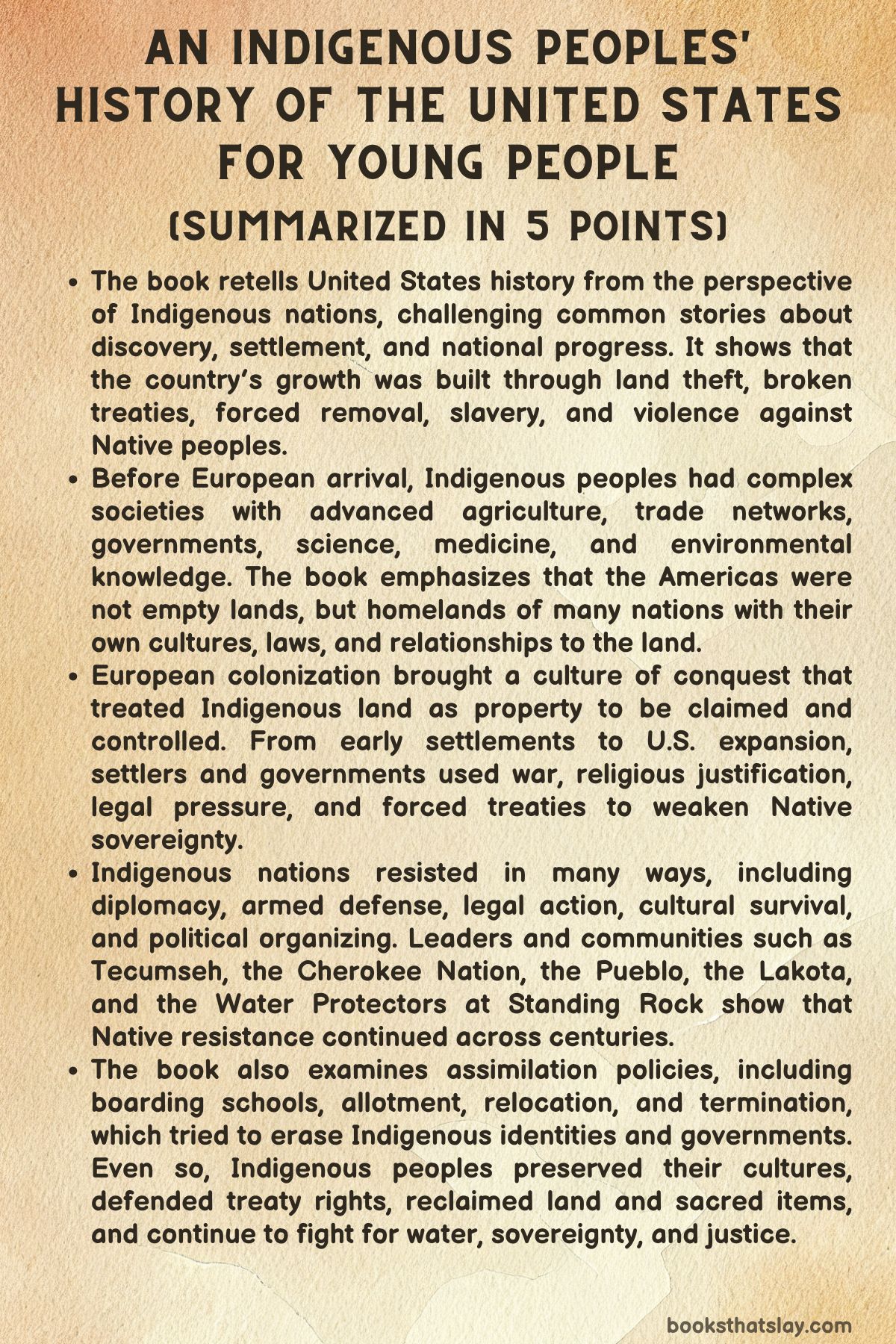
An Indigenous Peoples’ History of the United States for Young People by Roxanne Dunbar-Ortiz, adapted by Jean Mendoza and Debbie Reese, is a youth-focused account of United States history told from Indigenous perspectives. Rather than treating Native peoples as background figures in a national story of progress, the book places Indigenous nations, sovereignty, resistance, and survival at the center.
It challenges familiar stories about discovery, settlement, and expansion by showing how conquest, land theft, slavery, forced removal, broken treaties, and assimilation shaped the United States. At the same time, it emphasizes that Indigenous peoples were never passive victims; they built complex societies, defended homelands, and continue to fight for justice.
Summary
The book begins by challenging the origin story many Americans learn: that Europeans came to the Western Hemisphere seeking freedom, opportunity, and a better life. The book argues that this version hides the violence behind colonization.
European powers used the Doctrine of Discovery to claim lands already inhabited by Indigenous peoples, treating those lands as empty or available simply because Christians had “discovered” them. This belief became a legal and moral excuse for conquest, slavery, forced removal, and genocide.
The United States later presented itself as a nation of liberty and law, but from its earliest days it expanded through settler colonialism, pushing Indigenous nations from their homelands and weakening their sovereignty.
Before European arrival, Indigenous societies across the Americas were large, diverse, and highly developed. Millions of people lived in what is now the United States, while the broader Western Hemisphere held vast populations with advanced agriculture, trade routes, medicine, art, government, engineering, and environmental knowledge.
Corn, first cultivated in Mesoamerica, became central to many societies and supported dense communities. Civilizations such as the Maya and Aztecs built major cities, scientific systems, and agricultural networks.
In North America, communities such as the Hohokam, Akimel O’Odham, Cahokia, and the Haudenosaunee Confederacy created irrigation systems, political structures, trade connections, and laws of governance. Indigenous peoples shaped their environments through controlled burning, farming, hunting practices, and careful stewardship rather than exploiting land as a commodity.
The book then explains the European culture that shaped colonization. In medieval Europe, elites, monarchs, and the Catholic Church consolidated power, privatized common lands, and turned many poor people into soldiers or laborers.
The Crusades encouraged warfare in the name of religion while offering wealth, land, and status to fighters. Ideas about religious purity later helped form racial hierarchies and White supremacy.
England’s conquest of Ireland became a model for later colonization in North America: land seizure, cultural suppression, violence against civilians, and settlement by outsiders. These practices crossed the Atlantic with colonists who believed they had a divine and legal right to take Indigenous land.
European explorers and settlers did not enter an empty wilderness. They depended on Indigenous roads, agriculture, food stores, and local knowledge to survive.
Yet they viewed land as private property and saw Indigenous nations as obstacles. English colonies, especially those founded by Pilgrims and Puritans, carried religious ideas about covenant and chosen destiny.
These ideas later influenced American exceptionalism: the belief that the United States had a special mission and moral purpose. The book shows how this belief ignored Indigenous sovereignty and made conquest seem righteous.
Immigrants and settlers became part of this national covenant, even though the land had already belonged to Indigenous peoples.
As colonies grew, conflict intensified. Settlers and colonial governments used militias, rangers, scalp bounties, burned towns, destroyed crops, and spread disease.
The Powhatan Confederacy faced the Jamestown colony’s threats and attacks. The Pequot resisted English expansion, but colonists destroyed villages and massacred people at Mystic River.
The Cherokee, Shawnee, Delaware, Haudenosaunee, and many other nations confronted waves of violence, broken promises, and land hunger. Even Indigenous nations that tried neutrality or diplomacy were punished.
The book describes these conflicts not as isolated wars but as part of a long campaign to remove Native peoples and open land for settlement.
After the American Revolution, the United States claimed huge territories without the consent of the Indigenous nations who lived there. The Constitution placed relations with Indigenous nations under federal authority, but settlers and militias continued to invade Native lands.
In the Ohio Valley, Shawnee, Delaware, Miami, Wyandot, and other nations formed alliances to resist U.S. expansion. Leaders such as Tecumseh and Tenskwatawa tried to unite nations across a wide region, arguing that land belonged collectively to Indigenous peoples and could not be sold away by a few individuals.
The United States responded with military campaigns, town destruction, threats against civilians, and treaties that were quickly violated by settlers.
U.S. expansion continued under presidents such as Thomas Jefferson and Andrew Jackson. Jefferson’s Louisiana Purchase doubled the country’s claimed territory, although Indigenous nations were not part of the deal.
His policies encouraged debt, dependency, and land loss by pressuring Native peoples to adopt Euro-American farming and trade systems. Jackson’s military career rose through campaigns against the Muscogee and Seminole peoples.
After the Battle of Horseshoe Bend, the Muscogee were forced to give up millions of acres. As president, Jackson supported the Indian Removal Act of 1830, which led to the forced relocation of many Indigenous nations west of the Mississippi.
The Cherokee resisted through law and diplomacy, but the federal government ignored court protections and forced thousands on the deadly march known as the Trail of Tears.
The book also follows U.S. expansion into lands claimed by Spain and Mexico. Pueblo, Navajo, Apache, Ute, Comanche, Caddo, Miwok, and many other nations faced Spanish missions, military attacks, forced labor, and religious suppression.
Indigenous resistance was constant, including the Pueblo revolt led by Po’pay, which drove Spanish colonizers from Santa Fe for more than a decade. After Mexico gained independence from Spain, it became a refuge for some people fleeing U.S. control, but it also struggled to defend its northern territories.
Anglo-American settlers entered Texas, brought slavery, and eventually helped separate Texas from Mexico. The United States then fought Mexico, occupied Mexico City, and took half of Mexico’s territory through the Treaty of Guadalupe Hidalgo.
Indigenous nations again had no voice in these decisions.
During the Civil War era and after, the United States expanded settlement through laws that gave land, railroads, and colleges access to Indigenous territory. The Homestead Act, Pacific Railway Act, and Morrill Act helped settlers and corporations while weakening treaty obligations.
The Dakota, Cheyenne, Arapaho, Navajo, Apache, Modoc, Lakota, Nez Perce, and many other peoples faced military campaigns, massacres, imprisonment, and forced marches. The Sand Creek massacre, the Long Walk of the Navajo, the killing at Wounded Knee, and the seizure of the Black Hills show how the United States used both military force and law to take land.
The destruction of buffalo herds further attacked the survival of Plains nations. Even after treaties promised protected lands, gold seekers, settlers, and soldiers violated those promises.
By the late nineteenth century, most Indigenous peoples were confined to reservations, but the government continued to reduce their land base. The Dawes Act divided communal lands into individual parcels and sold so-called surplus land to non-Indigenous settlers.
This policy attacked collective landholding and caused massive land loss. At the same time, the United States pursued assimilation through missionary and boarding schools.
Indigenous children were taken from families, given English names, punished for speaking their languages, trained for low-wage labor, and taught that their cultures were inferior. These schools caused deep personal and community harm, including trauma that lasted for generations.
The book shows that U.S. colonialism did not stop at the continental West. In Hawai’i, Native people built democratic institutions and gained international recognition, but descendants of U.S. missionaries and business interests helped overthrow Queen Liliuokalani.
The United States annexed Hawai’i despite Native resistance. In Alaska, Native peoples endured Russian and then U.S. control, resource extraction, segregation, and exclusion.
Organizations such as the Alaska Native Brotherhood and Alaska Native Sisterhood fought for voting rights and civil rights, becoming important Indigenous-led movements.
Indigenous sovereignty persisted through legal action, organizing, and activism. The Indian Citizenship Act extended citizenship, but citizenship did not erase Native nationhood.
The Indian Reorganization Act ended allotment and recognized some aspects of tribal self-government, though later federal policies tried to terminate tribal recognition and move Indigenous people into cities. In the twentieth century, groups such as the National Congress of American Indians, the National Indian Youth Council, and the American Indian Movement fought for treaty rights, fishing rights, land return, and self-determination.
Actions at Alcatraz, the Trail of Broken Treaties, and Wounded Knee brought national attention to broken promises and federal abuse.
Later reforms strengthened Native rights in important ways. The Indian Self-Determination and Education Assistance Act gave tribal governments more control over federal funds and programs.
The Indian Child Welfare Act helped keep Indigenous children connected to Native families and nations. Legal battles also supported fishing rights, land claims, repatriation of remains and sacred items, and tribal authority in certain criminal cases.
Some nations regained lands or received compensation, though the Sioux refused money for the Black Hills because they want the land itself returned.
The final part connects this history to the twenty-first century. Indigenous lands remain targeted for mining, drilling, pipelines, and energy projects.
The fight against the Dakota Access Pipeline at Standing Rock shows that the same forces of land seizure and resource extraction continue. Water Protectors from many nations gathered to defend water, burial sites, treaty rights, and the land.
They faced police violence, surveillance, arrests, and state power, but they also used social media, community organizing, and broad alliances to challenge corporate and government narratives.
Overall, An Indigenous Peoples’ History of the United States for Young People retells U.S. history as a story of Indigenous survival, resistance, and sovereignty in the face of colonization. It argues that the United States was built through the taking of Native lands, but it also insists that Indigenous peoples are still here, still organized, and still defending their nations, cultures, waters, and futures.
Key Figures
Indigenous Peoples
Indigenous peoples are the central presence in An Indigenous Peoples’ History of the United States for Young People, not as a single group with one identity, but as many distinct nations with their own governments, languages, lands, economies, and spiritual systems. The book presents them as creators of complex societies long before European arrival, showing their agricultural skill, scientific knowledge, trade networks, and environmental care.
They are also shown as political actors who negotiate, resist, adapt, and defend their homelands across centuries. Their role in the book is not limited to suffering under colonization; they are the force that challenges the false idea that Native peoples disappeared.
Through their continued resistance, legal action, cultural survival, and activism, the book portrays Indigenous peoples as enduring nations whose histories are inseparable from the history of the United States.
Christopher Columbus
Christopher Columbus appears as a symbol of the violent beginnings of European colonization in the Americas. Rather than being presented as a heroic explorer, he is shown as someone driven by gold, status, and royal approval.
His arrival in the Caribbean begins a pattern that later European powers would repeat: claiming land, enslaving Indigenous people, using religion and empire to justify violence, and treating Native lives as obstacles to wealth. Columbus’s importance in the book lies less in his individual personality and more in what he represents.
He becomes an early example of how celebrated national myths often hide brutality. His actions expose the gap between the familiar story of “discovery” and the reality of invasion.
The Arawak People
The Arawak people are among the first Indigenous peoples shown facing European conquest directly. Their treatment by Columbus and his men reveals the destructive logic of colonization from the beginning.
They are not portrayed as nameless victims, but as people whose lives, communities, and freedom were attacked by Europeans seeking profit. Their enslavement and resistance help the reader understand that colonial violence was not accidental or limited to later American expansion.
It began with the earliest European arrivals. The Arawak people’s role in the book is especially important because their experience challenges the innocent language often used around exploration.
Their story shows that the so-called New World was already home to people with their own societies and rights.
The Maya
The Maya are presented as one of the great civilizations of the Western Hemisphere. Their society was built around agriculture, especially corn, and they developed advanced knowledge in science, mathematics, religion, art, and political organization.
The book does not romanticize them as perfect; it also notes social hierarchy, forced labor, and political conflict. This balanced portrayal gives the Maya depth as a civilization rather than turning them into a simple symbol.
Their importance lies in proving that the Americas were not undeveloped or empty before European arrival. They represent intellectual achievement, agricultural innovation, and cultural power, while their internal struggles also show that Indigenous societies had complex histories of their own before colonization.
The Aztecs
The Aztecs are shown as a powerful civilization with major agricultural, political, and trade systems. Their hydraulic farming and long-distance trade networks reveal a society with impressive planning and organization.
At the same time, the book places their fall in the context of Spanish conquest and regional rivalries, showing how conquistadors used existing conflicts to expand their own power. The Aztecs matter in the book because their defeat demonstrates how European conquest often depended not only on weapons, but also on manipulation, alliance-building, and extreme violence.
Their presence also challenges the idea that Indigenous nations lacked statecraft or large-scale systems before Europeans arrived.
The Hohokam and Akimel O’Odham
The Hohokam and Akimel O’Odham represent Indigenous ingenuity in difficult environments. Their agricultural systems in arid lands show a deep understanding of water, soil, and long-term survival.
The Akimel O’Odham’s irrigation systems, in particular, reveal engineering ability and community organization. These peoples are important because they challenge stereotypes that portray Native communities as primitive or passive users of land.
In the book, they stand for the intelligence and discipline required to live sustainably in challenging landscapes. Their history also shows continuity, since later Indigenous communities inherited, adapted, and preserved knowledge from earlier societies.
The Haudenosaunee Confederacy
The Haudenosaunee Confederacy is one of the clearest examples of Indigenous political sophistication in the book. Its Great Law of Peace, its continuing existence, and the influence it had on parts of U.S. political thought make it central to the book’s argument.
The Confederacy is shown as a model of governance that valued diplomacy, law, and collective decision-making. Women’s political authority within Haudenosaunee society is especially significant because it challenges European assumptions about gender and power.
The Haudenosaunee also appear as a nation forced to respond to colonial wars and American suspicion. Their portrayal shows both political strength and the heavy cost of being surrounded by expanding settler power.
The Powhatan Confederacy
The Powhatan Confederacy appears as one of the first major Indigenous powers to confront English settlement. Its leader, Wahunsonacock, initially engages with the Jamestown colonists through diplomacy, but the settlers’ demands, threats, and violence soon make conflict unavoidable.
The Powhatan people recognize that the English are not simply needy newcomers but a growing danger to their land and food systems. Their resistance is portrayed as defensive and rational, not as aggression without cause.
In the book, the Powhatan Confederacy shows how early colonial survival depended on Indigenous resources, even while colonists worked to dominate the very people who had made their survival possible.
Wahunsonacock
Wahunsonacock is presented as a leader facing an impossible colonial situation. As head of the Powhatan Confederacy, he must weigh diplomacy, protection of his people, and the threat posed by English settlers.
His interactions with John Smith reveal the imbalance between Indigenous efforts to manage relations and settler willingness to use hunger, weapons, and intimidation. Wahunsonacock’s role in the book highlights Indigenous leadership under pressure.
He is not treated as a background figure in Jamestown’s story; instead, he is a political leader defending a homeland against people who misunderstand generosity as weakness and negotiation as an opening for control.
John Smith
John Smith represents the aggressive face of English settlement at Jamestown. In the book, he is not the romantic adventurer often found in older colonial stories.
He is associated with threats against the Powhatan Confederacy when the colonists’ poor planning and hunger place them in danger. His role shows how settlers depended on Indigenous food and knowledge but still acted with entitlement and force.
Smith’s importance is that he exposes the contradiction at the center of early colonization: settlers were vulnerable and unprepared, yet they claimed authority over people whose societies were far more established in the land.
George Percy
George Percy is portrayed through the violence of English colonial warfare. His actions against Powhatan towns, crops, and families show how quickly settlement turned into organized terror.
He represents a style of conquest that targeted food systems and civilians, not only warriors. In the book, Percy matters because he demonstrates that colonial violence was not simply the result of misunderstanding.
It was a deliberate method used to weaken Indigenous resistance and clear land for English control. His presence helps the reader see that early colonial warfare laid the foundation for later U.S. military and settler practices.
The Pequot
The Pequot are shown as a nation that resisted English expansion after suffering from disease and colonial pressure. Their conflict with the Plymouth and Connecticut colonies leads to one of the book’s stark examples of settler violence: the burning of a Pequot fort filled with women, children, and elders.
The Pequot are important because their experience reveals how colonial war often aimed at destruction rather than limited victory. The book presents them as a people defending themselves against invasion and punishment.
Their survival through refuge and continuation also resists the idea that massacres fully erased Indigenous nations.
The Cherokee Nation
The Cherokee Nation is one of the most important Indigenous nations in An Indigenous Peoples’ History of the United States for Young People because its history shows diplomacy, resistance, adaptation, betrayal, and survival. The Cherokee face attacks from colonial militias, treaty violations, pressure from settlers, and later forced removal under U.S. law.
They develop constitutional government and take legal action to defend their sovereignty, but the federal government refuses to honor its own legal principles when land is at stake. The Cherokee experience shows that assimilation or legal argument did not protect Indigenous nations from removal.
Their forced march west, remembered as part of the Trail of Tears, becomes one of the clearest examples of how U.S. expansion sacrificed Native lives for settler land hunger.
The Shawnee
The Shawnee are portrayed as persistent defenders of their lands in the Ohio Valley and beyond. They resist settlers who ignore boundaries and treaties, and they become central to larger Indigenous alliances against U.S. expansion.
The Shawnee show how Indigenous resistance was often organized, strategic, and based on a clear understanding of settler goals. Their role is especially important because they challenge the idea that U.S. expansion was inevitable or uncontested.
Through their alliances and military action, the Shawnee reveal that Indigenous nations actively fought for political independence and territorial survival.
Tecumseh
Tecumseh is one of the most powerful leaders in the book. He argues that Indigenous land belongs collectively to Native peoples and cannot be sold away by isolated leaders under pressure.
His vision is broad, extending across many nations and regions. He understands that only unity can resist U.S. expansion, and his alliance-building shows political imagination and urgency.
Tecumseh’s death weakens the movement he helped build, but his role remains significant because he represents one of the strongest Indigenous challenges to the United States in its early expansionist period. He is portrayed as a leader of principle, strategy, and deep commitment to sovereignty.
Tenskwatawa
Tenskwatawa, Tecumseh’s brother, contributes spiritual and political energy to the Indigenous alliance movement. His leadership at Prophet’s Town reflects the importance of cultural renewal in resisting colonial pressure.
He is not merely a religious figure; his role shows how spiritual life, political identity, and land defense were closely connected. The attack on Prophet’s Town demonstrates how threatening Indigenous unity was to U.S. officials.
Tenskwatawa’s presence in the book helps show that resistance was not only military. It also involved rebuilding confidence, restoring traditions, and rejecting dependence on settler systems.
Little Turtle
Little Turtle, or Mshekinnoqquah, is presented as one of the leaders of the Indigenous alliance in the Ohio Valley. His military leadership shows that Native nations were capable of defeating U.S. forces through strategy, knowledge of land, and alliance warfare.
His role challenges any assumption that the early United States easily overpowered Indigenous resistance. Little Turtle represents the skill and determination of Native leaders who understood both the dangers of U.S. expansion and the need for coordinated defense.
His presence also shows how the United States responded to Indigenous success with harsher campaigns against towns, food sources, and civilians.
Blue Jacket
Blue Jacket, or Weyapiersenwah, stands alongside other leaders resisting U.S. control in the Ohio Valley. His role emphasizes collective leadership among Indigenous nations rather than one-person heroism.
He is part of a broader political and military response to invasion, and his presence shows that resistance grew from shared concerns across nations. Blue Jacket’s importance lies in his contribution to organized opposition against settlement and military pressure.
Through him, the book shows that Indigenous alliances were not spontaneous reactions but serious attempts to defend land, autonomy, and future generations.
The Delaware
The Delaware are especially significant because the book presents many of them as seeking neutrality and peace, including those connected to the Moravian church. Their experience at Gnadenhütten, where colonial militia murdered men, women, and children, shows that neutrality did not protect Indigenous people from settler violence.
The Delaware reveal the cruelty of a colonial system that often treated all Native people as enemies, regardless of their choices. Their role in the book is morally important because it exposes the lie that violence against Indigenous communities was always a response to warfare.
Often, it was simply punishment, fear, and land hunger.
Thomas Jefferson
Thomas Jefferson is presented as a key architect of U.S. expansion. Although often remembered for liberty and democracy, in this book he is associated with policies that pressured Indigenous nations into debt, dependence, and land loss.
The Louisiana Purchase becomes a major example of his disregard for Indigenous sovereignty, since the land was bought and claimed without the consent of the nations who lived there. Jefferson’s approach shows how polite language and policy could serve the same goals as open warfare.
His role is important because he represents the intellectual and governmental side of settler colonialism: expansion framed as progress while Native land rights are ignored.
Andrew Jackson
Andrew Jackson is one of the book’s clearest examples of violent expansionist power. His military campaigns against the Muscogee and his role in the Battle of Horseshoe Bend show his willingness to use extreme force against Indigenous peoples.
As president, his support for the Indian Removal Act leads to the forced relocation of many Native nations. Jackson’s character in the book is defined by ambition, brutality, and contempt for Indigenous sovereignty.
He also shows how U.S. democracy for settlers often grew alongside the destruction of Native rights. His defiance of legal protections for the Cherokee makes him a symbol of federal power used against justice.
The Muscogee Creek Confederacy
The Muscogee Creek Confederacy is portrayed as a nation divided by the pressures of U.S. expansion. Internal conflict grows between those who cooperate with U.S. agents and those who defend traditional ways and resist land loss.
This division is not treated as weakness, but as the result of intense outside pressure, manipulation, and survival choices. The Muscogee experience shows how colonization could fracture Indigenous communities by rewarding collaboration and punishing resistance.
Their forced cession of millions of acres after Jackson’s campaign reveals how military defeat was turned into massive land theft. The nation’s role in the book shows the human and political cost of colonial divide-and-rule tactics.
The Red Sticks
The Red Sticks represent Muscogee traditionalists who resist U.S. influence and the loss of their homelands. Their fight against the Lower Creeks and later against Andrew Jackson’s forces reflects a larger struggle over survival, culture, and sovereignty.
They are portrayed as defenders of independence rather than rebels without cause. Their defeat at Horseshoe Bend is devastating, not only because of the number killed, but because it leads to enormous land seizure.
The Red Sticks’ role in the book shows how Indigenous resistance was often punished so severely that entire nations were forced into new political realities.
The Seminole Nation
The Seminole Nation is portrayed as a community of resistance, refuge, and survival. Made up in part of Indigenous refugees and Africans escaping slavery, the Seminoles challenge both U.S. expansion and the slave system.
Their resistance in Florida is especially important because they never sign a treaty giving up their sovereignty in the way the United States demanded. The Seminoles represent the possibility of alliance between Native peoples and Black freedom seekers, which made them especially threatening to U.S. authorities.
Their role in the book shows that resistance to colonization and resistance to slavery were often connected.
Black Hawk
Black Hawk is presented as a Sauk leader who tries to reclaim his people’s homeland in present-day Illinois. His struggle shows the desperation and determination of Indigenous nations pushed onto reservations and denied access to ancestral land.
His resistance is brief but significant, revealing that forced relocation did not end Native attachment to homeland. Black Hawk’s role in the book is to show that even after treaties, removals, and military pressure, Indigenous leaders continued to challenge dispossession.
His story also reflects the growing imbalance between Native nations and the expanding settler state.
Po’pay
Po’pay is one of the most important figures of Indigenous resistance in the Southwest. As a religious leader, he helps unite Pueblo, Navajo, Apache, and Ute peoples against Spanish rule.
His leadership in the revolt that drives the Spanish from Santa Fe shows the power of coordinated resistance rooted in spiritual and cultural survival. Po’pay’s role is important because he proves that colonization was not a one-way process of European victory.
Indigenous peoples could and did defeat colonial powers, even if those victories were later challenged. He represents the connection between religion, identity, land, and freedom.
Junipero Serra
Junipero Serra is portrayed not as a saintly missionary, but as a figure tied to coercion, forced conversion, and labor in California’s mission system. His missions are shown as institutions that controlled Indigenous bodies, restricted freedom, and disrupted traditional life.
Serra’s role in the book challenges celebratory narratives about missions as places of education or faith. Instead, he represents the religious face of colonial domination.
Through him, the book shows how Christianity was often used to justify captivity, cultural destruction, and forced labor while presenting these actions as salvation.
Father Miguel Hidalgo
Father Miguel Hidalgo appears in the context of Mexico’s independence movement and is shown as a priest deeply connected with Indigenous communities. His role is different from that of many European religious figures because he helps lead a revolt against Spanish colonial power.
Hidalgo represents the possibility of anti-colonial struggle within a society shaped by empire. His presence also shows that Indigenous peoples were active supporters of independence movements across Latin America.
In the book, he helps connect North American Indigenous history to wider resistance against European rule in the Americas.
Abraham Lincoln
Abraham Lincoln is portrayed in a more complicated way than the usual image of the Great Emancipator. The book acknowledges his role during the Civil War era but also shows that he signed laws that supported westward settlement, railroads, and land-grant institutions at Indigenous expense.
His decision to approve the execution of 38 Dakota men, even after reducing the original number, remains the largest mass execution in U.S. history. Lincoln’s role shows that opposition to slavery did not necessarily mean justice for Indigenous nations.
He represents how U.S. leaders could advance freedom in one context while continuing colonial violence in another.
The Dakota
The Dakota are portrayed as a nation betrayed by broken treaty obligations and pushed into crisis by U.S. land seizure and neglect. Their revolt is shown as a response to hunger, dispossession, and government failure rather than simple violence.
The mass sentencing of Dakota men and the execution approved under Lincoln reveal how the United States punished Indigenous resistance with legal and military force. The Dakota’s role in the book shows the deadly consequences of treaty violations and the way Native desperation was criminalized by the same government that created the conditions for conflict.
The Cheyenne and Arapaho
The Cheyenne and Arapaho are central to the book’s account of massacre and broken trust. At Sand Creek, people seeking safety are attacked, killed, and mutilated by volunteer forces.
Their experience shows the extreme violence that could be carried out by civilians acting with military approval or tolerance. The Cheyenne and Arapaho also appear in later conflicts connected to the Plains wars and resistance to U.S. expansion.
Their role in the book demonstrates how Indigenous nations were punished whether they fought, negotiated, or sought protection. Their survival after such violence also reinforces the book’s larger argument that Native peoples endured despite repeated attempts to destroy them.
The Navajo
The Navajo are shown as a people who suffer forced removal and military assault but eventually negotiate a return to their homeland. Their forced march and imprisonment reveal the cruelty of U.S. policies that tried to separate Indigenous nations from the lands that sustained their identity and survival.
Their eventual return is significant because it shows that Indigenous resistance did not always end in permanent exile. The Navajo’s role in the book emphasizes the centrality of homeland.
Land is not treated as property alone, but as the basis of culture, memory, community, and sovereignty.
Goyathlay
Goyathlay, also known as Geronimo, is presented as an Apache leader whose long resistance challenges U.S. military power. His ability to evade capture for years shows strategic intelligence, courage, and deep commitment to Apache freedom.
His eventual surrender is described as validating Apache sovereignty, which gives his story political meaning beyond military conflict. Goyathlay’s role in the book is to show that Indigenous leaders continued to defend autonomy even when surrounded by expanding U.S. control.
He also represents how Native resistance was often turned into legend while the political reasons behind it were ignored.
Kintpuash
Kintpuash, also known as Captain Jack, is portrayed as a Modoc leader trying to return with his people to their California homeland after being placed in an unsuitable reservation with traditional enemies. His resistance against U.S. forces shows both desperation and determination.
The killing of a U.S. general during talks brings national attention, but the larger issue is the Modoc people’s right to live safely on their own land. Kintpuash’s execution reveals the harsh punishment given to Indigenous leaders who challenged federal authority.
His role in the book shows how reservation policy often ignored Native histories, rivalries, and needs.
Crazy Horse
Crazy Horse appears as a major Lakota leader associated with resistance to U.S. invasion of the Black Hills and the Plains. His role at Little Bighorn shows Indigenous military strength at a moment when the United States was violating treaty lands for gold.
Crazy Horse represents defense of sacred land and refusal to accept U.S. control. The book uses his leadership to show that Native victories were possible, even if the United States later responded with greater force.
He stands for courage, strategic resistance, and commitment to protecting land from settlers, soldiers, and gold seekers.
Sitting Bull
Sitting Bull is portrayed as a Lakota leader connected both to armed resistance and spiritual survival. His involvement in the events around Little Bighorn and later association with the Ghost Dance movement show how U.S. authorities viewed Indigenous leadership as a threat even when resistance was religious and nonviolent.
His killing while under house arrest reveals the fear the government had of Native unity and ceremony. Sitting Bull’s role in the book is powerful because he represents the refusal to surrender identity, land, and spiritual practice to U.S. control.
Big Foot
Big Foot is presented in connection with the massacre at Wounded Knee, one of the most devastating events in the book. He is shown not as a military threat, but as a leader trying to surrender and protect his people amid rising fear and repression.
His killing, along with nearly all of his followers, shows the brutality of U.S. military action against vulnerable Indigenous communities. Big Foot’s role is important because Wounded Knee becomes a symbol of the violence used to crush Native religious movements, political freedom, and physical survival at the end of the nineteenth century.
Sun Elk
Sun Elk appears through his experience at the Carlisle Indian Industrial School. His account helps readers understand the personal harm caused by boarding schools.
Through him, assimilation is not an abstract policy but a lived experience involving forced cultural change, racist teaching, discipline, and emotional damage. Sun Elk’s role in An Indigenous Peoples’ History of the United States for Young People is to give human shape to the boarding school system.
He represents generations of Indigenous children who were separated from families and trained to reject their own languages, appearances, and traditions.
Queen Liliuokalani
Queen Liliuokalani is portrayed as the leader of Hawai’i during a period of U.S.-backed political betrayal. Her overthrow shows how American expansion was not limited to the mainland and how Indigenous sovereignty was attacked in the Pacific as well.
She represents lawful leadership, Native independence, and nonviolent resistance against business interests, settler descendants, and military pressure. Her role in the book broadens the meaning of Indigenous history by including the Kanaka Maoli and showing that U.S. empire targeted many Indigenous peoples beyond the continental United States.
John Collier
John Collier is presented as a federal official who supported reforms during the New Deal era. As Commissioner of Indian Affairs, he worked with Indigenous communities to pass the Indian Reorganization Act, which ended allotment and recognized aspects of tribal sovereignty.
His role is important because he shows that federal policy was not always identical across time; there were moments of partial reform. At the same time, Collier is not presented as the savior of Indigenous peoples.
His importance lies in how his policies created space for Native self-government, even though later administrations tried to reverse those gains.
Belva Cottier
Belva Cottier is an important activist figure connected to the reclaiming of Alcatraz Island. Her recognition that abandoned federal land should return to Indigenous hands under treaty principles shows legal insight and political courage.
She helps transform a symbolic claim into a larger movement that attracts national attention. Her role in the book shows how Indigenous activism in the twentieth century combined treaty knowledge, public protest, and intertribal unity.
Cottier represents a shift from survival under federal control to direct public demands for land, recognition, and justice.
The American Indian Movement
The American Indian Movement functions almost like a collective character in the book. Formed in response to over-policing and injustice in urban Indigenous communities, it becomes a force for national protest and political pressure.
AIM’s role at the Trail of Broken Treaties and Wounded Knee shows anger at federal neglect, broken agreements, and abusive tribal and government authorities. The movement is portrayed as bold, confrontational, and controversial, but also necessary in a period when Indigenous rights were often ignored.
AIM represents the urgency of modern Native resistance and the refusal to remain invisible.
LaDonna Brave Bull Allard
LaDonna Brave Bull Allard is presented as a key figure in the Standing Rock resistance. By creating the Sacred Stone Camp, she helps bring together Water Protectors from many Indigenous nations and beyond.
Her leadership is rooted in defense of water, burial sites, treaty rights, and future generations. She represents the continuation of Indigenous stewardship into the twenty-first century.
Her role shows that Native resistance is not only historical; it remains active wherever land, water, and sovereignty are threatened by corporate and government power.
Water Protectors
The Water Protectors are a collective character representing modern Indigenous resistance. They gather at Standing Rock to oppose the Dakota Access Pipeline and defend water, sacred sites, and treaty rights.
Their use of nonviolent action, media documentation, intertribal unity, and community organization shows the evolution of resistance in the modern era. They face militarized police, surveillance, arrests, and violence, yet their movement gains national and international attention.
The Water Protectors connect the book’s long history of land defense to present struggles, showing that Indigenous sovereignty is not only a matter of the past but an ongoing demand.
Themes
Settler Colonialism and the Taking of Land
The book presents U.S. history as a long process of settler colonialism, meaning that colonizers did not only seek trade or temporary control; they came to stay, claim land, and replace Indigenous societies with their own settlements. This theme explains why treaties were broken so often and why violence continued even after wars seemed to end.
Land was the central issue. European monarchs, colonial companies, settlers, and later the U.S. government treated Indigenous homelands as property to be claimed, bought, divided, or seized.
The Doctrine of Discovery gave religious and legal cover to this theft, while later policies used treaties, debt, military campaigns, removal, allotment, and reservation systems to produce the same result. The book shows that expansion was not a peaceful movement of pioneers into empty space.
It was a planned and repeated assault on Native sovereignty. By showing how land theft shaped the United States from early colonies to pipelines and energy projects, An Indigenous Peoples’ History of the United States for Young People asks readers to question national stories that celebrate growth without naming its cost.
Indigenous Sovereignty and Resistance
Indigenous nations in the book are not portrayed as defeated peoples waiting for history to happen to them. They govern, negotiate, fight, adapt, sue, organize, pray, teach, and protect their lands.
Sovereignty is one of the strongest themes because the book repeatedly shows that Native nations had and still have political authority of their own. This authority existed before European arrival and did not disappear simply because colonizers refused to respect it.
Leaders such as Tecumseh, Po’pay, Sitting Bull, Belva Cottier, and LaDonna Brave Bull Allard represent different forms of resistance, but they are connected by a shared insistence that Indigenous peoples have the right to exist as nations. Resistance takes many forms: armed defense, treaty-making, legal challenges, occupations, fishing rights protests, cultural survival, and environmental activism.
The book’s treatment of resistance is important because it rejects the idea that Indigenous history is only a record of loss. Even when Native nations face removal, massacre, boarding schools, and termination policies, they continue to assert identity and authority.
Survival itself becomes political.
The Power and Danger of National Myths
The book repeatedly challenges the stories the United States tells about itself. Ideas such as discovery, Manifest Destiny, the frontier, the nation of immigrants, and American exceptionalism are shown as myths that make conquest appear moral or natural.
These myths matter because they shape how people understand the past and excuse injustice in the present. If the land is imagined as empty wilderness, then Indigenous nations disappear from the story.
If settlers are imagined only as brave pioneers, then the violence used to clear land is hidden. If the United States is presented as uniquely committed to liberty, then its treatment of Indigenous peoples becomes easier to ignore.
The book shows that language plays a major role in this process. Words like settlement, progress, civilization, and removal can soften the reality of invasion, land theft, and forced migration.
By questioning these myths, the book asks readers to see history from the viewpoint of those who were pushed aside by the official story. This theme is especially important for young readers because it teaches that history is not only about facts, but also about who gets to frame them.
Cultural Survival, Assimilation, and Memory
Assimilation appears throughout the book as one of the most damaging tools used against Indigenous peoples. When direct warfare became less acceptable or less useful, the United States turned to policies meant to weaken Native identity from within.
Boarding schools forced children to abandon their languages, names, clothing, families, and traditions. Allotment attacked communal landholding.
Relocation policies pushed Native people into cities, often into poverty and isolation. Termination policies tried to erase tribal recognition altogether.
These efforts show that colonization targeted not only land but also memory, culture, and belonging. Yet the book also shows that cultural survival continued.
Indigenous peoples preserved languages, ceremonies, political traditions, family ties, and land-based responsibilities despite intense pressure. The return of remains and sacred objects, the defense of fishing rights, the revival of Native studies, and the Standing Rock movement all show memory becoming a form of resistance.
This theme reveals that culture is not decorative or secondary. For Indigenous nations, culture carries law, history, identity, and responsibility to future generations.