Anna In The Tropics Summary, Characters and Themes
Anna In The Tropics is a Pulitzer Prize-winning play by Nilo Cruz set in a Cuban-American cigar factory in Tampa, Florida, where tradition, desire, literature, and change collide. The story centers on a family-run factory that hires a lector to read aloud to workers as they roll cigars by hand.
When the lector begins reading Anna Karenina, the novel’s themes of love, betrayal, jealousy, and social pressure begin to echo through the workers’ lives. The play is about how art can awaken people, unsettle old habits, and expose emotions that have been hidden too long.
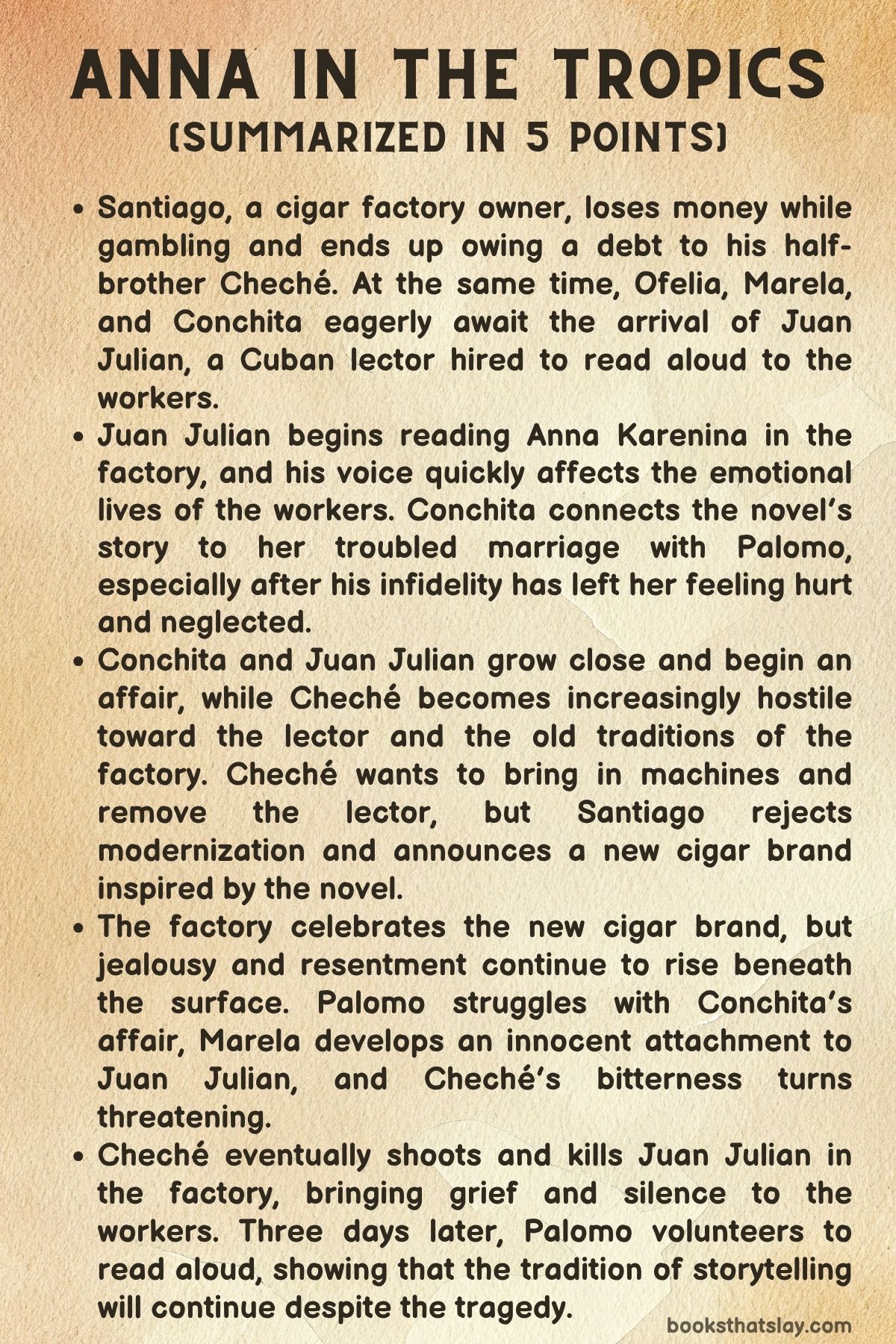
Summary
Anna In The Tropics begins in the world of gambling, cigar smoke, and old Cuban customs. Santiago, the owner of a cigar factory, is at a cockfight with his half-brother Cheché.
Santiago is reckless, drinking and betting more than he can afford, while Cheché is more cautious and resentful. Santiago keeps losing money and borrows from Cheché, promising repayment with the kind of loose confidence that comes from pride and liquor.
Cheché, however, takes the promise seriously and wants proof. Santiago eventually offers him a share of the factory if he cannot repay the debt, even signing the bottom of Cheché’s shoe as a makeshift contract.
At the same time, Santiago’s wife, Ofelia, and their daughters, Marela and Conchita, wait eagerly at the harbor for a ship from Cuba. They are not waiting for a relative or a businessman, but for a lector: Juan Julian Rios.
In their factory tradition, a lector reads literature aloud while cigar workers roll tobacco. Ofelia has secretly taken money from the factory safe to pay for his travel because she believes he is gifted and worth the expense.
The women are excited by his arrival before they even meet him. Marela, especially, turns the event into something almost magical.
She has written Juan Julian’s name on paper and placed it in water with brown sugar and cinnamon, hoping to influence fate. Conchita warns her that such rituals can be dangerous, but Marela’s longing is innocent and intense.
When Juan Julian arrives, he immediately makes an impression. He recognizes Ofelia by the gardenia in her hat, showing a refined, observant nature.
Marela is so overcome that she embarrasses herself, but the moment also shows how powerful his arrival feels to her. He is not just a hired reader; to the women, he represents beauty, imagination, Cuba, romance, and a link to a vanishing way of life.
At the factory, Cheché greets Juan Julian coldly and tries to turn him away, saying that no one is hiring. Ofelia corrects him and makes it clear that she hired the lector herself.
Cheché’s hostility is not only business-related. His wife, Mildred, left him for a lector, and Juan Julian’s presence reminds him of that humiliation.
For Cheché, lectors are not symbols of culture or tradition. They are men who stir emotion, awaken dissatisfaction, and take women away from their husbands.
The workers soon hear Juan Julian read from Tolstoy’s Anna Karenina. His voice and manner captivate Ofelia, Marela, and Conchita.
The reading gives the workers access to a larger emotional world, and the women respond deeply to it. Ofelia defends the lector tradition, explaining that even workers who may not read or write can carry great literature inside them because they have heard it spoken aloud.
For her, the lector is proof that labor and art can share the same room.
The novel begins to affect Conchita most strongly. She sees in Anna Karenina a woman trapped by marriage, convention, and longing.
Conchita’s own marriage to Palomo is troubled because he has been unfaithful. When Palomo tries to discuss the book with her, the conversation turns personal.
Conchita confronts him about his secret lover and refuses to remain quietly wounded. The novel gives her language for her own pain and desire.
Palomo senses this and says the book will ruin them, but the truth is that the book only reveals what is already wrong.
Santiago and Ofelia also face their problems. At home, they argue through Marela at first, forcing their daughter into the role of messenger.
Once Marela leaves in frustration, husband and wife speak more honestly. Santiago admits that he drinks too much and has behaved foolishly.
He explains that gambling losses hurt him not only because of money, but because they make him feel stripped of dignity. He fears he has also lost Ofelia.
She reassures him that she is still beside him, and their marriage, though strained, shows warmth and endurance.
Meanwhile, Conchita and Juan Julian grow closer. They talk about literature, memory, listening, childhood, and rituals.
Juan Julian explains that he became a listener when his family had to hide at home because of his father’s debts; during that time, his mother read aloud to them. Conchita tells him about the custom of cutting and burying women’s hair for the feast of Saint Candelaria.
Their conversation has a playful, intimate rhythm, and Juan Julian offers to bury her hair for her. The offer becomes a sign of attention that Conchita does not receive from Palomo.
Their attraction turns into a kiss, and then into an affair.
The affair gives Conchita a sense of renewal, but it also increases the emotional pressure inside the factory. At the start of the second half of the story, Conchita and Juan Julian are together physically in the factory.
Their secrecy is interrupted by Cheché arguing with Ofelia. Cheché has brought in a cigar-rolling machine and wants the factory to modernize.
He argues that other companies are moving ahead because they use machines. Ofelia rejects this, and Marela supports her.
For Ofelia and her daughters, hand-rolled cigars and the lector are part of the soul of the factory.
Cheché attacks the old customs and complains that he does not want his wages supporting a man who reads romantic novels. Juan Julian defends the tradition, arguing that modern methods threaten not just jobs but the entire meaning of cigar-making.
Santiago returns and settles the matter. He pays Cheché what he owes and announces that they will not fire Juan Julian or bring in machines.
Instead, the factory will create a new cigar brand named Anna Karenina. The decision is a victory for tradition, art, and the workers’ emotional investment in the story.
Cheché grows more bitter. He speaks of Mildred leaving him and says that the daily reading reminds him of his loss.
He hates the lector because Juan Julian seems to embody everything that wounded him. When Marela appears dressed as Anna Karenina to serve as the model for the new cigar label, her beauty draws admiration.
After others leave, Cheché is alone with her. His behavior becomes threatening and sexual.
He speaks to her in a disturbing way and tries to touch and kiss her. Marela rejects him forcefully and flees, shaken and furious.
Palomo soon learns about Conchita’s affair with Juan Julian. Instead of responding only with rage, he becomes obsessed with the details.
He asks Conchita what happened between them, and she answers with blunt honesty. Her openness wounds him, but it also draws him back toward her.
He asks her to show him how Juan Julian touched her. Their damaged marriage shifts into a strange attempt at reconnection, as Palomo tries to reclaim intimacy through the very affair that has humiliated him.
The workers later gather to celebrate the new cigar brand. The mood is festive but tense.
Ofelia is excited, Santiago is proud, and Marela appears in her Anna Karenina costume. The cigars are sampled, and Santiago suggests firing gunshots in celebration.
Palomo, however, is full of jealousy. He watches Conchita and Juan Julian and accuses her of looking at the lector throughout the night.
His words become cruel and violent, showing that his jealousy has not been healed.
After the party begins to break apart, Marela and Juan Julian speak privately. Marela confesses her feelings in a shy, poetic way, telling him she wants to preserve memories of him.
Juan Julian responds tenderly but does not exploit her affection. He kisses her face goodnight with kindness rather than desire.
After he leaves, Cheché emerges from the shadows and grabs Marela as she reads from Juan Julian’s copy of Anna Karenina. The scene suggests danger and deepens the sense that Cheché’s resentment has turned destructive.
The next morning, the factory resumes work. The workers wonder where Cheché is.
Marela arrives in a distressed state, wearing a long coat, clearly affected by what has happened. Juan Julian begins reading while everyone rolls cigars.
Then Cheché appears with a gun. In front of the workers, he shoots Juan Julian twice, killing him.
The act is the result of many forces inside Cheché: jealousy, shame, fear of change, hatred of lectors, anger over his wife’s betrayal, and rage at the emotional freedom Juan Julian seemed to bring others.
Three days later, the factory is quiet. The absence of Juan Julian is felt as a heavy silence.
Ofelia says they are listeners and asks for someone to read. Santiago mourns Juan Julian, saying he died too young.
Marela wants his spirit to know that he is welcome in the factory. The workers cannot return to life exactly as it was, but they also cannot abandon the tradition that gave meaning to their work.
In the end, Palomo volunteers to read. This is a significant act.
The husband who once blamed the book for his marital troubles now takes up the lector’s role. His reading suggests that literature will continue in the factory, even after violence has tried to silence it.
The final moment does not erase grief, betrayal, or loss, but it shows that the workers choose memory, voice, and art over silence. Anna In The Tropics closes with the sense that stories can disturb people, but they can also help them survive.
Characters
Santiago
Santiago is the owner of the cigar factory and one of the most flawed yet human figures in Anna In The Tropics. He is proud, impulsive, affectionate, irresponsible, and deeply tied to a sense of masculine dignity.
His gambling problem exposes his weakness early in the play, as he loses money at the cockfight and then borrows from Cheché with careless confidence. Santiago’s recklessness is not presented as simple foolishness; it comes from a wounded need to feel powerful in a world where money, business, and change threaten his authority.
When he loses, he feels that more than money has been taken from him. His dignity feels damaged.
This makes him a man who often acts badly but is still capable of self-awareness. His conversation with Ofelia shows that he knows he has failed as a husband and factory owner, and his honesty gives him emotional depth.
Santiago also represents loyalty to tradition. By rejecting Cheché’s machines and keeping Juan Julian as lector, he defends the old cigar-making culture.
His decision to create the Anna Karenina cigar brand shows that he can still be imaginative, proud, and generous when he is not ruled by drink or gambling.
Ofelia
Ofelia is the emotional and moral center of the family. She is practical, sharp-tongued, affectionate, and fiercely protective of the cigar factory’s traditions.
Her decision to take money from the safe to pay for Juan Julian’s journey shows both her boldness and her belief in culture. She understands that the lector is not a decorative luxury but part of the factory’s identity.
Ofelia values literature because it gives dignity to workers whose lives might otherwise be reduced to physical labor. She defends the lector tradition with conviction, making it clear that people who work with their hands can still carry great books, language, and ideas within them.
In her marriage, Ofelia is wounded by Santiago’s gambling and drinking, but she is not passive. She argues, mocks, scolds, forgives, and stands her ground.
Her strength comes from emotional intelligence rather than cold authority. She knows Santiago’s weaknesses but also sees his capacity for remorse.
Ofelia’s love is not blind; it is patient, realistic, and rooted in long endurance. She also serves as a counterforce to Cheché, refusing his attempt to use Santiago’s debt as a weapon against the family and the factory.
Marela
Marela is the most innocent and romantic character in the story. She responds to Juan Julian’s arrival with wonder, almost as if he belongs to a dream she has been waiting to enter.
Her use of sugar, cinnamon, water, and written names shows her belief in ritual, magic, and emotional possibility. Marela is not childish in a shallow way; rather, she lives with an open imagination that makes beauty feel urgent to her.
She sees Juan Julian as elegant, refined, and almost sacred because he brings literature into the factory. Her fascination with him is different from Conchita’s mature desire.
Marela’s love is idealized, tender, and full of longing. When she dresses as Anna Karenina for the cigar label, she becomes a symbol of the factory’s new artistic identity, but also of female beauty being watched, admired, and threatened.
Cheché’s disturbing behavior toward her marks a harsh collision between her innocence and his bitterness. After Juan Julian’s death, Marela’s grief is especially powerful because he represented imagination, gentleness, and hope to her.
In Anna In The Tropics, Marela shows how literature can awaken longing before a person fully understands the dangers around it.
Conchita
Conchita is one of the most emotionally complex characters in the play. She begins as a woman trapped in a marriage damaged by Palomo’s infidelity.
She is not naïve about betrayal, but she has been living with hurt that has not been fully spoken. Juan Julian’s reading of Anna Karenina gives her a way to understand her own dissatisfaction.
Through the novel being read in the factory, Conchita recognizes that desire, loneliness, and rebellion are not private weaknesses; they are human experiences that many women have faced. Her affair with Juan Julian is therefore not only an act of passion but also an act of self-recovery.
She wants to feel wanted, heard, and alive again. What makes Conchita especially interesting is her honesty.
When Palomo discovers the affair, she does not hide behind excuses. She speaks with startling directness, forcing him to face the consequences of his own betrayal.
Yet Conchita is not simply trying to punish him. Her affair, painful as it is, creates a strange path back toward intimacy in her marriage.
She becomes stronger because she stops accepting silence as the price of being a wife.
Juan Julian Rios
Juan Julian Rios is the lector whose arrival changes the emotional life of the factory. He is cultured, observant, sensual, and deeply respectful of literature.
His role is not limited to reading words aloud; he becomes a catalyst for hidden desires, resentments, and truths. Juan Julian’s voice gives Tolstoy’s novel a living presence among the workers, and his belief in literature makes him seem almost priestlike in the factory.
He understands reading as an intimate act, something that can alter the listener’s inner world. His own past explains this quality.
As a child, he learned the power of listening when his family hid from creditors and his mother read aloud to them. That memory shapes him into a man who values attention, patience, and emotional presence.
His relationship with Conchita grows from this ability to listen, and she is drawn to him because he offers the tenderness and recognition Palomo has failed to give her. Juan Julian is not without fault, since his affair with a married woman helps intensify conflict, but he is never portrayed as cruel.
His death shows how threatening art and desire can seem to those who fear change.
Cheché
Cheché is the darkest and most resentful figure in the play. He is shaped by humiliation, jealousy, and a deep fear of being replaced.
His hatred of lectors comes from personal injury: his wife, Mildred, left him for one. Because of this, Juan Julian’s arrival feels to Cheché like the return of an old wound.
He does not see the lector as a cultural figure or a worker in the factory; he sees him as a symbol of seduction, betrayal, and male defeat. Cheché also represents industrial modernity.
His desire to bring machines into the factory is partly practical, but it is also emotional. Machines would silence the lector, weaken the old traditions, and give Cheché a sense of control.
His conflict with Ofelia, Santiago, and Juan Julian is therefore about more than business. It is about what kind of world the factory will become.
Cheché’s behavior toward Marela reveals the ugliness beneath his grievance. He turns his pain into domination and threat.
By killing Juan Julian, he attempts to destroy the person who represents everything he hates: beauty, literature, desire, tradition, and the power to move women emotionally.
Palomo
Palomo is Conchita’s husband, and his character is built around guilt, jealousy, pride, and frustrated love. Before Conchita begins her affair, Palomo has already betrayed her, but he seems unprepared to face the emotional damage he has caused.
He is comfortable with his own secrecy until Conchita’s desire exposes the imbalance in their marriage. When he learns about her relationship with Juan Julian, he becomes jealous and wounded, yet his reaction is more complicated than simple anger.
He wants to know the details, even the painful ones, because he is trying to understand what Conchita found with another man that she did not find with him. His request that she show him how Juan Julian touched her is unsettling, but it also reveals his desperation to regain closeness.
Palomo’s final decision to read aloud after Juan Julian’s death is meaningful. He moves from blaming literature for his problems to taking up the lector’s role himself.
This does not make him heroic, but it suggests growth. He begins to understand that stories do not destroy marriages; they reveal what people have tried to hide.
Eliades
Eliades has a smaller role, but he helps establish the world of risk, performance, and masculine competition that surrounds Santiago and Cheché. As the operator of the cockfights, he belongs to a setting where men test luck, pride, and nerve through gambling.
His presence at the beginning of the play helps reveal Santiago’s recklessness and Cheché’s caution. Eliades does not need a large emotional arc because his function is mainly social and atmospheric.
He represents the public world outside the factory where money is lost, debts are formed, and male pride is exposed. Through him, the play shows how Santiago’s private family troubles are connected to habits and pressures beyond the home.
The cockfight setting also mirrors later conflicts: competition, wounded pride, and violence are present from the start, long before the final tragedy occurs.
Mildred
Mildred does not appear directly in the main action, but her absence strongly shapes Cheché’s character. She is important because she represents the betrayal Cheché cannot move beyond.
By leaving him for a lector, she turns the figure of the reader into an object of hatred in his mind. Cheché’s views on literature, women, and tradition are all distorted by what happened with Mildred.
He treats her departure not as the failure of one marriage but as proof that stories and lectors corrupt women. Because Mildred is absent, the reader mainly understands her through Cheché’s bitterness, which makes her more of a haunting presence than a fully developed person.
Still, her role matters greatly. Without Mildred’s abandonment, Cheché’s hostility toward Juan Julian would not carry the same personal intensity.
She is the unseen wound behind much of the play’s violence.
Themes
Literature as an Awakening Force
In Anna In The Tropics, literature does not remain safely separate from ordinary life. The reading of Anna Karenina enters the cigar factory and changes the way the workers understand themselves, their marriages, their desires, and their disappointments.
Juan Julian’s voice gives the novel an almost physical presence in the workplace. The workers are not simply entertained; they begin to measure their own lives against the emotions and conflicts of the story being read to them.
Conchita recognizes her loneliness through Anna’s suffering and desire. Marela’s imagination expands around the beauty and romance of the reading.
Palomo feels threatened because the play gives language to feelings that were easier to ignore when they remained unspoken. Cheché’s hatred of the lector also comes from his belief that stories give women dangerous ideas.
The play presents literature as powerful because it wakes people up. It can comfort, inspire, disturb, and expose.
It does not create every conflict in the factory, but it brings buried conflicts into the open. That is why Juan Julian’s role is so important.
He reads, but the act of reading becomes a force that changes the emotional weather of the entire workplace.
Tradition Against Modernization
The cigar factory stands at a crossroads between handcraft and machinery. Ofelia, Santiago, Marela, Conchita, and Juan Julian value the old ways because they see cigar-making as more than production.
The hand-rolled cigar carries memory, culture, rhythm, and dignity. The lector’s presence belongs to that same tradition, turning the workplace into a space where labor and literature exist together.
Cheché, on the other hand, argues for machines and modernization. His argument has practical force because other companies are changing, and the factory faces economic pressure.
Yet his desire for machines is not purely practical. He wants to remove the lector, silence the stories, and replace the emotional life of the factory with mechanical control.
This makes the conflict between tradition and modernization deeply personal. The play does not deny that modern methods can be efficient, but it asks what is lost when efficiency becomes the only value.
The factory’s old customs give workers a shared identity and a sense of beauty inside repetitive labor. The rejection of machines is therefore not merely resistance to progress.
It is a defense of human presence, artistic memory, and cultural pride.
Desire, Marriage, and Betrayal
Desire in the play is never simple. It can renew people, wound them, expose them, and push them toward dangerous choices.
Conchita’s affair with Juan Julian grows from a marriage already damaged by Palomo’s infidelity. Her betrayal of Palomo cannot be separated from his betrayal of her.
Through Conchita, the story shows how a person who has been emotionally neglected may seek recognition elsewhere. Juan Julian gives her attention, gentleness, and a sense of being fully seen.
This does not make the affair painless or harmless, but it explains why it matters to her. Palomo’s reaction is also complicated.
He is jealous and humiliated, yet he is drawn toward the very truth that hurts him. He wants to know what happened because he senses that Conchita’s affair reveals something missing in their marriage.
Santiago and Ofelia offer a different picture of marriage. Their relationship has been strained by gambling and disappointment, but they still possess loyalty and the ability to speak honestly.
Across these relationships, the play treats love as a living bond that must be tended. When ignored, it turns into resentment, secrecy, or longing.
Jealousy, Masculinity, and Violence
Jealousy in the story is closely tied to wounded masculinity. Santiago gambles partly because losing money makes him feel that his dignity has been attacked.
Palomo’s jealousy grows when Conchita’s affair forces him to face his own failure as a husband. Cheché’s jealousy is the most destructive because it has hardened into hatred.
After Mildred leaves him for a lector, he interprets women’s desire as betrayal and literature as a threat. He cannot accept that another man might possess emotional power that he lacks.
Juan Julian’s refinement, voice, and influence over the women make Cheché feel small, and instead of confronting his grief honestly, he turns it outward. His aggression toward Marela shows how easily wounded pride can become a desire to control or punish.
His murder of Juan Julian is the final expression of this broken masculinity. Violence becomes his way of silencing what he cannot understand or possess.
The play presents this violence not as sudden madness but as the result of bitterness, humiliation, and fear left unchecked. Cheché’s tragedy is that he mistakes destruction for power.