Anna Karenina Summary, Characters and Themes
Anna Karenina by Leo Tolstoy is a major work of Russian realism about love, marriage, family, social judgment, and the search for moral purpose. Set among Russian aristocrats and landowners, the novel follows Anna’s forbidden relationship with Count Vronsky alongside Konstantin Levin’s quieter struggle to build a meaningful life through work, marriage, and faith.
Tolstoy contrasts city society’s elegance and hypocrisy with rural labor, domestic responsibility, and spiritual doubt. The book is not only about romance or scandal; it is also about how people justify their choices, suffer their consequences, and search for truth in a world shaped by class, law, religion, and reputation.
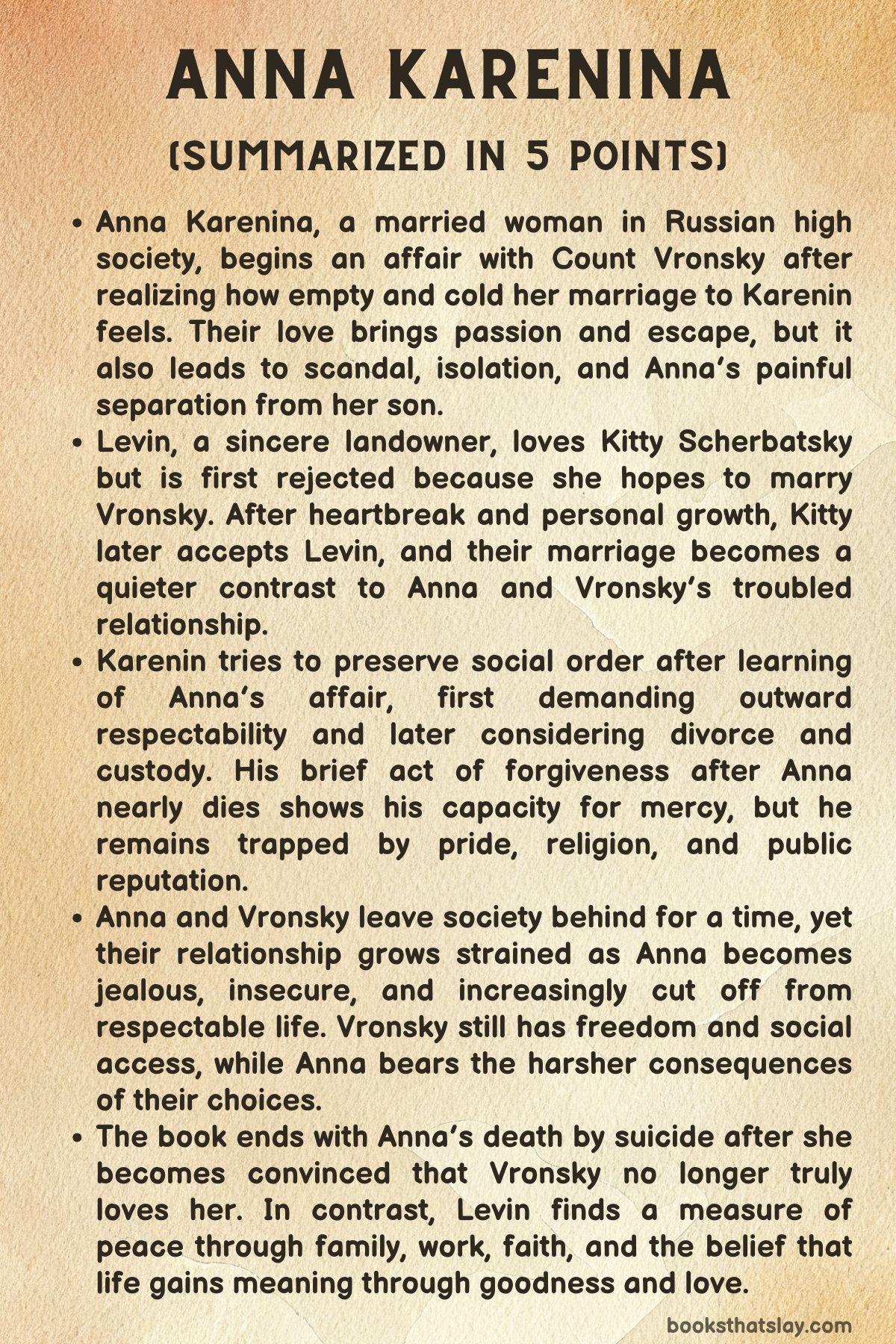
Summary
Anna Karenina begins in Moscow with disorder inside the Oblonsky household. Stiva Oblonsky has been unfaithful to his wife, Dolly, with a governess, and Dolly is devastated.
Their home has become tense and disorganized, but Stiva, charming and careless, hopes the problem will pass if his sister Anna comes from St. Petersburg and helps restore peace. Anna arrives with warmth, intelligence, and social grace, and she succeeds in softening Dolly’s anger, though she does not deny the pain Stiva has caused.
At the same time, Konstantin Levin comes to Moscow from his country estate to propose to Kitty Scherbatsky, Dolly’s younger sister. Levin is sincere, awkward, and deeply attached to rural life.
He has loved Kitty for a long time, but she refuses him because she expects a proposal from Count Vronsky, a handsome young officer. Vronsky enjoys Kitty’s admiration but has no serious intention of marrying her.
When Anna meets Vronsky at the railway station, he is immediately drawn to her. A railway worker dies in an accident there, and Anna takes the event as a dark omen.
At a grand ball, Kitty expects Vronsky to mark her as his future wife. Instead, he is captivated by Anna.
Their attraction is obvious, and Kitty is humiliated. Anna, alarmed by her own feelings, leaves for St. Petersburg, but Vronsky follows her.
Back home, Anna tries to return to her ordinary life with her husband, Alexei Karenin, and her beloved son, Serezha. Yet her marriage now feels cold and artificial.
Karenin is dutiful and respectable, but emotionally rigid. Anna becomes increasingly involved in the social circle where Vronsky appears, and their attachment grows.
Vronsky openly pursues Anna, and she eventually gives in to their passion. Their affair brings her joy, fear, guilt, and a sense of doom.
Karenin notices the scandal forming around them and warns Anna to preserve outward respectability. She resents him for caring more about reputation than feeling.
After Vronsky is injured in a horse race, Anna openly breaks down in public, and Karenin understands the truth. In the carriage afterward, she confesses that she is Vronsky’s mistress and cannot bear her husband.
Karenin first considers revenge, divorce, and custody of Serezha. Under Russian law and social custom, divorce would expose Anna and likely separate her from her son.
Anna is pregnant by Vronsky and feels trapped between love, shame, motherhood, and dependence. When she gives birth to Vronsky’s daughter and nearly dies, Karenin experiences a religious and emotional transformation.
He forgives Anna and Vronsky at her bedside. Vronsky, crushed by Karenin’s moral superiority and fearing Anna’s death, attempts suicide but survives.
Anna also survives, and the situation becomes even more difficult. Karenin’s forgiveness leaves Anna bound to a husband she no longer loves.
Eventually, Anna and Vronsky leave together for Europe, while Serezha remains with Karenin.
Parallel to Anna’s story, Levin returns to his estate after Kitty refuses him. He struggles with humiliation, loneliness, farming problems, his relations with peasants, and questions about how to live honestly.
Unlike Stiva and many aristocrats, Levin wants work to have moral value. He tries to reform his estate, understand peasant labor, and write about agriculture and Russian life.
Yet his theories often fail in practice. His sick brother Nikolai, who lives in poverty and anger, also forces Levin to confront mortality and the limits of intellectual solutions.
Kitty, meanwhile, falls ill after Vronsky abandons her hopes. Her family takes her abroad to recover.
At a German spa, she meets Varenka, a calm and selfless young woman who serves others. Kitty tries to imitate this spiritual charity, but gradually realizes that goodness cannot be performed for admiration.
She returns to Russia more mature and less self-centered. Later, when Levin and Kitty meet again at a dinner hosted by Stiva and Dolly, they understand each other without bitterness.
Through a simple game of written initials, they communicate their feelings, and Levin proposes again. This time Kitty accepts.
Levin and Kitty marry after a brief engagement. Their wedding is joyful, but marriage is not the ideal state Levin imagined.
They quarrel, misunderstand each other, and adjust to domestic life. When Levin learns that Nikolai is dying, Kitty insists on accompanying him.
Levin is ashamed to expose her to illness and poverty, but Kitty proves far stronger than he is. She nurses Nikolai with practical kindness, while Levin is overwhelmed by fear and helplessness.
Nikolai dies, and soon afterward Levin learns Kitty is pregnant. Death and new life stand side by side, deepening Levin’s spiritual unease.
Anna and Vronsky return to Russia after a period in Italy. In Europe, Vronsky becomes restless and tries painting, while Anna enjoys temporary freedom but suffers from separation from Serezha.
Back in St. Petersburg, Anna secretly visits her son on his birthday. Their reunion is tender but brief, and Karenin’s household, now influenced by the religious Countess Lydia Ivanovna, blocks Anna from seeing him again.
Anna’s legal and social position worsens. Without divorce, she cannot marry Vronsky; without marriage, she remains excluded from respectable society.
Vronsky can still move among men, attend public events, and pursue ambitions, but Anna is increasingly isolated.
At Vronsky’s country estate, Anna appears outwardly elegant and successful, but inwardly she becomes anxious and dependent on Vronsky’s love. Dolly visits her and sees both luxury and sadness.
Vronsky asks Dolly to persuade Anna to seek a divorce, partly so their children can be legitimate. Anna resists because divorce would likely mean finally losing Serezha.
She also fears that motherhood, age, and social disgrace will make Vronsky stop loving her. She uses charm, beauty, reading, and social skill to fill her life, but her insecurity grows.
Levin and Kitty, now expecting their child, spend time in Moscow. Levin meets Anna through Stiva and is deeply impressed by her beauty, intelligence, and directness.
Kitty becomes jealous, sensing Anna’s power over men, and Levin promises not to visit Anna again. Anna notices that she can still win admiration from someone like Levin, but this only makes her more aware that she is losing influence over Vronsky.
Her relationship with Vronsky becomes marked by suspicion, jealousy, and repeated quarrels.
Kitty gives birth to a son, and Levin experiences terror, prayer, gratitude, and wonder. The birth awakens a religious feeling in him, though his doubts do not disappear.
Meanwhile, Stiva tries to secure both a profitable government post for himself and a divorce for Anna. Karenin, now guided by Lydia and a spiritual adviser, refuses the divorce.
This refusal leaves Anna and Vronsky with no clear future.
Anna’s mental state declines rapidly. She believes Vronsky no longer loves her, resents his freedom, and imagines that his mother wants him to marry someone else.
Their arguments become more painful. After receiving news that divorce is unlikely, Anna becomes convinced that she is unwanted and trapped.
She sends Vronsky messages, visits Dolly, sees Kitty, and moves through Moscow in a state of agitation and despair. At the railway station, she remembers the worker’s death from the beginning of the novel and decides to end her life.
She throws herself under a train.
After Anna’s death, Vronsky is broken. He goes to fight as a volunteer in the Balkans, hoping for death.
His mother blames Anna for ruining him. Karenin takes custody of Anna and Vronsky’s daughter.
Stiva remains largely unchanged, still social and self-interested.
The novel closes with Levin, not Anna. Levin continues to wrestle with faith, reason, death, and goodness.
Philosophy fails to satisfy him, but a simple remark from a peasant about living for God helps him understand that moral truth is not reached by argument alone. He realizes that love and goodness have guided his life even when he could not explain them.
He remains flawed, irritable, and uncertain, but he gains a new sense that life can have meaning through faith, family, work, and service. Anna Karenina ends not with perfect answers, but with Levin’s quiet acceptance that he can live better even without solving every question.
Characters
Anna Arkadyevna Karenina
Anna is the emotional center of Anna Karenina, a woman whose intelligence, beauty, warmth, and social grace make her instantly memorable to nearly everyone who meets her. In the book, she first appears as a stabilizing force in Dolly’s troubled marriage, showing sympathy, tact, and emotional insight.
Yet the same sensitivity that helps her understand others also makes her painfully aware of the emptiness in her own marriage. Anna is not simply reckless or selfish; she is a woman trapped between social law, emotional hunger, motherhood, and personal dignity.
Her love for Vronsky gives her a sense of life and passion that her marriage to Karenin never offered, but it also separates her from her son, damages her social position, and leaves her dependent on Vronsky’s devotion. As the story progresses, her confidence gives way to jealousy, fear, and isolation.
She becomes increasingly aware that society punishes her far more severely than it punishes men who behave in similar ways. Her tragedy lies in the fact that she wants love to be absolute, but she lives in a world where love is controlled by law, reputation, gender, and power.
Konstantin Dmitrich Levin
Levin is one of the most searching and morally serious figures in the novel. He is awkward in society, deeply uncomfortable with artificial manners, and far more at home in the countryside than in drawing rooms or government circles.
His love for Kitty is sincere and idealistic, but when she rejects him, he turns back to his estate and tries to give his life meaning through work, farming, and ethical responsibility. Levin’s struggle is not only romantic; it is spiritual and philosophical.
He wants to understand how a person should live, how landowners should relate to peasants, whether social reform is meaningful, and whether faith can survive doubt. Unlike characters who accept social conventions without much reflection, Levin questions almost everything.
His marriage to Kitty teaches him that domestic happiness is real but imperfect. His brother Nikolai’s death forces him to confront mortality, while the birth of his son awakens religious feeling in him.
By the end of the book, Levin does not become flawless or fully certain, but he reaches a quieter understanding: goodness does not always come from reasoned theory, and a meaningful life can be built through love, duty, humility, and faith.
Alexei Kirillovich Vronsky
Vronsky begins as a charming, wealthy, and admired officer whose life is shaped by pleasure, status, and masculine freedom. He enjoys Kitty’s admiration without understanding the damage his careless attention causes her.
When he meets Anna, however, his casual approach to love changes into a serious passion. He gives up military advancement, accepts social risk, and builds his life around her, but his devotion has limits he does not fully understand.
Vronsky can sacrifice career opportunities, but he cannot experience the same social exile Anna faces. He continues to move through male spaces with relative freedom, while Anna becomes more confined and judged.
This unequal burden gradually strains their relationship. Vronsky wants practical solutions: divorce, legitimacy for their children, and a settled life.
Anna wants emotional certainty, complete loyalty, and reassurance that he has not grown tired of her. His tragedy is different from Anna’s: he is not destroyed by society in the same direct way, but he is left spiritually emptied by the consequences of their love.
After Anna’s death, his former confidence is gone, and he seeks danger in war because ordinary life has lost meaning for him.
Alexei Alexandrovich Karenin
Karenin is Anna’s husband, a high-ranking government official whose life is governed by duty, procedure, reputation, and self-control. He is not a melodramatic villain, but his emotional coldness makes him unable to meet Anna’s needs.
He treats marriage as an institution to be preserved rather than a living relationship requiring tenderness and honesty. When he learns of Anna’s affair, his first concerns are public scandal, legal position, and moral order.
Yet he is more complex than a merely rigid husband. At Anna’s sickbed, he experiences a genuine moment of forgiveness, releasing his anger toward both Anna and Vronsky.
This moment shows that he is capable of spiritual feeling, but he cannot sustain it freely in society. After Anna survives, his forgiveness becomes a new burden, and he falls under the influence of Countess Lydia Ivanovna.
Karenin’s weakness is his inability to act from emotional truth without turning that truth into doctrine, reputation, or self-protective righteousness. He suffers deeply, but he often converts suffering into moral superiority.
His character reveals how respectability can hide fear, loneliness, pride, and emotional failure.
Ekaterina Alexandrovna Shcherbatskaya
Kitty begins the story as a young woman shaped by romantic expectation and social ambition. She believes Vronsky’s attention means marriage, and she refuses Levin because she imagines a more glittering future with the officer.
Her disappointment after Vronsky turns toward Anna is humiliating, but it becomes the beginning of her moral growth. At the German spa, Kitty tries to remake herself through selfless service and religious feeling, but she learns that goodness cannot be copied as a social pose.
When she returns, she is less naïve and better able to understand both herself and Levin. As Levin’s wife, Kitty proves practical, compassionate, and emotionally intelligent.
Her care for Nikolai during his final illness shows a strength Levin lacks; where he is paralyzed by fear and philosophical distress, she acts with tenderness and competence. Kitty’s development is one of the book’s clearest examples of maturation.
She moves from youthful vanity and romantic confusion toward a more grounded form of love, one based on patience, responsibility, and shared life rather than fantasy.
Stepan Arkadyich Oblonsky
Stiva is charming, sociable, generous in mood, and deeply irresponsible. His betrayal of Dolly opens the novel, and his reaction to it reveals his moral shallowness.
He does not want to hurt his wife, but he also does not want to change. He treats pleasure, flirtation, spending, and social ease as natural rights, while Dolly carries the emotional and practical weight of family life.
Stiva is not cruel in an openly aggressive way; in fact, he is affectionate, likable, and often useful as a mediator. He helps bring people together, supports Levin’s marriage to Kitty, and tries to assist Anna with her divorce.
Yet his good nature does not excuse his selfishness. He benefits from a society that forgives male misconduct, while women such as Dolly and Anna endure lasting consequences.
Stiva’s character is important because he shows the ordinary, socially accepted version of the same moral disorder that destroys Anna. He survives because society smiles at his faults.
Darya Alexandrovna Oblonskaya
Dolly is one of the most quietly important characters in the story. She is a wife, mother, and sister whose life is marked by exhaustion, disappointment, and duty.
Stiva’s infidelity wounds her deeply, but separation is almost impossible because of children, finances, and social dependence. Dolly represents the cost of respectable domestic life for women who have little real power.
She loves her children and finds meaning in motherhood, but the work drains her youth and energy. Her visit to Anna later in the book is especially revealing.
Dolly feels some envy of Anna’s beauty, luxury, and romantic freedom, yet she also sees the emptiness and strain beneath Anna’s life with Vronsky. Dolly’s moral strength lies in her compassion.
She does not judge Anna harshly, because she understands that marriage can be lonely and unfair. At the same time, she cannot fully accept Anna’s choices.
Dolly’s life is not dramatic in the same way as Anna’s, but her suffering is steady, ordinary, and socially invisible.
Sergei Alexeyich Karenin
Serezha is Anna’s son and one of the most emotionally painful figures in the book. He is innocent of the adult conflicts around him, yet he suffers because of them.
Anna’s love for him is one of the strongest attachments in her life, and her separation from him becomes a source of lasting torment. Serezha cannot fully understand why his mother is absent or why adults speak of her as if she is dead to him.
His household under Karenin and Lydia Ivanovna becomes emotionally cold, shaped by discipline, religious control, and silence. His brief reunion with Anna on his birthday shows both his love for her and the cruelty of their separation.
Through Serezha, the novel shows that adultery, divorce, and social punishment are not only adult matters; children absorb the pain of arrangements they cannot comprehend. He also exposes the limits of Karenin’s moral system, which protects social order while wounding a child’s emotional life.
Nikolai Dmitrich Levin
Nikolai, Levin’s brother, is sick, angry, unstable, and socially disgraced, yet he is also one of the most important forces in Levin’s inner life. He lives outside respectable society, drinks heavily, quarrels with his family, and attaches himself to radical ideas about workers and social justice.
His relationship with Marya Nikolaevna, a former sex worker, places him even further outside polite circles. Nikolai is difficult and often bitter, but he is not merely a failure.
He represents suffering that cannot be solved by theory, class privilege, or family affection alone. For Levin, Nikolai is a painful reminder of death, guilt, and human helplessness.
Levin wants to help him but does not know how to face his illness honestly. Kitty’s care for Nikolai during his final decline reveals both Nikolai’s vulnerability and Levin’s emotional limitations.
Nikolai’s death becomes a turning point in Levin’s spiritual journey, forcing him to confront the question that haunts the book: how can life have meaning when death is certain?
Sergei Ivanovich Koznyshev
Sergei Ivanovich, Levin’s half-brother, is intellectual, respected, and socially polished. He represents the educated Russian thinker who speaks confidently about politics, peasants, public service, and national causes.
Unlike Levin, he can discuss ideas from a distance without being consumed by practical contradiction. His views on the peasantry, reform, and Pan-Slavism are sincere, but they often seem abstract beside Levin’s direct experience of rural life.
Sergei’s emotional restraint is also important. His near-romance with Varenka fails because he cannot fully move beyond the memory of an earlier love.
He is not cold, but he is controlled to the point of inaction. In contrast to Levin’s restless searching, Sergei appears composed, yet his composure may also be a form of limitation.
He helps show the difference between thinking about goodness and living through the messy demands of love, labor, illness, and family.
Countess Lydia Ivanovna
Countess Lydia Ivanovna is a religious and social figure who becomes increasingly influential over Karenin. She presents herself as spiritually elevated, charitable, and morally pure, but her behavior often reveals vanity, possessiveness, and cruelty disguised as righteousness.
Her treatment of Anna is especially harsh. She helps create an environment in which Anna is denied access to Serezha and treated as morally dead.
Lydia’s devotion to Karenin also contains personal attachment, though she frames it in religious language. Through her, the book criticizes a kind of piety that lacks mercy.
She speaks of forgiveness and spiritual life, yet she takes satisfaction in punishing Anna. Lydia is not important because she is powerful in a formal sense, but because she shows how moral language can be used to control others, protect wounded pride, and make cruelty appear virtuous.
Varenka
Varenka is calm, kind, modest, and devoted to serving others. Kitty first sees her as an ideal model of selflessness, especially after the pain of Vronsky’s rejection.
Varenka’s manner suggests a life freed from vanity and romantic agitation, and this attracts Kitty because Kitty wants to escape her own humiliation. Yet Varenka is not simply a symbol of perfect goodness.
Her life has also been shaped by disappointment, and her serenity comes partly from accepting limits rather than demanding happiness. Her connection with Sergei Ivanovich suggests the possibility of a quiet, mature marriage, but his hesitation prevents it.
Varenka’s role is most important in Kitty’s development. She helps Kitty see that suffering can lead to moral growth, but Kitty also learns that goodness must be natural and active, not imitated as an image of holiness.
Prince Alexander Shcherbatsky
Kitty’s father, Prince Shcherbatsky, is blunt, affectionate, and more perceptive than many around him. He sees through Vronsky earlier than Kitty’s mother does and understands that Levin, despite his awkwardness, has moral substance.
His anger after Kitty refuses Levin comes from both paternal concern and social realism. He recognizes the danger of trusting glittering manners over character.
At the German spa, his skepticism toward artificial spirituality also helps Kitty step back from her idealization of Madame Stahl. The Prince is not sentimental, but his love for his daughter is practical and protective.
He often cuts through social illusion with plain judgment, making him one of the more grounded older figures in the novel.
Princess Shcherbatskaya
Kitty’s mother is deeply invested in her daughter’s social future. She prefers Vronsky because he seems like the better match by aristocratic standards: wealthy, polished, fashionable, and familiar.
Her mistake is not that she does not love Kitty, but that she allows social ambition to distort her judgment. She does not understand Levin’s value because his rural seriousness and awkward honesty do not fit her idea of a desirable husband.
After Kitty’s heartbreak, the Princess must face the consequences of her misreading. Her character shows how marriage choices in aristocratic society are shaped not only by love but by family calculation, status, and maternal anxiety.
Marya Nikolaevna
Marya Nikolaevna, Nikolai Levin’s companion, is socially marginalized because of her past, but she is shown with sympathy and dignity. Levin initially feels discomfort at her presence, especially when thinking of Kitty, yet Marya is loyal and practical.
She cares for Nikolai, understands his illness, and communicates with Levin when help is needed. Her character challenges the judgments of polite society.
Though she lacks status, she often behaves with more honesty and devotion than people who are socially respectable. Through Marya, the novel reminds readers that moral worth and social position are not the same thing.
Betsy Tverskaya
Betsy Tverskaya is a fashionable society woman and Vronsky’s cousin. Her salon gives Anna and Vronsky a space in which their relationship can grow under the cover of aristocratic wit, gossip, and flirtation.
Betsy represents a social world that enjoys scandal but does not necessarily protect those destroyed by it. She is liberal in manner and amused by unconventional behavior, but her tolerance has limits.
When Anna’s position becomes too dangerous, even people like Betsy become cautious. Her character exposes the hypocrisy of high society: it feeds on transgression as entertainment but withdraws when the consequences become real.
Countess Vronskaya
Vronsky’s mother is proud, worldly, and concerned with her son’s future. At first, she may treat flirtation and affairs as normal parts of aristocratic life, but she becomes alarmed when Anna threatens Vronsky’s career, marriage prospects, and social position.
After Anna’s death, she blames Anna for ruining him, refusing to fully see her son’s role in the tragedy. Countess Vronskaya represents the aristocratic family’s concern with reputation and advancement.
Her attitude also reveals a gendered double standard: a man’s affair can be tolerated until it interferes with ambition, while the woman involved is treated as the source of disgrace.
Yashvin
Yashvin is Vronsky’s friend, a gambler and officer who lives by masculine codes of loyalty, courage, and appetite. He is not morally refined, but he is direct and dependable in his way.
Vronsky values him because Yashvin does not judge his affair with Anna and offers companionship without moral lectures. His presence helps define the male world Vronsky inhabits, where risk, pleasure, debt, and honor are treated very differently from domestic responsibility.
Yashvin also shows that Vronsky’s life is divided between Anna’s emotional demands and the freer, rougher social world of men.
Petritsky
Petritsky is another figure from Vronsky’s military circle. He represents the careless pleasures and loose morals of young officers in St. Petersburg.
His life is casual, disorderly, and largely free from the consequences that women face for similar behavior. Petritsky is not a central moral force, but he helps establish the atmosphere from which Vronsky comes: a world where affairs, drinking, jokes, and debt are ordinary.
This background makes Vronsky’s later attachment to Anna seem both more serious and more difficult, because he moves from a culture of easy pleasure into a relationship that demands lasting emotional responsibility.
Sviyazhsky
Sviyazhsky is a landowner and public figure whose practical intelligence interests Levin. He participates in local institutions and manages rural life with a calmness Levin lacks.
Unlike Levin, he can live with contradiction. He may recognize problems in Russian agriculture and society, but he does not feel compelled to solve every moral question before acting.
Levin is both attracted to and frustrated by this quality. Sviyazhsky’s role is important because he reflects an alternative to Levin’s intensity: a person can be useful, modern, and socially engaged without demanding complete philosophical certainty.
Yet to Levin, that very ease can seem evasive.
Vasenka Veslovsky
Vasenka Veslovsky is cheerful, flirtatious, and socially careless. His behavior toward Kitty offends Levin, who sees it as a violation of his home and marriage.
Other characters view Levin’s reaction as excessive because mild flirtation is common in their social world. Veslovsky’s role is to expose Levin’s jealousy and insecurity, especially his lingering pain over Kitty’s earlier attachment to Vronsky.
He is not malicious, but his casual conduct reveals how differently people understand boundaries, marriage, and honor. In Levin’s household, where emotional sincerity matters deeply, Veslovsky’s light manners become disruptive.
Golenischev
Golenischev is a Russian intellectual acquaintance whom Anna and Vronsky meet in Italy. He is cultured, talkative, and eager to discuss art and ideas.
His presence helps reveal Vronsky’s attempt to reinvent himself after leaving military life. Around Golenischev, Vronsky tries to take painting seriously, but the effort feels more like a fashionable pursuit than a calling.
Golenischev’s judgments about art and artists also contrast with Mikhailov’s deeper creative seriousness. He belongs to the world of cultivated opinion rather than artistic necessity.
Mikhailov
Mikhailov is the Russian painter Anna and Vronsky encounter in Italy. He is socially awkward, proud, and deeply committed to his art.
Unlike Vronsky, who approaches painting as an elegant activity, Mikhailov creates from inner necessity. He understands that aristocratic visitors often treat artists as objects of taste and patronage rather than as serious workers.
His portrait of Anna reveals more artistic truth than Vronsky’s efforts, and this quietly humiliates Vronsky. Mikhailov’s character highlights the difference between genuine vocation and amateur performance.
He also shows Tolstoy’s respect for labor done with conviction, whether artistic or agricultural.
Madame Stahl
Madame Stahl is an invalid whom Kitty admires during her time abroad. She appears spiritually elevated and self-sacrificing, but the book gradually questions the authenticity of her image.
Whether she is consciously false or merely dependent on her role as a holy sufferer, she becomes a warning to Kitty. Her version of goodness is too theatrical, too connected to reputation and performance.
Kitty’s father helps expose this, encouraging Kitty to value quiet, practical kindness over public displays of saintliness. Madame Stahl is important because she helps Kitty distinguish real moral growth from the desire to appear spiritually refined.
Landau
Landau, also known as Count Bezzubov, is a spiritualist whose influence over Countess Lydia and Karenin affects Anna’s fate. His vague mystical authority contributes to Karenin’s refusal to grant Anna a divorce.
Landau represents the irrational and theatrical side of fashionable religious culture. His presence is disturbing because serious human decisions are handed over to trance-like pronouncements and spiritual performance.
Through him, the book criticizes the surrender of moral responsibility to false mysticism.
Princess Miagky
Princess Miagky is socially sharp, outspoken, and less hypocritical than many aristocrats around her. She recognizes that Anna is condemned for openly living out what other society women conceal.
Her comments reveal one of the book’s central social criticisms: society is often less offended by wrongdoing itself than by exposure. Princess Miagky does not transform Anna’s situation, but her honesty cuts through the polite falsehoods of the circles around Karenin, Betsy, and Stiva.
Professor Katavasov
Katavasov is Levin’s scholarly friend, connected to scientific and intellectual life. He represents the educated world Levin both respects and resists.
Levin wants his ideas about agriculture and Russian society to be understood, but he often feels that intellectuals force life into categories that do not fit his experience. Katavasov is not hostile, but his presence reminds Levin of the distance between lived reality and academic explanation.
Later, when he travels with Sergei Ivanovich, he also offers a more skeptical view of public enthusiasm for war.
Prince Arseny Lvov
Prince Lvov, married to Kitty’s sister Natalie, is a model of responsible family life. Levin admires him because he is a devoted father and husband who takes domestic duty seriously.
In a book filled with failed marriages, infidelity, and emotional avoidance, Lvov represents a quieter ideal of masculine responsibility. He does not dominate the story, but his presence helps Levin see that family life can be honorable, disciplined, and loving without being sentimental.
Natalie Lvova
Natalie, Kitty’s sister, appears as part of a more stable family arrangement than Dolly’s marriage or Anna’s relationship with Vronsky. Through Natalie and Lvov, Levin sees a form of domestic order that is neither glamorous nor tragic.
Natalie’s role is relatively small, but she helps broaden the book’s picture of marriage. Not every union is shown as ruined, false, or suffocating; some are built on mutual care and responsible parenthood.
Annie
Annie, Anna and Vronsky’s daughter, is less emotionally central to Anna than Serezha, and that imbalance is important. Anna loves her daughter, but Annie is also a reminder of Anna’s unresolved position: she is Vronsky’s child, born outside Anna’s legal marriage, and tied to the question of legitimacy.
Anna’s weaker attachment to Annie reveals that motherhood in the novel is not treated in a simplified way. Anna’s deepest maternal bond remains with the son she lost, and her inability to feel the same toward Annie adds to her guilt and distress.
Themes
Love, Marriage, and Social Judgment
Love in Anna Karenina is never shown as a simple private feeling. It is shaped by marriage laws, family expectations, class reputation, gender roles, and public opinion.
Anna and Vronsky’s relationship begins with intense attraction, but once it becomes a lived reality, it must face custody, divorce, social exclusion, jealousy, and dependence. Their love is real, but it is not strong enough to escape the pressures around it.
In contrast, Levin and Kitty’s love grows after disappointment and humiliation. Their marriage is not idealized; they argue, misunderstand each other, and struggle with daily life.
Yet their relationship has room for growth because it is supported by social legitimacy, family approval, and shared domestic purpose. Dolly and Stiva’s marriage shows another side of the theme: a socially accepted marriage can be deeply unfair and emotionally damaging, especially for women.
Stiva’s repeated infidelity is treated lightly by society, while Anna’s affair leads to ruin. The book exposes the double standard at the heart of respectable life.
Men are forgiven, women are judged, and marriage often protects appearances more than truth.
The Unequal Burden Placed on Women
Women in the novel live under rules that restrict their choices far more severely than men’s. Anna and Stiva both commit adultery, but their consequences are completely different.
Stiva remains welcome in society, keeps his family position, pursues pleasure, and continues his career. Anna loses her reputation, her son, her social world, and eventually her emotional stability.
Dolly’s life shows a quieter form of the same inequality. She is expected to forgive, manage children, preserve the household, and endure the humiliation caused by her husband’s behavior.
Kitty’s early life is shaped by the marriage market, where her future depends on choosing correctly and being chosen in return. Even Anna’s legal situation reveals how little power a woman has over her own life.
Divorce, custody, legitimacy, and social acceptance are controlled by male authority and public judgment. The novel does not present women as identical in temperament or moral choice, but it repeatedly shows that their freedom is limited by systems designed to preserve male comfort and social order.
Their suffering is often treated as private, while male misconduct remains publicly manageable.
The Search for Moral and Spiritual Meaning
Levin’s story gives the novel its deepest inquiry into faith, goodness, and the purpose of life. He is not satisfied by fashionable politics, abstract philosophy, or easy religious answers.
He wants to know how to live rightly, how to treat peasants justly, how to work without exploiting others, and how to face death without despair. His brother Nikolai’s illness and death make these questions urgent.
Levin discovers that intellectual systems cannot protect him from fear, grief, or uncertainty. The birth of his son also awakens prayer in him, not as doctrine but as instinct.
His final spiritual realization comes not through formal theology but through a simple understanding that living for goodness, love, and God gives life meaning. This does not make him perfect.
He still becomes irritated, argues, and fails to live up to his own ideals. The importance of his realization is that it gives him direction without requiring complete certainty.
The novel suggests that moral life is not built from perfect theories but from daily choices, humility, service, and love that reason alone cannot fully explain.
City Society, Rural Labor, and Authentic Life
The contrast between city and countryside shapes the moral structure of the story. Moscow and St. Petersburg are places of salons, balls, gossip, government offices, theaters, and social performance.
People in these spaces often speak in polished ways while hiding desire, resentment, debt, or hypocrisy. Anna’s fall is accelerated by this social world, which first enjoys the excitement of her affair and then withdraws when she becomes too openly compromised.
Levin’s rural life is not romanticized as perfect. The peasants frustrate him, farming is inefficient, and his reforms often fail.
Yet the countryside gives him contact with work, seasons, animals, family duty, and practical reality. When Levin mows with the peasants, manages his estate, or thinks about his son’s inheritance, he feels closer to a meaningful life than he does in drawing rooms or political meetings.
The book does not say that rural life solves every problem, but it treats labor and domestic responsibility as more honest than social display. Authentic life, for Levin, is found not in reputation or clever talk, but in work, love, responsibility, and direct contact with ordinary human needs.