Anna Of Byzantium Summary, Characters and Themes
Anna Of Byzantium by Tracy Barrett is a historical novel about Anna Komnene, a Byzantine princess raised to believe she will one day rule an empire. Born into wealth, ceremony, and political expectation, Anna grows up surrounded by ambition, family rivalry, war, and betrayal.
Her intelligence makes her powerful, but her pride and resentment often blind her to the dangers around her. The book follows her fall from heir to exile, while also showing how knowledge, writing, and compassion slowly reshape her sense of identity. It is a story about power, loss, survival, and the making of a historian.
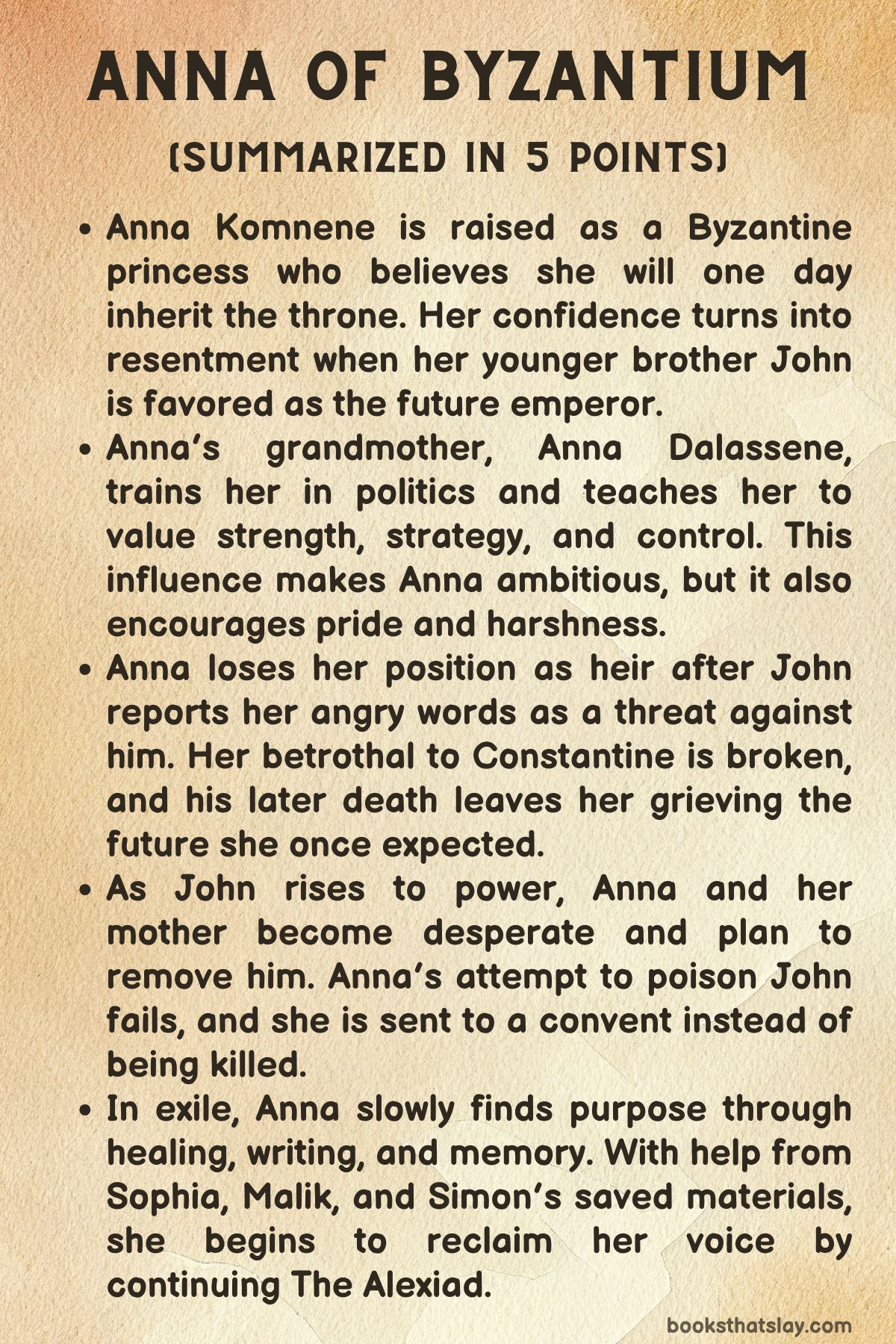
Summary
Anna Komnene, princess of Byzantium, lives in a convent under the strict routines of religious life, though she was once raised in the imperial palace and expected to inherit the throne. The quiet discipline of the convent feels like a punishment to her.
She misses the richness of court life, the attention she once received, and the future she believes was stolen from her. During a meal with the nuns, her mind returns to memories of a great betrothal banquet held for her years earlier.
When the mother superior notices her restlessness, Anna asks to work in the copying room. Even this small freedom requires approval from the emperor, who is also her younger brother John, the person she hates most.
Permission arrives, and Anna begins work in the scriptorium under Sister Thekla. The task she is given is simple and humiliating: copying the Greek letter alpha again and again.
Anna treats even this basic exercise as a contest of will. As she works, she remembers Simon, the enslaved eunuch who educated the imperial children and cared for the palace library.
Writing becomes more than a duty. It becomes a way for Anna to hold on to her past and arrange her memories before they disappear.
Her memories return to childhood, when she was still the favored child of Emperor Alexios and Empress Irene. At five, Anna entered the throne room during a meeting with foreign ambassadors, expecting the usual admiration given to her as heir.
Instead, attention shifted to her newborn brother, John. The ambassadors were surprised that a girl was expected to rule rather than the emperor’s son.
Anna’s grandmother, Anna Dalassene, defended her, but the moment planted the first bitterness in Anna’s heart. John’s birth changed everything.
From then on, Anna saw him not as a brother but as a threat.
Dalassene soon became Anna’s most powerful influence. She was severe, ambitious, and certain that Anna must be trained for rule.
She made Anna sit on the emperor’s throne so the child could feel the force of authority. From that day, Dalassene took charge of Anna’s political education, teaching her strategy, military thinking, and suspicion.
Anna admired her grandmother’s hardness and began to believe that mercy was weakness. At the same time, she grew close to Constantine Doukas, the young man to whom she had been betrothed since birth.
Constantine was kind, brave, and admired by the emperor. Anna imagined that their future together would secure both her personal happiness and her claim to power.
War interrupted that dream. The First Crusade drew Alexios and Constantine away, while Dalassene was left to rule in the emperor’s absence.
Anna watched her grandmother handle state affairs with cold confidence and longed to become like her. Simon warned Anna that she was becoming dangerously proud, comparing her to Icarus flying too close to the sun.
Anna did not want to hear him. She thought greatness required boldness, and she believed she was destined for the throne.
One thing separated Anna from Dalassene: literacy. Dalassene could not read, and Anna understood that this made her dependent on others.
Anna threw herself into her studies, valuing books as both weapons and shields. Her brother John, however, struggled badly with reading and resisted lessons, often with anger.
His difficulty suggested a problem beyond laziness, but Anna saw only weakness. The contrast deepened her belief that she was better suited to rule.
Anna’s mother, Irene, represented a different model of power. Irene believed rule should be guided by morality and compassion, while Dalassene believed power belonged to those ruthless enough to seize and keep it.
When Anna was forced to choose between them, she chose Dalassene. Irene was hurt, but Anna saw her mother’s gentleness as useless in the world of emperors and armies.
As Anna grew older, palace tensions sharpened. After Alexios returned victorious from war, Dalassene pushed Anna to wear purple, a color reserved for rulers, and a veil, a sign of marriageable womanhood.
The choice embarrassed Alexios and Irene and revealed Dalassene’s desire to elevate Anna beyond her proper station. At the same reception, Alexios gave gifts to his family.
Anna received a colorful parrot that had belonged to a Turkish leader. The gift delighted her briefly, but John later had the bird killed after it bit him.
The act confirmed Anna’s hatred of him and convinced her that he was cruel as well as unworthy.
A banquet was held to honor Anna’s betrothal to Constantine. Still upset by the parrot’s death, Anna drank too much wine and stepped outside.
Constantine followed her, and they exchanged romantic words. John overheard them and repeated their private conversation to the court, humiliating Anna.
Alexios treated the incident lightly, but Anna felt exposed and betrayed. The evening ended with another argument between Irene and Dalassene, showing how deeply divided the imperial family had become.
Soon after, Anna’s downfall began. In a meeting with Alexios and Dalassene, Anna tried to provoke her grandmother by revealing some of Dalassene’s claims about her own role in Alexios’s victories.
Alexios was amused by their stubbornness, but Dalassene saw Anna as a future rival. Later, in the library, Anna spoke rashly to Simon about wanting to make history, exile John, and force Dalassene to submit.
She even remembered having wished John dead when he was born. John overheard enough to accuse her of plotting murder.
Alexios responded harshly. He revoked Anna’s status as heir and named John in her place.
He also ended her betrothal to Constantine. Anna finally understood that Dalassene had maneuvered against her and that her own arrogance had made the trap easier to set.
Irene protested, saying John was not fit to rule, but Alexios accused her of disloyalty. Anna lost the throne, her future marriage, and much of her standing at court in one blow.
Her grief deepened when news arrived that Constantine had died in battle. With him gone, Anna lost the boy she loved and the life she had imagined.
Yet not all her actions were selfish. She discovered that Sophia, the Turkish girl enslaved as her maid, had been meeting secretly with Malik, the man she had once been promised to before her capture.
When guards seized Malik, Anna saved him by assigning him to work for Simon. She did this partly to repay Sophia for once protecting her from punishment, but it also marked one of the first moments when Anna used power to protect someone vulnerable rather than to advance herself.
Anna’s life was redirected again when she met Nikephoros Bryennios in the library. She spoke to him about history without realizing he was already a respected historian.
Soon she learned that Alexios had arranged for her to marry him. Though she still mourned Constantine, Anna accepted the match because refusal was not truly available to her.
At their betrothal banquet, she used formal language to remind the court that imperial decrees were supposed to be permanent, a clear reference to her father’s broken promise about the throne.
Marriage gave Anna her own household, and she began to shape a new identity. She studied medicine and cared for sick members of her household.
Simon introduced her to the hymns of Kassia, a saint and writer whose work showed strong women resisting oppression. Anna admired Kassia, though she could not understand why anyone would choose convent life.
She still defined herself by court, power, and the future she had lost.
When Alexios fell gravely ill, John and Dalassene began acting with greater authority. Anna was denied access to the throne room and kept away from her father’s sickbed.
She spent more time in the library, where Sophia admired an illuminated manuscript showing Constantinople watched over by a guardian angel. Anna did not believe in angels, but she envied the idea of protection.
Eventually Anna was allowed to visit Alexios. She noticed the doctors using a strange medicine and secretly took a vial.
Sophia helped conceal it. Anna later admitted that she intended to use it to end her own life if John and Dalassene seized power and threatened her.
Simon and Irene urged her to stop living only in bitterness and try to find meaning in what remained.
Alexios recovered briefly, then declined again. As death approached, John and Dalassene became bolder.
They discovered that Anna had begun writing a history of her father’s reign, The Alexiad, and destroyed her writing materials, also banning her from the library. Alexios died without restoring Anna as heir, and John was crowned emperor.
Anna and Irene feared imprisonment, exile, or death.
In desperation, Irene planned to assassinate John. Anna chose to carry out the act herself, believing her mother would be executed if caught.
She took the vial of medicine and poured a deadly dose into John’s wine. John and Dalassene caught her, and Anna was thrown into the dungeons.
Simon later revealed that he had warned them of the plot. Anna felt betrayed, unable at first to see that Simon may have acted to save her from a worse fate.
Irene broke under grief and fear, tried to attack John, and was sent to a convent. Dalassene wanted Anna tortured and killed, but John chose exile instead.
Anna was surprised to see him defy their grandmother. Before Anna left, John allowed her to take one enslaved person with her.
Rather than take Sophia, Anna freed her so she could live with Malik. This choice showed Anna changing.
She had lost imperial power, but she had learned to use what little power remained for mercy.
Years later, in the convent, Anna slowly builds a different life. She comes to know the nuns, bonds with the choir mistress over Kassia’s hymns, and uses her medical knowledge to help the sick.
Her reputation as a healer grows. She still remembers the past, but the convent is no longer only a prison.
When Sophia and Malik visit with their baby daughter, named Anna, they bring news that John has limited Dalassene’s influence. They also bring the saved materials for The Alexiad.
Simon had rescued them before dying in hiding.
Anna realizes that her life is not over. She may never rule Byzantium, but she can preserve its history.
She can write, heal, remember, and claim a family not through blood or rank alone, but through loyalty and love. The throne is gone, yet Anna’s voice remains.
Characters
Anna Komnene
Anna Komnene is the central figure of Anna Of Byzantium, and her character is built around the painful distance between what she is taught to expect and what life finally gives her. She begins as a proud Byzantine princess who believes that intelligence, birth, and preparation make her the rightful heir to the empire.
From childhood, she is treated as someone destined for greatness, and this shapes both her confidence and her flaws. Anna is highly intelligent, observant, educated, and ambitious, but she is also jealous, impulsive, and often unable to see beyond her own wounded pride.
Her hatred of John begins when she realizes that his birth threatens her position, and this resentment becomes one of the forces that drives her later mistakes.
Anna’s tragedy lies in the fact that she does possess many qualities of a ruler. She values learning, understands the importance of literacy, studies politics, and later develops skill in medicine and historical writing.
Yet she often confuses power with domination. Under Dalassene’s influence, she begins to admire ruthlessness and believes that mercy is a weakness.
This makes her vulnerable to manipulation, especially because she wants so badly to prove that she is strong enough to rule. Her downfall is not caused only by the sexism of her world or the ambitions of others, though both matter deeply.
It also comes from her own pride, her reckless speech, and her failure to understand that politics requires restraint as much as courage.
By the end of the book, Anna becomes a more mature and humane figure. Exile strips away her royal future, but it also forces her to examine what remains when rank is taken from her.
Her decision to free Sophia is one of her most important moral actions because it shows that Anna has begun to understand power differently. She can no longer command armies or claim a throne, but she can still choose mercy.
Her final commitment to writing The Alexiad gives her a new form of authority. She loses the empire, but she claims history, memory, and authorship.
Anna’s journey is not a simple fall from greatness. It is the story of a proud girl who loses political power and slowly discovers a deeper, more lasting strength.
John Komnenos
John Komnenos is Anna’s younger brother and rival, but he is not presented as a simple villain. In Anna’s eyes, he is the thief of her future, the child whose birth disrupts her place as heir and changes the structure of her life.
Much of the reader’s understanding of John is filtered through Anna’s resentment, so his character must be read carefully. He can be cruel, sneaky, and eager to expose Anna’s mistakes, as seen when he humiliates her after overhearing her private moment with Constantine.
His treatment of Anna’s parrot also shows a disturbing willingness to hurt what she loves, especially when he feels slighted.
At the same time, John is also a child placed under immense pressure. He struggles with reading and formal lessons, and the book suggests that his difficulty may not be simple laziness.
Because Anna values intelligence and education so highly, she sees John’s academic failure as proof that he is unfit to rule. Yet the novel complicates this judgment.
John may lack Anna’s scholarly gifts, but he develops political instincts of his own. He learns to listen, wait, and use information.
His ability to survive Dalassene’s influence and eventually resist her shows that he is not as weak or foolish as Anna believes.
John’s decision to exile Anna rather than have her tortured or killed is one of the most revealing moments in his characterization. Dalassene wants harsher punishment, but John refuses to follow her completely.
This does not make him noble in a pure sense, but it does show growth and independence. He has learned from the dangerous people around him, yet he is not entirely controlled by them.
His rivalry with Anna is central to the book because it is not only a personal conflict between siblings. It represents a struggle over gender, inheritance, education, legitimacy, and the meaning of fitness to rule.
John becomes emperor, but the book leaves room to question whether victory makes him more deserving or simply more successful.
Anna Dalassene
Anna Dalassene is one of the most powerful and intimidating figures in the story. As Anna’s grandmother, she becomes the young princess’s political mentor and shapes much of her early understanding of authority.
Dalassene believes in discipline, strategy, and the ruthless use of power. She teaches Anna that ruling requires hardness and that compassion can be dangerous.
To a young girl raised near the throne, this lesson is seductive. Dalassene makes Anna feel chosen, capable, and superior, and this attention gives Anna a sense of destiny.
Dalassene’s strength is undeniable. She is politically experienced, fearless in matters of state, and able to command respect in a male-dominated imperial world.
Her temporary rule while Alexios is away shows that she knows how to manage authority. Yet her power is also corrosive.
She does not merely teach Anna how to rule; she teaches her how to distrust, compete, and dominate. Dalassene’s rivalry with Irene exposes two different visions of rule: one based on mercy and moral responsibility, the other based on control and victory.
Dalassene’s contempt for Irene and the Doukas family also reveals how old political grudges continue to damage the next generation.
Her relationship with Anna is especially complex because she both builds Anna up and later helps destroy her. Dalassene initially encourages Anna’s ambition, but once Anna becomes a threat to her own influence, she turns against her.
This makes Dalassene a symbol of political power without love. She is willing to use even her granddaughter as a tool, and when that tool becomes dangerous, she discards it.
Her later loss of influence under John is fitting because she underestimates the people she tries to control. Dalassene is formidable, but her inability to value loyalty, tenderness, or moral limits makes her power unstable.
Empress Irene Doukaina
Empress Irene Doukaina serves as a moral counterweight to Dalassene. She is Anna’s mother, but for much of the story Anna fails to understand her strength.
Because Irene is gentler and more openly guided by conscience, Anna initially sees her as less useful than Dalassene. This is one of Anna’s great errors.
Irene’s power is quieter, but it is not weak. She believes that an empress must rule with moral awareness, and she resists the idea that political success justifies cruelty.
Irene’s tragedy is that she is often dismissed by the people around her. Dalassene looks down on her because of family rivalry and because Irene does not share her militaristic view of power.
Alexios also fails to take her warnings seriously, especially when she tries to alert him to Dalassene’s influence over Anna. Irene sees dangers that others ignore.
She understands that Anna is being shaped into someone bitter and hard, and she recognizes John’s limitations more clearly than Alexios wants to admit. Yet her influence over Anna weakens because Anna is drawn to the sharper, more glamorous promise of Dalassene’s political instruction.
Irene’s later actions show how suffering can distort even a compassionate person. When Alexios dies and John takes power, Irene becomes desperate enough to support assassination.
This does not erase her earlier moral vision; rather, it shows how completely fear and grief have broken her. Her collapse after the failed plot is one of the saddest turns in the book.
Irene is a character whose goodness does not protect her from damage. She loves Anna, sees her clearly, and tries to guide her, but she cannot prevent the family’s political ambitions from consuming them.
Emperor Alexios Komnenos
Emperor Alexios is a father, ruler, soldier, and political figure whose decisions shape Anna’s fate. He is admired as a successful emperor and military leader, and his presence carries great authority in the palace.
To Anna, his approval matters deeply. Her sense of identity is tied to his recognition of her as heir, which makes his later decision to replace her with John especially devastating.
Alexios is not cruel in the same direct way as Dalassene, but his failures are still severe.
His main weakness is his inability or unwillingness to confront the conflicts inside his own family. He dismisses Irene’s concerns about Dalassene, underestimates the emotional danger surrounding Anna and John, and treats certain humiliations as harmless when they have lasting consequences.
His indulgence toward John and amusement at courtly embarrassment deepen Anna’s sense of betrayal. As emperor, Alexios understands war and statecraft, but as a father, he often misjudges the children before him.
Alexios’s decision to revoke Anna’s status as heir is politically understandable within the world of the novel, but it is emotionally destructive. He responds to Anna’s reckless words and the accusation against her by stripping away her future.
In doing so, he allows Dalassene’s manipulation and John’s report to reshape the succession. His failure to restore Anna before his death leaves the family in crisis and pushes Anna and Irene toward desperate action.
Alexios is not portrayed as a monster, but the book makes clear that even respected rulers can cause deep harm when they avoid difficult truths within their own households.
Simon
Simon is one of the most important guiding figures in Anna’s life. As an enslaved eunuch, tutor, and keeper of the imperial library, he occupies a complicated position.
He has knowledge, wisdom, and moral authority, yet he lacks freedom and political power. His role in the book highlights the difference between intellectual influence and social status.
Simon shapes Anna’s mind through books, history, language, and warning, but he cannot fully control what she does with what he teaches her.
Simon understands Anna better than most characters do. He sees her brilliance, but he also sees the danger of her pride.
His warning about Icarus captures one of the book’s central concerns: ambition without humility can become self-destruction. Unlike Dalassene, Simon does not want Anna to become hard or merciless.
He wants her to become wise. He introduces her to historical writing and later preserves the materials for The Alexiad, making him essential to Anna’s final transformation into a historian.
His decision to reveal the assassination plot feels like betrayal to Anna, but it can also be read as an act of protection. Simon knows that Anna’s plan will not restore justice; it will likely destroy her.
By alerting John and Dalassene, he may be trying to prevent a greater disaster, even though the choice costs him Anna’s trust. His death in hiding gives his character a tragic dignity.
Simon’s lasting legacy is not political victory but preservation. He saves knowledge, protects history, and helps Anna become more than the failed heir others see.
Sophia
Sophia is one of the most quietly significant characters in the novel. She enters Anna’s life as a Turkish girl captured and enslaved by the Byzantine army, then assigned as Anna’s maid.
Through Sophia, the book forces attention onto the human cost of imperial power and war. While Anna worries about succession and status, Sophia has already lost home, freedom, and the life she expected to have.
Her presence challenges Anna’s narrow view of suffering.
At first, Sophia’s role may seem secondary, but she repeatedly acts with courage and intelligence. She protects Anna by hiding the stolen chalice, later helps conceal the medicine vial, and maintains her own secret hope of freedom through her relationship with Malik.
Sophia is not passive. Even within captivity, she makes choices, guards secrets, and holds on to love.
Her loyalty to Anna is real, but it does not erase the injustice of her enslavement.
Anna’s relationship with Sophia becomes one of the strongest signs of Anna’s moral growth. Earlier in the book, Anna is absorbed by her own losses and often blind to the suffering of others.
By freeing Sophia instead of taking her to the convent, Anna finally recognizes Sophia as a person with her own future, not as property or a servant attached to royal life. Sophia’s later return with Malik and their daughter shows that this act of freedom has lasting meaning.
She represents survival, gratitude, and the possibility of family formed outside bloodlines and imperial rank.
Malik
Malik represents love, loyalty, and the life Sophia was meant to have before war changed everything. He is not present as often as the major palace characters, but his importance is clear.
He has saved money to buy Sophia’s freedom, showing patience, devotion, and practical courage. His willingness to risk secret meetings near the palace reveals how strongly he remains tied to her despite danger.
Through Malik, the novel expands beyond imperial concerns. His presence reminds the reader that the empire’s victories create suffering for ordinary people.
While generals and emperors celebrate conquest, people like Sophia and Malik are separated, displaced, and forced to negotiate survival under the rule of those who defeated them. Malik’s love for Sophia stands in contrast to the political marriages and strategic alliances of the palace.
His bond with her is based not on power but on memory, loyalty, and shared hope.
Malik also becomes part of Anna’s eventual redefinition of family. When he and Sophia visit Anna at the convent with their daughter, they bring not only news but also restoration.
Their child, named after Anna, shows that Anna’s one merciful choice has created affection that outlives the palace conflict. Malik helps carry Simon’s saved materials to Anna, connecting love, freedom, and history in the closing movement of the story.
Constantine Doukas
Constantine Doukas is Anna’s first betrothed and the figure attached to her earliest dream of happiness. He belongs to the political world of arranged marriage, but Anna’s feelings for him become personally meaningful.
To her, Constantine represents not only romance but also continuity. Marrying him would affirm the future she has been promised since childhood.
His presence gives Anna a vision of adulthood in which love, rank, and destiny seem to fit together.
Constantine is presented as brave, courteous, and worthy of admiration. Alexios respects him, and Anna sees him as far superior to John.
Because their interactions are limited by court rules, much of Anna’s attachment is built from anticipation and idealization. Still, his kindness to her matters, especially in a palace where affection is often shaped by ambition.
Their private exchange during the banquet gives Anna a rare moment of emotional openness, but John’s public exposure of it turns that tenderness into humiliation.
His death in battle marks the end of Anna’s first imagined future. Losing Constantine means losing both the boy she loves and the political arrangement that supported her identity as heir.
His absence helps push Anna further into grief and resentment. Constantine is not developed as deeply as Anna or her family members, but he is important because he represents the life Anna thought she was owed before power shifted away from her.
Nikephoros Bryennios
Nikephoros Bryennios enters the story as a historian and soldier, and he becomes Anna’s second betrothed after her future with Constantine is destroyed. Anna first meets him without recognizing his importance, and her embarrassment after speaking too confidently about history shows both her intelligence and her pride.
Nikephoros represents a different kind of future for Anna, one based less on youthful romance and more on intellect, scholarship, and endurance.
Unlike Constantine, Nikephoros is not connected to Anna’s childhood dream of becoming empress. Anna accepts the marriage reluctantly because she has little choice.
Yet his role is still meaningful because he belongs to the world of history writing, the very field through which Anna eventually claims her lasting identity. His presence helps shift the story from succession politics toward authorship and memory.
Nikephoros also reflects the value of intellectual achievement in a court dominated by military and dynastic struggle. While many characters fight for control of the throne, he is associated with the preservation and interpretation of events.
For Anna, who wants to make history, meeting Nikephoros is humbling. He reminds her that ambition in scholarship requires discipline, knowledge, and seriousness, not only desire for fame.
Maria
Maria, Anna’s younger sister, functions as a gentler contrast to Anna. She is less politically ambitious and more fearful of consequences, especially when Anna behaves recklessly.
During the incident with the chalice, Maria is frightened by Anna’s mischief, which shows the difference between the sisters’ temperaments. Anna is daring, proud, and convinced she can manage danger; Maria is more cautious and aware that rules can carry real punishment.
Although Maria is not one of the central political players, she helps reveal Anna’s personality. Around Maria, Anna can appear playful and protective, but also careless.
She promises to take blame for the stolen chalice, suggesting that Anna does have a sense of responsibility toward those she loves. At the same time, the very act shows her willingness to treat sacred and political boundaries as things she can bend.
Maria’s presence also reminds the reader that Anna is still a child during many early events. The palace may train her for power, but she is also a girl playing with dolls, testing limits, and learning how serious consequences can become.
Maria helps soften the emotional world of the book by showing Anna in a more domestic and sisterly setting, away from the throne room’s harsher contests.
Sister Thekla
Sister Thekla represents the discipline of convent life and the humbling of Anna’s pride. When Anna begins copying in the scriptorium, Thekla gives her the most basic possible exercise: writing the letter alpha repeatedly.
Anna interprets this as humiliation, but the task also has symbolic meaning. A princess who once expected to rule must begin again with the first letter.
Thekla’s strictness forces Anna into patience, repetition, and obedience.
Thekla is important because she belongs to the world Anna initially rejects. To Anna, the convent seems small, severe, and beneath her former status.
Yet figures like Thekla show that this world has its own order and purpose. The scriptorium becomes the place where Anna reconnects with writing, and writing becomes the path through which she survives exile.
Thekla may not intend to give Anna power, but the discipline she demands helps Anna return to the work that will define her.
The Mother Superior
The mother superior is a figure of authority in Anna’s convent life, but her authority differs from imperial power. She does not command armies or compete for the throne.
Instead, she governs through structure, restraint, and spiritual discipline. At first, Anna experiences her as part of the system that confines her.
Every request must pass through proper channels, and Anna is frustrated that even her desire to work in the copying room requires permission.
Over time, however, the mother superior becomes part of Anna’s new community. She notices Anna’s unhappiness and responds not with cruelty but with controlled concern.
Her acceptance of Anna’s visitors near the end of the book suggests that the convent is no longer only a place of punishment. It becomes a space where Anna can be known not just as a failed heir but as a healer, writer, and member of a different kind of household.
The mother superior helps mark the change from exile as defeat to exile as transformation.
Themes
Power and the Cost of Ambition
Power in Anna Of Byzantium is never treated as simple glory. It gives people status, command, and influence, but it also damages families, distorts love, and turns children into rivals.
Anna is raised to believe that she is destined for the throne, and this belief gives her confidence, discipline, and hunger for learning. Yet it also feeds her pride.
She begins to measure her worth by her closeness to imperial authority, so John’s birth feels not merely disappointing but personally unbearable. Dalassene intensifies this ambition by teaching Anna that rule requires severity and that mercy weakens a leader.
Under this influence, Anna starts to admire hardness more than wisdom.
The book shows that ambition becomes dangerous when it loses moral direction. Anna wants to rule, but she does not always ask what kind of ruler she would become.
Dalassene already shows one possible answer: a person so devoted to control that even family becomes a political instrument. Alexios also reveals the cost of power through his inability to protect his household from the logic of succession.
The throne turns sibling rivalry into a matter of survival. By the end, Anna’s loss of political power is painful, but it also frees her from one destructive version of ambition.
Writing history gives her a different kind of legacy, one based on memory rather than domination.
Gender, Inheritance, and the Right to Rule
Anna’s claim to the throne is shaped by a world that admires her intelligence but remains uneasy about female rule. As a child, she is presented as heir, yet the birth of John immediately threatens that position because he is male.
The foreign ambassadors’ surprise at Anna’s status reveals a broader assumption that power naturally passes through sons. Dalassene challenges this view when it benefits Anna, but even her support is not purely feminist or selfless.
She wants Anna to rule partly because Anna can become an extension of her own political influence.
The question of who deserves to rule becomes more complicated because Anna and John have opposite strengths and weaknesses. Anna is educated, articulate, and intellectually gifted, while John struggles with reading and formal study.
From Anna’s perspective, this proves that she is more qualified. Yet the book does not allow the issue to remain that simple.
John learns forms of political behavior that Anna underestimates: silence, observation, timing, and survival. The injustice Anna faces as a girl is real, but her own flaws also matter.
She is not denied power only because she is female; she also damages her position through pride and reckless anger. The theme is powerful because it refuses an easy answer.
Anna may be better prepared in many ways, but the system around her is built to favor John, and once that system turns against her, talent alone cannot save her.
Education, Writing, and Historical Memory
Learning is one of Anna’s greatest sources of power. Books, languages, medicine, and history give her a sense of identity beyond court ceremonies.
Her education separates her from Dalassene, who is politically brilliant but illiterate, and from John, who cannot or will not succeed in lessons. Anna understands that reading and writing protect a person from dependence on others.
This is why the library matters so much to her. It is not just a room of books; it is a place where authority can be studied, questioned, and preserved.
Writing becomes especially important after Anna loses the throne. When John and Dalassene destroy her writing materials and ban her from the library, they are attacking more than a pastime.
They are trying to erase her power to shape the record of events. Simon’s rescue of her materials shows that history can survive political violence through loyalty and courage.
Anna’s decision to complete her father’s history gives her a form of agency that exile cannot fully destroy. She may not rule the empire, but she can decide how its story is remembered.
The theme also changes the meaning of success. Anna begins by wanting to make history through power; she ends by making history through authorship.
The written word becomes her lasting throne.
Mercy, Freedom, and Moral Growth
Anna’s moral growth is clearest in the way she slowly learns to see other people’s suffering as real, not merely secondary to her own. At the beginning, she is deeply absorbed in her lost status and her hatred of John.
She feels wronged, and often she is wronged, but her pain makes her self-centered. Sophia’s presence challenges this narrowness.
Sophia has been captured, enslaved, and separated from the life she should have had. Compared with Anna’s political loss, Sophia’s loss is more basic: she has been denied freedom.
The relationship between Anna and Sophia becomes a test of Anna’s character. Sophia protects Anna more than once, but Anna’s most important response comes when she chooses to free Sophia rather than take her into exile.
This act matters because Anna gives up the comfort of having a loyal servant with her. She finally recognizes Sophia’s right to her own life with Malik.
Mercy here is not weakness, as Dalassene would suggest. It is the first sign of Anna using power responsibly.
The same theme appears in John’s choice to exile Anna instead of allowing Dalassene to kill or torture her. Mercy does not erase harm, but it interrupts cycles of revenge.
By the end, the book suggests that moral strength lies not in crushing enemies but in choosing restraint, freedom, and human dignity when bitterness would be easier.