Absolutely Normal Chaos Summary, Characters and Themes
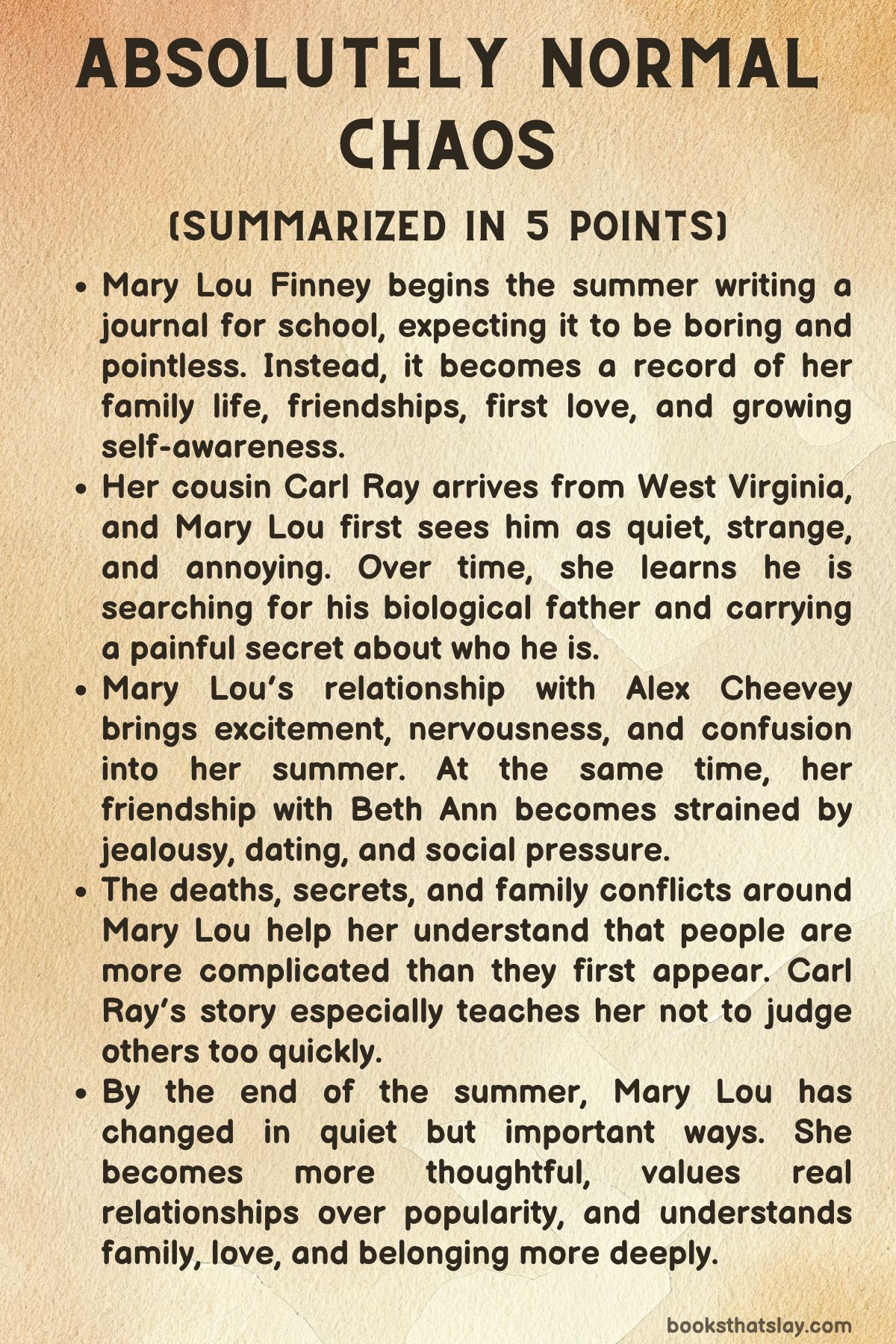
Absolutely Normal Chaos by Sharon Creech is a coming-of-age novel told through the summer journal of thirteen-year-old Mary Lou Finney. At first, Mary Lou treats the assignment like a nuisance, but her entries slowly become a record of a season that changes her.
Through family tensions, first love, jealousy, death, and surprising discoveries, she begins to see people more clearly, including herself. The book balances comedy and sadness with a voice that feels direct, restless, and honest. As Mary Lou reads The Odyssey during the summer, she starts connecting its ideas about home, identity, and journey to the confusing events unfolding around her own life.
Summary
Mary Lou Finney begins the summer not expecting much. She lives in Easton, Ohio, in a loud, busy household full of siblings, routines, teasing, and small frustrations.
She thinks of her family as ordinary in its own strange way, and she is still trying to figure out who she is within it. Her journal starts as a school assignment, and at first she is unsure how to write in it.
Before long, though, it becomes the place where she records her thoughts, complaints, embarrassments, and discoveries.
At the beginning of summer, Mary Lou feels left out of the social world around her. Certain parties and groups seem to belong to a different side of town, and she often feels awkward beside girls who seem more polished and experienced.
Her best friend Beth Ann is one of the main people in her life, but even that friendship becomes strained as dating, popularity, and jealousy start to matter more. Mary Lou watches others seem to move ahead into romance and social status while she remains uncertain, observant, and annoyed by nearly everyone.
The summer shifts when her older cousin Carl Ray arrives from West Virginia to stay with the family. He comes to look for work, but his arrival immediately disrupts the house.
Mary Lou resents the special treatment he receives and finds him dull, silent, messy, and inconvenient. She is irritated that her family rearranges routines for him and that she is expected to help take care of his room and needs.
At first he barely speaks, stays apart from the family, and seems more like a burden than a guest.
Around the same time, Mary Lou becomes increasingly aware of growing up. She thinks about kissing, remembers a childhood incident that caused neighborhood scandal, and wonders what romance is really supposed to feel like.
These thoughts become more urgent when Alex Cheevey begins appearing in unexpected places. Alex has always been hard for her to read.
He is quiet, thoughtful, and gives her the sense that he is always holding something back. Their early conversations are awkward, but Mary Lou is drawn to him.
Meanwhile, Carl Ray gets a job at Mr. Furtz’s hardware store. Mr. Furtz is a familiar neighborhood figure, and his sudden death shocks Mary Lou deeply.
Seeing death up close unsettles her and leaves her thinking about how quickly life can end. The funeral affects the whole neighborhood, but it also reveals another side of Carl Ray.
He is openly emotional, and his grief seems stronger than Mary Lou expects. For the first time, she senses that there is far more going on inside him than anyone understands.
During this period, Mary Lou begins reading The Odyssey, first out of obligation and then with growing interest. The epic becomes a lens through which she views her own life.
She starts comparing people and events around her to characters and ideas from the poem. The story gives shape to feelings she cannot yet fully explain: homesickness, searching, danger, pride, longing, and the wish to find where one belongs.
Her reading also gives her a way to think about Carl Ray, Alex, and herself.
As the summer continues, Mary Lou and Alex grow closer. They meet at the pool, talk about books, spend time walking, and gradually move from awkwardness into affection.
Their relationship is full of nervous pauses, anticipation, and small moments that feel enormous to Mary Lou. She overthinks every call, every touch, every almost-kiss.
Her joy makes her distracted and dreamy, and her journal reflects how strongly first love takes over her mind. Alex also proves to be more thoughtful than she first assumed, especially in the way he understands The Odyssey and its meaning.
At the same time, Beth Ann becomes involved with an older boy and then gets hurt when that relationship falls apart. Her friendship with Mary Lou suffers under the pressure of envy and competition.
Each girl wants to be admired, wanted, and included. Beth Ann also becomes interested in social groups that once might have impressed Mary Lou, but as the summer goes on, those things begin to matter less to her.
She starts to recognize how shallow and temporary some of those ambitions are.
The mystery around Carl Ray deepens when he receives a surprising sum of money and a college fund from an unnamed source. Instead of being happy, he seems anxious.
Mary Lou grows curious and tries to piece together the truth. She notices odd reactions from adults, a ring connected to Mr. Furtz, and the way Carl Ray avoids explaining himself.
The tension grows when Mary Lou is forced to accompany him on a trip back to West Virginia.
That trip becomes one of the most important experiences of her summer. Away from home, she feels uncomfortable, homesick, and out of place.
She dislikes the lack of modern comforts, feels judged by her country relatives, and is humiliated more than once. Yet this visit changes her understanding of Carl Ray.
She sees what it means to be the outsider in someone else’s family world. She also notices the strain between Carl Ray and the man who raised him, Uncle Carl Joe.
Gradually she realizes that Carl Ray has been carrying a private struggle tied to his identity and his place in the family.
When they return, the truth finally comes out. Carl Ray had come to Easton not just to work, but to find his biological father.
That man was Mr. Furtz. Years earlier, Carl Ray’s mother had been involved with him before marrying Uncle Carl Joe, who then raised Carl Ray as his own son.
Carl Ray only recently learned the truth and came looking for answers. Mr. Furtz accepted him, offered him kindness, work, money, and a family connection just before dying.
The ring and inheritance were not random gifts but acts of recognition and care. Mrs. Furtz, after confusion and suspicion, comes to accept Carl Ray too.
The revelation brings pain, but it also brings clarity.
For Mary Lou, this discovery is humbling. She realizes how much she failed to notice while being absorbed in her own worries.
She begins to understand that people can carry deep stories behind ordinary behavior. Carl Ray, whom she first judged as lazy and annoying, becomes someone she genuinely respects and loves.
He also comes to see Mary Lou more clearly, and they build a bond based on honesty and affection.
Mary Lou’s own emotional world keeps developing. She and Alex finally kiss, and the relationship becomes sweeter and more comfortable, though still marked by the intensity and confusion of being young.
Her view of herself changes too. She becomes less concerned with appearing impressive and more interested in what is true.
Invitations from exclusive groups no longer tempt her the way they once did. She senses that she has changed, even if she cannot fully define how.
Near the end of summer, Carl Ray faces another crisis when he is badly injured in a car accident and falls unconscious. The accident gathers together both sides of his family, along with Mary Lou, Beth Ann, Alex, and others who care about him.
The fear of losing him forces everyone to confront what he means to them. Mary Lou feels guilt for the ways she treated him early on and recognizes again how helpless love can make a person in the face of suffering.
When Carl Ray wakes up, his recovery feels like a gift to all of them.
By summer’s end, the conflicts that seemed so large at the beginning have settled into a fuller understanding of family, love, and belonging. Mary Lou is no longer the same girl who started the journal.
She has fallen in love, made mistakes, lost illusions, faced death, and learned to read the people around her with greater care. The season leaves her with a stronger sense of self and with a deeper awareness that ordinary lives can hold confusion, comedy, pain, and discovery all at once.
Characters
Mary Lou Finney
Mary Lou is the center of the novel and the character through whom every major event is filtered. At thirteen, she stands in that uneasy space between childhood and adolescence, old enough to judge the people around her sharply but not yet mature enough to understand them fully at first.
Her voice is energetic, funny, impatient, dramatic, and deeply honest, even when she is being unfair. She begins the summer feeling ordinary, overlooked, and unsure of who she is.
That uncertainty shapes much of her behavior. She compares herself to other girls, worries about popularity, thinks constantly about boys, and reacts strongly whenever she feels excluded.
What makes her such a strong character is that she does not present herself as polished or wise. She is often jealous, nosy, self-absorbed, and impulsive, yet she is also observant, affectionate, and capable of real growth.
Mary Lou’s development is the emotional backbone of Absolutely Normal Chaos. At the start, she sees most situations in terms of how they affect her own comfort or pride.
Carl Ray is an inconvenience, Beth Ann is a rival as much as a friend, and Alex is a puzzle she wants to solve partly because he makes her feel chosen. As the summer goes on, however, she becomes more thoughtful.
Death unsettles her. Love softens her.
Time away from home gives her perspective. Most importantly, Carl Ray’s hidden story forces her to admit how much she failed to notice in someone she lived beside every day.
By the end, she is still recognizably herself, still comic and emotional and quick to react, but she has become kinder and more self-aware. She learns that growing up is not about becoming sophisticated all at once.
It is about learning to see other people as fully real, with hidden fears and histories of their own.
Carl Ray Finney
Carl Ray is one of the most important and layered figures in the story because he arrives as a mystery and slowly becomes its emotional center. When he first appears, he seems disappointing to both Mary Lou and the household.
He is quiet, awkward, untidy, and difficult to read. He does not charm anyone immediately or fit easily into the family rhythm.
This first impression matters because it reflects the way people often judge what they do not understand. Mary Lou assumes he is lazy, self-important, or simply dull.
In truth, he is carrying emotional strain that no one around him fully sees. His silence is not emptiness but burden.
As the story unfolds, Carl Ray becomes a portrait of a young man caught between identities. He has been raised by one father while longing to understand another.
He is suspended between West Virginia and Ohio, between the family that formed him and the truth that complicates that belonging. His journey is not only about discovering his biological father but also about deciding what fatherhood really means.
He is sensitive, proud, and vulnerable, and these qualities emerge in moments that surprise Mary Lou: his grief at the funeral, his tenderness with Tommy, his discomfort over the money, and his refusal to treat his discovery as a simple happy ending. He does not become shallowly transformed into a hero.
Instead, he becomes understandable. By the end, he represents the novel’s deepest idea about family: blood matters, but love, sacrifice, and years of care matter too.
Carl Ray’s story gives the book much of its emotional force.
Alex Cheevey
Alex is Mary Lou’s first romantic ideal, but he is more than a simple crush figure. He is quiet, a little distant, and sometimes hard to interpret, which is exactly why Mary Lou is drawn to him.
He does not overwhelm scenes with dramatic speeches or grand gestures. Instead, his presence works through pauses, small admissions, shared activities, and understated affection.
For Mary Lou, who is always thinking, analyzing, and reacting, Alex’s calmness makes him seem almost mysterious. She often feels that she is missing part of what he means, and that uncertainty gives their relationship much of its tension.
What makes Alex important is that he participates in Mary Lou’s emotional education without dominating it. He is thoughtful, gentle, and capable of awkward sincerity.
His interest in The Odyssey gives him depth in Mary Lou’s eyes because it suggests an inner life that matches her own growing habit of looking for meaning. He shares his worries, including his sense that he may not fully resemble his family, and that helps create intimacy between them.
Their relationship captures the confusion of first love: long anticipation, misread signals, exaggerated fears, and moments that feel immense because they are new. Alex is not presented as perfect.
He forgets things, hesitates, and sometimes seems absent-minded. That slight imperfection helps him remain believable.
He matters because he helps Mary Lou feel seen at a moment when she is trying to understand herself.
Beth Ann
Beth Ann is one of the clearest examples of how friendship changes under the pressure of adolescence. At first she is Mary Lou’s best friend and a familiar, dependable part of everyday life.
Yet as the summer progresses, their friendship becomes strained by envy, competition, insecurity, and the desire to seem more grown-up. Beth Ann wants attention, status, and proof that she is moving forward in the social world.
Dates, invitations, and membership in exclusive groups matter a great deal to her. She is not cruel by nature, but she is highly sensitive to embarrassment and eager to attach herself to whatever seems glamorous or important.
Beth Ann’s role in the story is valuable because she shows how ordinary friendships can be damaged by comparison. Both girls want to be admired, and both sometimes fail to support the other generously.
Beth Ann can be vain, dramatic, and self-centered, but she is also recognizably young and insecure. Her bad decisions often come from a fear of being left behind.
Her involvement with Derek and later with Carl Ray reveals how much she is trying to shape herself through male attention and social approval. Yet she is not simply shallow.
When she is hurt, she is genuinely hurt. When Carl Ray is injured, her regret is real.
Beth Ann helps show that adolescence is full of messy emotions that are not neatly noble or mean. She remains flawed, but human.
Sam Finney
Sam, Mary Lou’s father, provides warmth, humor, and a sense of family tradition. He is one of the stabilizing adults in the story, though he is not presented as distant or idealized.
He is lively, expressive, and deeply invested in family rituals, whether those involve speeches, meals, or household habits. Through Mary Lou’s eyes, he often seems larger than life in the everyday way that parents can seem during childhood and early adolescence.
His presence contributes to the noisy, crowded, affectionate feeling of the household.
At the same time, Sam represents one version of fatherhood that the novel quietly values. He is there.
He participates. He gives shape to family life not through dramatic revelations but through constancy.
In a story so concerned with who belongs to whom and what makes a parent real, characters like Sam matter because they show that fatherhood is lived in daily acts. Mary Lou does not spend the novel analyzing him deeply, but his steady place in the household helps explain why family remains such a powerful force in her life, even when it annoys her.
Sally Finney
Sally, Mary Lou’s mother, is practical, busy, and often the manager of household order in a family that easily slips into noise and disorder. She is loving, but her love is expressed through discipline, instructions, reminders, and expectations rather than sentimental speeches.
Mary Lou often experiences her as irritating because mothers in adolescence are often seen first as the people who assign chores, set limits, and notice what is not being done. Yet beneath that friction, Sally is clearly attentive and deeply committed to her children.
Her character is especially important because she reflects the tension between care and control. She expects responsibility from Mary Lou and the others, and that expectation sometimes feels unfair to Mary Lou, especially when a guest like Carl Ray seems to receive special treatment.
Still, Sally’s judgments usually come from a wider understanding of other people’s needs, something Mary Lou only gradually learns to appreciate. She helps anchor the family and provides an example of adult responsibility that Mary Lou resists before she begins to understand it.
Maggie Finney
Maggie, Mary Lou’s older sister, functions as a visible symbol of a more advanced stage of teenage life. She has a boyfriend, goes to parties, cares about clothes, and appears to occupy a world that Mary Lou both criticizes and envies.
Maggie’s dramas with Kenny seem theatrical, but to Mary Lou they also carry the fascination of adult-looking romance. Mary Lou watches her carefully, half mocking her and half studying her for clues about what lies ahead.
Maggie is significant because she gives Mary Lou a nearby model of femininity that is glamorous but not always admirable. She can be selfish, absorbed in her own social life, and eager to avoid responsibilities at home.
Yet she is also affectionate and capable of sharing information and comfort with Mary Lou. She belongs to that familiar category of older sibling who is annoying and useful at the same time.
Through Maggie, the story shows that growing older does not automatically bring wisdom. It simply brings different forms of confusion.
Dennis Finney
Dennis often contributes to the noisy energy of the household and helps establish the family as lively rather than orderly. He participates in the teasing, roughhousing, and sibling chaos that fill Mary Lou’s world.
Though he is not one of the most psychologically explored characters, he matters because he helps create the environment from which Mary Lou’s voice emerges. Her reactions, complaints, and humor are shaped partly by being one among many children rather than the center of family attention.
Dennis also plays an important role late in the story by accompanying Carl Ray back to West Virginia, a parallel that quietly emphasizes how Mary Lou’s difficult trip was not merely personal oversensitivity but part of a real cultural and emotional distance. He helps reflect the family’s collective character: practical, noisy, resilient, and deeply involved in one another’s lives.
Tommy Finney
Tommy, the youngest child, often serves as a source of humor and small domestic commotion, but he also brings out gentleness in others. Mary Lou takes him to the pool, worries over him, and includes him in many of her daily routines.
Carl Ray’s tenderness toward Tommy is one of the first signs that Carl Ray is warmer and more emotionally open than Mary Lou assumes. Because Tommy is young and vulnerable, he often reveals the protective instincts of the people around him.
In narrative terms, Tommy helps keep the story grounded in family life rather than allowing it to become only about romance or self-discovery. He is part of the ordinary daily fabric that Mary Lou may complain about but never really escapes.
His presence reminds the reader that Mary Lou’s summer unfolds inside a family network, not in isolation.
Mr. Furtz
Mr. Furtz becomes one of the most quietly important figures in the novel. At first, he seems to be a neighborhood adult with no special centrality beyond employing Carl Ray.
His sudden death shocks Mary Lou because it is one of her first serious encounters with mortality. That alone gives him narrative importance, but later revelations transform him into much more.
He turns out to be Carl Ray’s biological father, a fact that redefines many earlier scenes. His kindness toward Carl Ray, his offer of work, his gift of the ring, and the money he leaves behind all gain emotional meaning in retrospect.
What is striking about Mr. Furtz is that he is not granted a long stretch of explanation in life. Instead, he becomes known partly through aftermath, memory, and impact.
He embodies the sorrow of a connection found too late, yet he is not reduced to regret alone. His acceptance of Carl Ray suggests decency, generosity, and emotional courage.
Even in absence, he reshapes the living. He becomes proof that a person can alter many lives in a brief time, especially when truth arrives close to loss.
Mrs. Furtz
Mrs. Furtz initially appears as a grieving widow, but her role grows more complex after the truth about Carl Ray emerges. Her confusion over the ring and the old letter gives way to understanding, and then to an act of generosity.
Rather than rejecting Carl Ray as evidence of a painful hidden past, she accepts him as part of her husband’s life and legacy. This response matters because it would have been easy for the character to be written as bitter or purely suspicious.
Instead, she becomes another example of adult complexity.
Her eventual openness broadens the novel’s idea of family. She does not erase the pain of what she learns, but she allows grief and acceptance to exist together.
By offering Carl Ray a place among the Furtzes, she helps create the possibility of a wider family rather than a divided one. She represents emotional maturity of a kind Mary Lou is only beginning to recognize in adults.
Uncle Carl Joe
Uncle Carl Joe is one of the most morally important characters in the story even though he is absent from long stretches of it. His significance lies in what he has done: he raised Carl Ray as his own son, knowing the truth from the beginning.
When the secret becomes known, the emotional risk to him is enormous. He stands to lose not just authority but love, identity, and years of fatherhood.
His anger and jealousy are therefore understandable, even when they are painful for Carl Ray.
What makes him so compelling is that he complicates any simple distinction between biological and real parenthood. He may not be Carl Ray’s biological father, but he is unquestionably one of the novel’s truest fathers.
He fed, raised, protected, and claimed Carl Ray. His fear of being displaced comes from love, not vanity.
By the end, the story strongly affirms his importance. Carl Ray’s recognition that the man who raised him remains his real father is one of the book’s deepest emotional resolutions.
Uncle Carl Joe turns what could have been a simple secret-origin plot into a serious reflection on what family loyalty means.
Aunt Radene
Aunt Radene is central to the family secret that shapes Carl Ray’s life. She once loved Charlie Furtz, later married Carl Joe, and then lived with the burden of what to reveal and what to conceal.
Her decision to tell Carl Ray the truth changes the entire course of the summer. She is therefore a character defined by emotional conflict, guilt, maternal love, and the consequences of past choices.
She is also important because she shows how adults can make decisions for what they believe are good reasons and still create pain. Her secrecy protected a family structure for years, yet the truth eventually demanded to be known.
She is not portrayed as deceptive in a cold sense, but as a woman caught between histories and loyalties. Her tenderness, anxiety, and emotional reactions make clear that she never escaped the cost of those earlier events.
Through her, the novel suggests that truth delayed may still be necessary, even when it arrives painfully.
Christy
Christy represents the social world that once held great power in Mary Lou’s imagination. She is associated with parties, status, flirtation, and the exclusive club that fascinates some of the girls.
She does not need to be deeply developed to serve this purpose. Her importance is symbolic.
She stands for a version of popularity that feels glamorous from a distance but increasingly shallow as Mary Lou matures.
As the summer progresses, Christy’s influence weakens in Mary Lou’s mind. That change is meaningful.
It shows that Mary Lou is outgrowing the need to be validated by closed circles and social performance. Christy remains part of the adolescent landscape, but no longer the center of it.
Derek
Derek serves mainly as a catalyst in Beth Ann’s storyline. He is less important as a fully developed individual than as a figure onto whom Beth Ann projects desire, status, and disappointment.
Through him, the story shows how quickly adolescent romance can become performance, hurt, and rivalry. He appears charming enough to attract attention, but not substantial enough to sustain loyalty or trust.
His role helps expose the fragility of Beth Ann’s social ambitions. He is the kind of person around whom people build fantasies that collapse quickly.
That collapse, in turn, sharpens the contrast between surface-level attraction and the deeper, more revealing relationships elsewhere in the novel.
Mr. Birkway
Mr. Birkway appears mainly as the future reader of Mary Lou’s journal, but that role gives him structural importance. He stands at the edge of the story as the imagined audience for everything Mary Lou confesses, exaggerates, misunderstands, and learns.
His presence creates tension because Mary Lou writes privately while knowing that another person may eventually judge what she has written.
He matters not for direct action but for what he represents: the fear of being seen truthfully. By the end, Mary Lou’s hesitation over handing over the journal reflects how much she has revealed without intending to create a polished self-portrait.
In that sense, he represents the public world waiting beyond summer, while the journal preserves the raw private self that summer brought into view.
Themes
Growing Up as a Process of Learning to See Clearly
Mary Lou begins the summer with strong opinions and very limited understanding, and that gap between confidence and insight gives the novel much of its shape. She is quick to judge, quick to complain, and quick to assume that she understands the people around her.
At first, she sees events mainly through the lens of her own inconvenience. If Carl Ray is quiet, she thinks he is dull.
If Beth Ann acts differently, she takes it personally. If adults make decisions she dislikes, she assumes they are being unfair.
This way of seeing is believable for a thirteen-year-old, and the novel treats it honestly without mocking her. What changes over the summer is not simply that she gets older by a few months, but that she begins to notice that other people have full inner lives that do not revolve around her.
That shift happens in stages. Death unsettles her certainty.
Falling in love makes her more emotionally open. Visiting West Virginia teaches her what it feels like to be the outsider rather than the observer.
Carl Ray’s hidden pain forces her to confront how much she has missed while standing close to him every day. These experiences do not transform her into a calm, all-knowing person.
She remains dramatic, funny, jealous, and impulsive. But she becomes more capable of self-correction.
She starts to look back on her earlier reactions with embarrassment and understanding. One of the most important parts of her growth is that she learns not only that she was wrong about some things, but that being wrong is part of becoming wiser.
The novel presents adolescence not as a neat move from innocence to knowledge, but as an uneven process of rethinking. Mary Lou does not acquire maturity through lectures or formal lessons.
She learns it by living through awkwardness, misreading situations, feeling ashamed, and then trying again. Even her journal reflects this theme because it records her before she has had time to edit herself into someone more impressive.
The reader can watch her judgments change in real time. That makes growth feel active and often uncomfortable.
She is not learning abstract life lessons. She is learning how to see people more fully and herself more honestly.
This theme also explains why the ending feels earned. By the close of the summer, Mary Lou has not outgrown confusion, but she has gained a better kind of attention.
She notices more. She listens more.
She understands that love does not mean control, that families carry histories children do not always see, and that ordinary life can contain grief, secrecy, tenderness, and change all at once. The movement toward maturity is therefore not about becoming less emotional.
It is about becoming less narrow in her vision. That is one of the book’s most convincing achievements.
Family as Love, Chaos, and Chosen Responsibility
Family in this novel is noisy, inconvenient, affectionate, embarrassing, and impossible to ignore. The Finney household is crowded with siblings, chores, arguments, routines, and teasing, and that everyday disorder gives the story much of its warmth.
Home is not presented as a peaceful, ideal place where everyone understands one another. Instead, it is a place where people interrupt, annoy, protect, and depend on one another.
That is what makes the theme of family so strong. It is not sentimental.
It is built out of the repeated facts of shared life.
Mary Lou often experiences family as frustration. She feels overlooked, burdened with responsibilities, and trapped by the needs of others.
She notices unfairness immediately, especially when Carl Ray arrives and seems to receive special treatment. From her point of view, family can look like a system in which she is expected to give more than she gets.
Yet the novel keeps showing that this same family structure is also what holds people steady. Meals are shared.
Illness is managed collectively. Crises become everybody’s business.
Emotional life is not private for long because everyone is pulled into one another’s concerns. The result is a picture of family that feels active and lived rather than idealized.
Carl Ray’s storyline deepens this theme by asking what makes someone a real parent or a real child. The revelation about his biological father could have turned the story into a simple claim that blood is the deepest truth.
Instead, the novel resists that idea. Charlie Furtz matters.
His recognition of Carl Ray matters. The connection is real and emotionally important.
But the man who raised Carl Ray, cared for him, and claimed him all those years is Carl Joe. The story treats that bond with seriousness and respect.
Family, then, is shown as both biological and chosen, both inherited and built. Responsibility matters as much as origin.
Love is not reduced to a single category.
Mary Lou’s trip to West Virginia also expands her understanding of family by making her experience what it means to be out of place inside another household’s habits. She finally understands, through discomfort, what Carl Ray may have felt in Easton.
That realization is central. It shows that family belonging is not automatic even when people are related.
It must be practiced through acceptance, patience, and effort. By the end, several family circles overlap: the Finneys, Carl Ray’s West Virginia home, and the Furtzes.
The novel does not erase the tensions among them, but it does suggest that family can grow wider without becoming less real.
What emerges is a view of family as disorderly but durable. It is where people are shaped, annoyed, forgiven, and held.
It can wound, but it can also absorb shock. In Absolutely Normal Chaos, family is not the opposite of conflict.
It is the place where conflict happens because connection is already there. That is why the moments of reconciliation carry so much weight.
They do not come from perfection. They come from endurance, memory, and the choice to remain responsible for one another.
Identity, Belonging, and the Search for Home
Questions of identity move quietly through nearly every major relationship in the novel. Mary Lou begins by saying that she does not yet know what she is, and that uncertainty gives the story one of its deepest concerns.
She is not simply trying to decide what kind of girl she wants to be socially. She is trying to understand where she belongs, how she is seen, and what makes a person feel at home in the world.
This theme appears in obvious ways through romance and friendship, but it reaches its fullest expression through Carl Ray and through the presence of The Odyssey in Mary Lou’s reading life.
Carl Ray’s search for his biological father turns identity into something emotionally urgent. He is not looking for trivia about his past.
He is trying to understand himself. Once he learns that the man he has called father is not his biological parent, his place in the family becomes unstable in his mind even if it has not changed in practice.
That gap between lived belonging and uncertain origin creates real pain. He feels pulled toward the truth of where he came from, but he is also bound to the father who raised him.
The novel does not make this a puzzle with one final answer. Instead, it shows identity as something more difficult: a person may need to know the truth of origin without letting that truth erase the reality of love and upbringing.
Mary Lou’s own experiences echo this on a smaller but still meaningful scale. She feels divided between childhood and adolescence, between the ordinary family world of Easton and the more glamorous social world she sometimes admires from a distance.
She wants to be included, admired, and chosen, but she also resists becoming false in order to belong. At the beginning, invitations from certain girls carry real power for her because they seem to offer a more valuable identity.
By the end, she recognizes that these forms of belonging are shallow compared with relationships built on affection, honesty, and shared experience. Her refusal to chase status marks an important shift in how she understands herself.
The West Virginia visit sharpens the theme further by showing that home is not just the place one is told to belong. Mary Lou is related to the people there, but she feels alien in their environment, habits, and expectations.
That discomfort helps her realize that belonging is not guaranteed by kinship alone. It is lived through familiarity, participation, and emotional ease.
The same idea applies to Carl Ray in Easton. He may be family, but at first he is still a stranger in the house.
Over time, those barriers soften. Belonging is shown to be less like a label and more like a gradual recognition between people.
The connection to The Odyssey gives this theme even greater depth. Mary Lou starts to understand that the search for home is not only about geography.
It is about finding the place where one’s life makes sense. Home can mean family, truth, acceptance, or emotional return.
People in the novel are always trying to find that place, whether they know it or not. Mary Lou wants to know who she is becoming.
Carl Ray wants to know where he comes from and where he should stand. Alex wonders how he fits within his own family.
The result is a rich view of identity as unfinished, relational, and tied closely to love. In Absolutely Normal Chaos, belonging is not something handed down once and for all.
It is something people seek, question, and gradually build.
Love, Loss, and the Limits of What One Person Can Repair
Love in the novel is not presented as a single feeling or a simple reward. It appears in many forms: first romance, parental care, friendship, family loyalty, grief, and the longing to protect someone from pain.
Because these forms overlap, the story keeps asking what love can actually do. It can bring joy, comfort, closeness, and recognition.
But it cannot prevent suffering, undo death, or guarantee that others will be safe. This tension gives the emotional life of the novel its seriousness.
Mary Lou’s relationship with Alex introduces the excitement and vulnerability of first love. Their connection is awkward, intense, hopeful, and full of exaggerated feeling, which makes it convincing.
Small things become huge because they are new: a phone call, a held hand, a missed kiss, a rose, a fear that something has gone wrong. These moments show love as possibility.
It expands Mary Lou’s sense of herself and makes the world feel charged. Yet the novel does not leave love at the level of delight.
Even in romance, there is uncertainty. Feelings are easily misunderstood.
Expectations are fragile. Happiness can turn suddenly into panic.
This is not presented cynically. It is simply part of what makes love real.
Carl Ray’s story gives the theme a broader and more painful dimension. His connection with Mr. Furtz comes too late and is cut short by death.
There is love there, or at least the beginning of recognition and care, but it cannot make up for lost years. At the same time, Carl Joe’s love has been present all along in the form of raising him, yet that love does not prevent the wound caused by the secret.
The novel refuses to rank these forms of love too neatly. Instead, it shows that love can be genuine and still incomplete, healing and still painful.
Mrs. Furtz’s acceptance, Aunt Radene’s conflicted honesty, and Carl Joe’s hurt pride all belong to this same emotional field.
Mary Lou comes closest to understanding the limits of love when Carl Ray is injured in the car accident. At that point, affection becomes helplessness.
Everyone gathers, prays, waits, and regrets. No amount of caring can force recovery.
This experience teaches Mary Lou something she could not have learned from romance alone: loving someone means accepting that you cannot control what happens to them. You may want to fix, explain, or reverse disaster, but often you can only remain present.
Her statement to Alex about the pain of liking people because you cannot make bad things stop is one of the clearest expressions of this theme.
This idea is also connected to death earlier in the summer. Mr. Furtz’s sudden passing awakens Mary Lou to the fact that life does not bend itself around personal readiness.
People die before questions are answered. People suffer before others understand them.
Love therefore becomes valuable not because it conquers loss, but because it exists despite that fact. It creates meaning within uncertainty rather than removing uncertainty altogether.
By the end, the novel offers neither despair nor easy reassurance. People are still vulnerable.
Accidents still happen. Regret remains possible.
But love is shown as the force that gathers people when control is gone. It does not solve every problem, yet it keeps relationships from collapsing into isolation.
That is why the emotional resolution feels convincing. Survival and reconciliation matter not because pain has been denied, but because care has endured through it.