Absolutely Almost Summary, Characters and Themes
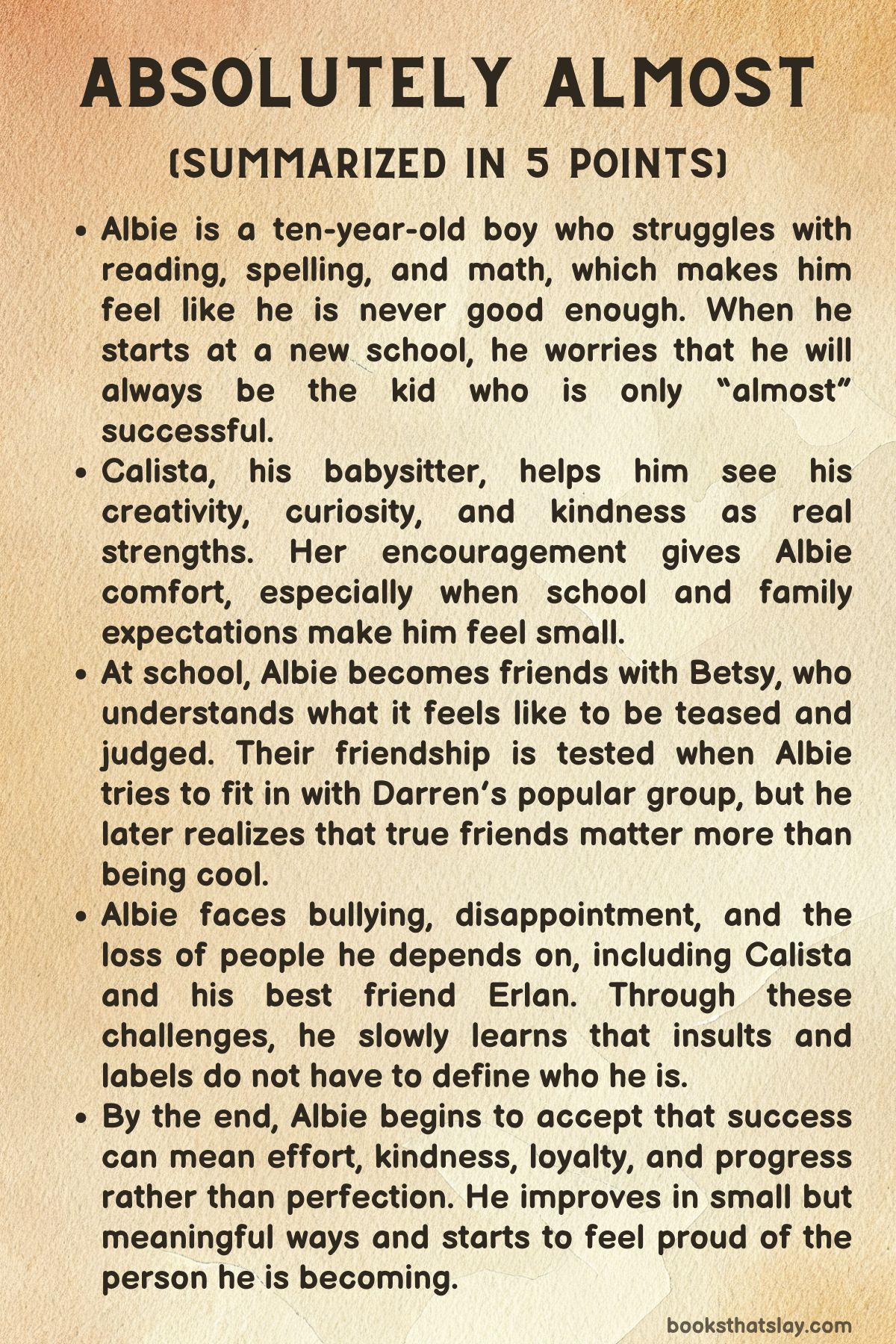
Absolutely Almost by Lisa Graff is a middle-grade novel about a boy who often feels like he never quite measures up. Ten-year-old Albie struggles in school and worries that he will always be the kid who is “almost” good enough but never truly successful.
As he starts at a new school, he meets people who see his kindness, curiosity, and determination in ways he never has before. Through friendships, family challenges, and the guidance of caring adults, Albie slowly begins to understand that intelligence and success can look different for everyone. The story explores self-worth, friendship, and the idea that being kind and persistent matters just as much as being perfect.
Summary
Ten-year-old Albie lives with his parents in a New York City apartment and is preparing to start fifth grade at a new public school. His previous school sent a letter home suggesting that he leave, though Albie never actually read it.
He only knows that school has always been difficult for him. Numbers, spelling, and reading confuse him, and he often feels slower than the other kids.
When he overhears his grandfather comparing people to rocks in a pile—some at the top and some at the bottom—Albie worries that he might be one of the rocks at the bottom.
At home, Albie’s parents care deeply about him but often struggle to understand how to help. His mother wants him to succeed academically and constantly worries about his progress.
His father believes that harder work and discipline will solve the problem. Their expectations make Albie anxious because he tries hard but still cannot keep up.
Albie’s life begins to change when his mother hires a babysitter named Calista. Calista is an art student with a relaxed attitude and a creative way of looking at the world.
At first, Albie resents having a babysitter because he thinks he is too old for one. However, Calista quickly proves that she treats him differently from the adults who usually focus on his mistakes.
Instead of criticizing him, she spends time exploring the city with him, playing games, drawing pictures, and encouraging his curiosity. She often tells him that he is smart, especially when he notices details that other people miss.
At school, Albie makes friends with a girl named Betsy. Betsy has a stutter, which causes other children—especially a boy named Darren—to tease her.
Albie likes Betsy because she is kind to him and never makes fun of him for being slow with schoolwork. She often shares gummy bears with him and patiently explains things when he does not understand.
Their friendship grows as they support each other through the teasing they both receive.
Albie’s teacher enrolls him in math club, even though math is one of his weakest subjects. The club is led by Mr. Clifton, a friendly teacher who tells jokes and makes math feel less frightening.
When Albie tries to quit because he feels embarrassed about getting answers wrong, Mr. Clifton shows him an old report card revealing that he once failed math himself. He explains that struggling with something does not mean a person cannot eventually learn it.
This encouragement begins to change the way Albie thinks about his abilities.
Outside school, Albie spends time with his best friend Erlan, who lives across the hall. Erlan’s family is filming a reality television show, which brings cameras and attention into their lives.
While the idea of fame seems exciting to Albie, Erlan secretly dislikes the constant filming and attention. Their friendship remains strong despite these changes.
Meanwhile, Albie continues to face difficulties in school. No matter how much he studies spelling with Calista, he rarely scores well on tests.
When the school counselor suggests that he might have dyslexia, Albie and his mother both hope for the diagnosis because it would explain why learning is so difficult. When the test shows that he does not have dyslexia, Albie feels even worse.
Without a clear explanation, he begins to think that something is simply wrong with him.
Despite his struggles, Albie experiences small successes. At the neighborhood bodega, he begins stacking cups while Calista talks with the shop owner.
Eventually he realizes that he is organizing them into groups of twenty-five and creating stacks that add up to one hundred. When he tells Mr. Clifton about this, the teacher points out that Albie has been doing math without realizing it.
Albie’s social life becomes complicated when Darren suddenly starts acting friendly toward him. Hoping to be accepted by the popular group, Albie begins sitting with Darren and his friends at lunch.
Darren tells him that if he wants to be “cool,” he should stop sitting with Betsy. Wanting to fit in, Albie follows this advice.
However, the choice hurts Betsy’s feelings, and their friendship begins to fade.
Soon afterward, Darren turns on Albie. Because Albie’s face is blurred in Erlan’s television show, Darren accuses him of lying about being Erlan’s friend and begins calling him “dummy.” The other boys join in, leaving Albie feeling lonely and ashamed.
He realizes that trying to be cool cost him his true friendship with Betsy.
Around the same time, Erlan’s family moves to a bigger apartment in another neighborhood because their show becomes successful. Losing his best friend next door makes Albie feel even more alone.
Things become worse on Albie’s birthday. When he brings cupcakes to school, Darren and his friends ruin them and write an insult on the box.
At home, his father gives him a model airplane kit as a birthday present, unaware that he had already given Albie the same kit long ago and forgotten about it. Feeling ignored and misunderstood, Albie throws the original model airplane out the window in frustration.
Calista notices how upset Albie is and spends the day cheering him up by taking him to the zoo. Later, she surprises him with a giant donut-shaped cake for his birthday.
Unfortunately, when Albie tries to protect Calista by forging a note explaining his absence from school, the truth is discovered. His parents fire Calista, and she disappears from his daily life.
Losing her is one of the most painful experiences Albie has faced.
Gradually, however, Albie begins rebuilding his confidence. Mr. Clifton teaches him that words like “dummy” only have power if he allows them to hurt him.
With time, Albie learns to ignore Darren’s insults.
He also reconnects with Betsy. When Darren bullies her again, Albie stands up for her and even takes the blame for something she did to protect her.
Betsy forgives him, and their friendship returns. They begin studying spelling together, using cookies as rewards instead of stressful flash cards.
Albie’s father also begins to understand him better. After learning about the first model airplane that Albie threw away, he apologizes and helps Albie finish building the second one.
The two of them work together, strengthening their relationship.
Eventually, Albie realizes that he does not need to be the smartest student or the most popular kid to have value. His kindness, creativity, and loyalty are qualities that matter just as much as perfect grades.
When Calista secretly leaves him a set of drawings showing a superhero whose power is kindness, Albie begins to see himself differently.
By the end of the story, Albie’s spelling scores have improved, though they are not perfect. He places a test with a “B” grade on his bedroom door beside the letter from his old school.
Instead of seeing it as failure, he sees it as proof that he is improving.
Albie finishes by listing the many things he now understands about himself and the world. For the first time, he recognizes that he is not a rock at the bottom of the pile.
He may still be “almost” good at many things, but he knows that kindness, effort, and friendship make him someone worth being proud of.
Characters
Albie
Albie is the central character of Absolutely Almost, and the story largely follows his thoughts, worries, and growth. He is a sensitive and observant ten-year-old who struggles academically and often feels like he is falling behind his classmates.
Throughout much of the story, Albie believes that he is simply not smart enough, especially when spelling tests, math problems, and reading assignments repeatedly frustrate him. Because he compares himself to others, he develops the painful belief that he is someone who is always “almost” good at things but never truly successful.
Despite these struggles, Albie possesses a deep sense of kindness and empathy. He stands up for Betsy when others tease her, comforts Calista when she is sad, and shows loyalty toward his friends even when he makes mistakes.
Over time, he begins to realize that intelligence is not the only measure of worth. Through encouragement from caring adults and supportive friendships, Albie slowly gains confidence and starts to see that his compassion, curiosity, and determination are valuable strengths.
Calista
Calista plays an important role as Albie’s babysitter and emotional supporter. Unlike many adults in his life who focus heavily on academic performance, Calista values creativity, curiosity, and individuality.
She approaches problems in playful and imaginative ways, which allows Albie to relax and express himself more freely. Her artistic background shapes how she interacts with the world, and she often encourages Albie to draw, observe, and experiment.
Calista consistently reassures him that he is intelligent and capable, especially when he notices details that others overlook. She treats Albie with respect and sees potential in him even when he doubts himself.
Although she is warm and supportive, she is not perfect. Her personal struggles, including difficulties with her boyfriend and pressures from art school, show that she is still figuring out her own life.
Her decision to take Albie to the zoo during a difficult day leads to consequences that ultimately cause her to lose her job. Despite this, the influence she has on Albie remains powerful, especially through the artistic encouragement and emotional reassurance she gives him.
Betsy
Betsy becomes one of Albie’s closest friends at school and represents acceptance and mutual support. She has a stutter, which causes other students to mock her, yet she remains thoughtful, patient, and kind.
Betsy treats Albie with understanding because she knows what it feels like to be judged by others. Their friendship is built on simple gestures, such as sharing gummy bears and helping each other through difficult moments.
She explains things to Albie without making him feel embarrassed and enjoys their playful conversations about bugs and other small discoveries. When Albie briefly distances himself from her in an attempt to become “cool,” Betsy is deeply hurt, which highlights her emotional honesty and self-respect.
Eventually, their friendship is repaired when Albie shows loyalty and kindness again. Betsy’s presence in the story emphasizes the importance of authentic friendship and mutual acceptance, especially among children who feel different from their peers.
Mr. Clifton
Mr. Clifton, the teacher who runs math club, serves as one of the most encouraging adult figures in Albie’s life. His teaching style is relaxed, humorous, and supportive, which contrasts with the pressure Albie feels elsewhere.
By beginning every session with jokes and games, he creates a classroom environment where mistakes are not treated as failures but as part of the learning process. Mr. Clifton’s personal story about struggling with math as a child becomes an important lesson for Albie.
Instead of presenting himself as naturally talented, he openly admits that he once found the subject extremely difficult. This honesty allows Albie to understand that learning challenges do not define a person’s future.
Mr. Clifton also helps Albie rethink the power of words when he explains that insults like “dummy” only hurt if someone believes them. Through patience and understanding, he helps Albie develop confidence and resilience.
Mrs. Rouse
Mrs. Rouse is Albie’s classroom teacher, and she represents quiet support and understanding. Although she does not openly praise Albie as often as Calista or Mr. Clifton, she consistently shows subtle encouragement.
She places him in math club because she believes it will help him grow rather than because she expects immediate success. When she notices that Albie is reading a different book than the one listed on his reading log, she chooses not to embarrass him and instead quietly encourages him to keep reading.
This small gesture reveals her awareness of his struggles and her willingness to support him without increasing his anxiety. Mrs. Rouse also protects students from hurtful language and tries to maintain a respectful environment in the classroom.
Her calm guidance helps create a space where Albie can slowly build confidence.
Albie’s Mother
Albie’s mother is a caring but often anxious parent who deeply wants her son to succeed. She believes strongly in education and worries constantly about his academic progress.
Her concern sometimes leads her to push Albie toward achievements that he finds difficult, such as reading more challenging books or running for class office. Although her intentions are good, her expectations sometimes increase Albie’s feelings of pressure and self-doubt.
At the same time, she regularly reminds him that he is caring, thoughtful, and good, showing that she values his character even when she worries about his school performance. Her protective instincts are also clear when she becomes angry at Albie’s grandfather for insulting him.
Through these moments, she demonstrates that her love for her son is strong even when she struggles to understand how best to help him.
Albie’s Father
Albie’s father initially appears strict and focused on achievement. He believes that effort and discipline are the keys to success, and he often expects Albie to perform better in school.
Because he had strong academic abilities himself, he sometimes struggles to understand why Albie finds certain subjects so difficult. This gap in understanding causes tension between them, especially when Albie receives low grades.
However, as the story progresses, his perspective softens. When he discovers the truth about the model airplane, he realizes that he has overlooked some of Albie’s efforts and feelings.
His apology and willingness to build the airplane together represent a turning point in their relationship. He begins to recognize that his son’s experiences are different from his own and that support and patience are more helpful than pressure.
Darren
Darren is one of the main sources of conflict in Albie’s school life. He is confident, popular, and often cruel toward classmates he considers weaker.
Darren frequently mocks Betsy for her speech and later targets Albie by calling him names and questioning his intelligence. His behavior reflects the social hierarchies that exist among children in school environments.
At one point he briefly pretends to be friendly with Albie, inviting him into his group and encouraging him to run for class office. However, this friendliness proves shallow and manipulative, as Darren quickly turns against him again.
Darren’s character highlights the pressure many children feel to fit into social groups and the harm caused by bullying.
Erlan
Erlan is Albie’s best friend and neighbor at the beginning of the story. His family’s reality television show introduces the idea of fame and attention into the narrative.
While others may envy Erlan’s situation, he actually dislikes being constantly filmed and judged. This experience helps illustrate that popularity and visibility do not necessarily bring happiness.
Erlan values his friendship with Albie because Albie treats him normally rather than focusing on his television fame. When Erlan’s family moves away, it becomes one of the most painful changes in Albie’s life.
Their friendship represents loyalty and the comfort of having someone who understands you without judgment.
Grandpa Park
Grandpa Park represents a harsh and critical perspective on success and intelligence. His comments about people being rocks at the bottom of the pile suggest that he believes some individuals are destined to fail.
His dismissive attitude toward Albie’s abilities deeply upsets the family and reveals how damaging such beliefs can be. When he insults Albie during dinner, Albie’s mother firmly defends her son, demonstrating that the family ultimately rejects Grandpa Park’s negative view.
His presence in the story highlights the harmful effects of labeling children based on perceived ability.
Darissa
Darissa appears later as a new student who joins math club. She becomes part of Albie’s growing circle of friends along with Betsy.
Because she is also not part of the “cool” group at school, she easily fits into the supportive friendship that Albie and Betsy develop. Albie is asked to help her adjust, which shows how much his confidence and leadership have grown since the beginning of the story.
His ability to guide someone else reflects his increasing sense of self-worth and maturity.
Themes
Self-Worth Beyond Academic Success
A powerful idea explored in Absolutely Almost is the struggle to understand personal worth when academic performance becomes the main way children are judged. Albie constantly feels that he is not good enough because schoolwork is difficult for him.
Spelling tests, math exercises, and reading assignments repeatedly remind him that other children seem to learn faster. This creates a belief that something is wrong with him.
His experiences show how children often connect their value to grades or intellectual ability, especially when adults emphasize academic success as the most important measure of achievement.
Albie’s parents, particularly his father, unintentionally reinforce this pressure. His father expects him to perform better if he simply tries harder, which causes Albie to question himself even more when effort does not lead to perfect results.
His mother also worries constantly about his performance, which makes Albie feel responsible for her anxiety. These reactions highlight how family expectations, even when they come from love and concern, can shape how children judge their own abilities.
Over time, other characters help challenge Albie’s belief that intelligence is the only important quality. Calista praises his curiosity and creativity.
Mr. Clifton points out that struggling with a subject does not mean someone is incapable of learning it. Betsy values Albie’s kindness and loyalty rather than his academic skills.
Through these interactions, Albie slowly begins to understand that success can look different for different people.
By the end of the story, Albie starts recognizing his own strengths. He notices that he is observant, thoughtful, and supportive of others.
His spelling scores improve gradually, but the more meaningful change occurs in how he sees himself. Instead of defining himself as someone who always fails, he begins to accept that progress and effort are important achievements on their own.
The theme emphasizes that children should not be measured only by academic standards, because qualities such as compassion, perseverance, and curiosity are equally valuable.
The Power of Kindness and Empathy
Acts of kindness shape many of the most meaningful relationships in the story and show how empathy can create strong connections between people who feel misunderstood. Albie’s natural instinct is to treat others with care and understanding, even when he is dealing with his own insecurities.
His friendship with Betsy grows largely because he refuses to join other students who mock her stutter. Instead, he defends her and treats her as an equal.
This respect allows both of them to feel safe around each other, forming a friendship based on mutual understanding.
Betsy responds to Albie’s kindness with patience and generosity. She often shares gummy bears with him, a small but symbolic gesture that represents acceptance and support.
She also helps him understand classroom topics without making him feel embarrassed. Their relationship demonstrates how empathy allows people to recognize each other’s struggles.
Both characters know what it feels like to be judged unfairly, and that shared experience strengthens their bond.
Calista also shows kindness in ways that influence Albie’s emotional development. Rather than focusing on his academic weaknesses, she celebrates his creativity and curiosity.
Her willingness to listen to him and treat him seriously makes him feel valued. Even simple moments, such as drawing together or exploring the city, remind Albie that adults can appreciate him for who he is rather than what he achieves in school.
The theme becomes especially meaningful when Albie begins offering the same support to others. When Calista feels heartbroken after problems in her relationship, Albie brings her ice cream to cheer her up.
When Betsy is bullied again, he stands up for her and takes responsibility for something she did so that she will not be punished. These actions show that kindness is not simply something Albie receives but also something he actively gives.
The story suggests that empathy can transform relationships and help people feel valued even when they face criticism or rejection elsewhere.
The Harmful Effects of Labels and Bullying
Social labels and bullying create much of the conflict in the story and reveal how damaging negative language can be, especially for children who already doubt themselves. Albie frequently hears words such as “dummy” from classmates like Darren.
These insults are not just casual teasing; they reinforce the fear that Albie already carries about his own abilities. Because he struggles academically, the word begins to feel like a confirmation of what others think about him.
The repeated use of this label slowly affects his confidence and shapes how he views himself.
Betsy faces a similar experience because of her stutter. Other students treat her speech difference as something to laugh at, which isolates her socially.
These reactions demonstrate how easily children can become targets when they appear different from the majority. The bullying is not limited to individual insults but becomes part of the social structure of the classroom, where popularity and “coolness” determine how people treat one another.
The story also shows how labels can influence behavior. When Darren briefly pretends to be friendly toward Albie, he encourages him to stop spending time with Betsy in order to appear cool.
For a short period, Albie accepts this idea and distances himself from his friend. This decision illustrates how social pressure can cause individuals to adopt values they do not truly believe in.
Albie eventually realizes that popularity based on exclusion and cruelty is not worth the cost.
Supportive adults help challenge the power of these labels. Mr. Clifton explains that insults only have meaning if someone accepts them as truth.
This idea encourages Albie to reconsider the way he reacts to the word “dummy.” Instead of allowing it to define him, he begins to mentally reshape the word until it loses some of its emotional impact. The theme highlights how important it is to question negative labels rather than internalize them.
Through these experiences, the narrative emphasizes the emotional damage caused by bullying and the importance of rejecting harmful stereotypes. The story also shows that overcoming such labels requires both internal strength and support from understanding people.
Growth Through Supportive Relationships
Personal growth throughout the narrative is closely connected to the presence of supportive relationships. Albie’s progress does not occur because he suddenly becomes academically gifted but because certain people help him see himself differently.
These relationships provide encouragement, patience, and understanding at moments when he feels most discouraged.
Calista plays a central role in this process. She introduces Albie to creative activities like drawing and encourages him to focus on things he enjoys rather than only on tasks that make him feel inadequate.
Her relaxed attitude allows him to experiment and learn without fear of failure. She treats mistakes as natural parts of learning rather than as evidence of weakness.
This approach contrasts with the pressure Albie often feels from school and home, giving him a new perspective on personal development.
Mr. Clifton also contributes significantly to Albie’s growth by modeling resilience. When he reveals that he once struggled with math himself, he challenges the assumption that intelligence is fixed.
His classroom environment encourages curiosity and humor, which helps Albie approach math with less fear. This supportive atmosphere allows Albie to experience moments of success that gradually build his confidence.
Friendship also becomes an important source of encouragement. Betsy’s patience and loyalty show Albie that he is valued for qualities beyond academic ability.
When their friendship temporarily breaks due to social pressure, Albie learns an important lesson about the importance of staying true to people who genuinely care about him. Their reconciliation marks an important step in his emotional maturity.
Family relationships evolve as well. Although Albie’s father initially struggles to understand his son’s learning challenges, he eventually begins to recognize Albie’s efforts and feelings.
Their shared moment building the model airplane symbolizes a new level of connection and understanding.
These relationships collectively demonstrate that personal development rarely happens in isolation. Growth often occurs when individuals receive encouragement from people who believe in their potential.
In Absolutely Almost, the supportive figures in Albie’s life help him recognize that he is capable, valuable, and deserving of confidence even when success does not come easily.