Absalom, Absalom Summary, Characters and Themes
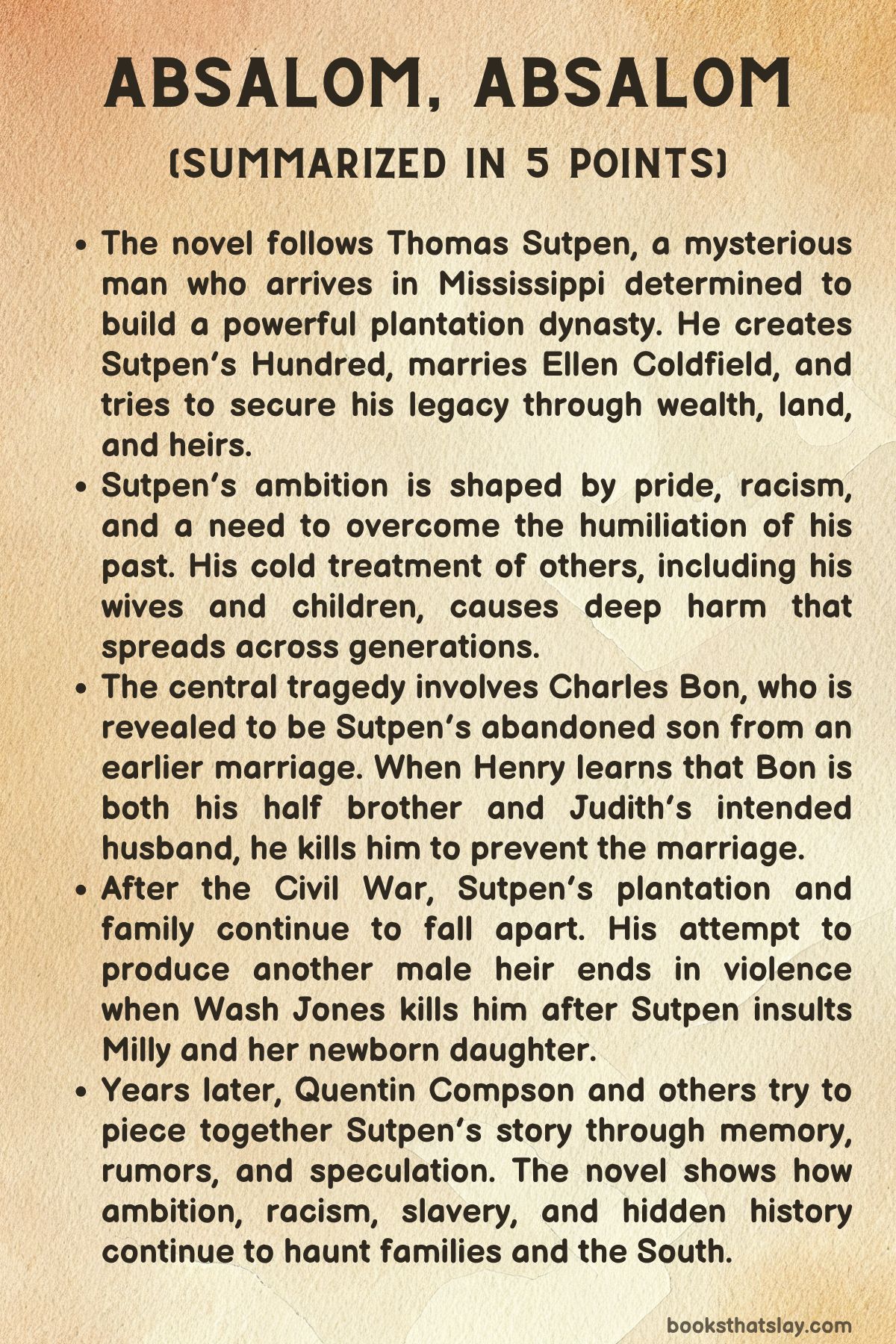
Absalom, Absalom by William Faulkner is a classic Southern Gothic novel that explores memory, history, race, and the destructive pursuit of power. Set in Mississippi before, during, and after the American Civil War, the story centers on the rise and collapse of Thomas Sutpen, a mysterious man who arrives in a small town determined to build a powerful plantation dynasty.
Through fragmented stories told by several narrators, the novel examines how personal ambition, racism, and hidden family secrets shape generations. As characters attempt to reconstruct the past, the narrative reveals how history is remembered differently by each person and how the legacy of slavery and violence continues to haunt the American South.
Summary
The story begins with Quentin Compson visiting an elderly woman named Rosa Coldfield at her house in Jefferson, Mississippi. Rosa has summoned Quentin because she wants someone to hear the history of Thomas Sutpen, a man she despises.
As she speaks, Quentin listens to a long and emotional account of Sutpen’s arrival and the destruction that followed him. Rosa’s narrative is filled with bitterness and anger, and it soon becomes clear that Sutpen’s life is closely connected to her own family.
Thomas Sutpen arrived in Jefferson in 1833 under mysterious circumstances. No one in the town knew where he came from or what his past had been.
He appeared suddenly with a horse, two pistols, several enslaved Black people, and a French architect. Shortly afterward, he obtained a large piece of land and began building a plantation called Sutpen’s Hundred.
The house that rose on the property was enormous but strangely plain, lacking decoration or warmth. During the early years, Sutpen lived there alone while enslaved workers completed the construction.
The townspeople were fascinated and suspicious of him. Sutpen behaved in unusual ways.
He invited men from town to watch violent fights between enslaved men and seemed to enjoy displays of strength and power. Despite his strange reputation, he soon sought respectability by marrying Ellen Coldfield, the daughter of a merchant.
Their marriage shocked the town at first because Sutpen’s past was unknown, but eventually the scandal faded.
Ellen moved to Sutpen’s Hundred and had two children with Sutpen: a son named Henry and a daughter named Judith. For a time, Ellen enjoyed her status as the wife of the richest man in the county.
She visited town frequently and took pride in her position. Meanwhile, her younger sister Rosa grew up mostly apart from the household.
Rosa’s mother died giving birth to her, and her father blamed her for the loss. She spent much of her childhood isolated and developed a fearful image of Sutpen, seeing him as a frightening figure.
Years later, Henry went away to university, where he met a charismatic and elegant young man named Charles Bon. The two quickly formed a close friendship.
Henry admired Bon deeply and invited him to visit Sutpen’s Hundred. During the visit, Bon and Judith appeared to grow fond of each other.
Many people assumed they would eventually marry.
However, something happened during that visit that changed everything. Henry and his father argued violently.
After the confrontation, Henry left home with Bon and gave up his inheritance. Ellen was devastated by the conflict and withdrew into her room, eventually dying after years of isolation.
As the nation moved toward civil war, Henry and Bon joined the Confederate army. Meanwhile, life at Sutpen’s Hundred grew increasingly difficult.
Judith remained at the plantation with Clytie, Sutpen’s daughter by an enslaved woman. They struggled to survive during the war years.
Eventually Judith received a letter from Charles Bon saying that he intended to return and marry her. The women began preparing for the wedding even though Henry had not reconciled with his family.
When Bon finally arrived at Sutpen’s Hundred near the end of the war, Henry confronted him at the gate. In a shocking moment, Henry shot and killed Bon before he could enter the house.
The reasons for the murder remained unclear for many years. People in Jefferson speculated about jealousy or betrayal, but the true explanation was hidden.
After the war, Thomas Sutpen returned home to find his plantation in ruins. Despite the destruction, he immediately began trying to rebuild his former power.
During this time he proposed marriage to Rosa Coldfield. She accepted, believing that the marriage might restore dignity to the broken household.
However, the engagement ended in humiliation. Sutpen revealed a cruel condition for the marriage.
He suggested that Rosa should bear him a son before the wedding so that he could ensure the continuation of his family line. Rosa was deeply insulted and left the plantation in anger.
She never forgave him.
Sutpen’s life continued to decline. Determined to produce another male heir, he began a relationship with Milly Jones, the teenage granddaughter of a poor white man named Wash Jones.
Milly became pregnant and later gave birth to a child. When Sutpen discovered that the baby was a girl instead of a boy, he reacted with cold indifference and insulted Milly.
Wash Jones, who had trusted and admired Sutpen, was furious at the way his granddaughter had been treated. In a violent act of revenge, he killed Sutpen with a scythe and then killed Milly and the baby before taking his own life.
Although Sutpen was dead, the consequences of his earlier actions continued to unfold. It was eventually revealed that Charles Bon had been Sutpen’s son from an earlier marriage in the Caribbean.
Years before arriving in Mississippi, Sutpen had married a woman there and had a child with her. When he learned that she had Black ancestry, he abandoned both wife and child and began his plan for a new dynasty in Mississippi.
This meant that Charles Bon and Judith were half siblings. Sutpen had discovered this secret before the planned marriage and had tried to stop it.
Henry eventually learned the truth as well. The knowledge forced him to choose between protecting his sister and preserving his friendship with Bon.
In the end, Henry killed Bon to prevent the marriage and the scandal it would cause.
After Bon’s death, Bon’s mixed-race son, Charles Etienne de Saint Valery Bon, was brought to Sutpen’s Hundred and raised there by Judith and Clytie. Years later, Charles Etienne had a son named Jim Bond, who would become the last living descendant of Sutpen.
Tragedy continued to strike the remaining members of the family. Judith and Charles Etienne both died during an outbreak of yellow fever.
Only Clytie and Jim Bond remained at the decaying plantation house.
Years later, Rosa Coldfield became convinced that someone else was secretly living inside the ruined mansion. She asked Quentin Compson to accompany her to the house to investigate.
One night they went together to Sutpen’s Hundred. Clytie tried to stop Rosa from entering, but Rosa pushed past her and went upstairs.
Inside one of the rooms Quentin discovered Henry Sutpen, who had secretly returned to the house after decades in hiding. Henry was old and sick and had come back to die where his family’s story had begun.
Quentin took Rosa away from the house, but the discovery soon led to another tragedy. When Rosa later sent help to retrieve Henry, Clytie believed strangers were coming to capture him.
In desperation she set fire to the house to protect him. The burning building destroyed the last remains of Sutpen’s Hundred and killed both Clytie and Henry.
Only Jim Bond escaped the fire. He wandered away from the ruins, leaving behind the final remnants of Sutpen’s failed dream of a powerful dynasty.
Years later, Quentin recounts the entire story to his roommate Shreve while studying at Harvard. Together they attempt to reconstruct the past from fragments of memory and speculation.
As they discuss the events, they reflect on how Sutpen’s ambition, racism, and secrecy destroyed his family and left a legacy of suffering.
The conversation ends with Quentin struggling to understand the meaning of the story and its connection to the history of the American South. Even though the plantation and its owner are gone, the consequences of that history continue to shape the lives of those who remember it.
Characters
Thomas Sutpen
Thomas Sutpen is the central figure around whom the entire story revolves. He is a man defined by relentless ambition and an unwavering desire to build a powerful family dynasty.
Arriving mysteriously in Mississippi with no known past, he immediately begins creating the foundation of his grand plan by establishing Sutpen’s Hundred. His determination is shaped by an early experience of humiliation during childhood, when he realized the rigid class and racial hierarchy of Southern society.
From that moment, he decided that he would never again occupy a position of weakness. This decision becomes the driving force behind his life.
Sutpen’s personality is characterized by emotional detachment and ruthless practicality. He views people not as individuals with feelings but as components in a larger design meant to fulfill his vision of success.
His marriage to Ellen Coldfield is less an act of love than a strategic step toward social respectability. Similarly, his treatment of others, including his children and the people who work for him, reflects his belief that they exist only to serve his goals.
His willingness to abandon his first wife and child when he learns of their mixed racial heritage reveals the depth of his prejudice and his obsession with maintaining a “pure” lineage.
Despite his outward strength and confidence, Sutpen’s life gradually collapses under the weight of his own decisions. His carefully constructed plan fails because he cannot control the moral and emotional consequences of his actions.
The revelation of Charles Bon’s identity destroys his family structure, while his cold behavior toward Milly Jones ultimately leads to his violent death. In Absalom, Absalom, Sutpen represents the destructive power of unchecked ambition and the tragic consequences of building a life on exploitation, racism, and emotional indifference.
Quentin Compson
Quentin Compson serves as one of the primary narrators and observers of the story. As a young man from Mississippi studying at Harvard, Quentin becomes deeply involved in piecing together the history of Thomas Sutpen and his family.
Much of the narrative unfolds through Quentin’s attempts to understand the past, often through conversations with others who remember the events differently. His role is not simply to recount the story but to struggle with its meaning and implications.
Quentin’s personality reflects the burden of historical memory. Growing up in the South, he has inherited a complicated relationship with the region’s past, including its traditions, social structures, and racial conflicts.
As he listens to Rosa Coldfield and later discusses the story with his roommate Shreve, Quentin becomes increasingly troubled by the moral failures embedded in the history he is trying to reconstruct. The more he learns about Sutpen’s actions, the more he feels the weight of that legacy.
His emotional response to the story reveals his deep internal conflict. Quentin wants to understand the forces that shaped the people of the South, yet he is also disturbed by the cruelty and injustice at the center of that history.
This tension becomes especially clear during his conversations with Shreve, when he insists that he does not hate the South even though the story clearly causes him pain. Quentin ultimately represents the struggle of a younger generation trying to come to terms with a troubled past that continues to influence the present.
Rosa Coldfield
Rosa Coldfield is one of the earliest narrators of the story and a character driven by intense resentment toward Thomas Sutpen. Her life has been deeply shaped by the events surrounding Sutpen and his family, and she spends many years holding onto bitterness and anger.
When she tells the story to Quentin, her narrative is filled with emotional intensity and moral judgment, revealing how strongly she feels about the injustice she believes Sutpen brought into her life.
Rosa’s childhood was marked by loneliness and emotional neglect. Her mother died giving birth to her, and her father blamed her for the loss.
Growing up without affection, she developed a rigid sense of morality and a deep awareness of humiliation. These early experiences contribute to the severity of her reaction when Sutpen later insults her during their engagement.
What might have been a personal disappointment becomes, for Rosa, a defining moment of betrayal and disgrace.
Her hatred for Sutpen continues long after his death, shaping her view of the entire family history. Yet beneath her anger lies a sense of personal tragedy.
Rosa has spent much of her life isolated, clinging to memories and grievances that prevent her from moving forward. Her decision to revisit Sutpen’s Hundred near the end of her life shows both her obsession with the past and her desire to confront it directly.
Through Rosa, the narrative illustrates how unresolved resentment can dominate a person’s identity for decades.
Henry Sutpen
Henry Sutpen, the son of Thomas Sutpen and Ellen Coldfield, plays a crucial role in the tragic events that unfold within the family. As a young man, Henry admires his friend Charles Bon and quickly forms a deep attachment to him during their time at university.
Their friendship appears intense and possibly complicated, suggesting emotional connections that Henry struggles to fully understand.
Henry’s relationship with his father becomes strained when Sutpen reveals the truth about Charles Bon’s background. Learning that Bon is both his half brother and a man of mixed racial ancestry forces Henry into an impossible moral dilemma.
On one hand, he loves and respects Bon as a friend. On the other hand, he feels compelled to protect his sister Judith from an incestuous marriage that would also violate the racial boundaries of Southern society.
The moment Henry kills Charles Bon marks the turning point of his life. After committing the act, he spends many years in hiding, separated from the world and haunted by the consequences of his decision.
His eventual return to Sutpen’s Hundred late in life reflects a desire to confront the past and accept his fate. Henry’s story illustrates how a single moment of violence, shaped by social pressures and personal conflict, can determine the course of an entire lifetime.
Judith Sutpen
Judith Sutpen, the daughter of Thomas Sutpen and Ellen Coldfield, represents a quieter but deeply tragic presence in the narrative. Unlike many of the other characters, Judith rarely speaks directly, and much of her character must be understood through the memories and interpretations of others.
Despite this distance, she emerges as a figure marked by resilience and quiet strength.
Judith’s relationship with Charles Bon forms one of the emotional centers of the story. She appears to genuinely care for him and prepares for their expected marriage with excitement and hope.
When Bon is killed at the gate of Sutpen’s Hundred, Judith must confront a devastating loss that changes the direction of her life. Instead of collapsing under grief, she continues to live at the plantation and takes responsibility for the household during the difficult years after the Civil War.
Her later decision to raise Charles Bon’s son reveals her compassion and sense of loyalty. By accepting the child into the household, Judith acknowledges Bon’s memory and defies the rigid racial attitudes that shaped her father’s actions.
Her eventual death during a yellow fever epidemic brings a quiet end to her life, reinforcing the theme that many of the people connected to Sutpen’s story suffer consequences they did not create.
Charles Bon
Charles Bon is one of the most mysterious and intriguing characters in the story. From the moment he appears, he captivates those around him with his elegance, charm, and calm confidence.
His friendship with Henry Sutpen and his romantic relationship with Judith place him at the center of the family’s tragic history.
Bon’s past, however, contains secrets that ultimately determine his fate. As the abandoned son of Thomas Sutpen’s earlier marriage, he carries a connection to the family that he only partially understands.
His mixed racial heritage and his existing marriage to a woman in New Orleans complicate his identity and position within Southern society. Despite these obstacles, Bon continues to pursue his relationship with Judith, possibly as a way of confronting his father’s rejection.
His decision to return to Sutpen’s Hundred and marry Judith despite knowing the risks suggests a mixture of defiance and resignation. Bon seems aware that his actions could provoke a violent response, yet he proceeds anyway.
His death at the hands of Henry becomes the most dramatic moment in the narrative, exposing the hidden secrets that Sutpen tried to conceal. Bon’s character embodies the consequences of a past that refuses to remain hidden.
Clytie Sutpen
Clytie, often called Clytie, is Thomas Sutpen’s daughter by an enslaved woman. She grows up within the household yet exists on the margins of the family structure due to racial divisions.
Despite this position, she becomes one of the most loyal guardians of the Sutpen household.
Clytie’s life is defined by devotion to the remnants of the family after its decline. She remains at Sutpen’s Hundred long after the others have died or disappeared, caring for Judith and later for Jim Bond.
Her loyalty suggests a complicated relationship with the family that both includes and excludes her.
Her final act of burning the house represents a desperate attempt to protect Henry from capture. In doing so, she destroys the physical symbol of Sutpen’s ambition.
Her death in the fire marks the end of the plantation and the last attempt to preserve its legacy. Clytie’s story highlights the contradictions of loyalty within a system built on inequality and injustice.
Charles Etienne de Saint Valery Bon
Charles Etienne de Saint Valery Bon is the son of Charles Bon and his mixed race partner in New Orleans. After his father’s death, he is brought to Sutpen’s Hundred and raised by Judith and Clytie.
His life represents the continuation of the complex racial and familial connections created by Thomas Sutpen’s earlier actions.
As he grows older, Charles Etienne struggles with identity and belonging. He is both a descendant of the Sutpen family and someone marginalized by the racial hierarchy of Southern society.
His marriage and later behavior reflect a sense of instability and anger, suggesting that he cannot reconcile the conflicting parts of his heritage.
His death during the yellow fever epidemic ends his troubled life, but his son Jim Bond survives him. Through Charles Etienne, the narrative shows how the consequences of Sutpen’s decisions extend across generations.
Jim Bond
Jim Bond is the great grandson of Thomas Sutpen and the final living descendant of the family line. He is portrayed as intellectually disabled and lives under the care of Clytie at the decaying plantation house.
Although he appears only briefly in the story, his presence carries symbolic significance.
Jim Bond represents the ultimate outcome of Sutpen’s failed attempt to create a powerful and “pure” dynasty. Instead of producing the strong male heirs Sutpen desired, the family line ends with a vulnerable and marginalized figure wandering alone after the destruction of the plantation.
His survival after the burning of Sutpen’s Hundred suggests that history continues even after the collapse of grand ambitions. In Absalom, Absalom, Jim Bond stands as a haunting reminder that the consequences of past actions cannot be erased and will continue to shape the future long after the original actors are gone.
Themes
The Destructive Nature of Ambition
Thomas Sutpen’s life demonstrates how ambition, when pursued without moral limits, can lead to personal and social destruction. His entire existence is built around what he calls a “design,” a rigid plan to create a powerful plantation dynasty in the American South.
This design includes acquiring land, gaining wealth, marrying into respectable society, and producing male heirs who will continue his lineage. However, the ambition that drives Sutpen is not guided by empathy or ethical reflection.
Instead, it is shaped by humiliation from his childhood, when he learned that social power in the South was controlled by wealth, race, and status. That moment produces a determination to control his destiny at any cost.
Sutpen’s ambition causes him to treat human relationships as tools rather than meaningful bonds. His marriage to Ellen Coldfield is motivated less by affection than by the desire to secure social legitimacy in Jefferson.
He views his children primarily as extensions of his plan rather than as individuals with their own lives and emotions. When obstacles arise that threaten the structure he has built, Sutpen attempts to solve them through cold logic rather than compassion.
His abandonment of his first wife and child after discovering their racial background reveals the depth of his commitment to maintaining a socially acceptable lineage.
The collapse of Sutpen’s dream demonstrates that ambition alone cannot control the complexities of human life. The secret of Charles Bon’s identity destroys the structure he worked so hard to create, leading to murder, isolation, and generational tragedy.
Even after the Civil War devastates the plantation economy, Sutpen refuses to abandon his vision, continuing to pursue a male heir despite the ruin around him. His final attempt to restart the dynasty through Milly Jones leads directly to his death.
The theme shows that ambition built on domination and denial of human value ultimately produces the very ruin it attempts to avoid. Sutpen’s life becomes a warning about the consequences of constructing a future through power rather than responsibility.
The Burden of History and Memory
The narrative structure itself reflects how the past continues to shape the present. Characters spend years reconstructing events that occurred decades earlier, showing how memory becomes a powerful force in understanding identity and history.
The story unfolds through multiple narrators, including Rosa Coldfield, Mr. Compson, Quentin Compson, and Shreve. Each narrator remembers or imagines events differently, creating a layered account in which the truth is constantly reexamined.
This approach reflects the idea that history is not a single fixed story but a collection of interpretations shaped by emotion, perspective, and distance.
Quentin Compson’s involvement in the narrative illustrates how younger generations inherit the psychological weight of earlier events. Although he did not witness the rise or fall of Thomas Sutpen directly, the story becomes deeply personal to him.
Listening to Rosa and discussing the events with Shreve forces Quentin to confront the moral failures embedded in Southern history. The plantation, the violence, and the racial divisions described in the story represent a broader history that continues to influence the society in which Quentin grew up.
Memory also shapes the identities of other characters. Rosa Coldfield spends much of her life defined by her resentment toward Sutpen, demonstrating how the past can trap individuals within emotional cycles that never fully resolve.
Her decision to revisit Sutpen’s Hundred near the end of her life shows how memory compels people to revisit painful experiences even when doing so offers little comfort.
The fragmented storytelling in Absalom, Absalom mirrors the difficulty of understanding historical truth. Characters often rely on speculation and imagination to fill the gaps in what they know.
This uncertainty emphasizes how history survives through storytelling rather than through direct experience. The theme highlights how individuals and communities remain connected to events that occurred long before their own lifetimes, suggesting that the past continues to influence identity, morality, and cultural understanding across generations.
Race, Slavery, and the Social Structure of the South
The social world depicted in the story is shaped by the racial hierarchy that defined the American South before and after the Civil War. Sutpen’s plantation exists within a system built on slavery, and the labor of enslaved people is essential to the creation of his wealth and power.
From the moment he arrives in Mississippi, Sutpen relies on enslaved workers to clear land, construct his mansion, and sustain the plantation economy. The existence of Sutpen’s Hundred itself reflects the broader historical reality of plantations that depended on exploitation and racial oppression.
Sutpen’s attitudes toward race are central to the tragedy that unfolds. His decision to abandon his first wife and child after discovering their partial African ancestry reveals the extreme importance he places on racial purity.
In the social environment he inhabits, the legitimacy of his family line depends on maintaining clear racial boundaries. This belief becomes the reason he tries to prevent Charles Bon from marrying Judith.
The possibility that his daughter might marry someone with mixed ancestry threatens the image of respectability that Sutpen has spent years constructing.
The characters who exist outside the dominant racial hierarchy reveal the human cost of this system. Clytie, Sutpen’s daughter by an enslaved woman, lives within the household yet remains excluded from the privileges enjoyed by her white relatives.
Her position reflects the contradictions of a society that recognizes family connections while simultaneously enforcing racial divisions. Charles Etienne and his son Jim Bond also represent the complicated legacy created by these divisions, as they inherit identities shaped by both family ties and social prejudice.
The eventual survival of Jim Bond after the destruction of the plantation carries symbolic meaning. Sutpen’s obsession with racial purity ultimately fails, leaving his final descendant as a man who exists outside the rigid categories that Sutpen tried to maintain.
Through these characters and events, the narrative exposes how racial ideology shapes personal decisions and social structures while also demonstrating the instability of those boundaries over time.
The Collapse of the Southern Aristocratic Dream
The rise and fall of Sutpen’s Hundred mirrors the broader decline of the plantation aristocracy in the American South. Before the Civil War, plantations represented wealth, authority, and social prestige.
Sutpen’s determination to build such a plantation reflects his desire to enter this elite class and secure a lasting legacy. The large mansion, the vast landholdings, and the carefully constructed family line all symbolize the traditional ideals associated with Southern aristocratic power.
However, the story reveals that this social structure is built on unstable foundations. The plantation economy depends on enslaved labor and rigid racial hierarchies, both of which become increasingly fragile as political and social tensions grow.
The Civil War disrupts this system dramatically, leaving plantations financially ruined and socially disorganized. When Sutpen returns from the war, the world that once supported his ambitions has already begun to disappear.
The physical deterioration of Sutpen’s Hundred after the war reflects the decline of the entire social order that produced it. The mansion becomes a decaying structure inhabited by only a few remaining family members.
Judith and Clytie struggle to maintain the household despite limited resources, showing how the grandeur of the plantation era has been replaced by hardship and isolation. The once powerful estate becomes a symbol of failure rather than success.
The final destruction of the house by fire marks the complete collapse of Sutpen’s dream. With the deaths of Henry and Clytie, the last physical connection to the plantation disappears.
What remains is only memory and speculation about the events that took place there. In Absalom, Absalom, the fall of Sutpen’s Hundred represents the end of a social system that once defined Southern identity.
The story suggests that the ideals associated with that system were always unstable because they relied on inequality, violence, and unrealistic expectations about permanence and control.