Anne of Avonlea Summary, Characters and Themes
Anne of Avonlea by Lucy Maud Montgomery is the second novel in the Anne Shirley (Anne of Green Gables) series. It follows Anne after her years as a student, when she becomes a young teacher in Avonlea and begins learning what adulthood means.
The story is gentle, comic, and warm, centered on everyday village life rather than large dramatic events. Anne is still imaginative and impulsive, but she is also growing more responsible. Through teaching, friendships, mistakes, children, neighbors, romance, and change, the plot shows Anne standing between girlhood and womanhood while keeping her bright, hopeful spirit alive.
Summary
Anne of Avonlea begins with Anne Shirley at sixteen, living at Green Gables with Marilla Cuthbert and preparing to teach at the Avonlea school. Anne is older than she was in Anne of Green Gables, but she still drifts into dreams and ideals.
Her first conflict comes through Mr. Harrison, the new neighbor, whose blunt manners, untidy home, and rude parrot Ginger make him a subject of local gossip. When Anne’s cow Dolly gets into his oats, he storms over in anger.
Anne tries to be polite, but his insult about her red hair makes her answer sharply. Their first meeting is awkward and fiery, but it begins one of the book’s most enjoyable friendships.
Soon after, Anne makes a serious mistake. Seeing a Jersey cow in Mr. Harrison’s field, she assumes it is Dolly and sells it to a passing buyer.
Only later does she discover Dolly is still safely locked up and that she has sold Mr. Harrison’s cow instead. Mortified, Anne goes to apologize with a cake.
To her surprise, Mr. Harrison is not furious. He admits that he is also too quick-tempered, and the two share tea.
Anne learns that beneath his roughness he is lonely and kind in his own odd way. Their friendship grows, though Ginger continues to insult her.
Anne’s new life as a teacher begins with anxiety. She worries that her former schoolmates will not respect her, and she firmly believes she can manage her classroom through affection rather than punishment.
Her friends have different views: Jane Andrews believes discipline must be strict, while Gilbert Blythe takes a more moderate position. Anne’s first day is exhausting but not disastrous.
She meets new students, including difficult Anthony Pye and imaginative Paul Irving. Paul immediately attracts Anne because he sees the world with the same unusual brightness she does.
He becomes one of her favorite pupils.
Teaching tests Anne’s ideals. She tries to win Anthony Pye through patience, but he resists her kindness.
One day, while suffering from a toothache and a bad mood, Anne loses control. After a classroom prank involving a mouse, she whips Anthony, breaking her promise never to use physical punishment.
She is ashamed afterward, yet the event strangely earns Anthony’s respect. The moment does not prove Anne’s ideals false, but it teaches her that growing up means facing her own limits.
Meanwhile, Anne and Gilbert help start the Avonlea Village Improvement Society. Their goal is to make the village cleaner and more beautiful, but the society faces resistance, jokes, and accidents.
The most famous disaster happens when the town hall, meant to be painted green, is painted a dreadful blue. At first Anne thinks this will ruin the society, but the mistake brings the community together in support of improvement.
Later, the society stops a plan to cover a roadside fence with advertisements, partly because Anne accidentally witnesses a political conversation that gives Mr. Parker a reason to cooperate.
Green Gables changes when Marilla takes in six-year-old twins, Davy and Dora Keith, after the death of their mother. Dora is obedient and proper, while Davy is restless, mischievous, curious, and often troublesome.
He steals food, torments Dora, asks impossible questions, and causes disasters in the house and at church. Anne and Marilla are often worn out by him, but they also grow deeply attached to him.
Davy’s behavior slowly improves because of their care, though he never becomes easy to manage. His presence adds humor and chaos to Green Gables and also reminds Anne of her own lonely childhood.
Anne’s friendship with Paul Irving becomes especially important. Paul lives with his grandmother while his father, Stephen Irving, is away.
Like Anne, Paul has a rich imagination. He tells her about the “rock people” he sees near the shore and worries that others think something is wrong with him.
Anne reassures him that his imagination is a gift, not a defect. Paul’s tenderness toward his dead mother and his trust in Anne reveal the softer emotional center of the story.
Anne also meets Miss Lavendar Lewis after she and Diana take the wrong road during a walk. They arrive at Echo Lodge, a charming stone house where Miss Lavendar lives with Charlotta the Fourth.
Miss Lavendar is older, unmarried, whimsical, and lonely, yet still lively and romantic in spirit. Anne immediately feels close to her.
Later, Anne learns that Miss Lavendar was once engaged to Stephen Irving, Paul’s father. Their engagement ended many years earlier because of pride, jealousy, and a foolish quarrel.
Both lived with the consequences of that separation.
Anne begins bringing Paul to Echo Lodge, and Miss Lavendar is moved by how much he resembles Stephen. Paul and Miss Lavendar quickly become friends, and Anne begins hoping that the old romance might be repaired.
When Stephen eventually returns to Prince Edward Island, he asks Anne about Miss Lavendar. Anne arranges for him to visit Echo Lodge.
The meeting restores the bond between them, and Stephen proposes. Miss Lavendar accepts, bringing a long period of regret to a peaceful close.
The novel is filled with smaller comic incidents that show Anne still has plenty of the impulsive girl in her. She breaks Miss Barry’s valuable blue willow platter and must search for a replacement.
That errand leads her to the Copp sisters, where she climbs onto a shed roof to look through a pantry window and falls through. Another time, she eagerly prepares for a visit from the famous writer Charlotte Morgan, only for the visit to be delayed.
When Mrs. Morgan later arrives unexpectedly, Anne is caught doing messy housework, covered in feathers, and with her nose stained red from a mistaken bottle of dye. Despite her embarrassment, she manages the visit with dignity and learns to stop worrying so much about her looks.
Mr. Harrison’s story also develops. Avonlea assumes he is a bachelor, but his wife Emily suddenly arrives.
Anne learns that the couple separated years before because of stubbornness, household neatness, and Ginger the parrot. After Ginger dies during a terrible storm, Emily returns and takes charge of the house.
Mr. Harrison pretends to be resigned to his fate, but he is clearly pleased to have her back. This reunion adds another example of old misunderstandings being healed.
As Anne’s two years of teaching come to an end, change comes to Avonlea. Thomas Lynde dies, leaving Mrs. Rachel Lynde alone.
Marilla, whose eyesight remains a concern, invites Rachel to live at Green Gables. This arrangement makes it possible for Anne to resign from teaching and attend Redmond College with Gilbert.
Anne is thrilled by the chance to continue her education, though she is sad to leave Marilla, the twins, her students, Diana, Paul, and the places she loves.
Diana’s engagement to Fred Wright makes Anne feel that childhood is slipping away. Anne loves Diana and promises to be her bridesmaid, but she is unsettled by the fact that Diana has entered a more adult world.
Anne still clings to her dream of an ideal romantic hero and refuses to think seriously about Gilbert. Yet Gilbert’s steady presence keeps entering her thoughts, even when she tries to dismiss it.
The book closes with Miss Lavendar and Stephen’s wedding at Echo Lodge. Anne helps prepare the house and watches the ceremony with joy.
Afterward, she waits with Gilbert, and their conversation about Miss Lavendar and Stephen quietly changes something in her. Gilbert suggests it would have been better if the lovers had never lost so many years to pride and misunderstanding.
Anne suddenly senses that love may not always arrive as a dramatic dream, but may grow beside a person through familiar friendship and loyalty. She is not ready to admit her feelings, but she has begun to see Gilbert differently.
Anne of Avonlea ends with Anne leaving childhood behind, ready for college, change, and the wider life ahead.
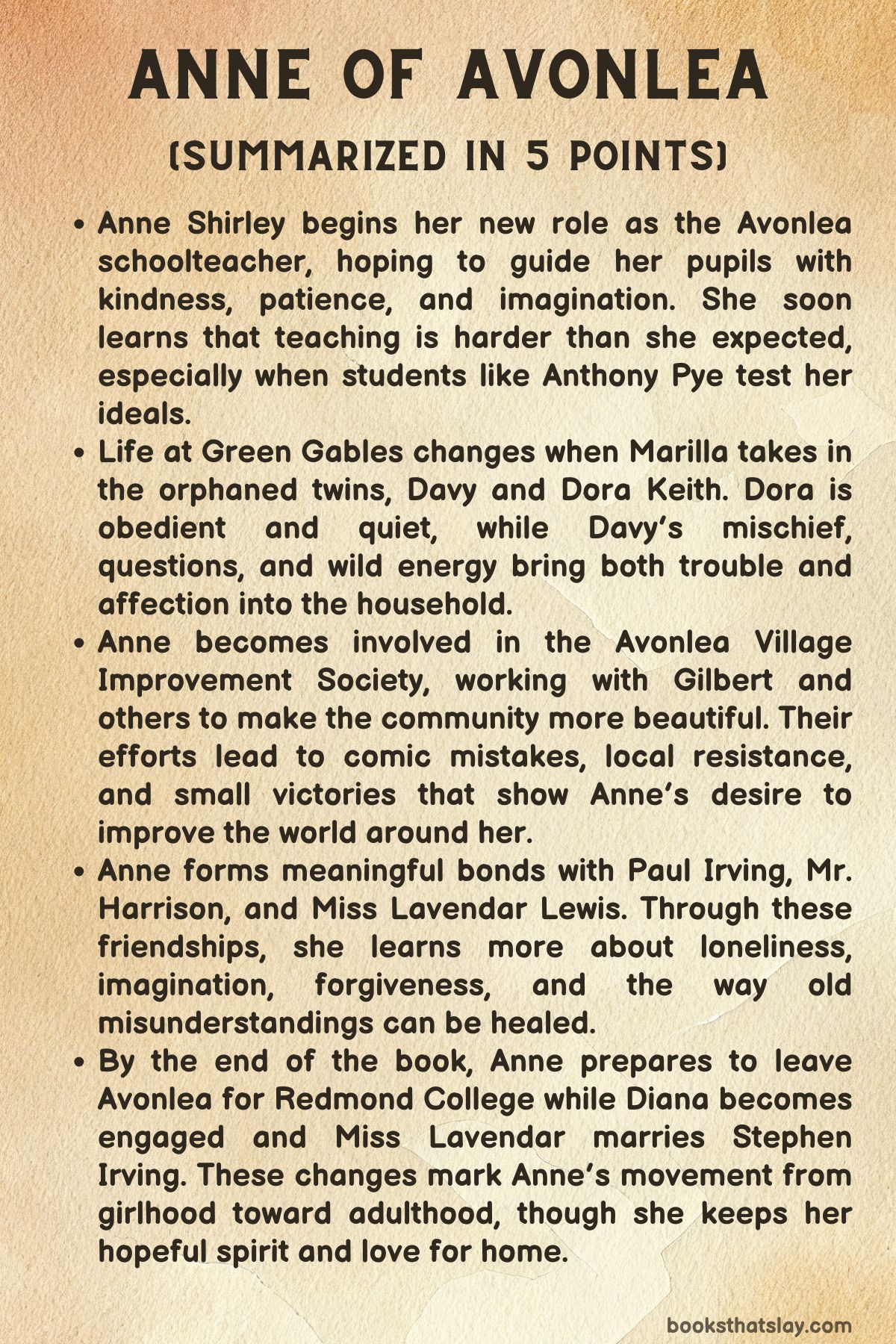
Characters
Anne Shirley
Anne Shirley stands at the center of Anne of Avonlea as a young woman caught between the imaginative freedom of childhood and the duties of adulthood. She is no longer the lonely orphan who first arrived at Green Gables, but she has not lost the emotional intensity, romantic imagination, and quick sensitivity that define her.
Her new position as the Avonlea schoolteacher forces her to test her ideals against real life. Anne begins with firm beliefs about kindness, beauty, and moral influence, especially in the classroom, but she quickly learns that good intentions do not always produce perfect results.
Her struggle with Anthony Pye shows this clearly: she wants to win him through patience, yet frustration leads her to act against her own principles. This does not make her weak; it makes her human.
Anne’s mistakes are part of her growth.
Anne is also a character who tries to improve the world around her. Through the Village Improvement Society, her teaching, her friendships, and her influence on children like Paul and Davy, she wants life to be finer, cleaner, kinder, and more beautiful.
She often sees possibilities where others see only ordinary roads, old houses, awkward neighbors, or troublesome children. At the same time, the book does not present her imagination as childish nonsense.
It is one of her greatest strengths, because it helps lonely people feel seen. Paul Irving, Miss Lavendar, and even Mr. Harrison respond to Anne because she meets them with openness rather than judgment.
Her emotional journey also includes a quiet awakening toward Gilbert. She still clings to a dream of an ideal romantic figure, but by the end of the story, she begins to sense that real love may arrive through friendship, loyalty, and shared growth.
Marilla Cuthbert
Marilla Cuthbert remains practical, stern, and emotionally restrained, but the book shows how much she has softened since Anne first came to Green Gables. She is still cautious in speech and firm in discipline, yet her heart is more open than her manner suggests.
Her decision to take in Davy and Dora Keith reveals her moral seriousness and quiet compassion. She does not adopt them because it is easy or convenient; she does it because the children need care.
Davy tests her patience constantly, and Marilla often reacts with frustration, but her affection for him grows in spite of herself. His impulsive hugs and honest questions reach the tenderness she usually tries to hide.
Marilla also serves as a grounding force for Anne. Where Anne becomes carried away by ideals, romance, or despair, Marilla offers common sense.
She reminds Anne not to collapse when plans fail and not to dress ordinary disappointments in grand tragedy. Yet Marilla is not simply a practical contrast to Anne.
She understands love through action rather than speech. Her willingness to invite Mrs. Rachel Lynde to live at Green Gables shows both kindness and wisdom.
By doing so, she gives Rachel security after widowhood and frees Anne to attend college. Marilla’s love is quiet, but it is one of the strongest forces in the story.
Gilbert Blythe
Gilbert Blythe represents steadiness, ambition, patience, and emotional maturity. He is Anne’s friend and intellectual equal, but he is also ahead of her in understanding his own feelings.
While Anne still imagines romance as something dramatic and idealized, Gilbert’s love is rooted in daily companionship and respect. He admires Anne not because she fits a fantasy, but because he knows her as she truly is: brilliant, impulsive, loyal, funny, and flawed.
His desire to become a doctor shows his practical sense of purpose. He wants to do useful work in the world, and this gives him a grounded seriousness that balances Anne’s more romantic hopes.
Gilbert’s role in the book is subtle but important. He does not pressure Anne, and he does not force his feelings into the open before she is ready.
Instead, he remains near her as a friend, colleague, and quiet supporter. Their conversations about teaching, the Village Improvement Society, and the future reveal a deep partnership already forming beneath the surface.
By the end, when he reflects on the wasted years between Miss Lavendar and Stephen, his words touch Anne because they speak indirectly to their own future. Gilbert’s patience makes him one of the novel’s most emotionally stable characters.
Diana Barry
Diana Barry is Anne’s dearest friend and a symbol of loyalty, comfort, and ordinary happiness. She is less imaginative than Anne, but she never dismisses Anne’s inner world cruelly.
Instead, she accepts Anne’s romantic language and emotional intensity as part of the person she loves. Diana is practical, affectionate, and dependable.
She joins Anne in many adventures, including the search for the replacement platter and the visits connected with the Village Improvement Society. Her presence often gives Anne’s life warmth and continuity.
Diana’s engagement to Fred Wright marks one of the clearest signs that childhood is ending. Anne is happy for her, but she also feels a sudden loneliness because Diana has entered a stage of life Anne does not yet understand.
Diana’s choice of Fred is important because he does not match Anne’s romantic expectations. To Anne, he seems too ordinary, but to Diana, he is the person with whom she can imagine a home and future.
Through Diana, the book shows that love does not need to look poetic from the outside to be real. Diana’s growth is quieter than Anne’s, but it is just as meaningful.
Davy Keith
Davy Keith is one of the most lively and difficult children in the book. He arrives at Green Gables after his mother’s death and immediately disrupts the household with mischief, questions, appetite, and noise.
He torments Dora, steals preserves, creates trouble at church, hides his sister, and tests every rule placed before him. Yet Davy is not cruel at heart.
He is energetic, undisciplined, and shaped by a lack of steady guidance before coming to Marilla and Anne. His behavior often comes from curiosity, a desire for attention, or a wish to create excitement.
Davy’s importance lies in the way he brings out both frustration and tenderness in Anne and Marilla. He forces them to practice the patience they believe in.
Anne sees something of her own neglected childhood in him, which makes her more forgiving. Marilla, though often exasperated, becomes deeply attached to him.
Davy is also comic, especially through his literal questions about religion, death, sleep, and adulthood. His gradual improvement suggests that love and structure can reshape a child without erasing his spirit.
He remains mischievous, but he becomes more secure, more affectionate, and more aware of right and wrong.
Dora Keith
Dora Keith is Davy’s twin sister, but she is almost his opposite. She is obedient, neat, quiet, and proper.
Adults often find her easy to manage because she causes little trouble, yet this very goodness makes her less vivid beside Davy. Dora’s character shows the limits of perfect behavior in fiction and in family life.
She is admirable, but she does not demand attention in the same way her brother does. This creates a realistic contrast: the troublesome child often receives more emotional energy than the well-behaved one.
Dora also serves as a measure of Davy’s behavior. His pranks against her reveal his immaturity, but his claim that he would not let anyone else hurt her shows that his teasing exists alongside genuine sibling loyalty.
Dora’s fearfulness and vulnerability make the adults protective of her. Though she does not transform as dramatically as Davy, her presence matters because she helps define the new family structure at Green Gables.
She brings softness and order, while Davy brings disorder and growth.
Paul Irving
Paul Irving is one of the most imaginative and sensitive children in Anne of Avonlea. He immediately draws Anne’s attention because he seems to belong to her own spiritual family.
Paul sees invisible companions, invents stories about rock people, and speaks with a seriousness that separates him from ordinary children. His imagination is not treated as a flaw by Anne; she recognizes it as a sign of depth.
Others may misunderstand him, but Anne protects his inner life by taking it seriously.
Paul also carries emotional sadness because of his mother’s death and his father’s absence. His longing for maternal tenderness appears in his bond with Anne and later with Miss Lavendar.
He is affectionate, thoughtful, and unusually open about grief. Through Paul, the story explores the needs of children who are imaginative and emotionally intense.
He does not need correction as much as understanding. His connection with Miss Lavendar becomes central to repairing the broken romance between her and Stephen Irving.
Because Paul resembles his father and possesses his own gentle charm, he becomes a living bridge between past regret and future happiness.
Miss Lavendar Lewis
Miss Lavendar Lewis is one of the most memorable adult figures in the novel. She lives at Echo Lodge, surrounded by beauty, memory, and echoes, and she has preserved a youthful spirit despite years of loneliness.
Her charm lies in the contrast between age and inner freshness. Though she has white hair and a secluded life, she shares Anne’s love of make-believe, beauty, and romantic possibility.
This makes her a kindred spirit to Anne, but also a warning of what can happen when pride and disappointment freeze a life in place.
Miss Lavendar’s past romance with Stephen Irving defines much of her emotional life. Their separation came from vanity, jealousy, and stubborn pride, not from a lack of love.
Her regret has lasted for years, and Echo Lodge becomes both a sanctuary and a prison. When Paul enters her life, he awakens old feelings because he resembles Stephen and carries the tenderness she has missed.
Her eventual reunion with Stephen offers healing, but it does not erase the cost of lost time. Miss Lavendar’s story teaches Anne that romantic ideals are beautiful, but pride can damage real happiness.
Stephen Irving
Stephen Irving is important less for his constant presence than for the emotional history attached to him. He is Paul’s father and Miss Lavendar’s former fiancé.
As a young man, he allowed pride and jealousy to separate him from the woman he loved. Instead of resolving the quarrel, he left and built another life.
His return many years later shows that time can change circumstances without fully erasing feeling. When he comes back to Prince Edward Island, his interest in Miss Lavendar reveals that the old bond has survived.
Stephen also appears as a loving father. Paul trusts him deeply and believes he will choose a good second mother, which says much about the warmth of their relationship.
Stephen’s reunion with Miss Lavendar is not merely a romantic resolution; it also creates a new family for Paul. His character shows the consequences of youthful pride and the possibility of late repair.
He is not idealized as flawless, but he is given the chance to correct what was left unfinished.
Mr. Harrison
Mr. Harrison begins as a rough, rude, suspicious neighbor, but he becomes one of the book’s funniest and most sympathetic characters. Avonlea sees him as strange because he is untidy, blunt, solitary, and uninterested in local customs.
His parrot Ginger adds to his bad reputation by insulting visitors. At first, Anne clashes with him because of Dolly and the cow incident, but their relationship changes when Anne apologizes and discovers his hidden kindness.
Mr. Harrison’s honesty can be harsh, but it is rarely malicious. He simply lacks polish and patience.
His friendship with Anne shows how good she is at finding value in people other villagers dismiss. Mr. Harrison responds to her warmth because she does not treat him only as a scandal or inconvenience.
His later reunion with his wife Emily reveals the backstory behind his bachelor-like life. Their separation came from domestic conflict, stubbornness, and Ginger’s role in the household.
Once Emily returns, Mr. Harrison’s home and appearance improve, but he remains comic in his grumbling. Beneath that grumbling, however, he is pleased to be cared for again.
His character adds humor while also showing that difficult people often have lonely histories.
Ginger
Ginger, Mr. Harrison’s parrot, is not a human character, but the bird has a strong comic presence. Ginger’s rude remarks make Mr. Harrison’s house seem even more disorderly and socially alarming to Avonlea.
The parrot insults Anne and visitors, often repeating language that reflects the rougher parts of Mr. Harrison’s life. Ginger is a source of embarrassment, irritation, and amusement, but also companionship.
For Mr. Harrison, the bird is not merely a nuisance; Ginger is part of his daily life and one reason his lonely home feels less empty.
Ginger also plays a role in Mr. Harrison’s marriage. Emily Harrison could not tolerate the bird, and the conflict over Ginger became one of the final causes of their separation.
When the storm kills Ginger, the loss is comic on one level because of the bird’s bad behavior, but it is also sad because Mr. Harrison loses his companion. Ginger’s death makes Emily’s return possible, turning a comic animal into a small but meaningful force in the plot.
Mrs. Rachel Lynde
Mrs. Rachel Lynde is sharp-tongued, observant, opinionated, and deeply attached to Avonlea life. She often speaks before considering the softness of her words, but she is not cold.
Her gossip and criticism are balanced by loyalty, energy, and practical kindness. She represents the watchful voice of the village, always ready to judge newcomers, report events, and comment on other people’s choices.
Yet her judgments often come from a sincere belief in order and community standards.
Her life changes after the death of Thomas Lynde. As a widow, she faces loneliness and uncertainty, especially because financial strain affects her future.
Marilla’s invitation to live at Green Gables gives Rachel a new role. The arrangement may seem risky because both women are strong-willed, but it also makes sense.
Rachel is useful, capable, and rooted in Avonlea. Her move allows Anne to attend college, so Rachel becomes part of the structure that supports Anne’s next stage of life.
She is comic, intrusive, and sometimes severe, but she is also necessary.
Jane Andrews
Jane Andrews is practical, disciplined, and conventional. As a young teacher, she believes in firm control and sees punishment as a normal part of managing children.
Her approach contrasts with Anne’s idealistic desire to rule through affection. Jane is not presented as cruel; rather, she represents a more traditional view of education.
She values order, authority, and visible results. Her confidence before beginning teaching differs from Anne’s nervousness, but the contrast shows that teaching is not only about method.
It also depends on temperament.
Jane later becomes Anne’s replacement at the Avonlea school. This suggests that she is competent and trusted, even if she lacks Anne’s warmth and imaginative connection with children.
Jane’s character helps define Anne by contrast. Where Anne seeks to inspire, Jane seeks to manage.
Both approaches have strengths and weaknesses, but the novel clearly values Anne’s ability to reach children emotionally.
Priscilla Grant
Priscilla Grant is Anne’s friend from Queen’s Academy and a link to Anne’s broader world beyond Avonlea. She is cheerful, supportive, and shares enough of Anne’s imagination to enjoy her company fully.
Her connection to Charlotte Morgan creates one of Anne’s most embarrassing but memorable episodes, when the long-awaited visit from the famous writer happens unexpectedly. Priscilla’s presence reminds readers that Anne has friendships outside her childhood circle and that college life is waiting for her.
Priscilla does not dominate the story, but she represents education, literary ambition, and the future Anne hopes to enter. She belongs to the world of study, culture, and wider opportunity.
Her visits help keep Anne connected to that future even while Anne remains tied to Green Gables and Avonlea responsibilities.
Mrs. Allan
Mrs. Allan is gentle, wise, and spiritually supportive. She has endured personal sorrow, including the loss of a child and the illness of another, yet she remains compassionate rather than bitter.
Her conversations with Anne carry emotional weight because she understands both ideals and suffering. She encourages Anne to hold onto her values without expecting life to fulfill them perfectly.
This makes her a quiet mentor figure.
Mrs. Allan also recognizes Anne’s youth. She sees that Anne is moving toward adulthood but still retains much of the child within her.
Her advice about college and ideals helps Anne think about her future without feeling forced into maturity too quickly. Mrs. Allan’s role is small but morally important because she offers kindness grounded in experience.
Miss Stacy
Miss Stacy remains an important figure from Anne’s earlier life, though she appears less often here. As Anne’s former teacher, she represents inspiration, education, and the model of a woman who shaped Anne’s ambitions.
Her presence during the failed Charlotte Morgan visit reminds readers of Anne’s roots as a student and of the teacherly influence she now carries forward in her own classroom.
Miss Stacy’s importance lies in continuity. Anne’s teaching career is partly an extension of what Miss Stacy gave her: encouragement, intellectual excitement, and faith in young minds.
Even when Miss Stacy is not central to the action, her influence can be felt in Anne’s desire to be more than a rule-giver. Anne wants to awaken something noble in her pupils, just as Miss Stacy once awakened confidence in her.
Anthony Pye
Anthony Pye is one of Anne’s most difficult students and a test of her teaching philosophy. He comes from a family with a reputation for stubbornness, and Anne feels determined to win him through kindness.
Anthony resists her efforts, behaving badly and refusing to give her the affection she receives from other pupils. His defiance frustrates Anne because she sees him as the one child her ideals cannot reach.
The turning point comes when Anne, in pain and anger, punishes him physically after the mouse prank. Anne feels she has failed morally, yet Anthony unexpectedly begins to respect her afterward.
This creates an uncomfortable lesson. The book does not simply say Anne was right to abandon her principle; rather, it shows that human relationships are complicated.
Anthony’s respect is tied to his own values and upbringing. Through him, Anne learns that influence is not always neat, predictable, or perfectly aligned with theory.
Mrs. Donnell
Mrs. Donnell is a comic portrait of social pretension. Her elaborate clothing, dramatic manner, and insistence on changing her son’s name from Jacob to St. Clair reveal her desire to appear refined and aristocratic.
She is less concerned with simplicity or sense than with status. Her visit to Anne after the first school day is funny because she overwhelms Anne with instructions before Anne can properly respond.
Mrs. Donnell’s character reflects one of the book’s recurring sources of humor: the gap between how people wish to appear and how they actually seem. She wants elegance, but her behavior comes across as absurd.
Through her, the story gently mocks social ambition when it becomes detached from humility and good sense.
St. Clair Donnell
St. Clair Donnell, formerly Jacob, is significant mainly through the expectations placed on him by his mother. His renamed identity shows how adults can project their vanity onto children.
The name “St. Clair” is meant to sound grand, but it becomes comic because the reason for the change is so artificial. As a student, he belongs to Anne’s lively classroom world, where each child brings a different family background and set of difficulties.
His character also helps show Anne’s challenge as a teacher. She is not only teaching children; she is dealing with parents, family pride, local expectations, and social oddities.
St. Clair’s presence reminds readers that a classroom is never separate from the community around it.
Charlotta the Fourth
Charlotta the Fourth is Miss Lavendar’s young helper at Echo Lodge. Her name comes from the fact that her older sisters also worked for Miss Lavendar, and Miss Lavendar simply continues the name across them.
Charlotta is energetic, admiring, and full of youthful excitement. She adores Anne and tries privately to imitate her walk and manner, which shows how Anne herself has become an inspiring figure to younger girls.
Charlotta also brings liveliness to Echo Lodge. Without her, Miss Lavendar’s home might feel too still and lonely.
She is practical enough to help with household duties, but romantic enough to rejoice in the reunion between Miss Lavendar and Stephen. Her excitement during the courtship and wedding preparations makes her a comic and affectionate presence.
She reflects the younger, admiring audience for Anne’s charm.
Emily Harrison
Emily Harrison, Mr. Harrison’s wife, enters the story as a surprise and immediately changes the understanding of her husband’s life. She is neat, capable, determined, and socially confident.
Her return explains why Mr. Harrison has been living in such disorder and why he never fully fit into Avonlea as people expected. Emily’s conflict with him came from her desire for order and his resistance to being managed, especially where Ginger was concerned.
Emily is not portrayed as a villain. She may be strict about housekeeping, but she also cares for her husband and quickly improves his life.
Her friendship with Mrs. Rachel shows that she can belong in Avonlea more easily than Mr. Harrison first did. Her return turns a comic scandal into a domestic reconciliation, showing again how pride and stubbornness can separate people who still care for each other.
Matthew Cuthbert
Matthew Cuthbert is dead before the events of this book, but his memory remains emotionally powerful. Anne continues to visit his grave and keeps his memory alive through flowers and devotion.
His absence shapes the tenderness of Green Gables. For Anne, Matthew represents unconditional love, the first deep safety she ever knew, and the quiet approval that helped her become herself.
His continued presence through memory also shows Anne’s loyalty. Others may move on with daily life, but Anne does not forget those who loved her.
Matthew’s influence can be seen in the gentleness Anne offers to children, especially Paul and Davy. She knows what it means for a child to be cherished because Matthew cherished her.
Hester Gray
Hester Gray never appears alive in the story, but her garden gives her a delicate symbolic presence. She was a young woman who knew she would die, yet she planted beauty for others to find later.
Her garden becomes meaningful to Anne because it captures one of Anne’s deepest beliefs: beauty matters, even when the person who creates it may not live to enjoy its full effect.
Hester’s story also connects love, mortality, and memory. She is remembered through a place rather than through direct action.
Her garden survives as an offering to unknown future visitors. For Anne, this is deeply moving because it suggests that a life can leave behind grace in quiet ways.
Hester’s presence expands the book’s emotional world beyond Avonlea’s daily comedy.
Fred Wright
Fred Wright is Diana’s fiancé and represents ordinary, dependable love. Anne does not find him romantic because he does not match her imagined ideal.
He seems plain and practical, but Diana’s affection for him reveals that love is not measured by outside drama. Fred is right for Diana because she can imagine a real home and future with him.
His character matters because he challenges Anne’s romantic assumptions. Diana’s engagement forces Anne to confront the fact that people she loves are growing up and choosing futures that do not depend on Anne’s ideals.
Fred may not be a vivid character on his own, but his role in Diana’s life is important. He marks the beginning of adult change within Anne’s closest friendship.
The Avonlea Community
The Avonlea community functions almost like a collective character in Anne of Avonlea. Its people gossip, judge, help, resist change, and eventually accept it.
The village is full of strong opinions, comic habits, family reputations, and local pride. Anne’s efforts through the Improvement Society show both the difficulty and value of trying to change a community.
People may laugh at reform, resent correction, or misunderstand good intentions, but they can also rally around a shared cause.
Avonlea is important because it gives Anne a world to love and leave. It is not perfect, and Anne does not pretend it is.
Its faults are part of its charm. The community gives the book much of its humor and warmth, while also creating the social pressure that shapes many characters’ choices.
By the end, Avonlea remains home, but Anne is ready to step beyond it.
Themes
Growing Up Without Losing Imagination
Anne’s growth is not shown as a simple movement away from imagination into practicality. Instead, the story suggests that maturity should refine imagination rather than destroy it.
Anne begins the novel as a young teacher with strong ideals about education, beauty, and human nature. Real life challenges those ideals almost immediately.
She misjudges situations, loses her temper, makes embarrassing mistakes, and discovers that children and adults cannot always be guided by dreams alone. Yet the book never asks Anne to become dull or hard in order to become mature.
Her imagination remains one of her finest qualities because it allows her to understand Paul, comfort Miss Lavendar, bring warmth to Green Gables, and see hope in ordinary places. What changes is the way she uses it.
She learns that beauty must be joined with patience, responsibility, and humility. By the end of Anne of Avonlea, Anne is more adult, but she has not surrendered the inner brightness that makes her Anne.
The theme is not that childhood must be abandoned, but that the best parts of childhood can be carried forward into a wiser life.
The Power and Difficulty of Teaching
Teaching in the book is presented as far more than giving lessons. Anne enters the schoolhouse with noble hopes, imagining herself shaping young minds and inspiring her students toward goodness.
Her first year quickly proves that teaching requires endurance, flexibility, self-control, and the ability to recover from failure. Each child brings a different challenge.
Paul needs understanding, Anthony Pye resists affection, Dora needs reassurance, Davy needs discipline, and other pupils bring their own habits, fears, mistakes, and family influences. Anne discovers that a teacher’s influence is not always immediate or visible.
Sometimes her words fail. Sometimes her actions contradict her ideals.
The incident with Anthony is especially important because Anne must face the pain of not living up to her own principles. Yet her work still matters.
She listens to the children’s thoughts, encourages their writing, and treats them as people with inner lives. The book values teaching as moral labor, not simply employment.
A good teacher may not be perfect, but she can leave children better, braver, and more open to beauty than they were before.
Love, Pride, and Second Chances
Several relationships in the story show how pride can separate people and how humility can restore what was damaged. Miss Lavendar and Stephen Irving are the clearest example.
Their long separation began not because love was absent, but because vanity, jealousy, and stubbornness prevented reconciliation. Their reunion is joyful, but it also carries sadness because so many years were lost unnecessarily.
Mr. and Mrs. Harrison offer a more comic version of the same idea. Their marriage broke under the strain of household disagreements, personal pride, and the ridiculous but meaningful conflict over Ginger.
When Emily returns, the reunion is humorous, but it also suggests that affection can survive beneath irritation and habit. These relationships quietly teach Anne about the danger of clinging too tightly to romantic ideals or wounded pride.
Gilbert’s comment after Miss Lavendar’s wedding deepens this theme by making Anne consider whether love should be recognized before misunderstanding has time to cause harm. The book treats second chances with warmth, but it does not ignore the cost of delayed honesty.
Home, Community, and Change
Green Gables and Avonlea are places of comfort, but they are not frozen in time. The book is filled with changes: Anne becomes a teacher, Marilla raises the twins, Rachel loses her husband, Miss Lavendar marries, Diana becomes engaged, Gilbert prepares for college, and Anne herself gets ready to leave for Redmond.
These changes bring excitement, but also grief and uncertainty. The story understands that home is precious partly because it cannot remain exactly the same.
Anne loves Avonlea deeply, which is why leaving it matters. Her work with the Village Improvement Society also shows that loving a place does not mean accepting every flaw.
Anne wants Avonlea to become more beautiful, and although the villagers resist, laugh, and complain, they gradually respond. Community in the book is noisy, judgmental, affectionate, and dependable all at once.
People gossip about one another, but they also show up in times of need. Green Gables changes when Rachel moves in, yet it remains a home because love and duty continue there.
The theme suggests that true belonging can survive change when people care enough to adapt.