Anne Of Green Gables Summary, Characters and Themes
Anne Of Green Gables by Lucy Maud Montgomery is a classic coming-of-age novel about Anne Shirley, an imaginative orphan girl who is mistakenly sent to live with Matthew and Marilla Cuthbert, a brother and sister on Prince Edward Island. They had asked for a boy to help on their farm, but Anne’s spirit, intelligence, and need for love slowly change their lives.
The novel follows her mistakes, friendships, ambitions, and growth from a lonely child into a capable young woman. At its heart, the story is about belonging, forgiveness, family, and the way one child’s presence can brighten an entire home.
Summary
Anne Of Green Gables begins in Avonlea, a quiet village on Prince Edward Island, where everyone knows everyone else’s business. Mrs. Rachel Lynde, a sharp-eyed neighbor, notices Matthew Cuthbert driving away from Green Gables in his best clothes and immediately wonders what could be happening.
Matthew is painfully shy and rarely goes anywhere without a clear reason, so Mrs. Rachel visits his sister, Marilla, to investigate. Marilla explains that Matthew has gone to the train station to collect an orphan boy from Nova Scotia.
The Cuthberts, now older and needing help on their farm, have arranged to adopt a boy through an acquaintance.
But when Matthew reaches the station, he finds not a boy but a thin, talkative girl with red hair, freckles, and a worn carpetbag. Her name is Anne Shirley, though she wishes she could be called something grander.
Matthew is bewildered but too gentle to leave her behind. On the ride to Green Gables, Anne talks almost without stopping, naming beautiful places, admiring the landscape, and revealing how deeply she longs for a real home.
Matthew, usually uncomfortable around girls and women, finds himself strangely moved by her.
Marilla is shocked when Matthew arrives with Anne. She insists there has been a mistake and that Anne must be sent back.
Anne is crushed, convinced that once again nobody wants her. Marilla allows her to stay for the night, though she means to settle the matter the next day.
Anne’s dramatic sorrow, unusual speech, and hungry delight in beauty unsettle Marilla, but they also catch her attention.
The next day, Marilla takes Anne to Mrs. Spencer, the woman who arranged the adoption. There she learns that another local woman, Mrs. Blewett, is willing to take Anne to help care for her children.
Marilla knows Mrs. Blewett is harsh and demanding, and when she sees Anne’s fear, she cannot hand the child over. She returns to Green Gables with Anne, and after speaking with Matthew, decides Anne may stay.
Matthew is delighted, while Marilla tells herself that Anne needs proper raising and discipline.
Anne’s adjustment to Green Gables is full of mistakes, emotion, and wonder. She has never had a stable home and knows little about ordinary family life.
Marilla teaches her prayers, chores, manners, and self-control, though Anne’s imagination often leads her astray. She renames trees, ponds, roads, and flowers, finding romance and beauty in everything.
Marilla is often exasperated, but she slowly begins to care for the girl. Matthew loves Anne almost from the start and quietly supports her, often defending her when Marilla is strict.
Anne soon meets Diana Barry, the girl next door, and immediately decides Diana must be her closest friend. Diana accepts her, and the two swear lifelong friendship.
Their bond becomes one of Anne’s greatest joys. Yet Anne’s strong feelings also lead to trouble.
When Mrs. Rachel Lynde criticizes Anne’s appearance, especially her red hair, Anne explodes in anger and insults her. Marilla forces Anne to apologize, and Anne gives such a theatrical apology that Mrs. Rachel forgives her.
At school, Anne works hard but is quick to take offense. When Gilbert Blythe teases her by calling her “carrots,” she smashes her slate over his head and vows never to forgive him.
Gilbert tries to apologize, but Anne rejects him. Their rivalry becomes one of the driving forces in her school life.
Anne wants to beat Gilbert in every subject, and her pride keeps her from accepting his friendship for years, even though she later begins to regret it.
Anne’s life in Avonlea is marked by a series of comic and painful mishaps. She accidentally serves Diana currant wine instead of raspberry cordial, making Diana ill and causing Mrs. Barry to forbid the girls from seeing each other.
Anne is heartbroken, but when Diana’s little sister Minnie May becomes dangerously sick with croup, Anne’s experience caring for younger children allows her to save the child’s life. Mrs. Barry repents, and Anne and Diana are reunited.
Other incidents reveal both Anne’s foolishness and her growth. She falsely confesses to losing Marilla’s brooch so she can attend a picnic, only for Marilla to discover Anne was innocent.
She flavors a cake with liniment instead of vanilla while trying to impress the minister’s wife, Mrs. Allan, who kindly comforts her. She accepts a dare to walk along a roof and breaks her ankle.
She buys hair dye from a peddler hoping to turn her red hair black, but it turns her hair green, forcing Marilla to cut it short. She and her friends act out a romantic poem in a leaking boat, and Anne is rescued from danger by Gilbert, yet she still refuses his offer of friendship.
Through these trials, Anne matures. She becomes better at school, more thoughtful, and less wild in her speech, though she keeps her love of beauty and dreams.
Miss Stacy, the new teacher, recognizes Anne’s talent and encourages her. Anne joins a special class preparing for the entrance exam to Queen’s Academy, where she can earn a teaching license.
Diana will not continue her education in the same way, which saddens Anne, but Anne accepts that growing up brings change.
Anne studies intensely, especially because Gilbert is also competing. Their rivalry pushes her forward, though the bitterness fades over time.
She passes the entrance examination tied with Gilbert for first place, making Matthew and Marilla deeply proud. Later, at Queen’s Academy, Anne chooses the difficult one-year course and competes for major honors.
She misses Green Gables badly but keeps working, inspired by the thought of making Matthew proud.
At Queen’s, Anne wins the Avery Scholarship, which would allow her to attend Redmond College. Gilbert wins the Queen’s Medal.
Anne is disappointed not to win both honors, but her scholarship is a remarkable achievement. Matthew and Marilla attend her graduation, filled with pride.
Anne returns to Green Gables with plans for Redmond and a bright future ahead.
Then sorrow enters her life. Matthew, whose heart has long been weak, dies suddenly after learning that the bank holding the Cuthberts’ savings has failed.
His death devastates Anne and Marilla. Anne struggles at first because she cannot cry, but when she remembers Matthew’s last loving words to her, her grief breaks open.
Marilla, usually controlled and reserved, finally tells Anne that she loves her. Their shared loss brings them closer.
Marilla’s troubles deepen when a specialist warns that she may go blind if she continues reading, sewing, and straining her eyes. With Matthew gone, the money lost, and her eyesight failing, Marilla believes she may have to sell Green Gables.
Anne cannot bear the thought. She gives up the Avery Scholarship and her plan to attend Redmond so she can stay with Marilla and teach.
At first, she arranges to teach in Carmody, which would still require travel, but then she learns that Gilbert has given up the Avonlea school position so Anne can teach close to home.
This act changes everything between them. Anne realizes the kindness behind Gilbert’s choice and thanks him.
Gilbert again asks if they can be friends, and this time Anne accepts. She admits that she had wanted to forgive him long before.
Their old conflict ends, replaced by mutual respect and the promise of friendship.
The novel closes with Anne sitting at her window at Green Gables, aware that her future has changed. She will not go away to college as planned, but she is not defeated.
She has found love, purpose, and a true home. Her dreams have not disappeared; they have simply taken a new road.
Anne Of Green Gables ends with Anne facing that road with hope, gratitude, and quiet strength.
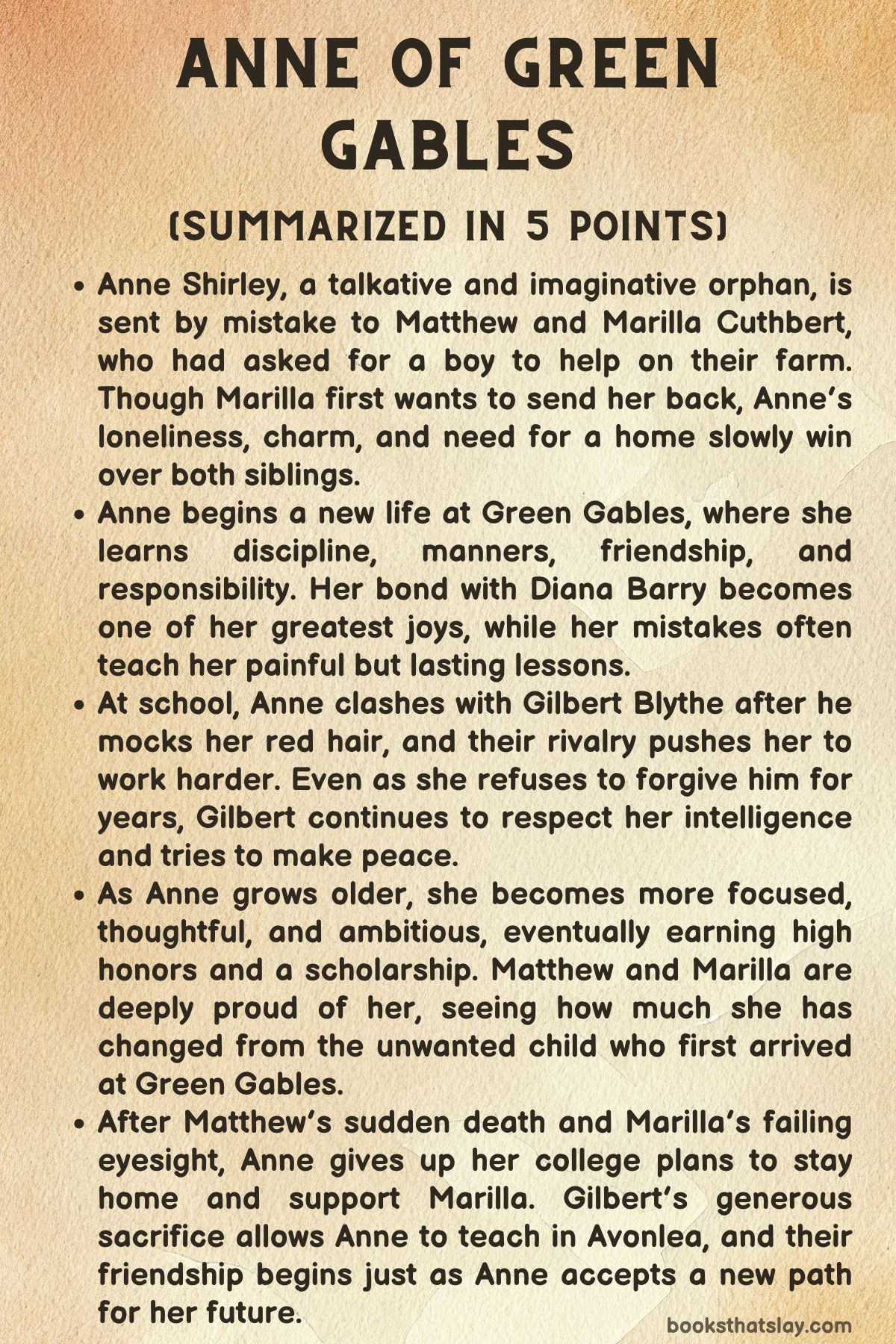
Characters
Anne Shirley
Anne Shirley is the emotional and imaginative center of Anne Of Green Gables. She enters the book as an unwanted orphan who has learned to survive loneliness by creating a rich inner life.
Her imagination is not merely childish play; it is her defense against neglect, rejection, and emotional hunger. Because she has never been securely loved, Anne feels everything intensely.
Small joys become magnificent events, and small humiliations feel unbearable. Her red hair, freckles, poverty, and orphan status make her deeply self-conscious, yet she also possesses a strong sense of dignity.
When she is insulted, she reacts fiercely because she has spent her life being looked down upon. Anne’s temper is one of her major flaws, but it is connected to her need to be seen as worthy.
As the story develops, Anne becomes more disciplined without losing her originality. Green Gables gives her the stability she has never known, and that stability allows her better qualities to grow: loyalty, intelligence, generosity, courage, and moral sensitivity.
Her friendship with Diana reveals her deep capacity for attachment, while her rivalry with Gilbert shows both her pride and her ambition. Anne’s mistakes often come from vanity, romantic exaggeration, or impulsiveness, but she usually learns from them.
By the end of the novel, she has changed from a lonely child desperate for belonging into a young woman capable of sacrifice. Her decision to give up the Avery Scholarship to stay with Marilla shows that she has learned the meaning of love as action, not only feeling.
Marilla Cuthbert
Marilla Cuthbert begins the book as a strict, practical, emotionally guarded woman who believes in duty, order, and self-control. She is not naturally expressive, and she initially sees Anne as an inconvenience caused by a mistake.
Yet Marilla is not cruel. Her hardness comes from habit, fear, and a life shaped by restraint.
She believes children should be trained, corrected, and made useful, but Anne challenges this narrow idea of upbringing. Anne’s openness, pain, and longing gradually awaken feelings in Marilla that she has kept buried for years.
Marilla’s development is one of the quiet strengths of the novel. At first, she tries to raise Anne by rules alone, but she slowly learns that love cannot be separated from discipline.
She is often amused by Anne, even when she tries not to show it, and her hidden tenderness becomes more visible as the story continues. Marilla’s love is not dramatic, but it is steady and transformative.
She learns to defend Anne, comfort her, and eventually confess her love openly after Matthew’s death. Her relationship with Anne also reveals her regrets, especially when she speaks of the old quarrel with Gilbert’s father.
Marilla’s growth shows that even a person long set in her ways can be changed by love, responsibility, and the presence of a child who needs more than food and shelter.
Matthew Cuthbert
Matthew Cuthbert is gentle, shy, and emotionally perceptive. He says little, especially around women and girls, but his silence does not mean weakness or indifference.
From the moment he meets Anne at the station, he senses her loneliness and need for kindness. Unlike Marilla, he does not worry first about practicality.
He responds to Anne as a human being who has been hurt. His quiet decision to bring her home, even though she is not the boy they requested, begins the emotional movement of the entire story.
Matthew’s love for Anne is simple, loyal, and unconditional. He rarely disciplines her and often leaves the serious work of raising her to Marilla, but he gives Anne something equally important: unquestioning acceptance.
He listens to her speeches, admires her achievements, and notices when she is treated differently from other girls. His insistence on getting her a dress with puffed sleeves is a small but powerful act because it shows that he understands her longing to feel beautiful and included.
Matthew’s pride in Anne gives her confidence, and his final words to her become one of the most meaningful moments in the book. His death is devastating because he has been Anne’s first experience of steady, fatherly love.
Through Matthew, Anne Of Green Gables presents kindness as a quiet force that can permanently shape a child’s life.
Diana Barry
Diana Barry is Anne’s first true friend and represents the companionship Anne has always wanted. Diana is more conventional than Anne, but she is warm, loyal, and receptive to Anne’s imagination.
She does not always fully understand Anne’s dramatic language or intense emotions, yet she accepts them with affection. This acceptance matters deeply because Anne has spent much of her life being dismissed as strange.
Diana gives Anne the joy of being chosen.
Diana’s role in the book is not to challenge society in the same way Anne does. She belongs more comfortably to Avonlea’s ordinary world, and her family does not plan the same ambitious educational path for her.
Even so, her friendship with Anne has emotional depth. Their separation after the currant wine incident shows how dependent Anne has become on Diana’s love, while their reunion after Minnie May’s illness restores one of Anne’s most important relationships.
Diana also helps mark Anne’s growth. As the girls mature, their paths begin to differ, but their affection remains.
Diana’s steady presence reminds readers that friendship can be one of the first forms of home for a child who has never had one.
Gilbert Blythe
Gilbert Blythe begins as Anne’s rival, but his character becomes more important as the story progresses. His teasing insult about Anne’s red hair creates a conflict that lasts for years, not because Gilbert is deeply cruel, but because he touches Anne’s greatest insecurity.
Gilbert quickly regrets the insult and tries to apologize, but Anne’s pride will not allow forgiveness. From that point on, he becomes the person against whom Anne measures her academic strength.
Gilbert is intelligent, confident, and competitive, but he is also fair-minded. He does not resent Anne’s success; in fact, he often respects it.
This makes Anne’s anger harder to maintain as she grows older. Their rivalry pushes Anne to work harder, but it also teaches her about pride, regret, and the cost of holding a grudge too long.
Gilbert’s rescue of Anne at the pond gives her an opportunity to forgive him, but she rejects it and later understands that she has made a mistake. His most generous act comes when he gives up the Avonlea school so Anne can remain close to Marilla.
This sacrifice proves his maturity and kindness. By the end, Gilbert is no longer merely a school rival.
He becomes a sign of Anne’s emotional growth, because accepting his friendship means letting go of old wounded pride.
Mrs. Rachel Lynde
Mrs. Rachel Lynde is Avonlea’s voice of public opinion. She is observant, talkative, judgmental, and deeply involved in the affairs of her neighbors.
At first, she seems like a comic figure because she cannot resist investigating anything unusual, especially Matthew’s trip to the station. Her blunt criticism of Anne’s appearance leads to one of Anne’s first major explosions at Green Gables.
Mrs. Rachel’s lack of tact makes her hurtful, but she is not presented as purely malicious.
Over time, Mrs. Rachel becomes a more layered character. She represents the strict standards of the community, but she also has common sense and genuine concern for others.
She advises Marilla, comments on Anne’s progress, and eventually recognizes Anne’s worth. Her relationship with Anne softens after Anne’s exaggerated apology, and she later speaks proudly of Anne’s achievements.
Mrs. Rachel’s character shows the power and danger of social judgment in a small community. She can wound with careless words, but she can also become part of the network of belonging that surrounds Anne as she grows.
Mrs. Barry
Mrs. Barry is Diana’s mother, and her importance lies in the authority she holds over Anne and Diana’s friendship. She is careful, proper, and protective, especially about whom Diana may associate with.
When Anne accidentally gives Diana currant wine, Mrs. Barry judges Anne harshly and forbids the friendship. Her reaction shows how quickly adults in Avonlea can label Anne as troublesome because she is an orphan and already seen as unusual.
Yet Mrs. Barry is capable of changing her mind when she sees Anne’s true character. After Anne saves Minnie May’s life, Mrs. Barry recognizes her courage, competence, and goodness.
Her apology is important because it restores Anne’s bond with Diana and gives Anne social approval from a woman who once distrusted her. Mrs. Barry’s development is not as central as Marilla’s, but it matters because it shows Anne gradually earning a place in Avonlea not through pretending to be ordinary, but through acts of real courage and care.
Minnie May Barry
Minnie May Barry is a small but important character because her illness gives Anne one of her first chances to prove her practical value. Until this moment, many adults view Anne as fanciful, impulsive, and difficult.
Minnie May’s dangerous illness reveals another side of Anne: the child who has cared for younger children under hard conditions and knows how to act in an emergency. Anne’s treatment of Minnie May is calm, firm, and capable.
Minnie May herself is not deeply developed as an individual, but her role changes how others see Anne. Through this crisis, Anne’s painful past becomes a source of strength.
The same years of unwanted labor that deprived her of childhood also taught her skills that save a life. Minnie May’s recovery helps repair Anne’s friendship with Diana and forces Mrs. Barry to reconsider her judgment.
In this way, Minnie May becomes a turning point in Anne’s acceptance by the Barry family.
Miss Stacy
Miss Stacy is one of the most positive adult influences in Anne’s education. Unlike Mr. Phillips, she is energetic, encouraging, and attentive to her pupils’ individual abilities.
She sees Anne’s intelligence and gives her the structure needed to develop it. Miss Stacy’s teaching style values imagination, effort, and ambition, which makes her especially important for Anne.
She does not try to crush Anne’s originality; she helps direct it.
Her role in the book is closely tied to Anne’s intellectual growth. She prepares Anne and the other students for the Queen’s entrance examination, and her confidence gives Anne a larger sense of possibility.
Through Miss Stacy, Anne begins to imagine a future shaped by education and achievement. Miss Stacy also represents a more modern model of womanhood than many of the older Avonlea women.
She is independent, capable, and professionally respected. Her influence helps Anne move from childish dreams toward disciplined ambition.
Mrs. Allan
Mrs. Allan, the minister’s wife, becomes a moral and emotional guide for Anne. Anne admires her almost immediately because Mrs. Allan is kind, gracious, and able to understand children without humiliating them.
When Anne ruins the cake by accidentally using liniment instead of vanilla, Mrs. Allan comforts her rather than making her shame worse. This response has a strong effect on Anne because she is used to correction, not gentle understanding.
Mrs. Allan’s importance lies in the kind of womanhood she represents. She is religious without being cold, refined without being snobbish, and kind without being weak.
Anne trusts her enough to share painful parts of her past, and Mrs. Allan becomes someone Anne can look up to. She also helps Anne understand grief after Matthew’s death, reassuring her that joy after loss is not betrayal.
Mrs. Allan’s presence gives Anne a model of adult goodness that combines faith, warmth, and emotional wisdom.
Aunt Josephine Barry
Aunt Josephine Barry is sharp, wealthy, demanding, and easily offended, but she is also intelligent and lonely. When Anne and Diana accidentally jump on her in the spare room bed, she reacts with anger, threatening to leave and withdraw support from Diana’s lessons.
Anne’s decision to face her and take responsibility reveals Anne’s courage and honesty. Instead of being further offended, Aunt Josephine is impressed.
Aunt Josephine becomes fond of Anne because Anne entertains and interests her. She sees in Anne a freshness and sincerity that her own comfortable but dull life lacks.
Her invitation to Anne and Diana to visit town expands Anne’s world beyond Avonlea and gives her access to culture, performance, and urban life. Aunt Josephine’s character shows that difficult people may respond to honesty when it is joined with courage.
She also helps confirm that Anne’s unusual personality, once seen as a problem, can be a source of charm and connection.
Josie Pye
Josie Pye functions as one of Anne’s social rivals. She is proud, sharp-tongued, and often unpleasant, especially in the way she challenges Anne’s pride.
Josie’s dare that leads Anne to walk on the roof reveals how easily Anne can be pushed into foolish action when her dignity is at stake. Anne knows the act is dangerous, but she cannot bear to seem cowardly in front of Josie.
Josie’s role in the novel is to bring out Anne’s vanity and competitiveness in a less noble form than Gilbert does. Gilbert challenges Anne intellectually, while Josie often provokes her socially.
Through Josie, the book shows how peer pressure can make children act against their better judgment. Josie is not given much tenderness or growth, but she is useful as a contrast to Diana.
Where Diana accepts Anne lovingly, Josie tests Anne’s pride and exposes the insecurity beneath it.
Ruby Gillis
Ruby Gillis is one of Anne’s school friends and represents a more ordinary, romantic, and fashion-conscious girlhood. She is often interested in appearances, admiration, and social excitement.
Anne enjoys Ruby’s company, but Ruby does not share Anne’s depth of imagination or intellectual seriousness. Her presence helps create the wider circle of Avonlea girls around Anne and Diana.
Ruby also becomes significant in relation to Gilbert, especially when Anne notices Gilbert walking with her during the Queen’s period. Anne’s irritation suggests that her feelings about Gilbert have become more complicated than she admits.
Ruby does not need to be a major character to serve this purpose. She reflects the ordinary social world Anne is part of, while also helping reveal Anne’s hidden emotional changes.
Jane Andrews
Jane Andrews is practical, steady, and sensible. She is one of Anne’s school companions, but she lacks Anne’s imaginative intensity.
Jane often represents the ordinary path of Avonlea girlhood: respectable, capable, and grounded. She participates in school life, social events, and the Queen’s preparation, but she does not stand out with Anne’s brilliance or dramatic nature.
Jane’s value in the book comes from contrast. She helps show that Anne is not simply one girl among many; Anne’s mind and personality are unusual.
At the same time, Jane is not mocked for being ordinary. Her practicality has its own place in the community.
She is part of the social circle that makes Anne’s life feel full, and her presence helps create a believable world of classmates, friends, and rivals.
Mr. Phillips
Mr. Phillips, the early schoolmaster, is an example of weak and unfair authority. He does not understand Anne well, and his punishments often shame rather than guide.
His decision to make Anne sit with Gilbert after she is late deepens her humiliation and contributes to her refusal to return to school for a time. He also shows favoritism, which makes him less respected by the students.
His role is important because he contrasts strongly with Miss Stacy. Under Mr. Phillips, school is rigid and sometimes unjust.
Under Miss Stacy, learning becomes meaningful and exciting. Mr. Phillips helps reveal why the right teacher matters so much in a child’s development.
Anne’s intelligence exists before Miss Stacy arrives, but it flourishes when it is recognized and properly encouraged.
Mrs. Spencer
Mrs. Spencer is the person whose mistake brings Anne to Green Gables. She is not malicious; she misunderstands the adoption arrangement and sends a girl instead of a boy.
Her error begins the central change in the Cuthberts’ lives. Without her confusion, Anne would not have found the home she needed, and Matthew and Marilla would not have discovered how much they needed her.
Mrs. Spencer also represents the casual way orphan children are passed between adults in the book. Anne’s future is discussed in practical terms, as though she is a worker to be placed where needed.
This makes Marilla’s decision to keep Anne more meaningful. In a world where Anne has often been treated as a burden or useful helper, Green Gables becomes the place where she is finally valued as a person.
Mrs. Blewett
Mrs. Blewett is a brief but important figure because she shows the kind of life Anne narrowly escapes. She wants an orphan girl not to love or raise, but to help care for her children.
Her harsh manner and reputation make it clear that Anne would likely face more labor, criticism, and emotional neglect in her home. When Marilla sees Anne’s fear at the possibility of going with Mrs. Blewett, her protective instincts awaken.
Mrs. Blewett’s presence forces Marilla to make a moral choice. Returning Anne to the system would be easier, but handing her to Mrs. Blewett would be cruel.
This moment helps Marilla move from duty to compassion. Mrs. Blewett therefore functions less as a fully developed character and more as a warning: she represents the practical, loveless future Anne might have had if no one had chosen her.
Mr. and Mrs. Hammond
Mr. and Mrs. Hammond belong to Anne’s painful past. Anne lived with the Hammond family and cared for several children, including twins, before she was sent to the orphan asylum.
Their household reflects the way Anne was used as unpaid help while still a child herself. She gained practical experience there, but at the cost of comfort, education, and affection.
The Hammonds are important because they explain Anne’s strange mixture of childishness and maturity. She can be fanciful and reckless, yet she knows how to handle a medical emergency with Minnie May because she has already carried adult responsibilities.
Her time with the Hammonds helps readers understand that Anne’s imagination is not a sign of a spoiled child; it is the refuge of a neglected one. In Anne Of Green Gables, Anne’s past is never only background.
It shapes her fears, skills, gratitude, and fierce longing for love.
Mrs. Thomas
Mrs. Thomas is another figure from Anne’s early childhood. After Anne’s parents died, she was taken into the Thomas household, where she became more of a caretaker than a cherished child.
Like the Hammonds, Mrs. Thomas represents the unstable and conditional care Anne received before Green Gables. Anne was kept because she could be useful, not because she was deeply wanted.
Anne’s account of Mrs. Thomas also reveals one of Anne’s defining traits: her effort to see goodness even in people who failed her. She does not describe her past with bitterness alone.
Instead, she often tries to believe that people meant well. This habit shows both innocence and survival.
Mrs. Thomas’s role helps explain why being wanted by Matthew and Marilla means so much to Anne.
Anne’s Parents
Anne’s parents, Walter and Bertha Shirley, are absent for nearly the whole story, but they matter because Anne clings to the idea of them. They were teachers, and this detail gives Anne a sense of inherited dignity.
Though she never truly knew them, the knowledge that they were educated and loving helps her imagine herself as more than an unwanted orphan.
Their absence is one of the emotional foundations of the book. Anne’s longing for family begins with the loss of her parents, and her later attachment to Matthew and Marilla partly fills that empty space.
The fact that her parents were teachers also quietly connects to Anne’s own academic gifts and future as a teacher. They represent the life Anne might have had, while Green Gables represents the life she is finally given.
Themes
Belonging and the Meaning of Home
Home in the story is not simply a house, a farm, or a place on a map. For Anne, home means being wanted.
Before arriving at Green Gables, she has lived in houses where she was useful but not cherished. She has cared for children, obeyed adults, and moved from place to place, but she has never belonged anywhere.
This is why her first sight of Green Gables affects her so strongly. She is not just admiring a pretty house; she is seeing the possibility of a life she has always imagined but never possessed.
Matthew accepts her emotionally before anyone else does, while Marilla takes longer to understand that keeping Anne is not a burden but a gift. As Anne becomes part of Avonlea, the meaning of home expands.
It includes Diana’s friendship, school, familiar roads, trees, and shared routines. By the end, Anne gives up Redmond not because she has stopped dreaming, but because Green Gables has become part of her moral identity.
Home is where love has claimed her, and she chooses to protect it.
Imagination as Survival and Growth
Anne’s imagination is one of her most visible traits, but it is more than a habit of dramatic speech. It is the tool she has used to survive a childhood filled with neglect, loneliness, and rejection.
When reality is painful, Anne renames places, invents friends, and creates beauty through language. Her imagination allows her to feel rich even when she owns almost nothing.
It gives her dignity when the world treats her as unwanted. At the same time, the book does not present imagination as harmless in every situation.
Anne’s fantasies sometimes lead to trouble: the Haunted Wood frightens her, romantic games put her in danger, and her desire for beauty makes her vulnerable to foolish choices. Her growth depends on learning how to keep imagination without letting it control her judgment.
Anne Of Green Gables values imagination because it gives life color, but it also shows that maturity requires balance. Anne does not lose her dreaminess as she grows older.
She learns to join it with responsibility, discipline, and care for others.
Love, Discipline, and Moral Education
Anne’s upbringing at Green Gables raises an important question: what does a child truly need in order to become good? Marilla first believes the answer is discipline.
She focuses on manners, chores, prayers, truthfulness, and obedience. These lessons matter, especially because Anne has had so little guidance.
Yet discipline alone cannot heal Anne’s insecurity or teach her trust. Matthew’s gentleness provides the emotional safety that Marilla’s rules cannot.
He loves Anne before she has earned approval, and that unconditional affection gives her confidence. Marilla, in turn, learns that correction must be joined with sympathy.
She often punishes Anne, but she also begins to understand the fear and loneliness behind Anne’s mistakes. The book suggests that moral growth comes through relationship, not control alone.
Anne becomes more truthful, patient, thoughtful, and responsible because she is loved into goodness. Her errors do not vanish instantly, but each one becomes part of her education.
The adults shape Anne, but Anne also educates them, teaching Matthew and Marilla tenderness, joy, and emotional openness.
Pride, Forgiveness, and Growing Up
Anne’s long conflict with Gilbert Blythe shows how pride can preserve hurt long after the original wound has passed. Gilbert’s insult is cruel because it strikes at Anne’s deepest insecurity, and her anger is understandable.
Yet her refusal to forgive him becomes a burden she carries for years. At first, the rivalry gives her energy.
She studies harder, aims higher, and measures her progress against his. But as Anne matures, she begins to see that Gilbert is not her enemy.
He respects her abilities, tries to make peace, and later makes a genuine sacrifice for her. Anne’s inability to accept his apology after he rescues her shows that pride can become a prison.
She knows almost immediately that she has acted wrongly, but she cannot undo it until much later. Their final reconciliation is significant because it marks Anne’s movement from childish injury toward adult generosity.
Forgiveness does not erase the past, but it frees Anne from being ruled by it. By accepting Gilbert’s friendship, she accepts a wider, kinder future.