Antigone by Jean Anouilh Summary, Characters and Themes
Antigone by Jean Anouilh is a modern retelling of the ancient Greek story of Oedipus’s daughter, written under the shadow of Nazi-occupied France. The play centers on Antigone, a young woman who refuses to accept King Creon’s order that her brother Polynices must remain unburied.
Her act is small in physical terms, but enormous in moral meaning. Anouilh presents a conflict between personal conscience and political power, between saying “no” and accepting compromise. Through Antigone and Creon, the play asks what dignity costs, what authority demands, and whether survival is worth the surrender of one’s deepest beliefs.
Summary
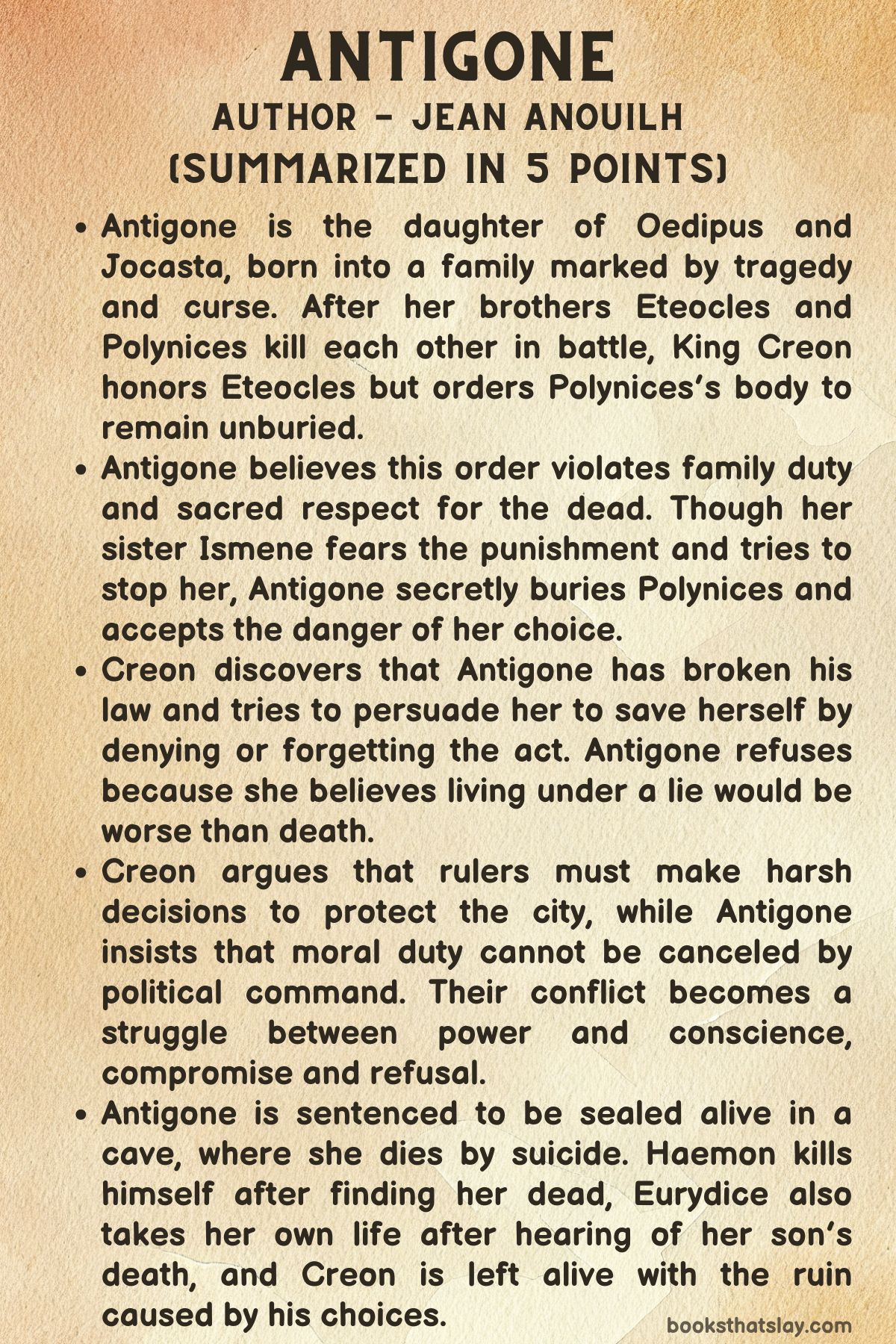
Jean Anouilh’s Antigone begins in the aftermath of a cursed royal family’s ruin. Antigone is the daughter of Oedipus, the former king of Thebes, and Jocasta.
Oedipus’s life was destroyed when he learned that he had unknowingly killed his father and married his mother, fulfilling the prophecy he had tried to escape. After Jocasta’s death and Oedipus’s exile, their children were left with the burden of their family’s shame.
Antigone returned to Thebes after her father’s death, while her brothers, Eteocles and Polynices, were supposed to share power by ruling in turns. Instead, ambition and hatred led them into conflict, and both brothers killed each other in battle.
Their deaths leave Thebes under the rule of Creon, Antigone’s uncle. Creon decides that Eteocles will be honored as a loyal defender of the city, while Polynices will be treated as a traitor.
He orders that Polynices’s body be left unburied outside the city, exposed to decay and animals. Anyone who attempts to bury him will be put to death.
This decree creates the central conflict of Antigone. For Creon, the order is a political necessity, a public act meant to restore order after civil war.
For Antigone, it is a violation of a sacred duty owed to the dead and to family. She believes Polynices must be buried, regardless of what the king commands.
At the opening of the play, the characters are presented almost as if their destinies have already been arranged. Antigone is young, serious, and physically less striking than her sister Ismene, yet she carries an inner force that sets her apart.
Ismene is beautiful, cautious, and attached to life. Haemon, Creon’s son, is engaged to Antigone, though he once seemed drawn to Ismene.
Creon appears as a ruler who tells himself that he governs only because someone must do the difficult work of leadership. He imagines himself as a practical man, not a tyrant, but the play gradually shows how deeply he values his authority.
Before dawn, Antigone slips back into the palace after secretly leaving during the night. Her Nurse, who raised her and Ismene after their parents’ deaths, catches her returning and demands to know where she has been.
Antigone avoids the truth. When the Nurse assumes she has gone out to meet a lover, Antigone briefly lets her believe it, then reassures her that she has not betrayed Haemon.
The exchange reveals Antigone’s tenderness as well as her secrecy. She knows she has already crossed a line from which she may not return, but she does not explain herself yet.
Ismene then confronts Antigone and begs her not to defy Creon. Ismene understands that leaving Polynices unburied is cruel, but she fears death and sees no use in throwing away her life.
She argues that they are only young women facing the power of the state, and that they cannot win. Antigone does not deny that the punishment is real.
She does not even claim she wants to die. But she cannot accept the idea of living by choosing safety over duty.
Ismene urges her to think of Haemon and the happiness she might still have. Antigone listens but remains fixed in her decision.
Antigone then speaks with the Nurse in a strangely childlike way, asking for comfort and making practical requests about her dog if something happens to her. The Nurse does not understand why Antigone sounds as though she is preparing to leave life behind.
When Haemon arrives, Antigone sends the Nurse away and meets him with intense affection. She apologizes for a quarrel they had the previous night and explains why she had tried to appear more beautiful, using perfume, rouge, and a dress borrowed from Ismene.
She wanted to feel certain that Haemon truly desired her and had not chosen her by mistake.
The meeting with Haemon is both intimate and final. Antigone imagines the child they might have had together and the ordinary future that might have belonged to them.
She asks Haemon to promise that he will leave without questioning her. After he swears, she tells him she cannot marry him and sends him away.
He is confused and hurt, but he keeps his promise. Soon after, Ismene returns in distress and again insists that Antigone must not bury Polynices.
Antigone then reveals that the act has already been done. She had gone out that morning and covered their brother’s body with earth.
Later, Creon receives news from a guard that someone has tried to bury Polynices. The guard, Private Jonas, reports that he and two others were watching the corpse when they discovered that the body had been covered.
A small child’s shovel was found nearby, leading them to believe the culprit might be a child. Creon is alarmed not simply because his law has been broken, but because the situation could become politically dangerous.
A child martyr killed by the state would make him look cruel and weaken his control. He orders the guards to keep the matter quiet, uncover the body, and arrest anyone who tries again.
The next time the guards appear, they have captured Antigone. They mock her because they found her clawing at the dirt with her hands as she tried once more to bury Polynices.
When Creon sees that the prisoner is his niece, he is shocked. He removes her restraints and questions her.
Antigone admits both attempts without hesitation. The first time, she used Polynices’s old toy shovel from childhood; after it was taken away, she returned and used her hands.
Her confession is calm, and she shows no interest in saving herself through lies.
Once Creon learns that no one else knows the truth, he tries to erase the problem. He offers to protect Antigone, blame the guards, and allow her to return to her room as if nothing happened.
This offer is not mercy alone; it is also political calculation. If the public never learns what Antigone did, Creon can preserve his authority without killing his son’s fiancée.
But Antigone refuses. She says she will try to bury Polynices again.
Creon cannot understand why she insists on an act that will be undone and punished. Antigone’s answer is simple: she owed it to her brother.
Creon argues that Antigone is like her father, drawn to suffering and proud refusal. He insists that ruling is a practical duty, not a matter of heroic purity.
He sees himself as the person who had to take charge when Thebes was broken by war. Someone had to restore order, make decisions, and accept the ugliness of power.
Antigone answers from a completely different moral world. She does not want compromise, excuses, or political explanations.
She believes that when a person knows what must be done, they must do it, even if the act is useless in worldly terms.
Trying another approach, Creon tells Antigone the truth about her brothers. He says Polynices was not noble and that Eteocles was no better.
Both were selfish, violent, and corrupt. Creon even claims that the decision to honor one and disgrace the other was based less on justice than on political convenience.
The body chosen for burial was simply the less damaged one. This revelation is meant to free Antigone from loyalty to Polynices by showing that her brother was not worth dying for.
But Antigone’s duty does not depend on Polynices’s virtue. She is not defending his character; she is defending the right of the dead to burial and her own refusal to obey an unjust command.
Creon urges Antigone to choose life. He speaks of happiness as something modest and human, made of marriage, children, ordinary pleasures, and survival.
He wants her to accept that adulthood requires compromise. Antigone rejects this version of happiness because it would require her to betray herself first.
She does not want a life bought by silence. In her eyes, Creon’s realism is cowardice, and his authority has made him smaller rather than stronger.
She has discovered the power of saying “no,” while Creon is trapped in the world of necessity, calculation, and command.
Ismene enters and tries to share Antigone’s fate. She claims that she helped bury Polynices and says Creon must kill her too.
Antigone refuses to accept this late courage. She knows Ismene chose life when the decision mattered.
Ismene insists that she now wants to stand with her sister, but Antigone will not let her borrow the meaning of an act she did not perform. Creon finally orders Antigone taken away.
The Chorus warns Creon that Antigone’s death will leave a mark that lasts for generations, but Creon will not yield. Haemon then pleads with his father to spare her.
He warns that the people will see Antigone as a martyr and hate Creon for killing her. Creon answers that Antigone chose death when she could have been saved.
Haemon cannot accept this and turns against his father.
Antigone is sentenced to be sealed alive inside a cave. In prison, the certainty she showed before gives way to fear.
She is terrified of dying alone and asks a guard to write a final letter to Haemon. The guard is ordinary, self-interested, and emotionally untouched by her suffering.
Before the message can be completed, Antigone is taken away to her death.
The catastrophe then unfolds quickly. After Antigone is sealed in the cave, Creon hears cries from inside and has the entrance opened.
Haemon is found beside Antigone’s body; she has hanged herself. Overcome with rage and grief, Haemon tries to attack Creon, then kills himself.
Creon returns, having placed Antigone and Haemon side by side. But his punishment is not finished.
Queen Eurydice, Haemon’s mother, learns of her son’s death, quietly finishes her knitting, goes to her room, and takes her own life.
Creon is left alive, surrounded by the results of his decisions. He has kept order, but he has lost his son, his wife, and his niece.
He remains convinced that he did what had to be done, yet his survival feels empty. Antigone, Haemon, and Eurydice are dead, while Creon must continue ruling and waiting for his own end.
The guards, unaffected by the tragedy, go on playing cards. Their indifference closes Antigone with a bleak image of the world: moral courage may lead to death, political power may destroy what it claims to protect, and ordinary life may continue without understanding either sacrifice or guilt.
Characters
Antigone
Antigone is the moral center of the play and the character through whom Jean Anouilh explores resistance, dignity, and the cost of refusing compromise. She is young, physically less dazzling than Ismene, and often treated as difficult or strange, yet her strength comes from an unshakable inner certainty.
Her decision to bury Polynices is not presented as a grand public rebellion at first; it is a private act of duty, performed with a child’s shovel and later with her bare hands. This detail makes her courage feel raw and personal.
Antigone does not romanticize death, and she does not pretend to be fearless. She admits she would rather live, marry Haemon, and have a future, but she cannot accept a life built on obedience to an order she knows is wrong.
In Antigone, she represents the person who says “no” even when saying no changes nothing practically. Her burial of Polynices will be undone, and Creon’s law will still stand, but for her, action matters because it preserves the truth of who she is.
She is also severe, especially toward Ismene, because she refuses late or convenient courage. Her tragedy lies in the fact that her purity leaves no room for ordinary human compromise, yet that same purity gives her moral power.
Creon
Creon is one of the most complex figures in the play because he is not shown simply as a cruel ruler. He sees himself as a practical man who has taken on an unpleasant responsibility after Thebes has been damaged by civil conflict.
He believes that someone must restore order, make hard decisions, and protect the state from chaos. His decree against Polynices is political theater as much as punishment: he needs one brother to stand for loyalty and the other to stand for treason, even though he knows the truth is far messier.
This makes Creon deeply compromised. He understands that his order is morally ugly, but he defends it as necessary.
His conversations with Antigone reveal a man who has accepted adulthood as a series of bargains, half-truths, and duties that stain the person who performs them. He tries to save Antigone because he loves his son, wants to avoid scandal, and perhaps recognizes something noble in her.
Yet he cannot allow her defiance to become public without weakening his authority. Creon’s tragedy is that he survives.
He wins the political argument and loses nearly everything human: Antigone, Haemon, and Eurydice. By the end, his power feels like a prison he built for himself.
Ismene
Ismene serves as Antigone’s contrast, but she is not merely weak or selfish. She represents the ordinary human desire to survive, to be loved, and to avoid suffering when resistance seems hopeless.
Ismene understands that Creon’s treatment of Polynices is wrong, but she cannot see the value of dying for a symbolic act. Her reasoning is practical: they are young women with no political power, facing a king who has already declared the punishment.
Her fear is believable, and the play uses her to show that moral courage is not easy or natural for everyone. Ismene’s beauty and softness distinguish her from Antigone’s sharper, more difficult nature, but her emotional attachment to her sister is sincere.
When she later tries to claim part in Antigone’s act, it shows both love and guilt. She wants to stand beside Antigone once she understands the full meaning of what is happening, but Antigone rejects her attempt because Ismene chose safety when the choice was real.
Ismene’s role is important because she makes Antigone’s decision appear even more extreme. Through her, the story asks whether survival is cowardice, whether caution is wisdom, and whether courage that comes late can still matter.
Haemon
Haemon is caught between love and obedience, between his father’s authority and his commitment to Antigone. At first, he appears as a young man defined mainly by his engagement, but his role grows darker as the conflict intensifies.
His love for Antigone is genuine, and her farewell to him reveals the tenderness of the life they might have shared. He represents the future Antigone gives up: marriage, children, intimacy, and ordinary happiness.
Yet Haemon is not only a symbol of lost domestic life. When Antigone is condemned, he confronts Creon and warns him that her death will turn her into a martyr in the eyes of the people.
This shows that Haemon understands both public feeling and private grief better than his father does. His final actions are driven by despair, rage, and helplessness.
Finding Antigone dead inside the sealed cave destroys the remaining bond between him and Creon. His attempt to attack his father and his later suicide show how Creon’s political decision has entered the family and poisoned it completely.
Haemon’s death transforms Antigone’s punishment into Creon’s punishment as well, proving that authority cannot isolate public violence from private consequence.
The Chorus
The Chorus acts as narrator, commentator, and interpreter of the play’s tragic structure. Unlike a character who is trapped entirely inside the action, the Chorus can step back and explain the movement of events to the audience.
This voice frames the story as something already shaped by fate, where each character has a role to play and tragedy begins once the first small push is given. The Chorus also helps separate tragedy from ordinary melodrama.
In this world, hope is not the central force; inevitability is. The Chorus prepares the audience to see Antigone not just as a young woman making a choice, but as part of an old pattern of resistance, punishment, and memory.
At the same time, the Chorus is not coldly detached. When Antigone is taken away, the Chorus directly warns Creon that her death will leave a lasting scar.
This moment gives the Chorus moral weight, because it recognizes the historical significance of Antigone’s refusal before Creon fully understands what he has done. The Chorus also closes the play by placing Antigone’s cause in a broader human context: the defense of moral law and dignity against power that has forgotten its limits.
The Nurse
The Nurse brings warmth, domestic concern, and ordinary affection into a play dominated by law, death, and political necessity. She raised Antigone and Ismene after the deaths of their parents, so her relationship with them is deeply maternal even though she does not hold royal power.
Her early confrontation with Antigone shows her practical, protective nature. She worries about where Antigone has been, whether she has behaved properly, and whether she is in danger, but she does not understand the scale of what Antigone has already done.
This gap between the Nurse’s concerns and Antigone’s secret gives their scene a painful innocence. The Nurse still belongs to a world of meals, scolding, comfort, pets, and bedtime care, while Antigone has already entered the world of death and consequence.
Antigone’s request that the Nurse care for her dog if she does not return is especially revealing. It shows that Antigone is not only an abstract symbol of resistance; she is a young person attached to small living things and childhood comforts.
The Nurse’s importance lies in making Antigone’s sacrifice feel human rather than purely heroic. Through her, the play reminds us what Antigone is leaving behind.
Eurydice
Eurydice appears quietly, but her presence carries great tragic force. She is introduced as a graceful woman who knits, and this image of calm routine follows her until the news of Haemon’s death reaches her.
Unlike Antigone and Creon, Eurydice does not argue about law, duty, or conscience. She occupies the background of power, seemingly removed from the central conflict, yet she becomes one of its victims.
Her silence is significant. She does not need a long speech to express the devastation caused by Creon’s choices.
When she learns that her son is dead, she finishes her row of knitting, sets it aside, and kills herself. The quietness of the act makes it even more severe.
Eurydice’s death shows that political decisions do not remain in the public sphere. Creon’s order against Polynices leads to Antigone’s death, then Haemon’s, then Eurydice’s.
As Creon’s wife and Haemon’s mother, Eurydice embodies the private cost of public authority. Her suicide strips Creon of any remaining illusion that his actions can be measured only by state necessity.
She is the final personal loss that leaves him alive but emotionally ruined.
The Guards
The Guards represent the ordinary machinery of state power. They are not grand villains, nor are they ideologically committed to Creon’s decree.
They are practical, coarse, self-interested men doing a job. Their behavior toward Antigone is often crude and indifferent.
They joke, think about rewards, discuss their own concerns, and treat the arrest as a professional opportunity rather than a moral event. This makes them disturbing in a different way from Creon.
Creon at least understands the ethical weight of what is happening, even if he chooses authority over mercy. The Guards, by contrast, show how injustice is carried out by people who do not think deeply about it.
Private Jonas, who reports the first burial attempt, is nervous mainly because he does not want to be blamed. Later, the guards who capture Antigone focus on the bonus they may receive.
Their ordinariness is essential to the play’s bleak vision of power. Great acts of conscience may be punished not only by tyrants, but also by functionaries who follow orders, seek payment, and return to their card games when the deaths are over.
Their indifference makes the tragedy feel even colder.
The Messenger
The Messenger serves as the bearer of terrible knowledge. His role is brief but crucial because he reports the consequences of Antigone’s execution to the stage and to Creon’s household.
In Greek tragic tradition, violent deaths often occur offstage and are delivered through messengers, and Anouilh preserves that dramatic function. The Messenger’s account of the cave reveals the full emotional cost of Creon’s decision: Antigone has hanged herself, Haemon has found her body, and Haemon has turned his grief first against his father and then against himself.
The Messenger does not cause the tragedy, but he makes it visible. His arrival marks the moment when Creon can no longer manage events through secrecy, orders, or political reasoning.
What has happened inside the cave must now be spoken aloud. The Messenger also intensifies the sense of inevitability.
By the time he appears, the choices have already been made, and language can only report the damage. His function in the story is to turn hidden suffering into public fact, forcing Creon and the audience to face the consequences that authority tried to control.
The Page
The Page is a minor character, but his presence beside Creon helps reveal the king’s position and isolation. He accompanies Creon during official business and stands near power without truly understanding it.
As a young attendant, he represents innocence placed close to political authority. He sees the routines of rule: messages, commands, reports, and decisions.
Yet he does not carry the burden of those decisions in the way Creon does. His silence and youth make him a subtle contrast to the older ruler.
Creon often speaks as though kingship is a trade that must be learned and performed, and the Page’s presence suggests the continuation of systems beyond any single ruler. Power has witnesses, servants, and successors.
The Page also makes Creon appear more official and more alone at the same time. Surrounded by attendants, guards, and messengers, Creon has very little real companionship.
By the end of Antigone, when Creon has lost his family, the machinery of rule still remains around him. The Page belongs to that machinery: quiet, obedient, and untouched by the full moral burden of command.
Polynices
Polynices never appears alive in the play, but his body drives the entire conflict. He is Antigone’s brother, one of Oedipus’s sons, and one of the two men whose battle for power leaves Thebes in crisis.
Publicly, Creon labels him a traitor and denies him burial as punishment. To Antigone, however, Polynices remains her brother, and that bond creates an obligation that no royal decree can erase.
One of the most important complications in the play is Creon’s claim that Polynices was not noble or innocent. He describes him as violent, selfish, and treacherous, stripping away any simple idea that Antigone is dying for a heroic man.
Yet this makes Antigone’s act more morally demanding, not less. She does not bury Polynices because he deserves admiration.
She buries him because the dead must not be used as political objects and because family duty survives personal failure. Polynices is therefore less a developed personality than a contested symbol.
To Creon, he is a tool for restoring civic order. To Antigone, he is proof that human dignity cannot depend on the state’s approval.
Eteocles
Eteocles, like Polynices, is absent from the stage but central to the political lie on which Creon builds his rule. He is publicly honored as the brother who defended Thebes, receiving the burial that Polynices is denied.
At first, this creates a simple contrast between loyal son and traitor. Creon later disrupts that contrast by admitting that Eteocles was no better than Polynices.
Both brothers were corrupt and violent, and the distinction between them was politically useful rather than morally true. This revelation is important because it exposes how public stories are manufactured by rulers.
Eteocles becomes the “good” brother because Creon needs a symbol of order, just as Polynices becomes the “bad” brother because Creon needs a symbol of rebellion. Eteocles’s character therefore shows how the dead can be reshaped by political necessity.
He is honored not because the truth demands it, but because the city requires an official version of events. His role deepens the play’s criticism of power by showing that authority often depends on simplified narratives that hide the uglier reality beneath them.
Oedipus
Oedipus is not an active character in the central action, but his history shadows every major event. As Antigone’s father and the former king of Thebes, he represents inherited guilt, prophecy, and the destructive force of the family curse.
His discovery that he had killed his father and married his mother led to blindness, exile, and disgrace, leaving his children marked by the consequences of his fate. Creon repeatedly connects Antigone to Oedipus, suggesting that she has inherited his pride, stubbornness, and attraction to suffering.
This comparison is partly an accusation, but it also reveals why Antigone seems larger than ordinary life. She belongs to a family that cannot escape extreme moral situations.
Oedipus’s curse on his sons also prepares the way for the deaths of Eteocles and Polynices, which in turn creates the conflict over burial. His presence in the background gives the play its sense of tragic inheritance.
Antigone’s choice is her own, but it is made within a family history already shaped by ruin, defiance, and punishment.
Jocasta
Jocasta belongs to the background of the story, but her fate helps define the broken world Antigone inherits. As Oedipus’s mother and wife, she is part of the terrible revelation that destroys the royal family of Thebes.
Her suicide after the truth comes out leaves Antigone and her siblings without a mother and adds another death to the family’s history of shame. Jocasta’s role is not developed through action in the play’s main conflict, yet her absence matters.
The Nurse’s maternal role gains importance because Jocasta is gone, and Antigone’s emotional hunger for comfort is shaped by the losses that came before the play begins. Jocasta also represents the older generation’s catastrophe, the original wound from which later suffering continues to spread.
Her death does not end the curse; it leaves the children to live inside its consequences. In that sense, Jocasta is part of the tragic inheritance that surrounds Antigone, Ismene, Eteocles, and Polynices.
Her story deepens the atmosphere of fatal family damage that makes the central conflict feel both personal and ancient.
Themes
Moral Law Against Political Law
The conflict between moral law and political law shapes the central struggle of Antigone. Creon’s decree is legal because he is king, but the play questions whether legality is enough to make an action right.
By refusing Polynices a burial, Creon turns the body of a dead man into a public warning. His law depends on display, fear, and obedience.
Antigone’s response comes from a different source of authority: family duty, religious obligation, and the belief that every human being deserves dignity after death. She does not argue like a politician because her position is not based on policy.
For her, some duties exist before the state and above the state. The tension becomes more powerful because Creon is not ignorant of morality.
He knows the order is harsh, but he believes the city needs harshness to survive. Antigone knows her action will not change the law, but she believes refusing injustice has value even without practical success.
The play does not make the conflict easy. It shows that political order can demand moral compromise, while moral purity can demand terrible sacrifice.
The tragedy grows from the fact that both law and conscience claim absolute authority.
The Price of Saying No
Antigone’s refusal is small in outward form but enormous in meaning. She does not lead an army, make speeches to the people, or attempt to overthrow Creon.
She covers her brother’s body with earth. Yet this simple act becomes dangerous because it says that the king’s command has a limit.
Her “no” is powerful because it cannot be absorbed into Creon’s system of compromise. Creon can bargain with fear, ambition, public order, and family loyalty, but he cannot bargain with someone who has already accepted the cost of refusal.
Antigone’s resistance is not based on optimism. She does not believe she will win, and she does not expect the world to become just because of what she does.
This makes her defiance severe and unsettling. She acts because she would rather die as herself than live as someone who has surrendered the truth.
The price of saying no is therefore not only death; it is loneliness, misunderstanding, and the loss of every possible future. Haemon, marriage, children, and ordinary happiness all become impossible.
The play presents refusal as both noble and devastating, showing that moral freedom can survive under tyranny, but it may survive only at the cost of life itself.
Power, Compromise, and Self-Deception
Creon’s character turns the theme of power into a study of compromise and self-deception. He does not present himself as a monster.
He describes kingship as work that someone must do, especially when the city is unstable. This makes his arguments persuasive in a worldly sense.
Governments do need order, rulers do face difficult choices, and public peace often depends on decisions that private citizens never have to make. Yet Creon uses necessity to excuse moral failure.
He tells himself that he is serving Thebes, but he also enjoys the authority that kingship gives him. He claims that refusing power would have been cowardly, yet his acceptance of power slowly makes him capable of cruelty.
His greatest self-deception lies in believing that he can control the meaning of events. He thinks he can decide which brother is honored, which brother is disgraced, whether Antigone’s crime becomes public, and how the people will understand justice.
But human grief and moral memory escape his control. Antigone becomes more powerful in death than she was in life, and Creon’s victory becomes a form of punishment.
The theme shows how authority can train people to call weakness practicality and call injustice duty.
Tragedy and the Absence of Escape
The play treats tragedy as something that begins before the characters fully recognize it. The Chorus presents the action as a machine already prepared, needing only a small push before it moves toward its end.
This sense of inevitability does not erase choice; instead, it makes each choice feel heavier. Antigone chooses to bury Polynices.
Creon chooses to enforce his decree. Ismene chooses caution and later tries to choose solidarity.
Haemon chooses love over obedience. Yet once these choices are made, the characters seem unable to return to safety.
Tragedy here is not simply that people die. It is that each person becomes trapped by the role they have accepted.
Antigone cannot become practical without betraying herself. Creon cannot become merciful without weakening the authority he has built.
Haemon cannot remain a loyal son after Antigone’s death. Eurydice cannot continue ordinary life after losing her child.
The absence of escape gives the ending its bleak force. Even after the deaths, life continues through the guards’ card game, suggesting that tragedy may transform the lives of the noble and powerful while leaving the ordinary machinery of the world unchanged.