Anthills Of The Savannah Summary, Characters and Themes
Anthills Of The Savannah by Chinua Achebe is a political novel set in the fictional West African nation of Kangan, where military power, personal loyalty, public truth, and social responsibility collide. The story follows three former school friends—Sam, Chris, and Ikem—whose lives are reshaped by the machinery of dictatorship.
Through their choices and failures, Achebe examines how educated elites can become separated from the people they claim to serve. The book also gives strong space to Beatrice, whose insight, memory, and moral clarity help carry the story beyond political collapse toward renewal and hope.
Summary
Anthills Of The Savannah takes place in Kangan, a fictional African country ruled by a military leader known as His Excellency. His real name is Sam, and before power changed him, he was one of three close friends educated in elite English institutions.
The other two are Chris Oriko, now Commissioner for Information, and Ikem Osodi, editor of the National Gazette. Their shared past gives them access to power, but it also makes their present conflicts more painful.
Sam expects obedience, Chris tries to manage the government from within, and Ikem uses his public voice to challenge corruption, fear, and injustice.
The story opens inside the Presidential Palace during a tense Cabinet meeting. Chris suggests that Sam visit Abazon, a drought-stricken province whose people are suffering badly.
Instead of considering the proposal, Sam reacts with anger. His temper reveals how insecure and suspicious he has become.
Outside the palace, a delegation from Abazon has arrived to petition the government. Sam treats this not as a cry for help but as a threat to his authority.
He orders Cabinet members detained while he consults security officials and loyal ministers.
The Abazon issue becomes the center of the political crisis. The province once refused to support Sam’s campaign to become president for life.
As punishment, the government stopped work on water boreholes, leaving the people exposed to drought and hardship. Their delegation has come to the capital not to rebel, but to plead for relief and submit to the regime’s demands.
Yet Sam and his advisers twist their visit into proof of conspiracy. The government’s response shows how dictatorship turns ordinary suffering into a security problem.
Chris is disturbed by what he sees but remains trapped in his official role. He helped build the regime and still believes that staying inside government may allow him to reduce harm.
Yet his influence is fading. Sam no longer sees him as a trusted friend, and other officials encourage the ruler’s paranoia.
Professor Okong flatters Sam and blames Ikem for public unrest. The attorney general suggests that Chris is dangerous because he still thinks of Sam as a former classmate rather than as an unquestionable ruler.
Slowly, friendship is replaced by suspicion.
Ikem, unlike Chris, refuses to soften his criticism. As editor of the National Gazette, he insists on his independence, even when Chris urges him to handle the Abazon story carefully.
Ikem understands that a government newspaper can become a tool of lies, and he resists being controlled. His writing combines political anger, myth, and moral reflection.
In one of his pieces, he connects Abazon’s present drought with older stories of violence and survival, suggesting that nations carry the wounds of their origins into the present.
Ikem is also shown in his private life, especially through his relationship with Elewa, a young working-class woman. Their relationship is affectionate but unequal.
He admires the common people and wants to speak for them, yet he does not always understand them. This tension appears when taxi drivers visit his home to thank him for using journalism to improve conditions at their taxi park.
They are grateful, but they are also puzzled by his battered car. To them, an important man should display importance.
Ikem realizes that oppressed people may still admire the symbols of those above them. Elewa agrees with the drivers, reminding him that his theories do not always match the views of ordinary people.
Beatrice Okoh, Chris’s girlfriend, gradually becomes one of the novel’s most important figures. She works in the civil service and is intelligent, independent, and observant.
Her life has been shaped by gender expectations from childhood. Her mother was disappointed that she was not born male, and one of her names means that a female is also something.
Beatrice carries this history with quiet strength. She sees weaknesses in both Chris and Ikem, and she understands earlier than they do that danger is closing in.
Sam invites Beatrice to a private dinner at the Presidential Retreat. The event exposes his vanity and insecurity.
He shows excessive respect toward Lou Cranford, an American journalist, while treating Beatrice as someone he can summon and dismiss. Beatrice confronts him about his behavior, especially his desire for approval from a foreign woman.
Sam reacts angrily and sends her away. The incident confirms Beatrice’s sense that power in Kangan has become morally diseased.
It also deepens her concern for Chris and Ikem.
Beatrice’s role is linked with older spiritual and cultural meanings. The story connects her with Idemili, a goddess associated with moral authority and the restraint of power.
Beatrice does not fully know these traditions, yet she seems to carry their force. She becomes a witness, a judge, and later a source of continuity.
After the dinner incident, she warns Chris that trouble is coming first for Ikem and then for him. She urges Chris to repair his relationship with Ikem, but Chris feels powerless.
He believes Ikem cannot be restrained and that leaving government may not save anyone.
Ikem’s conflict with the regime grows sharper after he meets the Abazon delegation at a hotel. An elder praises him as a storyteller, saying that stories give people the strength to survive and resist.
The elder tells a parable about a tortoise facing death at the hands of a leopard. The tortoise asks for a moment before being killed and uses that time to scratch the ground, leaving marks that show he struggled.
The lesson is that resistance matters even when victory is impossible.
Soon after, the regime moves against Ikem. Sam orders Chris to suspend him from the Gazette, claiming that Ikem has been involved in subversive activity.
Chris refuses to dismiss his friend and even tries to resign, but Sam rejects the resignation and threatens him. The machinery of state power is now turned against the old circle of friends.
Ikem receives his suspension notice and prepares to respond publicly. Chris and Beatrice urge caution, but Ikem believes silence would be a betrayal.
Ikem gives a major lecture at the University of Bassa. He uses the tortoise and leopard story to challenge the audience’s easy ideas about revolution and justice.
He criticizes not only rulers but also students, union leaders, and educated activists who claim to speak for the poor while enjoying privilege themselves. He argues that a writer’s duty is not to hand out simple solutions but to disturb false comfort and force people to think.
The speech is powerful, but it gives the regime an opening.
The government-controlled press twists Ikem’s words and accuses him of encouraging the killing of rulers. Soon afterward, security forces arrest him.
Chris and Beatrice find his apartment ransacked. The state later announces that Ikem died while trying to escape custody, but Chris knows this is a lie.
He goes into hiding and releases a statement to foreign media accusing the government of murder. Ikem’s death sparks protests, which are violently suppressed.
The university is closed, and Chris becomes a wanted man.
Beatrice now becomes a center of action. She finds Elewa and comforts her after Ikem’s death.
Elewa is pregnant with Ikem’s child, which gives the future a fragile but real form. Soldiers raid Beatrice’s apartment looking for Chris, but a sympathetic officer later warns her that Chris’s hiding place is about to be searched.
Beatrice arranges his relocation just in time. The officer continues helping through coded phone calls, while the government declares that anyone assisting Chris will face death.
Chris escapes Bassa with help from Emmanuel, a student leader, and Braimoh, a taxi driver connected to Ikem. Disguised in ordinary clothes, Chris passes through a major army checkpoint by acting like a common traveler.
His escape forces him to see Kangan from below rather than from the offices of power. As he moves through poor areas and later travels north by bus, he sees the distance between the capital’s wealth and the suffering countryside.
The journey strips away some of his old assumptions.
Chris, Emmanuel, and Braimoh head toward Abazon, where they hope Chris can hide. Along the way, checkpoints become less frightening than expected because soldiers are more interested in bribes than identification.
The country is collapsing into disorder. When the bus reaches the north, the travelers learn that a military coup has taken place.
Sam’s regime has fallen. For a brief moment, Chris appears to have survived the dictatorship that destroyed Ikem.
But his death comes suddenly and senselessly. During the confusion after the coup, a drunken police sergeant tries to abduct Adamma, a young student nurse.
Chris intervenes to protect her. The sergeant shoots him in the chest, and Chris dies by the roadside.
His death is not a formal execution like Ikem’s, but it comes from the same culture of armed power, lawlessness, and contempt for ordinary life.
Months later, the story closes in Beatrice’s apartment. A new community has formed around her, Elewa, Elewa’s baby, Emmanuel, Adamma, Braimoh, and others.
Beatrice holds a naming ceremony for Elewa’s daughter and breaks tradition by giving the child her name herself. She names her Amaechina, meaning “May-the-path-never-close.” The name honors survival, memory, and the hope that the future will not be sealed off by the failures of the past.
At the ceremony, Elewa’s uncle accepts the unusual naming and offers a prayer for the child and for a more inclusive Kangan. Emmanuel recalls Chris’s final words, but Adamma corrects him.
Beatrice understands that Chris was referring to a private joke about the “last green bottle.” For her, the phrase represents the fall of Sam, Ikem, and Chris—the three elite friends whose promise was destroyed by power, pride, and separation from the people. Yet the child’s naming suggests that the story does not end only in loss.
Through women, workers, students, and survivors, Anthills Of The Savannah points toward a future built not by rulers alone, but by a wider human community.
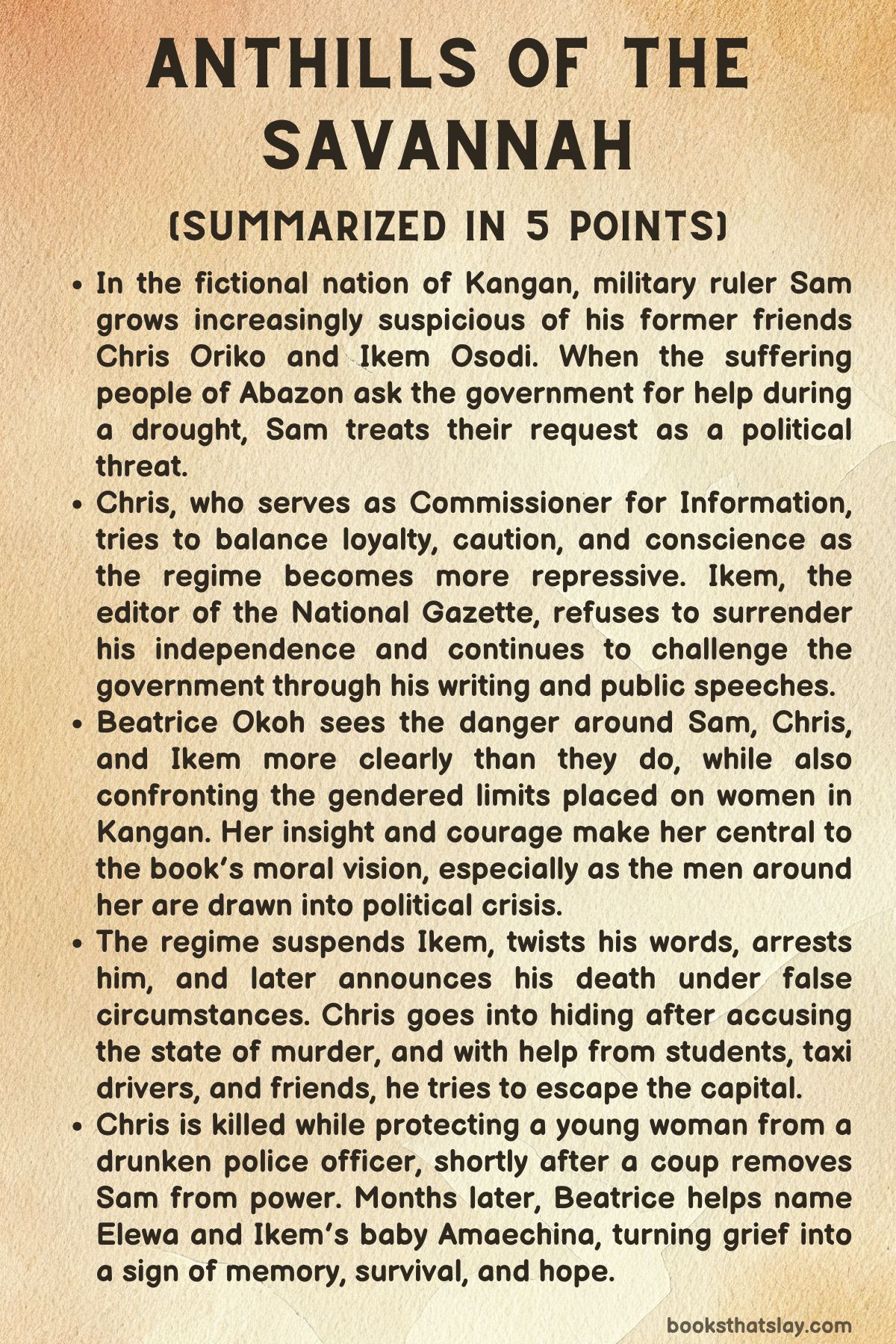
Characters
Sam / His Excellency
Sam is the ruler of Kangan and one of the most important figures in Anthills Of The Savannah, because his transformation shows how power can deform personality, friendship, judgment, and public responsibility. He begins as a former schoolmate of Chris and Ikem, part of an educated elite that once seemed capable of guiding the nation toward a better future.
Yet as Head of State, he becomes increasingly insecure, vain, and suspicious. He does not treat disagreement as advice; he treats it as disloyalty.
This is clear in his reaction to Chris’s suggestion that he visit Abazon, where people are suffering from drought. Instead of seeing the proposal as a humane duty, Sam sees it as an insult to his authority.
His need to be obeyed becomes stronger than his ability to govern wisely.
Sam’s tragedy lies in the fact that he is not presented simply as a born monster. The book shows that he is shaped by praise, fear, foreign models of dictatorship, and the flattery of people who benefit from his insecurity.
After coming into power, he begins to admire other authoritarian leaders and adopts their style of rule. He becomes obsessed with public image, silence, loyalty, and control.
His court is filled with officials who know how to feed his ego, while those who speak honestly are pushed aside or destroyed. He wants to be loved by the people, but he also punishes those who refuse to worship him.
His relationship with Chris and Ikem reveals the emotional weakness beneath his authority. Because they knew him before he became ruler, they threaten the grand image he wants to maintain.
Chris’s familiarity irritates him because it reminds him that his power is recent and human-made. Ikem’s independence enrages him because it proves that not everyone can be bought or frightened into silence.
Sam’s personal insecurity becomes a national danger. By the time the state moves against Ikem and Chris, Sam’s government has become a machine that protects one man’s ego at the cost of truth, justice, and life.
Christopher Oriko
Christopher Oriko, usually called Chris, is one of the most morally conflicted characters in the book. As Commissioner for Information, he stands close to power, but he is not fully comfortable with what power has become.
He knows Sam personally, understands the government from inside, and can see that the regime is growing more dangerous. Yet he continues to serve it for much of the story, partly because he believes he might still be able to limit its damage.
This makes Chris a character caught between conscience and compromise. He is not cruel or corrupt in the way some officials are, but his hesitation has serious consequences.
Chris’s weakness is his belief that intelligence, caution, and personal access to power can keep disaster away. He sees Sam’s faults clearly, but he underestimates the speed with which authoritarian power can turn against even its closest associates.
He tries to manage Ikem’s boldness, calm Beatrice’s fears, and reason with Sam, but the situation has already moved beyond private negotiation. His position becomes impossible when Sam orders him to suspend Ikem.
Chris’s refusal is one of his strongest moral acts. In that moment, he finally stops being a functionary and becomes a dissenter.
His journey as a fugitive changes him deeply. Once he leaves the protected world of government houses and official cars, he encounters Kangan as most citizens experience it: through fear, bribery, poor transport, poverty, and military harassment.
His escape with Emmanuel and Braimoh brings him into contact with people whom he had previously known more as ideas than as companions. This late awakening gives Chris dignity, but it also comes too late to save him.
His death while defending Adamma is important because it is both accidental and meaningful. He is not killed during a planned political execution, but while resisting the casual violence of a uniformed man.
In the end, Chris becomes a man who finally acts, not from position or strategy, but from human responsibility.
Ikem Osodi
Ikem Osodi is the intellectual and moral rebel of the story. As editor of the National Gazette, he occupies a public role that gives him influence, but unlike many others in the regime, he refuses to surrender his voice.
He believes that the writer’s duty is to disturb falsehood, question authority, and keep public memory alive. His independence makes him dangerous to Sam’s government, especially because he speaks with wit, courage, and moral force.
In Anthills Of The Savannah, Ikem represents the power of language against political lies.
Ikem is not idealized as perfect. He can be proud, impatient, and sometimes limited by his own education and class position.
He wants to stand with ordinary people, but he does not always understand their desires. His conversation with the taxi drivers and Elewa’s reaction to his shabby car reveal this gap.
Ikem may reject elite display, but those who live under poverty may still see material status as a sign of dignity and success. This tension makes him more believable.
He is a committed critic of oppression, but he is also learning that speaking for the people is not the same as listening to them.
His relationship with women also develops through the book. At first, his ideas about women’s roles are challenged by Beatrice, whose intelligence forces him to reconsider his assumptions.
His letter about gender inequality shows that he is capable of growth. His relationship with Elewa, meanwhile, connects him to a social world different from his own.
Through Elewa and later through their child, Ikem’s influence survives beyond journalism and politics.
Ikem’s lecture at the university is one of his defining moments. He refuses to offer easy revolutionary answers and instead asks his audience to examine their own privilege.
This is why the state finds him so threatening. He does not only criticize rulers; he also criticizes comfortable forms of opposition.
His murder exposes the cowardice of the regime. The government cannot defeat his ideas honestly, so it silences his body.
Yet his memory continues through Beatrice, Elewa, the child, and the people who understood his role as storyteller.
Beatrice Okoh
Beatrice Okoh is one of the most powerful characters in the novel because she carries insight, endurance, and renewal. She is not merely Chris’s lover or a witness to male political failure.
She becomes the person through whom the book imagines a different kind of moral authority. Educated, self-possessed, and emotionally perceptive, Beatrice sees the weaknesses of Sam, Chris, and Ikem with unusual clarity.
She understands the danger surrounding them before they fully accept it themselves.
Her childhood helps explain her strength. Born into a family disappointed by her gender, she grows up under the weight of patriarchal judgment.
Her name, meaning that a female is also something, captures the social world she must resist. This background gives her a sharp awareness of how women are undervalued, even by men who consider themselves enlightened.
Her friendship with Ikem is especially important because she challenges his views on women and helps him rethink them. She is not passive in intellectual life; she shapes it.
Beatrice’s confrontation with Sam at the Presidential Retreat reveals her courage. She sees through his fascination with foreign approval and refuses to flatter him.
Her honesty humiliates him because it exposes his dependence on outside validation and his inability to respect an African woman who stands before him as an equal. This moment also places Beatrice in opposition to the moral emptiness of the regime.
After Ikem and Chris die, Beatrice becomes the center of a new community. Her apartment becomes a place where grief, memory, class difference, gender, and hope meet.
By naming Elewa’s daughter Amaechina, she breaks with restrictive tradition while still honoring communal meaning. In Anthills Of The Savannah, Beatrice’s importance lies in her ability to survive political ruin without surrendering to bitterness.
She carries the past, interprets its losses, and helps open a path toward a more inclusive future.
Elewa
Elewa is Ikem’s girlfriend and one of the book’s most important working-class characters. She brings into the story a voice and experience that differ sharply from the educated world of Sam, Chris, Ikem, and Beatrice.
She is direct, emotional, practical, and socially grounded. Through her, the book shows that political ideas must be tested against ordinary life.
Ikem may speak passionately about the people, but Elewa often understands popular attitudes in a more immediate way than he does.
Her relationship with Ikem is affectionate but unequal. Ikem cares for her, yet he sometimes treats her world as something to study rather than fully respect.
Elewa’s speech, habits, and expectations reflect a class position that the elite characters do not always understand. When she agrees that Ikem should have a better car because a man of his status should appear important, she challenges his idealism.
Her view is not shallow; it reflects the reality that poor people often read dignity through visible signs of success because society has taught them to do so.
Elewa’s grief after Ikem’s death is one of the emotional centers of the later story. She loses the man she loves, but she also carries his child, which makes her central to the book’s movement from destruction toward continuity.
Her pregnancy is not used only as a symbol; it also places her in a vulnerable social position. Beatrice’s care for her becomes an act of female solidarity across class lines.
By the end, Elewa’s daughter becomes a living connection between the dead and the future. Elewa may not control the political events around her, but her presence changes the meaning of survival.
Through her, the story insists that the future of Kangan does not belong only to ministers, soldiers, writers, or intellectuals. It also belongs to women whose lives are often treated as secondary but who carry history forward in the most literal and human way.
Major Johnson Ossai
Major Johnson Ossai is a security officer whose role shows the quiet, frightening efficiency of authoritarian systems. He is not as publicly visible as Sam, but he is one of the figures who helps turn suspicion into action.
As a member of the State Research Council, he represents surveillance, intelligence gathering, and the hidden machinery of repression. His presence around Sam has a calming effect on the ruler, but that calm is dangerous because it helps convert Sam’s fear into organized state violence.
Ossai’s importance lies in his ability to operate behind the scenes. He does not need grand speeches or public displays.
He serves power by gathering information, interpreting threats, and helping the regime decide whom to target. His involvement in the events surrounding the Abazon delegation and Ikem’s downfall shows how ordinary political contact can be reframed as conspiracy.
Under men like Ossai, a meeting at a hotel becomes evidence of subversion, and journalism becomes a crime.
He also reflects the careerism that thrives in a dictatorship. As the crisis deepens, he is promoted, suggesting that loyalty to repression is rewarded.
His rise contrasts with the fall of Chris and Ikem, who retain some attachment to truth and conscience. Ossai’s character reminds the reader that tyranny does not survive through one ruler alone.
It depends on disciplined servants who know how to turn fear into files, arrests, raids, and official lies.
Professor Reginald Okong
Professor Reginald Okong is a portrait of opportunism within the political class. He is a man who knows how to survive by flattering whoever holds power.
As Commissioner for Home Affairs, he has status and education, but he lacks moral courage. Chris once helped recommend him for office, a decision he later regrets.
Okong’s behavior shows how intellectual ability without integrity can become a tool of oppression.
Okong’s instinct is always to please Sam. When the Abazon delegation arrives, he does not ask why the people are suffering or what the government owes them.
Instead, he blames them and suggests that Ikem is helping create unrest. His response shows how authoritarian governments turn social suffering into disloyalty.
Rather than speak truth upward, Okong protects himself by confirming the ruler’s prejudices.
His character is important because he is not driven by ideology as much as self-preservation. He represents people who may privately understand that a regime is unjust but choose comfort, promotion, and safety over principle.
Such people make dictatorship easier to maintain because they give it a language of official reason. Okong’s education does not make him wise; it makes his cowardice more polished.
Through him, the book criticizes elites who use learning as decoration while abandoning public responsibility.
The Attorney General
The attorney general is another figure who serves power by feeding Sam’s insecurity. His role is brief but revealing.
Rather than defend law, justice, or constitutional restraint, he advises Sam on how to view personal loyalty. He suggests that Chris may be dangerous because he still sees Sam as an old schoolmate rather than as a supreme ruler.
This advice encourages Sam to distrust friendship and ordinary human bonds.
As a legal figure, the attorney general’s failure is especially serious. He should represent the rule of law, but he instead helps personalize state authority around Sam.
His conversation with the ruler shows how law can be emptied of justice when lawyers become servants of dictatorship. He gives Sam intellectual permission to treat closeness as betrayal and memory as a threat.
The attorney general also shows the moral collapse of institutions. In a healthy state, legal officers limit executive power.
In Kangan, they help protect it from accountability. His character may not dominate the story, but he is part of the network that allows violence to appear official, reasonable, and necessary.
Emmanuel Obete
Emmanuel Obete, the student union president, represents youth politics, resistance, and the possibility of alliance across social groups. He first appears in connection with the student response to Ikem’s death and later becomes one of Chris’s companions during his escape.
His presence shows that opposition to the regime is not limited to famous intellectuals. Students, workers, taxi drivers, and ordinary citizens also participate in resistance, often at great risk.
Emmanuel is intelligent and brave, but the book does not present student politics as pure or beyond criticism. Ikem’s university lecture challenges students for their own privilege, reminding them that radical language can become empty if it ignores the poorest people.
Emmanuel’s later actions suggest that he has absorbed some of this challenge. By helping Chris and planting false information to mislead the authorities, he moves from rhetoric to practical courage.
His role in Chris’s escape is significant because it connects the fallen elite with younger political energy. Emmanuel does not have the same history with Sam, Chris, and Ikem, and this gives him a different relationship to the crisis.
He belongs more to the future than to the failed ruling circle. Through him, the book suggests that renewal may depend on younger people who learn from the mistakes of their elders while still acting with courage.
Braimoh
Braimoh is one of the taxi drivers who becomes important in the second half of the story. At first, he appears connected to Ikem through the world of taxi parks and public transport, but he later becomes essential to Chris’s survival.
His character shows the dignity, intelligence, and courage of ordinary working people. He may not hold office or write editorials, but he understands danger, loyalty, and practical action.
Braimoh’s help is not abstract sympathy. He gives Chris clothes, shelter, planning, and guidance.
He knows how checkpoints work, how soldiers behave, and how a fugitive must move among common people. In this sense, he possesses knowledge that Chris lacks.
Chris’s survival for as long as it lasts depends on people like Braimoh, whose experience of daily insecurity has made them alert and resourceful.
His role also challenges the elitism that has damaged Kangan. The educated men at the center of power often speak about the people, but when crisis comes, it is the people who act.
Braimoh’s loyalty to Ikem extends into loyalty toward Chris, and his grief at Chris’s death is active rather than ceremonial. He runs after the fleeing sergeant, even though he cannot save Chris.
Braimoh represents a moral community outside official power.
Mad Medico / John Kent
John Kent, known as Mad Medico, is an expatriate friend of Chris, Ikem, Beatrice, and others. His role allows the book to examine foreign presence, colonial influence, and the awkward relationship between Kangan’s elite and the West.
He is eccentric, outspoken, and often comic, but his comments carry serious criticism. He questions why Western-educated African leaders seem determined to reproduce English habits, values, and institutions in a country with its own realities.
Mad Medico is not a central political actor, yet his outsider position allows him to say things that others may avoid. He recognizes that Sam, Chris, and their circle have changed under power.
He also sees the continuing influence of English education on the ruling class. His critique is useful, though limited.
As a foreigner, he can observe certain contradictions, but he cannot fully inhabit the suffering of Kangan’s citizens.
His deportation shows the regime’s hostility toward independent voices, even foreign ones. Once Sam’s government becomes more frightened, it removes people who might embarrass it internationally or speak inconvenient truths.
Mad Medico’s character therefore serves two purposes: he offers satirical insight into postcolonial imitation, and his removal marks the tightening of repression.
Lou Cranford
Lou Cranford is an American journalist whose presence at the Presidential Retreat exposes Sam’s insecurity and his dependence on foreign approval. She speaks confidently about foreign debt and international politics, and Sam treats her with exaggerated respect.
His behavior toward her is important not because Lou herself controls events, but because she reveals something weak and humiliating in him.
To Beatrice, Sam’s deference to Lou is degrading. He gives a foreign woman the attention and seriousness he does not give to women from his own country.
This contrast sharpens the book’s criticism of postcolonial power. Sam wants to appear strong before his own citizens, yet he becomes eager and submissive before Western attention.
Lou’s role therefore helps expose the ruler’s vanity and his unresolved colonial mentality.
Lou is not portrayed as deeply developed in the same way as Beatrice or Chris, but her function is significant. She becomes a mirror in which Sam’s need for outside validation is reflected.
Through her, the story shows that political independence does not automatically free leaders from psychological dependence on foreign approval.
Agatha
Agatha, Beatrice’s maid, represents domestic labor, class distance, and the possibility of changed relationships between women. At first, her relationship with Beatrice is shaped by hierarchy.
Beatrice is educated, professional, and socially powerful, while Agatha works in her home and follows religious habits that Beatrice sometimes finds inconvenient. Yet as the crisis deepens, Beatrice begins to see Agatha with greater humility.
This shift is important because the book does not limit political awakening to public speeches or government conflict. Beatrice’s apology to Agatha marks a private moral correction.
She recognizes that class privilege can make even decent people careless toward those who serve them. Agatha’s presence helps Beatrice understand solidarity not as an idea but as a daily practice.
Agatha also shares in the atmosphere of fear and hope surrounding Chris’s escape. Her faith that he will not be captured gives emotional support to Beatrice and Elewa.
Though she remains a secondary character, she contributes to the new community that forms around Beatrice. Her role reminds the reader that political violence enters kitchens, bedrooms, and domestic routines, not only offices and streets.
Captain Abdul Medani
Captain Abdul Medani is a minor but important character because he complicates the image of the military. He participates in a raid on Beatrice’s apartment, yet he behaves with unexpected civility.
Later, he becomes the anonymous caller who warns Beatrice that Chris must be moved. His actions show that even within a violent system, individuals may retain conscience.
Abdul’s help is risky. By warning Beatrice, he acts against the machinery he serves.
He does not openly become a revolutionary, but he uses his position to prevent a killing or arrest. This makes him morally different from figures such as Ossai.
While Ossai turns state power into surveillance and repression, Abdul quietly interrupts that process.
His character suggests that institutions are not made only of faceless agents. People inside them still make choices.
Abdul’s choices do not save Chris in the end, but they matter. He gives Chris more time, gives Beatrice a chance to act, and shows that humanity can survive even in places shaped by fear.
Adamma
Adamma is the young student nurse whom Chris tries to protect near the end of the book. Her role is brief, but it is crucial because her danger brings Chris’s final moral decision into focus.
When a drunken police sergeant attempts to abduct her, Chris intervenes, even though he is a fugitive and should avoid attention at all costs. His decision to defend her leads directly to his death.
Adamma represents ordinary vulnerability in a militarized society. She is not involved in high politics, yet she is exposed to the violence of men with weapons.
Her situation shows how political breakdown especially endangers women’s bodies and freedom. The sergeant’s behavior is not separate from the national crisis; it is one expression of the same lawlessness that allowed the regime to murder Ikem and hunt Chris.
Her later correction of Chris’s final words is also meaningful. She preserves truth in a small but important way.
Emmanuel misremembers the phrase, but Adamma insists on what she heard. This act places her among the witnesses who help carry memory forward.
She is not merely the woman Chris dies protecting; she becomes part of the community that remembers him accurately.
Elewa’s Daughter / Amaechina
Amaechina, Elewa and Ikem’s daughter, appears only at the end, but she carries great symbolic weight. Her name means “May-the-path-never-close,” and this meaning gives the book’s ending a guarded hope.
She is born after Ikem’s murder and Chris’s death, so her life begins in the shadow of political violence. Yet her naming ceremony turns grief into continuity.
The circumstances of her naming are important. Beatrice breaks with tradition by naming the child herself, but the ceremony does not reject community.
Instead, it reshapes tradition to include women, friends, workers, students, and relatives in a wider circle of belonging. Amaechina’s name becomes a prayer against closure: the closure of political possibility, the closure of memory, and the closure of justice.
As Ikem’s child, she also carries forward the legacy of storytelling. She is too young to know the dead, but the adults around her will remember them.
Through her, the future is not presented as easy or guaranteed. It is fragile, dependent on those who survive and choose to build differently.
Amaechina stands for the possibility that Kangan may yet find another path.
Themes
Power, Fear, and the Corruption of Leadership
Power in the book is shown as something that does not merely give commands from above; it changes the person who holds it and the people who gather around it. Sam’s rule begins with the promise of order, but it becomes a system built on suspicion, flattery, silence, and punishment.
His authority depends less on public trust than on fear. The Abazon delegation’s request for help should be treated as a moral and political responsibility, but Sam sees it as an insult and a threat.
This reaction shows how authoritarian leadership loses contact with reality. Human suffering becomes conspiracy, advice becomes disrespect, and friendship becomes danger.
The people around Sam make this worse because they learn that survival depends on telling him what he wants to hear. Officials like Okong and the attorney general do not restrain power; they protect themselves by feeding it.
The result is a state where institutions no longer serve citizens. Security forces, newspapers, legal offices, and Cabinet positions become extensions of one ruler’s insecurity.
The book presents dictatorship not as a sudden accident but as a gradual moral failure involving many participants. Sam may stand at the center, but the system survives because others choose comfort, ambition, or fear over truth.
Storytelling, Truth, and Public Memory
Storytelling is treated as a serious public duty, not a decorative art. Ikem’s role as a writer and editor matters because he challenges the official version of events.
The regime wants to control what citizens see and believe, especially when its actions are cruel or unjust. By contrast, Ikem believes that stories, speeches, myths, jokes, and editorials can expose falsehood and preserve moral memory.
His meeting with the Abazon elder clarifies this idea. The elder values the storyteller because stories help people understand suffering, remember resistance, and refuse the shame of silence.
The tortoise and leopard parable captures this perfectly: even when defeat seems certain, the marks of struggle must remain. This theme becomes even stronger after Ikem’s death.
The government lies about how he died, but Chris challenges the lie, and later Beatrice, Emmanuel, Adamma, and others continue the work of remembering accurately. Truth in Anthills Of The Savannah is not held only in official documents or public speeches.
It survives in witnesses, private jokes, corrected memories, names, and ceremonies. Achebe suggests that when governments murder citizens and rewrite events, the act of remembering becomes a form of resistance.
Gender, Female Authority, and Renewal
Women in the book are not placed at the edge of political meaning; they become central to its deepest moral vision. Beatrice is especially important because she sees what the powerful men fail to see.
Sam has authority but lacks wisdom. Chris has intelligence but hesitates too long.
Ikem has courage but must still learn from women’s experience. Beatrice’s life has been shaped by patriarchal disappointment, beginning with a family that wished she had been male.
Instead of breaking her, this history sharpens her awareness of how women are dismissed, used, or underestimated. Her confrontation with Sam at the Presidential Retreat is not only personal; it exposes the ruler’s weakness, his colonial insecurity, and his inability to respect a woman who refuses to flatter him.
Elewa also matters deeply. As a working-class woman and Ikem’s lover, she brings a different kind of knowledge into the story, one rooted in everyday survival rather than elite debate.
After the deaths of Ikem and Chris, women become the guardians of continuity. Beatrice’s decision to name Elewa’s daughter changes the meaning of tradition without destroying it.
The final ceremony suggests that renewal will not come from military rulers or educated men alone. It will require women’s authority, memory, and care.
Class, Elitism, and the Distance from Ordinary People
The book strongly criticizes the distance between educated elites and the ordinary people they claim to represent. Sam, Chris, and Ikem all come from privileged educational backgrounds, and each has a different relationship to that privilege.
Sam uses his status to dominate. Chris remains trapped in the world of government offices and cautious political calculation.
Ikem fights for the people through journalism, but even he sometimes misunderstands the people he wants to defend. This tension appears clearly in his interactions with taxi drivers and Elewa.
Ikem rejects material display, but the drivers see status symbols as signs of dignity and proper recognition. Their view may seem contradictory, but it comes from a society where poverty constantly humiliates people.
The later parts of the story force Chris to cross the boundary between elite life and common life. As a fugitive, he depends on students, taxi drivers, poor households, and public transport.
He learns that survival in Kangan requires forms of knowledge that no elite school taught him. Braimoh’s courage and practical intelligence become more useful than ministerial rank.
Through these relationships, the book argues that national renewal cannot be led by detached elites speaking on behalf of the people while remaining socially separate from them. Real change requires humility, listening, shared risk, and a broader idea of community.